2017 2nd International Conference on Information Technology and Management Engineering (ITME 2017) ISBN: 978-1-60595-415-8
The Integration of Simulation Model for Anti-Missile Process
Based on a DDS Real-Time Platform
Zhi-gang TIAN
1,2,*, Chun-xia ZHAO
1and Zhi-ping SHEN
31
Nanjing University of Science and Technology, School of Computer Science and Engineering, Nanjing 210094, China
2
Beijing Institute of Specialized Machinery, Beijing, 100012, China 3
APPSOFT Technology Co. Ltd, Beijing, 100085, China
*Corresponding author
Keywords: Simulation model, Anti-missile procedure, DDS, Real-time platform.
Abstract. The framework of simulating experiment based on a real-time platform has been built by using DDS protocol. To realize the whole process simulation model integration and deduction of target detection, tracking, identification, interception and data communication of ballistic missile defense system, the communication control, system control and human-computer interaction mode based on real time network platform have been implemented in this paper. The simulation framework can effectively integrate all kinds of physical, semi physical and mathematical simulation models, and is compatible and extended.
Introduction
Simulation Framework Based on Real-Time Platform
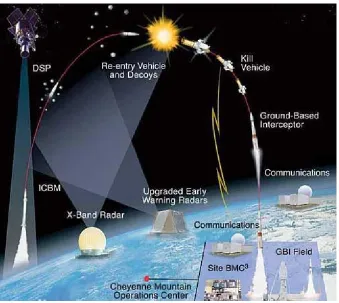
[image:2.612.138.477.183.486.2]A typical anti-missile operation process is as follows: Early warning satellites first detect the intercontinental missile, and send detection information to the command and control center (C2BMC) through data link, then C2BMC fuses different detection information, the early warning information is transmitted to the early warning radar ground station. The command center fuses all kinds of alert data to forecast drop point of missile, threat area and degree of threat, threat level according to the commander prompt intercept strategy. Because of the high efficiency of the combat process, the simulation for this process has a high demand of real-time implementation.
Figure 1. A typical anti-missile operation process.
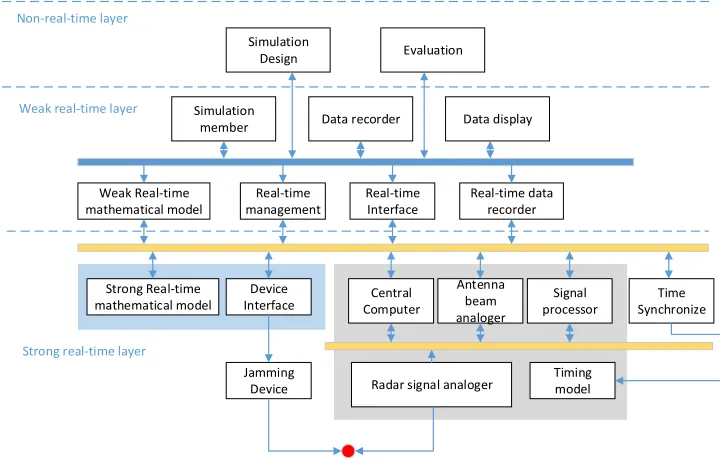
fiber optic reflective memory network; the jammer signals through the coaxial cable directly into the radar signal receiving module.
Simulation
Design Evaluation
Simulation
member Data recorder Data display
Non-real-time layer
Weak real-time layer
Real-time management
Real-time Interface
Real-time data recorder Weak Real-time
mathematical model
Device Interface Strong Real-time
mathematical model
Strong real-time layer
Central Computer
Antenna beam analoger
Signal processor
Radar signal analoger Jamming
Device
Time Synchronize
[image:3.612.124.484.99.334.2]Timing model
Figure 2. Brief framework of anti-missile simulation.
Implementation of Real-Time Simulation Data Service Platform Based on Centric-DDS
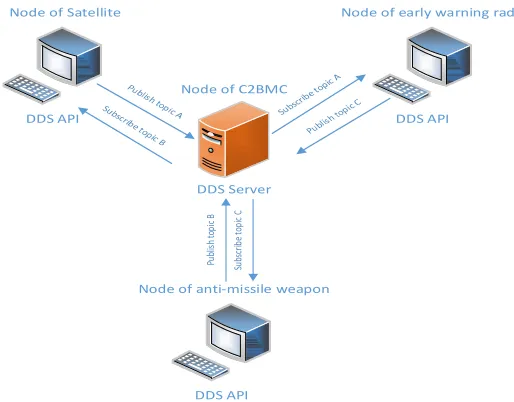
In the simulation of anti-missile operation process, operating instructions, all information is distributed around the command and control center (C2BMC). Whether early warning satellite, radar, or the end of anti-missile weapons are all based on the synergy between C2BMC centralized control, so the structure of centric-DDS is more appropriate for simulation of anti-missile operation process. Command and control center C2BMC as the server node, detection equipment and other anti-missile weapons exist as a client node, the detection information is sent to C2BMC, or from C2BMC will hit the target location information in real time distributed to all nodes, hit detection. In the centralized DDS architecture, data distribution service network in the presence of a globally unique server node, the server node stores each node communication between the necessary information, including data type information, subject information, publish/subscribe. The advantage of this kind of structure is good at facilitating the coordination between systems.
[image:4.612.184.441.274.475.2]The open source project TAO DDS has been adopted in this paper, the developing environment is ACE/TAO (Adaptive Communication Environment/The ACE ORB), its architecture is shown in figure.
DDS API Node of Satellite
DDS API
Node of early warning radar
DDS Server Node of C2BMC
DDS API
Node of anti-missile weapon
Pu
bl
is
h
to
p
ic
B
Su
bs
cr
ib
e
to
p
ic
C
Figure 3. General view of simulation based on Centric-DDS.
Process of data service. The whole process is shown in figure. Firstly, the publisher application
calls the “DDS interface” to register data type, topic and publishing information (①②③); Secondly,
the DDS service calls the “TAO interface” to complete remote registration (X, inner operation of TAO DDS middleware); Thirdly, subscriber application calls the “DDS interface” to register data
type, topic and publishing information (④⑤⑥);At the fourth step, the DDS service calls the “TAO
Real time applic-atioin TAO Interfa -ce DDS Interfc -e Node of publisher
① ② ③ ⑦ TAO Interfa -ce TAO Interfa -ce TAO DDS Server
X DDS Data-base Real time applic-atioin TAO Interfa -ce DDS Interfc -e ④ ⑤ ⑥ ⑨ Y
Node of subscriber
Figure 4. Process of data service in TAO DDS.
Interface design for client node. In this framework, clients include node of space-based satellite, node of remote early warning radar and anti-missile weapon. On the Open DDS platform, it is also required to implement the corresponding interface. Each simulation node submits to the DDS server the subject that they want to publish or subscribe to, as well as the required QoS information. The DDS server will provide each simulation node subscription or release information, when a node is matched with the node information required, the server will automatically release nodes and node matching subscriptions. When the pairing is completed, a data transmission connection is established between the subscriber and the publisher. When a new data object is released by the publisher, the subscriber will receive the data notification immediately, and then process the data received. Direct communication between publishers and subscribers, the DDS server is not involved in data dissemination and access process, and not because of the performance of the server and bandwidth constraints affect the data interface.
Create DDS client. “CreateClient (client_type, Transport_type, data_type, Topic_type, Qos)”. This interface is used to create a client node which using DDS to deliver data. The parameters in the interface can specify the type of client to be created, the data transfer mode, the data type, the topic type, and the type of QoS policy. Among them, the client type can be a publisher or subscriber or both; data transmission can be TCP, UDP etc.; the data type is defined according to the needs of their own, DDS specification writing; topic types can define their own types; QoS strategy can choose from several predefined strategies in.
Set Qos strategy. The interface can be set according to the needs of the client to create the QoS strategy. Detailed Qos policy settings need to refer to the DDS specification to support the description of the various QoS strategies
Send data. SendData(Message_Head,Message_Body). This interface can send data to all interested subscribers
Deal with receiving data. OnDataArrival( ). This interface is used to process the received data, and the data is transmitted to the required local program module. For different data types or messages, different processing procedures are required.
Release resources. CleanUp(Client_Type). The interface is used to release the allocated related resources, to close the data transfer connection and to remove the registration from the service program.
Simulating Experiment
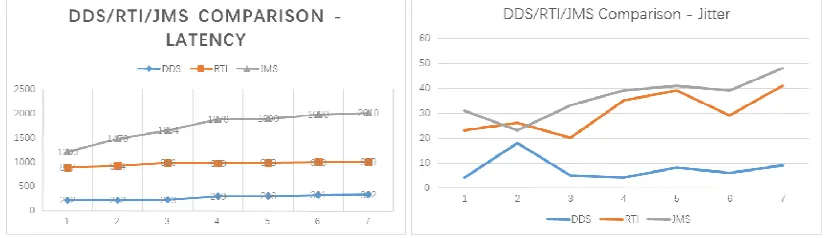
framework of RTI and JMS (Java Message Service), the comparison has been repeated for seven times, here are the result of each experiment in Figure 5.
Figure 5. Comparison of latency and jitter between DDS, RTI and JMS.
Summary
A simulation framework for anti-missile operation based on centric-DDS platform has been constructed in this paper, and the result shows that this framework could be efficient and practical.
References
[1]Feng Zhao, Dun Lee, X. S. Wang, Missile defense radar simulation system, Journal of system simulation. 18 (2006) 1190-1194.
[2]Feng Zhao, X. S. Wang, Shunping Xiao, Research on parallel processing of phased array radar
system simulation based on HLA, Journal of system simulation. 18 (2006) 2170-2173.
[3]Jin Liu, Dejun Feng, Feng Zhao, The key model and implementation of the simulation system for
target recognition in middle segment of the ballistic trajectory, Journal of system simulation. 20 (2008) 4588-4592.
[4]Zhichao Zhao, X. S. Wang, Yi Liu, Simulation method of time division network based on single
semi physical radar, Journal of system simulation. 21 (2009) 5614-5617.
[5]Ying Zhou, Feng Zhao, Jia Luo, Anti jamming performance evaluation of phased array radar based on hardware in the loop and digital simulation, Space electronic countermeasure. 21 (2005) 25-28.
[6]M. Yeddanapudi, Y Bar-Shatom, K R Pattipati, et al. Ballistic missile track initiation from satellite observations [J]. IEEE Transactions on Aerospace and Electronic Systems (S0018-9251), 31(1995) 1054-1071.