2017 2nd International Conference on Computer Science and Technology (CST 2017) ISBN: 978-1-60595-461-5
Research on the Interoperability of Systems Based on the
Polychromatic Sets Theory
Min YANG
1,b, Xiao-hua WANG
2,a*and Mei-mei RAN
1,c1College of Computer Science and Technology, Guizhou University, Guiyang, China 2Information Section, Affiliated Hospital of Zunyi Medical College, Zunyi, China
a[email protected], b[email protected], c[email protected]
*Corresponding author
Keywords: Interoperability system, Interoperability, Polychromatic sets theory, Polychromatic graph, Polychromatic sets.
Abstract. In view of the complexity of information system interoperability, a new
method based on polychromatic sets theory is proposed, and the research steps are given. Firstly, got a polychromatic graph model for system’s interoperability relationship by analyzing the relations among the subsystems and regard it as the edges, the model’s nodes is subsystems. Secondly, the resources of each interoperability subsystem are analyzed, and the color of the nodes and edges in the polychromatic graph model are determined according to the results of the analysis. Thirdly, the actions of the interoperability subsystems are analyzed. Since the action is a movement of the state, the initial state matrix and the final state matrix of the action based on the theory of polychromatic sets are given to describe the action of the interoperability subsystem. Finally, a formal description method of interoperability system based on the theory of polychromatic sets is presented. On the end, the interoperability of hospital information system as an example to verify the effectiveness of this formal method.
Introduction
The development of information technology led to the rapid increase of information systems, the different standards among systems lead to more and more information islands, so that the systems can not exchange and sharing of data well [1]. Heterogeneous interoperability among systems is to solve this problem, it can maximize the value of information among systems.
At present, most researches on interoperability among systems are based on interoperable methods or interoperable frameworks, but few formal descriptions of interoperation. This paper will use polychromatic sets theory to describe the interoperability of systems.
systems, and get a formal method of system interoperability based on polychromatic set theory.
Organization of the Text
In the first section, the relevant definition and technology are given. In the second section, the interoperability research steps based on polychromatic sets theory are given. Finally, the third section gives an example of interoperability in hospital information system to verify the effectiveness of the method.
The Relevant Definition and Technology Definition of Interoperability
Interoperability is the ability to obtain resources in heterogeneous entities
(architectures, operating systems, networks, languages, etc.) [10]. The interoperability defined by IEEE is that interoperability is the ability of two or more systems or components to exchange information and use information that has been exchanged [11].
Definitions Related to Interoperation Systems
Interoperation system (IS): A large system is composed of multiple subsystems, the
necessary information exchange between subsystems to complete the goal of a large system, such a large system is defined as the interoperability system.
Interoperation subsystem (ISub): A subsystem that constitutes an interoperation
system is defined as an interoperation subsystem.
Interoperation subsystem pairs (ISubP): the composition of the interoperability of
the two subsystems may exist information exchange, may not exist, call the two subsystems which exist information exchange is interoperation subsystem pairs.
Polychromatic Sets Theory
Polychromatic sets theory (PST): polychromatic sets theory uses a mathematical
model of uniform form to model different objects. Which includes polychromatic
sets(PS) and polychromatic graph(PG).
PS [12] [13], the elements of a PS are the elements of a traditional sets, and the PS and its elements can be painted with different colors to represent the different natures of the object and its elements. The color set F(ai), corresponding to each element, is
called individual pigmentation of the element ai. The color set F(A) corresponds to A,
and is called the unified pigmentation of the PS A. The expression for the PS is
)]) ( [ )], ( [ )], ( [ ), ( ), ( ,
(AF a F A A F a A F A A A F
PS= × × × .
The PG[13] [14] is based on the general graph G = (A, C), The color of nodes A and C
is added to represent the different properties of nodes and edges. The expression is
) , ), (
(F G PSA PSC
PG= , PSA and PSC represent PS of nodes and edges, respectively.
For more information on PST, please refer to the related literatures.
Research on the Interoperability of Systems based on the Polychromatic Sets Theory
For the research of interoperation based on PST, the following steps are given:
Step2: Analyze the relationships between the subsystems and the resource of the subsystems, and use it to determine the color of the nodes and edges of PG.
Step3: Analyze the actions between the subsystems, and use PST to describe. Step4: Determine the PST model of IS.
Interoperation between systems can be described by PG. The nodes of PG represent the subsystems and the edges connecting the two nodes represent the interoperation between the two subsystems. Interoperation between subsystems can be described using the following matrix [S×S] (Where S is a PS of all ISubs, and the elements
s1, ..., si, ..., sk represents all the subsystems, which are represented in PG as nodes. If there is an interoperable relationship between si and sj, sij = 1, and there will be a
polychromatic edge between the nodes si and sj in PG. If there is no interoperation
between them, sij = 0, there is no edge connection between the two nodes in PG.).
k j kk kj k ik ij i k j i s s s s s s s s s s s s s s S S 1 1 1 1 1 11 k 1 s ] [ = × k j nk nj n ik ij i k j n i c c sc sc sc sc sc sc sc sc sc s s s C S 1 1 1 1 1 11 1 c ] [ = ×
The resources of IS include user, device and others, and the resources of each ISub are determined. The IS and ISub can be described by the PST. Taking the user as an example, the descriptions of other resources are similar.
For each ISub, the user is certain and the relationship between the system and the user can be expressed as matrix [S×C] above (s1, ..., si, ..., sn are ISubs,
corresponding to the elements of PS S. c1, ..., cj, ..., ck represent the set of users C owned by the system, is the individual pigmentation F(s) for all elements, that is, F(s) = C. scij = 1 indicates that the system si owns the user cj, otherwise the system si does
not own the user cj.).
For the users in ISub, the user's operation on the information in ISub is determined by the authority, that is, the user's authority can be expressed as following matrix
]
[C×M (c1, ..., ci, ..., ck represent the users owned by ISub, corresponding to the
elements of set C. m1, ..., mj, ..., mq represents the message M that the user can
process, and is the individual pigmentation F(c) of all the elements, that is, F(c) = M. if cmij = 1, it means that the user ci can process the message mj, otherwise the user ci
can not process the message mj. In other words, the message mj can not be processed
by the user ci.).
q j kq kj k iq ij i q j k i m m m cm cm cm cm cm cm cm cm cm c c c M C 1 1 1 1 1 11 1 ] [ = × q j nq nj n iq ij i q j n i m m m sm sm sm sm sm sm sm sm sm s s M C C S M S 1 1 1 1 1 11 1 s ] [ ] [ ] [ = × • × = ×
The messages owned by ISub are determined, and the matrix multiplication can be used to derive the messages owned by ISub in the case of the two matrices [S×C] and
]
[C×M, and the result is shown in the matrix [S×M] above.
System interoperability is essentially a collection of information interaction action, and action is the transfer of the object state. Therefore, for an action, it is defined as from an initial state to a final state, namely.
For an object a, its action D (a) is defined as:D(a)=SI(a)→SF(a)
Where SI(a) represents the initial state Boolean matrix of the object a, SF(a) to
represent the final state Boolean matrix of the object a. If the state of the object changes from SI(a) to SF(a), the object a produces the action D(a).
The 'send message' action in system interoperability can be described using PST as follows.
The set S = {s1, s2, ..., sn}, s1, s2, ..., sn represents the ISub.
The individual pigmentation of the elements F(s) = {m1, m2, ..., mn}, m1, m2, ..., mn
represents the type of information involved in the action 'send message'.
The unified pigmentation F(S) = {m1, m2, ..., mp}, m1, m2, ..., mp of the PS
represents the type of information involved in the action 'send message'. Therefore, the action 'send message' is shown by matrix [S×F(s)].
q j
nq nj
n
iq ij
i
q j
n i
m m m
sm sm
sm
sm sm
sm
sm sm
sm
s s F S
1
1 1
1 1
11 1 s
)] s ( [
= ×
If the information mj is sent from the system si to the system sk, smij is 1 and smkj is
0 in the initial Boolean matrix SI(A). When the action 'send message' succeeds, the two systems si, sk both have the information mj, so in the final state Boolean matrix
SF (a), smij and smkj are both 1.
Sending multiple messages is similar. And the description of the other action is similar to the description of the action 'send message'.
Determine the PST model of the whole IS.
For an IS, if the relationship among its ISubs, the resources of the ISubs, and the actions among the ISubs are well described, then the PST model of the whole IS Can be determined. The following is an example of interoperation between ISubs in a hospital information system (HIS) to verify the application of PST in system interoperation.
Interoperability relationships among ISubs of HIS.
Figure 1. The ISubs in HIS.
[image:5.612.236.386.489.579.2]
Figure 2. Interoperability relationships among clinical diagnosis and treatment
subsystems.
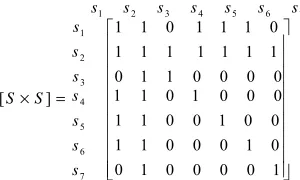
The ISubs in HIS shown in Figure 1 may need to be increased. In Figure 1, the ISubs are identified from right to left as s1, s2, s3, ..., s22, respectively. As HIS involves
too many ISubs, this example to clinical diagnosis and treatment of ISubs as an example to describe the interoperability among them, that is only described the interoperability relationship among s1, s2, s3, s4, s5, s6, s7.
The resident doctor’s workstation (RDW) obtains the basic information of the patient from the outpatient doctor workstation (ODW) or the nurses workstation (NursesW). The NursesW transfers the doctor's orders from the RDW, the ODW and the RDW can apply for the examination project, blood transfusion and image, RDW can apply for anesthesia. The interoperability relationships depicted in Figure 2 is formed (but the interoperability relationships depicted in Figure 2 may not be complete). That is, the interoperability relationships among s1, s2, s3, s4, s5, s6, s7 is
shown in Figure 2.
The interoperability relationships among s1, s2, s3, s4, s5, s6, s7 are represented by a
Boolean matrix as follows.
7 6 5 4 3 2 1
7 6 5 4 3 2 1
1 0 0
0 1 0
0 0 1
0 0 0
0 0 0 1
0 0 0 0
1 1 1 1
0 1 1
10 1 1 0 0 0 0 1 1 1 1 1 1 1
0 1 1 1 0 1 1
] [
s s s s s s s
s s s s s s s
S S
= ×
Description of interoperability among ISubs in HIS.
For each ISub in IS, analyzing the resources in each ISub. In this case, taking the user as an example, using PST to describe. For each ISub in the clinical diagnosis and treatment, suppose there are users c1, ..., ci in ODW, ci+1, ..., cj in RDW, cj+1, ..., ck in
NursesW, ck+1, ..., ch in the clinical test system, ch+1, ..., cp in transfusion management
system, cp+1, ..., cm in medical imaging system, cm+1,..., cn in operating room
• • • • • • • • • • • • • • • • • • • • • + + + + + + 7 6 5 4 3 2 1 1 1 1 1 1 1 1 s s s s s s s c c c c c c c c c c c c c
[image:6.612.113.504.67.163.2]c i i j j k k h h p p m m n
Figure 3. User description of each ISub in clinical diagnosis and treatment.
The information that each user can handle in each ISub can also be described as shown in Figure 4. In Figure 4, the information that the user in each ISub can operate is the information of the system that the user belongs. However, in the actual business process, the users owned by the ISub may be involved in information operation across the systems, and the figure is not reflected. Figure 4 is only a random description of the authority matrix, use according to the actual situation.
[image:6.612.125.498.256.471.2]• • • • • • • • • • • • • • • • • • • • • • • • • • • • • • • • • + + + + + + + + + + + + n m m p p h h k k j j i i b t t q q g g f f c c a a c c c c c c c c c c c c c c m m m m m m m m m m m m m m 1 1 1 1 1 1 1 1 1 1 1 1 1 1
Figure 4. The information that each user can handle in each ISub in clinical diagnosis and treatment.
A description of the information owned by each ISub is shown in Figure 5.
• • • • • • • • • • • • • • • • • • • • • + + + + + + 7 6 5 4 3 2 1 1 1 1 1 1 1 1 s s s s s s s m m m m m m m m m m m m m
m a a c c f f g g q q t t b
Figure 5. The information owned by each ISub in clinical diagnosis and treatment.
Description the interoperability actions among ISubs in HIS.
For the interoperability actions among ISubs in HIS, because the system is huge and very complex, two ISubs (RDW and clinical test system(CTS)) were selected as an example to describe the actions in the clinical diagnosis and treatment, and the description of other actions among ISubs was similar.
[image:6.612.146.471.502.595.2]The doctor in the RDW issues a Clinical Test Requisition (CTR) and sends it to the CTS. After receiving the CTR, the CTS obtains a test report (TR) through a series of internal and / or external operations and sends the TR to the RDW. These actions are described below with PST.
RDW sends the CTR to the CTS, which involves the information in the CTR, such as the patient's basic information, test items, etc. Here, the information in the CTR is treated as a complete information m. For this information, before sending it to the CTS, CTS no information m, when sent, both have information m, so there is the initial state and final state as follows.
m
s s S SI
= 01 ) (
4
2
m
s s S SF
= 11 ) (
4 2
So the action ‘send CTR’ is described as m
s s m
s s S S S S
D I F
→ = →
= ( ) ( ) 01 11
4 2
4
2 .
The description of the other actions is similar and is not repeated here. Establish the PST model of HIS interoperability.
Using the method described above, the ISubs in other modules in the HIS are described by PST, and finally the PST model of the whole HIS is obtained. However, since there may be cross-module interoperation among the modules in the HIS, attention should be paid to cross-module ISubs during analysis.
Conclusions
In this paper, PST is used to describe the interoperation among systems, and PST research steps based on system interoperation are given. Finally, the analysis and research of interoperation based on PST is carried out with HIS as an example. But this paper only gives the interaction between the two systems, not the complexity of multi-system interaction study. In future, we will study the complexity and security of multi-system interaction based on PST, and intends to study and describe the interoperability of the whole hospital information system based on PST.
Acknowledgement
This research was financially supported by the Guizhou Science and Technology Fund Project: Research on Collaborative Security Modeling of Full - PACS / RIS and HIS Based on IHE ([2012]2356), and by the Doctor Initial Foundation of Zunyi Medical College under grant No. F-335.
References
[1] Jian Qiu, The Effects on the Resources Sharing by the Phenomenon of Information Island [J], Medical Information, 2007. 20(5), pp. 720-721. In Chinese. [2] Pavlov V. V. Polychromatic sets and graphs for CALS [M]. Moscow, Stankin Press. 2002, pp. 10-19.
[4] Zong-bin Li, Huai-zu Li, Xin-min Han. Research and Application of Polychromatic Sets Theory in Advanced Manufacturing, Beijing: China Water Conservancy and Hydropower Press. 2005, pp. 12-23. In Chinese.
[5] Zong-bin Li, Tian-shi Li. Polychromatic Graphs and Its Application for Simulation of Complex Object and System [J], Journal of System Simulation [J]. 2001,13(6), pp. 759-762. In Chinese.
[6] Chun-ling Li. Discrete Manufacturing Industry Production Logistics System Modeling and Optimization Based on the Theory of Polychromatic Graph, Shenyang University, China. 2014. In Chinese.
[7] Tian-rong Zhu, Xin-sheng Xu, Xi-zhu Tao. Research on the Processing Route Methods of Mechanical Parts Based on Polychromatic Sets Theory [J], Modular Machine Tool & Automatic Manufacturing Technique. 2013, (9), pp. 129-131. In Chinese.
[8] Xuan Du, Long Wu, Yi Zhang. Research Study on the Conceptual Design of Mechanical Products Based on the Combination of Polychromatic Sets and Fuzzy Genetic [J], Modular Machine Tool & Automatic Manufacturing Technique. 2015, (4), pp. 15-18. In Chinese.
[9] Huan Shao, Ai-ping Li, Hai-bin Yu, Heng Zhang, Li-yun Xu. Multi-objective optimization algorithm for reconfigurable machining lines based on polychromatic sets [J]. Computer Integrated Manufacturing Systems. 2015, 21(9), pp. 2393-2402. In Chinese.
[10] Sen Su, Xue-fei Tang, The interoperability in open systems. Computer Applications [J]. 1997,17(6), pp. 4-7. In Chinese.
[11] Standards coordinating committee of the Computer Society of the IEEE. IEEE Std 610.12-1990 IEEE Standard Glossary of Software Engineering Terminology [S]. [12] Pavlov, V. V. Mathematics simulation of discrete production system [M]. Information Technology. 1995, pp. 15-19.
[13] Zong-bin Li, Chen Song, Tian-shi Li. Manufacturing Simulation of Product Based on Polychromatic Sets and Polychromatic Graphs [J]. Computer integrated manufacturing system. 2001,7(7), pp. 67-72. In Chinese.