Smart Waste Management System Using Zig-Bee
Vedant Nitin Agnihotri1, Atul Srivastava2, Kalpesh V. Joshi3
1,2,3 E & TC Department, Savitribai Phule Pune University, Pune
Abstract: Nowadays, Indian government’s purpose is to create smart cities. For that, most challenging problem is waste management for municipals, which are facing serious pollution problem due to the huge quantities of waste. If solid waste is not handled properly it may create lots many problems related to human health and environment. Therefore, there is a necessity of a system which provides information about filling of garbage level or the bin. So that, municipality can collect the waste from bin before overflowing and helps to maintain the environment clean. This paper presents brief review on technology like Zigbee, GSM etc. which enables to monitor of garbage bin in real time and will inform to authorized person when the garbage bin is about to fill. For practical and perfect solid waste collection and transportation monitoring and management these technologies are good enough to ensure for greener environment.
Keywords—Smart garbage Bin, smart cities, solid waste management, zig bee.
I. INTRODUCTION
At this present situation the volume of production of municipal solid waste is continuously increasing at very fast due to increase in population, industrialization and change in habit and life style of urban population [1]. The solid waste is consider as household’s refusal and waste from industrial, commercial are non-hazardous solid waste and institution like hospitals, market waste, yard waste and street sweepings. This waste thrown into municipal bins or waste collection centres and then by collecting all that waste it is dump into dumping areas or thrown into the landfills. However, either due to lack of resource or deficiency infrastructure and other facilities, it’s being critical to collect all waste and transport to the final dumping places. If the management and categorization of the waste is not done properly at this stage, it can cause serious impacts on human health and the problems to the surrounding environment and becomes unhygienic. The main problems of the existing solid waste collection and transportation process and management system are Lack of the proper system for monitoring the trucks, trash bins, rickshaws and houses and Lack of information related to collection time and area. Due to this a considerable amount of the total solid management budget is exhausted on waste collection and transportation.Through the large numbers of research have been done on different aspect of solid waste management, but from them few works have been done on bin monitoring. Some researchers discussed about, Geographic Positioning System (GPS), Radio Frequency Identification (RFID), transportation model, waste collection with bin monitoring application [2]. In that researchers collected bin data using GSM/GPRS communication from the bin to the server, which includes GSM/GPRS connectivity to each bin causing a large increase of operating cost. The proposed system use wireless sensor network and can respond as someone throw waste inside a bin. The purpose of this work is to design a frame work that can collect data on bin status in real time which in turn helps to optimize waste collection route resulting reduced operation.Structure of this paper is as follows: Section II illustrate the generalized system architecture of real time smart waste management system. Proposed model for waste management system is shown in Section III. Section IV outlines different technology used to build overall system. Section V highlights the algorithm. Section VI presents the results.
[image:2.612.184.428.638.708.2]A. System Architecture
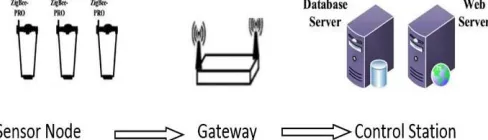
Fig shows the framework of system in fig. 1. Having three stages. From the left, first stage is composed by waste bin equipped with sensor. Second stage is a communication module and third stage is control station which provide data storage and controlling actions.
1) The Smart Bin: Sensor node is mounted on the bin that composed the smart bin. Ultrasonic sensors are used for level measurement of garbage in the bin. Sensors sent the measured data to the gateway through Zig Bee communication. [3]
2) Gateway: The status of bin is send to the control station through the gateway. The gateway passes the data and also stores to its own local database at the control station [6].
The use of the Industrial Scientific and Medical (ISM) bands eliminate the need of telephone operator by using different method of wireless communication, This solution reduces 50% cost [7].
3) Control Station: It receives real time data just like waste level in a bin through gateway and then saved in database. It contains the central server which hosts the database. For bin status monitoring and operator interaction with the system it having the web based user interface. Further these data can be used by control station to feed programs like optimization engines and routing and scheduling applications. [6]
[image:3.612.138.463.236.429.2]B. Integrated Technology
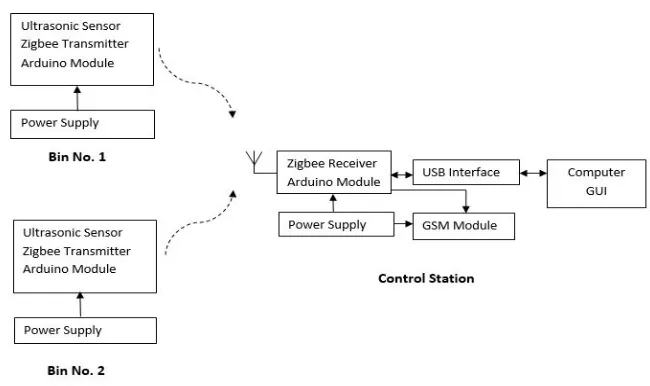
Fig. 2. Block diagram for proposed system model A. Sensors
To detect the garbage level of bin ultrasonic sensors are used. It is precise to detect small objects also.
It transmit the sound wave at the specific frequency on the object and after bouncing receives back. Then it calculate the time period for transmitting and receiving the sound wave and with the help of that it is possible to measures the distance between sensors and the object. The speed of sound in the air is about 344 m/s that is 1129 ft/s, to find the total round-trip distance of the sound wave multiply by 344 meters to that taken time. Assuming the all parameters and requirement, for level detection it can be implemented. HC –SR04 is mostly used ultrasonic sensor module which can be detect level ranging from 2cm to 4m. It operate at frequency of 40 kHz.
B. Zig bee
Zig Bee is an IEEE 802.15.4-based specification for a suite of high-level communication protocols used to create personal area networks with small, low-power digital radios, such as for home automation, medical device data collection, and other low-power low-bandwidth needs, designed for small scale projects which need wireless connection. Hence, Zig Bee is a low-power, low data rate, and close proximity (i.e., personal area) wireless ad hoc network. It has defined rate of 250 kbps.
The software X-CTU developed by Digi International used to configuration of Zigbee and has many features. It is the low power consumption device, and depending upon its output power and other environmental characteristics it transmits the data over the distance 10–100 meters sight. It is also capable to transmit the data over a long distance with the help of mesh network of intermediate devices.
C. GSM
used to communicate with authorized person to provide status of bin that is hoe it is filled? On the basis of bin ID and location address it can communicate via text massage. Hence particular person can collect waste from informed address. For two way communication GSM module can also be used. If cleaning is not properly done of waste bin then people can make the complaint on these number at corporate office.
SIM900A is low powered ultra-compact, wireless module and manufactured by company SIMCom. SIM900A work on frequency 900/1800 MHz With the help of RS232 it is interfaced to the microcontroller. The baud rate 9600-11520 of module configurable from through AT command instruction.
D. Microcontroller
Arduino/Genuino Uno is a microcontroller board based on the ATmega328P. It has 14 digital input/output pins (of which 6 can be used as PWM outputs), 6 analog inputs, one UART for serial communication, 16 MHz quartz crystal, a USB connection, a power jack, an ICSP header and a reset button. It contains all that things which are needed to support the microcontroller. By using a USB cable we can connect it. An AC-to-DC adapter or battery provides the power for starting up.
In this application, data reception i.e. level of garbage in bin is not too sensitive therefore it is programmed in such a way that it would control the wasting power. First of all it can calculate depth of the bin and set multiple threshold level say as 25, 50, 75, and 90 percent. The sensor can sense level of waste after certain period of time that can be allows the microcontroller. Because of periodic monitoring the bin it will saving the wasted energy through sensors. Therefore the sensors will be activated only after specific intervals of time. If pre-determined threshold level is lesser than sensed level then the data will be send to control station through Zig bee network. Therefore this module can be useful for any size of bin whose depth lies within this sensor range.
II. ALGORITHM
A) At garbage bin
1) Start.
2) Initialize setup, Calculate depth(X) of bin and set multiple threshold level. 3) Set flag f = 0
4) Check real time level i.e. fulfilment of garbage in bin and flag status.
5) If level > 50% of X and f = 0 then send notification to control station, increase flag by 1 and go to step d. 6) If level > 70% of X and f = 1 then send notification to control station, increase flag by 1 and go to step d. 7) If level > 90% of X and f = 2 then send notification to control station else go to step d.
8) Stop. 9) Start.
10) Initialize setup.
11) Receive available data, send it to computer. 12) Sort data coming from different bins.
13) Display level corresponding to each bin on graphic user interface. 14) Check bin status.
15) If bin is full then Alarm and send details of respective bin via SMS. Go to f. 16) Stop.
III. RESULT AND DISCUSSION
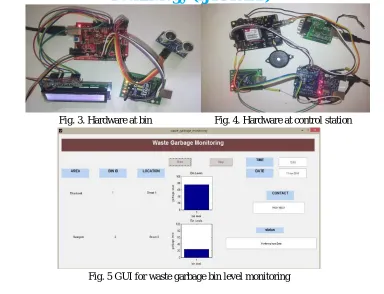
This model or technology is very precise for solid waste management and monitoring system. And it has been successfully implemented. Communication between one control station and two remote node is done with the help of Zigbee. For representing real time bin level in the graphical form we used matlab software and GUI was created in it. Fig. 3 and fig. 4 shows the hardware for bin (sensor node) and control station. Control station receives the information about bin level from remote node.
Fig. 5 shows the GUI which indicates real time garbage level at remote bin. That is built in matlab software.
Fig. 3. Hardware at bin Fig. 4. Hardware at control station
Fig. 5 GUI for waste garbage bin level monitoring
Fig. 6 Network monitoring and overall link quality indicator (LQI)
IV. FUTURE SCOPE
For a future point of view web server can also build for effective graphic user interface of a system and controlling action. All bins are configure with GPRS enabled embedded system. And information is transmitted from bins to the central server. It can store all necessary information such as record of bin level history, how many times vehicles collect the garbage etc. Thus based on prediction, through accumulation of data on amount bin level it enable optimization of number of vehicles used. Also some application for smartphone will be developed, which is useful for citizens so they can report to municipal office. When all such a technology integrated together a new way of waste management system emerges. This will help to reduce the amount of garbage in city and helps to maintain clean environment.
V. CONCLUSION
Regarding to management of Solid Waste we have examined different technology but the aim of all of them are same. In that technologies different types of sensors are used such as load sensor, IR sensor, etc. But ultrasonic sensors gives accurate level monitoring. In some technology GPS are also implemented but position of bins are fixed so it may become expensive, so instead of using GPS we can inform the status by sending the massage by using GSM at control stations. Here, we used Zigbee Pro module to communicate the server room over longer distances and can give real time status of bin.
REFERENCES
[1] D. Hoornweg, and P. Bhada-Tata, The World Bank: What a Waste- A Global Review of Solid Waste Management, Urban Development & Local Government Unit, World Bank , 1818 H Street, NW , Washington, DC 20433 USA, 2012. J. Clerk Maxwell, A Treatise on Electricity and Magnetism, 3rd ed., vol. 2. Oxford: Clarendon, 1892, pp.68–73.
[image:5.612.181.430.370.427.2][3] M. Faccio, A. Persona, and G. Zanin, “Waste collection multi objective model with real time traceability data,” Waste Management,vol. 31, no. 12, pp. 2391-2405, 2011.
[4] Belal Chowdhury, Morshed U. Chowdhury, “RFID-based Real-time Smart Waste Management System,” 2007 Australasian Telecommunication Networks and Applications Conference December 2nd – 5th 2007, Christchurch, New Zealand.
[5] Shubham Thakker, R.Narayanamoorthi, “Smart and Wireless Waste Management”, IEEE Sponsored 2nd International Conference on Innovations in Information Embedded and Communication Systems ICIIECS’15.
[6] Md.Abdulla Al Mamun, M.A.Hannan,Aini Hussain, “ Real Time Solid Waste Bin Monitoring System Framework Using Wireless Sensor Network”, Electronics, Information and Communications (ICEIC), IEEE International Conference on 15-18 Jan. 2014 Page(s):1 – 2, INSPEC Accession Number:14649014.
[7] Sauro Longhi, Davide Marzioni, Emanuele Alidori, “Solid Waste Management Architecture using Wireless Sensor Network technology” , New Technologies, Mobility and Security (NTMS), 5th IEEE International Conference on 7-10 May 2012. INSPEC Accession Number:12770930.