Technology (IJRASET)
Automatic Transmission Controller Using State
Flow
Sanjana.S1, Sreeja.R2, Madan Kumar.V3, Muthu Ramalingam.E. 4
1, 2,3,Student, Dept.of Electronics and Communication Engineering,Kumaraguru College of Technology,Tamilnadu,India.
4
Assistant Professor, Dept.of Electronics and Communication Engineering, Kumaraguru College of Technology, Tamilnadu,India
Abstract: Hydraulic technology can be used to capture and transfer high levels of energy extremely quickly and have a longer operating life compared with similarly sized electric systems. The hydraulic hybrid vehicle (HHV) includes two power sources that propel the vehicle: a fuel-efficient diesel combustion engine and hydraulic components. This technology replaces a conventional drive train with a hydraulic one, which eliminates the need for a mechanical transmission and driveline. To explore an optimal gear shifting strategy with best fuel economy for a seven-speed automatic transmission used on a hydraulic hybrid vehicle, a strategy is designed with a highest possible gear criterion as long as the torque requirement can be satisfied, except for braking process and torque demanding situations. The optimization strategy takes several other criteria into consideration, such as high motor displacement criterion, to improve efficiency and fuel economy. Then the optimization strategy is developed on the basis of these criteria from two main aspects of the existing SIMULINK truck model. One approach is based on the hydraulic. Keywords: HHV, HHV, SIMULINK, seven-speed automatic transmission.
I. FEATURE OF DRIVE TRAIN SYSTEM
In many systems, though, supervisory functions like hanging modes or invoking new gain schedules must respond to events that may occur and conditions that envelope over time. As a result, the environment requires a language capable of managing these multiple modes and developing conditions. In the following example, State flow shows its strength in this capacity by performing the function of gear selection in an automatic transmission. This function is combined with the drive train dynamics in a natural and intuitive manner by incorporating a State flow block in the Simulink block diagram.[2,3]
A. Analysis and Physics
Fig.1. shows the power flow in a typical automotive drive train. Nonlinear ordinary Differential equations model the engine, four-speed automatic transmission, and vehicle. The model discussed in this example directly implements the blocks from Fig 1 as modular Simulink subsystems. On the other hand, the logic and decisions made in the Transmission Control Unit (TCU) do not lend themselves to well-formulated equations. TCU is better suited for a State flow representation. State flow monitors the events which correspond to important relationships within the system and takes the appropriate action as they occur.[1]
Fig.1: Generic block diagram for a drive train system
The throttle opening is one of the inputs to the engine. The engine is connected to the impeller of the torque converter which couples it to the transmission (see Equation 1).
Technology (IJRASET)
The input-output characteristics of the torque converter can be expressed as functions of the engine speed and the turbine speed. In this example, the direction of power flow is always assumed to be from the impeller to the turbine (see Equation 2).
Equation 2
The transmission model is implemented via static gear ratios, assuming small shift times (see Equation 3).
Equation 3
The final drive, inertia, and a dynamically varying load constitute the vehicle dynamics (see Equation 4).
Equation 4
The load torque includes both the road load and brake torque. The road load is the sum of frictional and aerodynamic losses (see Equation 5).
Technology (IJRASET)
The model programs the shift points for the transmission according to the schedule shown in Fig.2. For a given throttle in a given gear, there is a unique vehicle speed at which an up shift takes place. The simulation operates similarly for a downshift.
Fig.2: Shift schedule
II. MODELING OF CONVENTIONAL AND PROPOSED SYSTEMS
The top-level diagram of the model is shown in Fig.3. To run the simulation, press the Play button on the toolbar in the model window. Note that the model logs relevant data to MATLAB Workspace in a data structure called sldemo_autotrans_output. Logged signals have a blue indicator (see Fig.3). After you run the simulation, you can view the components of the data structure by[4,5,6] typing sldemo_autotrans_output in MATLAB Command Window. Also note that the units appear on the subsystem icons and signal lines. To learn more about units in Simulink see Simulink Units.
Fig.3: Model diagram and sample simulation results (passing maneuver)
Technology (IJRASET)
The Engine subsystem consists of a two-dimensional table that interpolates engine torque versus throttle and engine speed. Fig.4 shows the composite Engine subsystem. Double click on this subsystem in the model to view its structure.
Fig.4: Engine subsystem
The Torque Converter and the Transmission Ratio blocks make up the Transmission subsystem, as shown in Fig.5. Double click on the Transmission subsystem in the model window to view its components.
Fig.5: Transmission subsystem
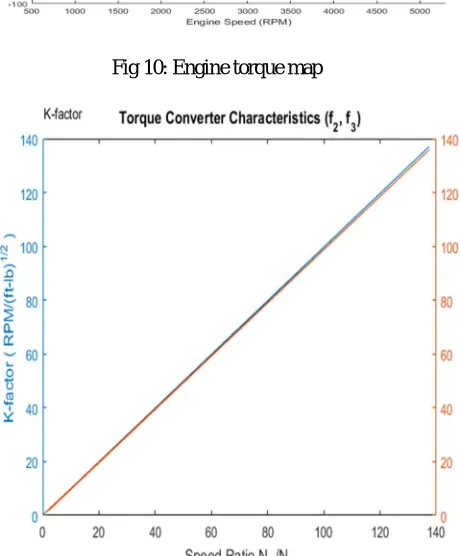
The Torque Converter is a masked subsystem, which implements Equation 2. To open this subsystem, right click on it and select Mask > Look under Mask from the drop-down menu. The mask requires a vector of speed ratios ( Nin/Ne ) and vectors of K-factor (f2) and torque ratio (f3). Fig.6 shows the implementation of the Torque Converter subsystem.[9,10,11]
Fig.6: Torque converter subsystem
Technology (IJRASET)
Table 1: Transmission gear ratios
Gear Rtr = Nin/Ne
1 2.393
2 1.450
3 1.000
[image:6.612.190.428.99.353.2]4 0.677
Fig.7: Transmission gear ratio subsystem
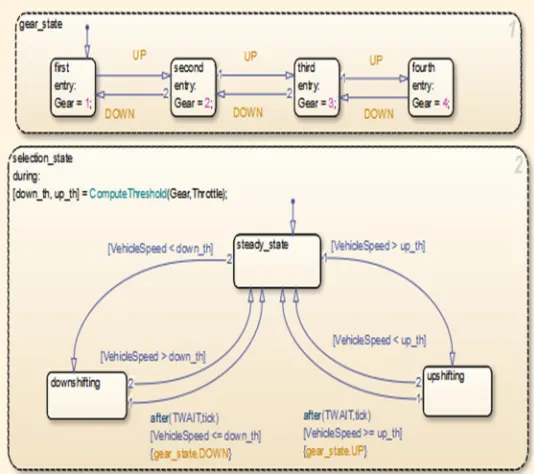
The State flow block labeled Shift Logic implements gear selection for the transmission. Double click on Shift Logic in the model window to open the State flow diagram. The Model Explorer is utilized to define the inputs as throttle and vehicle speed and the output as the desired gear number. Two dashed AND states keep track of the gear state and the state of the gear selection process. The overall chart is executed as a discrete-time system, sampled every 40 milliseconds. The Stateflow diagram shown in Fig 8 illustrates the functionality of the block.
[image:6.612.172.439.457.694.2]Technology (IJRASET)
[image:7.612.173.427.158.368.2]The shift logic behavior can be observed during simulation by enabling animation in the State flow debugger. The selection state (always active) begins by performing the computations indicated in its during function. The model computes the up shift and downshift speed thresholds as a function of the instantaneous values of gear and throttle. While in steady state, the model compares these values to the present vehicle speed to determine if a shift is required. If so, it enters one of the confirm states (up shifting or downshifting), which records the time of entry.[12,13]
Fig 9: Vehicle subsystem (masked)
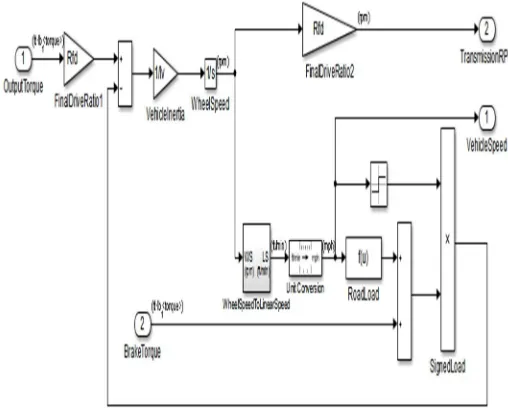
If the vehicle speed no longer satisfies the shift condition, while in the confirm state, the model ignores the shift and it transitions back to steady_state. This prevents extraneous shifts due to noise conditions. If the shift condition remains valid for a duration of TWAIT ticks, the model transitions through the lower junction and, depending on the current gear, it broadcasts one of the shift events. Subsequently, the model again activates steady_state after a transition through one of the central junctions. The shift event, which is broadcast to the gear_selection state, activates a transition to the appropriate new gear.For example, if the vehicle is moving along in second gear with 25% throttle, the state second is active within gear_state, and steady_state is active in the selection_state. The during function of the latter, finds that an upshift should take place when the vehicle exceeds 30 mph. At the moment this becomes true, the model enters the upshiftingstate. While in this state, if the vehicle speed remains above 30 mph for TWAIT ticks, the model satisfies the transition condition leading down to the lower right junction. This also satisfies the condition [|gear == 2|] on the transition leading from here to steady_state, so the model now takes the overall transition from upshifting to steady_state and broadcasts the event UP as a transition action. Consequently, the transition from second to third is taken in gear_state which completes the shift logic.The Vehicle subsystem (Fig 9) uses the net torque to compute the acceleration and integrate it to compute the vehicle speed, per Equation 4 and Equation 5. The Vehicle subsystem is masked. To see the structure of the Vehicle block, right click on it and select Mask > Look Under Mask from the drop-down menu. The parameters entered in the mask menu are the final drive ratio, the polynomial coefficients for drag friction and aerodynamic drag, the wheel radius, vehicle inertia, and initial transmission output speed.[9,10,11]
III. RESULTS AND DISCUSSION
Technology (IJRASET)
Fig 10: Engine torque map
Fig 11: Torque converter characteristics (see Fig 5 and Equation 2)
The first simulation (passing maneuver) uses the throttle schedule given in Table 2 (this data is interpolated linearly).
Table 2: Throttle schedule for first simulation (passing maneuver)
Time (sec) Throttle (%)
14.9 40
15 100
100 0
200 0
[image:8.612.198.428.235.513.2]Technology (IJRASET)
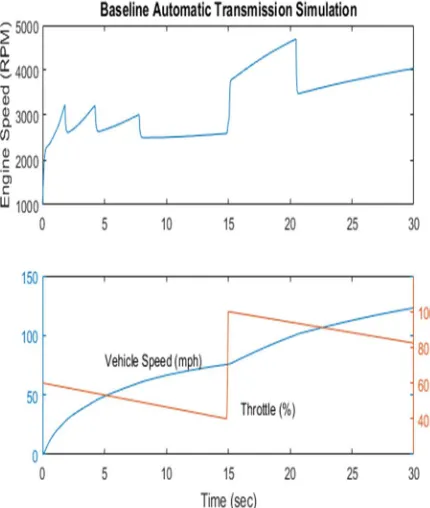
[image:9.612.196.411.170.424.2](brake torque is zero). The vehicle speed starts at zero and the engine at[14,15] 1000 RPM. Fig 12 shows the plot for the baseline results, using the default parameters. As the driver steps to 60% throttle at t=0, the engine immediately responds by more than doubling its speed. This brings about a low speed ratio across the torque converter and, hence, a large torque ratio (see Fig 6 and Fig 11. The vehicle accelerates quickly (no tire slip is modeled) and both the engine and the vehicle gain speed until about t = 2 sec, at which time a 1-2 upshift occurs. The engine speed characteristically drops abruptly, then resumes its acceleration. The 2-3 and 3-4 upshifts take place at about four and eight seconds, respectively. Notice that the vehicle speed remains much smoother due to its large inertia.
Fig 12: Passing maneuver simulation time history
At t=15sec, the driver steps the throttle to 100% as might be typical of a passing maneuver. The transmission downshifts to third gear and the engine jumps from about 2600 RPM to about 3700 RPM. The engine torque thus increases somewhat, as well as the mechanical advantage of the transmission. With continued heavy throttle, the vehicle accelerates to about 100 mph and then shifts into overdrive at about t = 21 sec. The vehicle cruises along in fourth gear for the remainder of the simulation. Double click on the ManeuversGUI block and use the graphical interface to vary the throttle and brake history. As shown in the Fig.13 and 14.
[image:9.612.174.439.527.687.2]Technology (IJRASET)
Fig.14: Results of the proposed system.
IV. CONCLUSION
One can easily enhance this basic system in a modular manner, for example, by replacing the engine or transmission with a more complex model. We can thus build up large systems within this structure via step-wise refinement. The seamless integration of Stateflow control logic with Simulink signal processing enables the construction of a model which is both efficient and visually intuitive.
REFERENCES [1] F. Paterno, Model-Based Design and Evaluation of Interactive Applications. .
[2] J. Friedman and J. Ghidella, “Using Model-Based Design for Automotive Systems Engineering – Requirements Analysis of the Power Window Example,” no. 724, 2006.
[3] “Model-Based Design.” [Online]. Available: http://se.mathworks.com/help/simulink/gs/model-based-design.html. [4] R. Cherukuri, Verification Workflow for Model Based Design Using Polyspace and Simulink Design Verifier.
[5] G. Rodriguez-navas, C. Seceleanu, H. Hansson, M. Nyberg, and O. Ljungkrantz, “Automated Specification and Verification of Functional Safety in Heavy-Vehicles: the VeriSpec Approach,” 2014.
[6] S. Moran, and Z. Nevo, “Incremental formal verification of hardware,” 2011 Form. Methods Comput. Des., pp. 135–143, 2011.
[7] H. Wong-toit and A. Balluchi, “Formal Verification of an Automotive Engine Controller in Cutoff Mode,” vol. 00, no. December, pp. 4271–4276, 1998. [8] M. Goran Begic, M. Jay Abraham, and M. Nishaat Vasi, Formal Verification Made Easy with MATLAB and Simulink. .
[9] P. Filipovikj, M. Nyberg, and G. Rodriguez-navas, “Reassessing the Pattern-Based Approach for Formalizing Requirements in the Automotive Domain,” pp. 444– 450, 2014.
[10] E. Clarke, A. Biere, R. Raimi, and Y. Zhu, “Bounded Model Checking using SAT Solving,” J. Form. Methods Syst. Des., vol. 19, no. 1, pp. 7–34, 2001.
[11] K. L. McMillan, “Methods for exploiting SAT solvers in unbounded model checking,” First ACM IEEE Int. Conf. Form. Methods Model. Co-Design, 2003. MEMOCODE ’03. Proceedings., pp. 135–142, 2003.
[12] S.Baskar,S.Pavithra,T.Vanitha,”Optimized Placement and routing algorithm for ISCAS-85 circuit”, Electronics and Communication Systems (ICECS), 2015 2nd International Conference on 2015/2/26, IEEE, 958-964
[13] S.Baskar,”ERROR DETECTION AND CORRECTION ENHANCED DECODING OF
[14] DIFFERENCE SET CODES FOR MEMORY APPLICATION,” International Journal of Advanced Research in Computer and Communication Engineering, IJARCCE, Issue 10, 2012, 816-820.
[15] S.Baskar, “Error recognition and correction enhanced decoding of hybrid codes for memory application” at Devices, Circuits and Systems (ICDCS), 2014 2nd IEEE Conference 1-6.