Technology (IJRASET)
©IJRASET 2015: All Rights are Reserved
340
Access Control List
Nahush Kulkarni1, Harsh Kothari2, Hardik Ashar3, Sanchit Patil4
1,2,3,4 Electronics and Telecommunication Department
K.J Somaiya College of Engineering- Mumbai University
Abstract— With the growth of internetwork, ACL’s have now become very important for network administrator. ACL’s are one of the main features of today’s internetwork router. Routers generally check each incoming packet against the rule of the ACL which are defined by the network administrator. These rules decide which network traffic is permitted and which type of network is denied. In this paper we configure an extended ACL in a private network to provide security for the network of the organization. It makes the router capable for performing the filtering of network packets which travels in or out of the router interfaces to increase the speed & performance of the server. It also restrict network usage by certain users or devices to enhance security. This all experiment with network behavior is done on the Cisco packet tracer 6.2.
Keywords— ACL, Cisco Packet Tracer, Router, Network, ICMP
I. INTRODUCTION
The Access Control List is basically a sequence or setoff rules also called ACL entries. These rule specify the type of network traffic that can be passed or block through a router. ACLs are deployed at almost all points of entry in a private network and outside internet. So that all the network traffic that is incoming and outgoing packet can be monitored. Different protocols can be used in ACLs like IPX, AppleTalk etc. A packet is basically contains a limited number of fields such as source or destination port no., IP address, the source and destination protocols type etc. Every packet is matched with the rules of the ACL starting from the first rule and so on until it match with the rule or the last Statement. This matching process decides how to apply the network security.
An ACL contains many rules and there can be conflicts between these rules such as redundancy, shadowing etc [1]. So the ACLs must be managed carefully so that the conflicts can be resolved [2].The Rule sets are generally composed of number of rules ranging from tens to five thousand [3].
II. TYPES OF ACL
Mainly three types of ACLs can be configure on the routers. These are as follows:
Standard ACL – This allows or denies packets based on IP address of source. Valid range of standard ACL IDs are from 1 – 99. Extended ACL – This allows or denies packets based on protocol information and also based on IP address of source and destination. Valid range of extended ACL IDs are from 100 – 199.
Named ACL– These are more convenient because you can specify a meaningful name that is easier to remember and associate with a task. Standard ACLs permit or deny packets based on source IP address. You can configure up to 99 standard ACLs. You can configure up to 1024 individual ACL entries on a device. There is no limit to the number of ACL entries an ACL can contain except for the system-wide limitation of 1024 total ACL entries. Extended ACL’s let you permit or deny packets based on the following information:
IP protocol Source IP address Destination IP address
Source TCP or UDP port (if the IP protocol is TCP or UDP) Destination TCP or UDP port (if the IP protocol is TCP or UDP)
The biggest advantage of named ACL is that one can reorder statements in or add statements to a named access list.
The ACLs can also be used in filtering route advertisements and also in enforcing network policies such as traffic shaping and NAT (network address translation)[4].
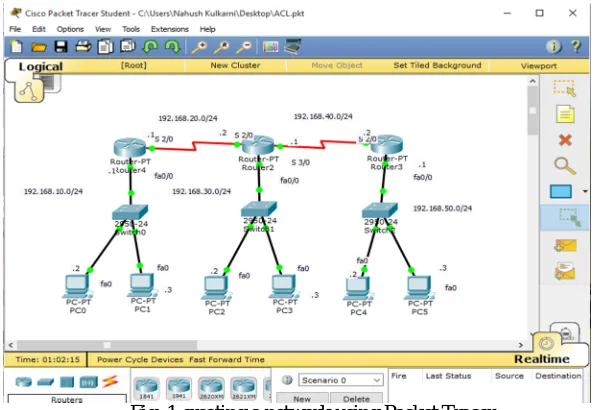
simulation program which allows students to experiment with the network behavior. Packet Tracer acts as a supplement for physical equipment in the classroom as it allowing students to create a computer network with an almost any number of devices, encouraging the practice, discovery and the troubleshooting. Initially a physical network is created with PCs, routers, switches, server and connections using Cisco packet tracer 6.2.Then the routers are configured and route is established by writing command in CLI. At this point all the packets are received by the server. Then extended ACL is created & configured on the router closed to the destination.
Fig. 1 creating a network using Packet Tracer
A. Creating And Applying Extended ACL
Router(config)#ip access-list extended nahush
Router(config-ext-nacl)#deny icmp 192.168.10.0 0.0.0.255 192.168.30.0 0.0.0.255 echo Router(config-ext-nacl)#deny tcp 192.168.10.0 0.0.0.255 192.168.30.0 0.0.0.255 eq 23 Router(config-ext-nacl)#permit ip any any
Router(config-ext-nacl)#exit Router(config)#int fa 0/0
Router(config-if)#ip access-group nahush in Router(config-if)#exit
[image:3.612.156.453.157.362.2]IV. DESIGNED SYSTEM AND RESULTS
Technology (IJRASET)
©IJRASET 2015: All Rights are Reserved
[image:4.612.104.518.38.527.2] [image:4.612.176.472.285.532.2]342
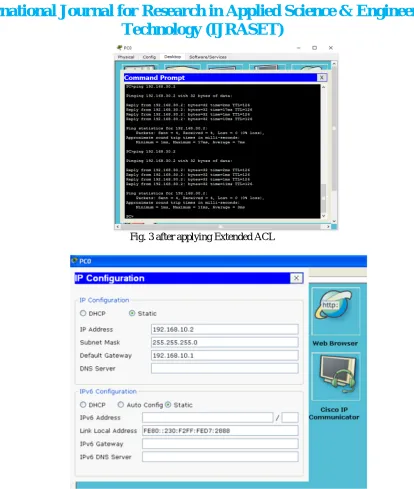
Fig. 3 after applying Extended ACLFig. 4 Configuring IPs
V. CONCLUSION
When the extended ACL was not applied on the interface we could use all the protocols. In this example, we could ping From PC0 to PC3. Ping uses the Internet Control Message Protocol (ICMP) protocol. After we apply the extended ACL, We get an error after we hit the ping command. This is because ICMP protocol has been denied from 192.168.10.0 network to the 192.168.30.0 Network. At the same time, we can ping to 192.168.50.0 network as no restrictions are mentioned about it in the ACL.
VI. ACKNOWLEDGMENT
It is our pleasure to refer Microsoft Word exclusive of which the compilation of this project would have been impossible. An assemblage of this nature could never have been attempted with our reference to and inspiration from the works of others whose details are mentioned in references section. We acknowledge our indebtedness to all of them. Last but not the least my Sincere thanks to all my friends who have patiently extended all sorts of help for accomplishing this undertaking.
REFERENCES
[2] S. Pozo, A.J. Varela-Vaca, and R.M. Gasca. A quadratic, complete, and minimal consistency diagnosis process for firewall acls. In Advanced Information [3] Networking and Applications (AINA), 2010 24th IEEE International Conference on, pages 1037-1046, April 2010.
[4] David E. Taylor.“Survey and taxonomy of packet classification techniques.”ACM Computing Surveys, Vol. 37, No. 3, 2005. Pages 238-275 [5] A. Velte and T. Velte. “Cisco: A Beginner’s Guide”, McGraw-Hill Inc. 3rd edition (2004).