Technology (IJRASET)
Simulation based performance of AODV (Reactive)
and DSDV (Proactive) routing protocol for
MANET
Ashish Srivastava
Information Technology, Rajkiya Engineering College, Azamgarh, India
Abstract— Mobile Ad hoc network which runs on battery power and is the major source of entire nodes, the entire network and network lifetime [14] is dependent on that battery power, if any of the node present in the network runs out of the battery then entire network get breakdown and not only the topology the entire network has to reestablish. Therefore routing in Manet is key issue and the protocols present for transmission is the lifeline for the nodes because these protocols actually decide when any node has to wake up and get into the sleep mode for this the classification of protocol gives a better idea but in this paper I have try to simulate under certain conditions with AODV (Reactive), DSDV (Proactive) and the outcome of the result is best and acceptable irrespective of the classification provided earlier and will help researchers in future.
Keywords-Manet, Routing, Aodv, Dsdv, Power consumption,
I. INTRODUCTION
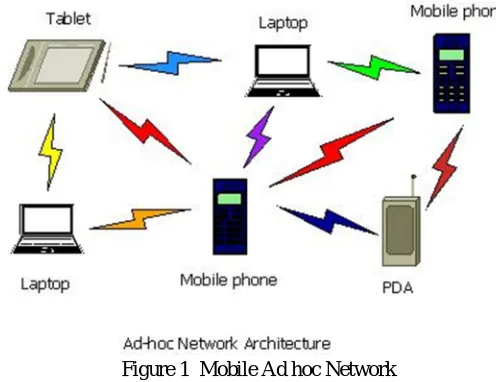
[image:2.612.177.425.405.596.2]The blow up of Wireless communication and Mobile communication has transformed sharply, unpredictly as well as swiftly in the recent years which has not only opened the door of research on self-organizing networks but has changed the scenario of communication which do not involve a pre-established infrastructure and these unplanned networks, more often than not are called Ad Hoc networks .
Figure 1 Mobile Ad hoc Network
These networks offer mobile users with the world over communication competence and information access despite of the place and position.
Technology (IJRASET)
lesser amount of energy consume components of mobile nodes such as processors, memory and OS power management strategies [4, 5, 6]
The Ad Hoc network is divided into two categories whether vigorously varying their position or not. These are Wireless sensor network (WSN)[12] and Mobile Ad Hoc network (MANET)[1].In Wireless sensor networks mobile nodes are deployed in huge amount on tiny region. After the nodes are deployed, they are stationary but in Mobile Ad Hoc networks the node are dynamic and changes its position also. The Ad Hoc network can be used in an area where an infrastructure for mobile communication is not easily available, because of deployment costs or in disaster situations and the network life time is defined as the time when a node runs out of its own battery power for the first time [7, 8].
The emblematic use of Ad Hoc network includes communication in battle field, emergency rescue and in expansion of the coverage region of cellular networks. Routing is one of the major and important tasks in MANETs because of their extremely active and distributed environment. The Ad-hoc routing algorithms is characterized into pro-active, reactive and hybrid routing algorithm. The pro-active routing algorithm exchanges routing information periodically and generates the routing table in advance of route request [3]. It selects the routes on the basis of least hop count. The reactive routing algorithm begin to find out the appropriate route when a route is requested [2].The hybrid routing algorithm is the combination of both.
II. ADHOC ON DEMAND DISTANCE VECTOR ROUTING
AODV [2][9] protocol is based on DSDV and DSR algorithm. It uses periodic beaconing and sequence numbering procedure of DSDV, identical route discovery procedure of DSR. There are two main differences between DSR and AODV. The first difference is; in DSR each packet carries full routing information, whereas in AODV the destination address is carried by packet which means AODV has lower routing overheads than DSR. The other difference is; route reply in DSR carry the address of each node beside the route, but in AODV the route reply has the destination IP address and the sequence number. The only advantage of AODV is it is adaptable to highly dynamic networks, but node may sometime suffers delay during route construction and if link failure occurs then route discovery will take place which in turn adds extra delay and consumes more bandwidth with the increase of network size.
III. DESTINATION SEQUENCED DISTANCE VECTOR ROUTING
DSDV [1] is an improvement of Distributed Bellman Ford [10] and is a hop-by-hop distance vector protocol which assures loop free routes. In DSDV there is a single path to the destination which is chooses using distance vector shortest path routing algorithm. The routing table updates are time driven and event driven. Two types of update packets are used viz. “full dump” and “incremental packets” to reduce the overhead transmitted through network. The full dump packet bear all the available routing information, it is suitable for fast changing networks and incremental packet handle only the information change since the last dump, it is suitable when network is stable. In DSDV minimum delay in the route setup process because there is availability of routes to all destinations at all times. Sequence number is used to distinguish previous from new ones and higher sequence number is always favorable .Large part of network bandwidth is used in updating procedures.
IV. SIMULATION RESULT
NS-2 is the Network Simulator 2 [11] which has emerged from the VINT project. NS-2 is used to simulate all types of Internet transmission as well as its implementations for IP, TCP, UDP, various routing protocols, several QoS methods as well.
The model implemented in NS-2 is already very detailed, which leads to high complexity in the software as well as in its calculation part. In NS-2 the front end is OTCL (Object Oriented Tool Command language) and backend is C++. It has a rooted TCL interpreter, so that TCL scripts can be used to organize and command the simulator.
NS-2 does not offer any data which can be used for performance evaluation. But, the whole event formed by the simulation events is transferred to a trace-file. Trace-file then approaches it to take out the required information. It may look like a logical tackle; however in case of small scale simulation plot of the trace-files is very large. Further results derived by ns 2 (trace files) is to be deal by other tools, i.e. the Network Animator (NAM), and Awk script.
Technology (IJRASET)
TABLE 1 Simulator Parameters
Mac Type IEEE 802.11
Protocols for observation AODV,DSR
Transmission Range 250m
Traffic type CBR
Antenna Omni directional
Node Speed Min-0.5m/s, Max-1.5m/s
Propagation Model Shadowing, Two Ray Ground
Channel Type Wireless channel
Mobility Model Static
Scenario Parameters
Number of Nodes 25
Topology Area 600*600
Placement Model Random
Simulation Time 200 seconds
Performance Metrics PDR, End to End Delay, Throughput etc.
A. AODV: (Packet Delivery Ratio) Graph
Technology (IJRASET)
C. AODV: (EndtoEnd Delay) Graph
D. DSDV: (Packet Delivery Ratio) Graph
Technology (IJRASET)
F. DSDV: (End to End Delay) Graph
V. CONCLUSION
In Ad Hoc networks the issue of power consumption is hot topic and to reduce the power consumption has increased great attention among the researchers from the past years. The simulation result shows that the performance of DSDV (Proactive), protocol is better than AODV (Reactive) protocol in terms of the percentage of packet delivery ratio with (5, 10, 15, 20, and 25) nodes. But in case of Routing Overhead DSDV performance lacks and its value increases with the increase of nodes.
REFERENCES
[1] B. Upadhyay, A. Srivastava, A. Mishra and S. Upadhyay, "Distinctive approach for Quality of Service (QoS) routing in MANET, IEEE” International Conference onAdvances in Engineering and Technology Research (ICAETR), 2014 Unnao, pp. 1-4.
[2] Srivastava, A., Mishra, A., Upadhyay, B., & Yadav, A. K. (2014, August). Survey and overview of Mobile Ad-Hoc Network routing protocols. IEEE International Conference on Advances in Engineering and Technology Research (ICAETR), 2014 Unnao,(pp. 1-6).
[3] Perkins, Charles E., and Pravin Bhagwat. "Highly dynamic destination-sequenced distance-vector routing (DSDV) for mobile computers." ACM SIGCOMM Computer Communication Review. Vol. 24. No. 4. ACM, 1994.
[4] Chansu Yu, Ben Lee Hee and Yong Youn, Energy Efficient routing protocols for mobile ad- hoc
networks,http://web.enger.oregonstate.edu/~benl/Publications/Journals/WCMC03.pdf.
[5] A. P. Chandrakasan, S. Sheng, and R. W. Brodersen, Low-power CMOS digital design, Solid-State Circuits, IEEE Journal of, vol. 27, pp. 473-484, 1992. [6] A. R. Lebeck, X. Fan, H. Zeng, and C. S. Ellis, Power Aware Page Allocation, in Architectural Support for Programming Languages and Operating Systems,
2000, pp. 105-116.
[7] L. Benini, A. Bogliolo, and G. De Micheli, A survey of design techniques for system-level dynamic power management, Very Large Scale Integration (VLSI) Systems, IEEE Transactions on, vol. 8, pp. 299-316, 2000.
[8] Q. Li, J. Aslam and D. Rus, Online Power-aware Routing in Wireless Ad-Hoc Networks, Proceedings of MOBICOM, July 2001.
[9] Sunsook Jung, Nisar Hundewale, Alex Zelikovsky, Energy efficiency of load balancing in MANET routing protocols, SNPD/SAWN 2005 Sixth International Conference on Volume , Issue , 23-25 May 2005 Page(s): 476 – 483.
[10] C. Perkins and E.M. Royer, Ad hoc on demand distance vector (AODV) routing, Proceeding of 2nd IEEE workshop on Mobile computing systems and Applications, Feb 1999.
[11] Abolhasan, Mehran, Tadeusz Wysocki, and Eryk Dutkiewicz. "A review of routing protocols for mobile ad hoc networks." Ad hoc networks 2.1 (2004): 1-22. [12] NS-2, http://www.isi.edu/nsnam/ns/doc/index.html.
[13] Pandey,Mayank, Siddharth Rai, & Ashish Chaudhary,”A study of vertical handover Algorithm in Heterogeneous Wireless Network”.