ADAPTIVE
BACKSTEPPING
SLIDING
MODE
CONTROL
OF
SPACECRAFT
ATTITUDE
TRACKING
1CHUTIPHON PUKDEBOON,
Nonlinear Dynamic Analysis Research Center, Department of Mathematics, Faculty of Applied Science,
King Mongkut’s University of Technology North Bangkok, Bangkok, Thailand
E-mail: [email protected]
ABSTRACT
This paper investigates the attitude tracking problem for rigid spacecraft. An adaptive backstepping sliding mode control law is proposed to solve this problem in the presence of inertia uncertainties and external disturbances. The control scheme is developed by combining sliding mode control with adaptive backstepping technique to achieve fast and accurate tracking responses. The proposed control law provides complete compensation of uncertainty and disturbances. Although it assumes that the uncertainty and disturbances are bounded, this control law does not require information about the bounds on the uncertainties and disturbances. The asymptotic convergence of attitude tracking is ensured by Lyapunov approach. Numerical simulations on attitude tracking control of spacecraft are provided to demonstrate the performance of the proposed controller.
Keywords: Attitude Tracking Control, Sliding Mode Control, Backstepping Design, Adaptive Control
1. INTRODUCTION
In recent years the attitude control of rigid spacecraft which has already attracted a great deal of attention. It is an important and practical problem due to its many different types of space
missions such as spacecrafts, satellites
maneuvering, satellite surveillance, spacecraft formation flying, and space station docking and installation. Since the attitude dynamics of spacecraft is coupled and highly nonlinear, the attitude controller designs are usually difficult. In practical situations, the model parameters of the spacecraft may not be exactly known and the
spacecraft is always subject to external
disturbances. Thus, the attitude control problem with external disturbance has become a very challenge and interesting problem.
A large variety of nonlinear control sechemes [13] have been proposed for solving the attitude tracking control problem. These control schemes include adaptive attitude control [4,5] sliding mode control [6,7], output feedback control [8,9], LMI-based control [10], passivity-LMI-based control [11,12], and fuzzy control [13]. Among these methods, sliding mode control (SMC) has been shown to be a potentially approach when applied to a system subject to disturbances which satisfy the matched uncertainty condition [14]. SMC can offer many
good properties, such as insensitivity to model uncertainty, disturbance rejection and fast dynamics responses. Robust attitude controllers based on the SMC scheme have been proposed in [15,16]. These control laws can achieve global asymptotic stability and provide good tracking resultsThe terminal sliding mode (TSM) method [17,18] can be used to design a robust controller that will guarantee a finite time convergence to the origin. This makes it a welcome method for attitude controller designs (see e.g., [19,20]).
Since the bounds on the uncertainty and disturbance of a spacecraft are often unknown, it is important to develop controllers that do not require this information. The adaptive sliding mode control (ASMC) method has been developed to solve this problem. In the ASMC method an adaptive scheme is combined with the SMC design. For example, an ASMC strategy has been proposed for the attitude stabilization of a rigid spacecraft, where the lumped uncertainty is assumed to be bounded by a linear function of the norms of angular velocity and quaternion (see e.g., [20,21]). On the other hand, backstepping design techniques have been widely applied to control nonlinear systems (see [22] and
reference therein). The main concept in
ISSN: 1992-8645 www.jatit.org E-ISSN: 1817-3195
stability of the entire systems is ensured. However,
the conventional backstepping design assumes that the lumped uncertainty in the system is constant or slowly changing. When, the derivatives of the model uncertainty and disturbance can not be regarded as zero, the backstepping design with integral adaptive laws is no longer useful. Control strategies which combine BT with SMC have been developed by [23].
In this paper a new attitude control algorithm is developed. The finite-time stability of the algorithm is analyzed using Lyapunov concepts and differential inequalities with backstepping method. The proposed adaptive backstepping sliding mode control (ABSMC) strategy ensures that asymptotic convergence of the errors is achieved.
The paper is organized as follows. In Section 2, the dynamic and kinematic equations that govern the attitude model [24, 25]. Section 3 states the control objective of the proposed control design. Section 4 proposes an adaptive backstepping sliding mode control (ABSMC) algorithm for a rigid spacecraft. The sliding manifold is chosen and the sliding control law is studied and a proof of finite time convergence is given by using the Lyapunov stability theory. In section 5, numerical simulations on attitude tracking control is presented to show the usefulness of the proposed controller. In Section 6, we present conclusions.
2. NONLINEAR MODEL OF SPACECRAFT AND PROBLEM FORMULATION
2.1 Kinematics of the Attitude Error
We now briefly explain the use of quaternions for description of the attitude error. We define
the quaternion 3
4 T T
Q=q q ∈ ℜ × ℜ with
[
]
31 2 3
T
q= q q q ∈ ℜ and
4 ,
T T
d d d
Q = q q
where
[
]
31 2 3 T
d d d d
q = q q q ∈ ℜ is the desired
reference attitude. The quaternion for the
attitude error is 3
4 T T
e e e
Q =q q ∈ ℜ × ℜ with
[
]
31 2 3 .
T
e e e e
q = q q q ∈ ℜ Using the multiplication
law for quaternions, we then obtain
4 4
4 4
d d r
e T
d d
q q q q q q Q
q q q q ×
− −
=
+
(1)
subject to the constraint
(
2)(
2)
4 4 1.
T T T
e e d d d
Q Q = q q+q q q +q = (2)
Remark 1 a quaternion consists of the scalar
4
q and the three - dimensional vector q, so it has four components. The scalar term is used for avoidance of singular points in the attitude representation [26]. The scalar q4 can be calculated easily using the vector q and the condition Q =1. For more details of quaternion and other attitude representation please see [24, 26].
The kinematic equation for the attitude error can be written as [25]
( )
1, 2
e
e T e
e T Q Q
q ω
=
−
& (3)
where I3 is the 3×3 identity matrix and
( )
e e 4e 3 T Q q× q I= + .
To avoid the singularity of T Q
( )
e that willoccur at 4 0
e
q = , we let the attitude of the spacecraft be restricted to the workspace W defined by [27]
{
| 4 , 1,T T
e e e e e
W = Q Q =q q q ≤β<
}
24e 1 0 ,
q ≥ −β > (4)
where β is a positive constant.
2.2 Dynamic Equations of the Error Rate
In [24], the dynamic equation for a rigid spacecraft rotating under the influence of body-fixed devices is given as
,
Jω&= −ω×Jω+u+d (5)
where
[
1 2 3]
T
ω= ω ω ω is the angular rate of the
spacecraft,
[
1 2 3]
T
u= u u u represents the control
vector,
[
1 2 3]
T
d = d d d are bounded
disturbances, J is the inertia matrix, and the
skew-symmetric matrix ω× is defined by
3 2
3 1
2 1
0
0 .
0
ω ω
ω ω ω
ω ω
×
−
= −
−
(6)
We denote
[
1 2 3]
Td d d d
ω = ω ω ω as the desired
reference rate and ωe=ω−Cωd with
(
2)
4 2 3 2 2 4
T T
e e e e e e e
C q q q I q q q q×
= − + − as the error
rate. As a result, the dynamic equation of the error rate can be obtained in form [25]
(
)
(
)
e e d e d
(
)
.e d d
J ω×Cω Cω
+ + & (7)
In this paper, qd,q& &&d,qd and ωd are assumed to
be bounded, and the objective is to design control laws which force the states of the closed-loop systems (3) and (7) to converge to a desired region contatining the origin in finite time.
2.3. Lemmas
Before giving the controller design, the following lemmas and assumptions are required.
Lemma 1 (Du et al. [28]) If p∈
(
0,1 ,)
then the following inequality holds
1
3 3 2
1 2 1 1 p p i i i i x x + + = = ≥
∑
∑
(8)Lemma 2 (Du et al. [28])Suppose V
( )
x is a smooth positive definite function (defined onn
U ⊂ ℜ ) and V
( )
x cVι( )
x+
& is negative
semi-definite on U ⊂ ℜn
for ι∈
(
0,1)
and c ,+
∈ ℜ then
there exists an area U0 ⊂ ℜnsuch that any V
( )
xwhich starts from U0 ⊂ ℜncan reach V
( )
x 0, ≡ in finite time. Moreover, if Tr is the time needed to reach V( )
x ≡0then( )
(
)
1 0 , 1 r V x T c ι ι − ≤− (9)
when V
( )
x0 is the initial value of V( )
x .Lemma 3 (Yu et al. [18]) For any numbers
1 0, 2 0, 0 1,
λ > λ > <ϖ < an extended Lyapunov
condition of finite-time stability can be given in the form of fast terminal sliding mode as
( )
1( )
2( )
0, V x λV x λVϖ x+ + ≤
&
where the settling time can be estimated by
(
)
( )
11 0 2
1 2 1 ln . 1 r V x T ϖ λ λ
λ ϖ λ
−
+
≤
− (10)
Lemma 4 If : 4 3
e e
P q I q×
= + then P& satisfies the following equation
1 . 2
T
e e e e
P&ω = − qω ω (11)
Proof.From Pwe have P q I4e 3 qe×
= +
& & & and then
(
4 3)
.e e e e
P&ω = q I& +q&× ω (12)
Using 1
2
e e
q& = Pω and substituting (1) into (12), one
has
1 1
.
2 2
T
e e e e e e
Pω q ω ω Pω ω
×
= − +
& (13)
We know that T T
e e e e
q ω =qω and 0.
e e
ω ω× = Hence,
1 . 2
T
e e e e
P&ω = − qω ω
To prove the asymptotic convergence of the proposed controller, the well-known Barbalat's lemma (see e.g., [29]) is restated by Lemma 5.
Lemma 5 If a continuous differentiable dual
function V:ℜ ×n [0, )∞ → ℜ has lower bound
( , ) 0,
V x t& ≤ and V x t&( , ) is uniformly continuous on [0, )∞ , then lim
(
,)
0.t
V x t
→∞ =
&
Assumption 1 We assume that the inertia matrix in (7) is of the form J =J0+ ∆J where
0
J
is a known nonsingular constant matrix and ∆J
denotes the uncertainties and satisfies J ≤λJ,
where λJ is the upper bound on the norm of the inertia matrix.
Based on Lemma 4, the time derivative of q&e along the system trajectory (3) satisfies
(
)
1 0 0 1 0 1 1 2 21 1 1
4 2 2
1
, 2
e e e
T
e e e e d d
q P P
q PJ J P C C
PJ u d
ω ω
ω ω −ω× ω ω× ω ω
− = + = − − + − + + & & && & % (14) where d%= ∆ +g d are the total uncertainties containing inertia uncertainties and external disturbances, and where
(
)
1 0 1 2
g PJ− ω× Jω Jω
∆ = − ∆ − ∆ & and 1
0
1 . 2 d PJ−d
=
Hence, we can obtain
0 ,
e
q = f +B u+d%
&& (15) where
(
)
1 0 0
1 1 1
4 2 2
T
e e e e d d
f = − qω ω − PJ−ω×J ω+ P ω×Cω −Cω&
and 1
0 0
1 . 2
B PJ−
= The dynamic model (15) will be
used in the subsequent control design and stability analysis.
Assumption 2 The desired system states
, ,
d d d
q q& q&& and ωd are assumed to be bounded.
ISSN: 1992-8645 www.jatit.org E-ISSN: 1817-3195
component of the total disturbance vector is
assumed to be bounded, i.e., , 1, 2, 3,
i i
d K∗ i
≤ =
&%
where *, 1, 2, 3
i
K i= are positive constants. The
term ˆ , 1, 2, 3
i
K i= can then be adapted to estimate
i
d&% and has an upper bound *
(
. . ˆ *)
.i i i
K i e K ≤K
3. THE CONTROL OBJECTIVE
In this paper the objective is to design a control law which forces the states of closed-loop systems (1) and (2) to asymptotically converge the
desired attitude motion qd and desired angular
velocity ωd . This can be expressed as
( )
lim 0, t
e t
→∞
= and lim e
( )
0,t
t
ω →∞
= (16)
where ωe= ω−ω&dis the angular velocity tracking error vector.
4. ABSMC
The adaptive backstepping method (ABT) used is a recursive Lyapunov-based scheme in which any useful nonlinearities can be introduced to improve the transient performance. SMC is a potential robust control approach for dealing with nonlinear systems with uncertainties. In this section, the SMC and ABT methods are combined to develop a control law that can achieve accurate tracking.
As an example of the application of the new method, we consider set-point control of robot systems. Let x1=qe and x2=q&e, respectively. The expression (15) can then be written as
x&1=x2
2 0 .
x& = f +B u+d% (17) Let x2 be a virtual input defined by
( )
( )
2 1 1 1 1 1 ,
x K signα x ρx φ x
= − − = (18)
whereK1=diag k
(
11,k12,k13)
and(
)
1 diag 11, 12, 13
ρ = ρ ρ ρ are positive diagonal
matrices, 0<α<1 and
( )
1
n
x R
φ ∈ with φ
( )
0 =0.The function signγ
( )
yis defined as
( )
1( )
1 ... ,(
)
.T
m m
signγ y =y γ sign y y γ sign y
With 0<γ <1 and .
m
y∈R
Next, let z=x2−φ
( )
x1 , Then the model (17) can be written asx&1=φ
( )
x1 +z( )
0 1
z&= f +B u+d%−φ& x (19)
It is obvious that the derivative of φ
( )
x1 will beinfinite at 1 0
i
x = and
1i 0.
x& = To avoid this problem, the term φ&
( )
x1 is approximated asφ&
( )
x1i = −k1iψ( )
x1i −ρ1ix2i, i=1, 2, 3 (20) with( )
1
1 1 1 1
1
1 1 1 1
1
, 0 0
, 0 0
0, 0,
i i i i
i i i i i
i
x x x and x
x x x and x
x
α
α α
ψ α
−
−
≠ ≠
= ∆ = ≠
=
& &
& &
&
(21)
where x1i is the ith element of vector
( )
1i, 1i
x φ& x is
the ith element of vector
( )
1 x
φ& and ∆i is a small
positive constant, i=1, 2, 3. The proposed
controller is designed as
( )
(
( )
( )
)
1
0 1 2 2
1 ˆ
u B f x K sign z z
Ksign z x
α ρ
φ
−
= − − − −
− + &
(22)
where
(
)
(
)
2 21, 22, 23 , 2 21, 22, 23 .
K =diag k k k ρ =diag ρ ρ ρ
Here, the adaptive lawKˆiis updated by
ˆ , 1, 2, 3, i i
K& =η z i= (23)
where η is a positive scalar.
Let a sliding surface be defined as
( )
2 1 .
s=z=x −φ x (24)
Substituting (22) into (19), one obtains the scalar form as
x1i K1i x1i sign x
( )
1i 1ix1i siα
ρ
= − − +
&
( )
( )
2 1 2
ˆ , 1, 2, 3. i i i i i i i
i i
s K s sign s x s
d Ksign z i
α
ρ
= − − −
+ − =
&
% (25)
Theorem 1 Under Assumptions 1- 3, the action
of the control law u (22), the state trajectories
1 x
and the sliding variable s of the system (25)
globally asymptotically converge to the origin.
Proof. The proof proceeds using the
backstepping method [29] and terminal sliding mode control [18].
Consider the differential equation
1 1 1
( )
1 1 1.i i i i i i
x& = −K x αsign x −ρ x (26) Consider the Lyapunov function
2 1 1
1 2 i
Differentiating V1 with respect to time yields
( )
(
)
1 1i 1i 1i 1i 1i 1i 1i
V& = −x K x αsign x −x ρ x
1 2
1 1 1 1.
i i i i
K x α+ ρ x
= − − (14)
Define k1m=min
( )
k1i and ρ1m=min(
ρ1i)
. the expression (14)satisfies the following inequality1 2
1 1m 1i 1m 1i
V& = −k x α+ −ρ x (15)
which can be further written as 1 2 1 1 1 1 1 ,
V V k V
α ρ
+
≤ − −%
& % (16)
where k1 2( 1 / 2) k1m
α+ =
% and
1 2 1m.
ρ% = ρ
It is obvious that V&1 is negative semi-definite. According to the Lemma 3, the equilibrium state of the differential equation x&1= −K1signα
( )
x1 −ρ1 1x is globally finite-time stable with the estimated settling time(
)
( )
(
)
121 1 0 1
1 1
2
ln .
1 r
V x k
T
α ρ
ρ α ρ
− + ≤ − % % % %
We next choose the Lyapunov function
2 2
2 1
1 1 ˆ
( )
2 i 2 i i
V V z K
η
= + + − Γ , (31)
which can be written as
2 2
2
1 1 ˆ
( )
2 i 2 i i
V ξ K
η
= + − Γ (32)
where
[
1]
.T
i i
x z
ξ= For analyzing the
closed-loop system dynamic of (25). The time derivative of V2 is obtained as
( )
(
)
( )
(
( )
2 1 1 1 1 1 1
2 1 2
1
ˆ (ˆ )ˆ
i i i i i i i
i i i i i i i
i i i i i i i
V x k x sign x s x
s k s sign s x s
d s K sign s K K K
α α ρ ρ η ∗ = − − + − + − − − − − + − & & %
( )
1 2 1 2
1 1 1 1 2 2
ˆ (ˆ )
i i i i i i i i
i i i i i i i
k x x k s s
d s K sign s K K z
α α ρ ρ + + ∗ = − − − + % − + − (33)
With si =zi, it follows that
(
)
(
)
1 1 2 2
2 3 1 3 1
,
i i i i i i
i i i i
V k x s x s
d s K s
α α ρ + + ∗ ≤ − + − + + − & &% (34)
where k3i =min
(
k1i,k2i)
and(
)
3i min 1i, 2i .
ρ = ρ ρ
Letting εi Ki di
∗
= −% be a positive scalar, one
obtains
(
)
(
)
1 1 2 2
2 3 1 3 1
.
i i i i i i
i i
V k x s x s
s α α ρ ε + + ≤ − + − + − & (35)
By Lemma 1 and ξi ≥ si , we have
1 2 2 3i i 3i i i i V& ≤ −k ξ α+ −ρ ξ −ε s
2
3i i
ρ ξ
≤ − (36)
In view of (36), it is shown that ξi, Kˆi,i=1, 2, 3
are bounded and 2 3 .
i i i
V&& ≤ −ρ ξ ξ& Since i ξ is bounded, then we get that x1i,si,i=1, 2, 3 are all
bounded. Using Assumption 1 and the above analysis, one concludes that ξ&i is bounded. It follows that V&&2 is also bounded. Then
2
V& is
uniformly continuous on [0, )∞ . By Lemma 5, we
conclude that lim 2( ) 0
t
V t
→ ∞ =
& , thus lim ( ) 0
t t
ξ
→ ∞ = . Thus, the state trajectories x1 and the sliding
variable s of the system (25) globally
asymptotically converge to the origin. This competes the proof.
Remark 2 According to Theorem 1, the
Lyapunov function V2 defined in (31) is used to ensure the asymptotic stability of the whole system. Although, finite-time stability of the first equation in (25) is ensured, for the whole system, the asymptotic stability is achieved.
5. SIMULATIONS
An example of a rigid-body satellite [21] is presented with numerical simulations to verify the performance of the developed controller (22). The spacecraft is assumed to have the nominal inertia matrix
2
20 1.2 0.9
1.2 17 1.4
0.9 1.4 15
J kg m
= ⋅
and the parameter uncertainties
(
)
(
)
(
)
sin 0.1 2 sin 0.2 3sin 0.2
J diag t t t
∆ =
2
kg m⋅ The attitude control problem is considered
in the presence of external disturbance d t
( )
. The external disturbances are described as( )
(
)
(
)
(
)
0.1sin 0.1
0.2 sin 0.2 .
0.3sin 0.3
t
d t t N m
ISSN: 1992-8645 www.jatit.org E-ISSN: 1817-3195
In this numerical simulation, we assume that the
desired angular velocity is given by
( )
sin 100
2
0.05 sin / . 100
3 sin
100 d
t
t
t rad s
t
π
π ω
π
=
(18)
For the initial condition of the unit quaternion and
the target unit quaternion, we set
( )
0[
0.3 0.1 0.2 0.9277]
TQ = − and
( )
0[
0 0 0 1]
T, dQ = Finally, the initial value
of the angular velocity is assumed to be
( )
0[
0.02 0.01 0.02]
Tω = − rad/s.
For the ABSMC scheme (22), the chosen parameters are given as ρ1=diag
(
2.5, 2.5, 2.5)
(
)
(
)
2 diag 2.0, 2.0, 2.0 , K1 diag 2.0, 2.0, 2.0 ,
ρ = =
(
)
2 1.5,1.5,1.5
K =diag ,
3 0.5,
5
η= α = and
0.001
ε= .
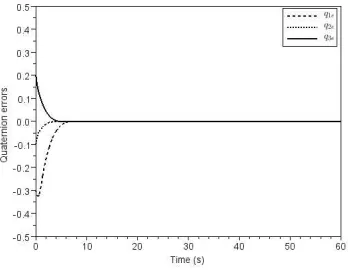
The attitude quaternion tracking errors and angular velocity tracking errors are shown in Figs.1 and 2. It can be seen that the ABSMC scheme (22) gives smoother quaternion and angular velocity tracking errors and fast convergence to zero. From
Fig. 3 it can be seen that the sliding surface s=0
[image:6.595.79.500.84.720.2]is reached after 10 seconds. As shown in Fig. 4, the ABSMC scheme (22) provides smoother response of control torques.
[image:6.595.312.484.306.450.2]Figure 1: Quaternion tracking errors under (22).
Figure 2: Angular velocity errors under (22).
[image:6.595.315.485.493.626.2]Figure 3: Switching function under (22).
Figure 4: Control torques under (22).
6. CONCLUSIONS
[image:6.595.95.269.539.674.2]quaternion-based spacecraft-attitude-tracking maneuvers. Using the Lyapunov stability theory and adaptive backstepping design we prove that the error dynamics asymptotically converge to the origin. Numerical simulations are also given to demonstrate the performance of the proposed control law.
7. ACKNOWLEDGMENTS
This research was funded by King Mongkut’s University of Technology North Bangkok. Contract no. KMUTNB-GEN-56-16.
.
REFRENCES:
[1] S.M. Joshi, A. G. Kelkar and J. T. –Y. Wen, “Robust attitude stabilization of spacecraft using nonlinear quaternion feedback”, IEEE
Transactions on Automatic Control, vol. 40,
No. 10, pp. 1800 – 1803, 1995.
[2] W.Cai, X.H. Liao and Y. D. Song, “Indirect robust adaptive fault-tolerant control of attitude tracking of spacecraft”, Journal of
Guidance, Control and Dynamics, vol. 31, no.
5, pp. 1456 – 1469, 2008.
[3] F.K. Yeh, “Sliding mode adaptive attitude controller design for spacecraft with thruster”,
IET Control Theory and Applications, vol. 4,
no. 7, pp. 1254-1264, 2010.
[4] Z. Chen and J. Huang, “Attitude tracking and disturbance rejection of rigid spacecraft by
adaptive control”, IEEE Transactions on
Automatic Control, vol. 54, no. 3, pp.
600-605, 2009.
[5] H. Anton, J. de Ruiter, “Adaptive spacecraft attitude tracking with actuator saturation”,
Journal of Guidance, Control and Dynamics,
vol. 33, no.5, pp.1692-1695, 2010.
[6] J. D. Boskovic, S.M. Li and M.K. Mehra, “Robust adaptive variable structure control of
spacecraft under input saturation”, Journal of
Guidance Control and Dynamics, vol. 24, no.
1, pp. 14-22, 2001.
[7] K. Lu, Y. Xia, Z. Zhu, and M. V. Basin, “Sliding mode attitude tracking of rigid spacecraft with
disturbance”, Journal of the Franklin
Institute, vol.349, pp. 413-440, 2012.
[8] B. T. Costic, D. M. Dawson, M. S. de Queiroz and V. Kapila, “Quaternion based Attitude
tracking control without velocity
measurments”, In Proceedings of the 39th
IEEE Conference on Decision and Control,
Sydney, Australia, December, 2000.
[9] H. Wong, M. S. de Queiroz and V. Kapila, “Adaptive tracking control using synthesized
velocity from attitude measurements”,
Automatica, vol. 37, no. 6, pp.947-953, 2001.
[10] L. Show, J.Juang and Y. Jan, “An LMI-based
nonlinear attitude control approach”, IEEE
Trans. on Control Systems Technology, vol.
11, no. 1, pp.73-83, 2003.
[11] F. Lizarralde and J. Wen, “Attitude control without angular velocity measurement: a
passivity approach”, IEEE Transactions on
Automatic Control, vol.41, no. 3, pp. 468-472,
1996.
[12] P. Pisu and A. Serrani, “Attitude tracking with adaptive rejection of rate gyrodisturbances”,
IEEE transactions on automatic control, vol.
52, no. 12, pp.2374-2379, 2007.
[13] A. Zou, and K. D. Kumar, “Adaptive fuzzy fault-tolerant attitude control of spacecraft”,
Control Engineering Practice, vol. 19, no.1,
pp.10-21, 2011.
[14] V.I. Utkin, Sliding Modes in Control and Optimization, Springer, Berlin, 1992.
[15] J. Erdong and S. Zhaowei, “Robust controller design with finite time convergence for attitude tracking control”, Aerospace Science
and Technology, vol. 12, pp. 324-330, 2008.
[16] S. Wu, G. Radice, Y. Gao, and Z. Sun, “Quaternion-based finite time control for
spacecraft attitude tracking”, Acta
Astronautica, vol.69, pp. 48-58, 2011.
[17] Z. Man, A. Paplinski, H. Wu, A robust MIMO terminal sliding mode control for rigid
robotuc manipulators, IEEE transactions on
automatic control 39 (1994) 2464-2469.
[18] Y. Feng, X. Yu, Z. Man, Non-singular terminal sliding mode control of rigid manipulators,
Automatica, vol. 38, pp.2159-2167, 2002.
[19] Zhu, Z., Xia, Y. and Fu, M., “Attitude stabilization of rigid spacecraft with
finite-time convergence”, International Journal of
Robust and Nonlinear Control, vol.21, no.6,
pp.1199-1213.
[20] Y. Xia, Z. Zhu, M. Fu and S. Wang, “Attitude tracking of rigid spacecraft with bounded
disturbances”, IEEE Transactions on
Industrial Electronics, vol. 58, no.2,
pp.647-659, 2011.
[21] K. Lu, Y. Xia and M. Fu, “Controller design for rigid spacecraft attitude tracking with actuator
saturation”, Information Science, vol. 220,
ISSN: 1992-8645 www.jatit.org E-ISSN: 1817-3195
[22] M. Krstic, I. Kanellakopoulos and P.
Kokotovic, Nonlinear and Adaptive Control
Design, Wiley, New York, 1995.
[23] C. C. Peng, W.T. Hsue Alber and C. L. Chen, “Variable structure based robust backstepping controller design for nonlinear systems”,
Nonlinear Dynamics, vol.63, no. 1-2,
pp.253-262, 2011.
[24] J. R. Wertz, Spacecraft Attitude Determination
and Control, Kluwer Academic Publishers,
1978.
[25] M. J. Sidi, Spacecraft Dynamics and Control,
Cambridge: Cambridge University Press, 1997.
[26] M. D. Shuster, “A survey of attitude
representations”, The Journal of Astronautical
Sciences, vol. 41, no.4, pp. 439-517, 1993.
[27] C. Pukdeboon, A.S.I. Zinober and M.- W.L. Thein, “Quasi-continuous higher-order sliding mode controllers for spacecraft attitude
tracking manoeuvres”, IEEE Transactions on
Industrial Electronics, vol.57, no. 4,
pp.1436-1444, 2010.
[28] H. Du, S. Li, and C. Qian, “Finite-time attitude tracking control of spacecraft with application to attitude synchronization”, IEEE Trans. on
Automatic Control, vol. 56, no. 11, pp.
2711-2717, 2011.