Development 140, 156-166 (2013) doi:10.1242/dev.084624 © 2013. Published by The Company of Biologists Ltd
INTRODUCTION
During eukaryotic chromosome replication, both genetic and epigenetic information are accurately duplicated, which maintains identical cellular memory through mitoses (Margueron and Reinberg, 2010). DNA replication accompanies chromatin assembly, and the cooperation between these two processes has long been proposed to be important for the mitotic maintenance of epigenetic information (Alabert and Groth, 2012; Ransom et al., 2010; Smith and Whitehouse, 2012).
DNA polymerase α is responsible for initiating replication at both the origins and the lagging strand (Kunkel and Burgers, 2008). In Arabidopsis, the single copy gene INCURVATA2 (ICU2) encodes the catalytic subunit of DNA polymerase α, and transfer DNA (T-DNA)-inserted knockout mutants of ICU2showed a lethal phenotype during gametogenesis and embryogenesis (Barrero et al., 2007). A missense mutation in ICU2, icu2-1, was isolated by the resulting upward curling phenotype of the rosette leaves (Serrano-Cartagena et al., 2000). This mutant exhibits early flowering and homeotic transition of the floral organs, as observed in mutants of Polycomb Repressive Complex 2 (PRC2) (Barrero et al., 2007). Accordingly, certain PRC2 target genes are de-regulated in icu2-1(Barrero et al., 2007). Another missense allele of ICU2, polα, was identified by suppressor mutant screening of the repressor of transcriptional silencing 1 (ros1) (Liu et al., 2010a), which has a defect in the DNA demethylase ROS1 (Gong et al., 2002). The polαmutant exhibited a similar phenotype to icu2-1,
and showed de-repression of some heterochromatic elements in the Arabidopsisgenome, although the DNA methylation levels in the centromeric repeats and transposons were not affected. ICU2 has a genetic relationship with CURLY LEAF (CLF), a SET-domain component of PRC2; LIKE-HETEROCHROMATIN PROTEIN 1 (LHP1), a potential PRC1 component; and FASCIATA1 (FAS1), a chromatin assembly factor (Barrero et al., 2007).
The vernalization response in Arabidopsis thaliana is an example of the mitotic inheritance of histone marks in plants (Kim et al., 2009). Vernalization is the acquisition of floral competence through exposure to prolonged cold in winter. In Arabidopsis, the two strong floral repressors FRIGIDA (FRI) and FLOWERING LOCUS C (FLC) synergistically interact to cause late flowering (Shindo et al., 2005). FRIinduces the expression of FLC, and the resulting high level of FLC inhibits floral induction. However, vernalization induces the downregulation of FLC, and this repression is mitotically remembered until reproduction, even after a return to warm conditions (Choi et al., 2009; Kim et al., 2009; Sheldon et al., 2008). As a result, plants exposed to long-term cold treatment undergo the transition to flowering.
Covalent histone modifications at the FLCgenomic region is a key process for maintaining FLCrepression (Kim et al., 2009). During vernalization, FLC repression is initiated by VERNALIZATION INSENSITIVE 3 (VIN3) through the deacetylation of histone H3. Simultaneously, VERNALIZATION2 (VRN2)-PRC2 deposits H3K27me3 at the FLCregion (De Lucia et al., 2008; Finnegan and Dennis, 2007; Sung and Amasino, 2004; Wood et al., 2006). The accumulation of H3K27me3 results in the stable repression of FLC. Accordingly, a loss-of-function vrn2 mutant normally shows a downregulation of FLC during vernalization. However, the mutant fails to accumulate H3K27me3, so FLC is de-repressed when the vrn2 plants return to warm conditions (Gendall et al., 2001). Remarkably, the H3K27me3 mark is inherited and propagated to nearby histones in the FLC 1Department of Biological Sciences, Seoul National University, Seoul, 151-742,
Korea. 2Section of Molecular Cell and Developmental Biology and Institute for
Cellular and Molecular Biology, University of Texas at Austin, TX 78712, USA. 3Plant
Genomics and Breeding Institute, Seoul National University, Seoul 151-747, Korea.
*Author for correspondence ([email protected])
Accepted 7 October 2012 SUMMARY
Mitotic inheritance of identical cellular memory is crucial for development in multicellular organisms. The cell type-specific epigenetic state should be correctly duplicated upon DNA replication to maintain cellular memory during tissue and organ development. Although a role of DNA replication machinery in maintenance of epigenetic memory has been proposed, technical limitations have prevented characterization of the process in detail. Here, we show that INCURVATA2 (ICU2), the catalytic subunit of DNA polymerase ain Arabidopsis, ensures the stable maintenance of repressive histone modifications. The missense mutant allele icu2-1caused a defect in the mitotic maintenance of vernalization memory. Although neither the recruitment of CURLY LEAF (CLF), a SET-domain component of Polycomb Repressive Complex 2 (PRC2), nor the resultant deposition of the histone mark H3K27me3 required for vernalization-induced FLOWERING LOCUS C (FLC) repression were affected, icu2-1mutants exhibited unstable maintenance of the H3K27me3 level at the FLCregion, which resulted in mosaic FLCde-repression after vernalization. ICU2 maintains the repressive chromatin state at additional PRC2 targets as well as at heterochromatic retroelements. In icu2-1mutants, the subsequent binding of LIKE-HETEROCHROMATIN PROTEIN 1 (LHP1), a functional homolog of PRC1, at PRC2 targets was also reduced. We demonstrated that ICU2 facilitates histone assembly in dividing cells, suggesting a possible mechanism for ICU2-mediated epigenetic maintenance.
KEY WORDS: DNA polymerase a, Epigenetic maintenance, Chromatin assembly
The catalytic subunit of
Arabidopsis
DNA polymerase
a
ensures stable maintenance of histone modification
Youbong Hyun1, Hyein Yun1, Kyunghyuk Park1, Hyonhwa Ohr1, Okchan Lee1, Dong-Hwan Kim2, Sibum Sung2and Yeonhee Choi1,3,*
D
E
V
E
LO
P
M
E
N
region in subsequent warm growing conditions by an unknown mechanism (De Lucia et al., 2008; Finnegan and Dennis, 2007). Therefore, stable inheritance of H3K27me3 and the concomitant FLCsilencing are crucial for the acquisition of floral competence after vernalization.
In this study, we presented new evidence that ICU2 is specifically involved in the maintenance of repressive histone marks during mitoses, but not in the mark deposition on histones, by analyzing the mitotic maintenance of vernalization memory in icu2-1mutants. In addition, the role of ICU2 in silencing diverse chromatin loci and the functional relationship of ICU2 with PRC2 and LHP1 were also examined. Lastly, we identified a possible mechanism for ICU2-mediated epigenetic inheritance by analyzing DNA replication-dependent chromatin assembly in icu2-1mutant plants.
MATERIALS AND METHODS
Plant materials, growing conditions, histochemical GUS staining and microscopy
All plants used in this study originated from the Col-0 background except for the icu2-1(En-2), polα(C24) and clf-2(Ler) mutants. To generate icu2-1 FRIand clf-2 FRI, each mutant allele was introduced into FRI-Col through five backcrosses. The plants were grown in either long-day (16 hour light/8 hour dark) or short-day (8 hour light/16 hour dark) photoperiodic conditions under cool white fluorescent light (100 μmole/m2/s) at 22°C with 60% relative humidity. For the vernalization treatment, seeds or plants grown in soil were incubated at 4°C under short-day conditions. To prepare samples in equivalent developmental stages, seeds of non-vernalized (NV) samples were germinated at 3 days before the end of vernalization treatment of vernalization +21 days warm growth (V+21d) samples. Under our experimental conditions, this condition provided the most equivalent developmental stages between NV and V+21d samples.
-Glucuronidase (GUS) activity in vernalized plants was analyzed by incubation in 50 mM NaPO4(pH 7.0), 1 mM X-Gluc, 1 mM K3Fe(CN)6, 1 mM K4Fe(CN)6, 10 mM EDTA and 0.2% Triton X-100 at 37°C for 8-10 hours. The stained tissues were photographed using an Axio Imager A1 microscope with an AxioCam HRc camera (Carl Zeiss).
Gene expression analysis
Total RNA was extracted from whole seedlings using an RNeasy Plant Mini Kit (Qiagen). After RNase-free DNase (TaKaRa Bio) treatment, 2 μg of total RNA was converted to cDNA using an oligo-dT primer and M-MLV reverse transcriptase (Ambion). Real-time qPCR was performed using a CFX96 Real-Time System (Bio-Rad), and the relative transcript level of each gene was determined by normalization of the resulting expression levels to that of TUB2. The primer sequences for real-time qPCR are listed in the supplementary material Table S1.
Generation of ICU2::GUSconstruct
To generate ICU2::GUSrecombinant DNA, ~1.7 kb of the promoter of ICU2 was cloned by PCR (supplementary material Table S1). The amplified DNA was inserted into a pBI101.1 binary vector (Clontech).
Chromatin immunoprecipitation (ChIP) analysis
ChIP analysis was performed as described previously (Ko et al., 2010) with minor modifications. After chromatin isolation, immunoprecipitation was performed using H3K27me3 (Upstate), H3K4me3 (Upstate), H3K9me2 (Upstate) and GFP (Invitrogen) antibodies. Real-time qPCR was performed, and the relative enrichment of the IP/Input at each genomic region was normalized to that of the ACT7reference genomic locus as described previously (De Lucia et al., 2008).
Generation of anti-CLF antibody
A polyclonal anti-CLF antibody was obtained using a synthesized peptide antigen (390-TNSDKVSSSPKVKG-405; Genscript). Synthesized peptide was conjugated to keyhole limpet hemocyanin (KLH) and immunized in
rabbit by active immunization. The resultant antisera were further purified by affinity purification (Genscript).
Generation of partial ICU2 protein series
To construct a 35S::partial ICU2series, the partial cDNA fragments of ICU2were amplified by PCR as presented in Fig. 5A. The amplified partial ICU2cDNAs were cloned into a binary vector myc-pBA. To examine the phenotypes of the partial ICU2transgenic plants, we analyzed at least 20 independent transgenic lines for each construct.
Yeast two-hybrid analysis
Yeast two-hybrid analysis using the Matchmaker Two-Hybrid system (Clontech) was performed according to the manufacturer’s protocol with minor modifications. Full- and partial-length cDNAs from ICU2and LHP1 were reciprocally cloned into the pGBKT7 bait vector and pGADT7 prey vector in the Matchmaker Two-Hybrid system (Clontech). The constructed recombinant clones were introduced into AH109 yeast cells following the manufacturer’s protocol. Transformed yeast colonies were examined their growth on –Ade/–His/–Leu/–Trp quadruple dropout media to determine interactions.
Bimolecular fluorescence complementation (BiFC) analysis BiFC analysis was performed as described previously (Jeong et al., 2011). Full-length cDNAs from ICU2and LHP1were reciprocally cloned into pSAT4-nEYFP-C1and pSAT4-cEYFP-C1-Bvectors containing the CaMV 35Spromoter. The constructed recombinant clones were introduced into Arabidopsismesophyll protoplasts by polyethylene glycol transfection, as described previously (Yoo et al., 2007). The fluorescence images were photographed and processed using a DV ELITE DeltaVision microscope (Applied Precision).
In vivoco-immunoprecipitation (co-IP) analysis
To generate ICU2::H3.1:GFP, the ICU2promoter used in ICU2::GUS construction was cloned into a pBI101.1 binary vector (Clontech) containing the sGFP coding sequences. Next, the H3.1 cDNA was sequentially inserted in frame with the GFPopen reading frame to generate an ICU2::H3.1:GFPbinary vector. To perform in vivoco-IP analysis with intact chromatin, the nuclear fraction was purified and immunoprecipitated following the same protocol that was used in the ChIP experiment. The input and immunoprecipitated samples were separated on 10% acrylamide SDS-PAGE gel and hybridized with H2B (Abcam), GFP (Invitrogen) and H3 (Abcam) antibodies. After signal detection, the relative band intensity was quantified using ImageJ software (NIH).
RESULTS
Spatiotemporal expression pattern of ICU2
To understand the role of ICU2, we first quantified the spatiotemporal expression pattern of ICU2in Arabidopsis. Our reverse transcription-real-time qPCR (RT-qPCR) results revealed that ICU2is highly expressed in seedlings, inflorescence meristems with floral buds, open flowers and pistils, which all have highly proliferating cells (Fig. 1A,B). We also generated ICU2::GUS transgenic plants and analyzed the GUS expression pattern (Fig. 1C-K). The transgene contains the 1.7 kb promoter region of ICU2before the start codon, and the promoter includes the E2F-binding motif TTTCCCGC, which is characteristic of cell cycle-regulated genes (Chabouté et al., 2000). ICU2::GUSexpression was detected in the shoot apex, young emerging leaves, meristematic zone in root tip, lateral root primordia, young floral buds and ovules in open flowers (Fig. 1C-K). These expression patterns of ICU2 and ICU2::GUS suggest that ICU2 might function in the proliferating tissues of Arabidopsis.
Vernalization memory in icu2-1 FRIpopulation As icu2-1mutants show phenotypes similar to that of the PRC2 mutants, we hypothesized that ICU2 might play a role in
D
E
V
E
LO
P
M
E
N
vernalization memory. To check this, icu2-1 mutation was introduced into a FRI-Col ecotype that requires vernalization for flowering using backcrosses repeated five times. The resultant icu2-1 FRIplants showed an early flowering phenotype under both long-day (LD) and short-day (SD) photoperiod conditions (Fig. 2A; Fig. 4B). In RT-qPCR analysis, we observed a slight downregulation of FLCand the ectopic expression of the floral activator FLOWERING LOCUS T (FT) in icu2-1 FRI(Fig. 2B). These results are consistent with the previous study of icu2-1plants lacking an active FRIgene (Barrero et al., 2007).
To investigate the ICU2 regulation on FLC in vernalization memory, we crossed icu2-1 FRIto the FLC::GUStransgenic plants in FRI-Col background (Choi et al., 2009; Michaels et al., 2005), and the GUSexpression pattern was examined in the FLC::GUS icu2-1 FRIplants. In FRI-Col, vernalization induced FLC::GUS repression, and the repression was maintained until 32 days after vernalization (V+32d) (Fig. 2C,E,F,M,O) as we reported previously (Choi et al., 2009). In non-vernalized (NV) conditions, FLC::GUS was weaker in the icu2-1 FRIplants than in the FRI-Col plants (Fig. 2C,D,M,N). FLC::GUSexpression in the icu2-1 FRIwas effectively repressed in response to vernalization (Fig. 2Q). However, the repression of FLC::GUSwas not maintained in the icu2-1 FRI after vernalization treatment (Fig. 2G-L,P). Surprisingly, the degree of de-repression was variable among individual icu2-1 FRIplants. In addition, the differential defects were also observed even in cell populations or organs (Fig. 2G-L), thereby resulting in a mosaic GUSstaining pattern in the icu2-1 FRIplants. This is similar to a previous result showing the mosaic de-repression of AGAMOUS (AG)::GUSin icu2-1 (Barrero et al., 2007).
To examine the maintenance of endogenous FLCrepression, the FLCexpression was analyzed by RT-qPCR. Efficient repression of FLCwas observed in both FRI-Col and icu2-1 FRIat V+0d and at V+5d, but was partially released at V+10d and V+21d in the icu2-1 FRIplants (Fig. 2Q). Interestingly, a similar partial mosaic de-repression of the silenced loci was also observed in the mutants of
the components of CHROMATIN ASSEMBLY FACTOR-1 (CAF-1), fasciata 1(fas1) and fas2, as well as in brushy 1(bru1), the cooperation factor for CAF-1 (Ono et al., 2006; Ransom et al., 2010; Takeda et al., 2004). Recently, two studies reported that the mosaic FLC::GUSpattern can also be observed in plants that were only vernalized for two weeks, showing that the length of the cold treatment is crucial for a stable FLCrepression (Angel et al., 2011; Satake and Iwasa, 2012). To ensure that our results were not biased by the relatively short vernalization period of 4 weeks, we analyzed FLCexpression in plants vernalized for 8 weeks. In this condition also, icu2-1 FRI showed a defect in the maintenance of FLC repression (Fig. 2Q).
Taken together, we suggest that ICU2is required for the stable maintenance of the mitotic memory of vernalization, and that its defect induces a mosaic de-repression of FLCafter vernalization.
Role of ICU2 in the maintenance of H3K27me3 during mitoses
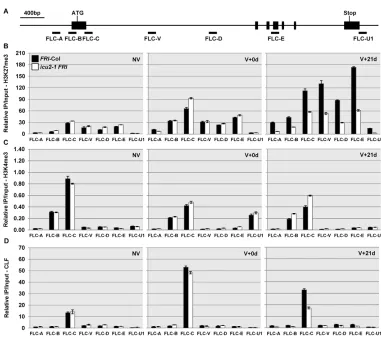
[image:3.612.52.429.58.334.2]To characterize the epigenetic function of ICU2 in vernalization memory, the chromatin state at the FLC genomic region was analyzed by performing a chromatin immunoprecipitation (ChIP) experiment. During cold treatment, H3K27me3 initially accumulates around the transcriptional start region of FLC, and the histone mark is stably inherited and propagated to the gene body region of FLCin subsequent warm conditions (De Lucia et al., 2008; Finnegan and Dennis, 2007). Consistently, we observed H3K27me3 enrichment in the specific start region at V+0d and the subsequent inheritance and propagation of H3K27me3 to the FLC gene body region at V+21d in FRI-Col plants (Fig. 3B). The icu2-1 FRIplants showed specific H3K27me3 enrichment similar to that of FRI-Col plants in response to vernalization (Fig. 3B, V+0d). However, at V+21d, the inheritance and propagation of H3K27me3 failed in icu2-1 FRI plants (Fig. 3B). Consistent with FLC expression (Fig. 2Q), the icu2-1 FRImutants exhibited reduced H3K27me3 level at V+10d, but not at V+5d (supplementary material Fig. S1A,B). Taken together, these results suggest that Fig. 1. Spatiotemporal expression pattern of ICU2. (A) RT-qPCR analysis of ICU2mRNA level in wild-type 10-day-old Arabidopsis seedlings (SD), rosette leaves (RL), cauline leaves (CL), floral bud clusters including inflorescence meristems (FB) and open flowers (OF). (B) RT-qPCR analysis of ICU2 mRNA level in wild-type open flowers (OF), pistils (PI), stamens (ST) and sepals plus petals (SE PE). (C-K) GUS activity in wild-type ICU2::GUS10-day-old seedlings (C), shoot apical meristem regions (D), root tips (E), lateral root meristems (F-I), floral bud clusters (J) and open flowers (K). Error bars indicate s.e.m.
D
E
V
E
LO
P
M
E
N
ICU2 is involved not in the deposition of the histone mark but in the mitotic inheritance of H3K27me3 after vernalization.
To delineate further the chromatin state at FLC region, we analyzed the enrichment of H3K4me3, an active chromatin mark. H3K4me3 was specifically enriched at the transcriptional start region of FLCunder NV conditions (Fig. 3C) (Ko et al., 2010; Pien et al., 2008; Tamada et al., 2009). In response to vernalization, both FRI-Col and icu2-1 FRI plants showed a loss of H3K4me3 enrichment (Fig. 3C, V+0d), consistent with FLCdownregulation (Fig. 2Q). At V+21d, icu2-1 FRI plants showed a greater
accumulation of the H3K4me3 whereas the wild-type plants showed a stable reduction of the mark (Fig. 3C).
[image:4.612.56.455.58.617.2]To understand the molecular mechanism of ICU2 on H3K27me3 inheritance, we examined whether ICU2 mediates the recruitment and/or retention of PRC2. Using an antibody against CLF, a SET-domain component in PRC2 (supplementary material Fig. S1C), we performed ChIP analysis. During cold treatment, CLF was specifically recruited to the region where H3K27me3 initially accumulated in both FRI-Col and icu2-1 FRIplants (Fig. 3B,D, V+0d). The level of CLF was reduced in the FRI-Col plants at Fig. 2. Vernalization memory in icu2-1 FRIpopulation. (A) Early flowering phenotype of icu2-1 FRI. (B) RT-qPCR analysis of FLCand FT mRNA levels in 3-week-old FRI-Col and icu2-1 FRI Arabidopsis seedlings. Error bars indicate s.e.m. (C-P) FLC::GUS expression in FRI-Col and icu2-1 FRIplants before and after vernalization. (C) FLC::GUS FRI -Col in non-vernalized (NV) condition. (D) icu2-1 FLC::GUS FRIin NV condition. (E,F) FLC::GUS FRI-Col in 4 weeks vernalization followed by 10 days further growth at 22°C under LD (V+10d); the shoot apical meristem region in E is enlarged in F. (G-L) Three independent icu2-1 FLC::GUS FRIsiblings at V+10d; their enlarged images are shown in H, J and L. (M) FLC::GUS FRI-Col in NV. (N) icu2-1 FLC::GUS FRIin NV. (O) FLC::GUS FRI-Col at V+32d. (P) icu2-1 FLC::GUS FRI at V+32d. (Q) RT-qPCR analysis of FLCmRNA expression at NV, V+0d and V+21d time points after a 4- or 8-week vernalization. Three biological replicates were performed with similar results. Error bars indicate ±s.e.m. of PCR replicates (n=3).
D
E
V
E
LO
P
M
E
N
V+21d, which is consistent with the previous result that the protein abundance in VRN2-PRC2 components is reduced after vernalization (Wood et al., 2006). However, the enrichment level was still higher than that observed in NV conditions (Fig. 3D), supporting the retention of CLF on FLCafter vernalization (De Lucia et al., 2008; Heo and Sung, 2011). In icu2-1 FRI, the enrichment of CLF was lower than that in FRI-Col only at V+21d (Fig. 3D). This demonstrates that the icu2-1mutation resulted in the failure of CLF retention during cell proliferation after vernalization.
Taking these data together, we suggest that ICU2 is involved not in the establishment of the epigenetic states for the vernalization memory, but in the mitotic maintenance of these states.
Chromatin states at various genomic loci in icu2-1 FRIplants
To determine whether ICU2 is required for general epigenetic maintenance in Arabidopsis, the chromatin states at additional genomic loci were analyzed. We examined two PRC2 target genes, FT and AG, and two heterochromatic retroelements, Transcriptionally Silent Information (TSI) and Ta3. We also explored the chromatin states in the clf-2 knockout mutants to compare biochemical functions of ICU2 and CLF. We introduced an active FRIallele into clf-2knockout mutants by genetic crosses and compared the epigenetic states in icu2-1 FRIplants with those in clf-2 FRIplants.
In RT-qPCR analysis, all of the mutants exhibited ectopic expression of FTand AG(Fig. 4A). In LD conditions, all mutants showed an early flowering phenotype compared with FRI-Col (Fig. 4B). In SD conditions, the delay of flowering is slight in
icu2-1 FRI, whereas the clf-2 FRIplants were still sensitive to the photoperiod conditions (Fig. 4B), implying an additional defect in icu2-1compared with clf-2. The early flowering in icu2-1 FRIwas still observed after vernalization although the mutant showed FLC de-repression (Fig. 2). It is possible that the ectopic expression of FTresulted in the early flowering because the FTis downstream and epistatic to FLCin the floral pathway (Searle et al., 2006). Consistently, the same flowering phenotype was observed in the lhp1-4 mutants showing ectopic FT expression and FLC de-repression after vernalization (Mylne et al., 2006; Sung et al., 2006).
[image:5.612.49.430.54.393.2]To check the H3K27me3 states at FTand AGloci, we performed ChIP analysis. Consistent with the previous study (Turck et al., 2007), our ChIP-qPCR analysis revealed that H3K27me3 is abundant at the 3⬘region of FTand the entire genomic region of AGin FRI-Col (supplementary material Fig. S2). The icu2-1 FRI plants showed a loss of H3K27me3 at both the FTand AGregions (supplementary material Fig. S2), but the reduction in the icu2-1 FRIplants was weaker than that in the clf-2 FRIplants (Fig. 4C), consistent with a defect in H3K27me3 inheritance but not in deposition. Although the H3K27me3 reduction in the clf-2 FRI plants was higher than in the icu2-1 FRI, the FTexpression in the clf-2 FRI was less elevated (Fig. 4A). This can probably be explained by the fact that the clfmutants exhibit increased FLC mRNA levels (Jiang et al., 2008), and that the FTexpression is repressed by FLCin a PRC2-independent manner (Helliwell et al., 2006; Searle et al., 2006). To extend our analysis, we investigated ten additional loci known to be targeted by PRC2 (Lu et al., 2011). In the icu2-1 FRImutant, all the loci showed decreases in the H3K27me3 level (supplementary material Fig. S3).
Fig. 3. Role of ICU2 in mitotic H3K27me3 maintenance and CLF retention. (A) Schematic of the Arabidopsis FLClocus. The exons are represented by black boxes. The location of each PCR amplicon is represented by a black bar. (B-D) ChIP-qPCR analysis at FLCin FRI-Col and icu2-1 FRI plants at NV, V+0d and V+21d time points; the levels of H3K27me3 (B), H3K4me3 (C) and CLF (D) binding are shown. Three biological replicates were performed with similar results. Error bars indicate ±s.e.m. of PCR replicates (n=3).
D
E
V
E
LO
P
M
E
N
In contrast to the repression of PRC2 targets, the silencing of the heterochromatic elements TSIand Ta3was released only in the icu2-1 FRIplants, not in the clf-2 FRIplants (Fig. 4A). Accordingly, H3K9me2, the heterochromatic mark enriched at TSIand Ta3loci, was reduced only in the icu2-1 FRImutants (Fig. 4D).
Conclusively, our results suggest that ICU2 plays a role not only in the repression of PRC2 targets but also in the silencing of retroelements. Moreover, icu2-1 FRI mutant shows epigenetic defects that are not observed in the clf-2 FRImutants.
Relationship between ICU2 and LHP1
In a previous report, an in vitroGST pull-down assay suggested that the C-terminal portion of ICU2 interacts with LHP1, possibly through the putative MIR domain in the protein. In addition, the LHP1:GFP fusion protein was mislocalized in the rosette leaves of icu2-1mutants (Barrero et al., 2007). Therefore, we explored the in vivo biochemical relationship between ICU2 and LHP1 to elucidate the mechanism by which ICU2is involved in epigenetic maintenance.
We first confirmed that icu2-1and polαmutants, both of which have a missense mutation near the putative MIR domain, showed similar epigenetic defects (supplementary material Fig. S4). However, we did not observe the reduction of FLCand the de-repression of Ta3in NV conditions in the polαmutants. Similarly, the polαmutation caused milder defects in flowering time and FLC expression in the FRI-Col background under NV conditions (our unpublished data). Although these results imply that polα is a weaker mutant allele than icu2-1, the same defects in both mutants still suggest the importance of MIR domain for ICU2 function. To investigate the function of the MIR domain, we generated transgenic plants that overexpress partial ICU2 proteins under the 35S promoter. We observed that only the overexpression of transgenes with a C-terminus that includes the MIR domain phenocopied the icu2-1 FRImutants, displaying, for example, early flowering and the de-repression of FTand AG(Fig. 5A-C). This raises the possibility that overexpression of the MIR-containing partial domain of ICU2 sequesters the ICU2-interacting partners for epigenetic maintenance, thereby preventing endogenous ICU2 protein from functioning in this process.
To test whether ICU2 interacts with LHP1 through the putative MIR domain, we performed a yeast two-hybrid analysis
using both full- and partial-length ICU2 proteins. In our results, the interaction between ICU2 and LHP1 was not observed in any of the combinations (Fig. 5D). To analyze further the interaction between ICU2 and LHP1 in planta, a bimolecular fluorescence complementation (BiFC) assay was also performed using protoplasts from Arabidopsis mesophyll cells. Although the interaction between the F-box protein UCL1 and CLF was observed as previously reported (Jeong et al., 2011), we failed to detect any reconstituted YFP fluorescence from ICU2 and LHP1 reciprocal combinations in our experimental conditions (Fig. 5E). Therefore, our yeast two-hybrid assay and BiFC results do not support a direct interaction between ICU2 and LHP1.
LHP1 is known to be colocalized with H3K27me3 in the Arabidopsisgenome (Exner et al., 2009; Turck et al., 2007; Zhang et al., 2007). Our study also revealed that icu2-1FRIresulted in the reduction of H3K27me3 at the PRC2 target loci (Fig. 4; supplementary material Fig. S3). These results raise the possibility that the retention of LHP1 on PRC2 targets is also reduced by the icu2-1mutation, which is consistent with previous cytological results (Barrero et al., 2007). To examine the retention of the LHP1:GFP fusion protein at its target loci, we generated icu2-1 LHP1:GFP lhp1-4plants from a genetic cross between icu2-1and LHP1:GFP lhp1-4plants, which fully rescued the lhp1-4knockout mutant phenotypes (Sung et al., 2006). The ChIP-qPCR results demonstrated that icu2-1 caused a reduced accumulation of LHP1:GFP at its binding loci, FT and AG (Fig. 5F,G). Taken together, our data suggest that ICU2 and LHP1 do not interact directly in vivo, but that icu2-1causes loss of LHP1 binding at its target loci in Arabidopsis.
Role of ICU2 in H3.1 inheritance and incorporation in proliferating tissues
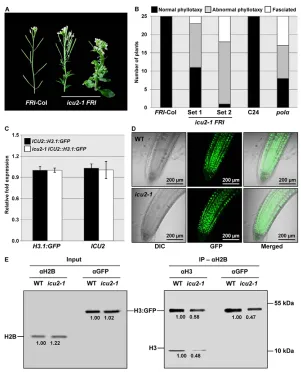
[image:6.612.50.386.59.272.2]We suggested that icu2-1 mutants share distinctive epigenetic defects, such as the mosaic de-repression of silenced loci and the de-repression of both PRC2 targets and retroelements, with the knockout mutants of chromatin assembly factors FAS1, FAS2and BRU1(Figs 2, 4) (Ono et al., 2006; Takeda et al., 2004). Abnormal phyllotaxy and fasciation of stems, a typical phenotype of fas1, fas2and bru1mutants, were also observed in both icu2-1 FRIand polα mutants (Fig. 6A; supplementary material Fig. S4C). As
Fig. 4. Loss of epigenetic states at various genomic loci in icu2-1 FRI.(A) RT-qPCR analysis of FT, AG, TSIand Ta3mRNA levels.
(B) Photoperiod sensitivity in flowering in Arabidopsis. FRI-Col did not flower under short day photoperiod conditions in our study. Arrow indicates no flowering of FRI-Col in SD conditions. (C) Levels of H3K27me3 at FTand AGchromatin. (D) Levels of H3K9me2 at TSIand Ta3chromatin. The location of each PCR amplicon is represented in supplementary material Fig. S2A. All of the samples were obtained at the 21-day-old seedlings grown under NV+LD. Three biological replicates were performed with similar results. Error bars indicate ±s.e.m. of PCR replicates (n=3).
D
E
V
E
LO
P
M
E
N
reported in bru1mutants, the degree of abnormal phyllotaxy and fasciation varies between individual plants and even between neighboring branches of the same plant (Fig. 6B). Therefore, these
[image:7.612.54.506.58.587.2]aspects led us to examine whether chromatin assembly upon DNA replication is affected by icu2-1, which could explain various epigenetic defects in the mutant.
Fig. 5. Biochemical interaction between ICU2 and LHP1.(A) Schematic of full- and partial-length ICU2 proteins. (B) Recapitulation of icu2-1 phenotype by overexpression of partial-length ICU2 possessing the MIR domain. (C) RT-qPCR analysis of FTand AGmRNA levels in partial-length ICU2overexpressors. (D) Interaction test between full- and partial-length ICU2 and LHP1 in a yeast two-hybrid assay. The combination for the interaction assay is presented in the bottom panel. AD-T + BD-p53 and AD + BD were used as positive and negative interaction controls, respectively. –Ade/–His/–Leu/–Trp, quadruple (adenine, histidine, leucine and tryptophan) dropout media; –Leu/–Trp, double (leucine and tryptophan) dropout media; AD, GAL4 activation domain; BD, GAL4-binding domain. (E) BiFC assay of protein-protein interaction of ICU2 and LHP1 in Arabidopsisprotoplasts. Deconvoluted images of protoplasts are shown. The 35S::GFPconstruct was used as a transfection control, and the binding of CLF and UCL1 was used as a positive control for BiFC. Scale bars: 10 mm. (F,G) Retention of LHP1:GFP on FT(F) and AG(G) chromatin in 21-day-old seedlings grown under NV+LD conditions. Two biological replicates were performed with similar results. Error bars indicate ±s.e.m. of PCR replicates (n=3).
D
E
V
E
LO
P
M
E
N
To analyze this impact, an ICU2::H3.1:GFP construct was transformed into icu2-1/+heterozygous plants, and wild-type and icu2-1siblings showing the same expression levels of the transgene were isolated (Fig. 6C). The canonical histone variant H3.1 is known to be incorporated into nucleosomes in a DNA replication-dependent manner (Ransom et al., 2010), and it is more enriched at genomic regions with a low transcription rate in Arabidopsis (Stroud et al., 2012). A previous study suggested that the H3.1:GFP fusion protein behaves similarly to the endogenous H3.1 in Arabidopsis(Ingouff et al., 2010). As seen in our ICU2::GUS analysis (Fig. 1), ICU2::H3.1:GFP showed strong GFP fluorescence in proliferating tissues (supplementary material Fig. S5A-C). This GFP pattern is similar to the fluorescence pattern of 5-ethynyl-2⬘-deoxyuridine (EdU), a chemical used for S-phase cell cycle-specific detection (Kotogány et al., 2010). We could also observe H3.1:GFP fluorescence at the segregating chromosomes in dividing root cells (supplementary material Fig. S5D-G), suggesting efficient incorporation of the fusion protein during DNA replication. No significant difference was observed in the subcellular localization of H3.1:GFP between wild-type and icu2-1 siblings (Fig. 6D), and H3.1:GFP was also observed at the segregating chromosomes of icu2-1 root cells (supplementary material Fig. S5H), suggesting that the intrinsic biochemical feature of H3.1:GFP is not likely to be altered in icu2-1 mutants. Therefore, ICU2::H3.1:GFPcan provide a tool to examine the DNA replication-dependent chromatin assembly in Arabidopsis proliferating tissues.
[image:8.612.48.349.57.429.2]Next, we compared the association of H3.1:GFP in assembled chromatin in wild-type and icu2-1plants with an in vivo co-immunoprecipitation (co-IP) analysis using an antibody against histone H2B (αH2B). Because the histone octamer is formed after the binding of two molecules of an H2A-H2B dimer to an H3.1-H4 tetramer at the DNA replication fork, an IP with αH2B should purify the assembled histone octamer as well as any free H2A-H2B dimers not incorporated in nucleosomes. The co-IP experiment demonstrated that H3.1:GFP was efficiently associated with H2B in the nuclear fractions from wild-type siblings (Fig. 6E). By contrast, we found that the association of H3.1:GFP and endogenous H3 was reduced in the icu2-1nuclear fraction (Fig. 6E), suggesting that the icu2-1mutation resulted in inefficient chromatin assembly in proliferating tissues. We also examined nucleosome density in the ChIP experiment using an H3 antibody. In the icu2-1 mutant, less DNA was immunoprecipitated at ACT7, FT, AG, FLCand TSIloci with a similar reduction ratio (supplementary material Fig. S5I). However, the ratio between the histones with or without trimethylation at K27 was specifically reduced at FTand AGloci in NV conditions (supplementary material Fig. S5J), suggesting that low nucleosome density is not the technical reason for the reduced H3K27me3 levels observed at those loci. Combining these findings with the observed epigenetic defects in chromatin assembly factor mutants, we suggest that ICU2 facilitates chromatin assembly and ensures stable maintenance of repressive histone marks in dividing cells.
Fig. 6. Role of ICU2 in chromatin assembly in proliferating tissues.(A) Abnormal phyllotaxy and fasciation of stems in icu2-1 FRI. Primary shoots from two independent icu2-1 FRIplants showing the defects are presented. (B) Ratio of shoot defects in icu2-1 FRIand polapopulations. The numbers of plants with normal shoot, abnormal phyllotaxy and fasciated shoot in two independent icu2-1 FRIpopulations and one pol population are presented. (C) RT-qPCR analysis of H3.1:GFPand ICU2in ICU2::H3.1:GFPwild-type and icu2-1siblings. Error bars indicate s.e.m. (D) Confocal microscopy GFP images of root tips from ICU2::H3.1:GFP wild-type and icu2-1siblings. (E) In vivoco-IP analysis of H3.1:GFP with H2B in ICU2::H3.1:GFPwild-type and icu2-1siblings. The relative band intensity was quantified using ImageJ software and is indicated under each immunodetected band. The band intensity of the wild-type sample was set to 1. Two biological replicates were performed with similar results in two independent transgenic lines.
D
E
V
E
LO
P
M
E
N
DISCUSSION
Epigenetic inheritance during DNA replication is crucial for the maintenance of identical cellular memory (Margueron and Reinberg, 2010). In this study, we elucidated a role of ICU2, the catalytic subunit of DNA polymerase α, in the maintenance of repressive chromatin states in Arabidopsis.
Loss of epigenetic memory in icu2-1 mutants during mitoses
During vernalization, the PHD-PRC2 complex deposits H3K27me3 on the FLClocus, which is crucial for establishment of FLCsilencing (Kim et al., 2009). For stable FLCrepression after vernalization, which is known to be impaired in mitotically quiescent cells (Finnegan and Dennis, 2007), the H3K27me3 has to be correctly inherited upon DNA replication in subsequent mitoses. Recently, a transiently expressed long noncoding RNA, known as COLDAIR, was identified; this RNA recruits CLF to the FLC region during cold treatment (Heo and Sung, 2011). Interestingly, CLF remains in association with the FLCregion in the absence of COLDAIR even after vernalization (Fig. 3D) (De Lucia et al., 2008; Heo and Sung, 2011). In animals, PRC2 associates with its target DNA loci through replication (Hansen et al., 2008; Margueron et al., 2009; Margueron and Reinberg, 2010; Petruk et al., 2012). These findings indicate that the retention of PRC2 at its targets could be the mechanism for the mitotic maintenance of H3K27me3 enrichment. Although we could not examine the retention of SWINGER (SWN), a major SET-domain component in PHD-PRC2 for vernalization (De Lucia et al., 2008; Heo and Sung, 2011), owing to a lack of antibody, our study suggested that ICU2 is involved in retention of the PRC2 complex. However, in Arabidopsis, GFP:CLF fusion proteins were not detected in the segregating chromosomes in the dividing root cells (Schubert et al., 2006), suggesting that the PRC2 complex could act differently upon DNA replication in animals and plants. It is possible that ICU2 mediates the retention of PRC2 through unknown factors that re-recruit the complex after cell division at the PRC2 target loci. Interestingly, the C-terminal domain of ICU2, which includes the putative MIR motif, is important for the epigenetic function of the protein (Fig. 5A-C). Protein complexes interacting with the C-terminal portion of ICU2 could be the factors for the retention of PRC2 in Arabidopsis. In addition to the H3K27me3 maintenance, propagation of H3K27me3 to the gene body region of FLCwas also impaired in the icu2-1 FRImutants (Fig. 3B). As the icu2-1 FRI mutants showed defects in the retention of CLF, the failure of the histone mark propagation could be caused by a reduced level of PRC2 complexes at the FLClocus. However, it is also possible that ICU2 could mediate the activation or the recruitment of additional factors for the histone mark propagation during mitoses.
Roles of ICU2 that are independent to functions of PRC2 and LHP1
A previous study identified that knockout mutants of the PRC2 complex show slight upregulation of FLCin NV conditions (Jiang et al., 2008). However, in the icu2-1 FRIplants, the expression of FLCand FLC::GUSwere reduced (Fig. 2). If the icu2-1mutation induces the epigenetic defect only in PRC2- and H3K27me3-mediated gene regulation, the mutant should show increased expression of FLC in NV conditions. In this study, we characterized the defects in icu2-1 FRI plants, such as the low sensitivity in photoperiodic flowering and the release of heterochromatic loci, that were not observed in clf-2 FRIplants.
These findings suggest that there should be additional epigenetic defects in the icu2-1 mutants that are not related with the functions of PRC2. As diverse epigenetic mechanisms for FLCregulation have been characterized so far (Kim et al., 2009), those defects could result in the downregulation of FLCin NV conditions.
In the fission yeast Saccharomyces pombe, the DNA polymerase α catalytic subunit Swi7 binds to the HP1 homolog Swi6, and a missense mutation in Swi7 inducing the failure of the interaction with Swi6 resulted in the de-repression of heterochromatin loci (Ahmed et al., 2001; Nakayama et al., 2001), further supporting additional roles of ICU2 that are not related with PRC2 functions. Although LHP1 has been isolated as a homolog of HP1 in Arabidopsis, we could not detect a direct interaction between ICU2 and LHP1 (Fig. 5D,E). Diverse studies have suggested that the epigenetic function of LHP1 is limited to H3K27me3-mediated epigenetic gene regulation (Lindroth et al., 2004). LHP1 is not likely to be the interaction partner of ICU2 for heterochromatin maintenance. However, in icu2-1 mutants, the retention of the LHP1:GFP fusion protein at the FTand AGregions was impaired (Fig. 5F,G). As LHP1 is known to be colocalized with the H3K27me3 mark (Exner et al., 2009; Turck et al., 2007; Zhang et al., 2007), the loss of LHP1:GFP retention in the icu2-1mutants could be caused by a reduction of H3K27me3 levels at those loci.
Roles of DNA replication machinery in epigenetic maintenance
The DNA polymerase α complex, including the primase subunit, initiates DNA replication by the synthesis of a primer at the replication fork. Replication factor C (RFC) binds to the DNA at the template-primer junctions and displaces DNA polymerase α. The binding of RFC to DNA creates a loading site for recruitment of proliferating cell nuclear antigen (PCNA) complexes. PCNA then acts as a scaffold for recruiting histone modification enzymes and chromatin assembly factors (Majka and Burgers, 2004; Petruk et al., 2012; Ransom et al., 2010). In this study, we suggested that the icu2-1and polαmutants share distinctive epigenetic defects with the knockout mutants of chromatin assembly factors in Arabidopsis(Figs 2, 4; supplementary material Fig. S4) (Kaya et al., 2001; Kirik et al., 2006; Ono et al., 2006; Takeda et al., 2004). In addition, inefficient chromatin assembly in proliferation tissues was observed in the icu2-1 mutants (Fig. 6). Although the direct relationship between ICU2 and the chromatin assembly factors has yet to be identified, our results suggest that ICU2 could facilitate chromatin assembly at the replication fork through a direct or indirect biochemical relationship with those factors. Consistent with this possibility, the catalytic subunit of DNA polymerase α in the budding yeast S. cerevisiae has been reported to form a complex with SPT16, a subunit of the FACT chromatin assembly factor (Wittmeyer and Formosa, 1997). Fortunately, many recent reports have characterized diverse epigenetic defects in Arabidopsis and mammals with mutations in various components of the DNA replication machinery (del Olmo et al., 2010; Liu et al., 2010b; O’Donnell et al., 2010; Xia et al., 2006; Yin et al., 2009). Additional studies that investigate the functional and biochemical relationship between ICU2 and these factors will provide further insights into DNA replication-coupled epigenetic inheritance.
Acknowledgements
We are grateful to José Luis Micol and Zhizhong Gong for providing the icu2-1 and polamutant seeds, respectively. We thank Robert Fischer, Tzung-Fu Heish, Ilha Lee and Ramin Yadegari for their critical reading of this manuscript.
D
E
V
E
LO
P
M
E
N
Funding
This work was supported by the Mid-career Researcher Program through a National Research Foundation of Korea grant funded by the Ministry of Education, Science and Technology (MEST) [2009-0079227 to Y.C.]; a grant from the Next-Generation BioGreen 21 Program (No. PJ009105), Rural Development Administration, Republic of Korea [to Y.C.]; grants from the Brain Korea 21 program [to Y.H.]; and an NSF grant [IOS 0950785 to S.S.].
Competing interests statement
The authors declare no competing financial interests.
Supplementary material
Supplementary material available online at
http://dev.biologists.org/lookup/suppl/doi:10.1242/dev.084624/-/DC1
References
Ahmed, S., Saini, S., Arora, S. and Singh, J.(2001). Chromodomain protein Swi6-mediated role of DNA polymerase alpha in establishment of silencing in fission Yeast. J. Biol. Chem.276, 47814-47821.
Alabert, C. and Groth, A.(2012). Chromatin replication and epigenome maintenance. Nat. Rev. Mol. Cell Biol.13, 153-167.
Angel, A., Song, J., Dean, C. and Howard, M.(2011). A Polycomb-based switch underlying quantitative epigenetic memory. Nature476, 105-108.
Barrero, J. M., González-Bayón, R., del Pozo, J. C., Ponce, M. R. and Micol, J. L.(2007). INCURVATA2 encodes the catalytic subunit of DNA Polymerase alpha and interacts with genes involved in chromatin-mediated cellular memory in Arabidopsis thaliana. Plant Cell19, 2822-2838.
Chabouté, M. E., Clément, B., Sekine, M., Philipps, G. and Chaubet-Gigot, N. (2000). Cell cycle regulation of the tobacco ribonucleotide reductase small subunit gene is mediated by E2F-like elements. Plant Cell12, 1987-2000. Choi, J., Hyun, Y., Kang, M. J., In Yun, H., Yun, J. Y., Lister, C., Dean, C.,
Amasino, R. M., Noh, B., Noh, Y. S. et al.(2009). Resetting and regulation of Flowering Locus C expression during Arabidopsisreproductive development. Plant J.57, 918-931.
De Lucia, F., Crevillen, P., Jones, A. M., Greb, T. and Dean, C.(2008). A PHD-polycomb repressive complex 2 triggers the epigenetic silencing of FLC during vernalization. Proc. Natl. Acad. Sci. USA105, 16831-16836.
del Olmo, I., López-González, L., Martín-Trillo, M. M., Martínez-Zapater, J. M., Piñeiro, M. and Jarillo, J. A.(2010). EARLY IN SHORT DAYS 7 (ESD7) encodes the catalytic subunit of DNA polymerase epsilon and is required for flowering repression through a mechanism involving epigenetic gene silencing. Plant J.61, 623-636.
Exner, V., Aichinger, E., Shu, H., Wildhaber, T., Alfarano, P., Caflisch, A., Gruissem, W., Köhler, C. and Hennig, L.(2009). The chromodomain of LIKE HETEROCHROMATIN PROTEIN 1 is essential for H3K27me3 binding and function during Arabidopsisdevelopment. PLoS ONE4, e5335.
Finnegan, E. J. and Dennis, E. S.(2007). Vernalization-induced trimethylation of histone H3 lysine 27 at FLC is not maintained in mitotically quiescent cells. Curr. Biol.17, 1978-1983.
Gendall, A. R., Levy, Y. Y., Wilson, A. and Dean, C.(2001). The VERNALIZATION 2 gene mediates the epigenetic regulation of vernalization in Arabidopsis. Cell 107, 525-535.
Gong, Z., Morales-Ruiz, T., Ariza, R. R., Roldán-Arjona, T., David, L. and Zhu, J. K.(2002). ROS1, a repressor of transcriptional gene silencing in Arabidopsis, encodes a DNA glycosylase/lyase. Cell111, 803-814.
Hansen, K. H., Bracken, A. P., Pasini, D., Dietrich, N., Gehani, S. S., Monrad, A., Rappsilber, J., Lerdrup, M. and Helin, K.(2008). A model for transmission of the H3K27me3 epigenetic mark. Nat. Cell Biol.10, 1291-1300.
Helliwell, C. A., Wood, C. C., Robertson, M., James Peacock, W. and Dennis, E. S.(2006). The ArabidopsisFLC protein interacts directly in vivowith SOC1 and FT chromatin and is part of a high-molecular-weight protein complex. Plant J.46, 183-192.
Heo, J. B. and Sung, S.(2011). Vernalization-mediated epigenetic silencing by a long intronic noncoding RNA. Science331, 76-79.
Ingouff, M., Rademacher, S., Holec, S., Solji , L., Xin, N., Readshaw, A., Foo, S. H., Lahouze, B., Sprunck, S. and Berger, F.(2010). Zygotic resetting of the HISTONE 3 variant repertoire participates in epigenetic reprogramming in Arabidopsis. Curr. Biol.20, 2137-2143.
Jeong, C. W., Roh, H., Dang, T. V., Choi, Y. D., Fischer, R. L., Lee, J. S. and Choi, Y.(2011). An E3 ligase complex regulates SET-domain polycomb group protein activity in Arabidopsis thaliana. Proc. Natl. Acad. Sci. USA108, 8036-8041. Jiang, D., Wang, Y., Wang, Y. and He, Y.(2008). Repression of FLOWERING
LOCUS C and FLOWERING LOCUS T by the ArabidopsisPolycomb repressive complex 2 components. PLoS ONE3, e3404.
Kaya, H., Shibahara, K. I., Taoka, K. I., Iwabuchi, M., Stillman, B. and Araki, T.(2001). FASCIATA genes for chromatin assembly factor-1 in Arabidopsis maintain the cellular organization of apical meristems. Cell104, 131-142.
Kim, D. H., Doyle, M. R., Sung, S. and Amasino, R. M.(2009). Vernalization: winter and the timing of flowering in plants. Annu. Rev. Cell Dev. Biol.25, 277-299.
Kirik, A., Pecinka, A., Wendeler, E. and Reiss, B.(2006). The chromatin assembly factor subunit FASCIATA1 is involved in homologous recombination in plants. Plant Cell18, 2431-2442.
Ko, J. H., Mitina, I., Tamada, Y., Hyun, Y., Choi, Y., Amasino, R. M., Noh, B. and Noh, Y. S.(2010). Growth habit determination by the balance of histone methylation activities in Arabidopsis. EMBO J.29, 3208-3215.
Kotogány, E., Dudits, D., Horváth, G. V. and Ayaydin, F.(2010). A rapid and robust assay for detection of S-phase cell cycle progression in plant cells and tissues by using ethynyl deoxyuridine. Plant Methods6, 5.
Kunkel, T. A. and Burgers, P. M.(2008). Dividing the workload at a eukaryotic replication fork. Trends Cell Biol.18, 521-527.
Lindroth, A. M., Shultis, D., Jasencakova, Z., Fuchs, J., Johnson, L., Schubert, D., Patnaik, D., Pradhan, S., Goodrich, J., Schubert, I. et al.(2004). Dual histone H3 methylation marks at lysines 9 and 27 required for interaction with CHROMOMETHYLASE3. EMBO J.23, 4146-4155.
Liu, J., Ren, X., Yin, H., Wang, Y., Xia, R., Wang, Y. and Gong, Z.(2010a). Mutation in the catalytic subunit of DNA polymerase alpha influences transcriptional gene silencing and homologous recombination in Arabidopsis. Plant J.61, 36-45.
Liu, Q., Wang, J., Miki, D., Xia, R., Yu, W., He, J., Zheng, Z., Zhu, J. K. and Gong, Z.(2010b). DNA replication factor C1 mediates genomic stability and transcriptional gene silencing in Arabidopsis. Plant Cell22, 2336-2352. Lu, F., Cui, X., Zhang, S., Jenuwein, T. and Cao, X.(2011). ArabidopsisREF6 is a
histone H3 lysine 27 demethylase. Nat. Genet.43, 715-719.
Majka, J. and Burgers, P. M.(2004). The PCNA-RFC families of DNA clamps and clamp loaders. Prog. Nucleic Acid Res. Mol. Biol.78, 227-260.
Margueron, R. and Reinberg, D.(2010). Chromatin structure and the inheritance of epigenetic information. Nat. Rev. Genet.11, 285-296. Margueron, R., Justin, N., Ohno, K., Sharpe, M. L., Son, J., Drury, W. J., 3rd,
Voigt, P., Martin, S. R., Taylor, W. R., De Marco, V. et al.(2009). Role of the polycomb protein EED in the propagation of repressive histone marks. Nature 461, 762-767.
Michaels, S. D., Himelblau, E., Kim, S. Y., Schomburg, F. M. and Amasino, R. M.(2005). Integration of flowering signals in winter-annual Arabidopsis. Plant Physiol.137, 149-156.
Mylne, J. S., Barrett, L., Tessadori, F., Mesnage, S., Johnson, L.,
Bernatavichute, Y. V., Jacobsen, S. E., Fransz, P. and Dean, C.(2006). LHP1, the Arabidopsishomologue of HETEROCHROMATIN PROTEIN1, is required for epigenetic silencing of FLC. Proc. Natl. Acad. Sci. USA103, 5012-5017. Nakayama, J., Allshire, R. C., Klar, A. J. and Grewal, S. I.(2001). A role for
DNA polymerase alpha in epigenetic control of transcriptional silencing in fission yeast. EMBO J.20, 2857-2866.
O’Donnell, L., Panier, S., Wildenhain, J., Tkach, J. M., Al-Hakim, A., Landry, M. C., Escribano-Diaz, C., Szilard, R. K., Young, J. T., Munro, M. et al. (2010). The MMS22L-TONSL complex mediates recovery from replication stress and homologous recombination. Mol. Cell40, 619-631.
Ono, T., Kaya, H., Takeda, S., Abe, M., Ogawa, Y., Kato, M., Kakutani, T., Mittelsten Scheid, O., Araki, T. and Shibahara, K.(2006). Chromatin assembly factor 1 ensures the stable maintenance of silent chromatin states in Arabidopsis. Genes Cells11, 153-162.
Petruk, S., Sedkov, Y., Johnston, D. M., Hodgson, J. W., Black, K. L., Kovermann, S. K., Beck, S., Canaani, E., Brock, H. W. and Mazo, A.(2012). TrxG and PcG proteins but not methylated histones remain associated with DNA through replication. Cell150, 922-933.
Pien, S., Fleury, D., Mylne, J. S., Crevillen, P., Inzé, D., Avramova, Z., Dean, C. and Grossniklaus, U.(2008). ARABIDOPSISTRITHORAX1 dynamically regulates FLOWERING LOCUS C activation via histone 3 lysine 4 trimethylation. Plant Cell 20, 580-588.
Ransom, M., Dennehey, B. K. and Tyler, J. K.(2010). Chaperoning histones during DNA replication and repair. Cell140, 183-195.
Satake, A. and Iwasa, Y.(2012). A stochastic model of chromatin modification: cell population coding of winter memory in plants. J. Theor. Biol.302, 6-17. Schubert, D., Primavesi, L., Bishopp, A., Roberts, G., Doonan, J., Jenuwein,
T. and Goodrich, J.(2006). Silencing by plant Polycomb-group genes requires dispersed trimethylation of histone H3 at lysine 27. EMBO J.25, 4638-4649. Searle, I., He, Y., Turck, F., Vincent, C., Fornara, F., Kröber, S., Amasino, R. A.
and Coupland, G.(2006). The transcription factor FLC confers a flowering response to vernalization by repressing meristem competence and systemic signaling in Arabidopsis. Genes Dev.20, 898-912.
Serrano-Cartagena, J., Candela, H., Robles, P., Ponce, M. R., Pérez-Pérez, J. M., Piqueras, P. and Micol, J. L.(2000). Genetic analysis of incurvata mutants reveals three independent genetic operations at work in Arabidopsisleaf morphogenesis. Genetics156, 1363-1377.
Sheldon, C. C., Hills, M. J., Lister, C., Dean, C., Dennis, E. S. and Peacock, W. J.(2008). Resetting of FLOWERING LOCUS C expression after epigenetic
repression by vernalization. Proc. Natl. Acad. Sci. USA105, 2214-2219.
D
Shindo, C., Aranzana, M. J., Lister, C., Baxter, C., Nicholls, C., Nordborg, M. and Dean, C.(2005). Role of FRIGIDA and FLOWERING LOCUS C in
determining variation in flowering time of Arabidopsis. Plant Physiol.138, 1163-1173.
Smith, D. J. and Whitehouse, I.(2012). Intrinsic coupling of lagging-strand synthesis to chromatin assembly. Nature483, 434-438.
Stroud, H., Otero, S., Desvoyes, B., Ramírez-Parra, E., Jacobsen, S. E. and Gutierrez, C.(2012). Genome-wide analysis of histone H3.1 and H3.3 variants in Arabidopsis thaliana. Proc. Natl. Acad. Sci. USA109, 5370-5375.
Sung, S. and Amasino, R. M.(2004). Vernalization in Arabidopsis thalianais mediated by the PHD finger protein VIN3. Nature427, 159-164. Sung, S., He, Y., Eshoo, T. W., Tamada, Y., Johnson, L., Nakahigashi, K.,
Goto, K., Jacobsen, S. E. and Amasino, R. M.(2006). Epigenetic maintenance of the vernalized state in Arabidopsis thalianarequires LIKE HETEROCHROMATIN PROTEIN 1. Nat. Genet.38, 706-710.
Takeda, S., Tadele, Z., Hofmann, I., Probst, A. V., Angelis, K. J., Kaya, H., Araki, T., Mengiste, T., Mittelsten Scheid, O., Shibahara, K. et al.(2004). BRU1, a novel link between responses to DNA damage and epigenetic gene silencing in Arabidopsis. Genes Dev.18, 782-793.
Tamada, Y., Yun, J. Y., Woo, S. C. and Amasino, R. M.(2009). ARABIDOPSIS TRITHORAX-RELATED7 is required for methylation of lysine 4 of histone H3 and for transcriptional activation of FLOWERING LOCUS C. Plant Cell21, 3257-3269. Turck, F., Roudier, F., Farrona, S., Martin-Magniette, M. L., Guillaume, E.,
Buisine, N., Gagnot, S., Martienssen, R. A., Coupland, G. and Colot, V.
(2007). ArabidopsisTFL2/LHP1 specifically associates with genes marked by trimethylation of histone H3 lysine 27. PLoS Genet.3, e86.
Wittmeyer, J. and Formosa, T.(1997). The Saccharomyces cerevisiae DNA polymerase alpha catalytic subunit interacts with Cdc68/Spt16 and with Pob3, a protein similar to an HMG1-like protein. Mol. Cell. Biol.17, 4178-4190. Wood, C. C., Robertson, M., Tanner, G., Peacock, W. J., Dennis, E. S. and
Helliwell, C. A.(2006). The Arabidopsis thalianavernalization response requires a polycomb-like protein complex that also includes VERNALIZATION INSENSITIVE 3. Proc. Natl. Acad. Sci. USA103, 14631-14636.
Xia, R., Wang, J., Liu, C., Wang, Y., Wang, Y., Zhai, J., Liu, J., Hong, X., Cao, X., Zhu, J. K. et al.(2006). ROR1/RPA2A, a putative replication protein A2, functions in epigenetic gene silencing and in regulation of meristem development in Arabidopsis. Plant Cell18, 85-103.
Yin, H., Zhang, X., Liu, J., Wang, Y., He, J., Yang, T., Hong, X., Yang, Q. and Gong, Z.(2009). Epigenetic regulation, somatic homologous recombination, and abscisic acid signaling are influenced by DNA polymerase epsilon mutation in Arabidopsis. Plant Cell21, 386-402.
Yoo, S. D., Cho, Y. H. and Sheen, J.(2007). Arabidopsismesophyll protoplasts: a versatile cell system for transient gene expression analysis. Nat. Protoc.2, 1565-1572.
Zhang, X., Germann, S., Blus, B. J., Khorasanizadeh, S., Gaudin, V. and Jacobsen, S. E.(2007). The ArabidopsisLHP1 protein colocalizes with histone H3 Lys27 trimethylation. Nat. Struct. Mol. Biol.14, 869-871.