IAPI QUAD-FILTER: AN INTERACTIVE AND ADAPTIVE
PARTITIONED APPROACH FOR INCREMENTAL
FREQUENT PATTERN MINING
1SHERLY K.K, 2Dr. R. NEDUNCHEZHIAN, 3Dr. M. RAJALAKSHMI
1
Assoc. Prof., Dept. of Information Technology, Toc H Institute of Science & Technology, Ernakulam 2
Principal, Sri Ranganathar Institute of Engineering & Technology, Coimbatore, India 3
Associate. Professor, Department of Computer Science, Coimbatore Institute of Technology, Coimbatore
E-mail: [email protected], [email protected]
,
3
ABSTRACT
Association rule mining has been proposed for market basket analysis and to predict customer purchasing/spending behaviour by analyzing the frequent itemsets in a large pool of transactions. Finding frequent itemsets from a very large and dynamic dataset is a time consuming process. Several sequential algorithms have contributed to frequent pattern generation. Most of them face problems of time and space complexities and do not support incremental mining to accommodate change in customer purchase behaviour. To reduce these complexities researchers propose partitioned and parallel approaches; but they are compromising on anyone of these. An interactive and adaptive partitioned incremental mining algorithm with four level filtering approaches for frequent pattern mining is proposed here. It prepares incremental frequent patterns, without generating local frequent itemsets in less time and space complexities and is efficiently applicable to both sequential and parallel mining.
Keywords
—
Frequent Pattern Mining; Association Rule; Partitioned Database; Parallel Mining; Interactive Mining; Incremental Mining1. INTRODUCTION
In the present scenario plenty of data and information are available globally. The explosive growth of electronic commerce increases online transactions every year. Organizations store their ever-increasing day-to-day transactional details in their transaction databases. Data mining techniques can be used for retrieving knowledge from the available data and information. It prepares models by analyzing the hidden relationships among stored data. Association rule mining (ARM) is one of the data mining tasks, which has been applied for different real-life applications: [1] and [2].
Association rules identify the set of items that are most often purchased with another set of items in a transaction database. Frequent pattern mining is an important task to obtain associations or correlations among items in a large dataset which in turn becomes a time consuming process. Frequent patterns are itemsets that appear frequently in a dataset. The main operation in the frequent pattern mining process is computing the occurrence frequency of the interesting set of items and identifying the subsets of items that frequently occur in many database transactions. Association rules derived from frequent patterns enable behavioural analysis, marketing policies, web log analysis, decision
making and even in medical diagnosis and fraud detection [8] and [14].
As the amount of transactions increases it becomes very difficult to determine the frequent patterns with fewer complexities. Thus efficient techniques are required to find association rules from very large databases. A potential solution for
improving the performance and providing
Journal of Theoretical and Applied Information Technology 10th May 2014. Vol. 63 No.1
© 2005 - 2014 JATIT & LLS. All rights reserved.
ISSN: 1992-8645 www.jatit.org E-ISSN: 1817-3195
148 support values for different applications, finding an appropriate support value is a challenging task. It is better to provide the user with the facility to interactively adjust the support value as per their requirement. Hence an algorithm capable to handle very large database with incremental and interactive data mining capability is required for dynamic databases.
The objective of this research is to propose a method which can solve these shortcomings and generate frequent patterns which are efficient, scalable, faster and interactive with the capability to accommodate behaviour changes with less CPU and I/O overheads. To overcome these limitations a new partitioned approach is proposed which generates frequent itemsets without generating any local frequent itemsets. This algorithm is designed for dealing with the problems of space complexity, time complexity and computational cost faced by the researchers in frequent pattern mining of very large database and provides incremental mining as well as interactive mining to accommodate the change in behavioural patterns.
1.1 Overview
The proposed frequent pattern mining algorithm, Incremental and Adaptive Partitioned Incremental Mining Four-level filter (IAPI Quad-filter) deal with the problems and difficulties of association rule mining in very large datasets. This algorithm uses a database partitioning approach to produce frequent itemsets without generating local frequent itemsets. In this approach, transaction items are pre-processed and arranged according to the item code, thus individual item counting and count comparisons are made faster. Rather than fixing single minimum support value IAPI
Quad-filter uses a range of support values (low, high) for
making the dynamic and the interactive mining faster. It divides the dataset into small sized non-overlapping partitions of user specified sizes so that each partition can be accommodated in the main memory. To reduce the computational cost as well as I/O overhead and space complexity while finding the frequent itemsets, each frequent item transaction group is collected separately and four
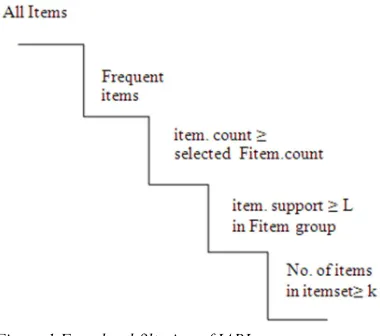
level filtering is done to remove infrequent items,
which is shown in Figure 1. First, it removes the global infrequent items from the selected transactions, then items which have count less than the count of the selected frequent item are removed from each transaction. Also similar transactions of the resultant transaction sets are removed, after recording their occurrence count. Then to reduce the computational cost further, items which are found to be infrequent in the selected group are also
removed and considered only the frequent ones to get the frequent itemsets.
[image:2.595.308.498.353.521.2]In Apriori when the length of the itemsets increased, the number of candidate sets gets reduced accordingly, but the size and the number of transactions to be compared remains same. But in IAPI-Quad-filter the number of transaction to be compared and their size also get reduced in finding higher frequent itemsets. This method is supported by incremental database features and is also adaptive to the customer behavioural changes. IAPI also provides the user with the facility to interactively adjust the minimum support value as per one’s own conveniences. Thus, this algorithm performs better than the existing algorithms with respect to scalability, speed and efficiency. The main attraction of this approach is that it generates the frequent itemsets without producing any local frequent itemsets; thus generation of false frequent itemsets are eliminated.
Figure 1 Four-level filtering of IAPI
This paper is organized as follows. Section 2 describes related work on different frequent pattern mining algorithms. Section 3 presents the basic terminologies associated with the proposed method. Section 4 gives the details of the various phases of the proposed algorithm and their functionalities are described using sample data. Section 5 gives the details of experiments conducted and performance analysis. Section 6 concludes the paper.
2. RELATED WORK
transactions are no longer needed in later passes. It generates candidate item sets iteratively. Thus its computational cost is very high. Eclat, M.J.Zaki. [4] is basically a depth-first search algorithm uses vertical database layout and uses intersection based approach to compute the support of an itemset. First scan of the database builds the TID_set of each single item. The advantage of Eclat over Apriori is that there is no need to scan the database to find the support of (k+1) itemset, because the TID_set of each k-itemset carries the complete information required for counting support and it also uses the Diffset technique. However, the TID_set can be long, taking more memory space as well as computation time for intersecting the long sets. The hybrid algorithm, C.Borgelt. [5] performs best when Apriori was switched to Eclat after the second iteration.
To improve the efficiency of the mining process, Han et al. [6] proposed a tree structure based algorithm FP-growth that constructs a frequent pattern tree which generates frequent patterns in two database scans without generating
candidate sets. It shows an outstanding
improvement over Apriori. The disadvantage of FP-growth is that it has to generate conditional pattern bases and sub- conditional pattern tree recursively. Addition of new transactions may require reconstruction of the FP-tree. M. El-Hajj et al. [7] proposed another approach COFI tree that uses a compact memory based data structure. For each frequent item, a relatively small independent tree is built summarizing co-occurrences and a clever pruning reduces the search space drastically. Finally, a simple and non-recursive mining process reduces the memory requirements as minimum candidacy generation and counting is needed to generate all relevant frequent patterns. Qian Wan et al. [9] use a compact tree structure, called CT-tree, to compress the original transactional data. This allows the CT-Apriori algorithm, to generate frequent patterns quickly by skipping the initial database scan and reducing a great amount of I/O time per database scan. It reduces the storage space requirement and mining time. These are static algorithms.
To obtain frequent sets from very large datasets with low memory space utilization in two database scan, researchers propose partitioning algorithms. Ashok Savasere et al. [10] suggest a partitioning algorithm, which splits the given database into a number of small segments. During the first scan on the database, it identifies the local frequent itemsets of individual segments. At the end of the first scan, these local large itemsets
are merged to generate a set of all potential large itemsets. In the second scan, the actual support for these itemsets are generated and the large itemsets are identified. This algorithm is highly dependent on the heterogeneity of the database; it may generate too many independent local frequent itemsets and they may not fit in the memory. To analyze the problem of market basket data, Sergey Brin et al. [11] present an algorithm DIC which uses fewer passes over the data than classical algorithms to find the frequent itemsets. DIC provides the flexibility to add and delete itemsets on the fly. DIC checks all the subsets of each transaction to find frequent sets which is expensive both in time and space compared to partition algorithm. DIC can accommodate the behavioural changes and interactive mining with less time complexity.
CARMA proposed by C.Hidber [12] requires two database scans to produce all large itemsets. During the first scan, the algorithm continuously constructs a lattice of all large item-sets. For each set in the lattice CARMA provides a lower bound and an upper bound for its support. The user is free to adjust support and confidence at any time. During the second scan, the algorithm determines the precise support of each set in the lattice and continuously removes all small itemsets. Carson Kai-Sang et al. [13] propose a dynamic algorithm CanTree which facilitates incremental mining as well as interactive mining. In this approach, the items in each transaction are arranged in a canonical order and the entire transactions are stored in a tree structure with one database scan. The construction of CanTree is independent of the threshold values. Thus, interactive mining is possible without rescanning the entire database. S.K Tanbeer et al. [15] present a novel tree structure called CP-tree, which creates efficient frequent patterns with interactive and incremental mining functionalities in one database scan. It has two phases, insertion phase that inserts transactions into CP-tree and tree reconstructing phase that rearranges the items according to the frequency order. Since items are arranged in the ascending order, CP-tree has less number of nodes compared to CanTree. But tree reconstruction introduces additional computations. M. Hamedanian et al. [16] have proposed a new prefix tree structure to reduce the time of restructuring.
3. BASIC TERMINOLOGIES
The database D consists of variable length
transactions T and these transactions have itemsets
Property 2: To reduce the memory utilization and searching delay in finding the frequent itemsets, each frequent item transaction groups are collected separately and infrequent items in the selected group are filtered out at four levels.
Property 3: Each frequent item has a co-occurring
itemset list Cf for finding the frequent itemsets, the
same set of items is considered while adding new transactions.
Property 3.1: Co-occurring items list of each frequent item is decided at the time of initial frequent pattern generation, based on their support count value and is updated only on every removal of old partitions.
4.2.1 Frequent Itemsets Generation
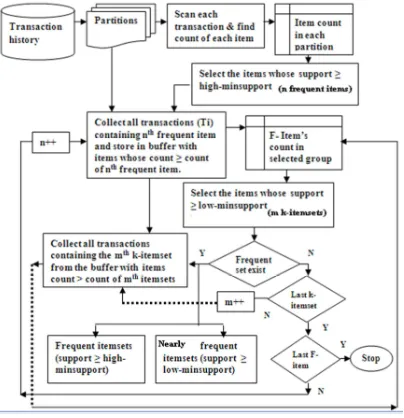
There are two steps in the first phase; the first step is to find the frequent items in the entire dataset and the second step is to find the frequent itemsets among the identified frequent items. The phase I functional details are shown in figure 2.
Figure 2 Functional block diagram of phase I
For finding the frequent items f, first divide the
database into convenient size of non-overlapping partitions and from each partition find the count of individual items and record their count in each partition separately in an item count table. Then find the frequent items which meet the minimum support count (Sh) in the entire dataset during the first database scan. Initially, items in each transaction are arranged according to the item code, which is a fixed global ordering and a counter is set up for each item and initialized to zero. Increment the count of items as per their occurrence in each transaction and record their count in each partition separately. Then their cumulative count gives the global support for the items. Support calculation is
done by scanning transaction one by one, and increasing the counter of the itemset if it is a subset of the transaction. Figure 3 illustrates the first step of phase I, that is global frequent items generation using a sample dataset having 15 transactions with 14 distinct items and these transactions are divided into 3 partitions with 5 transactions each. IAPI
Quad-filter uses two preset minimum values (Sl,
Sh) to facilitate incremental and interactive mining
[image:5.595.306.508.280.565.2][property 1]. The given example sets low, high values as 25% and 40% respectively. Here among 14 items, 7 are found to be globally frequent (support ≥ 40%).
[image:5.595.91.293.357.566.2]Figure 3 Frequent Item Generations
Figure 4:Frequent itemset generation of item C Table 1: Co-occurring Items List
To find the frequent itemsets first collect all the transactions that contain the first frequent item f1 from the entire database and store only the items whose count is greater than the selected frequent item in memory buffer[property 2]. Keep a
list of items Cf which are considered along with
Journal of Theoretical and Applied Information Technology 10th May 2014. Vol. 63 No.1
© 2005 - 2014 JATIT & LLS. All rights reserved.
ISSN: 1992-8645 www.jatit.org E-ISSN: 1817-3195
152 The same sets of items are considered together for finding the frequent itemsets on addition of new set of transactions [property 3]. Figure 4 shows the
frequent itemset generation steps of item C by
grouping the transactions containing item C into a
buffer. To reduce the buffer size and computational cost of finding frequent itemsets, it collects only 3 items {I,J,N}, where their count is greater than or
equal to the count of item C which is 9. These three
items are recorded in the co-occurring list of item C
[image:6.595.91.291.304.361.2]shown in Table 1. Then record the count of each item in that transaction group and remove the infrequent ones (support < 25%) from the selected transaction set, which gives the count of frequent and nearly frequent 2-itemsets.
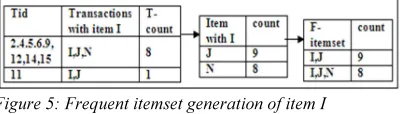
Figure 5: Frequent itemset generation of item I
Now to find the frequent 3-itemsets, select the set of transactions containing the first frequent
2-itemset {C,I} from the buffer by eliminating the
items having count less than the count of item I in
the 2-itemset group and identify the items having
support ≥ Sl. The same procedure is used for
finding the higher frequent itemsets (4-itemset, 5-itemset and so on). For finding the support of k-itemsets it is necessary to collect only the transactions containing at least k items. Similar
steps are used for other 2-itemsets {C,N}of item C
to get their co-occurring higher frequent itemsets.
Repeat the same for all other frequent items {I,J,N}
identified in the first scan and find all possible frequent itemsets of the whole dataset (Figure 5). Keep the list of frequent and nearly frequent itemsets separately. There may be chances of new frequent itemsets to occur, on adding new
transaction sets to the existing one. Thus NFsets
helps to avoid the rescanning of the whole dataset, while adding new partitions and updates the frequent patterns with less time compared to the existing methods[property 1.1]. Updating the
NFsets on addition of every partition requires more
time. Thus NFsets are updated only if they appear
as a frequent set in the newly added partition. To keep track of how many newly added partitions are
to be scanned for updating the NFset, every NFset
is tagged with the lastly updated partition number
Pn [property 1.2].
4.2.1.1 IAPI Quad-filter Algorithm -Phase I
1. Partition database into r non-overlapping
partitions of convenient size (Z) to
accommodate in memory. Fix two minimum
support values, Sh as the user selected
minimum support and Sl to accommodate
dynamic support (Sl < Sh).
2. Find the count of each item in each partition,
then calculate their total count and identify
frequent 1-itemsets (support ≥ Sh) and
initialize item length k=1.
3. Prepare a co-occurring item list, Cf for each
frequent item, i.e. items having support greater than or equal to the support of that item which is considered for the frequent itemset selection.
4. Select each frequent k-itemset and find its
co-occurring frequent items from the set of transactions containing the selected frequent itemset by removing the items having count less than the count of that itemset from each transaction.
5. Remove the items having count less than the
low minimum support count in the selected
group and identify the (k+1)-itemsets with support ≥ Sl, then increment k.
6. Repeat the steps 4, 5 for higher itemsets till no
higher frequent sets are obtained, then
decrement k.
7. Repeat the steps 4,5 and 6 for all k-itemsets of
the selected frequent item and identify the
frequent itemsets (support ≥ Sh) and nearly
frequent itemsets (support between Sl and Sh)
containing the selected frequent item say f1;
also record the current partition number (Pn) along with each nearly frequent itemsets.
8. Repeat the same for the remaining frequent
items.
4.2.1.2 Memory and CPU overhead Management
To reduce the delay in finding the occurrence count of each item in the first scan and the filtering delay in the frequent itemset generation, pre-processing is done to arrange the items in each transaction according to the order of item codes. Unlike Apriori, this approach avoids the searching of entire dataset to obtain the occurrence count of each itemset and thus reduces the CPU overhead and the number of database accesses. To optimize the memory utilization, co-occurring frequent itemsets of each frequent item is obtained by collecting all transactions containing these frequent items separately in to memory buffer. Further four level filtering is done to reduce the size of the selected transactions.
together to identify the frequent itemset also increases. At the same time, the number of items in each transaction gets reduced due to filtering approach. It also shows that rather than searching in the entire database it needs to search only in the buffer for obtaining higher frequent itemsets. To reduce the searching delay in incremental and interactive mining, nearly frequent itemsets count is not getting updated on every new transaction set addition. These are updated only if they are found to be frequent in the newly added partitions and if the user wishes to interactively reduce the preset
minimum support value (Sh); here the partition
number indicates the last partition that the itemset had counted before and only the remaining partitions are to be searched to obtain its support count.
4.2.2 Incremental Mining
This method accommodates the newly arrived transactions and updates the frequent patterns with less computational delay. To reduce the computational cost, it is suggested to include transactions at the end of the day or store the newly arrived transactions separately in a temporary partition and after a partition becomes full, add it to the existing partitions. Then find the count of each item in the newly added partition and update the count in the existing list. Also update the count of existing frequent itemsets. If any existing frequent item/itemsets is found to be infrequent, remove it from the Fset list. Then include it with the NFset
list if it’s support ≥ Sl along with the current
partition number. Further find the count of its subset and if found to be frequent include it in the
Fset. Then find the new frequent itemsets having
support ≥ Sh in the new partition, if any, then find
its count in other partitions by searching it in the
NFset list. If not obtained, conduct a possibility test using equation 4. If there is possibility to be frequent, search its count in the entire dataset. If
found to be frequent include it in the Fset list, else
if nearly frequent, include in NFset list else discard
it. At the end of day (or partition become full), find the frequent supersets of the newly generated frequent items if any, by collecting all the transactions containing the new item from the entire dataset.
∗ 1 ∗ 1 ∗ ∗ 1 ∗ ∗ ... (4)
WherePi– no. of partitions used for initial pattern
generation, Pc – current partition no.
Z– Partition size, L - Lower minimum support,
U - Upper minimum support,
S - new Fset support in new partition
Table 2: Newly Added Partition
Table 2 shows the sample partition added to the existing database and the updated count of individual items are shown in table 3. In the given
example, a new frequent item E is generated on
addition of the new partition 4. Thus to find the
frequent supersets of item E, collect all transactions
containing item E and follow the same frequent
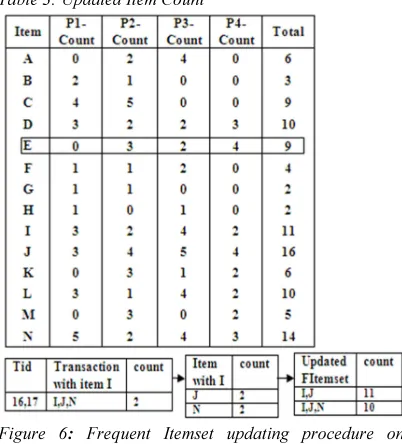
itemset generation procedure. Also update the count of existing itemsets. Figure 6 shows the frequent
itemset updating procedure of item I.
Table 3: Updated Item Count
Figure 6: Frequent Itemset updating procedure on
adding new partition (Item I)
4.2.2.1 IAPI Quad-filter Algorithm (Phase II) - Incremental Mining
1. Find each item count in the new partition,
then update its total count and identify the frequent items.
2. If any new frequent item is generated, find its
frequent supersets. Consider the existing frequent items and other new frequent items having count greater than the selected one as
co-occurring items Cf.
3. Include the co-occurring item list Cf of each
new frequent item to the existing list. Also include the newly formed frequent and nearly
[image:7.595.306.507.351.573.2]Journal of Theoretical and Applied Information Technology 10th May 2014. Vol. 63 No.1
© 2005 - 2014 JATIT & LLS. All rights reserved.
ISSN: 1992-8645 www.jatit.org E-ISSN: 1817-3195
154
4. Find the frequent itemsets in the new partition
by considering only the items listed in Cf and
update their total count. Also update the count of other existing Fsets and if their support <
Sh, shift them to the nearly frequent set list and record the current partition number.
5. If any new frequent itemset is obtained from
the new partition, find its total count by referring to the NFset list.
6. If not found in the NFset list, conduct a
possibility test using equation 4 and if there is a possibility to be frequent, scan the entire old transactions containing the selected frequent item and find its total count. If its support ≥
Sh, include it in the Fset list else if support ≥
Sl, keep it in NFset list along with the current
partition number (Pn). If there is no
possibility to be frequent, discard it.
4.2.3 Accommodation of Behavioural Changes (Phase III)
After a certain period, if the
behaviour/purchase pattern changes, older
transactions (partitions) are removed. Then update the existing frequent patterns. When the older partitions are removed, the count of each frequent itemsets in the partition, where the removal happened is obtained and their count is deducted from the frequent set list. Also count of each item in that partition which is deducted from the total count. After the partition removal the occurrence frequency of each item may change and due to the heterogeneity of the dataset, there is a chance of new frequent itemsets to occur with the existing frequent items. Thus a new co-occurring item list
Cf is prepared and generates the new Fset and
NFset lists using the same frequent itemset
generation procedure [property 3.1]. The
partitioning technique used in the proposed method helps to update the item count without rescanning the entire database.
1. Count of each item in the old partition which
is removed is deducted from the total count and identifies the frequent items in the remaining dataset.
2. Find the Fsets and NFsets of each frequent
item from the remaining partitions using the frequent pattern mining procedures stated above.
4.2.4 Interactive mining (Phase IV)
Interactive mining provides the user to interactively adjust minimum support value. Finding an appropriate support value for a dataset is a challenging task. It is better to provide the users
with the facility to change the support value as per their requirements.
1. When user increase the preset Sh value,
choose the itemsets with support ≥ new
support as Fset from the existing frequent set
and shift others to the NFset list and record their partition number (Pn) as last partition number.
2. When the user reduces the Sh value, select the
itemsets having support ≥ new support from
the existing NFset and include it along with
the existing Fset list. If the partition number (Pn) of the NFset is less than the current
partition number (Pc), then find their count in
the remaining partitions (Pn+1,Pn+2,…Pc) to get the total count and identify the newly
formed Fsets.
3. Also choose the items having count greater
than or equal to the newly set support count as frequent items and find their frequent supersets from the entire database.
5. EXPERIMENTAL SETUP AND PERFORMANCE ANALYSIS
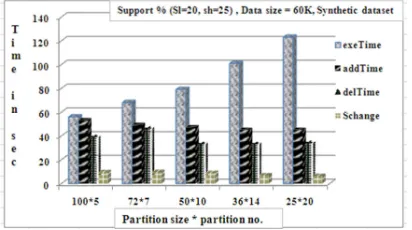
Functionalities and effectiveness of the proposed algorithm IAPI Quad-filter were tested with market basket datasets T10I4D100K prepared by IBM Almaden Quest research group and a Synthetic dataset. This algorithm is developed and tested on Intel(R) core (TM) 2 Duo, 2.1 GHz CPU having 1.2 GHz, 3 GB RAM with Microsoft Windows XP using NetBeans IDE 7.0.0 and MySQL Server 4.1. Execution time and memory utilization are compared for various support threshold values with differently sized partitions as well as with different number of partitions in both datasets (Figure 7).
Figure 7: Time comparison of IAPI in initial pattern generation, addition and deletion, support change using synthetic dataset
[image:8.595.306.512.547.662.2]the number of partitions is more, but at the same time new partition addition and deletion of old partitions require less time if the partition size is small with constant dataset size, i.e updating time depends on the size of the data added/deleted. Test results given in figure 8 shows that addition of 20% of data requires about 55% to 60% of the initial pattern creation time, 10% of data takes 25% to 30% of the initial pattern creation time. It is observed that, when the support threshold reduces, the number of frequent items increases, thus execution time required is more (Figure 9). Due to heterogeneity of dataset there are chances of reducing the number of frequent items, even though the dataset size increases. The test results illustrate that the execution time of IAPI Quad-filter directly depends on the number of frequent items in the dataset. Graphical representations of the test results of IAPI are shown in Figures 7, 8 and 9.
Figure 8: Frequent pattern generation time comparisons of IAPI with T10I4D100K
Figure 9: Frequent pattern generation time of IAPI with different support values
5.1 Performance Comparison
Performance of IAPI Quad-Filter
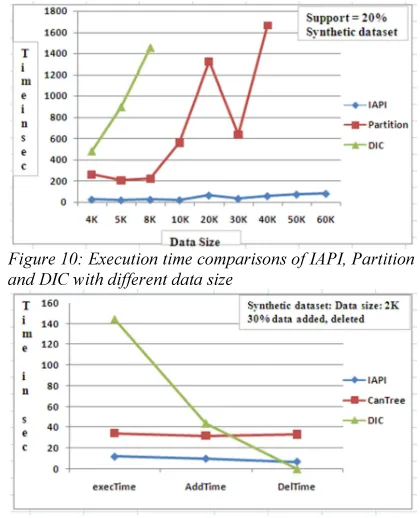
algorithm is compared with three popular algorithms: Partition Algorithm, DIC and CanTree using T10I4D100K dataset. Speed of execution of IAPI Quad-filter is ten times faster than Partition algorithm and twenty times faster than DIC. The memory requirement of IAPI Quad-filter is around five to six times lesser than Partition algorithm and
[image:9.595.301.511.328.587.2]twenty to thirty times less compared to DIC (Figure 10 and 11). Though partition algorithm is designed for very large dataset due to large number of independent local frequent itemsets generated for dense datasets, it requires more memory; thus there is limitation in dataset size. Since IAPI Quad-filter is not generating any local frequent sets, it is suitable for both dense and sparse datasets. A large number of frequent sets require more computations; thus execution time required is more in partition algorithm due to the occurrence of large number of local frequent itemsets. Partition algorithm creates static patterns and for incrementally updating the frequent patterns, it is required to keep all local frequent itemsets in memory, also if the user wishes to change the support value, the rescanning of the entire database is required for updating the frequent sets.
[image:9.595.88.307.342.618.2]Figure 10: Execution time comparisons of IAPI, Partition and DIC with different data size
Figure 11 Time comparison of IAPI, CanTree and DIC in initial pattern creation, addition and deletion of partitions using synthetic dataset
DIC is developed for dynamic frequent set generation, thus it requires four to ten times less time for incrementally updating the database, compared with the initial frequent set generation. It is observed that, in DIC, removal of old transaction requires five to ten times less time compared with IAPI. But the main difficulty with DIC is that it has to keep the count of all possible subsets in the entire transaction set; thus it consumes more memory and hence not suitable for very large data
sets. Subset generation introduces more
Journal of Theoretical and Applied Information Technology 10th May 2014. Vol. 63 No.1
© 2005 - 2014 JATIT & LLS. All rights reserved.
ISSN: 1992-8645 www.jatit.org E-ISSN: 1817-3195
156 more time than IAPI for the initial frequent set generation. CanTree is suitable for both incremental and interactive mining. It keeps the entire transactions in the CanTree for preparing frequent itemsets; thus it requires two to three times more
memory than IAPI. CanTree requires
re-construction of FP tree for each frequent item for every addition, deletion as well as the support
change cases, which may lead to more
computational delay.
6. CONCLUSION
Most of the real life databases are very large and dynamic. Thus it is essential to have an approach which has the flexibility to handle larger dynamic dataset efficiently and effectively. This study proposes an incremental and interactive mining algorithm with partitioning approach, designed to obtain frequent patterns from a very large sized dataset without generating local frequent itemsets. Most of the frequent pattern mining algorithms have complex structures and requires more database scans. This approach combines the features of various algorithms such as Apriori, CanTree, CARMA and Partitioning algorithm to obtain frequent itemsets with no complex calculations or data structures using small memory space in short time duration. Unlike Apriori, IAPI Quad-filter avoids the searching of entire dataset to obtain the occurrence count of each itemsets. The size and the number of transaction to be compared are further reduced with higher itemsets, due to four level filtering approaches. Thus 50% to 60% of memory space reduction and 30% to 40% of data comparisons reduction are achieved by this approach. This approach uses two
bounds (low, high) for minimum support and
generates two category itemsets: frequent itemsets
having support greater than high minimum support
value and nearly frequent itemsets having support
in between low and high. Partitioning approach
avoids the first database scan while deleting the old partitions and the nearly frequent itemsets help to reduce search delay for updating the frequent itemsets in incremental mining and interactive mining. The most attractive feature of IAPI is that this can be applied on both sequential and parallel mining approaches. Thus the proposed method can prepare more accurate user spending profile in short time period with less space and computational complexity.
REFERENCES
[1] R. Agrawal, T. Imielienski, and A. Swami, ‘Mining Association Rules between Sets of
Items in Large Databases’.Proceedings of the
Management of Data Conference, ACM Press, New York, NY, USA, 1993, pp. 207– 216.
[2] R. Agrawal, R. Srikant, ‘Fast algorithms for
mining generalized association rules’,
Proceedings of the 20th International Conference on Very Large Databases, 1994, pp. 487–499.
[3] David Wai-Lok Cheung, Vincent T. Y. Ng, Ada Wai-Chee Fu, Yongjian Fu. ‘Efficient Mining
of Association Rules in Distributed
Databases’, IEEE Trans. Knowl. Data Eng.
Vol. 8 No. 6, pp. 911-922.
[4] M.J.Zaki. (2000), ‘Scalable Algorithms for
Association Mining’, IEEE Transactions on
Knowledge and Data Engineering, 1996,
Vol. 12, pp. 372-390.
[5] C.Borgelt, ‘Efficient Implementations of
Apriori and Eclat’, Proceedings of 1st IEEE
ICDM Workshop on Frequent Item Set Mining Implementations. CEUR Workshop Proceedings 90, Aachen, Germany. 2003. [6] J. Han, J. Pei, and Y. Yin. (2000), ‘Mining
frequent patterns without candidate
generation’, Proceedings of ACM SIGMOD
International Conference on Management of
Data, pp. 1–12.
[7] M. El-Hajj and O. R. Zaiane, ‘COFI approach for mining frequent itemsets revisited’,
Proceedings of the 9th ACM SIGMOD Workshop on Research Issues in Data Mining and Knowledge Discovery, New York, 2004, pp. 70–75.
[8] Chuang-Cheng Chiu and Chieh-Yuan Tsai. ‘A Web Services-Based Collaborative Scheme
for Credit Card Fraud Detection’,
Proceedings of the 2004 IEEE International Conference on e-Technology, e-Commerce and e-Service (EEE’04), pp. 177-181,28-31 march 2004.
[9] Qian Wan and Aijun An. (2005), ‘Compact Transaction Database for Efficient Frequent
Pattern Mining’, IEEE international
conference on Granular Computing, Vol. 2, pp. 652-659.
[10] Ashok Savasere Edward Omiecinski Shamkant Navathe. (1995), ‘An Efficient Algorithm for Mining Association Rules in
Large Databases’, Proceedings of the 21st
[11] Sergey Brin, Rajeev Motwani, Jeffrey D Ullman and Shallom Tsur. (1997), ‘ Dynamic itemset counting and implication rules for
market basket data’, Proceedings of ACM
SIGMOD International conference on Management of data, Vol. 26, No. 2 of SIGMOD record, pp. 255-264.
[12] C. Hidber. (1999), “Online association rule
mining”, Proceedings of the ACM SIGMOD
International Conference on Management of
Data, pp. 145–156.
[13] Leung C.K., Khan, Quamrul I., Li Zhan., Hoque, T. (2007), ‘CanTree: A Canonical-Order Tree for Incremental Frequent-Pattern
Mining’, Knowledge and Information
Systems, Vol. 11, No. 3, pp. 287–311.
[14] Jianyun Xu, Andrew H. Sung and Qingzhong Liu., ‘Behaviour Mining for Fraud Detection’,
Journal of Research and Practice in Information Technology, Vol. 39, No. 1, p.p 3-18, February 2007.
[15] S. K Tanbeer, C. F Ahmed, Byeong-Soo Jeong, Young-Koo Lee. (2008), ‘Efficient single-pass frequent pattern mining using a
prefix-tree’, Information Science, Vol. 179,
pp. 559–583.
[16] Mohadeseh Hamedanian, Mohammad