Munich Personal RePEc Archive
Impact of Physical Attractiveness on
Selection and Recruitment Process
Subhani, Muhammad Imtiaz
Iqra University Research Centre (IURC), Iqra university Main
Campus Karachi, Pakistan, IQRA UNIVERSITY
2012
Online at
https://mpra.ub.uni-muenchen.de/39104/
Accepted in
International Journal of Accounting and Finance (IJAF), 2012
Impact of Physical Attractiveness on Selection and Recruitment Process
Muhammad Imtiaz Subhani
Director Research, Iqra University, Research Center
[email protected]
Sumayya Azmat
Research Scholar, Iqra University, Research Center
[email protected]
Abstract
The personality traits which include physical appearance in particular always matter once an organization goes for hiring new entrants. The principal point of this study is to comprehend the relationship of a candidate's physical appearance, qualification, dressing style, attractive communication skills, gender, and candidate’s photograph on resume with the hiring decision taken by a manager. The findings of this paper reveal that decision of hiring managers does not necessarily based upon the physical attractiveness but is influenced by various other factors which include candidate’s appearance, his/her dressing style and educational qualifications.
Keywords: Photograph, Physical attractiveness, Hiring, Selection, Recruitment, Dressing style
1.
Introduction
In today’s organizations, the issues adjoining selecting and recruiting the right employees are getting difficult day by day. One of the reasons of this difficulty is the decrease in the number of capable candidates and the increasing complicationsof global economy. Another reason might be the discrimination of the employers for the applicants. There are different hidden issues also that can influence the recruitment and selection procedure other than the qualification and experience of candidates. These issues can be related to ethical, cultural or social aspects but may have a significant impact on the recruitment process and maybe are keys to issues generating by discrimination. There is a chance that those organizations which ignore the importance of such issues which are related to physical appearance, dressing style, gender, qualification, race, communications skills or looks might themselves are involved in such activities that are based on any sort of biasness.
biasness can put an organization into risk for applying unethical actions, so employers must be cautious of the reputation of the organization [Kleimanand Farley, 1988].
The purpose of this study is to comprehend the association between a candidate's physical appearance, relevant qualifications, age, dressing style, grooming, presence of photograph on resume, and the hiring decisions by the managers to determine the impact of physical attractiveness on recruitment process.
2.
Literature Review
From ages, throughout the society, appearance-basedbiasness can be recognized but still it seems that not much importance is given to the subject, in fact, very few have ever considered the potential consequences [Cash, 1981]. Philosophers and researchers are continuously studying the concept of this phenomenon at workplaces to understand the importance it can contain for an individual. In this study, we are focusing primarily on that impact of attractiveness at the time of hiring.
2.1 Beautyism
"Beautyism" is a term that describes the social advantage attractive people get whereas less attractive people get discriminated over a lot of less attractive attributes [Cash, 1990]. It is well-known that physical beauty earns an individual fame and significant social benefit within the culture or society [Dermer& Thiel, 1975]. Male and female who are attractive are taken as more social, responsive, confident and effective in their everyday life whether there are careers or personal/official relationships [Cash, 1981; Cash, Kehr, Polyson, & Freeman, 1977].
2.2 Theory of “What is Beautiful is Good”
"What is Beautiful is Good" [Dion, Berscheid, and Walster, 1972], is one of most famous studies, examined the concept of physical appearance within society. The study focused on the perceptions of people upon seeing a person for the first time and drawing certain stereotypes about his/her personality traits and nature. It concluded that on seeing a person'sbeauty, society unwillinglyconcludes opinions about the person's overall personality, and success level in life.
2.3 Physical Attractiveness-What Society thinks about it
It is a common observation that we notice in our daily life routines that attractive individuals are more popular that the unattractive ones, they are better treated and are offered more opportunities at workplaces and even in relationships just because of their appearances [Langlois, J., Kalakanis, L., Rubenstein, A., Larsen, A., Hallam, M., & Smoot, M., 2000]. When society thinks that social competence is necessary, it refers to the idea that attractive persons are good in building positive relationships and posses good communications skills.
2.4 Role of Physical Attractiveness at Workplace
Arvey&Terpstra, 1977; Marlowe, Schneider, & Nelson, 1996]. However, there is an exception like the area of modeling or acting where hiring decision must be based on this physical attractive biasness [Cash &Kilcullen, 1985].
We know that face-to-face communication job positions require attractive candidates like receptionist or front-desk officers. Beehr and Gilmore [1982]stated that physical attractiveness is very important in occupation where face-to-face communication is required.
2.5 Importance of Dressing
Being attractive or unattractive is a part of fate or is in genetics, but there are some attributes which can be changed and modified to make the personality of a person much desirable or more presentable. Dress or dressing style comes under this category; even sometimes dressing style enhances the personality more as compared to physical features. In a research done on the impact of physical attractiveness, dressing style, and job category, Johnson and Roach-Higgins [1987]concluded that dressing style has a dominant effect on the perception of an employer. Riggio and Throckmorton [1988]concluded that suitable dressing has more powerful impact on the hirers than physical attractiveness.
3.
Methodology
The purpose is to analyze the relationship and associations between physical attractiveness andselection and recruitment process. in order to carry out research, primary data was collected through 'questionnaires-survey' as the research tool from employers and employees of different organizations working in Pakistan, Saudi Arabia, United Arab Emirates, United Kingdom, United States of America and Bahrain.
The total of 250 questionnaires with instructions to fillwas hand delivered and emailed to the respondents. T-test (one sample test) is used to test the impact of physical attractiveness on recruitment process. By using t-test, we found out that physical attractiveness has no direct impact on hiring decision of manager but it somehow influences the hiring decisions made by managers.
[image:4.612.87.529.515.722.2]4.
Hypotheses, Results and Discussions
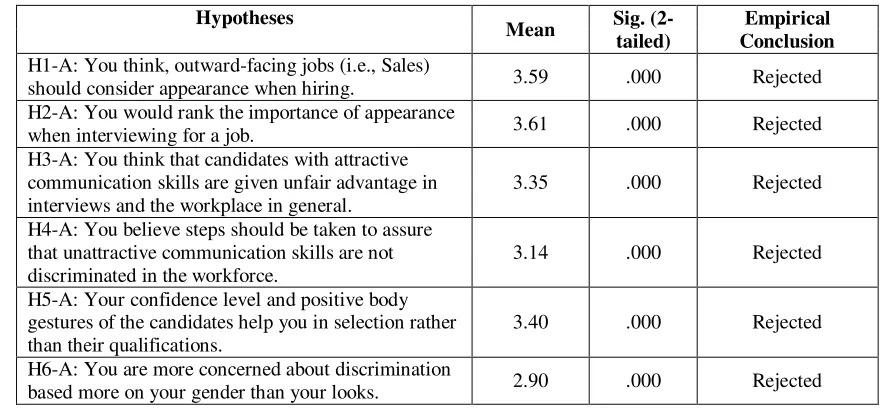
Table 1: One sample test- Employees’ Perception
Hypotheses
Mean Sig. (2-tailed)
Empirical Conclusion H1-A: You think, outward-facing jobs (i.e., Sales)
should consider appearance when hiring. 3.59 .000 Rejected H2-A: You would rank the importance of appearance
when interviewing for a job. 3.61 .000 Rejected
H3-A: You think that candidates with attractive communication skills are given unfair advantage in interviews and the workplace in general.
3.35 .000 Rejected
H4-A: You believe steps should be taken to assure that unattractive communication skills are not discriminated in the workforce.
3.14 .000 Rejected
H5-A: Your confidence level and positive body gestures of the candidates help you in selection rather than their qualifications.
3.40 .000 Rejected
H6-A: You are more concerned about discrimination
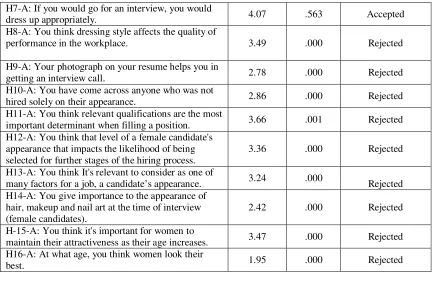
H7-A: If you would go for an interview, you would
dress up appropriately. 4.07 .563 Accepted
H8-A: You think dressing style affects the quality of
performance in the workplace. 3.49 .000 Rejected
H9-A: Your photograph on your resume helps you in
getting an interview call. 2.78 .000 Rejected
H10-A: You have come across anyone who was not
hired solely on their appearance. 2.86 .000 Rejected H11-A: You think relevant qualifications are the most
important determinant when filling a position. 3.66 .001 Rejected H12-A: You think that level of a female candidate's
appearance that impacts the likelihood of being selected for further stages of the hiring process.
3.36 .000 Rejected
H13-A: You think It's relevant to consider as one of
many factors for a job, a candidate’s appearance. 3.24 .000 Rejected H14-A: You give importance to the appearance of
hair, makeup and nail art at the time of interview (female candidates).
2.42 .000 Rejected
H-15-A: You think it's important for women to
maintain their attractiveness as their age increases. 3.47 .000 Rejected H16-A: At what age, you think women look their
[image:5.612.95.529.61.342.2]best. 1.95 .000 Rejected
Table 2: One sample test- Employers’ Perception
Hypotheses
Mean Sig. (2-tailed)
Empirical Conclusion
H1-B: Outward-facing jobs (i.e., Sales) should
consider appearance when hiring. 3.64 .008 Accepted H2-B: Rank the importance of appearance when
interviewing for a job. 3.78 .061 Accepted
H3-B: Candidates with attractive communication skills are given unfair advantage in interviews and the workplace in general.
3.30 .000 Rejected H4-B: Steps should be taken to assure that
unattractive communication skills are not discriminated in the workforce.
3.08 .000 Rejected H5-B: The confidence level and positive body
gestures of the candidates help you in selection rather than their qualifications.
3.59 .001 Accepted
H6-B: Discrimination is based more on gender than
looks. 3.29 .000 Rejected
H7-B: Much importance is giving to the candidate's
dressing at the time of interview. 3.35 .000 Rejected H8-B: Dressing style affects the quality of
performance in the workplace. 3.11 .000 Rejected
H9-B: Attractive candidates are called for interviews more than the unattractive candidates (presence of photograph on resumes)
2.88 .000 Rejected H10-B: Candidates are not hired solely on their
appearance. 3.45 .000 Rejected
H11-B: A candidate's qualifications are the most
H12-B: The level of a female candidate's appearance that impact the likelihood of being selected for
further stages of the hiring process. 3.16 .000 Rejected H13-B: It's relevant to consider as one of many
factors for a job, a candidate’s appearance. 3.51 .000 Rejected H14-B: Importance is given to the appearance of hair,
makeup and nail art when interviewing female candidates.
2.79 .000 Rejected H15-B: Important for women to maintain their
attractiveness as their age increases. 3.32 .000 Rejected H16-B: At what age, women look their best. 2.15 .000 Rejected
The formulated research hypotheses which have been shown in Table 1 and 2 were interrogated via applying the 1-sample T-Test. The testing proceedings showed that H7-A and H11-A for Table-1 were accepted because their p values were greater than 0.05, thus making the 2-tailed value insignificant. All remaining hypotheses were rejected. In Table 2, the hypotheses H1-B, H2-B, H5-B and H11-B were accepted because their p values were greater than 0.05, thus making the 2- tailed value insignificant, all other hypotheses were rejected. At the time of interview though, employees have placed a rather higher value to the importance of dressing (H7-A, Table 1).
During this present study, we realized that when we see someone who is physically appealing, a certain perception of good thoughts occurs as an instinctive reaction. At the same time, we also found out that this perception was studied with limitations in the present study. The completeresults did not match with this idea but it did show influence of physical attractiveness on the hiring decisions by managers at certain levels.
Lots of research studies have found that within employment settings, candidates who are attractive are given more preferences over the unattractiveness [Beehr& Gilmore, 1982; Dipboye, Arvey, &Terpstra, 1977; Marlowe, Schneider, & Nelson, 1996]. Dion [1972] demonstrated views on personality traits which showed the dominance of physically attractive people on unattractive people, who lack in several personalities’ attributes. The present study tested this theory but did not find any evidence which can support above mentioned studies in the case of employees but the employers’ results show that there is influence of appearance at the time of interview (H2 and H5-Table 2). Male and female who are attractive are taken as more social, responsive, confident and effective in their everyday life whether there are careers or personal/official relationships [Cash, 1981; Cash, Kehr, Polyson, & Freeman, 1977]. The present study [Table 2: H5] strongly supports that candidates who are confident are successful in getting jobs; confidence along with good communication skills can lead the employees to a higher grade of achievement where even biases like physical attractiveness and gender differentiation have no impact.
5.
ACKNOWLEDGEMENTS
First and foremost, I would like to offer thanks to Allah; this research paper is a proof that with his grace and help, everything is possible. Mr. M. I. Subhani, my mentor and supervisor who inspired me to both understand and appreciate the value of great research - thank you Mr. Subhani for your continued patience and guidance, my parents Mr. & Mrs. Azmatullah and my friends for their immense support throughout my research.
6.
References
Beehr, T., & Gilmore, D. (1982).Applicant attractiveness as a perceived job-relevant variable in selection of management trainees. Academy of Management Journal, 25, 607-617.
Berscheid, E., &Walster, E. (1974).Physical attractiveness.In L. Berkowitz (Ed.), Advances in experimental social psychology (Vol. 7, pp. 158-215). New York: Academic Press.
Cash, T., Kehr, J., Polyson, J., & Freeman, V. (1977). Role of physical attractiveness in peer attribution of psychological disturbance. Journal of Consulting and Clinical Psychology, 45, 987-993.
Cash, T. (1981). Physical attractiveness: An annotated bibliography of theory and research in the behavioral sciences.
Social & Behavioral Sciences Documents, 11, 83. (MS# 2370)
Cash, T. (1990). The psychology of physical appearance: Aesthetics, attributes, and images. Body images: Development, deviance, and change. New York: Guilford Press.
Cash, T., &Kilcullen, R. (1985). The aye of the beholder: Susceptibility of sexism and beautyism in the evaluation of managerial applicants. Journal of Applied Social Psychology, 15, 591-605.
Dermer, M., & Thiel, D. L. (1975).When beauty may fail. Journal of Personality and Social Psychology, 31, 1168-1176.
Dion, K., Berscheid, E., &Walster, E. (1972). What is beautiful is good. Journal of Personality and Social Psychology, 24, 285-290.
Dipboye, R., Arvey, R., &Terpstra.D.(1977). Sex and physical attractiveness of raters and applicants as determinants of resume evaluations.Journal of Applied Psychology, 62, 288-294.
Johnson, K.K., & Roach-Higgins, M.E. (1987).The influence of physical attractiveness and dress on campus recruiters' impressions of female job applicants. Home Economics Research Journal, 16, 87-95.
Kleiman, L., & Farley, R. (1988). Voluntary affirmative action and preferential treatment: Legal and research implications. Personnel Psychology, 41.
Langlois, J., Kalakanis, L., Rubenstein, A., Larsen, A., Hallam, M., & Smoot, M. (2000).Maxims or myths of beauty?A meta-analytic and theoretical review. Psychological Bulletin, 126, 390-423.
Marlowe, C., Schneider, S. & Nelson, C. (1996). Gender and attractiveness bases in hiring decisions: Are more experienced managers less biased? Journal of Applied Psychology,81(1), p. 11-21.
Morrow, P., McElroy, J., Stamper, B., & Wilson, M. (1990).The effects of physical attractiveness and other demographic characteristics on promotion decisions. Journal of Management, 16, 723-736.
Quereshi, M., & Kay, J. (1986).Physical appearance, age, and sex as determinants of reactions to resumes. Social Behavior Personality, 14, 103-112.
Riggio, R.E., & Throckmorton, B. (1988). The relative effects of verbal and nonverbal behavior, appearance, and social skills on evaluations made in hiring interviews. Journal of Applied Social Psychology, 18, 331-348.