BIROn - Birkbeck Institutional Research Online
Grubert, Anna and Eimer, Martin (2015) Rapid parallel attentional target
selection in single-color and multiple-color visual search.
Journal of
Experimental Psychology: Human Perception and Performance 41 (1), pp.
86-101. ISSN 0096-1523.
Downloaded from:
Usage Guidelines:
Please refer to usage guidelines at or alternatively
Rapid parallel attentional target selection in single-colour and multiple-colour visual search
Anna Grubert and Martin Eimer*
*Corresponding author
Department of Psychological Sciences, Birkbeck College, University of London, Malet Street, London WC1E 7HX, UK
Phone: 0044 20 76316358 Fax: 0044 20 76316312 Email: [email protected]
Abstract
Previous work has demonstrated that when targets are defined by a constant feature, attention can be directed rapidly and in parallel to sequentially presented target objects at different locations. We assessed how fast attention is allocated to multiple objects when this process cannot be controlled by a unique colour-specific attentional template. N2pc components were measured as temporal markers of the attentional selection of two colour-defined targets that were presented in rapid succession. Both targets either had the same colour (One Colour task) or differed in colour (Two Colour task). Although there were small but systematic delays of target selection in the Two Colour task relative to the One Colour task, attention was allocated extremely rapidly to both target objects in the Two Colour task, which is inconsistent with the hypothesis that their selection was based on a slow switch between different colour templates. Two follow-up experiments demonstrated that these delays did not reflect template switch costs, but were the result of competitive interactions between simultaneously active attentional templates. These results show that the control of focal attention during multiple-feature search operates much faster and more flexibly than is usually assumed.
Introduction
In complex real-life visual scenes, where multiple objects compete for access to visual perception and action control, selective attention determines which of these objects are processed preferentially at any given moment in time. When observers search for a particular target object, the allocation of attention is guided by representations of target-defining features (attentional templates or top-down attentional sets) in working memory (e.g., Duncan & Humphreys, 1989; Wolfe & Horowitz, 2004; Olivers et al., 2011). Attentional templates can be set up prior to the arrival of visual search displays, and facilitate the visual processing of template-matching visual objects in a spatially selective fashion (e.g., Desimone & Duncan, 1995; Eimer, 2014). In situations where multiple potentially task-relevant objects appear simultaneously or in rapid succession, template-guided selection processes should be able to allocate attention flexibly and rapidly in line with current task demands. This is required when observers search for several target objects or features at the same time, or when they encounter a new object that requires immediate attention while their attention is already focused elsewhere.
each trial whether the two target-colour items in the two displays belonged to the same alphanumerical category (two letters, two digits) or not (one letter and one digit). To track the attentional selection of the two sequentially presented target-colour objects in real time, we measured N2pc components triggered by these objects. The N2pc is an enhanced negativity that is elicited at posterior electrodes contralateral to the visual field of a target object in multi-stimulus visual displays. This component that typically emerges 180-200 ms after stimulus onset, is generated in extrastriate areas of the ventral visual processing stream (Hopf et al., 2000), and reflects the attentional selection of candidate target objects among distractors in visual search (e.g., Luck & Hillyard, 1994; Eimer, 1996; Woodman & Luck, 1999). Because the N2pc is computed by comparing contralateral and ipsilateral ERP waveforms to targets in the left versus right visual field, no N2pc is elicited for target objects that appear on the vertical meridian (Woodman & Luck, 1999; Hickey, McDonald, & Theeuwes, 2006; Hickey, Di Lollo, & McDonald, 2009; Eimer, Kiss, & Nicholas, 2011; Eimer & Grubert, 2014). In our previous study (Eimer & Grubert, 2014), the target/nontarget pair in one display always appeared on the horizontal meridian (to the left and right of fixation), and the stimulus pair in the other display was presented on the vertical meridian (above and below fixation; see Figure 1). Trials where the horizontal display preceded the vertical display (horizontal target first: H1 targets) and trials where this order was reversed (horizontal target second: H2 targets) were randomly intermixed. This procedure allowed us to measure the attentional selection of horizontal target objects, as reflected by the N2pc component, independently of any parallel attentional processing of the vertical target objects in the other display on the same trial. When both displays were separated by a 100 ms SOA, the N2pc to H1 targets preceded the N2pc to H2 targets by almost exactly 100 ms. Critically, when the SOA between the two displays was reduced to 10 ms, the latency difference of the N2pc components to the two targets again mirrored this objective time interval precisely, as the N2pc to H2 targets emerged 10 ms later than the N2pc to H1 targets. Furthermore, both N2pc components were equal in size and overlapped in time. These observations demonstrate that focal attention can be allocated rapidly and in parallel to several target objects, with each selection process following its own independent time course.
always allocated in a strictly sequential fashion to different objects, this may only apply to situations where multiple target objects are defined by a shared perceptual feature, and their selection can therefore be guided by a single attentional template. In our earlier study, target items always had the same colour (e.g., all targets were red), and participants could therefore maintain a single colour-specific attentional set throughout the experiment. It is well known that in such contexts, objects with target-matching features will capture attention in a task-set dependent fashion, even when they are known to be task-irrelevant (e.g., Folk et al., 1992; Eimer & Kiss, 2008). The rapid parallel allocation of attention to different target objects observed in our previous study (Eimer & Grubert, 2014) may therefore be specific to conditions that elicit task-set contingent involuntary attentional capture, and may not be observed in task contexts where target-defining features are no longer fixed. The aim of the present study was to measure the allocation of spatial attention to sequentially presented colour-defined target objects that could have one of two possible colours, and to compare it to the attentional selection of two successive target objects in a task where a single-colour attentional template can be applied. Experimental procedures were similar to Eimer & Grubert (2014), except that target definitions differed between task conditions. The One Colour task was identical to our previous study. Participants had to select two target items in two successive displays, and to report whether their alphanumerical identity was the same or different. Targets were defined by one constant colour throughout the experiment. In the new Two Colour task, instructions were the same, except that two different colours were now designated as possible target colours for each participant. In Experiment 1, the target item in the first display was presented randomly and unpredictably in one of these colours, and the target in the second array always had the other colour (see Figure 1). Target-colour items were accompanied by a nontarget-colour distractor on the opposite side in both tasks. Horizontal target/nontarget displays preceded vertical displays on half of all trials (H1 targets), and this order was reversed in the other half (H2 targets; see Figure 1). In different blocks, the SOA separating the first and second display was 100 ms or 10 ms.
overlap in time, demonstrating that when the selection of two successively presented target items can be guided by a single attentional template for one particular target colour, attention can be allocated rapidly and in parallel to both target objects, with each selection process following its own independent time course. The critical question concerned the time course of attentional object selection in the new Two Colour task. In this task, attention could no longer be guided by a unique colour-specific attentional template, and this should affect the speed and efficiency with which attention was allocated to target objects in the first and second display.
attentional control settings can be applied more effectively and selectively when targets are defined by one particular constant feature. If this is the case, task performance should generally be much better in the One Colour task than in the Two Colour task of the present study. In particular, impairments in the control of attentional target selection in the Two Colour task should be reflected by delayed N2pc components to successively presented target objects in this task relative to the One Colour task.
selection of a red target followed by the selection of a green target) requires the time-consuming sequential creation of two independent Boolean maps.
If switching between feature-specific attentional templates is an effortful process that takes several hundred milliseconds to complete (e.g., Dombrowe et al., 2011), the allocation of attention to the second target should be strongly delayed in the Two Colour task of Experiment 1, in particular when the onset asynchrony between the two search displays is extremely short (10 ms). This should be reflected in marked performance decrements relative to the One Colour task, and in large delays of N2pc components to H2 targets. Alternatively, it is possible that two colour-specific templates can be active simultaneously. In this case, there should only be moderate performance and N2pc differences between the One and Two Colour tasks of Experiment 1. In Experiments 2 and 3, different versions of the Two Colour task were employed to investigate how these differences are affected when the order of the two target-colour items in the first and second display is constant and therefore fully predictable or completely unpredictable.
Experiment 1
Methods
Participants
Fourteen participants were paid to take part in this study. Two of them were excluded from analysis due to excessive eye movement activity. The remaining twelve participants were aged between 26 and 40 years (mean age 33 years). Seven were female, and three were left-handed. They all had normal or corrected-to-normal vision and normal colour vision, as substantiated by means of the Ishihara colour vision test (Ishihara, 1972).
Stimuli and procedure
time, as verified with a photodiode). Participants were seated in a dimly illuminated cabin and viewed the screen at a distance of approximately 100 cm. Stimulus presentation, timing, and response recollection were controlled by a LG Pentium PC running under Windows XP, using the Cogent 2000 toolbox (www.vislab.ucl.ac.uk/Cogent/) for MATLAB (Mathworks, Inc.).
Stimuli were coloured uppercase letters (B, H, S, or T) or digits (1, 2, 3, or 4), subtending 0.9 x 0.9 degrees of visual angle. They were presented at an eccentricity of 2.4° from central fixation against a black background. The four possible object colours were red (CIE colour coordinates: .637/.329), green (.264/.556), blue (.179/.168), and yellow (.423/.461). All colours were equiluminant (~7.5 cd/m2). A central grey fixation point (.321/.352; 0.2° x 0.2° of visual angle) remained continuously present throughout each experimental block. On each trial, two successive stimulus displays were presented for 20 ms. Each stimulus display contained one object in a target colour and another distractor object in a randomly selected nontarget colour (Figure 1). Four different stimulus identities were selected randomly for each trial. On each trial, one target-nontarget pair was presented on the horizontal meridian (left and right of fixation), and the other pair appeared on the vertical meridian (above and below fixation). In half of all trials, the horizontal stimulus pair was presented first (horizontal target first: H1 trials). In the other half, the vertical target/nontarget display preceded the horizontal display (horizontal target second: H2 trials). H1 and H2 trials were randomly intermixed in each block, and the position of the target in these two displays (left/right; top/bottom) was randomly and independently determined on each trial. Participants’ task was to report whether the alphanumerical identity of the two successively presented colour-defined target items was the same (two digits or two letters) or different (one digit, one letter) by pressing one of two purpose-built vertically aligned response keys. Half of all participants pressed the top key with their left hand and the bottom key with their right hand, and this hand-to-key mapping was reversed for the other half. The mapping between response (“same” versus “different”) and key was counterbalanced across participants. Trials requiring a “same” or “different” response were equiprobable and randomly intermixed in each block.
colours served as target colour for three participants. The other three colours served as nontarget colours in this task. In the Two Colour task, there were two possible target colours. On each trial, the target item in one of the two successively presented displays appeared in one of these colours and the item in the other display was presented in the other colour. The order in which these two target colours appeared was randomly determined for each trial. For half of all participants, target colours were red and green, and nontarget colours yellow and blue. This assignment was reversed for the other six participants. This procedure ensured that the two target colours were not linearly separable in colour space from the two nontarget colours. For each participant, the target colour for the One Colour task served as nontarget colour in the Two Colour task (e.g., a participant who searched for red targets in the One Colour task would search for yellow and blue targets in the Two Colour task). In both tasks, the combination of target and nontarget colours in the two subsequent displays was determined randomly on each trial, with the restriction that nontarget colours were never repeated within one trial.
For each task, two blocked SOA conditions were run (see Figure 1). In SOA100 blocks, the two consecutive stimulus displays were separated by a 80 ms blank interval. In SOA10 blocks, the onset of the first display preceded the onset of the second display by only 10 ms (i.e., there was a 10 ms overlap between these two displays). In all blocks, the interval between the offset of the second display and the onset of the first display on the next trial was 1900 ms.
The experiment contained 24 blocks, with 64 trials per block. There were 16 trials for each combination of target location (left, right, top, or bottom) and display sequence (H1 or H2). The One Colour and Two Colour tasks were each run in 12 successive blocks (with six successive blocks for the SOA100 and SOA10 conditions). Six participants started the experiment with the One Colour task, and the other half with the Two Colour task. Within each task, six participants started with the SOA10 condition, and the other six with the SOA100 condition. Those participants who had started the first task with the SOA10 condition started their second task with the SOA100 condition, and vice versa. One practice block preceded the experimental blocks for both tasks.
The continuous EEG was DC-recorded from 23 scalp electrodes (Fpz, F7, F3, Fz, F4, F8, FC5, FC6, T7, C3, Cz, C4, T8, CP5, CP6, P7, P3, Pz, P4, P8, PO7, PO8, Oz), sampled at a rate of 500 Hz, and digitally low-pass filtered at 40 Hz. No other offline filters were applied. All channels were online referenced to the left earlobe and re-referenced offline to the average of both earlobes. Trials contaminated with artifacts (eye movements exceeding ±30 µV in the HEOG channels; eye blinks exceeding ±60 µV at Fpz; muscular movements exceeding ±80 µV in all other channels), and trials with incorrect, anticipatory (faster than 200 ms), very slow (slower than 1500 ms), or missing responses were excluded from EEG analyses. This led to a rejection of 5.6% and 4.9% of all trials in the SOA10 and SOA100 conditions of the One Colour task, and of 5.3% and 4.6% of all trials in the SOA10 and SOA100 conditions of the Two Colour task. For the remaining trials, EEG was segmented into epochs ranging from 100 ms prior to 500 ms after the onset of the first stimulus display, and was baseline corrected relative to the 100 ms pre-stimulus interval. EEG was averaged separately for each of the sixteen combinations of task (One Colour and Two Colour) SOA (100 ms and 10 ms), display sequence (H1 trials and H2 trials), and horizontal target location (left and right).
N2pc components were quantified on the basis of ERP waveforms measured at lateral posterior electrodes PO7 and PO8. N2pc onset latencies were measured on the basis of difference waveforms, computed by subtracting ERPs at PO7/8 ipsilateral to the target side from contralateral ERPs. Onset latencies were determined with a jackknife-based procedure (Miller, Patterson, & Ulrich, 1998). Twelve grand-average difference waves were computed for each experimental condition, each excluding one different participant from the original sample. N2pc onset latency was defined as the point in time when each subsample difference wave reached an absolute onset criterion of -1 µV1. Differences in N2pc onset latencies between experimental conditions were assessed with repeated-measures ANOVAs and two-tailed t-tests, with F- and t-values corrected according to the formulas described by Ulrich and Miller (2001) and Miller et al. (1998). The corrected tests are indicated with Fc and tc, respectively. Because N2pc components emerged at different
post-stimulus latencies in different experimental conditions, the time intervals used for
1
measuring N2pc mean amplitudes were determined separately for each condition on the basis of the grand-averaged N2pc peak latency for this condition. N2pc mean amplitudes were measured for an 80 ms interval centred on this peak latency (from 40 ms before to 40 ms after the N2pc peak for a particular experimental condition). The resulting N2pc mean amplitude windows for H1 trials were 204-284 ms (One Colour/SOA10), 195-275 ms (One Colour/SOA100), 205-285 ms (Two Colour/SOA10), and 194-274 ms (Two Colour/SOA100). For H2 trials, the respective time windows were 210-290 ms (One Colour/SOA10), 315-395 ms (One Colour/SOA100), 224-304 ms (Two Colour/SOA10), and 329-409 ms (Two Colour/SOA100).
Results
Behavioural performance
Although error rates tended to be higher in the Two Colour task relative to the One Colour task (5.0% versus 3.0%), this difference only approached significance, F(1,11) = 4.6, p = .054. There was also a tendency for more errors with long relative to short SOAs (4.7% versus 3.3%), but this difference was also not statistically reliable, F(1,11) = 4.0, p = .069, nor was the interaction between task and SOA, F(1,11) = 1.7, p = .223.
N2pc components
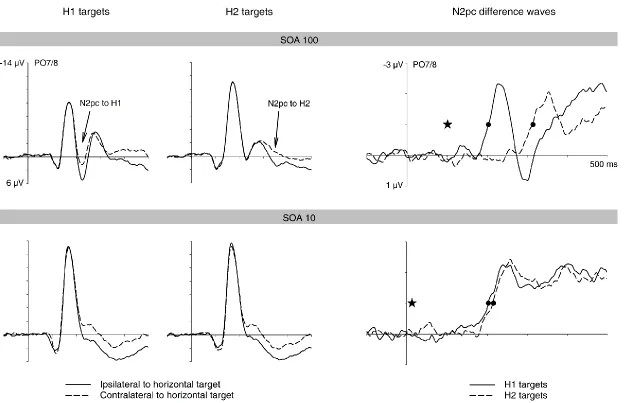
One Colour task. Figure 2 (left and middle panels) shows ERPs at posterior electrodes
PO7/8 contralateral and ipsilateral to the side of the horizontal target-colour item for trials where this item appeared in the first display (H1) or in the second display (H2). ERPs are shown separately for the SOA100 and the SOA10 conditions. In both SOA conditions, N2pc components were elicited to H1 and H2 targets. This was substantiated by repeated-measures ANOVAs with the factors display sequence (H1 versus H2 trials) and laterality (electrode ipsilateral and contralateral to the side of the horizontal target) conducted separately for the SOA100 and SOA10 conditions. Both ANOVAs revealed a main effect of laterality, both F(1,11) > 17.1, both p < .003, confirming that N2pc components were reliably elicited by horizontal target items. Importantly, there was no interaction between laterality and display sequence for either SOA condition, both F(1,11) < 1, demonstrating that N2pc amplitudes were statistically equivalent on H1 and H2 trials, both when the two targets were separated by a 100 ms or by a 10 ms SOA.
The right panel of Figure 2 shows N2pc difference waveforms obtained by subtracting ipsilateral from contralateral ERPs, separately for trials where the horizontal target-colour item appeared in the first or second display, and for both SOA conditions. In blocks where both displays were separated by a 100 ms SOA, N2pc components to H1 and H2 targets showed no temporal overlap. Their onset latency difference was 110 ms (202 ms versus 312 ms), tc(11) = 20.8, p < .001, which closely matched the physical onset difference
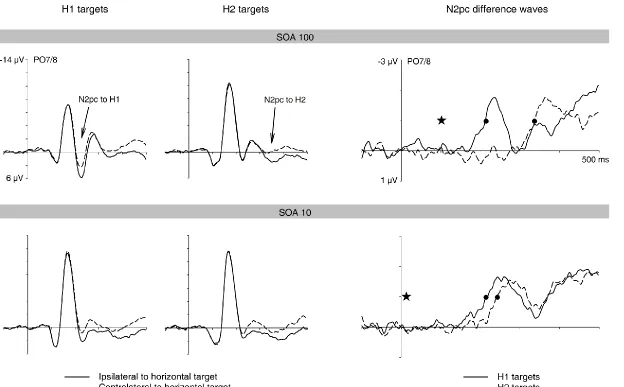
Two Colour task. Figure 3 shows ERP waveforms for the Two Colour task. ERPs at
contralateral and ipsilateral posterior electrodes (PO7/8) for the SOA100 and SOA10 conditions are displayed separately for trials where the horizontal target item appeared in the first or second display (H1 and H2 trials), together with the corresponding contralateral-ipsilateral difference waveforms. Overall, the pattern of N2pc results obtained in the Two Colour task was similar to the One Colour task. Repeated-measures ANOVAs on N2pc mean amplitudes conducted separately for both SOA conditions with the factors display sequence and laterality obtained a main effect of laterality, both F(1,11) > 32.3, p < .001, reflecting the presence of N2pc components to horizontal target items in the SOA100 and SOA10 conditions. As in the One Colour task, there was no interaction between laterality and display sequence for either SOA condition, both F(1,11) < 2.7, p > .137, indicating that N2pc components were equal in size on H1 and H2 trials.
The N2pc difference waveforms in Figure 3 (right panel) show the onset delay of the N2pc on H2 trials relative to H1 trials, separately for the SOA100 and SOA10 conditions. As in the One Colour task, the two N2pc components showed no temporal overlap when the SOA between the two displays was 100 ms, and considerable overlap with an SOA of 10 ms. In the SOA100 condition, N2pc components emerged at a post-stimulus latency of 213 ms and 338 ms on H1 and H2 trials, and this onset latency difference of 125 ms was highly significant, tc(11) = 31.5, p < .001. In the SOA10 condition, the N2pc on H2 trials was delayed
by 31 ms relative to the N2pc on H1 trials (243 ms versus 212 ms), and this difference was also reliable, tc(11) = 2.3, p = .045.
Comparison of N2pc components between the One Colour and Two Colour tasks.
trials), the target N2pc emerged approximately 10 ms later in the Two Colour task relative to the One Colour task (212 ms versus 202 ms and 213 ms versus 202 ms in the SOA10 and SOA100 conditions, respectively). A repeated-measures ANOVA of N2pc onset latency estimates in H1 trials with the factors task (One Colour versus Two Colour task) and SOA condition (100 versus 10) obtained a main effect of task, Fc(1,11) = 14.6, p = .003, confirming
that the small N2pc onset delay for the Two Colour task relative to the One Colour task was reliable. There was no task x SOA condition interaction, Fc(1,11) < 1. When the horizontal
target appeared in the second display (H2 trials), the N2pc to these targets was delayed by approximately 30 ms in the Two Colour task relative to the One Colour task (243 ms versus 213 ms and 338 ms versus 312 ms in the SOA10 and SOA100 conditions, respectively). An ANOVA of N2pc onset latency estimates in H2 trials with the factors task and SOA condition obtained a main effect of task, Fc(1,11) = 17.7, p = .001, confirming that the N2pc on H2
trials emerged reliably later in the Two Colour task relative to the One Colour task. There was no task x SOA condition interaction, Fc(1,11) < 1.
Because N2pc onset latencies were more strongly delayed in the Two Colour task relative to the One Colour task for horizontal targets in the second display than for H1 targets, N2pc onset latency differences between H1 and H2 trials were therefore larger in the Two Colour task (125 ms versus 110 ms for the SOA100 condition, 31 ms versus 11 ms for the SOA10 condition). An ANOVA on jackknife-derived N2pc latency differences between H1 and H2 trials (obtained by subtracting N2pc onset latencies on H1 trials from onset latencies on H2 trials) with the factors task (One Colour versus Two Colour task) and SOA (100 versus 10) obtained an effect of SOA, Fc(1,11) = 90.0, p < .001, and, more importantly, a
main effect of task, Fc(1,11) = 8.0, p = .016, thus confirming that the interval between the
onset of the N2pc on H1 and H2 trials was reliably increased in the Two Colour task than the One Colour task. There was no significant task x SOA interaction, Fc(1,11) < 1, demonstrating
that this increase was similar in size in both SOA conditions.
the Two Colour task was not reliable. There was also no effect of SOA, F(1,11) < 1, and no interaction between task and SOA, F(1,11) = 1.6, p = .226, for N2pc amplitudes.
Discussion of Experiment 1
The findings from the One Colour task confirmed the observations from our previous study (Eimer & Grubert, 2014). N2pc components were elicited by the first and second target in each trial, and the temporal separation of these two N2pc components closely matched the objective time interval between the two successive search displays. The onset difference of the N2pc to H1 and H2 targets was 110 ms in the SOA100 condition and 11 ms in the SOA10 conditions. These findings demonstrate that the allocation of attention to new target objects can be triggered extremely rapidly, even when attention had been directed to another object just a few milliseconds earlier. The fact that the N2pc components to H1 and H2 targets in the SOA10 condition overlapped in time, and were identical in amplitude (see Figure 2) provides strong evidence for the parallel allocation of attention to multiple target objects. If attention had to be de-allocated from its previous position before it could be directed to a new target location, as implied by strictly serial models of attentional object selection, the N2pc to H1 targets should have been very small and short-lived in the SOA10 condition, and should show only minimal temporal overlap with the N2pc to H2 targets. There was no evidence for this in the One Colour task, which strongly suggests that attention was allocated in parallel and independently to the two successive target objects in this task. The fact that the onset latency difference between the N2pc components to H1 and H2 targets in the SOA10 condition (11 ms) matched the objective interval between these two targets suggests that both were selected independently, and the two parallel selection processes followed their own distinct time course.
differences between the two N2pc components to H1 and H2 targets were only 20-25 ms longer than the objective onset asynchrony between the two displays in the Two Colour task. This demonstrates that attention was rapidly allocated to a new colour-defined target object, even though its colour always differed from the target that was selected first, and even when the SOA between the two targets was extremely brief (10 ms). The observation that the N2pc components to H1 and H2 targets in the SOA10 condition of the Two Colour task were equal in size and overlapped in time (see Figure 3, bottom panel) strongly suggests that analogous to the One Colour task, these two targets were selected independently and in parallel.
There were however small but systematic N2pc onset latency differences between the One Colour and Two Colour tasks. The N2pc to target objects in the first display was delayed by approximately 10 ms in the Two Colour task. An N2pc onset delay for two-colour as compared to single-colour search was also observed in our previous study (Grubert & Eimer, 2013) where participants searched for colour-defined target digits that appeared together with a grey distractor object in the opposite visual field, indicating that attentional target selection is triggered more rapidly when it can be guided by a unique colour-specific attentional template. The N2pc onset delay observed for H1 targets in the Two Colour task relative to the One Colour task of the present experiment could be due to the fact the observers did not know which of the two possible target colours would appear in the first display, or the fact that two different colours were known to be task-relevant on each trial. These two alternatives were tested in Experiment 2.
The onset delay of the N2pc to H2 targets in the Two Colour task relative to the One Colour task was slightly longer (approximately 30 ms) than the corresponding N2pc delay for H1 targets (10 ms), and the interval between the two N2pc components to H1 and H2 targets was therefore increased in the Two Colour relative to the One Colour task. In other words, the attentional selection of H2 targets was delayed by an additional 20 ms in the Two Colour task, and the size of this delay did not differ between the SOA100 and SOA10 conditions.2 These findings are difficult to reconcile with previous claims that only one
2 To determine whether the N2pc delay to H2 targets in the Two Colour task was linked to an increased N2pc onset latency
attentional template can be active at any given moment (e.g., Olivers et al., 2011), and that it may take up to 300 ms to switch between different attentional templates (Dombrowe et al., 2011). If the attentional selection of H2 targets in the Two Colour task was based on a top-down controlled switch to a new colour-specific attentional template, colour switch costs on N2pc latencies to H2 targets should have been much larger than was actually observed, in particular for the SOA10 condition.
An alternative account that is more consistent with the results of Experiment 1 is that when target objects are defined by one of two equally likely colours, two colour-specific attentional templates can operate simultaneously. In this scenario, the delay of N2pc components to H1 targets in the Two Colour task relative to the One Colour task, and the presence of additional colour switch costs for the N2pc to H2 targets in this task both reflect competitive interactions between two simultaneously active attentional templates. Competition between two colour templates in the Two Colour task generally reduces their activation level relative to a unique colour template in the One Colour task, resulting in a small but systematic delay of attentional object selection. If the activation of one colour template increases during the attentional selection of the first target, the activation of the other template will show a corresponding decrease. This should delay the selection of the second target in the Two Colour task, as reflected by the additional N2pc onset delay of 20 ms observed in this task.
Experiment 2
Participants performed the One Colour task and two variants of the Two Colour task. One version was identical to the Two Colour task of Experiment 1, where the sequence in which the two target colours appeared varied unpredictably across trials (Two Colour-Variable). In the new fixed-sequence version of the Two Colour task, the targets in the first and second display differed in colour, but the respective colours of the first and second target were always the same (e.g., red targets followed by green targets). To maximize the opportunity for participants to perform a top-down controlled switch from one particular colour template to another, only the longer of the two SOA conditions (100 ms) tested in Experiment 1 was employed in Experiment 2.
The small but reliable delay of N2pc components to H1 targets observed in Experiment 1 for the Two Colour task relative to the One Colour task could be due to the fact that the colour of the first target was unpredictable, and no specific colour template could therefore be prioritized in advance. If this was the case, no such N2pc onset delay should be found for H1 targets in the Two Colour-Fixed task, where the colour of the first target was constant and therefore fully predictable. If the additional delay of N2pc components to H2 targets observed in the Two Colour task of Experiment 1 reflects the time demands of a rapid switch between two colour-specific attentional templates, such a switch should arguably operate even more efficiently when participants know the target colour sequence in advance. In this case, the N2pc to H2 targets should emerge earlier in the Fixed relative to the Variable version of the Two Colour task. No such N2pc onset latency difference between these two versions of the Two Colour task should be observed if the delayed N2pc to H2 targets during two-colour search reflects competitive interactions between two simultaneously active search templates.
Methods
13 paid participants were tested. One of them was excluded from analysis due to excessive eye movement activity. The remaining twelve participants were aged between 23 and 41 years (mean age 32.7 years). Six were female, and three were left-handed. All had normal or corrected-to-normal vision and normal colour vision.
Stimuli and procedure
There were three task conditions. The One Colour task and the Two Colour-Variable task were identical to the One Colour and the Two Colour tasks of Experiment 1 (SOA100 conditions). In the new Two Colour-Fixed task, the colour of the target items in the first and second display remained constant across all trials. Six participants searched for red and green targets in both Two Colour tasks, and the other six searched for blue and yellow targets in these two tasks. Each of these two target colours appeared randomly in the first or second display in the Two Colour-Variable task. In the Two Colour-Fixed task, there were four possible target colour sequences (red->green, green->red, blue->yellow, yellow ->blue). Each of these was assigned to three participants. The target colour in the One Colour task (red, green, blue, or yellow) was counterbalanced across participants, and always differed from the colours that were task-relevant in the Two Colour tasks. Six successive blocks with 64 trials per block were run for each task, resulting in a total number of 18 blocks. Six participants started the experiment with the One Colour task, three with the Two Colour-Variable task, and three with the Two Colour-Fixed task. In all other respects, procedures were identical to Experiment 1.
EEG recording and data analyses
204-284 ms (Two Colour-Variable), 196-276 ms (Two Colour-Fixed). For H2 trials, the respective time windows were 304-384 ms (One Colour), 325-405 ms (Two Colour-Variable), 336-416 ms (Two Colour-Fixed).
Results
Behavioural performance
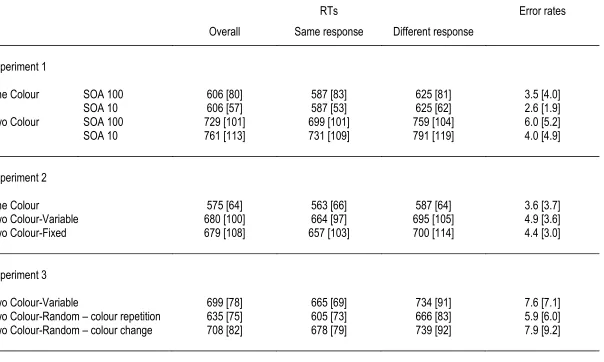
The removal of anticipatory or very slow responses resulted in the exclusion of less than 0.2% of all trials. Table 1 shows RTs and error rates for the different tasks conditions of Experiment 2. There was a main effect of task (One Colour, Two Colour-Variable, Two Colour-Fixed) for RTs on trials with correct responses, F(2,22) = 16.8, p < .001. Participants responded more than 100 ms faster in the One Colour task (575 ms) relative to the Variable and Fixed Versions of the Two Colour Task, where RTs were virtually identical (680 ms and 679 ms, respectively). “Same” responses on trials where the alphanumerical categories of the two target items matched were faster than “different” responses on category-mismatch trials (628 ms versus 661 ms), resulting in a main effect of target category, F(1,11) = 18.3, p < .001. An interaction between target category and task, F(2,22) = 4.8, p = .019, indicated that this RT difference was larger in the two versions of the Two Colour task (37 ms) than in the One Colour task (24 ms). Errors tended to be more frequent in the Variable and Fixed versions of Two Colour task (4.9% and 4.4%) relative to the One Colour task (3.6%), but there was no significant effect of task on error rates, F(1,11) = 1.4, p = .267.
N2pc components
components to H1 targets preceded N2pc components to H2 targets by approximately 100-130 ms. N2pc onset latency differences between H1 and H2 targets were 102 ms, 118 ms, and 133 ms, in the One Colour, Two Colour-Fixed, and Two Colour-Variable tasks, and these differences were all significant, all tc(11) > 17.1, all p < .001. N2pc mean amplitudes to H1
and H2 targets were assessed by ANOVAs conducted separately for the three tasks with the two factors display sequence (H1 versus H2 trials) and laterality (electrode ipsilateral versus contralateral to the side of the horizontal target). All three ANOVAs revealed main effects of laterality, all F(1,11) > 17.1, all p < .003, confirming reliable N2pc components to H1 and H2 targets in all three tasks. None of the laterality x display sequence interactions reached significance, all F(1,11) < 4.0, all p > .073, indicating that N2pc amplitudes did not differ systematically between H1 and H2 targets.
Onset latency differences of N2pc components between the three tasks were assessed by separate analyses for H1 and H2 targets. The onset of the N2pc to H1 targets differed reliably across the three tasks, Fc(2,22) = 5.6, p = .011. Follow-up t-tests revealed
that the N2pc emerged earlier in the One Colour task relative to the Two Colour-Variable task (205 ms versus 214 ms; tc(11) = 3.0, p = .037), confirming the results of Experiment 1.
Importantly, the onset latency of the N2pc to H1 targets in the new Two Colour-Fixed task (206 ms) was statistically identical to the One Colour task, tc(11) < 1, and was reliably earlier
than the latency of the N2pc to H1 targets in the Two Colour-Variable task, tc(11) = 3.0, p =
.039. The latency of N2pc components to H2 targets also varied reliably across tasks, Fc(2,22) = 12.0, p < .001. Follow-up t-tests confirmed the observation from Experiment 1
that the N2pc to H2 targets emerged earlier in the One Colour task relative to the Two Colour-Variable task (302 ms versus 333 ms; tc(11) = 4.6, p = .002). Critically, the N2pc to H2
targets in the new Two Colour-Fixed task (onset latency: 338 ms) was also reliably delayed relative to the One Colour task, tc(11) = 4.6, p = .002, while there was no reliable N2pc onset
latency difference between the Two Colour-Variable and Two-Colour Fixed task, tc(11) < 1.
Discussion of Experiment 2
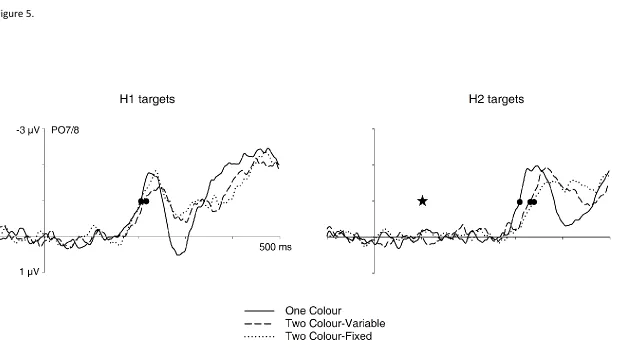
perfectly replicate the findings from the SOA100 conditions of Experiment 1, and confirm the existence of small but systematic delays of colour-guided attentional target selection during two-colour as compared to single-colour visual search. The N2pc results for the new Fixed version of the Two Colour task provide additional insights into the factors responsible for these delays. The N2pc to H1 targets in the Two Colour-Fixed task emerged at the same time as the N2pc in the One Colour task, and reliably earlier than the N2pc to H1 targets in the Variable version of the Two Colour task (Figure 5, left panel). This demonstrates that the speed with which the first colour-defined target was selected was determined by the predictability of its colour. Because the first target colour was known in advance both in the One Colour task and Two Colour-Fixed tasks, participants could selectively prioritize a colour-specific search template prior to the presentation of this search display. This was not possible in the Two Colour-Variable task, where the colour of the first target varied unpredictably across trials. The fact that two different colour targets had to be selected in rapid succession in in the Two Colour-Fixed task while a single colour was relevant in the One Colour task apparently did not affect the selection speed for H1 targets. This will be further discussed below.
Two Colour task needs to be compared to another version of this task where the colour of the second target is entirely unpredictable. This was done in Experiment 3.
Experiment 3
In the new fully random version of the Two Colour task, the colours of the first and second target were selected randomly and independently on each trial. As a result, the target in the second display could have the same colour or a different colour as the target in the first display (colour repetition versus colour change trials). Furthermore, the colour of the first target was now entirely uninformative with respect to the colour of the second target. Behavioural performance and N2pc components in this new Two Colour-Random task were compared to the Variable version of the Two Colour task that was identical to the task used in Experiments 1 and 2. The SOA between the two successive displays was always 100 ms.
Methods
Participants
15 paid participants were tested. Three were excluded due to excessive eye movement activity. The remaining twelve participants were aged between 20 and 42 years (mean age 30.9 years). Seven were female, and two were left-handed. All had normal or corrected-to-normal vision and normal colour vision.
Stimuli and procedure
Two variants of the Two Colour task were run, and the SOA between the first and second display was always 100 ms. The Two Colour-Variable task was identical to Experiment 1 (SOA100 condition) and Experiment 2. In the new Two Colour-Random task, the colour of the target in the first and second display was determined randomly and independently on each trial. As a result, the two targets had the same colour on half of all trials (colour repetition trials), and differed in colour on the other half (colour change trials), and the colour of both H1 and H2 targets was always unpredictable. Six participants searched for red and green targets in both tasks, and the other six for blue and yellow targets. The Two Colour-Variable task was performed in six successive blocks of 64 trials. For the new Two Colour-Random task, twelve blocks of 64 trials were run, in order to equate the number of colour repetition and colour change trials to the number of trials obtained in the Two Colour-Variable task, where there was always a colour change between the first and second target. Six participants completed the Two Colour-Variable task prior to the Two Colour-Random task, and this order was reversed for the other six participants. In all other respects, procedures were identical to Experiments 1 and 2.
EEG recording and data analyses
40 ms before to 40 ms after the N2pc peak). N2pc mean amplitude windows for H2 targets were 380-460 ms (Variable task), 320-400 ms (Random task: colour repetition), and 386-466 ms (Random task: colour change).
Results
Behavioural performance
Anticipatory or exceedingly slow responses led to the exclusion of less than 0.3% of all trials. Table 1 shows RTs and error rates for the different tasks conditions of Experiment 3. RTs on trials with correct responses were compared between the Two Colour-Variable task and colour repetition versus colour change trials in the Two Colour-Random task. There was a main effect of task condition, F(2,22) = 14.1, p < .001. RTs were faster on colour repetition trials in the Random task (635 ms) relative to colour change trials in this task (708 ms) and RTs in the Variable task (699 ms), both t(11) > 4.0, both p < .007. RTs in colour change trials did not differ from RTs in the Variable task, t(11) < 1. As in the first two experiments, “same” responses on category-match trials were faster than “different” responses on category-mismatch trials in the Variable task (665 ms versus 734 ms), as well as on colour repetition trials (605 ms versus 666 ms) and colour change trials (678 ms versus 739 ms), in the Random task, resulting in a main effect of target category, F(1,11) = 31.6, p < .001. There was no interaction between task condition and target category, F(2,22) < 1. Error rates did not differ reliably between the Variable task (7.6%) and colour repetition or change trials (5.9% and 7.9%) in the Random task, F(2,22) < 1.
N2pc components
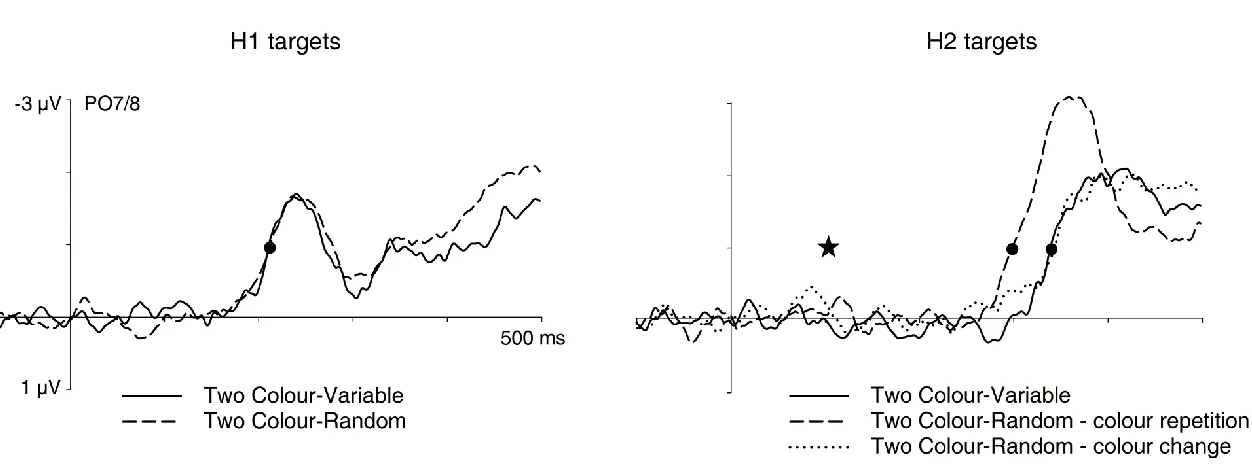
unpredictable in both tasks. In contrast, as shown in the difference waveforms of Figure 6 (right panel), there were systematic differences in the onset of N2pc components to H2 targets between colour repetition and colour change trials in the Random task and the Variable task, Fc(2,22) = 144.9, p < .001. The N2pc to H2 targets emerged earlier on colour
repetition trials in the Random task (299 ms) relative to colour change trials in the same task (343 ms) and to the Variable version of the Two Colour task (339 ms), both tc(11) > 6.7, both
p < .001. There was no N2pc onset difference between colour change trials in the Random
task and the Two Colour-Variable task, tc(11) < 1. As can be seen in Figure 6 (right panel),
N2pc components to H2 targets differed in size, F(2,22) = 7.6, p = .003; they were larger for colour repetition trials in the Random task relative to the other two task conditions (Random – colour change and Variable task), and these amplitude differences were significant, both t(11) > 4.8, both p < .004.
Discussion of Experiment 3
template that had already been activated during the preceding selection of the first target than on trials where the target template was not involved in this earlier selection episode.
General Discussion
The aim of the present study was to assess the speed of allocating attention to two successively presented target objects under conditions where attention cannot be controlled by a single feature-specific attentional template. We measured the N2pc component as a marker of attentional object selection in a One Colour task where both targets were defined by the same colour and in different versions of a Two Colour task where these two targets could have one of two possible colours. If the requirement to simultaneously maintain two colour-specific attentional templates generally reduces the efficiency of attentional target selection (e.g., Houtkamp & Roelfsema, 2009; Stroud et al., 2011; Grubert & Eimer, 2013), task performance should be impaired in the Two Colour task, and the attentional selection of the two successively presented targets should operate much more slowly, as reflected by strongly delayed N2pc components relative to the One Colour task. The results of Experiment 1 demonstrated that the attentional selection of colour-defined target objects that are presented in rapid succession remains remarkably fast and efficient even when it cannot be guided by a single feature-specific attentional template. Relative to the One Colour task where all targets were defined by a single known colour, the selection of the first target was delayed by approximately 10 ms when its colour was not known in advance, and the selection of a second target was delayed by an additional 20 ms when its colour differed from the colour of the first target. This was the case both for a 100 ms SOA between the two targets and when this SOA was reduced to 10 ms. Even though these N2pc onset latency differences between the One and Two Colour tasks are theoretically important, the fact remains that the two target objects were still selected extremely rapidly in the Two Colour task, and the time course of their selection closely matched the objective time interval between the two displays.
templates. In these two experiments, the SOA between the first and second target display was always 100 ms, in order to provide sufficient time for participants to initiate a top-down controlled template switch when the colour of the second target was predictable. However, the N2pc delay to H2 targets in the Two Colour task was unaffected by whether the target colour sequence varied randomly across trials or remained constant and was therefore known in advance (Experiment 2), and by whether the colour of the second target item was predictable or unpredictable once the first target had been presented (Experiment 3). If the selection of the second target on each trial had been guided by a top-down controlled switch to a new colour template, its speed should have been strongly affected by the predictability of the second target’s colour. The absence of any such colour predictability effects on N2pc onset latencies to H2 targets in the Two Colour task rules is inconsistent with this rapid template switch hypothesis. The pattern of N2pc results observed in Experiments 2 and 3 with an SOA of 100 ms between the two displays also implies that top-down controlled template switches cannot account for the N2pc onset delay to H2 targets in the SOA10 condition of Experiment 1, as such an extremely short SOA will provide even less opportunity for such switches to be initiated.
of an upcoming target can enhance the activation of one of these templates, so that target selection efficiency becomes similar to single-colour search. Evidence for this was found in the Two Colour-Fixed task of Experiment 2, where the target colour sequence was known in advance, and the N2pc to H1 targets emerged at the same time as the N2pc to H1 targets in the One Colour task. Even though the colour of the second target was just as predictable in this Two Colour-Fixed task, the N2pc to H2 target was delayed, reflecting a competitive disadvantage of the second colour template as the result of a colour switch between the first and the second target.
Similar performance costs linked to feature changes between visual target objects are well documented in the literature. In tasks where observers have to classify stimuli with respect to one dimension and ignore another dimension, performance is impaired when features in the irrelevant dimension change randomly across trial (e.g., Garner, 1970). This is usually interpreted as a failure in the attentional separation of relevant and irrelevant dimensions (e.g., Garner & Felfoldy, 1970; Garner, 1988). Along similar lines, observers often fail to ignore changes in task-irrelevant dimensions during same-different comparisons between multidimensional objects, and this can interfere with the comparison process (e.g., Egeth, 1966). This interference has been attributed to response compatibility, which delays the selection of “same” responses on trials where the two objects differ on the irrelevant dimension and of “different” responses on trials where both objects share the same task-irrelevant feature (e.g., Garner, 1988). However, response compatibility cannot account for the slow RTs observed in the Two Colour tasks of the present study. In all three experiments, RTs were faster on trials where the alphanumerically category of two successively presented targets matched relative to category-mismatch trials. Importantly, this RT advantage for “same” over “different” responses was reliably larger in the Two Colour tasks of Experiments 1 and 2, in spite of the fact that there was always a colour change between the two targets, which should have produced response compatibility benefits for “different” responses.
category matching process in the present study. In this context, it is interesting to note that in our previous N2pc study of one-colour versus two-colour search (Grubert & Eimer, 2013) where participants simply had to identify colour-defined targets and no comparison was required, the target N2pc onset delay between the two tasks matched the RT difference between them, suggesting that in the absence of working memory comparison processes, performance costs during multiple-feature search can be fully accounted for by the reduced speed of attentional target selection processes. The exact nature of the effects of feature variability on the cognitive and neural mechanisms that are involved in object comparison processes needs to be clarified in future experiments.
We have previously found that when target objects appear in rapid succession at different locations in the visual field, focal attention can be allocated rapidly and independently to multiple objects (Eimer & Grubert, 2014). The current results show that this fast mode of selective spatial attention is not restricted to situations where target objects are defined by a unique and constant attribute, and their selection can therefore be guided by a single feature-specific attentional template. They challenge the widely held assumption that visual attention operates in a strictly serial fashion by demonstrating that even when target-defining features are not fully predictable and change between successive selection episodes, attention can still be allocated extremely rapidly to multiple objects. They also challenge the hypothesis that only a single feature-specific attentional template can be active at any moment in time. The control processes that are responsible for the allocation of focal attention to task-relevant visual objects appear to operate much faster and more flexibly than is commonly thought.
References
Beck, V. M., Hollingworth, A., & Luck, S. J. (2012). Simultaneous control of attention by multiple working memory representations. Psychological Science, 23, 887-898.
Cavanagh, P., & Alvarez, G. A. (2005). Tracking multiple targets with multifocal attention. Trends in Cognitive Sciences, 9, 349-354.
Desimone, R., & Duncan, J. (1995). Neural mechanisms of selective visual attention. Annual Review of Neuroscience, 18, 193-222.
Dombrowe, I., Donk, M., & Olivers, C. N. L. (2011). The costs of switching attentional sets. Attention, Perception, & Psychophysics, 73, 2481-2488.
Duncan, J., & Humphreys, G. W. (1989). Visual search and stimulus similarity. Psychological Review, 96, 433-458.
Egeth, H. E. (1966). Parallel versus serial processes in multidimensional stimulus discrimination. Perception & Psychophysics, 1, 245-252.
Eimer, M. (1996). The N2pc component as an indicator of attentional selectivity. Electroencephalography and Clinical Neurophysiology, 99, 225-234.
Eimer, M. (2014). The neural basis of attentional control in visual search. Trends in Cognitive Sciences. Online publication. doi: 10.1016/j.tics.2014.05.005.
Eimer, M., & Grubert, A. (2014). Spatial attention can be allocated rapidly and in parallel to new visual objects. Current Biology, 24, 193-198.
Eimer, M., & Grubert, A. (2014). The gradual emergence of spatially selective target processing in visual search: from feature-specific to object-based attentional control. Journal of Experimental Psychology: Human Perception and Performance. Online
publication. doi: 10.1037/a0037387.
Eimer, M., & Kiss, M. (2008). Involuntary attentional capture is determined by task set: Evidence from event-related brain potentials. Journal of Cognitive Neuroscience, 20, 1423-1433.
Folk, C. L., Remington, R. W., & Johnston, J. C. (1992). Involuntary covert orienting is contingent on attentional control settings. Journal of Experimental Psychology: Human Perception and Performance, 18, 1030–1044.
Garner, W. R. (1970). The stimulus in information processing. American Psychologist, 25, 350-358.
Garner, W. R. (1988). Facilitation and interference with a separable redundant dimension in stimulus comparison. Perception & Psychophysics, 44, 321-330.
Garner, W. R., & Felfoldy, G. L. (1970). Integrality of stimulus dimensions in various types of information processing. Cognitive Psychology, 1, 225-241.
Grubert, A., & Eimer, M. (2013). Qualitative differences in the guidance of attention during single-color and multiple-color visual search: Behavioral and electrophysiological evidence. Journal of Experimental Psychology: Human Perception and Performance, 39, 1433–1442.
Grubert, A., Krumenacher, J., & Eimer, M. (2011). Redundancy gains in pop-out visual search are determined by top-down task set: behavioral and electrophysiological evidence. Journal of Vision, 11, 1-10.
Hickey, C., Di Lollo, V., & McDonald, J. J. (2009). Electrophysiological indices of target and distractor processing in visual search. Journal of Cognitive Neuroscience, 21, 760–775. Hickey, C., McDonald, J. J., & Theeuwes, J. (2006). Electrophysiological evidence of the
capture of visual attention. Journal of Cognitive Neuroscience, 18, 604–613.
Hopf, J. M., Luck, S. J., Girelli, M., Hagner, T., Mangun, G. R., Scheich, H., & Heinze, H. - J. (2000). Neural sources of focused attention in visual search. Cerebral Cortex, 10, 1233– 1241.
Houtkamp, R., & Roelfsema, P. R. (2009). Matching of visual input to only one item at any one time. Psychological Research, 73, 317–326.
Huang, L., & Pashler, H. (2007). A Boolean map theory of visual attention. Psychological Review, 114, 599-631.
Hyun, J., Woodman, G. F., Vogel, E. K., Hollingworth, A., & Luck, S. J. (2009). The comparison of visual working memory representations with perceptual inputs. Journal of Experimental Psychology: Human Perception and Performance, 35, 1140-1160.
Luck, S. J., & Hillyard, S. A. (1994). Spatial filtering during visual search: Evidence from human electrophysiology. Journal of Experimental Psychology: Human Perception and Performance, 20, 1000–1014.
Menneer, T., Cave, K. R., & Donnelly, N. (2009). The cost of search for multiple targets: effects of practice and target similarity. Journal of Experimental Psychology: Applied, 15, 125-139.
Miller, J., Patterson, T., & Ulrich, R. (1998). Jackknife-based method for measuring LRP onset latency differences. Psychophysiology, 35, 99–115.
Olivers, C. N. L., Peters, J., Houtkamp, R. & Roelfsema, P. R. (2011). Different states in visual working memory: when it guides attention and when it does not. Trends in Cognitive Sciences, 15, 327-334.
Stroud, M. J., Menneer, T., Cave, K. R., Donnelly, N. & Rayner, K. (2011). Search for multiple targets of different colours: misguided eye movements reveal a reduction of colour selectivity. Applied Cognitive Psychology, 25, 971-982.
Treisman, A., & Gelade, G. (1980). A feature-integration theory of attention. Cognitive Psychology, 12, 97–136.
Ulrich, R., & Miller, J. O. (2001). Using the jackknife-based scoring method for measuring LRP onset effects in factorial designs. Psychophysiology, 38, 816–827.
Vickery, T. J., King, L. W., & Jiang, Y. (2005). Setting up the target template in visual search. Journal of Vision, 5, 81-92.
Wolfe, J. M. (1994). Guided Search 2.0: A revised model of visual search. Psychonomic Bulletin and Review, 1, 202–238.
Wolfe, J. M. (2007). Guided Search 4.0: Current Progress with a model of visual search. In W. Gray (Ed.), Integrated Models of Cognitive Systems (pp. 99-119). New York: Oxford. Wolfe, J. M., & Horowitz, T. S. (2004). What attributes guide the deployment of visual
attention and how do they do it? Nature Reviews Neuroscience, 5, 495-501.
Wolfe, J. M., Horowitz, T. S., Kenner, N., Hyle, M., & Vasan, N. (2004). How fast can you change your mind? The speed of top-down guidance in visual search. Vision Research, 44, 1411-1426.
Acknowledgements
Figure Legends
Figure 1. Schematic illustration of the time course of stimulus events in Experiment 1. On each trial, two displays with a colour-defined target and a nontarget-colour distractor on opposite sides were presented sequentially. One target/nontarget pair appeared on the horizontal meridian and the other on the vertical meridian, and the SOA between the two displays was 100 ms or 10 ms (in different blocks). In the One Colour task, all targets had the same colour. In the Two Colour task, there were two possible target colours, and target colour always changed between the first and second display. Participants had to judge the alphanumeric category of the two target objects (same/different). Left: A trial from the One Colour task. The two targets are red and a separated by an SOA of 100 ms. The first target appears on the horizontal meridian (H1 target), and the second target is presented on the vertical meridian. Right: A trial from the Two Colour task. The two targets are yellow and blue, the SOA between the two displays is 10 ms. The first target appears on the vertical meridian, while the second target is presented on the horizontal meridian (H2 target).
Figure 2. N2pc results obtained in the One Colour task in the SOA100 condition (top panel) and the SOA10 condition (bottom panel) of Experiment 1. Grand-average ERP waveforms measured in the 500 ms interval after the onset of the first display at posterior electrodes PO7/PO8 contralateral and ipsilateral to the target in the first display are shown separately for trials with a horizontal target in the first display (H1 targets) or in the second display (H2 targets). The panels on the right show N2pc difference waveforms obtained by subtracting ipsilateral from contralateral ERPs, separately for H1 and H2 targets. Circles mark the point where differences reach the onset criterion value (50% of maximum amplitude). Stars mark the onset of the second display (100 or 10 ms after the onset of the first display). Circles mark the points in time when N2pc amplitudes reach the onset criterion value (-1V). The onset latency difference between N2pc components to H1 and H2 targets closely matches the objective time interval between the two target displays.
electrodes PO7/PO8 contralateral and ipsilateral to the target in the first display are shown for trials with H1 and H2 targets, together with N2pc difference waveforms obtained by subtracting ipsilateral from contralateral ERPs. Stars indicate the onset of the second display, and circles the points when N2pc amplitudes reached the onset criterion value. Target N2pc component latencies again closely matched the objective onset latency between the two target displays.
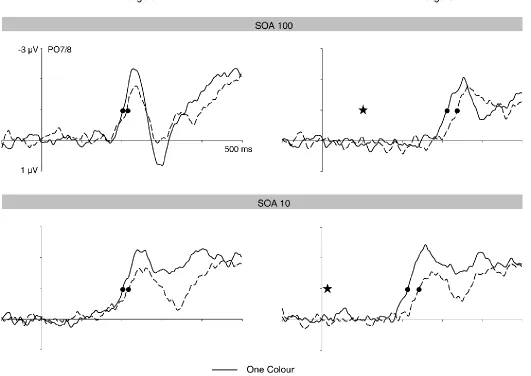
Figure 4. Comparison of target N2pc components obtained in response to H1 targets (left panels) and H2 targets (right panels) in the One and Two Colour tasks of Experiment 1. N2pc difference waves obtained by subtracting ipsilateral from contralateral ERPs are shown separately for the SOA100 and SOA10 conditions. The onset of the second display and the points when the N2pc onset criterion value was reached are marked by stars and circles, respectively. There was a small target N2pc onset delay in the Two Colour task, which was more pronounced for H2 targets.
Figure 5. N2pc components obtained in response to H1 targets (left panels) and H2 targets (right panels) in the three different task conditions of Experiment 2. N2pc difference waves were obtained by subtracting ipsilateral from contralateral ERPs. The onset of the second display is indicated by a star, and the points when N2pc onset criterion values were reached by circles. For H1 targets, N2pc onset is delayed in the Two Colour-Variable task. For H2 target, N2pc components emerge later in both versions of the Two Colour task relative to the One Colour task.
RTs Error rates Overall Same response Different response
Experiment 1
One Colour SOA 100 606 [80] 587 [83] 625 [81] 3.5 [4.0] SOA 10 606 [57] 587 [53] 625 [62] 2.6 [1.9] Two Colour SOA 100 729 [101] 699 [101] 759 [104] 6.0 [5.2] SOA 10 761 [113] 731 [109] 791 [119] 4.0 [4.9]
Experiment 2
One Colour 575 [64] 563 [66] 587 [64] 3.6 [3.7]
Two Colour-Variable 680 [100] 664 [97] 695 [105] 4.9 [3.6] Two Colour-Fixed 679 [108] 657 [103] 700 [114] 4.4 [3.0]
Experiment 3
[image:40.842.90.694.83.445.2]Two Colour-Variable 699 [78] 665 [69] 734 [91] 7.6 [7.1] Two Colour-Random – colour repetition 635 [75] 605 [73] 666 [83] 5.9 [6.0] Two Colour-Random – colour change 708 [82] 678 [79] 739 [92] 7.9 [9.2]
Table 1. RTs (in milliseconds) and error rates (in percentages), shown separately for all task conditions of Experiments 1 to 3. Brackets show standard deviations from the mean. SOA was always 100 ms in Experiments 2 and 3.