N A N O E X P R E S S
Open Access
A delta-doped quantum well system with
additional modulation doping
Dong-Sheng Luo, Li-Hung Lin
2*, Yi-Chun Su
3, Yi-Ting Wang
3, Zai Fong Peng
2, Shun-Tsung Lo
3, Kuang Yao Chen
3,
Yuan-Huei Chang
3, Jau-Yang Wu
4, Yiping Lin
1*, Sheng-Di Lin
4, Jeng-Chung Chen
1, Chun-Feng Huang
5,
Chi-Te Liang
3*Abstract
A delta-doped quantum well with additional modulation doping may have potential applications. Utilizing such a hybrid system, it is possible to experimentally realize an extremely high two-dimensional electron gas (2DEG) density without suffering inter-electronic-subband scattering. In this article, the authors report on transport measurements on a delta-doped quantum well system with extra modulation doping. We have observed a 0-10 direct insulator-quantum Hall (I-QH) transition where the numbers 0 and 10 correspond to the insulator and Landau level filling factorν= 10 QH state, respectively.In situ titled-magnetic field measurements reveal that the observed direct I-QH transition depends on the magnetic component perpendicular to the quantum well, and the electron system within this structure is 2D in nature. Furthermore, transport measurements on the 2DEG of this study show that carrier density, resistance and mobility are approximately temperature (T)-independent over a wide range ofT. Such results could be an advantage for applications in T-insensitive devices.
Introduction
Advances in growth technology have made it possible to introduce dopants which are confined in a single atomic layer [1]. Such a technique, termed delta-doping, can be used to prepare structures which are of great potential applications. For example, many novel structures based on delta-doped structures [2-10] can be experimentally realized using very simple fabrication techniques. It is found that delta-doped quantum wells may suffer from surface depletion and carrier freeze-out, which compro-mise their performances, thereby limiting their potential applications. To this end, a delta-doped quantum well with additional modulation doping can be useful. The modulation doping provides extra electrons so as to avoid carrier freeze-out. On the other hand, it preserves the advantages of a delta-doped quantum well structure, such as an appreciable radiative recombination rate between the two-dimensional electron gas (2DEG) and the photo-generated holes [9], and an extremely high 2DEG density, suitable for high-power field effect
transistor [8]. It is worth mentioning that doped quan-tum wells with additional modulation doping [11-16] have already been used to study the insulator-quantum Hall (I-QH) transition [17-23], a very fundamental issue in the fields of phase transition and Landau quantiza-tion. In order to fully realize its potential as a building block of future devices, it is highly desirable to obtain thorough understanding of the basic properties of a delta-doped quantum well with additional modulation doping. In this article, extensive resistance measure-ments on such a structure are described. At low tem-peratures (0.3 K≤T≤4.2 K), the authors have observed a low-field direct I-QH transition. In situ tilted-field experiments demonstrate that the observed direct I-QH transition only depends on the magnetic field compo-nent applied perpendicular to the quantum well, and thus the electron system within our device is 2D in nat-ure. Resistivity, carrier density, and hence mobility of the device developed are all weakly temperature depen-dent. These results may be useful for simplifying circui-try design for low-temperature amplifiers, and devices for space technology and satellite communications since extensive, costly and time-consuming tests both at room
* Correspondence: [email protected]; [email protected]; [email protected]
1
Department of Physics, National Tsinghwa University, Hsinchu, 300, Taiwan.
2Department of Electrophysics, National Chiayi University, Chiayi, 600, Taiwan.
Full list of author information is available at the end of the article
temperature and at low temperatures may not be required.
Experimental details
The sample that we used in these experiments was grown by molecular beam epitaxy (MBE). The layer sequence was grown on a semi-insulating (SI) GaAs (100) substrate as follows: 500 nm GaAs, 80 nm Al0.33Ga0.67As, 5 nm GaAs, Si delta-doping with a
den-sity of 5 × 1011 cm-2, 15 nm GaAs, 20 nm undoped
Al0.33Ga0.67As, 40 nm Al0.33Ga0.67As layer with a Si-dop-ing density of 1018 cm-3, and 10 nm GaAs cap layer. It is found that electrical contacts to a delta-doped quan-tum well with the same doping concentration do not show Ohmic behaviour atT < 30 K. Therefore, addi-tional modulation doping is introduced in order to pro-vide extra carriers so as to avoid this unwanted effect. As shown later, the carrier density of the 2DEG is indeed higher than the delta-doping concentration. Moreover, the electrical contacts to the 2DEG all show Ohmic behaviour over the whole temperature range (0.3 K≤T≤290 K). Both results demonstrate the usefulness of additional modulation doping. The sample was pro-cessed into a Hall bar geometry using standard optical lithography. The sample studied in this study is different from that reported in Ref. [14] but was cut from the same wafer. Low-temperature magnetotransport mea-surements were performed in a He3 cryostat equipped with anin siturotating insert. Transport measurements over a wide range of temperature were performed in a closed-cycle system equipped with a water-cooled elec-tric magnet.
Results
[image:2.595.305.539.88.610.2]In the system developed in this study, ionized Si dopants confined in a layer of nanoscale can serve as nano-scatterers close to the 2DEG. Figure 1a shows longi-tudinal and Hall resistivity measurements at various temperatures when the magnetic field is applied perpen-dicular to the plane of the 2DEG. Minima inrxx corre-sponding to Landau level filling factorsν= 8, 6 and 4 are observed. On the other hand,rxyis linear at around ν= 8 and 6, and shows only a step-like structure, not a quantized Hall plateau at aroundν= 4. We can see that at the crossing fieldBc, approximately 2.4 T, where the corresponding filling factor is about 10,rxx is approxi-mately T-independent. Near the crossing field,rxx is close to rxy. Therefore, we observe a low-field direct I-QH transition, consistent with existing theory and experimental results [13-16,18-22]. In order to further study this effect, the sample was tilted in situso that
Figure 1Four-terminal magnetoresistance measurements:(a)
Longitudinal resistivityrxxmeasurements as a function of magnetic
fieldrxx(B) at various temperatures. Hall resistivityrxyas a function
ofBatT= 1.9 K is shown.(b)Longitudinal resistivity measurements as a function of total magnetic fieldrxx(Btot) at various
the angle between the appliedBand growth direction is 28.5°. Figure 1b showsrxxandrxyas a function of total magnetic field which is applied perpendicular to the 2DEG plane at various temperatures. Theν= 4 QH-like state is now shifted to a higher field ofBapproximately, 7 T. Similarly, the crossing field is shifted to a higher field of approximately, 2.9 T. The authors now re-plot the data as a function of perpendicular component of the total magnetic field, as shown in Figure 1c. It can be seen that both crossing field and the minimum in rxx corresponding to the ν= 4 QH-like state are now the same as those shown in Figure 1a. The results therefore demonstrate that the electron system are indeed 2D in nature since all the features only depend on theB com-ponent perpendicular to the growth direction. Further-more, the corresponding approximatelyT-independent point inrxxat the crossing field is the same, despite an in-plane magnetic field of approximately 1.4 T being introduced in our tilted-field measurements.
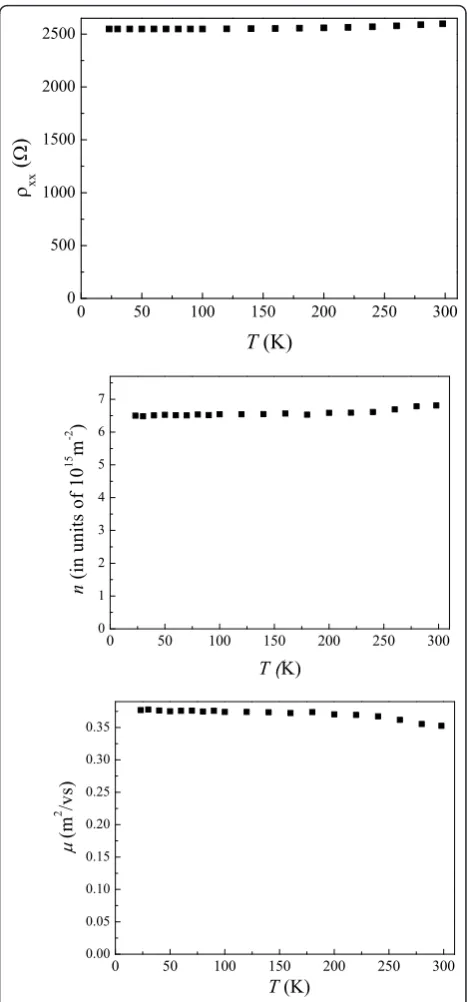
As mentioned earlier, it is highly desirable to obtain a thorough understanding of the basic properties of our system so as to fully realize its potential in electro-nic and optoelectroelectro-nic devices. Figure 2a shows
resis-tivity measurements as a function of T over a wide
range of temperature. Interestingly, rxx is almost T -independent from room temperature down to 23 K. To understand why rxx atB = 0 is insensitive to the temperature, the T-dependence of n is investigated, and μ is obtained using rxx = 1/neμ at zero magnetic field, as shown in Figure 2b, c. The carrier concentra-tion does not decrease too much, and thus the 2DEG does not suffer from the carrier freeze-out at low tem-peratures because of the extra modulation doping.
While μ increases with decreasing T in most 2DEG
because of the reduced electron-phonon scattering, it
can bee seen from Figure 2c that μ saturates and
remains at approximately 0.37 m2/v/s from T = 230 K. For a 2DEG in the delta-doped quantum well, with decreasing T, it shall be considered that the enhance-ment of the multiple scattering may decrease the mobility and thus compensate the reduced electron-phonon scattering effect [6,7]. Therefore, we can design the devices insensitive to T by using the delta-doped quantum well with the extra modulation doping. For example, when designing a circuit for a low-temperature amplifier, such as the one used for space technology and satellite communications, one needs to perform a test at room temperature (RT) first. When cooling down the amplifier, its characteristics can be significantly different since the resistance of the device based on HEMT structure may be a lot lower than that at RT [24]. Therefore substantial variation in the circuitry design based on the RT test is required. Since the rxx, n and μ of our structure are almost
T-independent over a wide range of temperature, a RT test may be sufficient.
[image:3.595.305.539.87.589.2]Both the strong and weak localization effects can com-pensate the reduced electron-phonon effect with decreasing T. To clarify the dominant mechanism lead-ing to the compensation in this study, it is noted that the direct I-QH transition inconsistent with the global Figure 2 Electrical measurements over a wide range of temperature:(a)Resistivity as a function of temperaturerxx(T),(b)
phase diagram of the quantum Hall effect reveals the absence of the strong localization [17,18]. The magneto-oscillations following the semiclassical Shubnilkov-de
Haas formula when B < 6T also indicates that the
strong localization is not significant nearB= 0 [14,23]. Therefore, the weak localization effect should be respon-sible for the enhancement of the multiple scattering, compensating for the reduced electron-phonon effect [25].
Conclusions
In summary, electrical measurements of a delta-doped single quantum well with additional modulation doping have been presented. A direct I-QH transition in such a structure has been observed. In situtilted-field measure-ments demonstrate that the observed 0-10 transition only depends on the magnetic field component applied perpendicular to the quantum well, and therefore the electron system within the sample studied is 2D in nat-ure. Neither carrier freezeout nor second electronic sub-band at a high density of 6.5 × 10¹⁵ m-2is observed in the system proposed. Transport measurements over a wide range of temperature reveal that rxx, n andμ all show very weakTdependencies. These results could be useful for devices which can maintain their characteris-tics over a wide range of temperature. Our results could also be useful for circuit design for low-temperature amplification, and devices for space technology and satellite communications.
Abbreviations
2DEG: two-dimensional electron gas; I-QH: insulator-quantum Hall; MBE: molecular beam epitaxy; RT: room temperature; SI: semi-insulating;T: temperature.
Acknowledgements
This study was funded by the NSC, Taiwan.
Author details
1Department of Physics, National Tsinghwa University, Hsinchu, 300, Taiwan. 2
Department of Electrophysics, National Chiayi University, Chiayi, 600, Taiwan.
3Department of Physics, National Taiwan University, Taipei, 106, Taiwan. 4
Department of Electronics Engineering, National Chiao Tung University, Hsinchu, 300, Taiwan.5National Measurement Laboratory, Centre for
Measurement Standards, Industrial Technology Research Institute, Hsinchu, 300, Taiwan.
Authors’contributions
DSL, LHL, YTW and ZFP performed the low-temperature tilted-field measurements. YCS, STL, and KYC performed the measurements over a wide range of temperature. YHC started the project. CFH and CTL drafted the manuscript. YL and JCC coordinated the measurements. JYW processed the sample. SDL grew the MBE wafer. All authors read and approved the final manuscript.
Competing interests
The authors declare that they have no competing interests.
Received: 31 July 2010 Accepted: 14 February 2011 Published: 14 February 2011
References
1. Wood GEC, Metze G, Berry J, Eastman LF:Complex free-carrier profile synthesis by“atomic-plane’’doping of MBE GaAs.J Appl Phys1980,
51:383.
2. Liu DG, Lee CP, Chang KH, Wu JS, Liou DC:Delta-doped quantum well structures grown by molecular beam epitaxy.Appl Phys Lett1990,
57:1887.
3. Wagner J, Ramsteiner M, Richards D, Fasol G, Ploog K:Effect of spatial localization of dopant atoms on the spacing of electron subbands inδ -doped GaAs:Si.Appl Phys Lett1991,58:143.
4. Kim Y, Kim MS, Min SK:Properties of center and edgeδ-doped GaAs-AlGaAs quantum wells grown by metalorganic chemical vapor deposition.Appl Phys Lett1993,62:741.
5. Kim TW, Kim Y, Min SK:Magnetotransport and electric subband studies of Si-delta-doped Al0.27Ga0.73As/GaAs single quantum wells grown by
metalorganic chemical vapour deposition.Thin Solid Films1995,254:61. 6. Lee CH, Chang YH, Suen YW, Lin HH:Magnetic-field-induced
insulator-quantum Hall conductor-insulator transitions in doped GaAs/AlxGa1-xAs quantum wells.Phys Rev B1997,56:15238.
7. Lee CH, Chang YH, Suen YW, Lin HH:Magnetic-field-induced
delocalization in center-doped GaAs/AlxGa1-xAs multiple quantum wells.
Phys Rev B1998,58:10629.
8. Lee CH, Chang YH, Huang CF, Huang MY, Lin HH, Lee CP:Transport and Optical Studies of the D–Conduction Band in Doped GaAs/AlGaAs Quantum Wells.Chin J Phys2001,39:363.
9. Wagner J, Fischer A, Ploog K:Fermi edge singularity and screening effects in the absorption and luminescence spectrum of Siδ-doped GaAs.Appl Phys Lett1991,59:428.
10. Oubram O, Mora-Ramos ME, Gaggero-Sager LM:Effect of the hydrostatic pressure on two-dimensional transport in delta-doped systems.Eur J Phys2009,71:233.
11. Kim GH, Liang CT, Huang CF, Nicholls JT, Ritchie DA, Kim PS, Oh CH, Juang JR, Chang YH:From localization to Landau quantization in a two-dimensional GaAs electron system containing self-assembled InAs quantum dots.Phys Rev B2004,69:073311.
12. Chang WH, Lin CH, Fu YJ, Lin TC, Lin H, Cheng SJ, Lin SD, Lee CP:Impacts of Coulomb Interactions on the Magnetic Responses of Excitonic Complexes in Single Semiconductor Nanostructures.Nanoscale Res Lett 5:680.
13. Huang TY, Juang JR, Huang CF, Kim GH, Huang CP, Liang CT, Chang YH, Chen YF, Lee Y, Ritchie DA:On the low-field insulator-quantum Hall conductor transitions.Physica E2004,22:240.
14. Chen KY, Chang YH, Liang CT, Aoki N, Ochiai Y, Huang CF, Lin LH, Cheng KA, Cheng HH, Lin HH, Wu JY, Lin SD:Probing Landau quantization with the presence of insulator-quantum Hall transition in a GaAs two-dimensional electron system.J Phys: Condens Matter2008,20:295223. 15. Huang TY, Liang CT, Kim GH, Huang CF, Huang CP, Lin JY, Goan HS,
Ritchie DA:From insulator to quantum Hall liquid at low magnetic fields. Phys Rev B2008,78:113305.
16. Huang TY, Huang CF, Kim GH, Huang CP, Liang CT, Ritchie DA:An Experimental Study on the Hall Insulators.Chin J Phys2009,47:401. 17. Kivelson S, Lee DH, Zhang SC:Global phase diagram in the quantum Hall
effect.Phys Rev B1992,46:2223.
18. Huckestein B:Quantum Hall Effect at Low Magnetic Fields.Phys Rev Lett
2000,84:3141, and references therein.
19. Huang CF, Chang YH, Lee CH, Chou HT, Yeh HD, Liang CT, Chen YF, Lin HH, Cheng HH, Hwang GJ:Insulator-quantum Hall conductor transitions at low magnetic field.Phys Rev B2002,65:045303. 20. Song SH, Shahar D, Tsui DC, Xie YH, Monroe D:New Universality at the
Magnetic Field Driven Insulator to Integer Quantum Hall Effect Transitions.Phys Rev Lett1997,78:2200.
21. Lin JY, Chen JH, Kim GH, Park H, Youn DH, Jeon CM, Baik JM, Lee JL, Liang CT, Chen YF:Magnetotransport Measurements on an AlGaN/ GaN Two-Dimensional Electron System.J Korean Phys Soc2006,
49:1130.
22. Chen KY, Liang CT, Aoki N, Ochiai Y, Cheng KA, Lin LH, Huang CF, Li YR, Tseng YS, Yang CK, Lin PT, Wu JY, Lin SD:Probing Insulator-quantum Hall Transitions by Current Heating.J Korean Phys Soc2009,55:64.
direct insulator-quantum Hall transition.Solid State Commun2010,
150:1902.
24. Boutez C, Crozat P, Danelon V, Chaubet M, Febvre P, Beaudin G:A low-noise cryogenically-cooled 8-12 GHz HEMT Amplifier for future space applications.Int J Infrared Millimeter Waves1997,18:85.
25. Pfeiffer L, West KW, Stormer HL, Baldwin KW:Electron mobilities exceeding 107 cm2/Vs in modulation-doped GaAs.Appl Phys Lett1989,55:1888.
doi:10.1186/1556-276X-6-139
Cite this article as:Luoet al.:A delta-doped quantum well system with
additional modulation doping.Nanoscale Research Letters20116:139.
Submit your manuscript to a
journal and benefi t from:
7Convenient online submission
7Rigorous peer review
7Immediate publication on acceptance
7Open access: articles freely available online
7High visibility within the fi eld
7Retaining the copyright to your article