A Monthly Double-Blind Peer Reviewed Refereed Open Access International e-Journal - Included in the International Serial Directories.
RISK OF OBSOLESCENCE OF SYSTEM IN E-BANKING IN INDIA
Prof. S. Singh,
Department of Business Administration
Chaudhary Devi Lal University, Sirsa-12505, Haryana,India.
ABSTRACT
This paper analyzed the bankers’ viewpoint towards the factors responsible for risk of
obsolescence of system in e-banking in India, its potential impacts and the risk management
measures taken by selected public, private and foreign banks in India. A sample of 107, 104 and
100 respondents (bank employees) is taken for data collection from the different branches
located in Haryana, Punjab, Chandigarh and Delhi from selected public, private and foreign
banks respectively. Statistical techniques such as mean, mode, standard deviation have been
used for the analysis of data. ANOVA technique has been applied to validate the results. The
analysis shows that delay in processing of transactions is found as the most important factor
leading to the risk of obsolescence of the system followed by disruptions in processing
transaction in public and private sector banks, whereas disruptions in processing transactions is
found as the most important factor leading to the risk of obsolescence of the system followed by
deficiencies in the system and delays in processing transactions in foreign banks. On the other
hand, adverse public reactions is viewed as the most potential impact on these banks followed
by possible legal repercussions as law suits could result from erroneous transactions and costs
associated with resolving customers’ problems. Further, regular review of capabilities of
existing software to overcome the risk of obsolescence of the system is viewed as the most
adopting measure followed by regular review of capabilities of existing hardware, installation
of accountability system that assigns responsibility for updates to equipment/system in the
selected banks under study.
RISK OF OBSOLESCENCE OF SYSTEM IN E-BANKING IN INDIA
Indian banking industry today is in the mid of an IT revolution. New private sector banks and
foreign banks have an edge over public sector banks in the implementation of technological
solutions. However, public sector banks are in the process of making huge investment in
technology. To be successful in this competitive environment, these banks have to take certain
steps like cost reduction by economies of scale, better relations with the customers by providing
better services and facilities to them. Pressure of performance and profitability will keep them on
their toes all the times as the shareholders expect good performance along with good returns on
their equity. The changing scenario and the new technologies like internet banking, mobile
banking, improvement in payment technology, etc. can help in increasing the scale of economies
in providing financial services. With the help of technology, the banks are now able to offer such
products and services, which were difficult or impossible with traditional banking. But Indian
banks have to go a long way before making themselves technology savvy. India has been able to
take one step in this direction - physical cash has been replaced by anytime, anywhere money,
but these are more pronounced in foreign and private sector banks. The public sector banks are
far behind in technology integration. Thus, there is a huge scope for automation in the banking
industry. The service based areas of banks have perhaps been the largest beneficiary of
e-banking. ATMs, credit cards, internet banking, mobile banking which are already widely used
around the world, have yet to reach their full potential in India. These services and products are
all expected to grow in the coming years. No doubt, e-banking provides so many benefits, but
face to face contact between the bank and the customer is absent in e-banking transactions,
which causes most of the problems like credit card frauds, fraud of internet, etc. Rising
competition is forcing the banks to find innovative ways to reduce the cost of transactions and
increase the profitability. Technology has been one of the major enabling factors for enhancing
the customer convenience in the products and services offered by the various banks and help in
enhancing service range but the security of the transactions is a major concern. While it mitigates
A Monthly Double-Blind Peer Reviewed Refereed Open Access International e-Journal - Included in the International Serial Directories. risk, operational risk, security risk, privacy/security risk, legal risk, cross-border risk,
reputational risk, liquidity risk, etc. These risks are highly interdependent and events that affect
one area of risk can have ramifications for a range of other risk categories.
Review of Literature
Various articles appeared in different journals in varied aspects of e-banking, which are
restrictive in nature and do not give a comprehensive picture. Ahmad et. al. (2010) discussed the
security issues on banking systems and stated that banking system intrusion shows the
vulnerabilities that exists in financial institution, that have been used by those illegal and
unauthorized individuals or groups to intrude an area with secure environment. With the
developing of high technology and information system around the world, banking system should
not be left behind in terms of security system and should keep a sharp eye when there is any
vulnerability in authentication and authorization that may lead to confidentiality, availability and
integrity issues. Fatima (2011) concluded that biometric based authentication and identification
systems are the new solutions to address the issues of security and privacy. One thing that can
be said with certainty about the future of the biometrics industry is that is growing. Biometrics is
finding their way into all kinds of applications beyond access control. It is expected that more
and more information systems/computer networks will be secured with biometrics with the rapid
expansion of internet and intranet. Adewuyi (2011) examined the concept of information
technology, meaning of e-banking, origin of e-banking in Nigeria, areas of information and
communication technology deployment by banks, guidelines on e-banking in Nigeria, reasons
for automation of banking operation, challenges of regulatory on e-banking in Nigeria and the
way forward. It is concluded that the adoption of TCT has influenced the content and quality of
banking operations and presents great potential for business re-engineering of Nigerian banks.
Thus investment in ICT should form an important component in the overall strategy of banking
operation to ensure effective performance. Mermod (2011) analyzed the internet bank branches
in Turkey with regard to many dimensions and found that online customers admit that internet
bank branches are safe and cheaper and understandable and saving extra time. Internet banking
usage rate of the internet banking is significantly related with the education levels. Education and
also income level makes an important difference in the usage of internet banking facilities.
Karimzadeh and Alam (2012) examined the e-banking challenges in India and concluded that
legal and security, socio-cultural and management, banking issues are accepted as challenges for
the development of e-banking. But there is less awareness regarding new technologies and
unsuitable software which are ranked respectively as the highest and lowest obstacles in India.
Osunmuyiwa (2013) examined the various aspects of online banking risks and the risk
management methods employed in mitigating these risks. It is widely recommended that banks
that carry out online banking clearly should explain the privacy rule and communicate it to their
clients. Banks can also make use of materials like vendor oversight, assignment sheet; excel
spreadsheet for risk assessment for policies amongst so many created from a range of date
resources to carry out data safekeeping. With this background, an attempt is made to examine the
various aspects of risk of obsolescence of system in e-banking in selected public, private and
foreign banks in India.
Scope of the Study
The present study is confined to the selected public, private and foreign banks in Haryana, Delhi,
Chandigarh and Punjab.
Objectives of the Study
The present study is conducted to achieve the following objectives:
1. To identify the factors leading to risk of obsolescence of system in e-banking.
2. To examine the potential impacts of risk of obsolescence of system in e-banking.
3. To appraise the risk management measures for overcoming the risk of obsolescence of
system in e-banking.
Research Hypotheses
The following hypotheses have been formulated and tested to validate the results of the study:
H01: There is no significant difference among the bankers’ viewpoint towards the factors
A Monthly Double-Blind Peer Reviewed Refereed Open Access International e-Journal - Included in the International Serial Directories.
H02: There is no significant difference among the bankers’ viewpoint towards the potential
impacts of risk of obsolescence of system in e-banking.
H03: There is no significant difference among the bankers’ viewpoint towards the risk
management measures to overcome the risk of obsolescence of system in e-banking.
Sample Profile
For the purpose of the study, all the banks have been divided into three categories i.e. public,
private and foreign banks. The banks selected from the public sector are State Bank of India
(SBI), State Bank of Patiala (SBP), State Bank of Bikaner and Jaipur (SBBJ), Punjab National
Bank (PNB), Dena Bank (DB), Oriental Bank of Commerce (OBC), Canara Bank (CB), Central
Bank of India (CBI), Union Bank (UB), Corporation Bank (CB), Bank of Baroda (BOB),
Allahabad Bank (AB), Bank of India (BOI), Syndicate Bank (SB) and Indian Bank (IB). The
banks selected from the private sector are ICICI Bank (ICICI), Axis Bank (AXIS), IDBI Bank
(IDBI), HDFC Bank (HDBC), Yes Bank (YB), Kotak Mahindra Bank (KOTAK) and The
Federal Bank Limited (FBL). Foreign banks include Standard Chartered Bank, City Bank, SBER
Bank, State Bank of Mauritius, ABN-AMRO Bank N.V., HSBC Bank, American Express, BNP
Paribas, Deutsche Bank and Barclays Bank.
Data Collection
The present study is of analytical and exploratory in nature. Accordingly, the use is made of
primary as well as secondary data. The primary data are collected with the help of pre-tested
structured questionnaire from the respondents (banks’ officials) of selected banks on five point
Likert Scale i.e. Strongly Disagree (SD), Disagree (A), Neutral (N), Agree (A), and Strongly
Agree (SA). A sample of 375 respondents is taken from the various branches of the selected
banks (125 respondents from each group). After examination, 107 questionnaires from public
sector banks, 104 from private sector banks and 100 from foreign banks were found complete
and used for further analysis. Besides questionnaires, interviews and discussion techniques were
also used to unveil the information. On the other hand, the secondary data were collected mainly
from RBI Monthly Bulletins, IBA Bulletins, Economic and Political Weekly, Bank
Management, Professional Banker; and newspapers like The Economic Times, The Financial
Data Analysis
The collected data were analyzed through descriptive statistical techniques like frequency
distribution, percentage, mean, mode, standard deviation. For coding and analyzing the data,
weights are assigned in order of importance i.e. 1 to Strongly Disagree (SD), 2 to Disagree (A), 3
to Neutral, 4 to Agree (A), and 5 to Strongly Agree (SA). To examine the bankers’ viewpoints
towards factors responsible for e-banking risks, their potential impacts, and the risk management
measures taken by the selected banks; ANOVA technique was employed to test the hypotheses
and validate the results. The analysis is in conformity with the objectives of the study and the
hypotheses formulated. The collected data are analyzed through PASW 18.0 version.
Results and Discussions
(A) Factors Leading to Risk of Obsolescence of System
The various factors leading to the risk of obsolescence of the system in selected banks are given
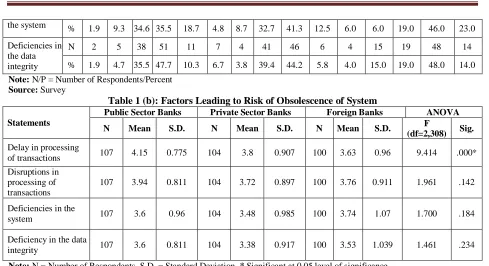
in Table 1 (a) and 1(b).
Public Sector Banks
Delay in processing of transactions (Mean = 4.15, S.D. = 0.775) is found as the most important
factor leading to the obsolescence of the system in these banks as per the responses of 63
respondents (58.9 per cent). Disruptions in processing of transactions (Mean = 3.94, S.D. =
0.811) is considered as the second important factor by 65 respondents (60.7 per cent). On the
other hand, deficiencies in the data integrity system (Mean = 3.6, S.D. = 0.96) and deficiencies in
the system (Mean = 3.6, S.D. = 0.811) are found as the last two important factors as per the
opinion of 51 respondents (47.7 per cent) and 38 respondents (35.5 per cent) respectively.
Table 1 (a): Factors Leading to Risk of Obsolescence of System
Statements N/P Public Sector Banks Private Sector Banks Foreign Banks
SD D I A SA SD D I A SA SD D I A SA
Delay in processing of transactions
N 2 2 7 63 33 5 5 10 70 14 4 7 26 48 15
% 1.9 1.9 6.5 58.9 30.8 4.8 4.8 9.6 67.3 13.5 4.0 7.0 26.0 48.0 15.0
Disruptions in processing of transactions
N 2 4 14 65 22 4 4 24 57 15 2 11 11 61 15
% 1.9 3.7 13.1 60.7 20.6 3.8 3.8 23.1 54.8 14.4 2.0 11.0 11.0 61.0 15.0
A Monthly Double-Blind Peer Reviewed Refereed Open Access International e-Journal - Included in the International Serial Directories.
the system % 1.9 9.3 34.6 35.5 18.7 4.8 8.7 32.7 41.3 12.5 6.0 6.0 19.0 46.0 23.0
Deficiencies in the data integrity
N 2 5 38 51 11 7 4 41 46 6 4 15 19 48 14
% 1.9 4.7 35.5 47.7 10.3 6.7 3.8 39.4 44.2 5.8 4.0 15.0 19.0 48.0 14.0
Note: N/P = Number of Respondents/Percent
Source: Survey
Table 1 (b): Factors Leading to Risk of Obsolescence of System
Statements
Public Sector Banks Private Sector Banks Foreign Banks ANOVA
N Mean S.D. N Mean S.D. N Mean S.D. F
(df=2,308) Sig.
Delay in processing
of transactions 107 4.15 0.775 104 3.8 0.907 100 3.63 0.96 9.414 .000*
Disruptions in processing of transactions
107 3.94 0.811 104 3.72 0.897 100 3.76 0.911 1.961 .142
Deficiencies in the
system 107 3.6 0.96 104 3.48 0.985 100 3.74 1.07 1.700 .184
Deficiency in the data
integrity 107 3.6 0.811 104 3.38 0.917 100 3.53 1.039 1.461 .234
Note: N = Number of Respondents, S.D. = Standard Deviation, * Significant at 0.05 level of significance
Source: Survey
Private Sector Banks
Delay in processing of transactions (Mean = 3.8, S.D. = 0.907) is viewed by 70 respondents
(67.3 per cent) as the most important factor leading to the obsolescence of the system.
Disruptions in processing of transactions (Mean = 3.72, S.D. = 0.897) is considered the second
important factor as per the responses of 57 respondents (54.8 per cent). On the other hand,
deficiencies in the system (Mean = 3.6, S.D. = 0.811) and deficiency in the data integrity system
(Mean = 3.6, S.D. = 0.96) are considered as the least important factors by 43 respondents (41.3
per cent) and 46 respondents (44.2 per cent) respectively.
Foreign Banks
Disruptions in processing of transactions (Mean = 3.76, S.D. = 0.911) is viewed by 61
respondents (61.0 per cent) as the most important factor leading to the obsolescence of the
system. Deficiencies in the system (Mean = 3.74, S.D. = 1.07) is found as the second important
factor as per the responses of 46 respondents (46.0 per cent). On the other hand, delays in
processing of transactions (Mean = 3.63, S.D. = 0.96) and deficiencies in the data integrity
system (Mean = 3.53, S.D. = 1.039) are considered as the last two important factors as per the
[image:7.612.78.567.68.334.2]The results of ANOVA in Table 1 (b) show that there is a significant difference among the
bankers’ viewpoint towards delays in processing of transactions (p=0.00, df=2, 308) at 0.05 level
of significance. Therefore, the null hypothesis (H01) is rejected.
(B) Potential Impacts of Risk of Obsolescence of System
The potential impacts of risk of obsolescence of system on the performance of selected banks are
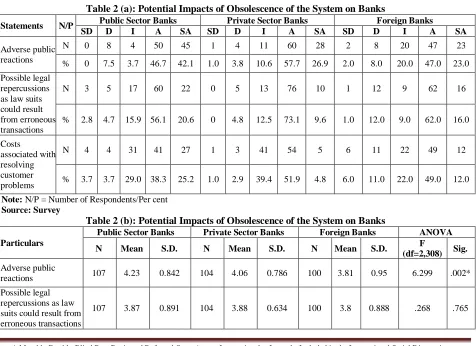
given in Table 2 (a) and 2 (b).
Public Sector Banks
Adverse public reactions (Mean = 4.23, S.D. = 0.842) is viewed as the most potential impact on
these banks as per the responses of 50 respondents (46.7 per cent). Possible legal repercussions
as law suits could result from erroneous transactions (Mean = 3.87, S.D. = 0.891) is considered
as the next potential impact by 60 respondents (56.1 per cent). However, the costs associated
with resolving customers’ problems (Mean = 3.78, S.D. = 0.993) is found as the next potential
impact as viewed by 41 respondents (38.5 per cent).
Table 2 (a): Potential Impacts of Obsolescence of the System on Banks
Statements N/P Public Sector Banks Private Sector Banks Foreign Banks
SD D I A SA SD D I A SA SD D I A SA
Adverse public reactions
N 0 8 4 50 45 1 4 11 60 28 2 8 20 47 23
% 0 7.5 3.7 46.7 42.1 1.0 3.8 10.6 57.7 26.9 2.0 8.0 20.0 47.0 23.0
Possible legal repercussions as law suits could result from erroneous transactions
N 3 5 17 60 22 0 5 13 76 10 1 12 9 62 16
% 2.8 4.7 15.9 56.1 20.6 0 4.8 12.5 73.1 9.6 1.0 12.0 9.0 62.0 16.0
Costs
associated with resolving customer problems
N 4 4 31 41 27 1 3 41 54 5 6 11 22 49 12
% 3.7 3.7 29.0 38.3 25.2 1.0 2.9 39.4 51.9 4.8 6.0 11.0 22.0 49.0 12.0
Note: N/P = Number of Respondents/Per cent
Source: Survey
Table 2 (b): Potential Impacts of Obsolescence of the System on Banks
Particulars
Public Sector Banks Private Sector Banks Foreign Banks ANOVA
N Mean S.D. N Mean S.D. N Mean S.D. F
(df=2,308) Sig.
Adverse public
reactions 107 4.23 0.842 104 4.06 0.786 100 3.81 0.95 6.299 .002*
Possible legal repercussions as law suits could result from erroneous transactions
[image:8.612.85.561.365.711.2]A Monthly Double-Blind Peer Reviewed Refereed Open Access International e-Journal - Included in the International Serial Directories.
Costs associated with resolving customer problems
107 3.78 0.993 104 3.57 0.679 100 3.5 1.04 2.568 .078
Note: N = Number of Respondents, S.D. = Standard Deviation, * Significant at 0.05 level of significance
Source: Survey
Private Sector Banks
Adverse public reactions (Mean = 4.06, S.D. = 0.786) is viewed as the most potential impact on
the private sector banks as per the responses of 60 respondents (57.7 per cent). Possible legal
repercussions as law suits could result from erroneous transactions (Mean = 3.88, S.D. = 0.634)
is considered as the next potential impact by 76 respondents (73.1 per cent). However, the costs
associated with resolving customers’ problems (Mean = 3.57, S.D. = 0.679) is found as the next
potential impact by 54 respondents (51.9 per cent).
Foreign Banks
Adverse public reactions (Mean = 3.81, S.D. = 0.95) is found as the most potential impact on
these banks as per the responses of 47 respondents (47.0 per cent). Possible legal repercussions
as law suits could result from erroneous transactions (Mean = 3.8, S.D. = 0.888) is considered as
the next potential impact by 62 respondents (62.0 per cent). On the other hand, the costs
associated with resolving customers’ problems (Mean = 3.5, S.D. = 1.04) is found as the next
potential impact by 49 respondents (49.0 per cent).
The results of ANOVA in Table 2 (b) show that there is a significant difference among the
bankers’ viewpoint towards adverse public reactions (p=0.002, df=2, 308) at 0.05 level of
significance. Therefore, the null hypothesis (H02)is rejected.
(C) Risk Management Measures to Overcome Risk of Obsolescence of System
The risk management measures to overcome the risk of obsolescence of the system in selected
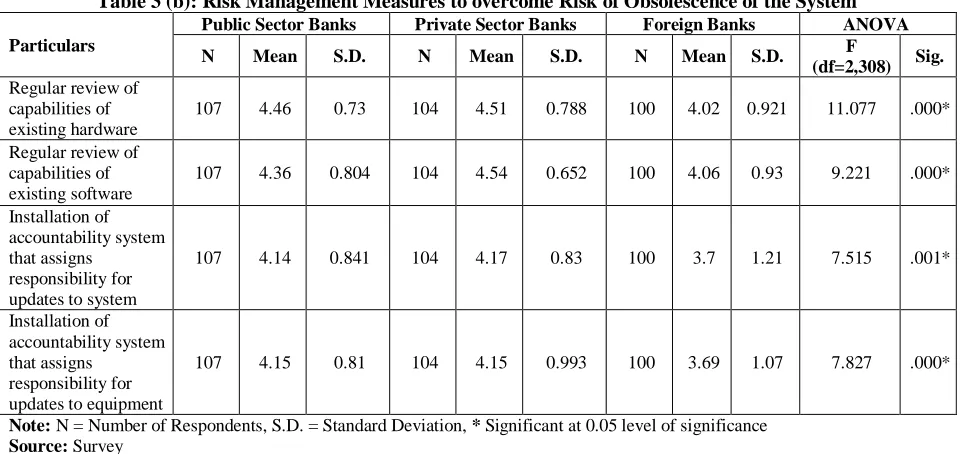
banks are presented in Table 3 (a) and 3 (b).
Public Sector Banks
Regular review of capabilities of existing hardware (Mean = 4.46, S.D. = 0.73) is viewed by 60
respondents (56.1 per cent) as the top most adopting measure in public sector banks. Regular
review of capabilities of existing software (Mean = 4.36, S.D. = 0.804) is considered as the next
most adopting measure as per the opinion of 54 respondents (50.5 per cent). However,
installation of accountability system that assigns responsibility for updates to equipment (Mean =
(51.4 per cent). Installation of accountability system that assigns responsibility for updates to
system (Mean = 4.14, S.D. = 0.841) is found as the next adopting measure as per the responses
of 51 respondents (47.7 per cent) in public sector banks.
Table 3 (a): Risk Management Measures to Overcome Risk of Obsolescence of System
Statements N/P Public Sector Banks Private Sector Banks Foreign Banks
SD D I A SA SD D I A SA SD D I A SA
Regular review of capabilities of existing hardware
N 0 4 3 40 60 1 3 4 30 66 1 10 5 54 30
% 0 3.7 2.8 37.4 56.1 1.0 2.9 3.8 28.8 63.5 1.0 10.0 5.0 54.0 30.0
Regular review of capabilities of existing software
N 0 6 4 43 54 0 1 6 33 64 1 8 10 46 35
% 0 5.6 3.7 40.2 50.5 0 1.0 5.8 31.7 61.5 1.0 8.0 10.0 46.0 35.0
Installation of accountability system that assigns responsibility for updates to system
N 0 7 10 51 39 0 5 13 45 41 9 7 17 39 28
% 0 6.5 9.3 47.7 36.4 0 4.8 12.5 43.3 39.4 9.0 7.0 17.0 39.0 28.0
Installation of accountability system that assigns responsibility for updates to equipment
N 1 4 10 55 37 5 3 5 49 42 5 9 20 44 22
% .9 3.7 9.3 51.4 34.6 4.8 2.9 4.8 47.1 40.4 5.0 9.0 20.0 44.0 22.0
Note: N/P = Number of Respondents/Percent
Source: Survey
Table 3 (b): Risk Management Measures to overcome Risk of Obsolescence of the System
Particulars
Public Sector Banks Private Sector Banks Foreign Banks ANOVA
N Mean S.D. N Mean S.D. N Mean S.D. F
(df=2,308) Sig.
Regular review of capabilities of existing hardware
107 4.46 0.73 104 4.51 0.788 100 4.02 0.921 11.077 .000*
Regular review of capabilities of existing software
107 4.36 0.804 104 4.54 0.652 100 4.06 0.93 9.221 .000*
Installation of accountability system that assigns
responsibility for updates to system
107 4.14 0.841 104 4.17 0.83 100 3.7 1.21 7.515 .001*
Installation of accountability system that assigns
responsibility for updates to equipment
107 4.15 0.81 104 4.15 0.993 100 3.69 1.07 7.827 .000*
Note: N = Number of Respondents, S.D. = Standard Deviation, * Significant at 0.05 level of significance
[image:10.612.85.561.148.442.2] [image:10.612.82.563.471.698.2]A Monthly Double-Blind Peer Reviewed Refereed Open Access International e-Journal - Included in the International Serial Directories.
Private Sector Banks
Regular review of capabilities of existing software (Mean = 4.54, S.D. = 0.652) is viewed as the
top most adopting measure by 64 respondents (61.5 per cent) in these banks. Regular review of
capabilities of existing hardware (Mean = 4.51, S.D. = 0.788) is considered as the next most
adopting measure by 66 respondents (63.5 per cent). However, the installation of accountability
system that assigns responsibility for updates to system (Mean = 4.17, S.D. = 0.83) is found as
the third important measure as per the responses of 45 respondents (43.3 per cent), whereas the
installation of accountability system that assigns responsibility for updates to equipment (Mean =
4.15, S.D. = 0.993) is found as the next adopting measure by 49 respondents (47.1 per cent) in
private sector banks.
Foreign Banks
Regular review of capabilities of existing software (Mean = 4.06, S.D. = 0.93) is viewed as the
most adopting measure as per the responses of 46 respondents (46.0 per cent). Regular review of
capabilities of existing hardware (Mean = 4.02, S.D. = 0.921) is considered as the next most
adopting measure by 54 respondents (54.0 per cent). However, the installation of accountability
system that assigns responsibility for updates to system (Mean = 3.7, S.D. = 1.21) is found as the
third important measure as per the responses of 39 respondents (39.0 per cent), whereas the
installation of accountability system that assigns responsibility for updates to equipment (Mean =
3.69, S.D. = 1.07) is viewed as the last adopting measure as per the responses of 44 respondents
(44.0 per cent) in foreign banks.
The results of ANOVA in Table 3 (b) show that there is a significant difference among the
bankers’ viewpoint towards regular review of capabilities of existing hardware (p=0.00, df=2,
308), regular review of capabilities of existing software (p=0.00, df=2, 308), installation of
accountability system that assigns responsibility for updates to system (p=0.001, df=2, 308) and
installation of accountability system that assigns responsibility for updates to equipment
(p=0.00, df=2,308) at 0.05 level of significance. Therefore, the null hypothesis (H03)is rejected.
Conclusion
To sum up, delay in processing of transactions is found as the most important factor leading to
private sector banks, whereas disruptions in processing transactions is viewed as the most
important factor leading to the obsolescence of the system followed by deficiencies in the system
and delays in processing transactions in foreign banks. On the other hand, adverse public
reactions is viewed as the most potential impact on these banks followed by possible legal
repercussions as law suits could result from erroneous transactions and costs associated with
resolving customers’ problems. Further, regular review of capabilities of existing software is
viewed as the most adopting measure followed by regular review of capabilities of existing
hardware, installation of accountability system that assigns responsibility for updates to
equipment/system in the selected banks under study.
References
Adewuyi, I. D. (2011), Electronic Banking in Nigeria: Challenges of the Regulatory Authorities and the Way Forward”, International Journal of Economic Development Research and Investment, Vol. 2, No. 01, April, pp. 149-156.
Ahmad, Mohd. Khairul Affendy and others (2010), “Security Issues on Banking Systems”, International Journal of Computer Science and Information Technologies, Vol. 1(4), pp. 268-272, ISSN: 0975-9646.
Fatima, Amtul (2011), “E-Banking Security Issues - Is There A Solution in Biometrics?”, Journal of Internet Banking and Commerce, August, Vol. 16, No. 02, pp. 1-9.
Karimzadeh, Majid and Alam, Dastgir (2012), “Electronic Banking Challenges in India: An Empirical Investigation”, Interdisciplinary Journal of Contemporary Research in Business”, Vol. 04, No.02, June, pp. 31-45.
Mermod, Asli Yijksel (2011), “Customer’s Perspectives and Risk Issues on E-Banking in Turkey: Should We Still be Online?”, Journal of Internet Banking and Commerce, Vol. 16, No.01, pp. 1-15.