Volume 2008, Article ID 350326,20pages doi:10.1155/2008/350326
Research Article
The Schwarz-Christoffel Conformal Mapping for
“Polygons” with Infinitely Many Sides
Gonzalo Riera, Hern ´an Carrasco, and Rub ´en Preiss
Departamento de Matem´aticas, Pontificia Universidad Cat´olica de Chile, Avenue Vicu ˜na Makenna 4860, 7820436 Macul, Santiago, Chile
Correspondence should be addressed to Gonzalo Riera,[email protected]
Received 22 January 2008; Revised 15 May 2008; Accepted 1 July 2008
Recommended by Vladimir Mityushev
The classical Schwarz-Christoffel formula gives conformal mappings of the upper half-plane onto domains whose boundaries consist of a finite number of line segments. In this paper, we explore extensions to boundary curves which in one sense or another are made up of infinitely many line segments, with specific attention to the “infinite staircase” and to the Koch snowflake, for both of which we develop explicit formulas for the mapping function and explain how one can use standard mathematical software to generate corresponding graphics. We also discuss a number of open questions suggested by these considerations, some of which are related to differentials on hyperelliptic surfaces of infinite genus.
Copyrightq2008 Gonzalo Riera et al. This is an open access article distributed under the Creative Commons Attribution License, which permits unrestricted use, distribution, and reproduction in any medium, provided the original work is properly cited.
1. Introduction
LetDbe a polygon in the complex plane withnvertices and interior anglesπαi, 0 ≤ αi ≤
2, 1≤i≤n; the exterior angles are given byπμi, whereαiμi1. The Schwarz-Christoffel
mapping of the upper-half plane ontoDis effected by a function of the form
fz α z
0
dx
x−aiμ1· · ·x−anμn
β, 1.1
wherea1<· · ·< anare real andα, β∈C.
Although there is ample literature on the subject see, e.g., 1–3, as well as the complete overview contained in Driscoll and Threfethen4, a few remarks would not be out of place here. First of all, even though1.1 gives the appearance of being an explicit formula, there is actually no known relation between the values of theai and the lengths
manyai.
Before proceeding, we review some variations of1.1. One of the points ai may be
located at∞, the formula remaining the same, and one of the vertices of the polygon may be at∞, where we use the relationμ1· · ·μn 2. The formula for mapping the unit disc
conformally ontoDis essentially the same, but with|ai|1, 1 ≤i≤n. The formula for the
mapping onto the exterior of the polygon is
gz α z
1
eλxx−a1μ1· · ·x−anμn
dx
x2 β 1.2
withλni1μi/ ai.
In this paper, we explore the case in which there are infinitely many pointsai on the
real lineor the unit circleand obtain results for two kinds of “polygons.”
1.1. Polygons with an infinite number of sides
This is the case, for example, of an “infinite stairway” with interior angles alternately equal toπ/2 and 3π/2. The formula in this case is
fz z
0
tanxdx. 1.3
The zeros of the denominator cosx correspond toai 2i1π/2, μi 1/2 and
those of the numerator sinxtoaiiπ, μi−1/2.
1.2. Fractals
This is the case, for example, of the interior of the Koch snowflake, for which the formula on the interior of the unit disc turns out to be
gz z
0
∞
n0
1x6·4ndx. 1.4
A similar generalization of1.2gives the conformal mapping onto the exterior of the Koch snowflake.
To reproduce the figures in the text, a program such as Derive, Maple, or Mathematica is required; we explain in each case how to obtain these figures.
We mention here the open problem of a half-strip slit along infinite sequences of equal-length line segments emanating from the infinite sides.
1.5
The mapping of the half-plane onto this domain is of importance in the study of differentials on hyperelliptic surfaces of infinite genus as considered in the pioneering work by Myrberg, see5.The formula for the case of the analogously slitted full strip is obtained below.
2. Polygons with an infinite number of sides
2.1. The infinite staircase
The first example we consider is the mapping defined on the upper half-plane by the formula
fz z
0
tanxdx. 2.1
The image is given inFigure 1, where the curves shown are the images of horizontal and vertical segments lying in the half-plane; they can be defined directly by
αs
Re
Numint
tanx, x0 to 0.6si
,
Im
Numint
tanx, x0 to 0.6si
, 0.1≤s≤1.1
2.2
for a vertical segment, and by
βs
Re
Numint
tanx, x0 to 0.09is
,
Im
Numint
tanx, x0 to 0.09is
, 0.4≤s≤10
2.3
for a horizontal segment.
The image of the real axis is the infinite staircase with steps of equal length π/2
0
tanxdx π √
2
2 . 2.4
7 6 5 4 3 2 1 1 2 3 4 5
Figure 1: The infinite staircase.fz z0√tanx dx.
π/2
3
2
0
1
Figure 2
Consider the trianglei.e., half-stripofFigure 2.
The image of the positive imaginary axislabeled1in the figureis given by is
0
tanxdx i s
0
tanitdt −1√i 2
s
0
et−e−t
ete−tdt 2.5
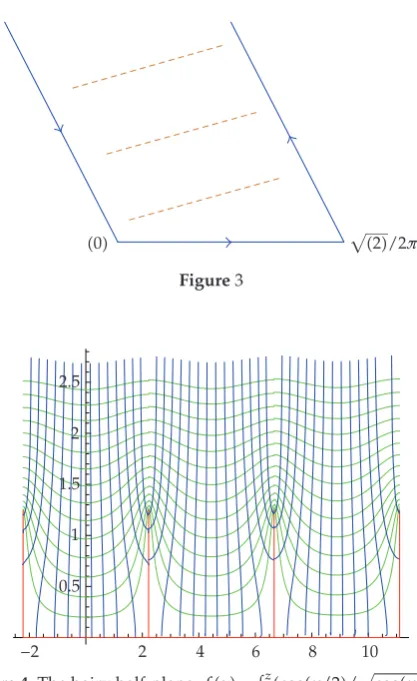
for 0≤s≤∞, so that it is the half-line making an angle of 3π/4 with the positively oriented real axis. The image of2is the real segment0, π√2/2, and that image of3is a half-line parallel to the first one and beginning atπ√2/2 as inFigure 3.
Consider the triangle ofFigure 3.
The general theory of conformal mappings applies to these two triangles, so that from the bijectivity on the boundaries we can conclude bijectivity in the interior. With the Schwarz reflection principle as applied to the vertical segments1,3, and their reflections, the mapping can now be extended to the entire upper half-plane.
The function
fz z
0
sinνx
cosμxdx, 2.6
[image:4.600.200.398.277.420.2]
2/2π
[image:5.600.194.403.88.429.2]0
Figure 3
10 8 6 4 2
−2 0.5
1 1.5 2 2.5
Figure 4: The hairy half-plane,fz z0cosx/2/cosxdx.
2.2. The hairy half-plane
We next consider interior anglesπ/2 atai 2i1π/2i∈Zand 2π atbi 2i1π.
The mapping function is therefore
fz z
0
cosx/2
cosxdx, 2.7
and the image is shown inFigure 4.
To establish that the given mapping is indeed one-to-one, it is first necessary to see that the length of the segment from an angleπ/2 to the tip of the hair is the same on both sides, that is, that
π
π/2
cosx/2
−cosxdx 3π/2
π
−cosx/2
−cosx, 2.8
an equality easily obtained by the change of variablex→2π−x.
0.2
−0.2
−0.4
−3
−2
[image:6.600.204.400.98.247.2]−1 1
Figure 5: The hairy plane,fz z0tanπx dx.
2 1
−1
−2
−1.5
−1
−0.5 0.5
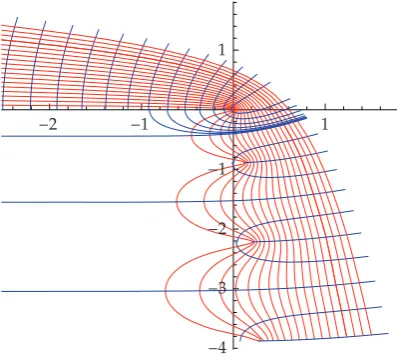
Figure 6: Half a stair or the stairway to the abyss,fz z0Γ1/2−x/Γ−xdx.
In a similar fashion, we obtain a formula for the hairy plane, which can be regarded as a polygon with infinitely many sides and interior angles alternately equal to 2πand 0.
This means taking
fz z
0
sinx
cosxdx 2.9
as inFigure 5.
2.3. The infinite half-staircase
In order to consider only one half of the stair, we have to take analytic functions in 1.1 having half as many zeros as before, which leads to theΓfunction. Indeed, the formula
fz z
0
Γ1/2−x
Γ−x dx 2.10
[image:6.600.202.397.300.418.2]However, to prove that the mapping given in2.10is one-to-one, we cannot use the arguments of examples 1 and 2 since there is no symmetry with respect to a line. We proceed as follows. Since
1
Γx eγxx ∞
n1
1x
n e
−x/n, 2.11
it follows that
Γ1/2−x
Γ−x e−γ/4
x
x−1/2Nlim→∞
N
n1
1−x/n 1 1/2−x/n
1/2
en/4. 2.12
The classical Schwarz-Christoffel formula can be applied to each finite product on the right-hand side, which gives a staircase with a finite number of steps. These conformal mappings converge uniformly to the required mapping since for each positive integer, the integral
m1/2
m
Γ1/2−x
Γ−x dx 2.13 is finite.
To obtain a half-stair with the steps moving to the left one would naturally use z
0
Γ−x
Γ1/2−xdx. 2.14 Finally, to obtain half a hairy plane, we take
fz z
−1
Γ1/2−x
Γ−x dx 2.15 as inFigure 7, or half a hairy half-plane via
Γ1/2−x
Γ−x/2 2.16 and so on.
3. Fractals
3.1. The Koch snowflake
Driscoll and Trefethen4, Chapter 4.5remark that the conformal mapping into the interior or exterior of complicated fractals, such as the Koch snowflake, ought to be treatable in a manner related to the multiple method. In the next theorem, we give an explicit geometric formula which does this.
1
−1
−2
−4
−3
−2
[image:8.600.200.399.98.277.2]−1
Figure 7: Half a hairy half-plane,fz z−1Γ1/2−x/Γ−xdx.
Step 1.
3.1
Step 2.
−0.5
−1
−1.5
−2.5
−1
[image:9.600.200.401.93.311.2]−0.5 0.5 1
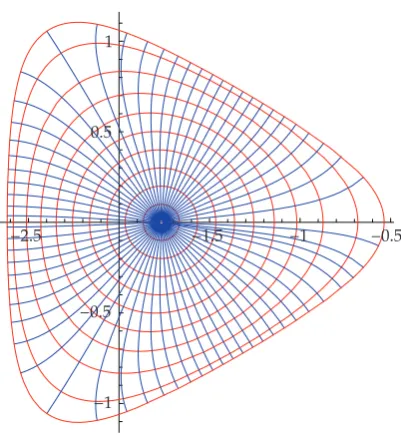
Figure 8: Interior of the Koch snowflake, Step1.
Step 3.
3.3
At each step, we consider the Schwarz-Christoffel mapping of the unit disc into the interior of the polygon; we use the notation of the introduction throughout.
Step 1. αk1/3, μk2/3, akexp2πik/3 k1,2,3;
Fz z
1
dx
x−12/3x−exp2πi/32/3x−exp4πi/32/3
z
1
dx
x3−12/3. 3.4
This conformal mapping is portrayed inFigure 8.
Step 2. akexp2πik/12 0≤k≤11;
αk 1
3, μk 2
3, k0,2,4,68,10 αk 4
3, μk −1
3 , k1,3,57,911.
−0.5
−1
−1.5
−2
−1
[image:10.600.203.398.102.323.2]−0.5 0.5
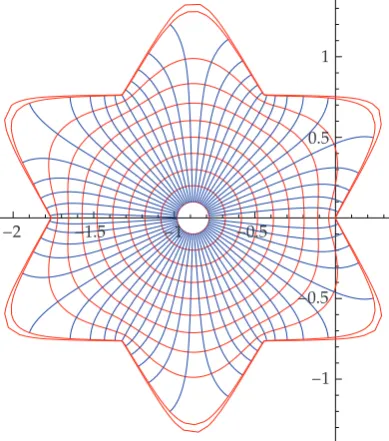
Figure 9: Interior the Koch snowflake, Step2.
The formula for the conformal mapping is
Fz z
1
x611/3
x6−12/3dx 3.6
and the image of the unit disc appears inFigure 9.
Step 3. akexp2πik/48 0≤k <47
αk 1
3, μk 2
3, k0,2,6,8,10,14,16,18,22,24,26,30,32,34,38,40,42,46, αk 3
4, μk −1
3 all otherk.
3.7
Although the combinatorics is not automatic, the formula for the conformal mapping is
Fz z
1
x61x2411/3
x3−1x31x1212/3dx, 3.8
the image of the unit disc is given inFigure 10. We may generalize the following.
Stepn. akexp2πik/3×4n, 0≤k <3×4nwith an integrand of the form
x61x241· · ·x6·4n−1
11/3
x3−1x31x121· · ·x3·4n−1
12/3
Figure 10: Interior of Koch’s snowflake, Step3.
Theorem 3.1. The formula for the conformal map from the interior of the unit disc to the interior of a Koch snowflake is
Fz z
0
∞
n0
1x6·4n
dx, |z|<1. 3.10
Proof. The wording “a Koch snowflake” means that it is the limit of polygons with the same angles as the polygons in the Koch pattern, but with unequal sides.
First, we rewrite the integrand for Stepnas
1x61x24· · ·
1x6·4n−1
1−x3·4n2/3 3.11 modulo a cube root of 1, so that for|x|<1 the integrand converges to the one indicated in the statement of the theorem.
That the lengths are not equal to the lengths in true Koch snowflake can already be seen at Step3:
Define
a 1
0
1x241/3
1−x242/3dx1.13856,
b 1
0
x61x241/3
1−x242/3 dx0.270237,
3.12
so that
F1 ab 3.13
is one vertex of the polygon. But then
π/6
π/6
F1
ab
0
expπ/6i a−b
Figure 11
The image of a circular sector from 0 to 1 to expπi/6is therefore a polygon of the form ofFigure 11.
If the lengths were equal to those of the regular snowflake then the vertex Fexpπi/6would be the vertex of the isosceles triangle with baseaband base angle π/6.
The side would equalab/√3. But a√b
3 < a−b, 3.15
showing that the second length in the small triangle is necessarily shorter than the first one, leading to a location ofFexpπi/6slightly “higher” than it should be.
Observe also that the location of this last vertex impliesthe angles being as required that the map is one-to-one on the boundary and therefore one-to-one throughout.
In general, the image in Stepndiffers somewhat, but not by too much, from a regular snowflake with all sides equal.
If we analyze a sufficiently general case as in Step3, say that we have the mapping
fz z
0
1x61x24
1x961/3
1−x962/3dx. 3.16
It is easy to obtain the points
P∗f1 1.35, Q∗feπi/24,
R∗feπy/8, S∗feπi/6. 3.17
If we compare them to a regular snowflake with verticesP, Q, R, S, we obtain points at a distance smaller than 0.1.
What is to be noticed is that for the image not be one-to-one on the boundary, the point Q∗ should differ sufficiently from Q, to be below P O, for example; the position of P∗, Q∗, R∗, S∗thus forces the actual polygon to be free of self-intersections, the angles being π/3 or 2π/3. We draw one such possible polygon inFigure 12.
π/6
R
Q
P
1.35 0
S
0.78
Figure 12
We check that the image is not all ofC. We claim that
F1 1
0
∞
n0
1x6·4ndx≤ 3
4. 3.18
Indeed, withyx6, we have 0≤y≤1 and
1y1y41y16· · ·1yy4y5y16y17y20y21· · · ≤1y2y44y16· · ·
1 ∞
n0
2ny4n.
3.19
Thus the integral is bounded from above by 1
0
1 ∞
n0
2nx4n·6dx1 ∞
n0
2n 6·4n ≤1
1 6
∞
n0
1 2n
4
3. 3.20
We also check that the image is not a disc. Set a 1 0 ∞
n1
1x6·4ndx, b 1
0
x6 ∞
n1
1x6·4ndx. 3.21
ThenF1 aband 0< b < a. But
Feπi/6eπi/6a−b 3.22
has modulus smaller thanF1.
since the branch we implicitly use by analytic continuation may not coincide with the fixed branches of the mathematical software.
With
uk, x log
exp
πik
24 −x , vk, x log
x−exp
πik
24
,
3.24
the numerator of the integrand is
Numx exp1/3u1, x u3, x u3, x u4, x u5, x
u7, x u9, x u11, x v12, x v13, x v15, x v17, x v19, x v20, x
v21, x v23, x v25, x v27, x
v28, x v29, x v31, x v33, x v35, x v36, x u37, x u39, x u41, x u43, x u44, x u45, x u47, x;
3.25
and the denominator is
Denx exp2/3u0, x u2, x u6, x
u8, x u10, x v14x v16, x v18, x v22, x v24, x v26, x v30, x v32, x v34, x u38, x u40, x u42, x u46, x.
3.26
At any rate, the formula of the theorem with terms of up to 6·46is sufficiently precise
and simpler to useand givesFigure 13.
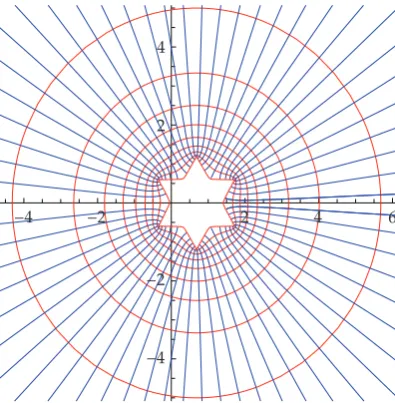
3.2. The exterior of the snowflake
At Step1, we use the formula of the introduction withak exp2πi/3×k, μk 2/3, 1 ≤
6 4 2
−2
−4
−6
−4
[image:15.600.200.400.97.299.2]−2 2 4 6
Figure 13: Exterior of the Koch snowflake, Step1.
6 4
2
−2
−4
−4
−2 2 4
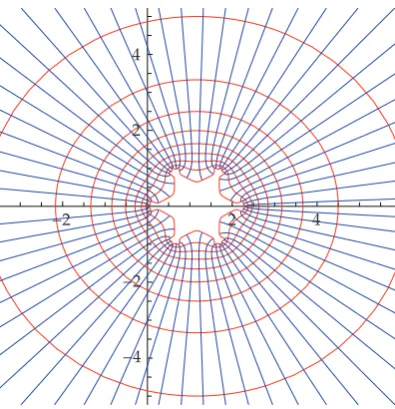
Figure 14: Exterior of the Koch snowflake, Step2.
In this case,λ2/33k1dk0 so that the formula is
Fz z
1
x3−12/3dx/x2 3.27
[image:15.600.201.399.352.554.2]4 2
−2
−4
[image:16.600.201.399.95.300.2]−2 2
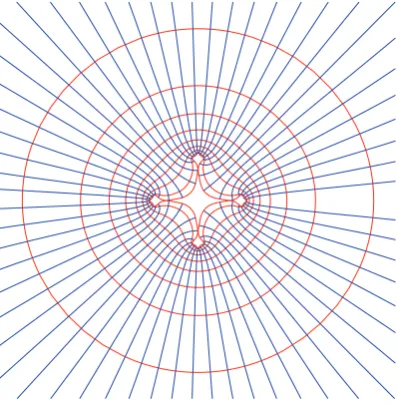
Figure 15: Exterior of the Koch snowflake, Step3.
In the same way, the formulas for Steps2and3are z
1
x3−1x312/3
x611/3
dx x2,
z
1
x3−1x31x1212/3
x61x2411/3
dx x2,
3.28
corresponding to Figures15and16.
The mapping from the unit disc to the exterior of the Koch snowflake is given by
Fz z
1
∞
n0
1x6·4n
−1
dx
x2. 3.29
3.3. Periodic Koch fractals
In a paper on diffusive transport by Brady and Pozrikidis cf. 6 the authors consider conformal mappings of a rectangle onto regionsRm, m1,2, . . .as inFigure 16.
The mappings can then be extended by reflections on the vertical sides to mappings from an infinite strip to regions bounded below by the given contours. In the limit, a fractal region is obtained.
The mapping is given by an iteration procedure which we summarize as follows.
DefineGξ
N
n0
∞
k−∞ sinh
2hξ−an−kaN αn
. 3.30
R1
m1
R2
m2
Figure 16
iiLocate the vertices on the triangular contours by
ZGn ZGn−1R an
an−1
Gξdξ 3.31
and compare them to the known exact values of the verticesan. If they are equal
the calculation stops; otherwise compute improved values foranusing the corrector
formula:
anewn anewn−1aoldn −aoldn−1Zn−Zn−1 ZG
n −ZGn−1
. 3.32
This procedure works well in the first few iterations but, as the authors explain, is computationally prohibitive already form5cf.6for details.
Using the Schwarz-Christoffel formula in a similar way as in number 2 above, we may define a conformal mapping to a region bounded below by a periodic fractal of Koch’s type obtained fromFigure 16. Form1 consider the function
Fz z
0
1−e2πix/3
1−e2πi1/3dx. 3.33
It maps the upper half plane to a region bounded by the periodic contour as inR1
extended by reflection on the vertical sides.
The actual lengths of the sides in the image are{1,2,1}so that they do not coincide with preassigned value 1 for all sides, but the image has the same geometrical shape.
Form2, the function is defined by z
0
1−e2πix/3
1−e2πix1/3
1e2πix2/3
1e4πix1/3dx 3.34
and in the limit, for Imz >0, z
0
1−e2πix/3
1−e2πix1/3
∞
n0
1e2πi4nx2/3
∞
n0
Step 1.
3.36
Step 2.
3.37
Step 3.
Figure 17: Exterior of a tree, Step3.
We want to define a sequence of Schwarz-Christoffel mappings from the unit disc to the complements of these trees.
The interior angles at Step1giveα1 α3 α5 α7 0 withμ1 μ3 μ5 μ7 1 at
the points andα2α4α6α83/2, μ2μ4μ6μ8−1/2 at the corners.
Therefore
Fz z
1
1x4
1−x41/2
dx
x2 3.39
is the required formula at Step1. At Step2, we obtain
Fz z
1
1x4
1−x41/2
1x8
1x161/2
dx
x2 3.40
with branches at the 32 roots of unity. Similarly, at Step3
Fz z
1
1x4
1−x41/2
1x81x32
1x161x641/2
dx
x2. 3.41
The image is shown inFigure 17. In the limit, we obtain the formula
Fz z
1
1x4
1−x41/2
∞
n1
1x2·4n
∞
n1
1x4n11/2
dx
x2 3.42
for the conformal mapping of the unit disc onto the exterior of this fractal.
that the formula can be extended to a variety of shapes with an infinite number of vertices, namely, stairs, slitted planes, fractals of Koch’s type and trees. It would be very interesting in the future to find exactly the branch points necessary in Koch snowflake as well as in specific slitted regions.
Acknowledgment
This research was partially suported by Fondecyt 1050904.
References
1 D. Bonciani and F. Vlacci, “Some remarks on Schwarz-Christoffel transformations from the unit disk to a regular polygon and their numerical computation,” Complex Variables and Elliptic Equations, vol. 49, no. 4, pp. 271–284, 2004.
2 P. Henrici, Applied and Computational Complex Analysis. Vol. 1: Power Series, Integration, Conformal Mapping, Location of Zeros, Pure and Applied Mathematics, John Wiley & Sons, New York, NY, USA, 1974.
3 E. Johnston, “A “counter example” for the Schwarz-Christoffel transform,” The American Mathematical Monthly, vol. 90, no. 10, pp. 701–703, 1983.
4 T. A. Driscoll and L. N. Trefethen, Schwarz-Christoffel Mapping, vol. 8 of Cambridge Monographs on Applied and Computational Mathematics, Cambridge University Press, Cambridge, UK, 2002.
5 P. J. Myrberg, “"Uber analytische Funktionen auf transzendenten zweibl"attrigen Rie-mannschen Fl"achen mit reellen Verzweigungspunkten,” Acta Mathematica, vol. 76, no. 3-4, pp. 185–224, 1945.