Construction Materials and Technology Series 1 2018 ISBN 978-967-2183-19-8
77
CHAPTER 6
SOME BASIC PROPERTIES OF CEMENT BOARD PRODUCED BY USING OIL PALM EMPTY FRUIT BUNCH (EFB) FIBRE
Nor Haslinda binti Abas1, Azman bin Jaafar1, Ahmad Shakri Bin Mat Seman²
1Faculty Engineering Technology
2Faculty of Civil and Environmental Engineering
Universiti Tun Hussein Onn Malaysia
,
Parit Raja,
Batu Pahat,
86400 Johor
,
Malaysia.
6
.
1 INTRODUCTIONThe utilization of any kind of fibres in cement and concrete has been developed for several decades before. Many researches had been carried out on the incorporation of various kinds of fibres such as steel, polymer, glass, asbestos, carbon and wood fibres in cement matrix and most of the study revealed that the presence of fibres in cement matrix improves flexural strength, crack control, fracture toughness, resistance to fatigue, impact, and thermal shock, and resistance to moisture, fire, fungi and insect [1].
Oil palm fibre is one of the cellulosic materials available in Malaysia which has yet to be used commercially elsewhere. In this study, the manufacturing of cement board using the EFB fibre was carried out.
BACKGROUND AND STATEMENT OF PROBLEM
In Malaysia, the total availability of oil palm fibres in the form of fronds, trunks and EFB for the year 1995 and 2000 are 25.64, 23.35 and 28.37 million tones, respectively. Unfortunately, these large amounts of lignocellulosea are currently commercially underutilised [2]. Nowadays, the oil palm industries are keen to convert the by-product and residues into fibre-based value-added products. Thus, this study was implemented to turn this oil palm residue into value-added product.
SIGNIFICANCE OF THE STUDY
The advantages of using this oil palm fibre EFB as reinforcement in cement board are:
Provides additional reinforcement material that can improve the brittle fracture of cement matrix.
Construction Materials and Technology Series 1 2018 ISBN 978-967-2183-19-8
78
By using this oil palm residue, which is discarded during replanting in oil palm plantation, a raw material is used to produce a value-added cement composite material.
6.2 LITERATURE STUDY
DEFINITIONS OF FIBRE REINFORCED CEMENT COMPOSITE
The International Organisation for Standardisation Technical Committee ISO/TC 77 defined that “Wood-fibre reinforced cement board consist of essentially of a mixture of wood fibres and Portland cement (or other cements with equivalent properties) to which other fibres, fillers and/or pigments may be added” [5]. Under this definition, sand is used as fillers. It is obviously that the fibre cement composite reviewed in this study uses short discrete fibres. Also, other definition of composite is a material made up of matrix material containing reinforcing fibres [1]. In this study, Portland cement is used as the matrix and oil palm fibres which are obtained from discarded oil palm tree, are used as reinforcing fibres.
Fibre Reinforced Concrete is a concrete made of hydraulic cements containing fine or fine and coarse aggregate and discontinuous discrete fibres [6]. By incorporating fibres into cement matrix, some reinforcement is provided for the concrete products through interlocking of the fibres in the cement matrix [1]. The oil palm fibre cement board discussed throughout this study could generally be defined as a board consisting of a mixture of oil palm fibres in cement matrix manufactured. The main objectives of adding the oil palm fibres are to improve the strength properties of cement, control cracking and change the flow characteristics of the material in the fresh state. This is due to the fact that cement, mortar or concrete possess inferior tensile strength and are brittle, even though they are cheap, durable and have acceptable compressive strength and stiffness [1]. The presence of randomly mixed fibres in cement matrix will form an interlocking system among the fibres and thus provide additional tensile, flexural strength and fracture toughness for the products.
OIL PALM FIBRE EMPTY FRUIT BUNCH
The definition of EFB given by MS 1408:1997 is the resulting material after the separation of fruits from the fresh fruit bunch. Meanwhile, EFB fibres shall mean the fibre strands derived from the stalk and spikelets of whole empty fruit bunch using any separation technique [3]. The availability of EFB in Malaysia is presented in Table 6.1. The specifications of EFB fibre that were used was in accordance to MS1408:1997 [3]
Table 6.1: Oil palm EFB supply outlooks in malaysia from 1996 to 2020 [7]
Year EFB (million
tonnes/year, dry weight)
1996 3.08
1997-2000 2.99
2001-2003 2.87
2004-2006 2.86
2007-2010 2.82
2011-2013 2.83
2014-2016 2.91
Construction Materials and Technology Series 1 2018 ISBN 978-967-2183-19-8
79
6.3 METHODOLOGY
TRIAL MIX DESIGN
Trial mixes were done for the selection of the appropriate proportion of materials to produce the required cement board. The ratio of cement from the total weight was fixed to 50% and the water-cement ratio was 0.85. The ratios for fibre and sand were 1) 15:5, and 2) 5:15. The desired physical of the boards were not achieved due to the brittleness of the board. The failure of the boards was due to the length of the fibres which were too short that causing the boards lack in strength. Therefore, for the next step to produce the desired board, the length of the fibres should be longer than the initial length. The decision is to use the fibre with the length of 10mm to 30mm which is appropriate to make the board.
PREPARATION OF MATERIALS
In this study, the materials that were used include: 1.EFB fibre – treated with Sodium Hydroxide 2.Cement – OPC
3.Sa nd 4.Water
5.Mould - 310mm x 310mm x 16mm
BOARD MANUFACTURE
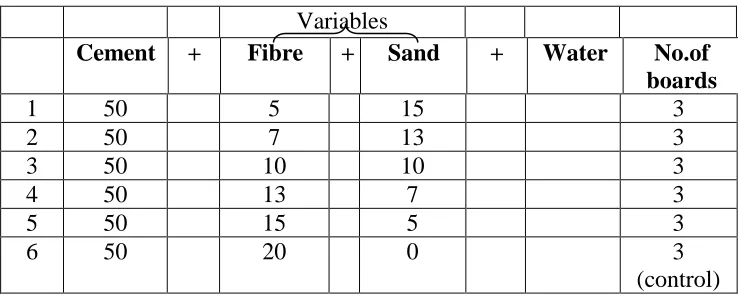
[image:3.597.113.482.615.769.2]Before mixing process is done, the fibres were separated from each other first to make sure that all of the surface area of fibres could be mixed with the mixing materials. The mixing process was done by combining the EFB, sand and cement in the appropriate amount first, then, blends them in 30 seconds. The appropriate amounts of water were added until the mixture is really wet, and continue the mixing process between 2 to 3 minutes until the mixture was properly mixed. After the materials have been prepared, they were laid into and even and consistent mat to be pressed into a panel. This can be accomplished by putting the mixture into the form mould (deckle frame) which is placed on the tray. After the formation, the mat was pre-pressed prior to cold pressing for 10 minutes to produce the cement board. The purposes of pre-pressing process are reduces the mat height and helps to consolidate the mat for pressing.Table 6.2 shows six series of variables were carried out where each series produced 3 boards which has made the total boards = 18.
Table 6.2: Six series of variable to be tested
Variables
Cement + Fibre + Sand + Water No.of
boards
1 50 5 15 3
2 50 7 13 3
3 50 10 10 3
4 50 13 7 3
5 50 15 5 3
6 50 20 0 3
Construction Materials and Technology Series 1 2018 ISBN 978-967-2183-19-8
80
BOARD TESTING
a) Dimension of Samples
[image:4.597.211.370.177.426.2]To carry out the test, the board will be cut into several pieces according to Figure 6.1.
Figure 6.1: The cut of the board for exposure test pieces [4].
b) Testing of Cement Board Produced by Using Oil Palm EFB Fibre
[image:4.597.112.489.600.672.2]The performances of cement board were determined by conducting several tests, which were bending strength (MOR&MOE), tensile strength, thickness swelling, increase in length and water absorption (WA) after specific durations of exposure (refer Table 6.3). These tests were implemented in accordance to MS 934:1986.
Table 6.3: Standard Values of Tests
MOR (MN/m2)
MOE (MN/m2)
TS (%)
Increase in length (%)
WA (%)
Tensile strength (MN/m2)
9 3000 2 2 60** 0.5
*MS934:1997[4] **Industrial requirement[8]
6.4 ANALYSIS AND DISCUSSION
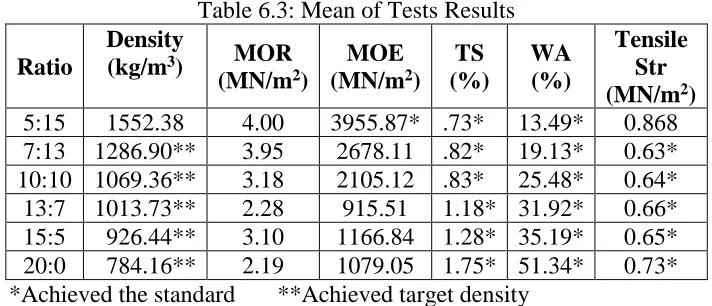
Table 6.3 and 6.4 summarize the mean of tests results and SPSS analysis. 100m
m
100m m
100m m
100mm 100mm 250mm
50mm
1/2
4/5 4/5
3 3 1/2
1 - MOE (Modulus of elasticity) 2 - MOR (Modulus of rupture) 3 - Tensile strength
Construction Materials and Technology Series 1 2018 ISBN 978-967-2183-19-8
[image:5.597.120.476.97.250.2]81
Table 6.3: Mean of Tests Results
Ratio
Density
(kg/m3) MOR (MN/m2)
MOE (MN/m2)
TS (%)
WA (%)
Tensile Str (MN/m2) 5:15 1552.38 4.00 3955.87* .73* 13.49* 0.868 7:13 1286.90** 3.95 2678.11 .82* 19.13* 0.63* 10:10 1069.36** 3.18 2105.12 .83* 25.48* 0.64* 13:7 1013.73** 2.28 915.51 1.18* 31.92* 0.66* 15:5 926.44** 3.10 1166.84 1.28* 35.19* 0.65* 20:0 784.16** 2.19 1079.05 1.75* 51.34* 0.73* *Achieved the standard **Achieved target density
Table 6.4: Least Significant Difference (LSD) Test
Ratio* MOR MOE WA Tensile
Strength 5:15 0.009* 0.000* 0.000* 0.002* 7:13 0.011* 0.010* 0.000* 0.009* 10:10 n.s 0.007* 0.000* 0.002* 13:7 0.013* 0.000* 0.000* 0.028* 15:5 n.s 0.000* 0.000* 0.029* 20:0 0.009* 0.000* 0.000* n.s *Significant at α = 0.05 [9]
n.s = not significant
MOR and MOE
Figure 6.2 and 6.3 show graphs for MOR and MOE cement board produced by using of oil palm EFB fibre. The values of MOR and MOE are decreased with the increasing quantity of EFB fibre. However, the MOR values are generally in the same average level, while the MOE values are obviously decreased with the increasing of quantity of fibres. The optimum MOR value is in 5:15 fibre-sand ratio which is 4.00MN/m2, while the optimum value of MOE is 3955.87MN/m2 which is still at 5:15 fibre-sand ratio. The boards did not satisfy MS934 for MOR, and only 5:15 fibre-sand ratio satisfied MS for MOE.
Construction Materials and Technology Series 1 2018 ISBN 978-967-2183-19-8
82
[image:6.597.177.417.185.393.2]From LSD test (Table 6.4), there were a significance difference between fibre-sand ratio of 5:15, 7:13 and 13:7 and MOR, which by means that these ratios have the effect on MOR. The optimum ratio suggested is 13:7 since it utilized more fibre than others. Besides that, there were also a significance difference between all ratios and MOE. However, the optimum ratio suggested here is 13:7 or 15:5.
Figure 6.2: MOR of EFB fibre cement board
Figure 6.3: MOE of EFB fibre cement board
THICKNESS SWELLING AND WATER ABSORPTION
Figure 6.4 and 6.5 show the graphs of thickness swelling and water absorption test (WA) of EFB fibre cement board. It could be seen that the values of TS fall under the Malaysian Standard value of swelling which is 2%. From the results, both TS and WA values were increase with the increasing quantity of EFB fibres. The optimum value of thickness swelling is 1.75% which is in fibre-sand ratio of 20:0, while the optimum WA ratio is 51.34% which the fibre-sand ratio is 20:0 too. Therefore, the more EFB fibres incorporated into the fibre-sand ratio lead to the more the absorption of water value.
Construction Materials and Technology Series 1 2018 ISBN 978-967-2183-19-8
83
From LSD test (Table 6.4), there was a significance difference between fibre-sand ratio of WA, which by means that these ratios significantly effect the WA. The optimum ratio suggested is either 13:7 or 15:5 since they utilized more fibre.
0 0.5 1 1.5 2 2.5
5:15 7:13 10:10 13:7 15:05 20:00
FIBRE : SAND
T h ickn ess S w el li n g ( % )
Figure 6.4: Thickness Swelling of EFB fibre cement board
0 20 40 60
5:15 7:13 10:10 13:7 15:05 20:00
FIBRE : SAND
W a te r A b s o rp ti o n (% )
Figure 6.5: Water Absorption of EFB fibre cement board
0.00 0.20 0.40 0.60 0.80 1.00 1.20 1.40 1.60 1.80 2.00
0 10 20 30 40 50 60
Water Absorption (%)
[image:7.597.172.421.487.629.2]Th ic k ne s s S w e ll ing ( % )
Figure 6.6: Relationship of TS and WA
TENSILE STRENGTH
Construction Materials and Technology Series 1 2018 ISBN 978-967-2183-19-8
84
strength exist in the board results with the required Tensile Strength.
From LSD test (Table 6.4), there were a significance difference between fibre-sand ratio at all ratios and Tensile Strength, which by means that these ratios significantly effect the Tensile Strength. The optimum ratio suggested are either 13:7 or 15:5 since they utilized more fibre
0 0.2 0.4 0.6 0.8 1
5:15 7:13 10:10 13:7 15:5 20:0
SAMPLES
T
ENSI
L
E
ST
R
ENG
T
H
(M
N
/m
2
)
Figure 6.7: Tensile Strength of EFB fibre cement board
DENSITY
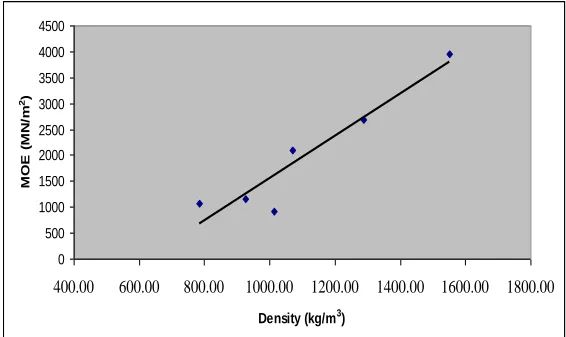
The density of cement board produced by using oil palm EFB fibre. Roughly, the density of the boards obtained from this study has fulfilled the targeted density which is less than 1500kg/m3. However, the density of 5:15 (fibre-sand) ratio is beyond the target which the value is 1552kg/m3. Some previous study indicated that the mechanical properties of composite board were influenced by its density [13] However, it does not influence the stability of the product [14]. Ishak [15], also stated that the MOE value is increase with the increase of density.
From results of Linear Regression statistical analysis, a strong positive correlation exists between Density and MOE [16]. This means that the denser the board, produce the more MOE for the board. From the analysis, the density predicts MOE, which means the density of cement board influence the MOE value. The relationship between MOE and density of cement board for this study is given in Figure 6.8.
0 500 1000 1500 2000 2500 3000 3500 4000 4500
400.00 600.00 800.00 1000.00 1200.00 1400.00 1600.00 1800.00
Density (kg/m3)
M
O
E
(
M
N
/m
[image:8.597.156.439.554.723.2]2)
Construction Materials and Technology Series 1 2018 ISBN 978-967-2183-19-8
85
6.5 CONCLUSION AND RECOMMENDATIONS
In conclusion, the study showed that it is possible to produce cement board by using oil palm EFB fibre. The use of oil palm EFB, however, is still subject to studies the optimum condition so as to improve the board properties. Further work is necessary to assess the physical and mechanical properties of the panel product and to determine the suitable operating parameters for the manufacturing process. Hopefully, the study will be continued and widen in the future considering the most appropriate methods and techniques; and to-date technology to produce the cement board with the best quality, economic and satisfy the standard.
The density of cement board produced from this study is below 1500kg/m3, except for fibre-sand ratio of 5:15. The optimum fibre-sand ratio suggested from this study is 13:7, which strictly significant with the tests implemented by using LSD from Univariate ANOVA of SPSS analysis.
The cement board produced from this study is suitable for internal application such as partition walls and others. This suggestion is made considering the properties of the boards from the tests. The lack of MOR and MOE values causing the product not suitable to be used for load bearing applications.
Several recommendations have been made for the use of future studies, which are:
i. The mixing process should be done thoroughly for all the materials. Mixing with vibrator should be considered.
ii. The EFB fibre should be boiling in hot water because some previous research had identified that the strength of board where the fibres were boilt in hot water was significantly higher if compared to treatment with sodium hydroxide [17].
iii. Include admixtures to increase the strength properties.
Construction Materials and Technology Series 1 2018 ISBN 978-967-2183-19-8
86
REFERENCES
[1] Rahim Sudin (1996). “Development, Properties and Durability of Oil Palm Fibre Cement Composites.” University of Sheffield for Degree of Doctor of Philosophy in Faculty of Engineering.
[2] Jalaludin Harun, Hanafi Idris, Nor Yuziah Mohd Yunus & Jamaludin Kasim(1994) “Property enhancement of acetylated oil palm fibre empty fruit bunch (EFB) particleboard.” In Proceeding of the3rd National Seminar On Utilisation Of Oil Palm Tree Oil Palm Residues:Progress Towards Commersialisatio, Sept. 27-29, 1994. pp 89.
[3] Anon. (1997) “Specification For Oil Palm Empty Fruit Bunch Fibre.” Malaysia: MS 1408.
[4] Anon. (1986) “Specification For Wood Cement Board.” Malaysia: MS 934
[5] Anon. (1989) The International Organisation for Standardisation Technical Committee ISO/TC 77
[6] A.M Neville and J.J.Brooks (2001) “Concrete Technology” Revised Edition 2001
[7] Kamarudin Hasaan, Ariffin Darus & Jalani Sukaimi (1994). A Survey on the Spatial-Temporal Distribution of Oil Palm Raw Materials. Pp 49-61 in Koh, M.P., Mohd Nor Mohd Yusoff, Khoo, K.C. & Nurulhuda Mohd Nasir (Eds.) Proceedings of the 3rd National Seminar on Utilisation of Oil Palm Tree and Other Palms. 27-29 Sept. 1994. Kuala Lumpur. FRIM, Kepong.
[8] Schneider M.H, Chui, Y.H, Ganev, S.B. (1996). “Properties of Particleboard Made With a Polyfurfuryl-Alcohol.” Forest Product Jurnal : Vol.46(9):79-83 in Azman Bin Jaafar (2004) “Kajian Sifat Mekanikal Papan Serpai Berlapis Mengandungi Habuk Gergaji” Kolej Universiti Teknologi Tun Hussein Onn for Degree of Master in Engineering.
[9] Jeremy J. Foster (2001). “Data Analysis Using SPSS for Windows for Versions 8 to 10”. Sage publications: London. ISBN 0761969268, pp 190.
[10] Joszef, B and Benjamin, A.J. (1982). “Mechanics of Wood and Wood Composites” 2nd Edition, New York, Van Nostrand Reinhold in Azman Bin Jaafar (2004). “Kajian Sifat Mekanikal Papan Serpai Berlapis Mengandungi Habuk Gergaji.” Kolej Universiti Teknologi Tun Hussein Onn for Degree of Master in Engineering. Pp. 79.
Construction Materials and Technology Series 1 2018 ISBN 978-967-2183-19-8
87
[12] Scheneider M.H., Chui, Y.H., Ganev, S.B. (1996). “Properties of Particleboard Made With a Polyfurfuryl – Alcohol” Forest Product journal : Vol.46(9): 79-83 in Azman Bin Jaafar (2004) “Kajian Sifat Mekanikal Papan Serpai Berlapis Mengandungi Habuk Gergaji” Kolej Universiti Teknologi Tun Hussein Onn for Degree of Master in Engineering. Pp. 67.
[13] Azman Bin Jaafar (2004). “Kajian Sifat Mekanikal Papan Serpai Berlapis Mengandungi Habuk Gergaji” Kolej Universiti Teknologi Tun Hussein Onn for Degree of Master in Engineering. Pp. 86.
[14] Desch, H.E. and Dinwoodie, J.M. (1983). “Timber – Its Structure, Properties and Utilisation.” 6th Edition, United Kingdom, The Macmillan Press in Azman Bin Jaafar (2004). “Kajian Sifat Mekanikal Papan Serpai Berlapis Mengandungi Habuk Gergaji.” Kolej Universiti Teknologi Tun Hussein Onn for Degree of Master in Engineering. Pp. 86.
[15] Ishak Baba (2002). “ Kajian Sifat Mekanikal Habuk Kayu Gergaji Dalam Pembuatan Papan Serpai” Kolej Universiti Teknologi Tun Hussein Onn for Degree of Master in Engineerin in Azman Bin Jaafar (2004) “Kajian Sifat Mekanikal Papan Serpai Berlapis Mengandungi Habuk Gergaji” Kolej Universiti Teknologi Tun Hussein Onn for Degree of Master in Engineering. Pp. 86.
[16] Mohd Salleh Abu and Zaidatun Tasir (2001). “Pengenalan Kepad Analisis Data Berkomputer SPSS10.0” Venton Publishing pp. 47
![Figure 6.1: The cut of the board for exposure test pieces [4].](https://thumb-us.123doks.com/thumbv2/123dok_us/8750325.891745/4.597.211.370.177.426/figure-cut-board-exposure-test-pieces.webp)