
A DUAL-WATERMARKING WITH QR CODE AGAINST CROPPING AND RESIZING ATTACK
LAU WEI KHANG
A dissertation submitted in fulfillment of the requirement for the award of the Degree Master’s of Computer Science (Information Security)
Faculty of Computer Science and Information Technology Universiti Tun Hussein Onn Malaysia
ABSTRACT
ABSTRAK
Watermarking merupakan salah satu corak yang memasukkan bits ke dalam satu imej digital, fail bunyi atau video yang dapat mengenal pasti maklumat tentang hak cipta pemilik. Ia merupakan salah satu teknik untuk mengelakkan pertindihan harta intelek daripada seseorang. Walau bagaimanapun, masih terdapat ruang untuk penambahbaikan bagi teknik-teknik baru untuk menahan serangan pengubahan saiz imej (resizing attack) dan serangan pangkas (cropping attack). Dalam projek Dual-Watermarking with QR code ini, watermark yang ketara (visible watermark) dan
watermark yang tersembunyi (invisible watermark) telah digunakan. Teknik yang dicadangkan telah dibandingkan dengan teknik MOHANTY dan teknik HSU & WU. Pertama, watermark kod QR yang ketara ditanam ke dalam imej dengan menggunakan teknik LSB 7 (tanam pada bit ketujuh dari kiri nombor binari). Kemudian, watermark kod QR yang tersembunyi ditanam juga ke dalam imej dengan menggunakan teknik LSB 1 (tanam pada bit pertama dari kiri nombor binari). Hasil kajian menunjukkan bahawa teknik yang dicadangkan menunjukkan bahawa
TABLE OF CONTENTS
DECLARATION ii
DEDICATION iii
ACKNOWLEDGEMENT iv
ABSTRACT v
ABSTRAK vi
TABLE OF CONTENTS vii
LIST OF TABLES x
LIST OF FIGURES xi
LIST OF ABBREVIARIONS xiii
LIST OF APPENDICES xiv
CHAPTER 1 INTRODUCTION 1.1 Overview 1
1.2 Problem Statement 2 1.3 Project Aim 3
1.4 Objectives 3 1.5 Scope 4
1.6 Contribution 4
CHAPTER 2 LITERATURE REVIEW 2.1 Introduction 5
2.2 Digital Watermarking 5 2.2.1 Visible Watermarks 10
2.2.2 Invisible Watermark 11
2.2.3 Public Watermark 11
2.2.4 Fragile Watermark 11
2.2.6 Perceptual Watermarks 12
2.2.7 Bit-stream Watermarking 12
2.2.8 Text Document Watermarking 12
2.3 QR Code 13
2.3.1 QR Code Model 1 16
2.3.2 QR Code Model 2 17
2.3.3 Micro QR code 17
2.3.4 iQR Code 18
2.3.5 SQRC 19
2.3.6 Logo Q 20
2.4 Image File Types 20
2.4.1 JPEG 21
2.4.2 TIFF 21
2.4.3 RAW 22
2.4.4 GIF 22
2.4.5 BMP 23
2.4.6 PNG 23
2.5 Dual-watermark Techniques 24
2.5.1 MOHANTY Dual-watermarking Technique 24 2.5.2 HSU & WU Dual-watermarking with QR
Code Technique 25
2.5.3 Comparison of Technique 27
2.6 Summary 28
CHAPTER 3 METHODOLOGY
3.1 Introduction 29
3.2 The Proposed Framework 29
3.2.1 Visible Watermarking of the Image 33 3.2.2 Invisible Watermarking with Embedded QR
Code of the Image 34
3.2.3 Extracts QR Code from Dual-Watermarked Image 35
3.3 Method of Validation 36
3.4 Comparison with Other Techniques 36
CHAPTER 4 IMPLEMENTATION
4.1 Introduction 38
4.2 Implementation Phase 38
4.2.1 Proposed Framework Flowchart 39
4.2.2 QR Code Generation 44
4.2.3 LSB Based Visible Watermark Function 46 4.2.4 LSB Based Invisible Watermarking Function 48 4.2.5 Watermark Extract Function 51
4.3 Summary 54
CHAPTER 5 EXPERIMENTATION AND RESULT
5.1 Introduction 55
5.2 Resizing Attack 55
5.2.1 Test on Resizing Attack 56
5.2.2 Result of Resizing Testing 65
5.3 Cropping Attack 66
5.3.1 Test on Cropping Attack 66
5.3.2 Result of Cropping Attack 70
5.4 Peak Signal-to-noise Ratio (PSNR) 71
5.4.1 PSNR Test 71
5.4.2 Result of PSNR Test 73
5.5 Summary 74
CHAPTER 6 CONCLUSION AND FUTURE WORKS
6.1 Introduction 75
6.2 Limitations 75
6.3 Future Works 76
6.4 Conclusion 77
REFERENCES 78
APPENDICES A 81
LIST OF TABLE
2.1 Weaknesses of MOHANTY and HSU & WU technique 27
3.1 Comparison of Dual-Watermarking technique 31
3.2 Comparison of related work 37
4.1 Extracted watermark from four watermarked cover image 53
5.1 Result of enlarging 56
5.2 Results of shrinking 58
5.3 Cover image : baboon512 Watermark image : UTHM_L 59 5.4 Cover image : baboon512 Watermark image : UTHM_M 60 5.5 Cover image : baboon512 Watermark image : UTHM_Q 60 5.6 Cover image : baboon512 Watermark image : UTHM_H 60 5.7 Cover image : lena512 Watermark image : UTHM_L 61 5.8 Cover image : lena512 Watermark image : UTHM_M 61 5.9 Cover image : lena512 Watermark image : UTHM_Q 61 5.10 Cover image : lena512 Watermark image : UTHM_H 62 5.11 Cover image : pepper512 Watermark image : UTHM_L 62 5.12 Cover image : pepper512 Watermark image : UTHM_M 62 5.13 Cover image : pepper512 Watermark image : UTHM_Q 63 5.14 Cover image : pepper512 Watermark image : UTHM_H 63 5.15 Cover image : UTHM512 Watermark image : UTHM_L 63 5.16 Cover image : UTHM512 Watermark image : UTHM_M 64 5.17 Cover image : UTHM512 Watermark image : UTHM_Q 64 5.18 Cover image : UTHM512 Watermark image : UTHM_H 64 5.19 Results of cropping attack based on cropping percentage 67
5.20 Results of random cropping attack 69
5.21 PSNR of each cover image with watermark image 72 5.22 Comparison between Dual-Watermarking and HSU & WU technique
LIST OF FIGURES
2.1 Fifty percent visibility of watermark 6
2.2 Hundred percent visibility of watermark 6
2.3 Classification of watermarks 9
2.4 Watermark embed spatial domain watermarking 10
2.5 Watermark extraction spatial domain watermarking 10
2.6 QR Code versus Barcode 14
2.7 QR Code modules 14
2.8 Version of QR Code 15
2.9 QR Code Model 1 with 73 × 73 modules 16
2.10 QR Code Model 2 with 177 × 177 modules 17
2.11 Micro QR Code that required one position detection pattern 17 2.12 Comparison of data size between QR Code, Micro QR Code and Barcode 18 2.13 Storage increase 80 percent than a regular QR Code 19 2.14 Smaller footprint is required to compare with regular QR Code 19 2.15 QR Code embedded with letters and color to create Logo Q 20
2.16 The flowchart of HSU & WU technique 26
2.17 The flowchart of watermark removing algorithm 26 3.1 Proposed framework of Dual-Watermarking with QR Code 32 3.2 Schematic of the proposed Dual-Watermarking with QR Code 32 3.3 Function E for encode visible watermark into raw image 33 3.4 QR Code that same size with watermarked image (I’ ) 34 3.5 Function E that encode invisible watermark ( Q ) and resulting (I’’) 35 3.6 Function D that decode (I’’) into (I’ ) and QR Code ( Q ) 36 4.1 Flowchart of Dual-Watermarking with QR Code 39
4.2 Flowchart to generate a watermark QR Code 40
4.3 Flowchart for visible watermark embedding 41
4.5 Flowchart for invisible watermark extracting 43
4.6 Call function for QR Code generator 44
4.7 Version mode for QR Code generator 44
4.8 Function mode for QR Code generator 45
4.9 Partial code for maximum data input 45
4.10 Graphic user interface for QR Code generator 46
4.11 Partial code for LSB based visible watermarking process using
MATLAB 47
4.12 Watermarked image I’ 48
4.13 Partial code that read both watermarks image and cover images 48 4.14 Partial code for checking the size of watermark image and cover
image using MATLAB 49
4.15 Algorithm calculation for LSB based invisible watermarking process
using MATLAB 50
4.16 Partial code for saving and display the watermarked image using
MATLAB 50
4.17 Watermarked image I’’ 51
4.18 Partial code for watermark extracts function 52 4.19 Watermark (QR Code) extracted from watermarked image I’’ 52 5.1 Watermarked image was divide into 25 parts which was 4 percent
LIST OF ABBREVIATIONS
BMP Bitmap File Format QR Code Quick Response Code FFT Fast Fourier Transform IPR Intellectual Property Rights MPEG Motion Picture Experts Group
TV Television
2-D 2 Dimension
MSB Most Significant Bit DFD Data Flow Diagram GUI Graphical User Interface
JPEG Joint Photographic Experts Group JPG Joint Photographic Experts Group LSB Least Significant Bit
PNG Portable Network Graphics
RP Rapid Prototyping
PHP PHP Hypertext-Preprocessor MATLAB Matrix Laboratory software TIFF Tagged Image File Format GIF Graphics Interchange Format
DWQR Dual-Watermarking with QR Code
OS Operating System
UTHM Universiti Tun Hussein Onn Malaysia
LIST OF APPENDICES
APPENDIX TITLE PAGE
CHAPTER1
INTRODUCTION
1.1 Overview
Besides that, this project is looking into another useful technique that can be applied into digital watermarking. QR Code (Quick Response Code) is the trademark for a type of matrix barcode (two-dimensional code). QR Code was invent in Japan by the Toyota subsidiary Denso Wave in 1994 to track vehicles during manufacturing [2] due to its fast readability and large storage capacity compared to UPC barcode standard that consists of black modules arranged in a square pattern on a white background. The information encoded can made up of four standardized types of modes of data that are similar to numeric, alphanumeric, byte, binary, kanji, through supported extensions or virtually any kind of data [3]. Therefore, the QR Code has become the focus of advertising strategy, since it provides quick and effortless access to the brand's website.
In this project, a proposed technique is dual-watermarking algorithm which is use of QR Code embed into image with both visible and invisible watermarking tech-nique.
1.2 Problem Statement
Although several researches have been done on digital watermarking using difference scheme, there are still several issues to be addressed. In digital watermarking many researchers only focus on certain attack that applies to watermarked image. Beside, most of researchers try to increase the watermark capacity by compromising image quality in order to tradeoff among data rate, security and imperceptibility of watermarked image.
watermark. Once the image attacked by cropping attack, the digital watermark are damaged and not retrivedable anymore. This happed to resizing attack too. Both shrink and enlarge attack to an image will course pixel of image change or damage. It will make digital watermark unable to be retrived.
1.3 Project Aim
Through this project, the aim is to work on the watermarking and to devise some ro-bust means to make the watermark withstand the attack from resizing and cropping.
1.4 Objectives
The objectives of this project is to ensure that the proposed version of dual-watermarking strengthen to make it more reliable than the previous versions. A watermark cannot defend against all form of attack but with improved watermarking algorithm, a watermarking algorithm can defend against multiple attacks. On the other hand, the current watermarking algorithm could not always be useful to prevent evolving forms of attack. Hence, an improved algorithm is needed to protect the intellectual property. The proposed algorithm is to overcome the problem stated above. The followings are the objectives of this project:
To propose a Dual-watermarking technique to withstand against cropping and resizing attacks using QR Code.
To develop the proposed algorithm.
1.5 Scope
In this project, experimentation and testing against cropping and resizing attacks will be using JPEG and TIFF image only.
1.6 Contribution
This project contributes to the image protection by solving the following issues. Firstly, this project is expect to come up with a combination of dual-watermarking technique that is more secure as compare to a single watermarking technique. Both visible and invisible watermark will be embedding into a cover image in order to against cropping attack and resizing attack. Secondly, the proposed visible watermark used QR Code as watermark image, QR Code can store information and QR Code has up to 30% of error correcting function. It will be harder to be deleted or tampered. Lastly, this project will provide an alternative option for the researchers to choose between the available versions of watermark algorithm for their image protection. The followings are the outline of the contributions.
Increase protection of image by combining two watermarking techniques (visible watermark and invisible watermark) to a more reliable one.
Visible watermark give smartphone user a hint that image is under protected by digital watermark.
CHAPTER 2
LITERATURE REVIEW
2.1 Introduction
In this part of the project, all related items are described in details to prove and to disclose how the previous development were achieved and how to proceed and develop a much better system.
2.2 Digital Watermarking
The difference between watermarking and steganography is watermark data are hidden in the message without the end user's knowledge, although some watermarking techniques have the steganographic feature of not being perceivable by the human eyes. Watermarking techniques tend to divide into two categories, text and image, according to the type of document to be watermarked [7]. For image watermarking, several different methods enable watermarking to be used in spatial domain. The simplest technique is to flip the lowest-order bit of chosen pixels in a grayscale or colour image. This will only work well if the image does not have any human or noise modification. Spatial domain watermarking is illustrated in Figures 2.1 and 2.2 that demonstrate how the degree of visibility of the watermark depending on its intensity and the nature of the background.
[image:17.595.257.382.490.617.2]Figure 2.1: Fifty percent visibility of watermark
Figure 2.2: Hundred percent visibility of watermark
then add some fixed intensity value for the watermark to the varied pixel values of the image. The outcome of watermark may be visible or invisible depending on the value of the watermark intensity. Nevertheless, this watermark is highly exposed to cropping attack, as a part of the image without watermark can be cropped and may be used without permission. Spatial watermarking can also be applied using colour separation [8]. In this way, the watermark appears in only one of the colour bands. This renders the watermark visibly subtle such that it is difficult to detect under regular viewing. However, the watermark appears immediately when the colours are separated for printing or xerography. This renders the document useless to the printer unless the watermark can be removed from the colour band. This approach is used commercially by journalists to inspect digital pictures from a photo-Stackhouse before buying un-watermarked versions. Watermarking can be applied in the frequency domain and other transform domains by first applying a transform like the Fast Fourier Transform (FFT) [9]. In a similar manner to spatial domain watermarking, the values of chosen frequencies can be altered from the original. Since high frequencies will lost by compression or scaling, the watermark signal is apply to lower frequencies, or better yet, applied adaptively to frequencies that contain important information of the original picture (feature-based schemes). Since watermarks apply to the frequency domain will be dispersed over the entirety of the spatial image upon inverse transformation, this technique is not as susceptible to defeat by cropping as the spatial technique. However, there is more of a tradeoff here between invisibility and decodability, since the watermark is affected indiscriminately across the spatial image.
watermarking algorithm that can prevent from all kinds of attack. Cropping attack, that deal with certain small parts of image does not protect the image from being used without permission. However, the drawbacks of visible watermarks are degrading the quality of image and detection by visual means only. Thus, it is not possible to detect them by dedicated programs or devices. Such watermarks have applications in maps, graphics and software user interface.
Invisible watermarks are potentially useful as means of identifying the source, author, creator, owner, and distributor or authorized consumer of a document or image [11]. It can be detected by authorized agency only. For this purpose, the objective to add a watermark into an image is to permanently and unalterably marked the image so that the credit or assignment is beyond being questioned. If the digital image is being detected as illegally used, the watermark would facilitate the claim of ownership, receipt of copyright payment, or the success of prosecution [12].
Figure 2.3: Classification of watermarks [13]
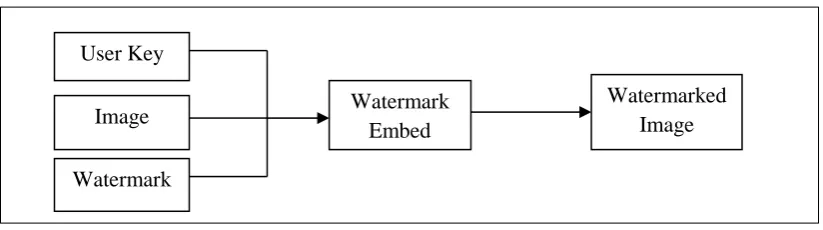
Digital watermarking software looks for noise in digital media and replaces it with useful information or owner details. A digital media file is nothing more than a large list of 0’s and 1’s. The watermarking software determines which of these 0’s and 1’s correspond to too many or irrelevant details. For example, the software might identify details in an image that is too small for the human eyes to see and flag the corresponding 0’s and 1’s as irrelevant noise. Then the flagged 0’s and 1’s can be replaced by a digital watermark. Watermarking process is shown in Figure 2.4 and 2.5.
Watermarking
According to domain
According to type of document According to human perception According to application Frequency domain Spatial Domain
Text Video Audio Image
Source Based
Destination Based
Visible Invisible
Robust Fragile
Private Public Invertible Non-Invertible
Quasi-Invertible
Figure 2.4: Watermark embed spatial domain watermarking
Figure 2.5: Watermark Eextraction spatial domain watermarking
Figure 2.4 and 2.5 demonstrate a typical spatial domain watermark embedding and extraction process applied to a static image. It is notable that a slight degradation of the original image occurs when the watermark is embedded. However, the retrieved watermark is very close to the original watermark, which can help resolve ownership issues.
2.2.1 Visible Watermark
Visible watermark are an extension of the concept of logos. Such watermarks are applicable to images only. These logos are inlaid into the image but they are transparent. Such watermarks cannot be removed by cropping the centre part of the image. Moreover, such watermarks are protected against attacks such as statistical analysis.
User Key
Watermarked Image
Watermark Extraction
Extracted Watermark User Key
Image
Watermark
Watermark Embed
2.2.2 Invisible Watermark
A code hides secretly in a cover image and carry copyright information or other secret messages. An invisible watermark consists of a very slight change of contrast over large areas of the picture, invisible to the human eyes, even fainter than the watermark on a piece of paper. Suitable software can recover the invisible watermark even if the image has been printed out, photographed, and scanned.
2.2.3 Public Watermark
Such a watermark can be read or retrieved by anyone using specialized algorithm. In this sense, public watermarks are not secured. However, public watermarks are useful for carrying Intellectual Property Rights (IPR) information. Public watermark are good alternatives to labels.
2.2.4 Fragile Watermark
2.2.5 Private Watermark
Private watermarks are also known as secure watermarks. To read or retrieve such watermark, it is necessary to have the secret key. It cannot be removed, altered or duplicated. It is a permanent part of the paper. It is an extension of corporate image. It conveys confidence.
2.2.6 Perceptual Watermark
A perceptual watermark exploits the aspects of human sensory system to provide invisible yet robust watermark. Such watermarks are also known as transparent watermarks which can provide extremely high quality contents.
2.2.7 Bit-stream Watermark
The term is sometimes used for watermarking compressed data such as video. The watermark is embedded into the MPEG-2 bitstream without increasing the bit-rate, and can be retrieved even from the decoded video and without knowledge of the original, un-watermarked video.
2.2.8 Text Document Watermark
2.3 QR Code
QR Code is two-dimensional barcode which is categorized in matrix barcode that can store data information. QR stands for “Quick Response” as the creator intended the code to allow its contents to be decoded at high speed. It was introduced in Japan by Denso Corporation in 1994 [14]. This kind of barcode was initially used for tracking inventory in vehicle parts manufacturing and is now used in a variety of industries. Because of its large information capacity, high reliability, ultra-high-speed read, QR Code is widely used in many fields, such as newspaper and TV media, product identification, security, electronic business cards, e-commerce, electronic guides, assembly line production, and etcetera. QR Code can be read by an imaging device such as camera. Data extracted from patterns present in both horizontal and vertical components of the image. As a variety of industries utilize the QR Code today, the applications for use can vary from product tracking, item identification, time tracking, document management and general marketing purposes [15]. QR Code reading is divided into two categories which are laser-way acquisition and image-acquisition. Image-acquisition type is used in most cases, but QR Code image based on image-acquisition have uneven illumination problems, resulting to recognition difficulty.
Figure 2.6: QR Code versus Barcode [16]
QR Code modules work with some functions that contain both horizontal and vertical directions. Some contain the actual data, while others are grouped into various function patterns that improve reading performance and allow symbol alignment, error correction and distortion compensation. The timing pattern lets the scanning device know the size of the symbol. There is also a required “quiet zone,” a buffer area containing no data, to ensure that surrounding text or markings are not mistaken for QR Code data.
Figure 2.7: QR Code modules [16]
[image:25.595.182.461.404.525.2]As a result, the QR Code does not require lengthy code searching, enabling reading speeds twenty times faster than those of conventional matrix codes. Also, searching the position detection patterns which can be performed by the scanning hardware, further increase overall speed by allowing image reading and data processing to be carried out simultaneously. Various versions of QR Code are shown in Figure 2.8.
[image:26.595.106.524.206.593.2]
Figure 2.8: Versions of QR Code [16]
Version 1 (21 x 21) Version 2 (25 x 25) Version 3 (29 x 29)
Content “Ver1” Content “Version 2” Content “Version 3 QR Code”
Version 4 (33 x33) Content “Version 4 QR Code, up to 50 char”
Version 10 (57 x57) Content “Version 10 QR Code, up to 174 char at H level, with 57x57 modules
One of the big selling points of QR Code is the capacity of the information storage. The amount of data that can be stored in the QR Code symbol depends on the data type, version, and error correction level. The highest storage capacities are available for 40-L symbols [15]. QR Code has a function of an error correcting for misreading that white is black. Error correcting is defined in four levels as follows [17] :
i) Level L : about 7% or less errors can be corrected. ii) Level M : about 15% or less errors can be corrected. iii) Level Q : about 25% or less errors can be corrected. iv) Level H : about 30% or less errors can be corrected.
In larger QR symbols, the message is broken into several Reed–Solomon code blocks. The block size is chosen so that at most 15 percent errors can be corrected in each block; this limits the complexity of the decoding algorithm. The code blocks are then interleaved together, making localized damage to a QR symbol to less likely will overwhelm the capacity of any single blocks.
2.3.1 QR Code Model 1
[image:27.595.271.362.601.687.2]The original QR Code is capable of coding 1167 numerals with its maximum version being 14 (73 × 73 modules). Figure 2.9 shows the QR Code Model 1 with 73 × 73 modules.
2.3.2 QR Code Model 2
[image:28.595.272.347.289.367.2]QR Code Model 2 is an improved version of Model 1 that can be read smoothly even if it is distorted in some ways. QR Codes Model 2 can be printed on a curved surface and the reading angle will not be affected or distorted by the reading images. The QR Code can be read efficiently by referring to an alignment pattern embedded in them. Besides that, QR Code Model 2 can encode up to 7,089 numerals with highest version being 40 (177 × 177 modules). Figure 2.10 shows the improved version of QR Code Model 2.
Figure 2.10: QR Code Model 2 [16] with 177 × 177 modules
[image:28.595.198.439.598.732.2]2.3.3 Micro QR Code
Figure 2.11 shows the Micro QR Code that has only one position detection pattern. Regular QR Code requires at least a four-module wide margin around a symbol, whereas a two-module wide margin is enough for Micro QR Code. This configuration of Micro QR Code allows printing in areas even smaller than QR Code.
Micro QR Code can only store up to a maximum of 35 numerals. Figure 2.12 shows Micro QR Code can encode data more efficiently than regular QR Code. Unlike the case with the regular code, Micro QR Code size is small and there are 4 variations, M1, M2, M3 and M4. The maximum amount of data that can be encoded for the maximum version of this code is M4. However, the data size that encoded in Micro QR Code M4 is still smaller than regular QR Code.
Figure 2.12: Comparison of data size between QR Code, Micro QR Code and Barcode
2.3.4 iQR Code
80 percent than a regular QR Code and Figure 2.14 shows iQR have smaller footprint compared to a regular QR Code.
[image:30.595.208.452.140.249.2]
Figure 2.13: Storage increase 80 percent than a regular QR Code [16]
Figure 2.14: Smaller footprint is required compared to regular QR Code [16]
2.3.5 SQRC
SQRC is a type of QR Code equipped with reading restricting function. This can be used to store private information and to manage company's internal information. However this function does not guarantee that the coded data are secured. There are three features of SQRC:
Locking up of encoded data. SQRC can be read only by specific types of scanners.
[image:30.595.207.446.318.424.2] Appearance and apparent properties of regular QR Code retained. Appearance of SQRC is no different from the regular QR Code. Functionalities that come with the regular QR Code including error correction function are all retained.
2.3.6 Logo Q
[image:31.595.132.513.408.497.2]LogoQ is a new type of QR Code created to enhance visual recognizability by combining it with letters and pictures in full colour. Since LogoQ is a highly designable type of QR Code, it becomes possible to differentiate LogoQ from the regular QR Code. A proprietary logic is used when generating LogoQ codes. The purpose of LogoQ is to combine designability and readability. Figure 2.15 shows regular QR Code embbed with letters and colour to create Logo Q.
Figure 2.15: QR Code embed with letters and colour to create Logo Q [16]
2.4 Image File Types
Lossy compression algorithms preserve a representation of the original uncompressed image that may appear to be a perfect copy, but it is not a perfect copy. Often lossy compression is able to achieve smaller file sizes than lossless compression because lossy compression algorithms allow for variable compression that trades image quality for file size.
2.4.1 JPEG
JPEG (Joint Photographic Experts Group) is a lossy compression technique. It is usually the compressed images and stored in the JPEG File Interchange Format (JFIF). The JPEG/JFIF filename extension is JPG or JPEG. JPEG applies lossy compression to images, which can result in a significant reduction of the file size. Applications can determine the degree of compression to apply, and the amount of compression affects the visual quality of the result. When not too great, the compression does not noticeably affect or detract from the image's quality, but JPEG files suffer generational degradation when repeatedly edited and saved. Besides that, JPEG are cross platform, meaning the same file will look the same on both Mac and PC [18].
2.4.2 TIFF
standard in the printing business. The TIFF format is widely supported by image-manipulation applications, by publishing and page layout applications, and by scanning, faxing, word processing, optical character recognition and other applications [19]. TIFF can handle device-specific colour spaces, such as the CMYK defined by a particular set of printing press inks. OCR (Optical Character Recognition) software packages commonly generate some forms of TIFF image for scanned text pages.
2.4.3 RAW
RAW refers to raw image formats that are available on some digital cameras, rather than to a specific format. These formats usually use a lossless or nearly lossless compression, and produce file sizes smaller than the TIFF formats. Although there is a standard raw image format which is ISO 12234-2, TIFF/EP, the raw formats used by most cameras are not standardized or documented, and different among camera manufacturers. Most camera manufacturers have their own software for decoding or developing their raw file format, but there are also many third-party raw file converter applications available that accept raw files from most digital cameras. Some graphic programs and image editors may not accept some or all raw file formats, and some older ones have been effectively orphaned already.
2.4.4 GIF
2.4.5 BMP
The BMP file format (Windows bitmap) handles graphics files within the Microsoft Windows OS. Typically, BMP files are uncompressed, and therefore BMP storing image information allows for crisp, high-quality graphics, but also produces large file sizes. Their advantage is their simple structure and wide acceptance in Windows programs and OS/2 [18]. The BMP file format is capable of storing 2D digital images of arbitrary width, height, and resolution, both monochrome and colour, in various colour depths, and optionally with data compression, alpha channels, and colour profiles. The JPEG and GIF formats are also bitmaps, but use image compression algorithms that can significantly decrease their file size. For this reason, JPEG and GIF images are used on the Web, while BMP images are often used for printable images.
2.4.6 PNG
2.5 Dual-watermark Techniques
In this section, MOHANTY [20] Dual-watermarking Technique for Images and HSU & WU Technique [21] Dual-watermarking with QR Code Applications in Image Processing technique are reviewed.
2.5.1 MOHANTY Dual-watermarking Technique
In 1999, a version of Dual-Watermarking algorithm was released in a paper: “A Dual-watermarking Technique for Images [20]”. In this watermarking algorithm, a visible and an invisible watermarking are both embedded into host image.
Firstly, a visible watermark is merged into host image in order to create a watermarked image. Host image (one to be watermarked) I and the watermark (image) W are divided into block. Let 𝑖𝑛 donate the 𝑛𝑡ℎ block of the original image I
and 𝑤𝑛 donate the 𝑛𝑡ℎ block of watermark W. For each block (𝑖𝑛 ), the local statistics; mean µ𝑛 and variance 𝜎𝑛 are computed. The image mean gray value µ is also found out. Watermarking is done blockwise. A watermarked image block is obtained by modifying 𝑖𝑛 as follows.
𝑖𝑛 = 𝛼𝑛 𝑖𝑛 + 𝛽𝑛𝑤𝑛 , n = 1, 2…
Where 𝛼𝑛 and 𝛽𝑛 are scale and embed factors respectively, depending on µ𝑛 and 𝜎𝑛 of each block.
At invisible watermarking part, a pseudo-random binary-sequence {0,l} of period N is generated using linear shift register. The period N is equal to the number of pixels of the image. Then the watermark is generated by arranging the binary sequence into blocks of size 4×4 or 8×8. After that start with bit-plane k=O (MSB) of the image I’. The watermark is EX-ORed with the 𝑘𝑡ℎ bit-plane of the image. This
REFERENCES
[1] Yeung, M.M. (1997). Digital Watermarking for High-Quality Imaging, Proc. IEEE First Workshop on Multimedia Signal Processing, New Jersey, pp. 357-362.
[2] Borko, F. (2011). Handbook Of Augmented Reality, Springer, pp.341-349.
[3] Denso-Wave. (2011). QR Code Features, Retrieved from : http://www.qrcode.com/en/
[4] Scott, M.C. (2000). Hiding Information in Images: An Overview of Watermarking, Cryptography Research Paper. Retrieved from : http://www.cim.mcgill.ca/~scott/RIT/CryptoPaper.html
[5] Tirkel, A.Z., Rankin, G.A., Schyndel, R.M.V., Ho, W.J., Mee, N.R.A. and Osborne, C.F. (1992). Electronic Water Mark. DICTA 93, Macquarie University, pp.666-673.
[6] Gao, X.B., Yuan, Y., Cheng, D. and Li, X.L. (2011). Lossless data embedding using generalized statistical quantity histogram, IEEE Transaction on circuits and systems for video technology, vol. 21, No. 8, pp. 1061-1070.
[8] Masoud, N., Ronak, K. and Hojat, A.H. (2012). Short Communication on Digital Watermarking in Images. Shaneh Branch Islamic Azad University.
Vol (2), No (4), pp.220-223.
[9] Pranab, K.D. and Kim, J.M. (2011). Digital Watermarking Scheme Based on Fast Fourier Transformation for Audio Copyright Protection International
Journal of Security and Its Applications, Vol. 5 No.2 , pp.33-48.
[10] Petitcolas, F.A.P., Anderson, R.J. and Kuhn, M.G. (1999). Proceedings of the IEEE, Volume 87, Issue 7, pp.1062-1078.
[11] Jaspreat, K. and Karmjeet, K. (2012). Digital Watermark : A Study. International Journal of Advanced Research in Computer Science and
Software Engineering. Volume 2, Issue 8
[12] Ruanaidh, Boland, F. and Dautzenberg, C. (1995). Watermarking Digital Images for Copyright Protection, Proc. IEE Conf. Image Processing and It’s
Applications, pp.87-94.
[13] Vanwasi, A.K. (2011). Digital Watermarking-Steering the future of security. Retrieved from: http://www.networkmagazineindia.com/200108/security1. html
[14] Yue, L., Yang, J. and Ming, J.L. (2008,). Recognition of QR Code with mobile phones, Control and Decision Conference Chinese, pp. 203-206.
[15] Denso-Wave. (2012). “Version and Maximum Capacity Table”. Retrieved
[16] Denso ADC. (2011). “ QR Code Essentials.”
Retrieved from: http://www.nacs.org/LinkClick.aspx?fileticket=D1FpV AvvJuo%3D&tabid=146&mid=4802
[17] Phaisarn, S. and Wichian, P. (2010). QR Code Generator Eighth International Conference on ICT and Knowledge Engineering. Thailand, pp. 90-101.
[18] Murray, James, D., Van, R. and William. (1996). Encyclopedia of Graphics File Formats (Second ed., pp. 1152-1169.
[19] Pachghare, V.K. (2005). Comprehensive Computer Graphics: Including C++.
Laxmi Publications, pp. 93-97.
[20] MOHANTY, S.P. (1999). A Dual-watermarking Technique for Images, Proc. 7th ACM International Multimedia Conference, ACM-MM’99, Orlando, USA, pp. 49-51.
[21] Hsu, F.H. and Wu, M.H. (2012). Dual-watermarking by QR Code Applications in Image Processing, 9th International Conference on Ubiquitous Intelligence and Computing, pp. 638-643.
[22] Gersho, A. and Gray, R.M. (1993). Vector Quantization and Signal Compression. Boston, MA: Kluwer, pp. 159-165.

![Figure 2.3: Classification of watermarks [13]](https://thumb-us.123doks.com/thumbv2/123dok_us/8760077.893851/20.595.115.525.71.543/figure-classification-of-watermarks.webp)
![Figure 2.6: QR Code versus Barcode [16]](https://thumb-us.123doks.com/thumbv2/123dok_us/8760077.893851/25.595.182.461.404.525/figure-qr-code-versus-barcode.webp)
![Figure 2.8: Versions of QR Code [16]](https://thumb-us.123doks.com/thumbv2/123dok_us/8760077.893851/26.595.106.524.206.593/figure-versions-of-qr-code.webp)
![Figure 2.9: QR Code Model 1 [16] with 73 × 73 modules](https://thumb-us.123doks.com/thumbv2/123dok_us/8760077.893851/27.595.271.362.601.687/figure-qr-code-model-modules.webp)
![Figure 2.11: Micro QR Code [16] has only one position detection pattern](https://thumb-us.123doks.com/thumbv2/123dok_us/8760077.893851/28.595.198.439.598.732/figure-micro-qr-code-position-detection-pattern.webp)

![Figure 2.13: Storage increase 80 percent than a regular QR Code [16]](https://thumb-us.123doks.com/thumbv2/123dok_us/8760077.893851/30.595.207.446.318.424/figure-storage-increase-percent-than-regular-qr-code.webp)
![Figure 2.15: QR Code embed with letters and colour to create Logo Q [16]](https://thumb-us.123doks.com/thumbv2/123dok_us/8760077.893851/31.595.132.513.408.497/figure-qr-code-embed-letters-colour-create-logo.webp)
