Transfer of technology in construction:
Absorption capacity and internalization
Amaratunga, RDG, Shanmugam, M and Rameezdeen, R
Title Transfer of technology in construction: Absorption capacity and internalization
Authors Amaratunga, RDG, Shanmugam, M and Rameezdeen, R
Type Conference or Workshop Item
URL This version is available at: http://usir.salford.ac.uk/9937/ Published Date 2005
USIR is a digital collection of the research output of the University of Salford. Where copyright permits, full text material held in the repository is made freely available online and can be read, downloaded and copied for noncommercial private study or research purposes. Please check the manuscript for any further copyright restrictions.
TRANSFER OF TECHNOLOGY IN CONSTRUCTION: ABSORPTION
CAPACITY AND INTERNALISATION
R. Rameezdeen1, S. Menaha 1 & R.D.G.Amaratunga2
1
Department of Building Economics, University of Moratuwa, Sri Lanka e-mail: [email protected]
2
Research Institute for the Built and Human Environment, The University of Salford, UK e- mail: [email protected]
ABSTRACT: In developing countries acquiring technology through importation is more economical than generation. Internalization of transferred technology reduces the dependence of recipient to a greater extent. This study aims to evaluate the extent of internalization of technology transfer in the construction industry of Sri Lanka. The ready mix concrete industry was selected as a case study. Four ready mix concrete manufacturers were selected based on the purposive sampling methodology. The operations of these four manufacturers were studied using two panels. The effectiveness of internalization of technology was evaluated based on the basic components and the technological capabilities. The results clearly show that except “Technoware” and “Operative Capability” other components and capabilities of technology have not been fully internalized.
Keywords – Internalization, Ready Mix Concrete, Sri Lanka, Technology Transfer
1 INTRODUCTION
Technology may be defined as the application of existing body of knowledge to the production of goods and services (Ofori, 1994). The developing countries face major challenges in properly developing, attracting and using modern technologies. Many writers stress the need to raise the level of technological development of construction industries of the developing countries (Ofori, 1994).
There are two major ways to acquire technology – Generation and Importation. Generation means developing technologies through in- house research and development whereas importation refers to the process through which various forms of technology are implanted into and adapted to recipient operation, thereby establishing the capacity to operate and maintain technology.
In a developing country environment it may be difficult for the construction industry to be self sufficient, in all technological capabilities, only by in-house generations, as technology generation costs money and involve risks (Hennayake, 1996). Therefore the technology transfer has become an essential process to be followed by the developing countries to survive under globalization trend.
Ganesan, 2002). As this has rarely been discussed, this study attempts to analyze the internalization of Technology Transfer in construction.
2 TECHNOLOGY TRANSFER
Technology Transfer has been defined in many different ways. According to Dichter et al. (1998); cited in Carrillo, (1994), technology transfer is ‘the process whereby knowledge in some form is transferred from a person or organization that possesses it (the transferor) to another person or organization that arranges to receive it (the transferee)’. Jain and Jones (2002) observe that Technology Transfer ‘is a process involving acquisition, assimilation, diffusion and development of technology and is accomplished through the creation of either formal or informal partnerships, and agreements between organizations’.
Technology is considered as a combination of four basic components, all of which dynamically interact together and accomplish any transformation operation. Those basic components are Technoware, Humanware, Inforware and Orgaware (Chatterji, 1990). Technoware refers to the object-embodied form of technology which includes all physical facilities such as instruments, equipment, machineries etc. necessary for the transformation of operation. Humanware is the person-embodied form of technology which includes all required abilities such as expertise, creativity, diligence, proficiency, dexterity, ingenuity etc. necessary for the transformation operation. Inforware denotes the document-embodied form of technology which includes all the facts and figures such as designs, observations, specifications, equations, charts, relations etc., required for the transformation operation. Orgaware is the institute-embodied form of technology which includes the framework such as groupings, allocations, systemization, management etc. required for the transformation operation (Chatterji, 1990).
Mere components of technology will not give the real power. The real power comes from technological capability. Technological capability consists of the Operative, Transaction, Innovative and Supportive capabilities. Operative capability includes capabilities to utilize and control technoware, to plan and manage production operation, provide information support and networking for production operations and to carry out preventive, routine maintenance. Transaction capability is to obtain and to choose a better technology in order to improve a firm’s operative capability. It includes capabilities to carry out detailed engineering studies to independently identify good sources of technology, to identify most suitable mode of acquisition of the technology and to negotiate terms of acquisition of the technology. Innovative capability refers to the ability to develop technologies which include capabilities to duplicate acquired technology, to adapt acquired technology and to carry out major and minor improvements. Supportive capability provides the foundation for the development of operative, transaction and innovative capability of a firm. It includes the capabilities to undertake project execution, to get funds for expansion of technology, to plan and implement human resource development and to identify new markets (Chatterji, 1990).
that may arise. The construction is a business in which time and profitability are intricately linked. Therefore, it is necessary to assess up to what extent the transferred technology has improved, along with time, to meet the increased demand by the construction clients for high quality concrete.
3 OBJECTIVES AND METHODOLOGY
This study was carried out to evaluate the extent of the internalization of transferred technology in Sri Lanka. In this connection the ready- mix concreting industry was selected as a case study in the construction industry. Ready- mix concreting is one of the technologies that were transferred to Sri Lankan construction industry from developed countries. Many firms in Sri Lanka are now using this technology to cater to the concrete requirement of the industry. This technology is becoming popular among the construction companies due to its high quality and quick delivery. Therefore, those who are engaged in ready- mix concrete manufacturing are forced not only to satisfy the clients’ immediate expectations but also to be prepared to face the challenges of an increased demand in the future. The objectives of this research were set as;
1. to evaluate the extent of internalization of the transferred technology in Sri Lanka, and 2. to assess the barriers to internalization.
Comprehensive case studies were carried out on four ready mix concrete manufacturers who were selected based on the purposive sampling methodology. In general, the case studies are the preferred research strategy when the focus is on a contemporary phenomenon within real- life context. Case study is an empirical inquiry that investigates a contemporary phenomenon within its real- life context, when the boundaries between phenomenon and context are not clearly evident; and in which multiple sources of evidence are used (Yin, 1994). The operations of these four manufacturers were studied using two panels. Panel Data Analysis refers to the pooling of observations on a cross-section of the subjects, over several periods of time (Tan, 2002). Panel data analysis in this study gives an opportunity to analyze the extent of internalization in two time periods. In addition the variance between the two periods could be ascertained. The data for the first panel was obtained in 1999. It covered the transfer of technology, its effectiveness and the internalization effort since the beginning. The second data panel was obtained in 2003 covering mainly the internalization efforts between the first and the second panel. The effectiveness of internalization of the technology was evaluated based on the basic components and the technological capabilities.
4 CASE STUDIES
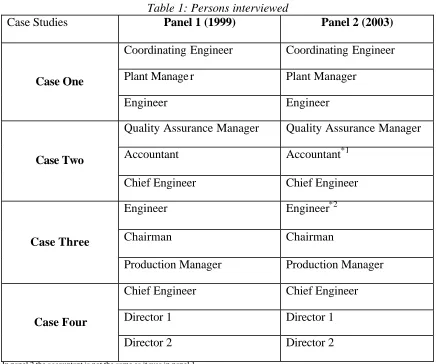
the same persons could not be found in that position. Though the questionnaire distributed to the target groups in both panel were similar in basic aspects, in Panel 2 more emphasis was given on the internalization. Table 1 provides the profile of the sample.
Table 1: Persons interviewed
Case Studies Panel 1 (1999) Panel 2 (2003)
Coordinating Engineer Coordinating Engineer
Plant Manage r Plant Manager
Case One
Engineer Engineer
Quality Assurance Manager Quality Assurance Manager
Accountant Accountant*1
Case Two
Chief Engineer Chief Engineer
Engineer Engineer*2
Chairman Chairman
Case Three
Production Manager Production Manager
Chief Engineer Chief Engineer
Director 1 Director 1
Case Four
Director 2 Director 2
*1 In panel 2 the accountant is not the same as it was in panel 1 *2 In panel 2 the Engineer is not the same as it was in panel 1
In each case the questions were focused on the internalization in terms of the components of the technology and the technological capabilities. Under the technoware the strength of each organization in terms of its physical technologies such as batching plants, truck mixers, pump cars, purification system, agitator trucks, admixture measuring system, cement bowser etc., were identified. Humanware was surveyed based on the learning mechanism adopted in the organizations. It includes learning by doing, crude copying, adaptive copying, training, hiring foreign management, and searching new techniques. The availability and/or the accessibility of useful information related to ready mix concrete technology was considered under the Inforware. The elements considered under this component are availability of drawings, specification, material list, operating manuals and computerized information systems. Orgaware focused on the adequacy of the organization structure in terms of aspects such as rigid versus flexible, centralized versus decentralized, and flat versus tall.
4.1 Case Study One
The organization in this case, started its operations in 1992 in the fields of asphalt production and bridge and road construction and expanded its business in 1993 to include the supply of ready mix concrete, which in turn led to other ventures such as building construction, production of pre cast concrete elements, etc.
The ready mix technology was transferred to the company with the purchase of a batching plant from an international contractor who brought the plant for a major road project in Sri Lanka. According to the agreement between the two parties of the transfer, the transferor had to provide operational as well as maintenance technologies. The ready mix concreting business at present is fully owned by the local firm.
Between Panel 1 and 2, there were minor improvements in technoware and orgaware. Only truck mixers were bought after 1999 in order to meet the increased demand for ready mix concrete. The organizational structure remains the same as the previous panel where the roles and responsibilities of the employees are very clearly defined. Up to the first panel, training was given to technical staff in the areas of execution, operation and maintenance. However, in the second panel it was found that the staff at the managerial level were also given training. The adoptation of evaluation programme on training is a notable improvement in humanware. Record keeping was observed to be improved in the second panel.
The operative capabilities were found to be satisfactory in both panels. The firm has erected a site based batching plant recently. Thus its operative capability has been improved to a certain extent. As far as the innovative capabilities are concerned the research activities in panel one was limited only to laboratory testing of concrete. However in the second panel, it was found that the company has established a separate division for research & development, mainly to increase their focus on quality and customer care.
4.2 Case Study Two
This company started its operations in 1980. They undertook construction projects ranging from domestic houses to multibillion-rupee complexes. The main motive of the company was to become technology leaders in ready mix concrete market and to capture the highest market share.
An international contractor who was engaged in a construction project in Sri Lanka had sold the batching plant at the end of the project. According to the agreement the transferor had to erect the plant and provide operational and maintenance assistance afterwards.
Between the two panels there had been a considerable amount of improvements in the physical facilities. Purchase of two additional batching plants could be cited as evidence. The humanware has continued to remain the same. Inforware has been identified by the firm as one of the important resources. Therefore, they have placed a higher value on inforware. Development of a system for the inforware is a radical improvement between the two panels.
4.3 Case Study Three
This company was incorporated in 1986 as a joint venture between a government corporation of Sri Lanka and a foreign collaborator from Japan. The joint venture status continued until 1996 when the Japanese partner trans ferred 49% of its holdings in the Company to its Sri Lankan counterpart. During the intervening years the company enjoyed the benefits of the transfer of technology and technical know-how from its Japanese partners.
Since 1996 it has been a 100% Government of Sri Lanka owned entity under the direct purview of the Ministry of Irrigation and Water Resources Management. This government link places it at an advantageous position in undertaking work on major internationally funded projects in which foreign collaborations are involved. The company's main line of activity is the production and supply of ready- mixed concrete and pre-cast concrete products. It has, therefore, developed the technical capability to undertake all types of major construction works, including the construction of buildings, bridges and highways. This competitive position is enhanced by the modern plant, which was bought by the government from their former partner.
Soon after the company commenced commercial operations, the foreign collaborator’s reputation in Japan for high quality concrete helped this local company to undertake the challenging task of supplying the entire requirement of ready mixed concrete to nearly every major construction project in Sri Lanka.
At the second panel it was observed that most of the technoware were in obsolete condition. However between the two panels a new batching plant was added to the system. Though the company made improvements on physical technology most of them are not utilized at present. Since it is a government organization the bureaucratic barrier has worked against improvements in humanware and orgaware. During the first panel information on every aspect was well maintained. However at the second panel, mainly due to the financial crisis, information management was not carried out efficiently.
The operative and supportive capabilities have decreased between the two panels. The company is not in a position to continue its business today as they face a severe financial crisis. They have almost gone into a state of bankruptcy.
4.4 Case Study Four
This company started its operations in 1980. Their main business is construction and not manufacturing or supplying of ready mix concrete. The technology was transferred to their organization by the purchase of a plant from China. The company uses the plant exclusively to satisfy the ready mix needs of their own construction clients.
The batching plant bought in the second panel is superior only in capacity and not in any other aspects such as quality, pollution control, cost etc. But still the present capability is not at all sufficient to meet the current market requirements. That’s why they have limited the supply of concrete to their regular clients. At present they possess only few truck mixers and one batching plant. The cement is supplied from another company and the pump cars are also hired. Initially training was provided to the technical staff. However, at present they are not keen in training staff as they do not intend changing the machinery.
4.5 Summary
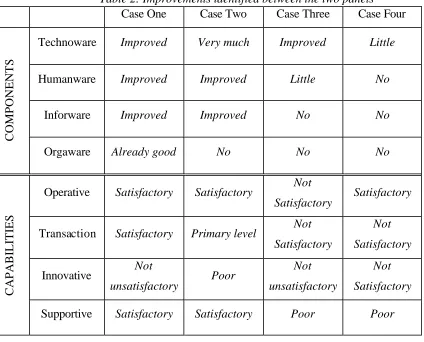
[image:8.596.70.494.190.532.2]According to the results of these four case studies improvements between the two panels are found as given in Table 2. As a generalization, the extent of internalization of the transferred technology has been found in terms of basic components of technology transfer and technological capabilities. The results are summarized in Table 3.
Table 2: Improvements identified between the two panels
Case One Case Two Case Three Case Four
Technoware Improved Very much Improved Little
Humanware Improved Improved Little No
Inforware Improved Improved No No
COMPONENTS
Orgaware Already good No No No
Operative Satisfactory Satisfactory Not
Satisfactory Satisfactory
Transaction Satisfactory Primary level Not
Satisfactory
Not
Satisfactory
Innovative Not
unsatisfactory Poor
Not
unsatisfactory
Not
Satisfactory
CAPABILITIES
Supportive Satisfactory Satisfactory Poor Poor
Table 3: Extent of the internalization of Technology Transfer in terms of basic components and technological capabilities
1. Basic components 2. Technological capabilities
1.1 Technoware High 2.1 Operative Good
1.2 Humanware Little 2.2 Transaction Satisfactory
1.3 Inforware Not much 2.3 Innovative Poor
[image:8.596.86.512.579.694.2]5 DISCUSSION
According to the results obtained from the case studies, among the components of the technology, except Technoware, other components of the technology have not been fully internalized. Appropriate human resource development (Humanware) is essential for the creation, support and preservation of a natural, scientific and technological capacity to absorb, adapt and manage the knowledge, products and techniques that are transferred. The enterprises need to keep contacts with technology information systems (Inforware) for technology transfer and assimilation. Those information systems are expected to provide the right information to the firm at reasonable costs.
Only the “Operative” capabilities have been internalized to a satisfactory level, leaving other three in abeyance. The high level of bureaucracy in the organizations is a definite limitation on the improvement of innovative skills of the lower level workers. Also due to poor research and development, innovative skills are not developed in the ready mix industry. The major barriers identified for the internalization are poor management capabilities, increased institutional gaps between the parties, inappropriate transfer of technology, poor research and development activities and very high level of bureaucracy and political interference in the organizations.
In all four case studies it was found that appropriate technology has not been selected by the recipient. In the first and the second cases, foreign contractors left their batching plants at the end of their projects. Local counterparts bought them at a cheaper price and made use of the opportunity. No proper analysis was done to find out the appropriateness of the technology to Sri Lankan context. Lack of focus on the learning mechanism is evidenced in insufficient resource allocation for training in almost all the cases. Although training has not been totally disregarded, it has mainly been of a narrow focus, aimed only at developing the level of skill necessary to operate the imported technology. Therefore, the learning mechanism should be encouraged within the companies. The need for research and development is another important area to be considered in Sri Lanka to make use of the opportunities created by the technology transfer. In a developing country it may be difficult for an enterprise to be self- sufficient in all technological capacities. They are to depend on external institutions such as Institute for Construction Training and Development (IC TAD), National Building Research Organization (NBRO), Center for Housing Planning and Building (CHPB) etc. for developed technical capabilities. Increased institutional gap between the transferor and the transferee is another major barrier to the effective transfer of technology. The institutional gap is measurable in terms of the structure of the organization, financial status, equipment ownership, managerial and technical level and communication system. In the third case all the managerial functions were looked after by the foreign collaborator. When the ownership of the firm was transferred to the local counterpart the staff confronted with difficulties in adapting to the new challenges. The organizational attitudes towards new technologies can also be a barrier to the adoption of new technologies. To enhance effectiveness, the organizational barriers should be well understood and minimized or eliminated if possible.
6 CONCLUSIONS
appropriate technology has not been selected by the recipient. In the first and the second cases, foreign contractors left their batching plant at the end of their projects. Local counterparts bought them at a cheaper price and made use of the opportunity. No proper analysis was done to find out the appropriateness of the technology to Sri Lankan context. The major barriers identified for the internalization are poor management capabilities, increased institutional gaps between the parties, inappropriate transfer of technology, poor research and development activities, and very high level of bureaucracy and political interference in the organizations. Lack of focus on the learning mechanism is evidenced in the insufficient resource allocation for training in almost all the cases. Although training has not been totally disregarded, it has mainly been of a narrow focus, aimed only at developing the level of skill necessary to operate the imported technology.
7 REFERENCES
Carrillo, P., 1994, Technology transfer: A survey of international construction companies, Construction Management and Economics, 12, pp 45-51
Chatterji, M., 1990, Technology transfer in the developing countries, Macmillan Press Ltd., London
Devepriya, K.A.K. and Ganesan, S., 2002, Technology Transfer through subcontracting in developing countries, Building Research and Information, 30(3), pp 171-182
Hennayake, P.D., 1996, The Techno logical Capabilities of a Firm, Symposium on Management of Technology, The Institute of Engineers Sri Lanka, Colombo.
Jain, R. and Jones, M., 2002, Technology Transfer for SMEs: challenges and barriers, International Journal of Technology Transfer and Commercialization, 1(1/2), pp 146-162
Ofori, G., 1994, Construction Industry Development: Role of Technology Transfer , Construction Management and Economics,12, pp 379-392
Saad, M. and Greenwood, M., 2001, Technology Transfer in Construction : a View of
Algeria. [Online]. U.K: The University of West of England. Available from:
http://buildnet.csir.co.za/cdcproc/docs/2nd/saad_m.pdf [Accessed 12 March 2003]
Tan, W., 2002, Practical Research Methods, Prentice Hall, Pearson Education Asia Pte Ltd., Singapore.