Journal of Chemical and Pharmaceutical Research, 2014, 6(4):568-574
Research Article
CODEN(USA) : JCPRC5
ISSN : 0975-7384
Study and modeling on saponification dynamics of the mixture of
insect wax and oil-tea camellia seed oil
Ma Jin-Ju, Ma Li-Yi, Zhang Zhong-Quan, Wang You-Qiong, Zhang Hong* and Duan Qiong-Fen
Research Institute of Resource Insects, Chinese Academy of Forestry, Kunming, China
_____________________________________________________________________________________________
ABSTRACT
The saponification reaction rate constant k and reaction order a of the mixture of insect wax and oil-tea camellia seed oil at 83、88、93℃ were derived out respectively by a series of experiments and MATLAB programming. And then according to the Arrhenius equation, the dynamics model was established as:
8
9203.3
6.8300 10 exp
273.15
a S
dC
v
C
dt
T
, which can reflect the saponification reaction process of the mixture of insect wax and oil-tea camellia seed oil and provide a theoretical foundation for saponification reaction of mixture of other waxes and olein and also can guide the existing laboratory study to select the most suitable operating conditions.Keywords: a mixture of insect wax and oil-tea camellia seed oil, saponification reaction, dynamics
_____________________________________________________________________________________________
INTRODUCTION
______________________________________________________________________________
EXPERIMENTAL SECTION
Materials and instruments:
The main materials that used in this study were anhydrous alcohol (A.R.), petroleum ether (A.R.), phenolphthalein (A.R.), concentrated hydrochloric acid (A.R.), NaOH-85% alcohol (self made), oil-tea camellia seed oil (Golden Dragon Fish, food grade). And the refined insect waxes were purchased from Emei Insect Wax Institute. Some instruments such as digital constant temperature water bath (HH-8, Jintan Hongke Instrument Factory), electronic balance (LT1002, d=0.01g), analytical balance (METTLER TOLEDO AB204-S, d=0.0001g) were used.
Principles and methods:
Hypothesis and theory foundation of the modeling: In reference to relevant information[5-6], the saponification dynamic model of the mixture of insect wax and oil-tea camellia seed oil in this work was established based on the following hypothesis:
(1) The saponification of the mixture of insect wax and oil-tea camellia seed oil should be homogeneous reaction. (2) Assuming there should be no temperature gradient among the reactants and the internal and external wall of reaction vessel. The saponification reaction would be completed at a constant temperature.
(3) The impact of the concentration of insect wax and oil-tea camellia seed oil on dynamic model parameters is not considered and could be included in the reaction rate constant k, because the amount of insect wax and oil-tea camellia seed oil far exceeds that of sodium hydroxide in this work.
The saponification reaction dynamic equation of the mixture of insect wax and oil-tea camellia seed oil was expressed as equation (1) based on the above hypothesis:
a
dC
v
kC
dt
(1)
Where C is the real-time concentration of sodium hydroxide at the moment of ts, k is the saponification reaction rate
constant, and a is the reaction order.
Dynamic model parameters calculation:
In the study process on reaction dynamics, a simple pre-experiment should be organized before trying systematic experiment generally for a qualitative or semi-quantitative recognition on the reaction[7]. Assuming the reaction order a was equal to 1 and making integral on both sides of the Eq. (1), then:
0
0
1
ln
C C
C
dC
t
kC
k
C
(2)
So:
0
1
ln(
C
)
k
t
C
(3)
Where C0 is the initial concentration of sodium hydroxide.
If the reaction rate constant k calculated according to Eq. (2) with the real-time concentrations of sodium hydroxide at different intervals was basically unchanged, then the saponification of the mixture of insect wax and oil-tea camellia seed oil would be the first order reaction. Conversely, the assumption did not hold, that is to say, a≠1, then Eq. (1) could be transformed into Eq. (4) by making integral on both sides of the equation.
0
1 1
0 0
1
(
)
(
1)
t C
a a
a C
dC
t
dt
C
C
kC
a
k
(4)So:
1 1
0
(
1)
a a
C
a
kt
C
(5)
There being three sets of data respectively corresponding to different experimental factors in this work, and then we assumed ei (i=1,2,3) was the concentration error of alkali solution. Then, the optimization objective function could
3 2 11
min
, ,
2
i i
i
L e a k
e
(6) subject to:
1 1 0,1
a ai i i
C
a
kt
C
e
(7)
Let
1 1
0,
,
a1
ai i i i
G a k
C
a
kt C
e
(8)
Then the objective function above mentioned could be converted to Eq. (9), according to the Wolfe duality theorem [8] and the Lagrange multiplier method[9].
3 2 3
1 1
1
max
, ,
*
,
2
i i i i
i i
L e a k
e
G a k
(9)
Where Lagrange multiplier λi≥0.
Then, from:
, ,
,
1
i ie i i
e i
L e a k
e
G a k
(10)We have:
i i
e
(11)
From:
1 10, 0,
, ,
0
,
ln
ln
a i
a a
a i i i i i
L e a k
G a k
C
C
kt
C
C
(12)Have:
1 1
0, ,0
ln
ln
0
a a
i i i i i
C
C
kt
C
C
(13)
From:
,
, ,
0
1
k i
k i
L e a k
G a k
a
t
(14)Have:
a
1
t
i0
(15)
So, from Eq. (11), (13) and (15), the objective function could be given by:
3 2 1 10, 1
1
max
,
2
a ai i i i i i
i
L
a
C
C
(16) Subject to
1 1
0, 0,
ln
ln
0
a a
i i i i i
C
C
kt
C
C
______________________________________________________________________________
Where C0,i is the initial concentration of sodium hydroxide, Ci is the real-time concentration of sodium hydroxide at
the moment of ts.
Then the experiment data would be analyzed with Eq. (18) by the MATLAB programming in order to obtain the values of saponification reaction rate constant k and reaction order a at different reaction temperature.
1 1
1 1 1 0,1 0,1
1 1
2 2 2 0,2 0,2
1 1
3 3 3 0,3 0,3
ln
ln
0
ln
ln
0
ln
ln
0
a a
a a
a a
C
C
kt
C
C
C
C
kt
C
C
C
C
kt
C
C
(18)Dynamic model establishing:
The selection of appropriate reaction temperature also affects the success or failure and costs of the reaction process. So the study on relationship between temperature and reaction rate is very important in practice and theory.
As is known, the Arrhenius equation is given: 0
a E RT
k
k e
Then taking logarithm of both sides of the above equation, such that:
0
1
ln
E
aln
k
k
R T
(19)Where Ea is the reaction activation energy, and k0 is the pre-exponential factor.
According to Eq.(19), a straight line would be obtained by plotting lnk as a function of 1/T. And the values of Ea and
k0 would be calculated from the slope and intercept of the straight line, respectively.
Then, from the Arrhenius equation, Eq. (1) becomes
/
0
a K E RT
a a
dC
v
kC
k e
C
dt
(20)Experimental method:
The oil-tea camellia seed oil (8.50g) was placed in a reaction vessel which was incubated in water bath at the setting temperature, then the insect wax (1.50g) was added into the oil-tea camellia seed oil. And then, 10.00 mL NaOH-85% alcohol solution was added into the vessel after the insect wax was dissolved. Accurate mass of reaction mixture which was taken out from the vessel in a certain interval during the reaction was dissolved in hot anhydrous alcohol/ petroleum ether (v/v, 1:3). Afterwards, we titrated the hot solution in the presence of phenolphthalein with 0.0250 M hydrochloric acid standard solution until the red colour just disappeared, and the volume of the consumed hydrochloric acid standard solution was recorded as V1(mL). Then, the real-time concentration of sodium hydroxide
was calculated according to Eq. (21).
1 HCl
NaOH
sample
V
C
C
V
(21)Where Vsample is the volume of reaction mixture which was taken out from the vessel, CHCl is the concentration of the
hydrochloric acid standard solution.
RESULTS AND DISCUSSION
Table 1. The values of reaction rate constant k at different temperature
Reaction temperature
(℃)
Saponification time (S)
Initial concentration of NaOH, C0 (mol/L)
Real-time concentration of NaOH, C (mol/L)
k(×10-3 ,
S-1)
83 300 0.4081 0.03988 7.7521
83 420 0.5344 0.04529 5.8763
83 600 0.6664 0.02038 5.8122
88 180 0.4079 0.07501 9.4078
88 300 0.5340 0.41612 0.8314
88 420 0.6680 0.02228 8.0966
93 180 0.4084 0.06458 10.2463
93 120 0.6685 0.12388 14.0477
93 300 0.5335 0.01030 13.1577
[image:5.595.89.526.293.402.2]As shown in table 1, the reaction rate constant k calculated with real-time concentrations of sodium hydroxide at different intervals fluctuated largely, which proved the saponification reaction of the mixture of insect wax and oil-tea camellia seed oil was not the first order reaction on the concentration of sodium hydroxide. Then, Eq. (18) was derived from Eq.(1).
Table 2. The initial and real-time concentrations of NaOH
Reaction temperature
(℃) Saponification time (S)
Initial concentration of NaOH, C0 (mol/L)
Real-time concentration of NaOH, C (mol/L)
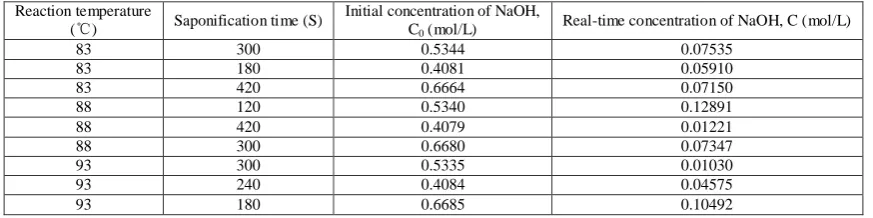
83 300 0.5344 0.07535
83 180 0.4081 0.05910
83 420 0.6664 0.07150
88 120 0.5340 0.12891
88 420 0.4079 0.01221
88 300 0.6680 0.07347
93 300 0.5335 0.01030
93 240 0.4084 0.04575
93 180 0.6685 0.10492
Table 2 provided the initial and real-time concentrations at the moment of ts of sodium hydroxide at 83, 88, 93 ℃.
Then analyzing all the data with Eq. (18), we had:
T=83 ℃, ⅰ
1 1
1 1
1 1
0.07535
ln 0.07535 300
0.5344
ln 0.5344
0
0.05910
ln 0.05910 180
0.4081
ln 0.4081
0
0.07150
ln 0.07150 420
0.6664
ln 0.6664
0
a a
a a
a a
k
k
k
T=88 ℃, ⅱ
1 1
1 1
1 1
0.12891
ln 0.12891 120
0.5340
ln 0.5340
0
0.01221
ln 0.01221 420
0.4079
ln 0.4079
0
0.07347
ln 0.07347 300
0.6680
ln 0.6680
0
a a
a a
a a
k
k
k
T=93 ℃, ⅲ
1 1
1 1
1 1
0.01030
ln 0.01030 300
0.5335
ln 0.5335
0
0.04575
ln 0.04575 240
0.4084
ln 0.4084
0
0.10492
ln 0.10492 180
0.6685
ln 0.6685
0
a a
a a
a a
k
k
k
Then equationsⅰ, ⅱ, ⅲ were solved by the multivariable nonlinear optimization function under constrained conditions in MATLAB programming[10-11] to obtain the optimum values of reaction rate constant k and reaction order a of the saponification reaction of the mixture, as shown in table 3.
[image:5.595.146.471.713.755.2]
Table 3. The values of reaction rate constant k and reaction order aat different reaction temperature
Reaction temperature (℃) reaction order a reaction rate constant k (×10-3, (mol/L)0.11·S-1 )
83 0.8508778122 3.9588775691
88 0.9245024582 6.2516441504
______________________________________________________________________________
As seen from table 3, the value of reaction order a was approximately 0.89 with some fluctuations at different reaction temperature. The different hydrolysis rates of ester groups in insect wax and oil-tea camellia seed oil under basic condition caused the polarity variance of the reaction system, which may lead to change in reaction order a[12]. Additionally, the different increase in viscosity of the reaction system may also lead to fluctuations in reaction order[13]. The saponification reaction rate constant k of the mixture of insect wax and oil-tea camellia seed oil was approximately (3.96~8.01)×10-3 (mol/L)0.11·S-1 under the temperature conditions in this work, and the values of reaction rate constant increased with increasing reaction temperature. That is to say, the higher the reaction temperature, the faster the saponification reaction rate.
Dynamic model establishing:
The values of lnk and 1/TK were calculated by analyzing the data listed in table 3 for study on relationship between
[image:6.595.213.399.239.281.2]temperature and reaction rate, as shown in Table 4.
Table 4. The values of lnk and 1/TK
Ts (℃) TK (K) 1/TK (1/K) lnk (mol/L)0.11·S-1
83 356.15 0.0028078057 -5.5317947360
88 361.15 0.0027689326 -5.0749107858
93 366.15 0.0027311211 -4.8269660467
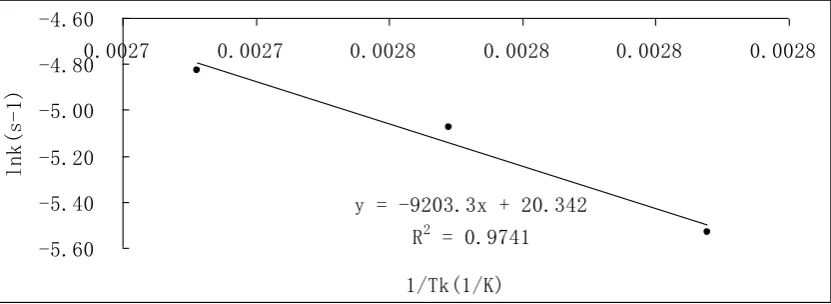
Then, as shown in Fig.1, a straight line was obtained by plotting lnk as a function of 1/TK according to the data
presented in table 4. And the values of Ea and k0 were calculated from the slope and intercept of the straight line,
respectively.
y = -9203.3x + 20.342 R2 = 0.9741 -5.60
-5.40 -5.20 -5.00 -4.80 -4.60
0.0027 0.0027 0.0028 0.0028 0.0028 0.0028
1/Tk(1/K)
lnk(s-1)
Fig.1. The relationship between lnk- 1/TK
The linear regression equation was showed as: lnk=-9203.3×(1/TK)+20.342, and the correlation coefficient
R=0.9870, which presented a good linear relationship between lnk and 1/TK. And from the linear regression equation,
we could have:
0
/
9203.3
ln
20.342
a
E
R
k
Then the values of Ea and k0 were calculated to be 7.6516×10⁴ J·mol-1 and 6.8300×10⁸ (mol/L)0.11·S-1, respectively.
So the saponification dynamics model of the mixture of insect wax and oil-tea camellia seed oil was established as:
8
9203.3
6.8300 10 exp
273.15
a
S
dC
v
C
dt
T
(22) [image:6.595.98.514.341.493.2]established dynamic model which reflected relationship among reaction rate, time and temperature and the derivation process of the model could offer some fundamental theories and reference tactics to the saponification of mixture of other waxes and olein and the study on other reaction kinetics and thermodynamics.
CONCLUSION
The saponification reaction rate constant k of the mixture of insect wax and oil-tea camellia seed oil was calculated to be 3.9589、6.2516、8.0108×10⁻³ (mol/L)0.11·S-1 at 83、88、93℃, respectively. And the value of reaction order a was approximately 0.89.
The saponification dynamics model of the mixture of insect wax and oil-tea camellia seed oil which reflected relationship among reaction rate, time and temperature was established as:
8
9203.3
6.8300 10 exp
273.15
a
S
dC
v
C
dt
T
Acknowledgement
This work was supported by the Special National Forestry Public Sector Projects (201204602).
REFERENCES
[1]JY Miao, K Che, XX Chen, et al, Chemistry and Industry of Forest Products, vol. 32, pp. 67-71, August 2012.
[2]WK Yuan, KH Zhu, Chemical reaction engineering analysis. Shanghai: East China University of Science and Technology Press, 1995.
[3]R Jia, JH Zhu, HY Liu, Study on saponification kinetics of soybean oil, Cereals and Oils, pp. 22-25, 2007(9). [4]DC Yin, GL Kang, MS Li, et al, Journal of Yunnan University (Natural Sciences Edition), vol. 27, pp. 79-82,
2005.
[5]GL Chen, Studies on extraction of higher aliphatic alkanol from filter mud in sugarcane factory, Guangxi: Guangxi University, 2006.
[6]HY Chen, Study on isolation and purification of high-level fatty alcohol, Zhejiang: Zhejiang University, 2003.
[7]MH Chen, WK Yuan, Methodology for the development of industrial reaction processes, Beijing: Chemical Industry Press, 1985.
[8]P Wolfe, Quarterly of Applied Mathematics, vol. 19, pp. 39-244, 1961.
[9]“Mathematic Dictionary” editorial committee, Mathematic Dictionary•the third volume. Jiangsu: Southeast University press, 2002.
[10] The guide of science and technology, MATLAB 6.0 program design and application, Beijing: China railway press, 2001.
[11] BW Wang, X Xu, MATLAB 5.3 practical course, Beijing: China water conservancy and hydropower press,
2000.
[12] A Fradet, E. Marechal, Polymer science: polymer chemistry edition, vol. 19, pp. 2905-2918, 1981.