Journal of Chemical and Pharmaceutical Research, 2017, 9(5):73-77
Research Article
CODEN(USA) : JCPRC5
ISSN : 0975-7384
73
One-Pot Synthesis of Substituted N-Phenyl Pyrazoles Using Ionic Liquid
Chandrashekhar G Devkate
1*, Khandu D Warad
2, Mahendra B Bhalerao
2, Digambar D
Gaikwad
3and Mohammad Idrees M Siddique
41Department of Chemistry, Indraraj Arts, Commerce and Science College Sillod, Aurangabad, India 2Department of Chemistry, Dr. Babasaheb Ambedkar Marathwada University, Aurangabad, India
3Department of Chemistry, Govt. College of Arts and Science, Aurangabad, India 4
Department of Chemistry, Government of Institute Science, Nagpur, India
_____________________________________________________________________________
ABSTRACT
A one-pot cyclocondensation of 1,3-dicarbonyl with phenyl hydrazines catalyzed by 1-Ethyl-3-methylimidazolium Chloride (Ionic Liquid, ILs) have been carried out to obtain substituted N-phenyl pyrazoles. The reaction has been carried out at room temperature and the products obtained in good to moderate yields with simple work up procedure.
Keywords: Ionic liquid; N-phenyl pyrazoles
_____________________________________________________________________________
INTRODUCTION
Pyrazole containing natural products are very rare and such heterocycles are frequently encountered in agrochemicals, pharmaceuticals, materials science, and synthetic chemistry [1-14]. Compounds bearing the pyrazole nucleus, in particular, have exhibited a wide spectrum of therapeutic application and a plethora of drugs have progressed to the market, [15-25] such as lonazolac, fipronil, Viagra, celecoxib, and many others. Pyrazoles also constantly act as essential building blocks of ligands for transition metals, supermolecules, and liquid crystals [26-28]. Owing to their multifarious and prominent properties, the discovery of environmentally benign, efficient and practical approaches for the construction and functionalization of pyrazole cores, especially in a regioselective manner, has always been an active field of research of high impact in synthetic chemistry [29-38].
74
EXPERIMENTAL SECTION
General considerations
All reagents and catalyst purchased from commercial sources were used as received. The solvents ionic liquids wasprepared by reported procedure and used. All reactions were carried out in oven-dried glassware and were magnetically stirred. FTIR spectra were taken on F.T.Infra-Red Spectrophotometer Model RZX (Perkin Elmer) and
1
H and 13C spectra were taken on bruker AVANCE II 400 MHzspectrometer with TMS as internal standard CDCl3 /
DMSO as solvent. ESI-Mass spectral data were recorded on Q-TOF Micro Waters (ESI-MS) Spectrometer.
General procedure for the screening of ionic liquids
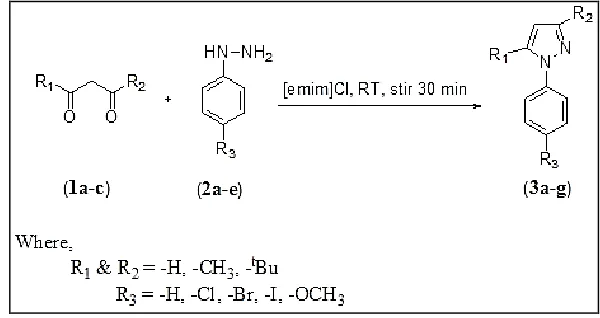
[image:2.612.154.454.385.544.2]A mixture of propan-1, 3-dial (1) (13.8 mmol) and phenyl hydrazine (2) (13.8 mmol) was dissolved separately in five different imidazolium-based ionic liquids (5 ml) and stirred at room temperature for 20 min. After stirring the reaction mixtures for 20 min., the reaction mixtures were poured on crushed ice. The obtained solids were filtered, washed with water and dried. The crude compounds were crystallized using DMF-Ethanol. After screening the imidazolium-based ionic liquids; it was found 1-Ethyl-3-methylimidazolium Chloride was a suitable and novel medium for carrying the cyclocondensation leading to title products with excellent yields (Table 1, entry 2). The advantage of 1-Ethyl-3-methylimidazolium Chloride is that, it is stable, easily synthesized, cost effective, and recyclable (Scheme 1).
Table 1: Screening of ionic liquids to search a suitable medium for one pot synthesis of substituted N-phenyl pyrazoles (2)a
Entry Ionic liquids Time (min.) Yieldb %
1 1-Ethyl-3-methylimidazolium tetrafluoroaluminate 20 75
2 1-Ethyl-3-methylimidazolium Chloride 20 95
3 1-Butyl-3-methylimidazolium Chloride 20 60
4 1-Butyl-3-methylimidazolium hexafluorophosphate 20 65
5 1-Butyl-3-methylimidazolium tetrafluoroborate 20 56
aReaction conditions: A mixture of propan-1,3-dial(1) (13.8 mmol)and phenyl hydrazine (2) (13.8 mmol) was dissolved in ionic liquids (5 ml)
and stirred at room temperature for 20 min; bIsolated yields
Scheme 1: One pot synthesis of substituted N-phenyl pyrazoles (3a-g) using 1-Ethyl-3-methylimidazolium chloride
General procedure for the synthesis of substituted N- phenyl pyrazoles (3a-g)
A mixture of 1,3-dicarbonyl (1) (13.8 mmol)and phenyl hydrazine (2) (13.8 mmol)was dissolved in ionic liquid,1-Ethyl-3-methylimidazolium Chloride (5 ml) and stirred at room temperature for 20 min. After stirring the reaction mixture for 20 min., the reaction mass was poured on crushed ice. The obtained solid was filtered, washed with water and dried. The crude compound was crystallized using DMF-Ethanol. In some cases after pouring the reaction mass on crushed ice, oily drops were obtained (Table 2, entry 3a, 3c and 3g) then the liquid products were extracted by using ethyl acetate and sodium chloride. The obtained organic layers were dried by dehydrating agent, sodium sulfate and distilled out to obtain the products. Compound 3c: Yield 94%; light yellow liquid; bp 141-142 C. FTIR Model RZX (Perkin Elmer) cm-1: 1518 (C=N str., Pyrazolyl); 1199 (C-N str.); 1H-NMR (400 MHz, CDCl3): δ 7.13
(t, 1H, Pyrazolyl), 7.67 (d, 1H, Pyrazolyl), 7.76 (d, 1H, Pyrazolyl), 7.59-7.62 (m, 5H, Ar-H) ppm; 13C-NMR (100 MHz, CDCl3): δ 141.03, 140.12, 129.40, 126.81, 126.35, 119.02, 107.66 ppm;MS (ESI, m/z): calcd for C9H8N2 (M
75
RESULTS AND DISCUSSION
[image:3.612.148.463.173.722.2]The titled compounds have been synthesized by one pot synthesis by using readily available starting materials, such as different 1,3-dicarbonyls (1a-g) andphenyl hydrazines (2). The ionic liquid, 1-Ethyl-3-methylimidazolium Chloride was prepared and used immediately. The reactions were carried out at room temperature for 20 min. and the progress of the reaction was monitored by TLC. Various 1,3-dicarbonyls (1a-g) could give target pyrazoles (3a-g) through the same action with excellent yields.
Table 2: One pot synthesis of substituted N-phenyl pyrazoles (3a-g), carried in 1-Ethyl-3-methylimidazolium chloride
Compound R’ R1 R2 Product Yield M. P./B.P
3a H Me Me
N N
Me
Me
90 b.p;144-145
3b H But But
N N
But
But
93 m.p;106-108
3c H H H
N N
93 b.p;141-142
3d p-I H H
N N
I
90 m.p.;90-91
3e p-Br H H
N N
Br
90 m.p;69-76
3f p-Cl H H
N N
Cl
87 m.p;88-91
3g p-OMe H H
N N
OMe
76
CONCLUSIONIn conclusion, we have developed a simple, highly efficient, and environmentally friendly method for the synthesis of substituted N-phenyl pyrazoles in ionic liquid, 1-Ethyl-3-methylimidazolium Chloride. It was found that the ionic liquid worked well and the conversion found to take place rapidly giving excellent yields. Further studies on the biological activities of the products and application of this methodology to other interesting pyrazole derivatives are underway in our laboratory.
REFERENCES
[1] J Catalan; F Fabero; RM Claramunt; MDS Maria; MC Foces-Foces; FH Cano; M Martinez-Ripoll; J Elguero; RJ Sastre. Am Chem Soc. 1992, 114, 5039.
[2] WC Shen; YJ Wang; KL Cheng; GH Lee; CK Lai. Tetrahedron. 2006, 62, 8035. [3] A Schmidt; A Dreger. Curr Org Chem. 2011, 15, 2897.
[4] A Schmidt; Z Guan. Synthesis. 2012, 44, 3251
[5] S Schnatterer. Phenylpyrazole-Containing Fiprole Insecticides. In Bioactive Heterocyclic Compound Classes: Agrochemicals; Lamberth, C., Ed.; Wiley-VCH: Weinheim, Germany, 2012.
[6] F Giornala; S Pazenok; L Rodefeld; N Lui; JP Vors; FR Leroux. J Fluorine Chem. 2013, 152, 2. [7] V Kumar; K Kaur; GK Gupta; AK Sharma. Eur J Med Chem. 2013, 69, 735.
[8] KM Kasiotis; EN Tzanetou; SA Haroutounian. Front Chem. 2014, 2, 78. [9] R Pérez-Fernández; P Goya; J Elguero. ARKIVOC. 2014, 233.
[10] C Li; L Liang; K Wang; C Bian; J Zhang; Z Zhou. J Mater ChemA. 2014, 2, 18097. [11] GN Lipunova; EV Nosova; VN Charushin; ON Chupakhin. J Fluorine Chem. 2015, 175, 84. [12] W Li; J Li; F Wang; Z Gao; S Zhang. ACS Appl Mater Interfaces. 2015, 7, 26206.
[13] G Küçükgüzel; S Enkardes. Eur J Med Chem. 2015, 97, 786.
[14] S Rai. KP Srivastava; H Gupta; MC Puerta; P Valerga; AK Tewari. Struct Chem. 2015, 26, 555. [15] HA De Wald; S Lobbestael; BPH Poschel. J Med Chem. 1981, 24, 982.
[16] E Vinge; SB Bjorkman. Acta Pharmacol Toxicol. 1986, 59, 165.
[17] AM Hosie; HA Baylis; SD Buckingham; DB Sattelle. Br J Pharmacol. 1995, 115, 909. [18] NK Terrett; AS Bell; D Brown; P Ellis. Bioorg Med Chem Lett. 1996, 6, 1819.
[19] TD Penning; JJ Talley; SR Bertenshaw; JS Carter; PW Collins; S Docter; MJ Graneto; LF Lee; JW Malecha; JM Miyashiro; RS Rogers; DJ Rogier; SS Yu; GD Anderson; EG Burton; JN Cogburn; SA Gregory; CM Koboldt; WE Perkins; K Seibert; AW Veenhuizen; YY Zhang; PC Isakson. J Med Chem.
1997, 40, 1347.
[20] GD Diana; PM Carabateas; GL Williams; F Pancic; BA Steinberg. J Med Chem. 1981, 24, 731.
[21] G Cocconcelli; E Diodato; A Caricasole; G Gaviraghi; E Genesio; C Ghiron; L Magnoni; E Pecchioli; PV Plazzi; GC Terstappen. Bioorg Med Chem. 2008, 16, 2043.
[22] SY Hassan. Molecules. 2013, 18, 2683.
[23] M Ahmad; S Aslam; MH Bukhari; C Montero; M Detorio; M Parvez; RF Schinazi. Med Chem Res. 2014, 23, 1309.
[24] S Aslam; S Zaib; M Ahmad; JM Gardiner; A Ahmad; A Hameed; N Furtmann; M Gütschow; J Bajorath; J Iqbal. Eur J Med Chem. 2014, 78, 106.
[25] KM Amin; SM Abou-Seri; FM Awadallah; AAM Eissa; GS Hassan; MM Abdulla. Eur J Med Chem. 2015, 90, 221.
[26] E Cavero; S Uriel; P Romero; JL Serrano; R Giménez. J Am Chem Soc. 2007, 129, 11608. [27] D Li; L Lv; P Sun; W Zhou; P Wang; J Wu; Y Kan; H Zhou; Y Tian. Dyes Pigm. 2009, 83, 180.
[28] MJ Mayoral; P Ovejero; JA Campo; JV Heras; MR Torres; C Lodeiro; M Cano. New J Chem. 2010, 34, 2766.
[29] O Mahé; D Frath; I Dez; F Marsais; V Levacher; JF Briere. Org Biomol Chem. 2009, 7, 3648. [30] S Fustero; M Sánchez-Roselló; P Barrio; A Simón Fuentes. Chem Rev. 2011, 111, 6984. [31] YL Janin. Chem Rev. 2012, 112, 3924.
[32] G Zhang; H Ni; W Chen; J Shao; H Liu; B Chen; Y Yu. Org Lett. 2013, 15, 5967. [33] B Chen; C Zhu; Y Tang; S Ma. Chem Commun. 2014, 50, 7677.
[34] XQ Hu; JR Chen; Q Wei; FL Liu; QH Deng; AM Beauchemin; WJ Xiao. Angew Chem Int Ed. 2014, 53, 12163.
77
[36] S Mantenuto; F Mantellini; G Favi; OA Attanasi. Org Lett. 2014, 2015, 17. [37] MC Pérez- Aguilar; C Valdés. Angew Chem. Int Ed. 2015, 54, 13729. [38] R Vanjari; T Guntreddi; S Kumar; KN Singh. Chem Commun. 2015, 51, 366. [39] A Omar; M Mahdi. Green Chem. 2007.
[40] V Jaitely; A Karatas; AT Florence. Int J Pharm. 2008, 354, 168.
[41] J Stoimenovski; EI Izgorodina; DR MacFarlane. Phys Chem Chem Phys. 2010, 12, 10341.
[42] P Moriel; EJ García-Suárez; M Martínez; AB García; MA Montes-Morán; V Calvino-Casilda; MA Bañares. Tetrahedron Lett. 2010, 51, 4877.