International Journal of Emerging Technology and Advanced Engineering
Website: www.ijetae.com (ISSN 2250-2459,ISO 9001:2008 Certified Journal, Volume 4, Issue 5, May 2014)
556
Design and Implemented Security Concept toward
Steganography with Image Encryption
Ankita Awasthi
1, Prof. Amit Saxena
21
Ankita Awasthi Mtech Scholar, CSE Dept & TRUBA institute of engineering and information technology Bhopal
2Prof. Amit Saxena, CSE Dept. & TRUBA institute of engineering and information technology Bhopal
Abstract—Primary concern of the proposed concept is not to provide security in perfect way. Rather, the concern of cryptography security can be protect information resources through making unauthorized accessing of the information or changing with the information costly than the existing value that can be gained. Any cryptography, when implemented properly then it will be very useful and, makes chance to violate cost-prohibitive security. In this paper the proposed work is to construct an efficient and effective technique/concept on the subject of combination of steganography and image encryption, mainly focused on embedding encrypted image data in digital images. This proposed work proposes combination of three individual methods as a variant of Image Displacement (ID) process for image by considering in the changes of pixel position. In method of displacement, vertical displacement process has been employed to blur the confidential Image called Vertical Image Blur Displacement. Second method is a variant of method one called image encryption, here self design image encryption process has been applied to encrypt blur image which is generated from first method. Third method employs standard Image Steganography has been adapted to send these Encrypted Images in an Un-Seen/unnoticeable way. Presented experiment has been performed to test the performance, effectiveness with the complexity of the proposed concept.
Keywords—Image, Entropy, Security, Decryption,
Encryption, Internet, Correlation, Histogram, Key, Steganography, Algorithm.
I. INTRODUCTION
Robust and easy information modification is possible through digital multimedia information. The information can be transmitted through networks with small to without interference and often without error [1,2]. Unfortunately, digital world media distribution takes a concern for digital information owners. Digital information can be copied in easy way without quality and content loss. Such type of poses can be creating a problem regarding intellectual property rights in the protection of copyright owners. The Watermarking can be solution to such type of problem [3,4]. This can be related or defined as embedding digital information, such type of information about the access level, the recipient, and the owner, without being identifiable in the host multimedia information. Steganography technique relies on covert message hiding in unsuspected multimedia information and is generally it is used in confidential communication between two known users.
Steganography technique is the technique of encryption that hides information among the bits of a cover image, or an audio or a video. The technique replaces insignificant bits or unused bits with the secret information [4]. Steganography technique cannot robust or attack free since the embedded information is vulnerable. The Watermarking technique has the characteristic of robustness against maximum attacks. Even if the method of embedding the information is known, it can be difficult to disturbed of destroy the confidential hidden information [5, 6]. Data embedding and data hiding can be classified as process between watermarking and steganography. In this, a new encryption algorithm is proposed by analyzing the principle of the encryption algorithm based on the combination of symmetric and steganography [10]. Moreover, the security and performance of the proposed algorithm will also estimate. The experimental results based on combination of symmetric and steganography will approve the effectiveness of the proposed concept, and the combination of symmetric and steganography will show large variation in key space and provide high-level security [9, 11]. The cipher image generate by proposed method approximately same with original image size and will be suitable for general implementation use in the secure transmission of private information via the Internet [8,13].
In this paper we are doing overcome these problem. Proposed work is basically image encryption and decryption, where any original image will encrypt into cipher image and cipher image will decrypt into original image through proposed algorithm which is defined in section -2. The performance of the proposed algorithm is evaluated and analyzed in section-3. Section IV is the overall conclusion of the paper.
II. RELATED WORK
International Journal of Emerging Technology and Advanced Engineering
Website: www.ijetae.com (ISSN 2250-2459,ISO 9001:2008 Certified Journal, Volume 4, Issue 5, May 2014)
557 In which two 8 bit gray level image of size P X Q and M X N are using as a secret image and cover image respectively. Huffman Encoding is performing over the secret image/message before embedding and each bit of Huffman code of secret image/message is embedded inside the cover image by replacing the least significant bit (LSB) of every pixel's intensities from cover image. The Huffman Table and Huffman encoded bit stream size are also included or embedding inside the cover image, so that the receiver got all the necessary information from the standalone Stego-Image. In [3] secret sharing that means this is a method of distributing or transmitting a secret between a group of users, each of whom is allocated with a share of the secret. The user’s used these shares to reconstruct the original secret. Single individual user share is of no use. The reversible image sharing approach and threshold schemes are used achieve the novel secret color image sharing. In [4] we have analyzed that author proposes three indigenous processes as a alternative of Cipher Block Chaining (CBC) mode to image encryption by making an allowance for three different traversing path (Horizontal, Vertical and Diagonal). In method one simple Raster Scan has been employed to scramble the confidential Image called Horizontal Image Scrambling (HIS). Method two is a variant of method one called Vertical Image Scrambling (VIS), here traversing path would be top to bottom left to Right. Third method employs diagonal traversing path called Diagonal Image Scrambling (DIS). Later Image Steganography has been adapted to send these Scrambled Images in an unnoticeable manner. In [5] a review of the steganography techniques appeared. Various image steganography techniques have been proposed. In this we investigate of founded steganography techniques and steganalysis techniques. we state a set of criteria to analyze and evaluate the strengths and weaknesses of the previous techniques. The least-significant bit (LSB) insertion method is the most common and easiest method for embedding messages in an image with high capacity, while it is detectable by statistical analysis such as RS and Chi-square analyses. In [6] focused on the combination of cryptography and steganography methods and a new technique – Metamorphic Cryptography has suggested. The message is transformed into a cipher image using a key, concealed into another image using steganography by converting it into an intermediate text and finally transformed once again into an image. Hence, in [7] described and reviewed the different research that has done toward text encryption and description in the block cipher. Moreover, in this suggests a cryptography model in the block cipher. There are many security issues in data communication. Cryptography is a substantially safe method to provide protection in data receiving and sending. In [8] expressed a technique of data hiding using cryptography named as ASK algorithm. Sensitive data is hided in a color image using cryptography.
III. PROPOSED WORK
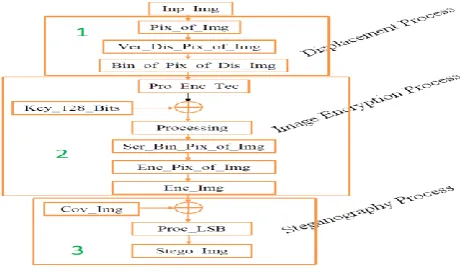
[image:2.595.321.552.573.712.2]Figures 1 depict the diagram of the proposed encryption model which is the combination of cryptographic and Steganography at first side. In this work model whole proposed work is divided into three sections. Section one is representing the displacement process where pixel value of selected image displace from its original position. This is because to image security in final produced image. Displacement process used vertical displacement process where each pixel of the selected image leave it original position and get new position within a proper way. After that proposed work read binary value from pixels of displaced image and goes to in next section. In this section proposed work perform encryption of the displaced image. To perform image encryption it used designed technique which is define in next section(). The proposed encryption technique is encrypting displaced image into encrypted image by using key value of 128 bits in size [12]. This key value is private and it will known to both side user. Due to key size proposed encryption is much secured and produced cipher image will not decrypted without knowing original key value. After completing process proposed work will goes in third section. This section is the last section of the proposed work, in this standard steganography technique is working on cover image and encrypted image to produced final stego image. Here steganography technique are selecting two images one is encrypted image which is generated in previous section (Section two) and a cover image which is larger from encrypted image almost triple in size because standard steganography technique using least significant bits (LSB) replacing technique where each encrypted pixel will replace from LSB pixel of cover image. After completing this process proposed work produce final stego image which is ready to transmission over public network with full security.
Figure 1: Proposed Work Model at First Side
International Journal of Emerging Technology and Advanced Engineering
Website: www.ijetae.com (ISSN 2250-2459,ISO 9001:2008 Certified Journal, Volume 4, Issue 5, May 2014)
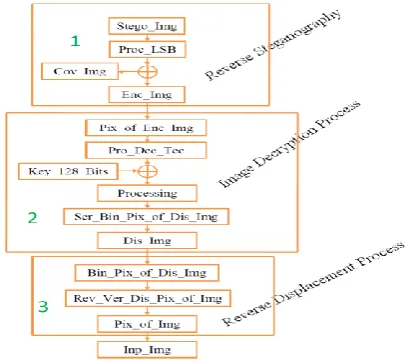
[image:3.595.64.268.407.587.2]558 Section one is the reverse steganography technique. In this proposed work perform steganography technique but in reverse order to get encrypted image from stego image. Here steganography technique read LSB from stego image and combine all LSB pixels to make encrypted image. Once proposed work get encrypted image and proposed work model goes in second section. Second section is the decryption section where decryption technique executed and produced results. Basically in this section encrypted image will decrypt through decryption technique. Decryption technique is the reverse of encryption technique and it is define in next section ().The proposed decryption technique is decrypting encrypted image into displaced image by using key value of 128 bits in size. This key value is private and it will known to both side user. Once proposed work get displaced image from encrypted image proposed work model goes in to third section. Third section is the last section of the work model. In this section displacement process is executed but in reverse order. After completing displacement process proposed work model produced original image which was the confidential image.
Figure 2: Proposed Work Model at Another Side
Displacement Process:
Displacement process is just using to blur the confidential image and only one type of displacement process is used known as vertical displacement. In this vertical displacement all the pixel value arranged in matrix form and shift 2 row in up direction Suggested Displacement process is defined in number of step at first (Sender) end and at another (Receiver) end is as follow:
Vertical Displacement Steps:
1. Select Confidential Image (Con_Image) of MXN size
2. Read Pixels value of Con_Image 3. Arrange all pixel in matrix form 4. Shift 2 row in up direction
5. Continue till all rows 6. Exit
Reverse Vertical Displacement Steps:
1. Select an image which will generate from decryption phase
2. Read Pixel value of that image 3. Arrange all pixel in matrix form 4. Shift 2 row in down direction 5. Continue till all rows 6. Exit
Steganography Technique: -
Suggested steganography concept is defined in number of steps at first (Sender) end and at another (receiving) end are as follow.
Steganography Algorithm Steps is Following.
1. Select a Cover Image (CImg) and Encrypted Image (EImg).
2. Read Pixel values of CImg and EImg.
3. Convert CImg and EImg pixel value into binary value.
4. Read LSB value from CImg and replace with encrypted value from EImg.
5. Repat steps 1 to 4 till all Encrypted pixels encountered.
6. Resultant of this knows Stego Image (SImg).
Reverse Steganography Algorithm Steps is Following.
1. Select Stego Image (SImg).
2. Read Pixel values of stego image (SImg) 3. Convert SImg pixel value into binary value. 4. Read LSB value from stego image (SImg) and
combine all LSB value into one place.
5. Resultant of this knows encrypted image (EImg).
Proposed Encryption/Decryption Concept:
International Journal of Emerging Technology and Advanced Engineering
Website: www.ijetae.com (ISSN 2250-2459,ISO 9001:2008 Certified Journal, Volume 4, Issue 5, May 2014)
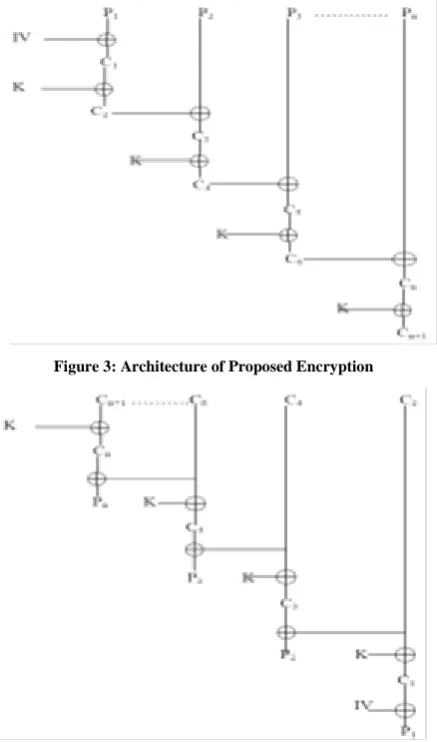
[image:4.595.310.540.132.607.2]559 In this whole confidential image are dividing into number of pixel (P1, P2, ….Pn) where first pixel of confidential image are XORing with Initialization vector (IV) and output of this process once again are performing XORing operation from Key value and generating final cipher value. In the second step this cipher value goes an initialization vector for second pixel and this process will continue till last pixel. After completing whole process combine all pixels to form encrypted image. Figure 4 is showing the architecture of decryption process where whole encrypted image are divided into number of pixels and apply process of XORing of pixels and Key and Initialization Vector. After completing whole pixel combine to them and form an image. Detailed Encryption and Decryption process step are defined in the following section.
Figure 3: Architecture of Proposed Encryption
Figure 4: Architecture of Proposed Decryption
Proposed Encryption Step:
1. Input Initialization Vector (IV) of 128 bits 2. Input Key (K) of 128 bits
3. Input Total Number of Pixels of Image 4. Execute XORing
a. Ck = Pi(128) IV (128) b. Ck+1 = Ck K
5. Ck+1 = Ck+1 + 1 6. Loop I = 2 to N
7. Read Pixels of Size 128 bits
Pi (128) € Pn { n = Total no of Pixels 8. Execute XORing
a. Cm = Pi(128) IV (128) IV = Ck+1 For I =2 = Cm+1 For I>=3 b.Cm+1 = Ck K
c. m = m + 1 d.I = I + 1
9. End Loop 10. Exit
Proposed Decryption Step:
1. Input Initialization Vector (IV) of 128 bits 2. Input Key (K) of 128 bits
3. Input Total Number of Pixels of Encrypted Image
4. Rearrange these pixel in following way C1 Cn and Cn C1
5. Loop I = 1 to N-1 6. Execute XOR
a. Pj = Ci(128) K (128) b. Pj+1 = Pj Ci+1
7. J = J+1 8. I = I+1 9. End Loop 10. Execute XOR
c. Pn-1 = Cn (128) K d. Pn = Pn-1 IV 11. Exit
IV. RESULT ANALYSIS
[image:4.595.57.276.325.696.2]International Journal of Emerging Technology and Advanced Engineering
Website: www.ijetae.com (ISSN 2250-2459,ISO 9001:2008 Certified Journal, Volume 4, Issue 5, May 2014)
560
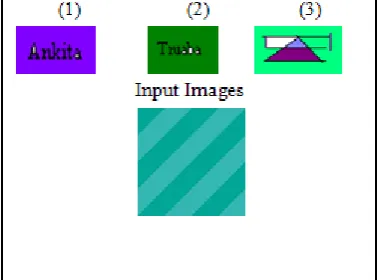
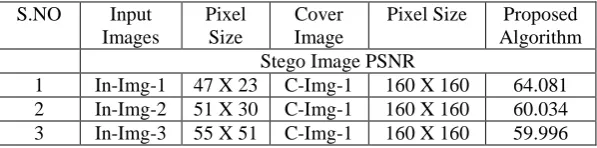
[image:5.595.70.260.142.282.2]“The Proposed Algorithm” has implemented on a number of images varying types of content and sizes of a wide range. Execution time to produced Stego image in table 1 and Execution time to getting secrete image from stego image in table 2, Setego image entropy in table 3, histogram of stego image in table 4 and Peek Signal to Noise ratio in table 5 of various images comparisons is shown.
Table 1
Execution Time Analysis of Stego Images through Proposed Algorithm
S.NO Input Images
Pixel Size
Cover Image
Pixel Size Proposed Algorithm Stego Image Entropy (Approx)
1 In-Img-1 47 X 23 C-Img-1 160 X 160 9.309 2 In-Img-2 51 X 30 C-Img-1 160 X 160 9.300 3 In-Img-3 55 X 51 C-Img-1 160 X 160 9.300
Table 2
Execution Time Analysis of Getting Secrete Images from Stego Image through Proposed Algorithm
S.NO Input Images
Pixel Size
Cover Image
Pixel Size Proposed Algorithm Stego Image Entropy (Approx)
1 In-Img-1 47 X 23 C-Img-1 160 X 160 9.309 2 In-Img-2 51 X 30 C-Img-1 160 X 160 9.300 3 In-Img-3 55 X 51 C-Img-1 160 X 160 9.300
Table 3
Entropy Analysis of Stego Images through Proposed Algorithm
S.NO Input Images
Pixel Size
Cover Image
Pixel Size Proposed Algorithm Stego Image Entropy (Approx)
1 In-Img-1 47 X 23 C-Img-1 160 X 160 9.309 2 In-Img-2 51 X 30 C-Img-1 160 X 160 9.300 3 In-Img-3 55 X 51 C-Img-1 160 X 160 9.300
Table 4
Histogram Analysis of Stego Images through Proposed Algorithm and Existing Algorithm
S.NO Input Images
Pixel Size
Cover Image
Pixel Size Proposed Algorithm Stego Image Histogram (Approx
International Journal of Emerging Technology and Advanced Engineering
Website: www.ijetae.com (ISSN 2250-2459,ISO 9001:2008 Certified Journal, Volume 4, Issue 5, May 2014)
[image:6.595.149.448.159.233.2]561 Table 5
PSNR Analysis of Stego Images through Proposed Algorithm and Existing Algorithm
S.NO Input Images
Pixel Size
Cover Image
Pixel Size Proposed Algorithm Stego Image PSNR
1 In-Img-1 47 X 23 C-Img-1 160 X 160 64.081 2 In-Img-2 51 X 30 C-Img-1 160 X 160 60.034 3 In-Img-3 55 X 51 C-Img-1 160 X 160 59.996
V. RESULTS ANALYSIS
Complexity of the proposed system is calculated and analyzed through execution time of stego image and return back to original secrete image. Table 1 and graph 1 are showing the execution results during stego image generation, in this input image-1 with cover image2 having 1062 execution time through proposed technique respectively.Similarly table 2 and graph 2 is showing the execution time results during secrete image generation form stego image, in this input image-1 with cover image2 having 1859 execution time through proposed technique respectively. It is clear that the execution time in both case are significantly good of the proposed technique from the respective existing technique and hence proposed technique provide higher efficiency on the proposed image encryption procedure. Proposed system have calculated and analyzed entropy, Histogram and Peek Signal to Noise Ratio (PSNR). In case of Entropy which is shown in table 3 and graph 3 of various stego image, with this results where proposed technique ios producing low results as compare exiting technique. In case of histograms of the several stego images as well as its original images that have widely different content. Table 4 and graph 4 is showing the various stego image histograms through proposed technique. Histogram for Input image-1 with cover image-2 through proposed 142. It is clear that the histogram of the stego image are significantly different from the respective histogram of the original secrete image and hence does not provide any type of clue to user on any statistical attack through the proposed image encryption procedure. In the case of PSNR which is shown in table 5 and graph 5 of various stego images with compare original cover image. PSNR for Input Image-1 with cover image-2 through proposed technique is 55.765 respectively and It is clear from more PSNR results (see table 5) that the picture quality of the stego image are significantly same from the respective picture quality of the original cover image and hence does not provide any clue to attackers for any statistical attack on the proposed stego image steganography procedure. Proposed work carried out key space analysis, statistical analysis, to demonstrate the security of the new steganography concept.
According to the results of our security analysis, it concludes that the proposed concept is expected to be useful for real-time image encryption and transmission applications.
VI. CONCLUSION AND FUTURE ENHANCEMENT Security, the most usable and common word which used by all users, any peripheral, any device since past three decade. Protection from unwanted or malicious type sources has become a part of the research or the invention cycle. Any techniques of protection or security are using from a simple authorization or authentication of the password in all cryptography algorithms for protecting the confidential data or extreme sensitive data. The technique though sounds complication is highly effective and easy design and implementation is the added to the advantage of image encryption with steganography incorporation. Though the image through information encryption is totally unclear or distorted the final output i.e. the encrypted information can be modified through private key. Proposed work is not intended to replace or changes the cryptography but it is additional for it. If information is encrypted and hidden with a steganography technique it provides an additional layer of protection and it is reduces the chance of the hidden information being detected. Steganography technique is still and fairly new technique to the general user although this is likely not true in the secrecy world. Efforts to improve the robustness of the encryption technique are necessary to ensure that the encryption technique and embedded information can securely defend against any type of brute force attacks.
International Journal of Emerging Technology and Advanced Engineering
Website: www.ijetae.com (ISSN 2250-2459,ISO 9001:2008 Certified Journal, Volume 4, Issue 5, May 2014)
562 REFERENCES
[1] AmrM. Riad, Amr H. Hussein and AtefAbou EI-Azm “A New Selective Image Encryption Approach using Hybrid Chaos and Block Cipher ”The 8th International Conference on INFOrmatics and Systems (INFOS2012) - 14-16 May Computational Intelligence and Multimedia Computing Track
[2] Rengarajan Amirtharajan\ Anushiadevi .R2, Meena .y2, Kalpana. y2 and John Bosco Balaguru “Seeable Visual But Not Sure of It” IEEE-International Conference On Advances In Engineering, Science And Management (ICAESM -2012) March 30, 31, 2012 [3] RigDas and Themrichon Tuithung ”A Novel Steganography
Method for Image Based on Huffman Encoding” IEEE 2012 [4] G.Karthigai Seivi, Leon Mariadhasan, K. L. Shunmuganathan
“Steganography Using Edge Adaptive Image” IEEE International Conference on Computing, Electronics and Electrical Technologies [ICCEET] 2012
[5] Amitava Nag, Saswati Ghosh, Sushanta Biswas, Debasree Sarkar, Partha Pratim Sarkar “An Image Steganography Technique using X-Box Mapping” IEEE-International Conference On Advances In Engineering, Science And Management (ICAESM -2012) March 30, 31, 2012
[6] L.Jani Anbarasi and S.Kannan “Secured Secret Color Image Sharing With Steganography” IEEE 2012
[7] Ashwak M. AL-Abiachi, Faudziah Ahmad and Ku Ruhana “A Competitive Study of Cryptography Techniques over Block Cipher” UKSim 13th IEEE International Conference on Modelling and Simulation 2011
[8] Guy-Armand Yandji, Lui Lian Hao, Amir-Eddine Youssouf and Jules Ehoussou RESEARCH ON A NORMAL FILE ENCRYPTION AND DECRYPTION” IEEE 2011
[9] Abhishek Gupta, Sandeep Mahapatra and, Karanveer Singh “ Data Hiding in Color Image Using Cryptography with Help of ASK Algorithm” 2011 IEEE
[10] Rosziati Ibrahim and Teoh Suk Kuan “Steganography Algorithm to Hide Secret Message inside an Image”Computer Technology and Application 2 (2011) 102-108
[11] Thomas Leontin Philjon. and Venkateshvara Rao. “Metamorphic Cryptography - A Paradox between Cryptography and Steganography Using Dynamic Encryption” IEEE-International Conference on Recent Trends in Information Technology, ICRTIT 2011
[12] Akhil Kaushik, AnantKumar and Manoj Bamela “ Block Encryption Standard for Transfer of Data “ IEEE International Conference on Networking and Information Technology 2010 [13] danah boyd and Alice Marwick “Social Steganography: Privacy