International Journal of Emerging Technology and Advanced Engineering
Website: www.ijetae.com (ISSN 2250-2459,ISO 9001:2008 Certified Journal, Volume 3, Issue 10, October 2013)
197
A Study on Penchant for E-Learning
Dr. Sonal Chawla
1, Pallavi Grover
21Department of Computer Science & Application, Panjab University, Chandigarh 2DAV College, Sector10, Chandigarh
Abstract— E-Learning, in the most basic terms, is utilization of technology to support delivery of education without any restriction on time and place. It can be said that it’s a nonlinear and flexible approach, when viewed with reference to the traditional approach.
Traditional way of learning or the classroom learning largely bounds the learner in terms of content and time besides putting restriction on user’s pace of learning.
By making excellent use of information and communication technologies, E-Learning offers competent solution to learner, keeping in view one’s environment variables and reader’s own pace and learning power. The learner controls his interactions with the content modules. Of course the efficiency of any E-learning module depends on learner’s attitude towards learning and technology, availability and access to technology and his own technical background.
This paper broadly analyzes the desire and openness, of students, to accept E-Learning as platform of providing education in addition to the traditional systems of learning. A combination of such system is called Blended Learning.
This research paper has fivefold objective. The paper begins with analysis of students’ perception of e-learning in higher education. The focus then shifts to students’ basic internet usage and ease of performing basic computer operations. The next part of study focuses students’ use of application software. Lastly the paper analyses students’ openness to electronic mode of learning. The study has been conducted through surveys on student enrolled in various graduate and post graduate courses in Chandigarh.
Keywords- E-Learning, Traditional Learning, Blended Learning, Internet, Information and communication technologies (ITC)
I. INTRODUCTION
The Internet is a global system of
interconnected computer networks that use the
standard Internet protocol suite to serve several billion users worldwide[1].Since the inception of internet in 1960’s it has undergone a phenomenal amount of change.When Internet entered India the term and the technology associated with it seemed distant. The count of Internet users has grown magnanimously over time. And today with computers and the internet becoming increasingly important, it is inevitable that they would be used for different things. Since internet is a very powerful tool for carrying and conveying information, therefore it is very valuable when comes to education.
E-Learning refers to use of electronic media and information and communication technologies (ICT) in education-Learning is broadly inclusive of all forms of educational technology in learning and teaching.[2]
E-Learning can be viewed as another dimension of providing quick, easy, anytime, anywhere access to information[3]. Indeed E-learning has many advantages over traditional classroom learning. It is self-paced, involves minimal cost and even faster in comparison to the traditional approach [4].Also it provides user with the option of just in time learning.
Considering these benefits e-learning comes across as a powerful tool but with certain limitation on user. To be able to utilize this tool successfully a user needs to be consistent, enthusiastic to learn, disciplined, patient and sharply focused. It is implicit that the user should have familiarity of using the software and possess other technical skills required for using the tool optimally. Beyond doubt online learning promises new ways for better resource utilization and provides desirable flexible methodologies to the learner and the teacher.
This study, thus, brings us to analysis of users’ openness and readiness to use of E-Learning systems. This is assessed through a questionnaire with its sample comprising of students enrolled in Graduate or Post Graduate courses.
II. STUDY
A.Objective
The objectives of this research paper are to broadly analyze the desire and openness of students to accept E-Learning as platform of providing education in addition to the traditional systems of learning. To gather knowledge about student’s perception of e-learning in higher education and to understand how open they are to newer forms of learning.
B.Methodology followed
International Journal of Emerging Technology and Advanced Engineering
Website: www.ijetae.com (ISSN 2250-2459,ISO 9001:2008 Certified Journal, Volume 3, Issue 10, October 2013)
--Demographics (i.e. Age, Gender, Academic Background etc)
--Perception about E-learning
--Basic Internet usage
--Knowledge of basic Computer Operations
--Openness to E-Learning
For the last four items data was collected based on the 5 point scale where Strongly Disagree(No Not at All)=1,
Disagree(No not much)=2, Maybe(Somewhat)=3,
Agree(Yes but not much)=4, Strongly Agree(Yes definitely) = 5.
Exactly 170 students responded to the questionnaire and the following was observed.
C. Analysis and Interpretation
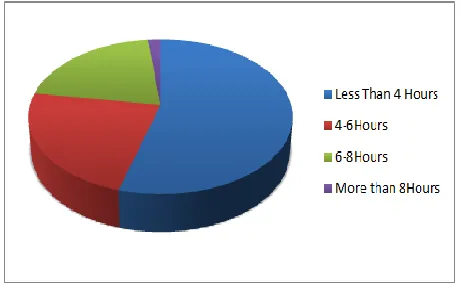
[image:2.612.54.284.376.519.2]On studying the frequencies closely it was observed the a cumulative percentage of 94.7% students have easy access to internet and about 54.1% students use internet for less than 4 hours per day.
[image:2.612.336.551.385.525.2]Figure 1.Internet usage per day
Figure 2 Purpose of using Internet
Majority of students state their purpose of using of
internet as Social Networking, Education and
Entertainment, with this being order of preference.
Figure3. Most favorite search engine
Further it was found that Google was the most preferred search engine amongst Yahoo, Bing, Google and Hotmail.
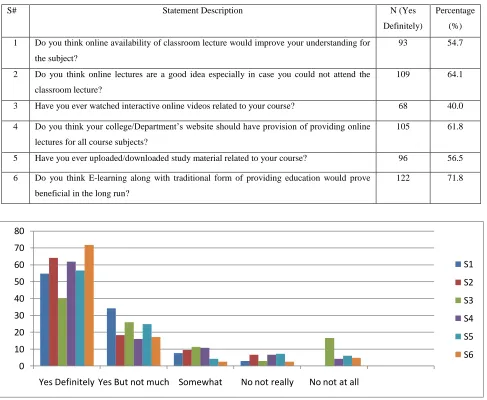
To analyze students’ desire to adapt to E-learning they were made to answer to the following statements The following were the frequencies (N) for various items regarding Openness to E-Learning.
International Journal of Emerging Technology and Advanced Engineering
Website: www.ijetae.com (ISSN 2250-2459,ISO 9001:2008 Certified Journal, Volume 3, Issue 10, October 2013)
[image:3.612.65.552.155.555.2]199 Table 1.
Student’s openness to E-Learning
S# Statement Description N (Yes
Definitely)
Percentage
(%)
1 Do you think online availability of classroom lecture would improve your understanding for
the subject?
93 54.7
2 Do you think online lectures are a good idea especially in case you could not attend the
classroom lecture?
109 64.1
3 Have you ever watched interactive online videos related to your course? 68 40.0
4 Do you think your college/Department’s website should have provision of providing online
lectures for all course subjects?
105 61.8
5 Have you ever uploaded/downloaded study material related to your course? 96 56.5
6 Do you think E-learning along with traditional form of providing education would prove
beneficial in the long run?
122 71.8
0 10 20 30 40 50 60 70 80
Yes Definitely Yes But not much Somewhat No not really No not at all
S1
S2
S3
S4
S5
S6
Figure 4.Graphical representation for Table1
From Figure 4 it can be interpreted that most students are in favor of E-learning in some way or the other. About 54% feel that online availability of classroom lecture would improve your understanding for the subject.40% of students claim to have watched online videos related to their course and about 56% to have uploaded/downloaded study material related to their course. Besides this, about 61% of students feel that their college/department’s website should have provision of providing online lectures for all course subjects and 71% believe that E-learning along with
traditional learning would prove beneficial for them in the long run.
On application of regression test we find that perception towards e-learning (PERCEPTION) is a dependent on ease of use of application software ( APP_SOFTWARE) and usage of internet (USAGE).The relation amongst these three variables can be represented as under
International Journal of Emerging Technology and Advanced Engineering
Website: www.ijetae.com (ISSN 2250-2459,ISO 9001:2008 Certified Journal, Volume 3, Issue 10, October 2013) Table 2
Coefficientsa
Model Unstandardized Coefficients Standardized Coefficients
t Sig.
B Std. Error Beta
1 (Constant) 95.262 4.132 23.055 .000
APP_SOFTWARE -1.309 .226 -.409 -5.802 .000
2
(Constant) 84.567 5.917 14.292 .000
APP_SOFTWARE -1.315 .222 -.411 -5.921 .000
USAGE .688 .276 .173 2.490 .014
Table 3
Model Summary Model R R Square Adjusted R
Square
Std. Error of the Estimate
Change Statistics
R Square Change F Change df1
1 .409a .167 .162 6.198 .167 33.665 1
2 .444b .197 .187 6.104 .030 6.199 1
From the equation it is clear that PERCEPTION is dependent on two variables namely APP_SOFTWARE and USAGE. Now the question is that to what extent can dependency be explained by those two variables?
According to Table 3 R Square Change for
APP_SOFTWARE and USAGE can be determined for PERCEPTION. The R Square Change value is 16.7% and 3% respectively. So the extent to which PERCEPTION can be explained by these two variables is 19.7% .
We assume that there are other factors on which PERCEPTION depends that weren’t taken into consideration.
On close analysis of Table 4 a negative correlation is found between
a.) PECEPTION & APP_SOFTWARE
b.) PERCEPTION and OPENNESS
i.e., (p<0.05)
and a direct correlation between OPENNESS and APP_SOFTWARE (p>0.05)
Table4
III. CONCLUSION
The main purpose of this research was to analyze students’ perception towards e-learning and to determine the factors that can influence their inclination and openness towards the concept of E-learning. The factors which
The results revealed that there was a connection between students’ ease of using softwares and their perception about E-Learning.
International Journal of Emerging Technology and Advanced Engineering
Website: www.ijetae.com (ISSN 2250-2459,ISO 9001:2008 Certified Journal, Volume 3, Issue 10, October 2013)
201
IV. FUTURE RESEARCH
The current research did not actually use any e-learning system to determine the attitude. The perception measurement was obtained purely on students’ own knowledge and awareness about any Learning Management System. This knowledge hold importance for those institutes which are planning to include e-learning as a parallel form of learning besides following the traditional methodologies of learning. Measuring students’ perception is first step before starting such a project.
Further research will include small sample of students who are already using or have used Learning Management System. The objective of study would be to identify issues which appear in use of such systems.
REFERENCES
[1] March 2009. Retrieved 26 October 2010. "Internet, n". Oxford English Dictionary (Drafted.). INTERNETWORK n., perhaps influenced by similar words in -net
[2] Tim Berners-Lee, 1996 The World Wide Web:Past,Present and
Future
[3] Baker, Celia Retrieved 31 March 2013 "Blended learning: Teachers
plus computers equal success". Desert News.
[4] http://people.howstuffworks.com/elearning4.htm
[5] Nichols, Mark 2003 A theory for e-learning