EXPLORATION OF USER INVOLVEMENT AND COLLABORATION
IN A CO-DESIGN PROJECT:
A CASE STUDY
Laura Maria SEPPÄLÄ
EXPLORATION OF USER INVOLVEMENT AND COLLABORATION
IN A CO-DESIGN PROJECT:
A CASE STUDY
Laura Maria SEPPÄLÄ
School of Nursing, Midwifery, Social Work and Social Sciences
College of Health and Social Care
University of Salford, Salford, UK
Table of Contents
List of figures ... X List of tables ... XI Acknowledgements ... XII Abbreviations ... XIII Terminology and key concepts ... XIV Abstract ... XX
CHAPTER 1. INTRODUCTION ... 1
The Design for Ageing Well research project ... 1
Overview of the conduct of the DfAW project ... 2
User Reference Group ... 2
User Advisory Group ... 4
Research team members ... 5
Project partners ... 6
The context and purpose ... 6
Global challenges ... 7
The research objectives and question ... 9
The researcher’s position ... 10
Researcher’s assumptions about the unique contribution ... 12
Chapter summary ... 13
Thesis overview ... 14
CHAPTER 2. LITERATURE REVIEW ... 15
Part 1. Literature review methods ... 15
Purpose and questions of the literature review ... 16
Thematic search ... 17
Systematized search ... 18
An example of a systematized literature search ... 19
Inclusion and exclusion criteria ... 19
Product ... 19
Physical presence ... 19
Co-design as the aim of the research ... 20
Age ... 20
Geographic location ... 20
Publication date ... 20
Rationale for literature search choices ... 20
Questions for the literature ... 20
Inclusion and exclusion criteria ... 21
Databases ... 21
Keywords ... 21
Data extraction ... 22
Refining the search, round one ... 22
Refining the search, round two ... 23
Section summary ... 23
Part 2. Older people ... 25
Demographic change: the ageing population ... 26
Defining age and ageing: who are older people? ... 27
Health and wellbeing in later life ... 29
Quality of life in old age ... 31
Older people as consumers: the ‘grey market’ ... 33
Section summary ... 35
Part 3. Public involvement ... 36
Definition of the terms ... 36
Public involvement in health and social care research ... 40
Levels of involvement ... 40
Phases of a research project and activities for members of the public ... 41
Definition and planning phase ... 42
Execution phase ... 43
Dissemination ... 43
Closing phase ... 43
Guides and guidelines for public involvement in research ... 44
Ethical considerations within different stages of the research ... 45
Payment for involvement in research ... 46
Benefits of user involvement ... 47
Challenges of public involvement ... 48
Part 4. Design approaches ... 49
User-centred design ... 50
Short history of user-centred design ... 53
Inclusive design ... 54
Design exclusion ... 56
Characteristics of co-design ... 59
Short history of co-design ... 61
Barriers to co-design ... 62
Co-design methods ... 63
The quality of engagement in co-design ... 65
Co-design guidelines ... 66
Multi-disciplinary collaboration ... 69
Shared knowledge and language ... 71
The research objectives and question ... 73
Chapter summary ... 73
CHAPTER 3. METHODOLOGY ... 74
Theoretical framework ... 74
Conceptual framework for running co-design projects ... 76
Methodology choices ... 78
Ethnography ... 80
Phenomenology ... 81
Grounded theory ... 82
Action research ... 83
Chosen methodology: case study using ethnographic methods ... 84
Rigour ... 86
Internal validity ... 86
External validity ... 87
Reliability ... 87
Chapter summary ... 88
CHAPTER 4. METHODS ... 89
Interviewing ... 89
Focus groups ... 90
Individual interviewing ... 92
Rationale for chosen method ... 94
Participatory workshops ... 95
Observation ... 96
Rationale for chosen method ... 98
Design of tools ... 99
Chapter summary ... 100
CHAPTER 5. DATA COLLECTION ... 101
Sample planned ... 101
Data collection achieved ... 102
Sample achieved ... 103
The Design for Ageing Well research team members ... 105
The Design for Ageing Well project partners ... 106
The User Reference Group (URG) in Wales ... 106
The User Advisory Group (UAG) in Salford ... 106
Comparability of units ... 107
Ethical considerations ... 107
Chapter summary ... 109
CHAPTER 6. DATA ANALYSIS ... 110
Data analysis plan ... 110
Achieved data analysis process ... 111
Thematic analysis ... 111
Observation data analysis ... 111
Interview data analysis ... 113
The first phase ... 113
The second phase ... 113
The third phase ... 113
The fourth phase ... 114
The fifth phase ... 114
Chapter summary ... 117
CHAPTER 7. FINDINGS ... 118
Visual representation of findings ... 118
Part 1. Team members ... 121
A) Co-design ... 121
1. Purpose ... 121
Motivation for involvement ... 123
Expectations and assumptions ... 126
Clear objectives and project scope ... 130
Activity planning ... 131
2. Co-design methods ... 134
Show and tell ... 137
Evaluation workshops ... 139
Homework ... 141
3. Facilitation of the workshops ... 141
B) Collaboration ... 146
1. Roles and responsibilities ... 147
2. Team building ... 150
3. Communication ... 152
4. Project management software ... 156
5. Shared language ... 161
Disciplinary knowledge and specialist perspective ... 166
Learning process ... 172
Understanding others ... 172
C) Setting ... 173
1. Location ... 174
The room setting ... 174
2. Equipment ... 175
Recording technology ... 175
3. Time ... 176
4. Hospitality ... 177
5. Finance ... 178
D) Impact ... 179
1. How user participation in co-design impacted the end result ... 179
2. How co-design participation impacted the team members ... 180
Part 2. Project partners ... 184
A) Co-design ... 184
1. Purpose ... 184
Motivation for involvement ... 185
Expectations and assumptions ... 185
Clear objectives and project scope ... 186
Activity planning ... 187
2. Co-design methods ... 188
B) Collaboration ... 189
1. Team building ... 189
2. Communication ... 190
3. Shared language ... 190
Disciplinary knowledge and specialist perspective ... 191
Learning process ... 191
Understanding users ... 192
4. Project Management ... 192
C) Setting ... 194
1. Location ... 194
2. Time ... 194
D) Impact ... 195
1. How user participation in co-design impacted the end result ... 195
2. How co-design participation impacted the people ... 196
Part 3. User Reference Group ... 198
A) Co-design ... 198
1. Purpose ... 198
Motivation for involvement ... 199
Expectations and assumptions ... 200
Concerns and fears ... 202
Clear objectives and project scope ... 203
Activity planning ... 204
2. Co-design methods ... 205
Show and tell ... 206
Evaluating the existing garments and fabrics ... 206
Last meeting of User Reference Group ... 208
B) Collaboration ... 208
1. Roles and responsibilities ... 209
2. Communication ... 211
3. Shared language ... 212
Glossary ... 213
C) Setting ... 214
1. Location ... 214
2. Time ... 214
3. Hospitality ... 217
D) Impact ... 218
1. How user participation in co-design impacted the end result ... 218
2. How co-design participation impacted the URG members ... 219
Gaining new knowledge ... 220
Meeting new people ... 221
Part 4. User Advisory Group ... 223
A) Co-design ... 223
1. Purpose ... 223
Concerns and fears ... 227
Clear objectives and project scope ... 228
The definition phase ... 230
Planning phase ... 231
People getting to know each other ... 235
2. Co-design methods ... 236
Advisory meetings ... 236
Walk ... 237
The route ... 239
Recording the conversations ... 239
Recording technology ... 239
Mystery shopping ... 239
Sprayway visit ... 240
Final meeting of the User Advisory Group ... 242
Evaluating the participation ... 242
3. Facilitation of the workshops ... 243
Facilitator’s role and responsibility ... 243
B) Collaboration ... 247
1. Roles and responsibilities ... 247
Selecting participants ... 248
2. Communication ... 248
3. Shared language ... 250
Learning process ... 250
Courage to ask ... 251
Glossary ... 251
C) Setting ... 252
1. Location ... 252
Setting of the room ... 253
2. Hospitality ... 254
D) Impact ... 257
1. How user participation in co-design impacted the end result ... 257
2. How co-design participation impacted the advisors ... 258
Gaining new knowledge ... 259
Meeting new people ... 260
Payment towards involvement ... 260
Creating interest in user engagement in the future ... 261
Evaluation of the experience and last advice ... 262
CHAPTER 8. DISCUSSION ... 264
Study limitations ... 264
Methodology limitations ... 264
Method limitations ... 266
Cultural challenges ... 267
Discussion of findings ... 268
A) Co-design ... 269
1. Purpose ... 269
The Need ... 271
The People ... 272
Motivation for involvement ... 274
Expectations and assumptions ... 276
Clear objectives and project scope ... 277
Activity planning ... 278
2. Co-design methods ... 279
Show and tell ... 281
Evaluating existing garments ... 282
3. Facilitation of the workshops ... 283
Facilitator’s role and responsibilities ... 284
Continuity of participation ... 291
Selecting participants ... 292
B) Collaboration ... 294
1. Roles and responsibilities ... 294
2. Team building ... 296
3. Communication ... 298
4. Project management software ... 300
5. Shared language ... 301
Disciplinary knowledge and specialist perspective ... 302
Learning process ... 302
Understanding others ... 303
C) Setting ... 304
1. Location ... 304
Setting the room ... 305
2. Equipment ... 306
3. Time ... 306
D) Impact ... 309
1. How user participation in co-design impacted the result ... 309
2. How co-design participation impacted users ... 310
Chapter summary ... 310
CHAPTER 9. CONCLUSIONS ... 311
Impact on practice and contribution ... 311
Recommendations ... 314
Chapter summary ... 314
Appendix 1. ... 315
Appendix 2. ... 318
Appendix 3. ... 324
Appendix 4. ... 325
List of figures
Figure 1. The order of DfAW workshops
Figure 2. Research focus
Figure 3. Background to the research
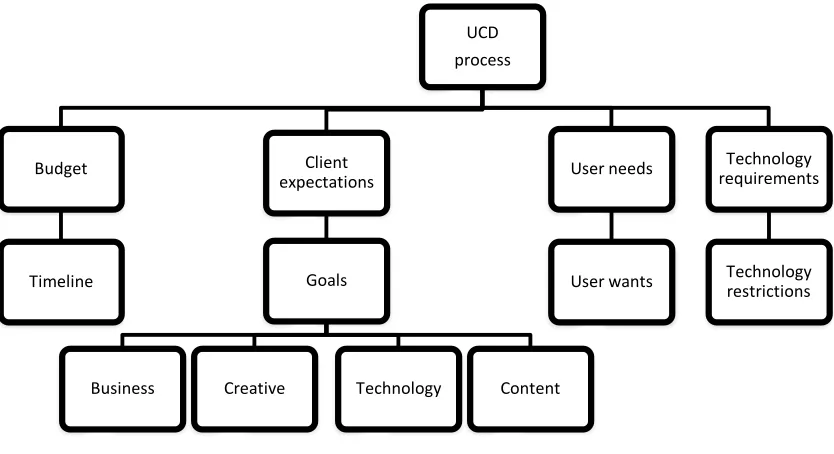
Figure 4. Different factors in user-centred design process
Figure 5. The five elements of my research process
Figure 6. Conceptual framework according to Chambers’ ideas
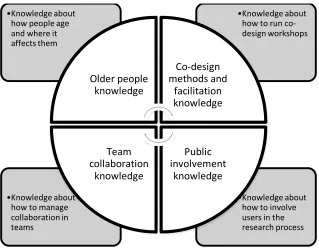
Figure 7. Knowledge areas that influenced this research
Figure 8. Sequence of co-design workshops and interviews
Figure 9. Final version of the codebook. Coding themes: co-design nodes. Nodes
arose inductively from the data and research questions.
Figure 10. Final version of the codebook. Coding themes: collaboration, setting
and impact nodes. Nodes arose inductively from the data and research questions.
Figure 11. Phases of a co-design project
Figure 12. Map of findings
List of tables
Table 1. Keywords for literature search
Table 2. Design approach terms
Table 3. Theoretical sample
Table 4. Sample achieved
Acknowledgements
This study was conducted during the years 2010-2017 at the School of Nursing, Midwifery, Social Work and Social Sciences, at the University of Salford, Salford, UK. This thesis was carried out as part of the Design for Ageing Well (DfAW) research project funded by the UK research council, ESRC.
First and foremost, I want to thank my supervisor Dr. Tracey Williamson, who has supported me over the years. I am thankful for many teaching sessions and inspiring conversations. I would also like to acknowledge my other supervisor, Dr. Julia Ryan. I thank her for her criticism and valuable comments.
I owe my gratitude to Jane McCann, and thank her for giving me the opportunity to join her group in the DfAW research project. Special thanks are also due to our DfAW research group for their professional help. Particular thanks go to the older walkers without whom this study would not have been possible. I also want to thank Vanessa Knowles for believing in me and supporting me.
I am grateful to Prof. Markku Ojanen, Dr. Antti Kasvio, Dr. Kaisa Kuurne, Dr. Lotta Hautamäki, Mik Pieniazek and Jari Koskinen for their valuable comments and discussion. I wish to thank Karin Turney and David Turney for their skilful revision of the language. Further thanks go to Kristina Öhrnberg for her continuous support.
I wish to express my gratitude to all my friends and my sincere gratitude is extended to Dr. Maija Salokangas and Johanna Ylinen in particular, for continuous reassurance. I want to thank especially Esa Korhonen for the support and encouragement. My deepest thanks are also due to my parents – my mother Riitta, and father Erkki – and my little brother Ilkka, for believing in me and supporting me in all my decisions.
Abbreviations
DfAW Design for Ageing Well research project
ESRC Economic and Social Research Council
NDA The New Dynamics of Ageing programme
NGO Non-governmental organisation
NHS National Health Service
PPI Public involvement
UAG User Advisory Group
UCD User-centred design
UOD User oriented design
URG User Reference Group
Terminology and key concepts
Case study A well-established research strategy where the focus is on a case (which is interpreted very widely, to include the study of an individual person, a group, a setting, an organisation, etc.) in its own right, taking its context into account. Typically involves multiple methods of data
collection.1
Co-design This means designing together. Co-designers are professional designers, other professionals, amateurs and citizens who identify problems, needs and challenges, develop a design brief and then design the
solution or outcome together.2
Collaboration This is a way of working together to combine intellectual, practical and aesthetic capabilities to a
greater effect than working alone.2
Community A group or network of people tied together with social relations that are important for their social identity and social practice; with the advent of the internet, the term
has been extended to virtual and online communities.2
Design activist A ‘non-aligned social broker and catalyst; a facilitator; an author; a creator; a co-author; and a ‘happener’
(someone who makes things happen).2
Design for sustainability Any design practice oriented towards development which balances environmental, social and economic impacts and concerns for sustaining the present and future.
Design probes A design method developed in the mid to late 1990s at the Royal College of Art, London, UK, by Bill Gaver, Antony Dunne and Elena Pacenti. Probes aim to explore the lives and habits of people as they interact with objects, products and spaces by giving them the means to record and reflect on their everyday practices. The means may be a diary, a camera, a set of questions, visual prompts or other devices, to enable the people to document their lives so that designers and design researchers may better understand the issues people
face and their needs.3
Design thinking Design-specific cognitive activities that designers apply during the process of designing: combining empathy
with the context of a problem.3
Do-it-together (DIT) An emerging movement originating from do-it-yourself (DYI), where activities are done together in a group, not
alone, for mutual benefit.3
Do-it-yourself (DIY) The method of building, repairing and modifying without the aid of professionals, taken up by environmental movements and ordinary citizens in the
1960s and 1970s, and continuing today.3
Empower The process of encouraging and developing the skills to enable people to become self-sufficient and autonomous, with the goal of eliminating future need
for charity or welfare.3
Focus group A form of qualitative research in which a group are asked about their perceptions, opinions, beliefs, and attitudes towards a product, service, concept, advertisement, idea, or packaging. Questions are asked
in an interactive group setting where participants are
free to talk with other group members.4
Grassroots approach Grassroots refers to the origination of ideas and activities plus, potentially, community, social and political change, through initiatives led by local people or by an online network focused on specific issues, or by other social groups often outside traditional political power structures. It is a ‘can-do’ approach characterised
by social and/or cultural actions.5
Inclusive design The design of mainstream products and/or services that are accessible to, and usable by, as many people as reasonably possible without the need for special
adaptation or specialised design.6
Intellectual property Patents, copyrights and trademarks are all examples of intellectual property that is owned by the creators and can be exploited by them or anyone to whom they legally agree to give a licence, giving them the rights of
exploitation.6
Mutual learning A learning model based on mutual respect and dialogue between teacher and student, where roles are interchangeable and experiences on both sides
enriching and transformative.6
Online community A virtual community whose members interact with each
other mostly via the internet.7
Open brand A concept originated by Openwear: a platform for sharing open fashion designs, to demonstrate that the
brand can be open and shared too.7
4 (Focus Group, Wikipedia 2016)
5 (Fuad-Luke et al., 2015, pp. 27–30)
Open design Emerging in the 1990s, open design was defined in 2010 in the seminal book, Open Design Now, by Van Abel et al., as ‘design whose makers allowed its free distribution and documentation and permitted modifications and derivations of it’. Today, the open design movement embraces everything from 3D printing and digital fabrication technologies to basic ‘how-to’ blueprints, patterns and instructions for DIY and DIT designs. It frequently involves collaborative designs and designing within specialist and/or generalist communities, from FabLabs to Maker Fairs and vast online platforms like
Etsy and Instructables.7
Participant end-users People who participate in the ideation, testing, creating, and ultimately use of a designed product, service, space,
building or experience.7
Participatory This refers to a process or experience where people are individually encouraged, and feel able to, contribute to
a collective act.7
Participatory design (PD) An approach to design attempting to actively involve all stakeholders in the design process to help ensure the results meet their needs and are usable. It was first recognised as a design approach in the 1960s in Scandinavia to help with the transition to more automated work practices in factories, but has evolved over the years to bring in the expertise of professionals, users, customers and, more recently, citizens, to share their experiences and generate more efficient and meaningful solutions. PD crosses with other participatory design approaches and methods including
user-centred design, co-design and open design.8
Participatory workshop An organised event which brings a group of people together to seek their opinions, extract their knowledge and to solve problems in a collaborative and creative
environment.9
Public involvement Doing research ‘with’ or ‘by’ the public, rather than ‘to’, ‘about’ or ‘for’ the public. This would include, for example, public involvement in advising on a research project, assisting in the design of a project, or in carrying
out the research.10
Re-design The reconfiguration of what already exists, possibly by bringing in new ingredients and smartly combining them
to create something new.8
Re-use Putting discarded things and materials back to use, by
re-purposing or modifying them.8
Reality The state of things as they actually exist, not as they seem or are imagined; everything that is, has been, or will be; also refers to worldviews and ways of perceiving
reality differently.8
Service design The activity of planning and organising people,
infrastructure, communication and material
components of a service in order to improve its quality and the interaction between service provider and
customers.11
Social design Also known as socially useful design, socially responsible design, social innovation design, or design for social innovation. It encourages grassroots and community creativity and focuses on the satisfaction of human needs, local services, economic development and livelihoods often framed within local/national
9 (Jisc, 2012)
government agendas. It includes strategic design thinking, co-design and other processes aimed at participation, and it involves professional design thinking, co-design and other processes aimed at participation, and it also involves professional designers working with people who do not think of themselves as
designers.11
Stakeholders Any person, group, community or organisation that has a share or interest in a project, enterprise or specific
contextual situation.11
Transdisciplinary Refers to research, knowledge and ways of thinking and doing which cross and hybridise many disciplinary boundaries to create a holistic approach and a body of
knowledge which transcends the original
contributions.12
User-involvement Refers to ways of applying the experience of the ‘user’ of a product , service or experience to improve the creative process and consequently, improve the final designs or outputs, for example, as in user-centred
design (UCD).12
User-centred design Design that focuses on the needs of the user.
Abstract
Introduction
Collaborative design (co-design) is an approach that includes ‘users’ in the design process. This approach is growing in popularity amongst companies seeking to develop a competitive advantage in the field of outdoor clothing and equipment. Health research is steadily developing a substantial evidence base of the effectiveness of public involvement in research, however, in the co-design research field, there is a less developed evidence base concerning user involvement aspects. This qualitative case study presents an exploration of the factors that influence the experience of user involvement in a study utilising a co-design approach. The case concerned is the New Dynamics of Ageing-funded study ‘Design for Ageing Well’, which presented an opportunity to explore both the co-design mechanisms utilised along with the experiences of the individuals involved in the study. They included research team members, project partners (e.g., outdoor clothing manufacturers), User Reference Group members (members of the public) and User Advisory Group members (also members of the public).
Methods
A single case study approach was utilised. Sampling was purposeful, taken from the above four groups of stakeholders. Data collection methods included one-to-one semi-structured interviews (35 people) and non-participant observations (44 total hours).
Findings
The three main factors that impact public involvement in co-design are:
• The facilitator’s knowledge and skills regarding co-design methods and
moderation
• Multidisciplinary collaboration
• The management of the co-design setting.
Conclusion
CHAPTER 1. INTRODUCTION
This study investigates the factors that facilitate and hamper co-design projects. The introductory chapter presents the problem statement, the purpose and the significance of this study. It begins with an overview of the UK’s Economic and Social Research Council (ESRC) funded collaborative study Design for Ageing Well (DfAW), which provided the research setting for the case study. This is followed by the presentation of the context and an investigation of the nature of the research problem. The chapter continues with the research aim and objectives. The researcher’s position is then considered. The chapter finishes with an overview of the structure of the thesis.
The Design for Ageing Well research project
This thesis was developed during one of three PhD research studentships funded by the UK’s Economic and Social Research Council (ESRC) and attached to the Design for Ageing Well (DfAW) collaborative research project. Utilising user-centred co-design methods, the DfAW project aimed to design and develop a functional clothing system with embedded technologies to promote the healthy ageing, autonomy and independence of older people. The DfAW project commenced in January 2009 and was completed in November 2012. The project was funded by the joint UK research councils and administered by the Economic and Social Research Council (ESRC) under the New Dynamics of Ageing (NDA) programme.
involved five university partners, who contributed with their efforts divided into three work packages.
WP 1 (Behaviour) was undertaken jointly by the University of Westminster and the University of Salford. The aim of WP 1 was to research user needs. I was asked to join WP 1 by the project lead. WP 2 (Clothing) was led by the University of Wales (Newport) with input from the University of Brighton. Developing the prototypes according to users’ needs was the primary goal of WP 2. WP 3 (Technology) was run by the University of Ulster. The goal of WP 3 was to develop a smartphone app and wearable technology. The DfAW had two user groups: the User Refererence Group, situated in Newport, Wales, and the User Advisory Group, in Salford.
Overview of the conduct of the DfAW project
This section describes an overview of the undertaking of the DfAW project. Prior to it starting, a one-year preparatory network project was conducted to inform the development of the bid, which was then successful. The user population to be sampled during my own research was originally one group (the User Advisory Group), but the DfAW unexpectedly took a two-group approach (with an additional User Reference Group). This provided a more diverse sample for me and the opportunity for comparison between the two user groups, which took different approaches.
User Reference Group
the project lead was based, where the original plan had been to only have a single User Advisory Group operating out of Salford.
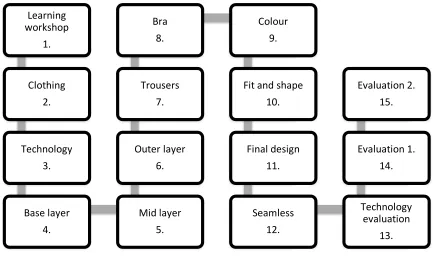
[image:26.595.92.525.291.553.2]I officially started my PhD in July 2010 and joined the DfAW project, which centred around 15 workshops. Before I officially joined the project, I took part in two workshops in May 2010, which focused on clothing and technology and aimed to develop a new shared language between the participants from different study backgrounds. The three following workshops (in the autumn) focused on each layer of clothing, from the base layer to the outer layer.
Figure 1. The order of the 15 DfAW workshops
These three workshops were all scheduled in the same way. In the morning, there was a ‘show and tell’ session, where the older participants presented their own walking clothing, and in the afternoon, new styles and materials were introduced by the industry, and participants commented on them. In the bra workshop, the participants were, naturally, only women. In these workshops, different options were presented, and stakeholders discussed their preferred choices. The colour workshop concentrated on preferred age-appropriate colours, colour families and combinations.
Learning workshop 1. Clothing 2. Technology 3. Base layer 4. Mid layer 5. Outer layer 6. Trousers 7. Bra 8. Colour 9.
In the morning, there was a presentation to put into context the effects of the commercial cycle that normally influences colour selection within the fashion trade.
‘The fit and shape workshop’ focused on the size, fit and style of the garments. The older users contributed to the design selection, with styles illustrated by designers and collected onto collection boards in July 2011. From here, the project lead led the technical development of the initial designs. The prototypes were manufactured by several industrial partners. The resulting prototypes, as well as the wearable technology, were evaluated in two further workshops. The last evaluation workshop was held in May 2012. All these workshops were videotaped by the DfAW team members.
User Advisory Group
Whilst there had been an agreement over the study design for the user groups, this evolved rapidly when the project lead set up the User Reference Group in Wales. The University of Salford partners still had a user group to set up with a meaningful purpose, as they had funding to do. Therefore, another group was established in Salford in November 2010, and named the User Advisory Group (UAG). This caused some challenges for the DfAW project as the roles of the two groups were carved out. The UAG ended up meeting for the first time six months after the URG was up and running. Some of these challenges are explored in this thesis, but what is important is that it presented me with two user groups to research and not one, as was initially expected.
example of the importance of the moderator in collaborative design meetings. The UAG also carried out three field trips. One was an organised walk, where recording equipment was tested.
The UAG made a trip to the showroom of the outdoor brand Sprayway, where the most ‘real-life’ co-design workshop was held. The designer gave a lecture about the design and development process of outdoor clothing. The advisors were given the task of picking up a combination of the clothes that they liked most, and then giving a critique of them. The third field trip was to downtown central Manchester. The method called ‘Mystery shopping’ was used to gain knowledge of how older people were treated in an outdoor shop, and to see if they got the information and advice they needed. In the last evaluation workshop, the project prototypes were presented to the advisors, and they could give a critique with ‘fresh eyes’, because they were not as immersed in the design processes of the URG co-design workshops in Wales. The lead of Work Package 1, who was responsible for the UAG, believed it never had a meaningful purpose in the project, as much of its intended purpose was taken over by the URG. Despite the advertised focus of my PhD studentship and the significantly different DfAW project design, I was able to determine a focus for my thesis that met my own needs and those of the DfAW project. The primary focus of my research was to broaden the understanding of what makes a ‘good’ co-design experience. The two user groups provided me with ample opportunity to explore which factors aid or hamper effective user involvement and collaboration in co-design projects.
Research team members
Project partners
The final group to be sampled was the project partners, who comprised an outdoor brand owner, a designer and senior advisors.
The context and purpose
This section introduces the concept of co-design and provides an overview of its importance, but also serves as a rationale for why the quality of user involvement and collaboration in co-design is essential to its success.
Collaborative design (co-design) is an umbrella term for different approaches to participatory design and refers to designing ‘with’ the users, instead of only ‘for’ the users of the product (Fuad-Luke, 2009; Sanders, 2002). There are a wide variety of co-design methods that can be adopted when engaging users in the co-design process (Hanington & Martin, 2012). Fuad-Luke (2009) describes co-design as a design process which includes all stakeholders, from designers to possible future users, and facilitates the discussion of their views about design. Carroll (2006, p. 4) agrees with this suggestion:
“The essence of co-design is founded on the principle that people who end up using a designed artefact are entitled to have a voice in determining how the artefact is designed.”
co-design can offer a successful and authentic solution to a problem by working with the people (Design Council, 2011).
By 2008, it had already been noted that the participation of users in the design process was becoming more popular (Buur & Matthews, 2008). Co-design is currently very topical due to the ways that the internet and social media have introduced new methods for user engagement, and companies realising the benefits of user-centred design. This research is based on the hypothesis that when increasing numbers of companies begin to adopt co-design methods and engage users in their design processes, it is important that good practices of public involvement and collaboration are emphasised and the impact on the users involved is considered.
Although the added value of user engagement is becoming widely accepted among design theorists and academic researchers in the design field, companies have been relatively slow to adopt co-innovation into their processes (Buur & Matthews, 2008). One of the reasons is that co-designing is time-consuming and requires a set of skills that differs from those needed in traditional design (Jisc, 2012). The facilitation of co-design workshops is a talent in itself and needs to be learned (Jisc, 2012).
Recent studies (Détienne, Baker, & Burkhardt, 2012; Feast, 2012) in the design field have looked at the quality of engagement in design, but user involvement in co-design and multi-disciplinary collaboration when designing functional outdoor clothing, especially for older people, lacks research. The problem merits further investigation to shed light on issues related to user engagement and collaboration in co-design.
Global challenges
(Fuad-Luke, 2009). Fuad-Luke (2009) introduced the term ‘design activism’. He describes a design activist as a co-creator and facilitator who can use design to help find solutions to environmental or social problems (Fuad-Luke, 2009). Back in the 1970s, Papanek (1970) suggested that designers are responsible for considering the environmental, social, economic and political consequences of design.
Sustainable development is a concept that was in fact created in the 1970s, when environmental problems started to gain more attention (Du Pisani, 2006). A sustainability approach can be adopted into any field of human activity, and sustainable thinking has been increasingly influencing design disciplines (Fletcher, 2008). The sustainability concept can be divided into four aspects: environmental, social, cultural and economic (Suojanen, 1997). Corporate responsibility in the outdoor industry is growing in importance and has become a critical issue that cannot be underestimated (European Outdoor Group, 2016). It is likely that in future, legislation will be firmer and companies will be compelled to work towards more environmentally and socially responsible business practices.
Another major global challenge is related to demographic change. The world’s population of older people is rapidly growing (Cracknell, 2010), which has extensive societal effects and challenges. The World Health Organization (WHO) states that people over 60 are the fastest growing age group in almost every country (World Health Organization, 2016). In the UK, for example, the number of people over 65 is predicted to almost double from 10 million people to around 19 million people within the next forty years (Cracknell, 2010). The primary cause of this development is a rise in life expectancy together with a decline in birth rates (World Health Organization, 2011). This change can be seen as a triumph of public health, but poses a number of challenges, for example, ‘age related diseases and disability’, ‘care for ageing populations’, ‘the feminization of ageing’, ‘ethics and inequities’ and ‘the economics of the ageing population’ (World Health Organization, 2002).
Clarkson et al. (2003) believe that markets should be aware of an ageing population. There is a need for the design community to create products and environments that can be used by all generations, which also take into account that people of different ages regularly live in the same areas (Clarkson et al., 2003). Older people need to be considered at the right stage within the design process, so that many more products have the potential to be appropriate for people of all ages (Clarkson et al., 2003). Fisk et al. (2009) claim that usability is often enhanced for younger people as well when it is improved for older adults. Also, it is a key consideration that those over 60 are a heterogenic group, and that generalisations should be avoided (Moschis, 2003).
The research objectives and question
a team member meant I had the opportunity to be a participatory researcher for the DfAW project, as my role was to explore multidisciplinary co-operation in order to understand and explain the best practices of involving members of the public in design. This included collaboration in design research, design activity and product development.
The specific objectives were:
1. To identify the factors that affect the experiences of older people involved in
design research, co-design and product development.
2. To critically examine trans-disciplinary research and identify factors which aid
or hamper effective collaboration.
3. To develop evidence to inform the production of good practice guidance for
the involvement of members of the public in design research, co-design and product development.
The research question was:
1. What are the factors that facilitate or hamper co-design projects?
This qualitative study primarily explores good practice in public involvement and contributes new insights into how the public can be better involved in the co-design process. The vehicle for this exploration is a case study of co-design in the development of functional outdoor clothing for older people.
The researcher’s position
invited to join this project because of my professional background in the outdoor clothing industry.
I have studied design for seven years, first completing a BA degree at the Häme School of Applied Sciences and then a Master of Arts degree at the University of Lapland (Finland). The principal focus of my studies has been functional outdoor clothing, and the topic of my master’s dissertation was concerned with sustainability issues in outdoor clothing. My professional background includes having worked as an assistant designer, a fabric purchaser and a sustainability manager for a Finnish outdoor clothing company. As sustainability manager, I chaired the Standards and Regulations Committee in the European Outdoor Groups’ Sustainability Working Group, and I belong to the Textile Institute’s Sustainability Special Interest Group. Through my voluntary commitments, I have achieved a much broader perspective on the outdoor industry sector in Europe, especially in the area of sustainability. This perspective has both influenced my research and guided my research interests.
My background in the outdoor clothing field and interest in sustainability has influenced me as researcher. From a professional perspective, I consider that environmental and social responsibility should be a high priority in industrial manufacturing, and I believe that every successful company will need to integrate the principles of sustainability into their general business strategy in the near future. There are signs of growing interest in collaborative and open design. There is significant value in multi-disciplinary collaboration in design, business and non-governmental organisations. There are many possibilities for co-design to change the world to be more sustainable and inclusive for all. The driving force for this study was that co-design is becoming more popular and there are not many existing guidelines on how to carry it out. My goal is to influence the field by working towards evidence-based guidance to carry out co-design.
the public in their design process. As an alternative, outdoor clothing brands often tackle user-centred design by involving sponsored athletes or ‘lead users’ in their design process, but this rarely includes casual users or older people, despite their increasing numbers. ‘Lead-user’ is the term introduced by von Hippel, meaning the users who are willing to try innovations before the market majority as a result of their willingness to try new ideas first (von Hippel, 2005). With this research, I am interested in supporting a change into involving casual users instead of just lead-users.
Due to changing demographics, there is increasing public demand for research into aspects of ageing. Meanwhile, there is also growing concern within the outdoor industry about protecting the outdoor environment. The design of technical outdoor clothing is attracting the concern of NGOs and government agencies, due to unsustainable processes within the supply chain. Also, due to climate change and the associated unpredictability of weather patterns, the need for innovations in outdoor clothing is increasing. Ageing and sustainability are global questions that have inspired me to do research and contribute to solutions. Key themes within this research, which are growing in importance, are sustainability, co-design, good practice of user engagement in co-design and team collaboration, with effective communication and a shared language.
Researcher’s assumptions about the unique
contribution
The underlying assumption of the DfAW project was that ‘smart, functional clothing’ might encourage older people to go outside, and in that way help them to remain active, staying socially connected and independent for a longer time. Participatory user-centred design may increase the wellbeing of people by creating fit-for-purpose products, and participation in a collaborative design project in itself can be empowering for older people.
2013). It is anticipated that the knowledge generated from this study will inform future evidence-based guidance about how to involve people in collaborative design and development projects. This evidence will include insights into public involvement in design research and co-design and product development processes, which will serve to expand the knowledge of public involvement in the design discipline and be of interest to research communities. There is a limited research evidence base about how to carry out co-design projects, and guidance in this study will increase knowledge about the good practice of co-design.
Chapter summary
Thesis overview
This thesis includes a further eight chapters:
Chapter 2. Literature review: presents the literature related to older people, public involvement and design approaches.
Chapter 3. Methodology: discusses the methodology choices and rationale for choosing a qualitative research enquiry and case study methodology.
Chapter 4. Methods: presents the research methods used.
Chapter 5. Data collection: describes the sample and data collection plan and the actual process of gathering data for the study.
Chapter 6. Data analysis: focuses on the original plan for how the collected data was to be analysed and the actual analysis process that took place.
Chapter 7. Findings: presents the results of the study. The chapter is divided into four parts, each presenting the findings for one stakeholder group.
Chapter 8. Discussion: includes a discussion of the methodology, a discussion of the used methods and a discussion of the findings.
CHAPTER 2. LITERATURE REVIEW
Existing knowledge and theory is important in any research. This section aims to review and discuss the ways in which literature has been used in the thesis, including an example of a systematized literature search process. This is followed by a critical analysis of the selected literature organised in three key themes: older people, public involvement and design approaches. Finally, key concepts from the reviewed literature will be synthesised to highlight the position of the thesis in relation to the existing knowledge and understanding.
Part 1. Literature review methods
The aim of my literature review is to lay out the background of this research project in order to fully understand the context of this research. Conducting a literature review is an important and common practice while undertaking research, and a number of reasons can be given for its importance (Hart, 2009; Ridley, 2008). At the onset of a study, finding and reading the existing literature, including previously conducted research, creates a deep understanding of the topic and what has been done previously (Hart, 2009; Ridley, 2008; Rowley & Slack, 2004). Reviewing relevant literature also helps identify areas where research has not yet been undertaken, or where knowledge is limited (Hart, 2009). Furthermore, knowledge of how the research topic has been researched previously can suggest appropriate research methods (Hart, 2009; Rowley, 2004). Importantly, an awareness of existing literature can prevent unnecessary replication (Ridley, 2008), ensuring that studies build on and develop what is already known.
The next section reveals the purpose of this review and the questions that the literature review aims to answer.
Purpose and questions of the literature review
I conducted two different kinds of literature searches, both thematic and systematic literature searches. This included both a broad literature review to establish the wider background and context for the study, and a specific systematized search to identify the existing research-based knowledge and evidence. The primary thematic literature search, which enabled me to identify the relevant background, was made in 2010. Continuous attention was paid to upcoming research papers during the study. The final systematised literature search was made between February 2016 and March 2016, in order to find relevant research evidence.
The purpose of the systematized literature review was to find out what research has been published about the topic previously, and to critically assess existing knowledge. The research question was:
• What are the factors that facilitate or hamper co-design projects?
The objective of the systematized literature search was to find out who has researched the topic before, what they found, and thus, overall, what is known about user involvement and collaboration in co-design projects. The following questions were set for the literature search:
• What is known about organising co-design projects with older users?
• Is there evidence-based research about user involvement in co-design
projects?
• Is there evidence-based research about collaboration and communication in
Thematic search
The thematic search was undertaken to establish broad context and background and formed the basis for the narrative review I present in the rest of the chapter.
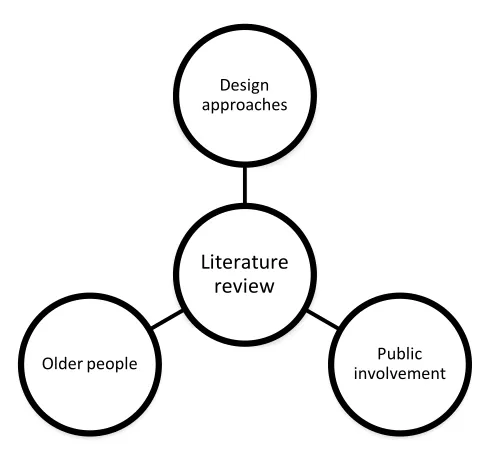
The broad background and context of the study was established through an iterative process of thematic searching. The themes (see Figure 2.) were derived from the research question and objectives. Design approaches related to user-centred design, inclusive design and co-design were identified as important topics relating to the research aims. Public involvement and older people were recognised to be important background topics, and the literature was searched separately for these. The three topics above form the literature review. These topics are derived from my research question and objectives.
[image:40.595.142.383.395.633.2]
Figure 2. Background to the research
I included relevant research papers, books and internet webpages from the topics, which were hand searched. The thematic search utilised the following databases, Ebsco host, Taylor & Francis online, Sage journals and Emerald, using keywords
Literature review
Design approaches
reports and other literature. The research papers were peer reviewed and books were identified as being written by experts in the field. Website searching helped to identify key sources of information and grey literature that are not always visible in academic databases. In addition, a key academic journal ‘CoDesign’ was hand searched, with all the abstracts starting from the year 2005 reviewed, to make sure that my keywords and inclusion criteria were right. Whilst some papers described research that included co-design methods, none focused on good practice in the co-design process. According to this search, there was a gap in knowledge and this study will make a doctoral level contribution. Methodology and method literature was searched separately to find appropriate material for qualitative research.
Systematized search
The systematised search was undertaken to look specifically for empirical research and evidence-based knowledge on the topic, and establish it as an under-researched issue. The intersection in the following figure presents the information I wanted to find from the research literature (see Figure 3.). The key words were grouped to represent each of these themes and the Boolean operator search should have brought up the intersection literature. Literature search engines use Boolean operators to find literature, plus mathematical sets and database logic. They connect the search words together to either narrow or broaden the set of results. The three basic Boolean operators are: AND, OR, and NOT (MITLibraries, 2017). They connect multiple pieces of information with several search terms to find searched information.
Figure 3. Research focus
co-design process
product design good
An example of a systematized literature search
Inclusion and exclusion criteria
Inclusion and exclusion criteria mean factors that define what literature is accepted into the literature review. This is a matter of relevance and quality of research. I decided to have seven inclusion criteria that I used when selecting papers. These inclusion and exclusion criteria were derived from my research question and my experience in the field.
Product
The first inclusion criterion was only to study literature about co-design projects where a concrete product was designed. The concrete artefact could have been any physical object or product. This meant that the co-design activity needed to be focused on designing a product or an item of clothing. The concrete artefact design criterion was required because the design processes for immaterial things and services are completely different. Research about service design and software design was excluded. Studies about community engagement projects and the built environment were also excluded.
Physical presence
Co-design as the aim of the research
There are many research papers about co-designing products, services and software, but the inclusion criteria were that the study needed to be about the co-design process itself, and about which factors contribute to a good co-design experience.
Age
The criteria included studies involving the adult population and excluded research about children participating in co-design. Children were excluded because they require different types of facilitation compared to adults. Possible research about older people would naturally be included.
Geographic location
Any geographic location was included.
Language
All searches were made in English. The included languages were English and Finnish.
Publication date
The literature search was based on a time-frame from January 1970 to January 2016.
Rationale for literature search choices
This section presents the rational for the choices made concerning questions around the literature, inclusion and exclusion criteria, databases and keywords. It is important to make aware and informed choices about these four matters, to ensure research quality.
Questions for the literature
The aim was to find evidence-based research studies about the co-design process and these questions target that.
Inclusion and exclusion criteria
The objectives and the case study of this research define the inclusion and exclusion criteria. These inclusion criteria were seen to be the most suitable, because they were closest to the purpose of the study.
Databases
In the first round, four comprehensive databases were searched: Ebsco host, Taylor & Francis online, Sage journals and Emerald. These databases were identified to be potential sources of co-design papers. The databases were identified with the professional help of a librarian to be most suitable ones.
Keywords
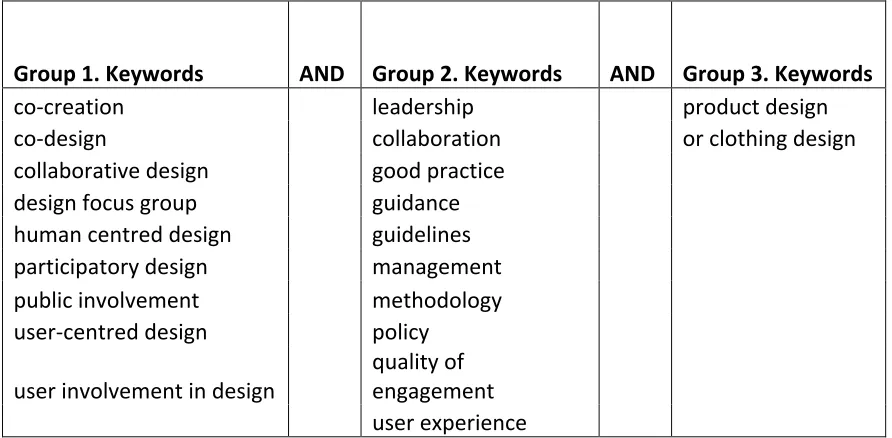
Keywords were identified through scoping searches made before the systematic searches. The keywords were divided into three groups (see table 1.).
Group 1. Keywords AND Group 2. Keywords AND Group 3. Keywords
co-creation leadership product design
co-design collaboration or clothing design
collaborative design good practice
design focus group guidance
human centred design guidelines
participatory design management
public involvement methodology
user-centred design policy
user involvement in design quality of engagement
[image:44.595.89.535.470.689.2]user experience
The rationale underpinning this was that the Group 1. keywords were chosen to describe design activity, the Group 2. keywords to describe good practice in co-design, and the third group of keywords to define that this must happen in the context of product design or clothing design.
Data extraction
The search parameters were set so that the keywords had to appear either in the title, keywords or abstract. The result was: 134 articles found from Ebsco host, 24 articles from Taylor & Francis, two articles from Sage Journals and five from Emerald Insight. These papers where retrieved and reviewed, and it was identified that none of these 165 articles matched the set criteria. They had not researched how to do co-design. As a result, I undertook a further search with parameters that the keywords appeared anywhere in the text, but this did not uncover relevant results.
When tested, they seemed to be appearing everywhere, but the results were not relevant at all. Therefore, it could be inferred that, at least according to this systematic literature search, research into how to do co-design had yet been undertaken, or at least not published.
Refining the search, round one
In an attempt to test the assumptions above, the search was refined with the intention of identifying relevant research. I discarded Group 2. and added new keywords.
‘Inclusive design’ was added to the Group 1. keywords because it describes design that is equally accessible.
The words ‘device’, ‘wearable technology’ and ‘assistive technology’ were added to the Group 3. list to expand the term ‘product design’ and to include specific products.
online, 24 from Sage Journals, 24 from Emerald Insight and 1,609 from Science Direct; altogether, 1,956 articles, but none of them fitted my inclusion criteria.
Refining the search, round two
A final search was undertaken to find articles about collaboration, good practice and guidance in co-design. I combined the Group 1. keywords with Group 2. keywords and left Group 3. out.
With this combination of keywords, I got 4,152 articles from Ebsco host, 1,095 articles from Taylor & Francis online, 222 from Sage Journals, 1,214 from Emerald Insight and 1,666 from Science Direct. This totalled 8,349 articles, but still, according to the abstracts, none fitted my inclusion criteria. This search was not limited to also including a mention of any kind of product or clothing design, which led to the number of relevant articles being so high, but it still did not bring any relevant results.
My aim was to find research papers about good practice in user involvement and collaboration in the co-design process. The specific criteria were that co-design studies should have been made in a real-life situation with users, and also that the designed object should be an artefact, therefore excluding service and software design.
Specifically, I was interested in finding individual studies about how the co-design process should be done. Despite my extensive literature search, I was not able to find a single research paper that would fit my criteria.
Section summary
Alternatively, it can be argued that a different search strategy could have been utilised. The research questions, databases or keywords could have been different, but they were chosen according to the best knowledge available.
Part 2. Older people
The primary focus of the DfAW collaborative research was to look at how the attributes of functional clothing and wearable technologies could be introduced, through appropriate design, to improve the everyday lives of older people. Part Two discusses the aspects of ageing that are of particular relevance to the DfAW project, and this thesis. Firstly, an overview of pertinent demographic data will be presented. Following this are discussions on ‘Health and wellbeing in later life’ and ‘Older people as consumers’. Issues specifically related to older people’s involvement in design and participation in research will be addressed in the design approaches section.
Design has the potential to solve fundamental environmental and social problems through design thinking and execution (Simmons, 2011). When design looks at the needs of the users, it is often referred to as user-centred design (Fuad-Luke, 2009). The basic principle of user-centred design is either to research the needs of the users the design is aimed at, or to involve them in the design process (Fuad-Luke, 2009).
Demographic change: the ageing population
Demographic change, in particular the ageing population, is a global phenomenon giving rise to range of new challenges (World Health Organization, 2011). It is claimed that the increasing number and proportion of older people in the population constitutes a unique historical period:
“Never before have older people formed such a large proportion of the total population; never before have physical and mental capabilities remained so high into advanced old age.” (Huppert, 2003, p. 31)
According to Coni, Davidson and Webster (1992), there is a suggestion that one third of all of the human beings who have ever lived to be older than 60 years old may be alive today. The percentage of older people in the population is increasing all over the world, but especially in developed countries (World Health Organization, 2002). The decline in birth rates is the principal causative factor of the increased proportion of older people in the population in comparison with other age groups (World Health Organization, 2011). The increase in the numbers of older people is also due to decreased mortality earlier in the life course.
There is huge inequality in average life expectancies based on the place where people live (Comission on Social Determinants of Health, 2008; United Nations, 2015). According to the Commission on Social Determinants of Health (2008), life expectancy may differ by more than 35 years due to social determinants, such as the circumstances where people live their lives.
(2013), the number of people over 60 years old is expected to increase from 841 million in 2013 to 2 billion by 2050.
Whilst population ageing can be depicted in a negative way, Huppert’s quote above proposes that today’s older people have better physical and mental health. The WHO (2002) stresses the importance of maintaining the health and wellbeing of older people and the need to keep older people socially active and secure. Together, therefore, the continuing trend of population ageing and the need to promote health and wellbeing provided the rationale for the DfAW project.
Defining age and ageing: who are older people?
Defining who ‘older people’ are is not straightforward and, dependent on source and context, can include people from the age of 50 years onwards. For example, the WHO (2016) suggests that most developed countries use 65 years plus to define an older person, however the United Nations proposes that 60 years plus is a more suitable global definition (World Health Organization, 2016, p. iii). I will use the United Nations standard in my research.
It is of note that, using these definitions, ‘old age’ can cover over thirty years of a person’s life span (Schaie and Willis, 1991). These researchers suggest that people over 65 can be divided into three sub-ages: the ‘young old’ (65 to 75 or 80), the ‘old- old’ (75 or 80 to about 90), and the ‘very old’ (over 90).
‘Chronological age’ is not the only way to o define where a person is in their life span (World Health Organization, 2002). Indeed, Schaie and Willis (1991) claim that ‘chronological age’ is an index that has very little meaning in itself, and suggest alternative concepts of age, for example biological, social and psychological ageing.
be due to several factors, including genetic makeup, life style factors, long-term ill health, disability and deprivation. Huppert (2003) draws attention to the differences, noting that active people who continue training into their old age can be in better physiological shape than a 30-year-old. Physiological ageing can be a source of frustration, as people have to come to terms with decreasing physical strength and a decreased ability to respond to physical stressors (Schaie and Willis, 1991).
Schaie and Willis (1991) define ‘psychological age’ as how a person functions in
response to environmental demands. They cite the work of Havighurst in the 1970s,
which listed the major developmental tasks to be faced in later life. These include adjustment to change (such as the decrease in strength and health, retirement and reduced income), expecting and surviving the possible death of their spouse, socialising with one’s own age group, and living in a pleasant and satisfactory way.
Then, by judging a person’s position in the life course against the average, we can determine a person’s ‘social age’ (Schaie and Willis, 1991). ‘Social age’ is very much culture-related, and set by norms defined by a person’s society. ‘Social age’ is also related to the time when a person lives.
A different conceptualisation of age was proposed by Levinson in 1978, with the life course divided into four eras: ‘childhood’ and ‘adolescence’, ‘early adulthood’, ‘middle adulthood’ and ‘late adulthood’ (Schaie & Willis, 1991). A term created by Laslett (1987) divided old age into two stages: the ‘Third Age’ as a time of activity and engagement, and the ‘Fourth Age’ as one of increasing frailty and decline.
possibilities. For example, older people tend to travel more than older people in previous generations and many are active users of information technology (Huppert, 2003).
The discussion above confirms the complexity of ageing, with its dependence on social, structural, individual and biological influences (Bengtson, Gans, Putney, & Silverstein, 1999). Old age can be viewed, perhaps, as a diverse stage of life, when the impact of the ageing process on individuals can differ considerably, and variations in their lifestyles are manifold (Huppert, 2003). Indeed, it should be acknowledged that the variances between persons who are the same age are greater than those between age groups (United Nations, 2015).
An understanding of the differing ways of looking at age, and how this applies to the individual, is an important contextual aspect to my research.
Health and wellbeing in later life
Central to the experience of ageing for individuals is health and wellbeing. The DfAW project had an aim of promoting and maintaining health and wellbeing through encouraging older people to be recreational walkers. This is in part a response to concerns regarding the health and functional capacity of older people (World Health Organization, 2002). A seminal definition of health is that given by the WHO in 1948, and still in common use:
“Health is a state of complete physical, mental and social well-being and not merely the absence of disease or infirmity.” (World Health Organization, 2011)
Social Services and Well-being (Wales) Act 2014 (2016, p. 5) defines well-being following way:
“Well-being”in relation to a person, means well-being in relation to any of the following:
• physical and mental health and emotional well-being
• protection from abuse and neglect
• education, training and recreation
• domestic, family and personal relationships
• contribution made to society
• securing rights and entitlements
• social and economic well-being
• suitability of living accommodation”
The definition acknowledges two additional point for adults:
• “control over day to day life
• participation in work”
‘Active ageing’ provides a specific construct for health in later life, and is defined as:
“Optimising opportunities for health, participation and security in order to enhance quality of life as people age.” (World Health Organization, 2002)