A study on the relationship between the
intelligibility and quality of
algorithmicallymodified speech for
normal hearing listeners
Tang, Y, Arnold, C and Cox, TJ
http://dx.doi.org/10.3390/ohbm1010005
Title
A study on the relationship between the intelligibility and quality of
algorithmicallymodified speech for normal hearing listeners
Authors
Tang, Y, Arnold, C and Cox, TJ
Type
Article
URL
This version is available at: http://usir.salford.ac.uk/id/eprint/44565/
Published Date
2017
USIR is a digital collection of the research output of the University of Salford. Where copyright
permits, full text material held in the repository is made freely available online and can be read,
downloaded and copied for noncommercial private study or research purposes. Please check the
manuscript for any further copyright restrictions.
Journal of
Otorhinolaryngology, Hearing and Balance Medicine
Article
A Study on the Relationship between the Intelligibility
and Quality of Algorithmically-Modified Speech for
Normal Hearing Listeners
Yan Tang *ID, Christopher Arnold and Trevor J. Cox ID
Acoustics Research Centre, University of Salford, Salford M5 4WT, UK; [email protected] (C.A.); [email protected] (T.J.C.)
* Correspondence: [email protected]; Tel.: +44-0-161-295-0469
Received: 17 November 2017; Accepted: 7 December 2017; Published: 8 December 2017
Abstract:This study investigates the relationship between the intelligibility and quality of modified speech in noise and in quiet. Speech signals were processed by seven algorithms designed to increase speech intelligibility in noise without altering speech intensity. In three noise maskers, including both stationary and fluctuating noise at two signal-to-noise ratios (SNR), listeners identified keywords from unmodified or modified sentences. The intelligibility performance of each type of speech was measured as the listeners’ word recognition rate in each condition, while the quality was rated as a mean opinion score. In quiet, only the perceptual quality of each type of speech was assessed. The results suggest that when listening in noise, modification performance on improving intelligibility is more important than its potential negative impact on speech quality. However, when listening in quiet or at SNRs in which intelligibility is no longer an issue to listeners, the impact to speech quality due to modification becomes a concern.
Keywords:speech intelligibility; speech quality; normal hearing; speech modification; noise
1. Introduction
During the last decade, a considerable number of speech modification algorithms have been proposed in order to boost speech intelligibility in adverse listening environments while maintaining a constant input-output speech intensity. Unlike traditional speech enhancement techniques (e.g., [1–5]), which focus on dealing with the noise-corrupted speech signal (i.e., speech-plus-noise mixture) and on removing background noise from the signal to achieve better listening experiences for listeners, these speech modification algorithms aim to alter the original clean speech signal so that the intelligibility may be preserved even when listened to in non-ideal listening conditions, in which background masking sources may exist. While the majority of modification algorithms operate in the frequency domain, such as enhancing frequency components which are important to speech intelligibility in noise [6–8] and boosting certain spectral regions based on optimising objective intelligibility metrics [9–12], other algorithms make changes in the time domain, including introducing pauses into speech and speeding up or slowing down part of the speech to avoid a temporal clash between the speech and masker [10,13]. Approaches combining both spectral and temporal modifications have achieved better performance than either of the approaches alone [14–16]. With a constant energy constraint, these modification algorithms essentially reallocate the energy of speech across time and frequency.
The performance of speech enhancement and speech modification techniques is usually evaluated using different subjective approaches. For enhanced speech as the output of the former technique, perceptualqualityratings are often used. The artefacts due to the under-removal of the noise signal and the over-removal of the speech signal largely affect listener’s preferences. In contrast, listeners’ word recognition performance for modified speech in noise is measured asintelligibilityto reflect the
effectiveness of speech modification algorithm. Although many studies pay great attention to the extent to which modifications can improve speech intelligibility in noise, how the perceptual quality of speech or listener preference to modified speech is affected by modifications is much less researched. Twenty-six speech modification algorithms were evaluated in the Hurricane Challenges [17,18]. The results suggested that the most efficient modification algorithm can boost intelligibility in noise to the equivalent of increasing the intensity of unmodified speech by 5 dB. However, the perceptual quality of the modified speech was not assessed. In [10,19], the intelligibility of speech modified by the proposed algorithms in noise were evaluated both objectively and subjectively, but the quality of the modified speech in quiet (i.e., SNR =+∞) was only inspected using an objective quality measure—the perceptual evaluation of speech quality (PESQ, [20]). Comparing the intelligibility performance of four algorithms, Taal et al. observed the objective quality of the modified speech in noise using PESQ [12]. They also conducted a listening test to study listeners’ preference for different types of modified speech with respect to quality at a SNR level which led to maximal intelligibility, but the perceptual quality in quiet was not reported. Thus, it is worth asking whether listeners have the same preference when listening to modified speech in both noise and quiet.
In this study, the relationship between the intelligibility and quality of speech modified by a range of modification algorithms that boost speech intelligibility is investigated. Two listening experiments were conducted to measure listener’s word recognition performance as the perceptual intelligibility and the mean opinion score (MOS) as the quality in both stationary and fluctuating noise maskers, and its MOS in quiet. The results and further implications to the design of modification algorithms in practice are further discussed.
2. Speech Modification Algorithms
Two speech modification algorithms, SpecShaping+DRCandSelBoost, which best improved intelligibility in noise in the Hurricane Challenge I [17] were chosen. The third modification, ConstBoostwas drawn from [21].
• SpecShaping+DRCconsists of two separate stages: spectral shaping in the frequency domain followed by dynamic range compression (DRC) in the time domain [14]. Spectral shaping adaptively enhances the formant information and applies a pre-emphasis filter to the voicing segments. A non-adaptive process is then implemented to avoid loss of high frequency components of the speech signal due to low-pass operations at the stage of signal reconstruction. The DRC stage subsequently applies a time-varying gain to the output of the spectral shaper, in order to increase the perceptual loudness of the output signal (e.g., [22,23]). The DRC used in [14] looks up the gain for each temporal window of 6.7 ms from an input/output envelope characteristic curve. The DRC has a release time of 2 ms and an almost instantaneous attack time for an initial dynamic stage. Its peak threshold is then set to be 30% of the max input speech envelope during the further static stage. Finally, the intensity of the output from the compressor is re-adjusted to that of the original unmodified speech signal. The combination of the two components led to a remarkable performance—SpecShaping+DRCoutperformed the other modifications in most of the conditions in the Hurricane Challenge I [17]. Online, modification of this system requires no noise information.
In this study, this modification is treated as two separate systems: SpecShapingonly and the originalSpecShaping+DRC. The aim is to examine the impact of DRC, as a temporal modification, to speech intelligibility and quality, as well as the combination effect with spectral modifications. Previous objective evaluation using PESQ suggested that temporal modifications appear to negatively affect quality more than spectral modifications [10]. Consequently, the DRC will be imposed on the following two modifications to further form another two modifications.
J. Otorhinolaryngol. Hear. Balance Med.2018,1, 5 3 of 10
speech intelligibility in noise. The spare energy may come from places where the local SNR is sufficiently high or is less important to speech intelligibility. Two separate optimisation processes were performed in [10], in order to select the T-F regions which are to be boosted. The results of the first optimisation decides the frequency range (1800-7500 Hz) and the boosting amount of 20 dB. The second optimisation, jointly maximising both objective intelligibility and quality, determines the T-F regions within which the local SNR range should be allocated extra energy. It suggests that boosting those regions where local SNR is under or barely above the threshold of audibility (i.e., less than 5 dB) is the effective strategy. As the local SNR of T-F regions needs to be computed as the criterion for boosting,SelBoostrequires access to the noise power spectral density. Along withSpecShaping+DRC,SelBoostalso demonstrated above-average performance in the stationary masker in the Hurricane Challenge [17].
• ConstBoost is inspired by the optimal spectral weightings found by maximising objective intelligibility metrics [11,21]. In [11], the spectral weightings were derived using a genetic algorithm with the glimpse proportion [24] as the objective function for a range of noise maskers/SNR conditions. It was found that, regardless of the masker type, the suggested weightings always tend to sparsely boost some of the frequencies above 1000 Hz by approximately 10 dB, although the patterns vary in details across maskers. Another attempt was made using a different optimisation algorithm and objective metric in [21]. A similar boosting pattern was observed, but with a boosting amount of 30 dB. Based on these findings, ConstBoost independently imposes a 30 dB gain to all frequency bands above 1000 Hz on the speech, as if applying a high-pass filter to the speech signal. In this way,ConstBoost no longer requires any noise information to operate. After energy renormalisation, the speech energy is effectively transferred to the boosted regions from elsewhere. Further evaluation confirmed thatConstBoost can be as or almost as effective as the noise- and level-dependent spectral weighting in the tested conditions [21].
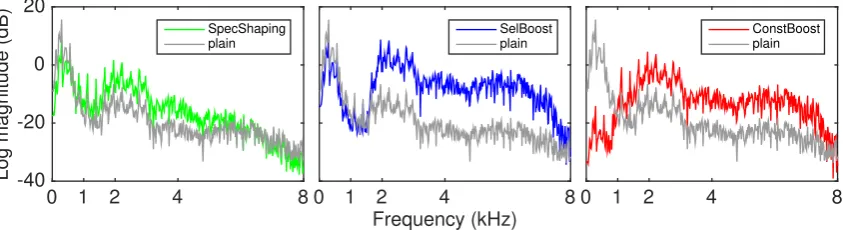
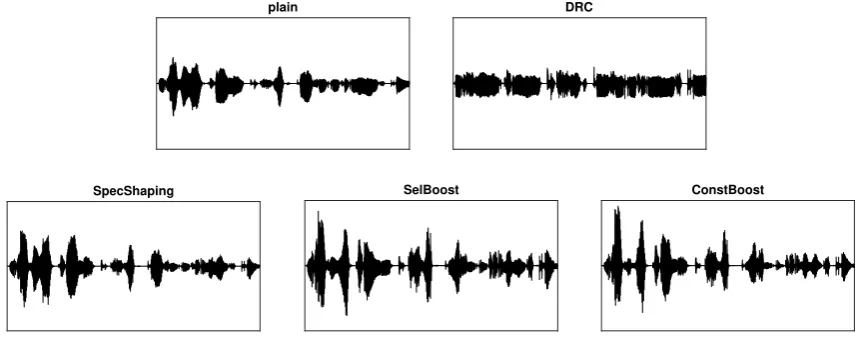
Figure1 shows examples of long term average spectra of speech uttered by a male talker, unmodified and spectrally-modified (no DRC applied) by the algorithms introduced above. Figure2 further illustrates the impact of the modifications to the speech signal in the time domain. Therefore, together with unmodified speech plain as the baseline as well as plain+DRC, the subjective intelligibility and quality of eight types of speech were examined.
0 1 2 4 8
Log magnitude (dB) -40
-20 0 20
SpecShaping plain
Frequency (kHz)
0 1 2 4 8
SelBoost plain
0 1 2 4 8
ConstBoost plain
[image:4.595.89.511.526.641.2].
plain DRC
SpecShaping SelBoost ConstBoost
[image:5.595.82.512.87.259.2].
Figure 2.Waveforms of unmodified and modified utterance of‘The overweight charmer could slip poison into anyone’s tea’.
3. Speech Intelligibility and Quality in Noise
3.1. Experiment Design and Procedure
Subjective intelligibility was measured as the word recognition rate in noise. Ten native British English speakers with normal hearing identified keywords from the Harvard sentences [25], which were uttered by a British male talker. Speech-shaped noise (SSN), babble noise recorded at a cafeteria (BAB) and competing speech (CS) of a female talker were used as the noise maskers. Speech was mixed with each type of noise at two SNR levels (SSN:−9 and−3 dB, BAB:−7 and−1 dB, CS:−18 and−12 dB), forming a low and a high intelligibility condition. The chosen low and high SNR led to subjective recognition rates of approximately 25% and 50% respectively for each noise masker in a pilot test. This setting led to 48 conditions (8 modification×3 maskers×2 SNRs). Each condition was presented four times, resulting in 192 different sentences being heard by each listener in total. Sentences were divided into six masker/SNR blocks. The presentation order of blocks, and the sentences in each block, were randomised for all listeners.
The playback of the stimuli was controlled by a MATLAB graphic programme. Stimuli were presented to listeners monaurally over a pair of Sennheiser (Wedemark, Germany) HD650 headphones after being pre-amplified by a Focusrite (High Wycombe, UK) Scarlett 2i4 USB audio interface. Listeners were allowed to listen to each sentence only once. The experiment took place in a semi-anechoic room with a background noise level lower than 15 dBA. The presentation level of speech was calibrated and fixed to 72 dBA; the noise level was then adjusted to the required SNRs.
J. Otorhinolaryngol. Hear. Balance Med.2018,1, 5 5 of 10
3.2. Results
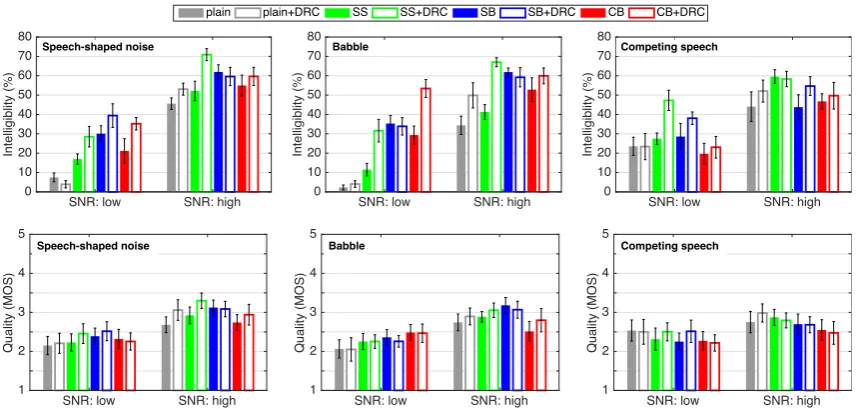
The mean subjective intelligibility score across listeners is presented in the upper row of Figure3. All the three modifications alone (without DRC) improved intelligibility over the unmodified speech plainbetween 6.6 and 22.6 percentage points in SSN, and between 6.9 and 33.0 percentage points
in BAB across SNR levels.SelBoostandConstBoostappeared less beneficial in CS than in the other two maskers. Nevertheless, an improvement of between 2.7 and 15.5 percentage points was received across all modifications and SNR levels. Except in the low SNR condition of SSN, DRC alone was more beneficial than harmful toplain. Furthermore, DRC seemed to always yield extra gain in addition toSpecShaping andConstBoost, especially in SSN and BAB. It boosted the two noise-independent modifications up to 2.9 to 25.7 percentage points over that achieved on their own. SelBoostdid not benefit from DRC in BAB and the high SNR condition of SSN. Inclusion of DRC however did not largely compromise the performance ofSelBoostin these cases.
SNR: low SNR: high
Intelligiblity (%) 0 10 20 30 40 50 60 70 80
SNR: low SNR: high
Intelligiblity (%) 0 10 20 30 40 50 60 70 80
plain plain+DRC SS SS+DRC SB SB+DRC CB CB+DRC
SNR: low SNR: high
Intelligiblity (%) 0 10 20 30 40 50 60 70 80
Speech-shaped noise Babble Competing speech
SNR: low SNR: high
Quality (MOS) 1 2 3 4 5
SNR: low SNR: high
Quality (MOS) 1 2 3 4 5
SNR: low SNR: high
[image:6.595.84.513.266.471.2]Quality (MOS) 1 2 3 4 5 Competing speech Babble Speech-shaped noise
Figure 3.Subjective speech intelligibility (upperrow) and quality (lowerrow) in noise. Scores are grouped by SNR level. Error bars indicate±1 standard error. SS, SB and CB denoteSpecShaping,
SelBoostandConstBoost, respectively.
A three-way repeated measures ANOVA with within-subjects factors of masker type, SNR level and modification on rationalised arcsine units [28] converted from the keyword scores supported visual impressions: modifications significantly altered the intelligibility of modified speech [F(7, 63)=27.58,p<0.001,η2=0.33]. As one of the dominant factors for speech intelligibility in noise,
the SNR effect is also significant [F(1, 9) =272.42, p<0.001,η2=0.55] All significant bi-factor and
three-way interactions suggested that the performance of the modifications varies with masker type and SNR level [allp<0.001].
Table 1.Mean mean opinion score (MOS) across modifications at each signal-to-noise ratio (SNR) level, witch 95% confidence interval in the parentheses.
SSN BAB CS
SNR: high 3.0 (±0.13) 2.9 (±0.14) 2.7 (±0.11) SNR: low 2.3 (±0.08) 2.3 (±0.11) 2.4 (±0.09)
A separate ANOVA with the same three main factors was performed on the MOS. The results confirmed that there was no significant main effect of modification type nor noise type, except that of SNR level [F(1, 9) =17.19, p<0.01, η2 =0.23]. The bi-factor interactions between masker type
and SNR level [F(2, 18) = 4.14, p < 0.05, η2 = 0.02], and between masker type and modification
[F(14, 126) =2.23, p<0.05, η2=0.03] were significant, but that between SNR level and modification
was not. There was no three-way interaction either.
[image:7.595.218.379.406.446.2]Post-hoc analyses using Fisher’s least significant difference (FLSD) were further conducted on the quality ratings separately for masker/SNR combination with the single factor of modification. The results in Table2confirmed that listeners provided similar quality ratings to all speech types at the low SNR level in SSN and CS. Speech modified byConstBoostwith or without DRC was rated as being lower quality than some of the others in the remaining conditions, except at the low SNR level in BAB, in which bothConstBoostwith and without DRC led to better quality thanplainwith and without DRC.
Table 2.Fisher’s least significant difference (FLSD) on MOS in each masker/SNR condition.
SSN BAB CS
SNR: high 0.42 0.46 0.40 SNR: low 0.41 0.39 0.40
4. Speech Quality in Quiet
4.1. Experiment Design and Procedure
The same 10 participants from the first experiment also rated the speech quality in quiet. AsSelBoostis noise-dependent, when noise masker varies the algorithm may affect the speech quality differently according to the objective evaluations using PESQ [10]. Therefore, the quality of speech modified bySelBoostin the three maskers were evaluated separately. In each masker, the modification was performed at ‘high’ SNR only, in which case the objective quality appears to be somewhat lower than when SNR is low [10]. Withplain,SpecShapingandConstBoost, 12 types of speech were evaluated including the 6 DRC-compressed versions.
The 12 conditions formed 6 groups, each of which consisted of an unmodified sentence and two modified sentences by the same modification with and without DRC. An identical utterance was used within a group so that the listeners would be able make a relatively fair judgement on the three conditions. Within a group, the participant could choose in which order to play the recordings and repeat them if necessary. Listeners listened to each group three times with different sentences each time (i.e., 18 groups); All the groups were presented to listeners in a random manner.
4.2. Results
J. Otorhinolaryngol. Hear. Balance Med.2018,1, 5 7 of 10
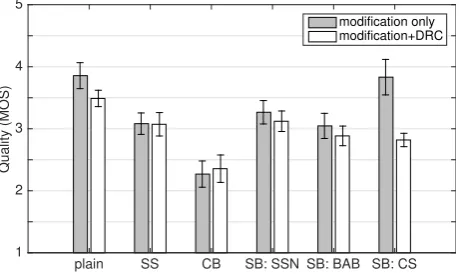
and without (MOS = 3.5) DRC, followed bySpecShapingandSelBoost. ForSelBoost, the quality was expected to decrease from stationary (SSN) to fluctuating (CS) masker, according to the PESQ predictions in [10]. However, listeners rated the quality without DRC in CS (MOS = 3.8) almost as high as the original unmodified speech.
plain SS CB SB: SSN SB: BAB SB: CS
Quality (MOS)
1 2 3 4 5
[image:8.595.184.414.155.292.2]modification only modification+DRC
Figure 4.Subjective speech quality rating in quiet. Error bars indicate±1 standard error.
A one-way ANOVA analysis revealed a strong effect of modification type [F(11, 99) = 10.82, p< 0.001,η2= 0.38]. Further FLSD [FLSD=0.4] analysis confirmed that the quality of unmodified
speech and speech modified bySelboostin CS is significantly better than that of others. While SpecShapingandSelBoostin SSN and BAB resulted in similar speech quality,ConstBoostled to the poorest speech quality according to listeners’ preference. Except forSelBoostin CS, where DRC drastically deteriorated the quality, DRC did not further decrease quality over the modifications.
5. Discussion
This study sought to explore the relationship between the intelligibility and quality of speech processed by intelligibility-boosting modification algorithms. In noise, the chosen modifications led to different level of intelligibility. The perceptual quality, however, varied little across most modifications at the same SNR, but did vary significantly when the SNR changed. The results therefore suggest that the noise effect determines speech quality more than do other factors. Another possibility could be that at certain SNR, listeners may not perceive the changes to the speech signal that would lead to a degradation in speech quality. This is likely because when the noise masker masks the audibility of speech, it could simultaneously disguise the artefacts or distortions on the speech due to the modifications, as argued in [12].
2 2.5 3 3.5 Quality (MOS)
0 10 20 30 40 50 60 70 80
Intelligibility (%)
R2 = 0.75, p < .001
[image:9.595.195.399.86.283.2]SSN BAB CS
Figure 5.Perceptual speech quality versus intelligibility in noise, coded by markers. Black and grey represent low and high SNR, respectively. The overallR2andpvalue are provided.
When rating speech quality in quiet, where intelligibility is the greatest it can be, listeners mostly preferredplainover modified speech, implying that modifications indeed harm perceptual quality to different degrees. Interestingly, the listeners rated unmodified speech the best in terms of quality even though they were not given any direct reference for quality rating in this study. They seem to have learned from their experiences and have formed a consistent ‘standard’ of quality. However, it is surprising to see that speech processed bySelBoostonly in CS (SB: CS) was rated as being as high quality asplain. As the modification needs to adapt to the large fluctuation of CS, a poorer quality would be expected compared to that of SSN and BAB. Thus, the reason behind the listener’s rating in this conditions is unclear here and needs further investigation. Compared to the other conditions, the larger error bar in Figure4indicates a larger variation in listeners’ opinions in this condition.
In [12] the quality of the unmodified speech and the speech modified by two independent algorithms was compared, when intelligibility converged in a noisy condition (SSN, 5 dB SNR). It was found that listeners mostly preferred one of the modified speech signals to the unmodified speech signals, which was rated better than the other modified signals. In this case, listeners’ judgement was probably still affected by the noise although intelligibility was no longer an issue at the chosen SNR. In addition, some modifications may introduce greater artefacts or distortions to the speech signal than others. When the SNR is high, the traces left by the modification start to stand out, resulting in low perceived quality—the same may apply toConstBoosthere—despite its significant intelligibility gain in noise. As shown in Figure1,ConstBoostboosts the mid-high frequencies by sacrificing energy from 1000 Hz below where the pitch and harmonic information exists. Speech signals in which this frequency range is largely attenuated tend to have poor perceptual quality [26].
6. Conclusions
J. Otorhinolaryngol. Hear. Balance Med.2018,1, 5 9 of 10
SNR estimation online, in order to determine the threshold for modification (de)activation in respect to speech quality.
Acknowledgments:This work was supported by the EPSRC Programme Grant S3A: Future Spatial Audio for an Immersive Listener Experience at Home (EP/L000539/1) and the BBC as part of the BBC Audio Research Partnership. Data underlying the findings are fully available without restriction, details are available from
https://dx.doi.org/10.17866/rd.salford2201281.
Author Contributions: Yan Tang and Christopher Arnold designed all the experiments in this study. Christopher Arnold conducted the experiments, and Yan Tang composed this manuscript. All authors approved the final manuscript.
Conflicts of Interest:The authors declare no conflict of interest.
References
1. Nørholm, S.M.; Jensen, J.R.; Christensen, M.G. Enhancement of non-stationary speech using harmonic chirp filters. In Proceedings of the Interspeech, 16th Annual Conference of the International Speech Communication Association, 6–10 September 2015, Dresden, Germany, 2015; pp. 1755–1759.
2. Mohammadiha, N.; Smaragdis, P.; Leijon, A. Supervised and unsupervised speech enhancement using nonnegative matrix factorization. IEEE Trans. Audio Speech Lang. Process.2013,21, 2140–2151.
3. Paliwal, K.; Wójcicki, K.; Schwerin, B. Single-channel speech enhancement using spectral subtraction in the short-time modulation domain. Speech Commun.2010,52, 450–475.
4. Martin, R. Speech Enhancement Based on Minimum Mean-Square Error Estimation and Supergaussian Priors. IEEE Trans. Speech Audio Process.2005,13, 845–856.
5. Rangachari, S.; Loizou, P.C. A noise-estimation algorithm for highly non-stationary environments.
Speech Commun.2005,48, 220–231.
6. Brouckxon, H.; Verhelst, W.; Schuymer, B.D. Time and frequency dependent amplification for speech intelligibility enhancement in noisy environments. In Proceedings of the Interspeech, 9th Annual Conference of the International Speech Communication Association, 22–26 September Brisbane Australia, 2008; pp. 557–560.
7. Villegas, J.; Cooke, M. Maximising objective speech intelligibility by local f0modulation. In Proceedings
of the Interspeech, 13th Annual Conference of the International Speech Communication Association, Portland, OR, USA, 9–13 September 2012; pp. 1704–1707.
8. Godoy, E.; Koutsogiannaki, M.; Stylianou, Y. Assessing the Intelligibility Impact of Vowel Space Expansion via Clear Speech-Inspired Frequency Warping. In Proceedings of the Interspeech, 14th Annual Conference of the International Speech Communication Association, Lyon, France, 25–29 August 2013; pp. 1169–1173. 9. Sauert, B.; Vary, P. Recursive closed-form optimization of spectral audio power allocation for near end
listening enhancement. In Proceedings of the ITG-Fachtagung Sprachkommunikation, Bochum, Deutschland, 6–8 October 2010; pp. 955–958.
10. Tang, Y.; Cooke, M. Energy reallocation strategies for speech enhancement in known noise conditions. In Proceedings of the Interspeech, 11th Annual Conference of the International Speech Communication Association, Makuhari, Chiba, Japan, 26–30 September 2010; pp. 1636–1639.
11. Tang, Y.; Cooke, M. Optimised spectral weightings for noise-dependent speech intelligibility enhancement. In Proceedings of the Interspeech, 13th Annual Conference of the International Speech Communication Association, Portland, OR, USA, 9–13 September 2012; pp. 955–958.
12. Taal, C.; Hendriks, R.C.; Heusdens, R. Speech energy redistribution for intelligibility improvement in noise based on a perceptual distortion measure.Comput. Speech Lang.2014,28, 858–872.
13. Aubanel, V.; Cooke, M. Information-preserving temporal reallocation of speech in the presence of fluctuating maskers. In Proceedings of the Interspeech, 14th Annual Conference of the International Speech Communication Association, Lyon, France, 25–29 August 2013; pp. 3592–3596.
15. Godoy, E.; Stylianou, Y. Increasing speech intelligibility via spectral shaping with frequency warping and dynamic range compression plus transient enhancement. In Proceedings of the Interspeech, 14th Annual Conference of the International Speech Communication Association, Lyon, France, 25–29 August 2013; pp. 3572–3576.
16. Schepker, H.; Rennies, J.; Doclo, S. Speech-in-noise enhancement using amplification and dynamic range compression controlled by the speech intelligibility index. J. Acoust. Soc. Am.2015,138, 2692–2706. 17. Cooke, M.; Mayo, C.; Valentini-Botinhao, C.; Stylianou, Y.; Sauert, B.; Tang, Y. Evaluating the intelligibility
benefit of speech modifications in known noise conditions. Speech Commun.2013,55, 572–585.
18. Cooke, M.; Mayo, C.; Valentini-Botinhao, C. Intelligibility-enhancing speech modifications: The Hurricane Challenge. In Proceedings of the Interspeech, 14th Annual Conference of the International Speech Communication Association, Lyon, France, 25–29 August 2013; pp. 3552–3556.
19. Tang, Y.; Cooke, M. Subjective and objective evaluation of speech intelligibility enhancement under constant energy and duration constraints. In Proceedings of the Interspeech, 12th Annual Conference of the International Speech Communication Association, Florence, Italy, 27–31 August 2011; pp. 345–348. 20. Rix, A.; Hollier, M.; Hekstra, A.; Beerends, J. Perceptual evaluation of speech quality (PESQ): The new ITU
standard for end-to-end speech quality assessment. Part I. Time-delay compensation.J. Audio Eng. Soc.2002,
50, 755–764.
21. Tang, Y.; Cooke, M. Learning static spectral weightings for speech intelligibility enhancement in noise.
Comput. Speech Lang.2017. https://doi.org/10.1016/j.csl.2017.10.003.
22. Blesser, B.A. Audio dynamic range compression for minimum perceived distortion. IEEE Trans. Audio Electroacoust.1969,17, 22–32.
23. Schmidt, J.C.; Rutledge, J.C. Multichannel dynamic range compression for music signals. In Proceedings of the 1996 IEEE International Conference on Acoustics, Speech, and Signal Processing (ICASSP), Atlanta, GA, USA, 9 May 1996; pp. 1013–1016.
24. Cooke, M. A glimpsing model of speech perception in noise. J. Acoust. Soc. Am.2006,119, 1562–1573. 25. Rothauser, E.H.; Chapman, W.D.; Guttman, N.; Silbiger, H.R.; Hecker, M.H.L.; Urbanek, G.E.; Nordby, K.S.;
Weinstock, M. IEEE Recommended practice for speech quality measurements.IEEE Trans. Audio Electroacoust. 1969,17, 225–246.
26. Gabrielsson, A.; Schenkman, B.N.; Hagerman, B. The effects of different frequency responses on sound quality judgments and speech intelligibility.J. Speech Lang. Hear. Res.1988,31, 166–177.
27. Hafter, E.; Schlauch, R.Noise-Induced Hearing Loss; Chapter Cognitive Factors and Selection of Auditory Listening Bands; Mosby-Year Book: St Louis, MO, USA, 1992.
28. Studebaker, G.A. A ‘rationalized’ arcsine transform. J. Speech Hear. Res.1985,28, 455–462.
29. Preminger, J.E.; Tasell, D.J.V. Quantifying the relation between speech quality and speech intelligibility.
J. Speech Hear. Res.1995,38, 714–725. c