S O F T W A R E
Open Access
Enhanced structural variant and breakpoint
detection using SVMerge by integration of
multiple detection methods and local assembly
Kim Wong
†, Thomas M Keane
†, James Stalker, David J Adams
*Abstract
We present a pipeline, SVMerge, to detect structural variants by integrating calls from several existing structural variant callers, which are then validated and the breakpoints refined using localde novoassembly. SVMerge is modular and extensible, allowing new callers to be incorporated as they become available. We applied SVMerge to the analysis of a HapMap trio, demonstrating enhanced structural variant detection, breakpoint refinement, and a lower false discovery rate. SVMerge can be downloaded from http://svmerge.sourceforge.net.
Rationale
Next-generation sequencing technologies promise a revolution in our ability to understand the architecture of the human genome, and to decipher how this archi-tecture contributes to disease [1]. This understanding is dependent on our ability to accurately detect differences between individuals on a genome-wide scale. Although nucleotide level variants such as SNPs and insertions/ deletions (indels) are numerous, large structural variants, such as deletions, duplications and inversions, affect more sequence, and as much as 15% of the human gen-ome falls into copy number variable regions [1]. Many of the software packages currently available to detect structural variants (SVs) employ algorithms that utilize data derived from the mapping of paired-end sequence reads, using anomalously mapped read pairs as a means for detecting and cataloguing these variants. Deletions, for example, are detected when the distance between mapped paired-end reads is significantly smaller than the average size distribution of other mapped read pairs from the same mate-pair sequencing library. Similarly, inversions may be identified when read pairs are mapped to the same strand of the reference genome. Examples of software using this approach include Break-Dancer [2] and VariationHunter [3]. Other software packages such as Pindel [4] apply a split-mapping
approach where one end of a pair of sequence reads is mapped uniquely to the genome and acts as an anchor, while the other end is mapped so as to detect the SV breakpoint. A third approach used to detect SVs involves ascertaining changes in read depth coverage, which reflect gains and losses in sequence copy number. Calling variants in this way will report regions of the reference genome that appear to be duplicated or deleted. This analysis, however, will not report the pre-cise location of the duplicated sequence. Several algo-rithms have been developed for calling copy number variants in this way, including cnD, which applies a hid-den Markov model to detect copy number variants [5], and RDXplorer, which uses a novel algorithm based on significance testing [6].
The location of large insertions can also be identified from mapping of paired-end sequence reads, where one end read is mapped to the reference sequence and the other end is either unmapped (for example, a novel sequence insertion), or mapped to another copy of the particular repeat element present in the reference (for example, insertion of a repetitive element, such as LINEs). We have developed two in-house tools, SEClus-ter and RetroSeq [7], to detect these insertion events (see Materials and methods).
Independently, each of these approaches has limita-tions in terms of the type and size of SVs that they are able to detect, and no single SV caller is able to detect the full range of structural variants. The approach of utilizing paired-end mapping information, for example, * Correspondence: [email protected]
†Contributed equally
Wellcome Trust Sanger Institute, Hinxton, Cambridge, CB10 1SA, UK
cannot detect SVs where the read pairs do not flank the SV breakpoints, which can occur due to sequence fea-tures such as SNPs near the SV breakpoint, or where the number of supporting read pairs is low. Further-more, the size of insertions that can be identified by paired-end analysis is limited by the library insert size. Insertion calls made using the split-mapping approach are also size-limited because the whole insertion break-point must be contained within a read. Read-depth approaches can identify copy number changes without the need for read-pair support, but cannot find copy number neutral events such as inversions, and read depth alone cannot be used to indicate the exact loca-tion of the duplicated sequence. For these reasons we developed SVMerge, a meta SV calling pipeline, which makes SV predictions with a collection of SV callers that are then merged, and computationally validated using localde novoassembly to gain a more comprehen-sive picture of the structural variants found within a genome. We show that SVMerge generates a more com-plete set of SV calls (>100 bp) compared to any single method alone, and provides refined SV breakpoints for downstream analysis. We have designed SVMerge to be both modular and extensible so that new SV calling methods may be incorporated into the analysis pipeline. Here we describe the main components of the pipeline, and results obtained from the analysis of three genomes from a HapMap trio sequenced using the Illumina plat-form. SVMerge is written in Perl and is freely available from [8].
Results
The SVMerge pipeline
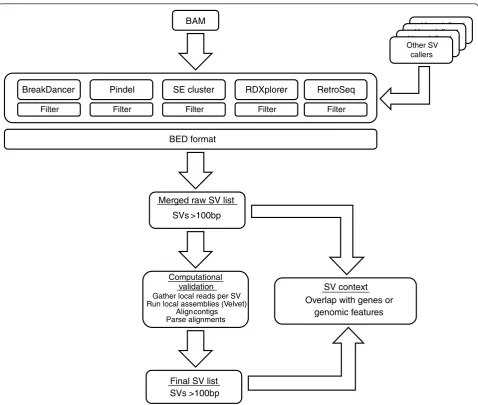
The SVMerge pipeline consists of four major modules: set-up and organization with a specific data structure, structural variant calling, filtering and merging of var-iant calls, and computational validation by de novo
assembly using sequence reads mapped proximally to predicted breakpoints (Figure 1). The final output of SVMerge is in a standard Browser Extensible Data (BED) format, which greatly facilitates downstream ana-lysis such as comparison of SV calls to gene lists using packages such as BEDTools [9], or visualization of SV calls using the UCSC [10] or Ensembl [11] genome browsers.
Each dataset to be analyzed is set up as a new project, and specific subdirectories are created to aid in the management of the data through each step of the pipe-line. All configurable parameters, discussed below, are specified in a single configuration file that is used by SVMerge at each step of analysis as the pipeline is deployed. For each dataset to be analyzed, the user must supply either a single standard Binary Alignment/Map (BAM) formatted file with the reads aligned to a
reference genome, or a set of BAMs consisting of one BAM per chromosome [12].
For the analysis presented here we have incorporated a variety of SV calling software packages into SVMerge. Table 1 lists the software, analysis method, and SV types called by these algorithms. The pipeline also allows for user-defined SV calls to be included, as the only requirement for subsequent steps of the pipeline is for SV calls to be in a specific tab-delimited format. Addi-tional filtering, if required, is performed on the raw out-put of each SV caller to remove calls with weak support, or those calls that may be artifacts. This filtering includes the removal of calls of low quality, which is indicated by a score assigned to each SV prediction, and filtering of calls by their proximity to reference sequence assembly gaps, highly repetitive regions of the genome, and centromeres and telomeres. After filtering, the SV calls are separated by SV type, and calls of the same type from all SV callers are merged to generate a non-redundant set of calls (see Materials and methods). The raw, merged SV calls are output in tab-delimited format, indicating the chromosomal coordinates, and a unique identifier that provides information about the predicted SV type. This call set is used for subsequent steps in the SVMerge pipeline.
this mapper are easily configurable and the output for-mat can be customized [15].
The final steps in SVMerge are automated parsing and interpretation of the contig alignment results to provide evi-dence supporting or refuting the original SV call. The first
source of evidence is a breakpoint-containing contig, which either contains both ends of an SV breakpoint (for example, a contig contains an entire 300-bp insertion), or a single breakpoint (for example, half of a contig aligns to the refer-ence and the other half is part of a larger insertion). For
User defined Calls User defined
Calls
BreakDancer Pindel SE cluster RDXplorer
User defined Calls Other SV
callers
BED format
Merged raw SV list
SVs >100bp
Computational validation Gather local reads per SV Run local assemblies (Velvet)
Align contigs Parse alignments
Final SV list SVs >100bp
SV context Overlap with genes or
genomic features BAM
Filter Filter Filter Filter
RetroSeq
[image:3.595.59.538.86.491.2]Filter
Figure 1An overview of the SVMerge pipeline. SVMerge uses a suite of software tools to detect structural variants (SVs) from mapped reads. The calls are filtered, merged and then validated computationally by localde novoassembly. The output is in BED format, allowing for easy downstream analysis or viewing in a genome browser. The SVMerge pipeline is extendable so that calls made by other software can be included in the downstream analysis. BAM, Binary Alignment/Map format.
Table 1 Structural variation callers used in SVMerge
Software Analysis method SV types called Size detection limitations
BDMax Paired-end mapping D, I, Inv, T Insertions limited by library insert size
Pindel Split-mapping D, I, D+I Insertions limited by read size; deletions <1 Mb
SECluster Clusters of one-end-mapped reads I Minimum size dependent on insert size
RetroSeq Targeted insertion calling RI Minimum size dependent on insert size
RDXplorer Read depth D, G Minimum size approximately 1 kb
Listed are the software used to call structural variants (SVs), the analysis method used, SV types called, and limitations of the SV caller.‘BDMax’is
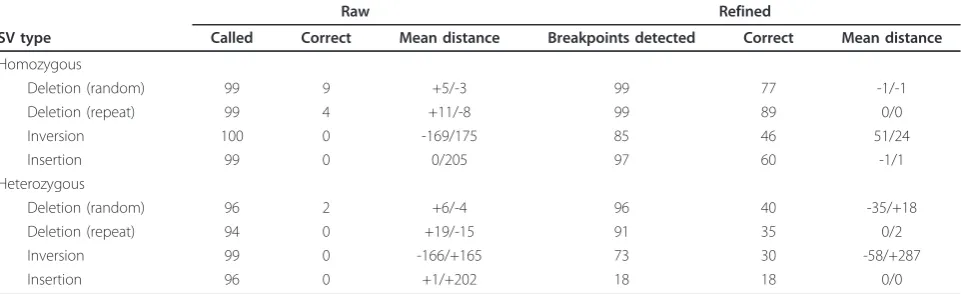
[image:3.595.56.540.639.713.2]deletions, another source of evidence may simply be the lack of contigs covering the region predicted to be deleted (for example, homozygous deletions). Because heterozy-gous deletions may be difficult to validate by local assem-bly, an additional examination of mapped read depth is performed to ensure that heterozygous deletions are not falsely invalidated (see Materials and methods). For all SV calls with breakpoint-containing contigs, the alignment information is used to refine the original SV breakpoint predictions. We evaluated the accuracy of breakpoint loca-lization obtained from the local assembly and contig align-ment method using simulated data. Deletions, insertions, and inversions were added to the human chromosome 20 reference sequence, and reads were generated to produce a depth of coverage of 40 × (see Materials and methods). The breakpoint refinement step was able to determine the exact SV breakpoints for 60 to 89% of homozygous SVs, depending on SV type; this is significantly higher than the proportion from the raw output of the SV callers (Table 2). As expected, breakpoint refinement for heterozygous SVs was more difficult, especially for heterozygous insertions.
Current SV callers do not attempt to call complex SVs, where more than one event appears to have taken place at a single locus. Local assembly analysis may reveal that a particular region is, in fact, complex, with more than one type of SV. SVMerge attempts to detect complex SVs, such as inversions that have occurred with a deletion or insertion, or a deletion that also con-tains an insertion at or near to the breakpoint. The final SV call set consists of deletions and copy number gains supported by read depth analysis, and complex SVs,
deletions, insertions and inversions supported by local assembly analysis.
Application of SVMerge to a HapMap trio dataset
We demonstrate the application of SVMerge to a data-set consisting of a high-depth HapMap trio (NA18506, NA18507, NA18508), which was sequenced on the Illu-mina platform [16]. The sequence data for these indivi-duals were downloaded from the Sequence Read Archive (accession numbers [SRA009347], [SRA009225], [SRA000271]) and aligned to the GRCh37 human refer-ence using BWA v0.5.5 [17] with default parameters. Sequence coverage depths for each genome were deter-mined to be 42 ×, 42 × and 40 × for NA18506, NA18507, and NA18508, respectively. A single BAM file for each individual was produced for SV analysis (see Materials and methods).
[image:4.595.58.539.515.662.2]The BAM file for each individual was used as input for BreakDancerMax [2], RDXplorer [6], SECluster (unpublished; see Materials and methods), and RetroSeq [7]; SVMerge provides a tool to read data from a BAM file to produce the necessary Pindel input file. Specific parameters for each SV caller are provided in the Mate-rials and methods section. The resulting BreakDancer-Max and Pindel calls were filtered, allowing a minimum score of 25. All SV calls were filtered by location, and calls less than 600 bp from a reference sequence assem-bly gap and 1 Mb from a centromere or telomere were excluded from further analysis. Only calls greater than 100 bp were considered; for RDXplorer the minimum size of SV calls included was 10 kb. BreakDancerMax is able to call inter-chromosomal translocations, although
Table 2 Improvement of breakpoint resolution using localde novoassembly and breakpoint refinement in SVMerge
Raw Refined
SV type Called Correct Mean distance Breakpoints detected Correct Mean distance
Homozygous
Deletion (random) 99 9 +5/-3 99 77 -1/-1
Deletion (repeat) 99 4 +11/-8 99 89 0/0
Inversion 100 0 -169/175 85 46 51/24
Insertion 99 0 0/205 97 60 -1/1
Heterozygous
Deletion (random) 96 2 +6/-4 96 40 -35/+18
Deletion (repeat) 94 0 +19/-15 91 35 0/2
Inversion 99 0 -166/+165 73 30 -58/+287
Insertion 96 0 +1/+202 18 18 0/0
To evaluate the performance of the local assembly and breakpoint refinement step in SVMerge, structural variants (SVs) were generated in human chromosome 20. For each category, 100 SVs were generated by random selection of location and size. Repeat deletions were selected from a list of LINEs and SINEs on
chromosome 20. The raw, unfiltered calls are from BreakDancer raw output, except insertion calls, which are from SECluster raw output.‘Called’is the total
number of SVs out of the 100 simulated SVs that were found in the raw output;‘Breakpoints detected’is the number of SVs, out of the total called, for which
the SVMerge pipeline was able to detect breakpoints with the local assembly, and contig alignment and analysis steps;‘Correct’is the number of predictions that
had matches to the actual breakpoint coordinates;‘Mean distance’is the mean distance from the actual breakpoints, where the numbers represent the 5’/3’
breakpoints. The‘+’indicates the mean distance was upstream of the actual breakpoint, and‘-’indicates the mean distance was downstream. Raw and refined
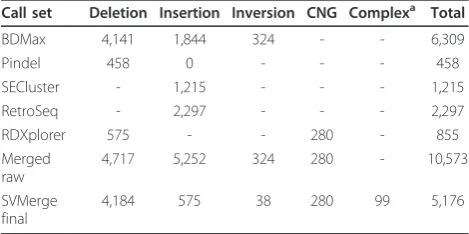
even with stringent filtering by score the number of translocation calls in these datasets was high (data not shown); since the majority of these are not likely to be real, they were excluded from further analysis. Table 3 shows the number and type of SV calls produced for the child, NA18506. Similar results were obtained for the parents (Additional file 1). A clear advantage was obtained by using a variety of SV calling methods, as demonstrated by comparing both the number of candi-date calls and SV types for individual callers versus the ‘merged raw’call set. Although read-pair analysis is able to find a large number of candidate deletions, deletions with low or no read-pair support require different approaches, such as split-read and read-depth analyses, which are provided by Pindel and RDXplorer, respec-tively. Similarly, the nominal overlap between the inser-tion calls from the different SV callers reflects the ability of the various callers to find insertions of a specific size or type.
The ‘merged raw’SV calls, excluding copy number gains and deletions without supporting read pairs or split-reads, were subjected to computational validation by local assembly. The‘final’ calls for the child (NA18506) are shown in Table 3. Similar results were obtained for the parents (Additional file 1). The final call set contains all copy number gain calls and deletion calls unique to RDXplorer, insertions and inversions with evidence of breakpoints from local assembly analysis, and deletions with either supporting evidence from local assembly analysis or read-depth analysis (see Materials and meth-ods). A number of complex SVs (for example, inversions with internal deletions) were also identified. Local assembly analysis was able to provide refined coordi-nates for approximately 60% of deletions in the ‘final’
call set. For the remaining deletions, where breakpoint refinement failed but read-depth analysis provided evi-dence of low or no read coverage, the original break-point coordinates from the‘merged raw’ call set were used in the‘final’call set. Only 11% of insertions in the ‘merged raw’call set were validated by local assembly and included in the ‘final’ call set, reflecting both the difficulty in detecting true insertions, as well as the diffi-culty validating these calls by local assembly.
Table 4 shows the number of SV calls in the‘final’call set that are unique to a specific SV caller, and those shared by at least one other caller. These numbers illus-trate a clear benefit of complementing paired-end map-ping analysis with read-depth analysis and other methods that target specific classes of repetitive ele-ments. BreakDancerMax alone produced 3,874 of the 5,176 calls to the‘final’call set; the addition of the other callers provided an additional 1,302 calls that would have otherwise been undetected.
To evaluate the final SV call set from SVMerge for the HapMap trio, we compared the overlap of the deletion, gain, and inversion calls against the curated Database of Genomic Variants (DGV; March 2010 release) [18]. SVMerge calls overlapped with calls in DGV at a rate significantly higher than expected by random chance (P
[image:5.595.56.291.520.637.2]< 0.001; Additional file 2). Of the deletion calls made by SVMerge, 71% (NA18506), 81% (NA18507), and 71% (NA18508) had a minimum 50% reciprocal overlap with regions of known copy number variation in DGV, while 29% (NA18506), 32% (NA18507), and 36% (NA18508) of the copy number gains overlap entries in DGV. The proportion of SVMerge inversion calls overlapping with known inversions in DGV was 47% (NA18506), 69% (NA18507), and 51% (NA18508). We further evaluated the calls in the child that did not overlap DGV calls by determining their presence in either parent’s raw SV call set. This accounted for a further 18% of deletions, 32% of inversions, and 54% of duplications in the child to give us estimated maximum false discovery rates of 11%,
Table 3 Structural variant calls for individual NA18506
Call set Deletion Insertion Inversion CNG Complexa Total
BDMax 4,141 1,844 324 - - 6,309
Pindel 458 0 - - - 458
SECluster - 1,215 - - - 1,215
RetroSeq - 2,297 - - - 2,297
RDXplorer 575 - - 280 - 855
Merged raw
4,717 5,252 324 280 - 10,573
SVMerge final
4,184 575 38 280 99 5,176
a’
Complex’refers to any locus with more than one structural variant type - for
example, an inversion with a deletion. Shown are the numbers of raw calls (>100 bp) from each structural variation (SV) caller, filtered by score and location only (see Materials and methods), for NA18506, the child in the
HapMap trio dataset.‘BDMax’is BreakDancerMax. Pindel is able to identify
deletions that also contain small insertions; these are included in the total
deletion count.‘Merged raw’is the resulting number of calls after merging of
these calls by their coordinates (see Materials and methods).‘SVMerge final’is
[image:5.595.305.539.591.688.2]the total number of calls made after refinement of the SV call list by local assembly and read depth analysis. Copy number gains (CNG) are not subject to validation by local assembly.
Table 4 Contribution of individual structural variant callers to the‘SVMerge final’call set for NA18506
Unique SV calls
Deletion Insertion Inversion CNG Shared SV calls
Total SVs
BDMax 3,283 45 124 - 442 3,874
Pindel 25 0 - - 404 429
SECluster - 449 - - 40 489
RetroSeq - 44 - - 7 51
RDXplorer 526 - - 280 49 855
Shown are the number of structural variant (SV) calls (>100 bp) from each SV
caller that are included in the‘final’call set for NA18506.‘Unique SV calls’are
those that are made by a single SV caller only, and‘Shared SV calls’are SVs
that were found by more than one method.‘BDMax’is BreakDancerMax. CNG,
21%, and 17% for deletions, inversions, and copy num-ber gains, respectively. Child-only insertions, with coor-dinates greater than 200 bp from any parental insertion, account for 14.4% of insertion calls. Collectively, all child-only SV calls comprise 11% of the child’s final SV call set. This is a considerable improvement from what was observed in the‘merged raw’SV call set, in which 50% of the calls are unique to the child. The majority of these are false insertion calls from read pair analysis, which may be due to an artifact of the library construc-tion; there is a significant tail at the lower end of the library insert size distribution (data not shown), which generates read pairs that align closer than expected based on the mean and standard deviation of the distri-bution. The maximum false negative rates, which can be estimated by assuming all of the child SV calls are real and comparing them to parental SV calls, are 21% for deletions, 40% for inversions, 23% for duplications, and 25% for insertions. False positive rates for individual structural variant callers and a comparison of confidence scores for child-only calls versus shared calls are pro-vided in Additional files 3 and 4, respectively.
Discussion
Genomic structural variation is increasingly being recog-nized as an important source of phenotypic variation [19]. The advent of new sequencing technologies means that it is now possible to create high-resolution maps of these variants; however, the range of SVs detected by individual SV callers is somewhat limited. For this rea-son, we have developed SVMerge, the first meta SV caller that integrates calls made from multiple sources and validates these calls using local de novoassembly. We illustrate that this approach produces a more com-prehensive set of variant calls, compared to calls made by any single caller alone. SVMerge is an extensible pipeline that allows calls from any method to be easily incorporated. As more algorithms and a wider variety of SV callers become available, we expect that our comple-mentary method will be able to produce an even wider spectrum of calls.
A key part of the SVMerge pipeline is the computa-tional validation step, which performs local assembly and breakpoint refinement. Analysis of the HapMap trio has enabled us to demonstrate that this part of the pipe-line can significantly reduce the false discovery rate. With simulated data, we show that this step also increases the accuracy of the predicted SV breakpoints compared to those produced by the individual callers (Table 2). However, computational validation of inser-tions and heterozygous SVs remains challenging. The proportion of computationally validated insertions is notably lower than other SV types. Local assembly of a
de novoinsertion is hampered by the lack of reads, since
the reads provided for assembly are those that map near the breakpoint, or unmapped reads with mates that align near the breakpoint. Heterozygous breakpoint detection and refinement would be improved by advancements in methods such as short read assemblers that can perform diploid assemblies, or the use of assembly graphs to detect breakpoints. In the case of copy number gain and loss calls based only on read depth, local assembly is not a suitable validation strat-egy. As an alternative strategy, a high-confidence set of copy number gain and loss calls could be derived by applying more than one read-depth-based copy number caller and considering the intersection of calls.
Identifying SVs from short read data has its limita-tions, in particular with complex SVs where multiple rearrangement events occur at a single locus. SVMerge attempts to identify a subset of complex SVs by inter-preting alignments of contigs generated from local assembly. However, these complex SVs are initially iden-tified from read pair analysis only as single SV type. Improvements to SV calling algorithms, which can interpret complex read pair patterns, and the develop-ment of new long range sequencing techniques, such as strobe sequencing [20], will enable identification and elucidation of complex SVs that are currently difficult to characterize.
Materials and methods Data
Sequence data for individuals NA18506, NA18507 and NA18508 were downloaded from the Sequence Read Archive (accession numbers [SRA009347], [SRA009225], [SRA000271]) and aligned to the GRCh37 human gen-ome reference sequence using BWA v0.5.5 [17] with default parameters. After alignment, the quality values were recalibrated using software tools from GATK [21], merged to the library level where duplicates were removed with Picard [22] and then a single BAM file for each individual was produced.
Structural variant callers
accepted was 30 with supporting reads from at least 3 read pairs, and a minimal size of 100 bp required. Pindel was downloaded from [24]. The insert size parameter was set to 200 bp and calls with scores less than 25 were excluded from further analysis. Deletions and insertions of at least 100 bp in size were considered for further analysis. SECluster, an in-house tool, attempts to locate large insertions by identifying adjacent clusters of forward and reverse-strand reads with unmapped mates. A minimum of five supporting reads mapped to the same strand, with minimal mapping qualities of 20, were required to form a cluster. Insertion signatures were then identified by comparing the outer coordinates of the forward and reverse clusters of reads allowing up to a 100-bp separation or a 50-bp overlap between the clusters. Mobile element insertions were identified using RetroSeq [7], which looks for clusters of reads with one end mapping to the reference and the other mapping to a mobile element in Repbase [25], or clusters of reads with mates mapped to a canonical mobile element on a different chromosome on the reference genome. Align-ments to Repbase were performed with SSAHA2 [26] with a minimum of 90% identify and hit length of 36 bp for a match. For read-depth-based copy number calling using RDXplorer, the default Z-score of 5 threshold was used, but we applied a minimum size cutoff of 10 kb. In addition to the above parameters and filtering criteria, calls in all call sets were excluded if they fell within 600 bp of a reference sequence assembly gap, or within 1 Mb of a centromere or telomere. We refer to this result-ing filtered set as the‘raw’calls.
Merging of raw calls
The raw call sets were merged by SV type and chromo-somal coordinate to generate a non-redundant SV call set. For example, all deletion calls from BreakDancer, Pindel, and RDXplorer were compared; if the coordinate spans from a BreakDancer deletion call and Pindel dele-tion call overlapped, then the calls were merged. The deletion calls from RDXplorer were then compared to the merged BreakDancer and Pindel set to identify addi-tional deletions not detected by either BreakDancer or Pindel. The rules applied for merging calls are outlined as follows: (1) if the overlap is less than 75 bp and the non-overlapping portion from each call is between 50 and 200 bp, take the outer coordinates of the union of the spans; (2) if the overlap is less than 75 bp and the non-overlapping portion from each call is≥200 bp, do not merge the spans; (3) otherwise, merge the calls and use the intersect of the spans.
Insertions from BreakDancerMax, RetroSeq, and SECluster were compared and merged by taking the intersection of overlapping spans. Inversions and copy number gains were only called by a single SV caller.
The resulting ‘merged raw’ set consists of deletions, insertion calls, inversions, and copy number gains.
Local assemblies and contig alignments
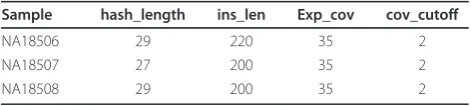
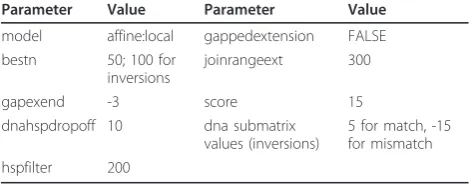
All SV calls, with the exception of copy number gains and deletion calls without any read pair support, were evaluated with local assembly of reads mapped near pre-dicted SV breakpoints. Mapped reads, and any unmapped mate-pairs, within 1 kb of a predicted inser-tion breakpoint, or 2 kb of all other SV types, were extracted from the BAM files, formatted to FASTA for-mat with interleaved read pairs, and assembled by Vel-vet (v.0.7.53). For inversions spanning over 10 kb, reads mapping within 5 kb of the insertion breakpoint were used for assembly. If the number of reads exceeded the maximum (over 10,000 reads for insertions, 200,000 for all other variant types), the SV call was deemed to be an artifact and was excluded from further analysis. The Velvet parameters used for each individual are shown in Table 5. Each local assembly was run with and without Velvet’s scaffolding option. All contigs generated for each SV call were aligned to the corresponding region in the reference genome using Exonerate (v.2.2.0) using the parameters described in Table 6.
Final call set
[image:7.595.304.540.678.731.2]For each SV call evaluated by local assembly, contig alignments were computationally parsed to determine if there was supporting evidence for the SV, and to loca-lize the breakpoints of the SV. Because reads that map to the breakpoints of heterozygous deletions are a mix-ture of reads that match the reference and reads that cross a breakpoint, local assembly may not always gen-erate a breakpoint-containing contig. Therefore, for deletions with supporting read pairs flanking the pre-dicted breakpoints, but no breakpoints found in assembled contigs, the original BAM files were used to check the read depth coverage across the predicted region. The Samtools ‘pileup’ utility [12] is used to report the depth of coverage and mapping quality of each base in the region. Any base with a root mean square mapping quality less than 30 is considered repe-titive. If the majority of bases are not repetitive and the mean depth of coverage across the region is less than 0.85 times the mean depth of coverage across the gen-ome, the predicted deletion is retained in the‘final’call set and the coordinates from the raw, merged set are
Table 5 Velvet parameters for each individual
Sample hash_length ins_len Exp_cov cov_cutoff
NA18506 29 220 35 2
NA18507 27 200 35 2
used. Short read aligners such as Maq [27] and BWA [17] place non-uniquely mapping read pairs randomly at one of all possible sites, meaning reads will be mapped even where LINEs, SINEs or other repetitive elements are absent in the query genome. Therefore, in regions where the root mean square <30 and the depth is lower than 1.2 times the mean depth of coverage across the whole genome, the original deletion call (which was sup-ported by spanning read pairs) is retained in the final call set. The‘SVMerge final’call set, therefore, consists of all SVs with breakpoints verified by local assembly analysis (deletions, inversions, insertions, complex SVs), deletions passing the read depth check, and all copy number gains from RDXplorer that passed initial filtering.
Simulation data set
To evaluate the breakpoint refinement step in SVMerge, we generated deletions, insertions, and inversions on the human reference chromosome 20, and simulated 38-bp paired short reads, with a mean insert size distribution of 220 bp. For each type of SV, 100 homozygous and 100 heterozygous SVs were generated by random selec-tion of locaselec-tion and size, and the exact breakpoints were recorded. Sizes were selected from a size distribution of those found by SVMerge in the NA18506 genome. Insertion sizes were selected from the deletion size dis-tribution. Repeat deletions were randomly selected from a list of RepeatMasker LINE and SINE elements >100 bp on chromosome 20 downloaded from the UCSC gen-ome browser website [10]. SNPs and indels were added at a rate of 1 per 1,000 bp, and read errors were added at rate of 1 per 100 bp. Reads were generated to pro-duce a depth of coverage of 40 ×. Reads were aligned with BWA, as described above in the‘Data’section, and a BAM file was generated. BreakDancerMax and SECluster were run as described above.
SVMerge software availability and requirements
All published software used for SV calling is freely avail-able, and must be installed prior to running SVMerge. SVMerge is written in Perl and is freely available from http://svmerge.sourceforge.net. Additional Perl modules
are described in the SVMerge documentation and avail-able from CPAN [28].
Additional material
Additional file 1: SV calls for individuals NA18507 and NA18508, made by individual SV callers and the final merged set.
Additional file 2: Number of SVMerge final SV calls overlapping DGV entries for the trio, compared to random sets.
Additional file 3: Comparison of the false discovery rates of individual SV callers.
Additional file 4: Comparison of the confidence scores of SVs unique to the child and those shared with the parents.
Abbreviations
BAM: Binary Alignment/Map; bp: base pair; BED: Browser Extensible Data; DGV: Database of Genomic Variants; GATK: genome analysis toolkit; LINE: long interspersed nuclear element; SINE: short interspersed nuclear element; SNP: single nucleotide polymorphism; SV: structural variant.
Acknowledgements
This work was supported by the Medical Research Council, UK and the Wellcome Trust. DJA is supported by Cancer Research-UK.
Authors’contributions
KW, TMK, JWS, and DJA conceived the ideas in the paper. KW and TMK implemented the software and carried out the data analysis. All authors read and approved the final manuscript.
Competing interests
The authors declare that they have no competing interests.
Received: 9 August 2010 Revised: 9 November 2010 Accepted: 31 December 2010 Published: 31 December 2010
References
1. Stankiewicz PÇ, Lupski JR:Structural variation in the human genome and its role in disease.Annu Rev Med2010,61:437-455.
2. Chen K, Wallis JW, McLellan MD, Larson DE, Kalicki JM, Pohl CS, McGrath SD, Wendl MC, Zhang Q, Locke DP, Shi X, Fulton RS, Ley TJ, Wiilson RK, Ding L, Mardis ER:BreakDancer: an algorithm for high-resolution mapping of genomic structural variation.Nat Methods2009, 6:677-681.
3. Hormozdiari F, Hajirasouliha I, Dao P, Hach F, Yorukoglu D, Alkan C, Eichler EE, Sahinalp SC:Next-generation VariationHunter: combinatorial algorithms for transposon insertion discovery.Bioinformatics2010,26: i350-357.
4. Ye K, Schulz MH, Long Q, Apweiler R, Ning Z:Pindel: a pattern growth approach to detect break points of large deletions and medium sized insertions from paired-end short reads.Bioinformatics2009,25:2865-2871. 5. Simpson JT, McIntyre RE, Adams DJ, Durbin R:Copy number variant
detection in inbred strains from short read sequence data.Bioinformatics
2010,26:565-567.
6. Yoon S, Xuan Z, Makarov V, Ye K, Sebat J:Sensitive and accurate detection of copy number variants using read depth of coverage.
Genome Res2009,19:1586-1592.
7. RetroSeq.[https://github.com/tk2/RetroSeq]. 8. SVMerge.[http://svmerge.sourceforge.net].
9. Quinlan AR, Hall IM:BEDTools: a flexible suite of utilities for comparing genomic features.Bioinformatics2010,26:841-842.
10. UCSC Genome Browser.[http://genome.ucsc.edu/]. 11. Ensembl Genome Browser.[http://www.ensembl.org].
12. Li H, Handsaker B, Wysoker A, Fennell T, Ruan J, Homer N, Marth G, Abecasis G, Durbin R, Genome Project Data Processing S:The Sequence Alignment/Map format and SAMtools.Bioinformatics2009,
[image:8.595.56.292.113.205.2]25:2078-2079.
Table 6 Exonerate (v.2.2.0) parameters used for mapping
de novocontigs back to the reference genome Parameter Value Parameter Value
model affine:local gappedextension FALSE bestn 50; 100 for
inversions
joinrangeext 300
gapexend -3 score 15
dnahspdropoff 10 dna submatrix values (inversions)
13. Simpson JT, Wong K, Jackman SD, Schein JE, Jones SJM, Birol I:ABySS: A parallel assembler for short read sequence data.Genome Res2009, 19:1117-1123.
14. Zerbino DR, Birney E:Velvet: Algorithms for de novo short read assembly using de Bruijn graphs.Genome Res2008,18:821-829.
15. Slater G, Birney E:Automated generation of heuristics for biological sequence comparison.BMC Bioinformatics2005,6:31.
16. Bentley DR, Balasubramanian S, Swerdlow HP, Smith GP, Milton J, Brown CG, Hall KP, Evers DJ, Barnes CL, Bignell HR, Boutell JM, Bryant J, Carter RJ, Keira Cheetham R, Cox AJ, Ellis DJ, Flatbush MR, Gormley NA, Humphray SJ, Irving LJ, Karbelashvili MS, Kirk SM, Li H, Liu X, Maisinger KS, Murray LJ, Obradovic B, Ost T, Parkinson ML, Pratt MR,et al:Accurate whole human genome sequencing using reversible terminator chemistry.Nature2008,456:53-59.
17. Li H, Durbin R:Fast and accurate short read alignment with Burrows-Wheeler transform.Bioinformatics2009,25:1754-1760.
18. Iafrate AJ, Feuk L, Rivera MN, Listewnik ML, Donahoe PK, Qi Y, Scherer SW, Lee C:Detection of large-scale variation in the human genome.Nat Genet2004,36:949-951.
19. Pleasance ED, Cheetham RK, Stephens PJ, McBride DJ, Humphray SJ, Greenman CD, Varela I, Lin ML, Ordóñez GR, Bignell GR, Ye K, Alipaz J, Bauer MJ, Beare D, Butler A, Carter RJ, Chen L, Cox AJ, Edkins S, Kokko-Gonzales PI, Gormley NA, Grocock RJ, Haudenschild CD, Hims MM, James T, Jia M, Kingsbury Z, Leroy C, Marshall J, Menzies A,et al:A comprehensive catalogue of somatic mutations from a human cancer genome.Nature
2010,463:191-196.
20. Eid J, Fehr A, Gray J, Luong K, Lyle J, Otto G, Peluso P, Rank D, Baybayan P, Bettman B, Bibillo A, Bjornson K, Chaudhuri B, Christians F, Cicero R, Clark S, Dalal R, Dewinter A, Dixon J, Foquet M, Gaertner A, Hardenbol P, Heiner C, Hester K, Holden D, Kearns G, Kong X, Kuse R, Lacroix Y, Lin S,et al: Real-Time DNA Sequencing from Single Polymerase Molecules.Science2009, 323:133-138.
21. McKenna AH, Hanna M, Banks E, Sivachenko A, Cibulskis K, Kernytsky A, Garimella K, Altshuler D, Gabriel S, Daly M, DePristo MA:The Genome Analysis Toolkit: A MapReduce framework for analyzing next-generation DNA sequencing data.Genome Res2010,20:1297-1303.
22. Picard.[http://picard.sourceforge.net].
23. BreakDancer Website.[http://breakdancer.sourceforge.net]. 24. Pindel Website.[http://www.ebi.ac.uk/~kye/pindel/].
25. Jurka J:Repbase Update: a database and an electronic journal of repetitive elements.Trends Genet2000,16:418-420.
26. Ning Z, Cox AJ, Mullikin JC:SSAHA: A Fast Search Method for Large DNA Databases.Genome Res2001,11:1725-1729.
27. Li H, Ruan J, Durbin R:Mapping short DNA sequencing reads and calling variants using mapping quality scores.Genome Res2008,18:1851-1858. 28. CPAN.[http://www.cpan.org].
doi:10.1186/gb-2010-11-12-r128
Cite this article as:Wonget al.:Enhanced structural variant and breakpoint detection using SVMerge by integration of multiple
detection methods and local assembly.Genome Biology201011:R128.
Submit your next manuscript to BioMed Central and take full advantage of:
• Convenient online submission
• Thorough peer review
• No space constraints or color figure charges
• Immediate publication on acceptance
• Inclusion in PubMed, CAS, Scopus and Google Scholar
• Research which is freely available for redistribution