I
An Investigation of the Factors Affecting the Readiness to
implement the EFQM Excellence Model
An Interpretive Case Study of the Syrian Banking Sector
DIMA ALSAYEED ASSAD
II
An Investigation of the Factors Affecting the Readiness to
implement the EFQM Excellence Model
An Interpretive Case Study of the Syrian Banking Sector
DIMA ALSAYEED ASSAD
Salford Business School,
College of Arts and Social Sciences,
University of Salford, Salford, UK
III
Table of Contents
Contents
Table of Contents ... III LIST OF TABLES ... VIII LIST OF FIGURES ... IX LIST OF APPENDICES ... XI DEDICATION ... XII ACKNOWLEDGEMENTS ... XIII GLOSSARY OF TERMS AND ABBERIVATIONS ... XIV ABSTRACT ... XVI
CHAPTER ONE ... 1
1.0Introduction ... 1
1.1 Background to the Study ... 1
1.2 The Need for the Research ... 2
1.2.1 The Necessity to Improve Service Quality in the Syrian Banking Sector ... 2
1.2.1.1 Expected External Competition ... 2
1.2.1.2 Existing Internal Competition ... 3
1.2.1.3 The Significance of the Sector ... 3
1.2.2 Governmental Policy ... 4
1.2.3 The Lack of Empirical Studies ... 5
1.4 The Rational for the Study ... 6
1.5 Outline of the Research………....7
1.6 Research Process ... 7
1.7 Expected Contributions to Knowledge ... 10
1.8 Structure of the Thesis ... 10
LITRATURE REVIEW ... 12
2.0 Chapter Introduction ... 12
2.1 Historical Perspective on Quality ... 13
2.2 The Concept of Quality ... 14
2.3 The Concept of Quality According to the Gurus‘ Philosophies ... 16
2.3.1 Dr W Edwards Deming ... 16
2.3.2Joseph Juran ... 18
2.3.3 Philip Crosby ... 19
2.3.4 Armand Feigenbaum ... 20
2.3.5 Kaoru Ishikawa ... 21
IV
2.5 Quality Benefits ... 24
2.6 Quality Management (QM)... 26
2.7 Quality Management Evolution ... 29
2.7.1 Inspection ... 29
2.7.2 Quality Control (QC) ... 30
2.7.3 Quality Assurance (QA) ... 32
2.7.4 Total Quality Management (TQM) ... 33
2.8 Models of Quality Management Awards ... 35
2.8.1 Deming Prize (Japan) ... 38
2.8.2 Malcolm Baldrige National Quality Award Model MBNQA (USA) ... 39
2.8.2.1 Baldrige Criteria: Core Values, Framework, Criteria ... 40
2.8.3 European Foundation Quality Management (EFQM) Business Excellence Model (Europe) ... 41
2.8.3.1 The EFQM Excellence Model: Fundamental Concepts, Framework, Criteria .... 41
2.8.3.2 Justification for Choosing the EFQM Excellence Model as Theortical Framwork for this Study ... 43
2.9 Quality Concepts in the Service Sector ... 45
2.9.1What is a Service? ... 46
2.9.2 Differences between Service and Manufacturing Systems ... 47
2.9.3 Service Characteristics ... 50
2.9.4Service Quality Management ... 50
2.9.5 Benefits of Effective Service Quality Management ... 52
2.9.6 Difficulties in Managing Service Quality ... 53
2.9.7 Service Quality in the Banking Sector ... 55
2.10 Why Readiness? ... 61
2.11 Readiness Studies in the Litrature ………...63
2.12 Factors Affecting the Readiness to Implement the EFQM Excellence Model…………65
2.12.1 Leading with Vision, Inspiration, and Integrity ... 65
2.12.2 Adding Value for Customers ... 71
2.12.3 Succeeding through People ... 74
2.12.3.1Training and Education ... 74
2.12.3.2 Empowerment and Involvement ... 77
2.12.3.3 Rewards and Recognition ... 81
2.12.3.4 Communication ... 83
2.12.4 Managing by Process ... 86
V
2.12.6 Achieving Balanced Results ... 93
2.12.7 Taking Responsibility for a Sustainable Future ... 100
2.12.8 Nurturing Creativity and Innovation ... 104
2.13 Chapter Summary ... 108
CHAPTER THREE ... 111
SYRIAN BANKING SECTOR CONTEXT ... 111
3.0 Chapter Introduction ... 111
3.1 Overview of Syrian Banking Sector (SBS) ... 111
3.1.1 State-Owned Banks ... 112
3.1.2 Private Banks... 113
3.1.3 Private Islamic Banks ... 115
3.2 Guardian Authorities ... 116
3.2.1 The Central Bank (CB) of Syria ... 116
3.2.2 Credit and Monetary Council (CMC) ... 116
3.2.3 Ministry of Finance (MOF) ... 116
3.3 Quality in the Syrian Banking Sector ... 117
3.4 Chapter Summary ... 119
CHAPTER FOUR ... 120
RESEARCH METHODOLOGY... 120
4.0 Chapter Introduction ... 120
4.1 Research Paradigm (Philosophy) ... 123
4.2 Research Approach ... 127
4.3 Methodological Choice ... 132
4.4 Research Strategy... 132
4.4.1 Case Study Strategy ... 133
4.4.2 Justification for Adopting the Case Study Strategy ... 134
4.4.3 Number of Case Studies ... 137
4.4.5 Case Study Organisations... 139
4.4.5.1 Real Estate Bank (REB) ... 139
4.4.5.2 Fransabank Syria (FBS)... 139
4.4.5.3 Syria International Islamic Bank (SIIB) ... 139
4.5 Time Horizon Choice ... 139
4.6 Data Collection Methods ... 140
4.6.1 Interviews ... 141
VI
4.6.2 Direct Observation ... 143
4.6.3 Documents ... 144
4.6.4 Archival Records ... 145
4.7 Structure of the Interview Protocol ... 145
4.7.1 Generating and Developing the Interview Questions ... 145
4.7.2 Preparing the Interview Protocol... 146
4.7.3 Translating the Interview Protocol ... 147
4.7.4 Number, Time, and Location of the Interviews ... 147
4.8 Triangulating ... 150
4.9 Negotiating Access and Research Ethics ... 153
4.9.1 Strategies for Gaining Access ... 153
4.9.2 Ethical Approval ... 154
4.10 Conducting the Pilot Study ... 155
4.11Quality in Qualitative Research ... 156
4.11.1 Validity ... 157
4.11.2 Reliability ... 159
4.12 Data Analysis ... 161
4.13 Chapter Summary ... 163
CHAPTER FIVE ... 165
PRELIMINARY RESEARCH FINDINGS ... 165
5.0 Chapter Introduction ... 165
5.1Service Quality Significance ... 165
5.2 Service Quality Appraisal ... 168
5.3 Factors Affecting the Excellence of Service Quality ... 171
5.4 Factors Affecting the Excellence of Service Quality According to the Fundamental Concepts of the EFQM Excellence Model ... 181
5.4.1 Leading with Vision, Inspiration, and Integrity ... 181
5.4.2 Adding Value for Customer ... 194
5.4.3 Succeeding through People ... 197
5.4.3.1 Training and Education ... 197
5.4.3.2 Empowerment and Involvement ... 201
5.4.3.3Communication ... 204
5.4.4 Managing by Process ... 209
5.4.5 Building Partnerships ... 212
VII
5.4.7 Taking Responsibility for a Sustainable Future ... 220
5.4.8 Nurturing Creativity & Innovation ... 225
7.4 Chapter Summary ... 227
CHAPTER SIX ... 228
DISCUSSION ... 228
6.0 Chapter Introduction ... 228
6.1 Service Quality Significance ………...228
6.2 Service Quality Appraisal ... 230
6.3 Factors Affecting the Excellence of Service Quality ... 230
6.4 Factors Affecting the Readiness to Implement the EFQM Excellence Model ... 246
6.4.1 Leading with Vision, Inspiration, and Integrity ... 246
6.4.2 Adding Value for Customer ... 250
6.4.3 Succeeding through People ... 252
6.4.3.1 Training and Education ... 252
6.4.3.2 Empowerment and Involvement ... 256
6.4.3.3 Communication ... 259
6.4.3.4 Reward and Recognition ... 260
6.4.4 Managing by Process ... 264
6.4.5 Building Partnerships ... 266
6.4.6 Achieving Balanced Results ... 268
6.4.7 Taking Responsibility for a Sustainable Future ... 274
6.4.8 Nurturing Creativity & Innovation ... 278
6.5 Chapter Summary ... 279
CHAPTER SEVEN ... 284
CONCLUSION and RECOMONDATIONS ... 284
7.0 Chapter Introduction ... 284
7.1 Achieving the Aim and Objectives of the Research ... 284
7.2 Research Originality and Contributions to Knowledge ... 286
7.3 Research Implications and Operational Recommendations ... 293
7.3 Research Limitations ... 297
7.4 Recommendations for Further Research ... 298
7.5 A Final Comment ... 299
REFERENCES...………....299
VIII
LIST OF TABLES
No. Table Page
No.
2.1 The Principles, Practices and Techniques of Quality Management 27
IX and Principles
2.3 Distinctions between Service and Manufacturing Systems 48
2.4 Reasons for Switching Service Provider 51
4.1 Approaches within the Two Main Paradigms 125
4.2 Comparison of the two Research Philosophies in Management Research 126 4.3 The Major Differences between the Deductive and Inductive Approaches 128
4.4 Deduction, Induction, and Abduction: From Reason to Research 130
4.5 Relevant Situations for Different Strategies 133
4.6 Strengths and Weaknesses of Six Sources of Evidence 141
4.7 Interviewee Groups and Respondent Level for the Three CSOs 146
4.8 Number of Interviewees in the Case Study Organisations 150
4.9 Comparing Quantitative and Qualitative Data Analysis 161
5.1 Service Quality Significance at the three CSOA – Views at all Managerial Levels 167
5.2 Motives for Service Quality Significance at the CSOA – Views at all Managerial
Levels 168
5.3 Service Quality Self-Appraisal at the CSOA – Views at all Managerial Levels 169
5.4 Typicality of Organisational Performance at the three CSOs – Views at all Managerial Levels
171
5.5 Factors Affecting the Excellence of Service Quality in the three CSOs-Views at all
Managerial Levels 180
5.6 Years of Service and Educational Qualifications – TMs in three CSOs 182 5.7 Leading with Vision, Inspiration, and Integrity (CSOs- TMs and MMs) 192
5.8 Leading with vision, inspiration, and integrity (CSOs - SFEs) 193
5.9 Adding Value for Customers (CSOs-Three Managerial Levels) 197
5.10 Some Financial Results for CSOs - 2008, 2009, and 2010 220
LIST OF FIGURES
No. Figure Page
No.
1.1 The Research Process 9
X
2.2 Ishikawa or Fishbone Diagram 22
2.3 Relationship between Improved Quality and Profitability 25
2.5 The levels of QM 28
2.6 Development of Quality Stages 29
2.7 Quality Control Evolution 32
2.8 Criteria for Performance Excellence 41
2.9 The Fundamental Concepts of Excellence 42
2.10 The EFQM Excellence Framework 43
2.11 Phases of TQM Implementation 60
2.12 The Relationship between Quality and Empowerment 79
2.13 A model of Service Quality Improvement and Profitability 100
2.14 Typology of Service Innovations 106
2.15 The ‗4P‘ Excellence Model Adapted for Innovation and New product Development 107
3.1 Credit to the Private Sector 114
3.2 Private Sector Deposits in the Banking System 115
4.1 A Nested Research Methodology 121
4.2 Research ‗Onion‘ 122
4.3 The Research Design for this Study 123
4.4 The Differences between the Deductive and Inductive Approaches 128
4.5 The differences between the Deductive and Inductive Approaches according to the Research Process
129
4.6 The Spiralling Research Approach 131
4.7 The Combination between the Deductive and Inductive Approach 131
4.8 Methodological Choice 132
4.9 Triangulating: observing from different viewpoints 151
4.10 Triangulation in the Study 152
4.11 Validity and Reliability Comparison 156
6.1 Factors Affecting the Excellence of Service Quality 243
XI
LIST OF APPENDICES
No. Appendices Name Page No.
1 Deming‘s 14 Points for Managing the Quality 351
2 Juran‘s Ten Steps 352
3 Crosby‘s fourteen points 353
XII
5 Criteria of Deming Prize 354
6 Baldrige Model Award Criteria 355
7 EFQM Excellence Model Criteria 357
8 Syria‘s Map 360
9 Companies Chosen for Case Studies 361
10 Interview Questions for Top Managers (TMs) and Middle Managers (MMs) 363
11 Interview Questions for Shop Floor Employees (SFEs) 365
12 Link between the Literature Review Themes and the Interview Questions 366
13 Introductory Arabic Letter for the CSOs 378
14 The main Study Letter 379
15 Ethical Approval 380
16 Information Letter for the Interviewees 381
DEDICATION
This endeavour is dedicated to:
My Country SYRIA which I hope to come back peaceful soon as it was.
XIII
My husband, Ziad, who affords me through this long journey and grants me his
great love, patience, and invaluable emotional support.
My sisters and brother, who grant me encouragement and love which have
influenced my success.
My lovely children Hala ,Tariq and Yazan, I hope this work inspire them in the
future.
Dima Alsayeed ASSAD
ACKNOWLEDGEMENTS
I am most grateful to Almighty ALLAH for granting me the ability and patience to accomplish this challenging journey.However; I wish take this opportunity also to acknowledge those who have participated in transferring my dream to reality.
XIV
work.Also, grateful thanks go to my previous supervisor Prof John Wilson for his valuable comments and generous support.I also would like to thank my final suprvisor Dr Tahir Rashid who supports me in the concluding stage of this journey.
I want to express my thanks and appreciation to the academic staff and administrative employees in Salford Business School for their help and encouragement, especially the lovely lady Susan Sharples who never be hesitated in granting her endless support and valuable advise.
I would like to thank my postgraduate colleagues at Salford business school and Build environment school for sharing the sad and pleasant occasions through this hard journey. In particular, my deepest thanks to Dr Abd Alrazak ben Jaber, I will never forget his generous support, invaluable recommendations, and his kind manners.
I also wish to convey my sincere thanks to the participants in the case study organisations; they deserve my great appreciation and gratitude for their offered time, effort and experience.Their participation was so vital for this research and without their involvement, this project can not be possible.
Finally, I would like to give deepest thanks to my family members and my friends who offere me varios types of support .They are too numerous to acknowledge individually; however I would mention in particular to my mother- in- law who grants me her daily prayers, my uncle Talal who introduces me to some interviewees and facilitates for me many other issues through data collection stage, and my friends Layla, Nour, and Hanan who grants me a lot of enthusiasm and help to accomplish this mission.
GLOSSARY OF TERMS AND ABBERIVATIONS
GDP Gross Domestic Product
EFQM European Foundation Quality Management QMSs Quality Management Systems
QP Quality Programme
QM Quality Management
TQM Total Quality Management
XV SQP Syrian Quality Programme SBS Syrian Banking Sector
BSSP II Banking Sector Support Program II BTC Banking Training Centre
QCs Quality Circles QC Quality Control
QA Quality Assurance
SPC Statistical Process Control
NQAs National Quality Awards
MBNQA Malcolm Baldrige National Quality Award
OECD Organization for Economic Co-operation and Development SQM Service Quality Management
TQC Total Quality Culture
ISO International Organisation for Standardisation RM Relationship Management
CSR Corporate Social Responsibility
CB Central Bank
CBS Central Bank of Syria
CMC Credit and Monetary Council MOF Ministry of Finance
EU European Union
SEBC Syrian Enterprise and Business Centre BTP Banking Training Project
CSOs Case Study Organisations REB Real Estate Bank of Syria FBS FRANSABANK Syria FBL FRANSABANK Lebanon
SIIB Syrian International Islamic Bank
RGEC Research Governance and Ethics Committee
GM General Manager
IT Information Technology
HR Human Resources
XVI
POS Point Of Sale
AML Anti Money Laundering TMs Top managers
MMs Middle Managers SFEs Shop Floor Employee s
SMEs Small and Medium Enterprises CSOA Case Study Organisation A CSOB Case Study Organisation B CSOC Case Study Organisation C
SCFMS Syrian Commission for Financial Market and Securities CFM Cross Functional Management
ABSTRACT
XVII
excellence of the EFQM Excellence Model have been borrowed from the literature as a theortical framework through which to investigate the Syrian Banking Sector (SBS).
To achieve the research aim, an interpretevist philosophy has been adopted as the means of understanding in depth, the factors influencing excellence in three case study organisations, which are selected to be representative of the state-owned banks (CSOA), private banks (CSOB), and Islamic private banks (CSOC). Different sources of data collection – semi-structured interviews, direct observation, archival records, and documentation - are used to achieve triangulation of the results.
The main contribution to knowledge of this research can be summarised fundamentally as: firstly designing a theoretical framework embracing the factors affecting the excellence of service quality in the Syrian banking sector. Secondly, conducting a comparative reserch approach between the three (CSOs) investigating the factors affecting the readiness to implement EFQM excellence model in each case study. The main findings have revealed that CSOC is more likely to achieve excellence than the other two banks, since CSOC has demonstrated consistent progress towards that aim. In respect of CSOA and CSOB, it is clear that certain negative managerial practices need to be remedied before the EFQM Excellence Model can seriously be pursued.
In addition, some unique factors have emerged, such as the intensive intervention of guardian authorities for the state-owned bank, the negative effect of religion and culture on employee performance in the state-owned bank, and the lack of banking culture in Syria in general. Furthermore, the research enriches the literature through the comparative dimension
highlighted in the three case studies (state-owned, private, and private Islamic banks) since
there are limitations in the literature regarding the readiness to implement the EFQM
1
CHAPTER ONE
INTRODUCTION
1.0Introduction
The main purpose of this introductory chapter is to provide an overview of the entire research project presented in the following chapters of this thesis. Its main focus is on the background to the research, the need for the study, the aims, research questions, and objectives of the study. This includes a brief indication of the proposed research methodology. Additionally, the expected contribution to knowledge is presented, and finally the structure of the thesis is provided.
1.1 Background to the Study
Service management and quality performance have become very important issues in the banking industry since the worldwide liberalisation of the banking sector has sparked aggressive competition (Selvaraj, 2009). As noted by Cowling and Newman (1995) some time ago, the improvement of quality and many other techniques such as providing good customer service, reducing costs, and maintaining high levels of innovation, have been suggested as strategies by which banks might retain their effectiveness and position in the market.
However, it is demonstrated that the provision of service quality is the way to survive in the global market, and that certainly this is a pre-requisite for success in the banking sector (Roger et al, 1996). In fact, the success of all service organisations, including banks, is linked to the organisation‘s ability to exceed customer expectations rather than simply meeting them (Saravanan and Rao, 2006; Selvaraj, 2009). According to Tannock et al. (2007), quality is a very decisive tool in meeting customers‘ requirements more effectively, improving internal efficiency, and reducing costs. Similarly, Soltani et al. (2008) confirm that the effective management of quality in an organisation will improve that organisation‘s competitiveness and help it to achieve business excellence.
Many quality award models have been introduced worldwide to guide organisations in their journey for excellence, and the EFQM excellence model is one of the most popular approaches which have been recognised in Europe.
2
excellent service quality. Equally, service organisations in the developing countries understand the imperative to turn to quality management systems and adopt customer- oriented philosophies to improve their performance (Rahaman et al. 2011). However, it is crucial to investigate the ‗readiness‘ of any organisation to accept a quality initiative before any launch is made of such a system. In this respect, Arasli (2002) emphasises the need to conduct a readiness investigation before designing, developing and implementing a TQM programme. According to Arasli, such an investigation is essential if the organisation is to avoid problems during the implementation, as it would highlight potential difficulties to be overcome.
Many cases of failure in respect of the adoption of quality management systems have been reported all around the world. For instance, a considerable number of TQM implementation attempts have either totally failed, or been seen not to add any value to their organisations (Koch and Fisher, 1998; Antony et al., 2002; Arasli, 2002; Soltani et al., 2010). This suggests that insufficient research has been conducted to highlight in advance the critical success factors.
1.2 The Need for the Research
1.2.1 The Necessity to Improve Service Quality in the Syrian Banking Sector
Several different factors are forcing Syrian banks to think seriously about improving the level of service quality they provide, and about adopting efficient Quality Management Systems (QMSs). Each of these is discussed in the following sub-sections.
1.2.1.1 Expected External Competition
3
In this context, Syrian banks have to be ready to penetrate the international market efficiently and with a strong presence. Hence, they must adopt the most suitable and efficient QMSs.
1.2.1.2 Existing Internal Competition
Responding to the requirements of the Euro-Mediterranean Partnership, the Syrian government issued the Private Banking Act No. 28 of 2001, allowing foreign banks to operate within the Syrian financial sector after four decades of a national bank monopoly. By 2012, there were nine private banks starting their operations in the Syrian market. These banks are mainly subsidiaries of regional banks although majority ownership is held by Syrian investors. According to the International Monetary Fund (IMF) report (2008), private banks appear to be well capitalised and competitive.
In 2005, encouraged by two successful years of private banking in Syria, the government legalised Decree No. 35, allowing for the establishment of Islamic banks, and soon thereafter, four Islamic banks were established.
Consequently, through the liberalisation of the SBS, there is an urgent need for all Syrian banks to contemplate how they can improve their efficiency and their competitive capabilities by adopting efficient QMSs.
1.2.1.3 The Significance of the Sector
In 2008, Syria achieved a GDP of US$ 55.20 billions. The value added of the service sector is 45%, compared to 20% in agriculture, and 35% in industry (World Development Indicator Data Base, 2009). The percentage added by the service sector is impressive, and indeed, vital to the economy, hence demonstrating the sector‘s significance. And among service organisations, the banking sector is perhaps the largest one that caters for the needs of people belonging to all sections of the society (Sureshchander et al., 2002).
Iranzadeh and Chakherlouy (2012) stress the need for developing countries to develop their banking systems in order to properly participate in the growth of their national economies. Similarly, Souker (2002:5) identifies that developing the monetary and banking system, and especially by introducing new QMSs within the Syrian banks, will bring great benefits to the economy as whole such as:
More capacity to mobilise domestic savings and deepen the role of financial
4
Increased efficiency of usage and distribution of the capital in the national economy
through the funding to meet the needs of the private sector more efficiently and to support the development of this sector.
Increased contribution of the banking sector to GDP through the restoration of
banking activities (commercial financing, etc.) which are performed outside Syria for Syrian residents.
Actually the effective adoption of appropriate QMSs can enhance the service quality, and increase profitability, through delivering competitive advantage for the SBS.
1.2.2 Governmental Policy
The Syrian government has become aware of the importance of enhancing the level of quality of Syrian products and services in order to become competitive and integrated within the global market. In this context, there have been many government initiatives to support national enterprises in the industrial and service sectors such that goods and services can be produced that meet the needs and expectations of people, and at appropriate and competitive prices.
The most important of these initiatives is the Syrian Quality Programme (SQP) ‗Strengthening Quality Management, Capabilities and Infrastructures in Syria‘, one of the largest EU projects in Syria with a value exceeding 12 million Euros, that has been under preparation since 2006. Having been fully operational since May 2008, this project is expected to continue for four years. Its overall objective is to reinforce all elements of the Syrian quality infrastructure: standardisation, conformity assessment, market surveillance and inspection, accreditation and metrology (Azmashly, 2009).Adopting the EFQM Excellence model in the Syrian organisations is one of the approved quality inititative under the terms of
this agreement.
5
institution developing the Syrian financial sector. The BTC formulates all the training policies and strategies for the administrative and banking programmes (Sabet, 2009).
1.2.3 The Lack of Empirical Studies
Considering the literature developed in the West, it is noted by Huq (2005) that the empirical focus on Quality Management (QM) in the service sector is limited, and as observed by Talib et al. (2012), there have been few empirical studies regarding TQM in banks reported.In this
context, it is valuable to inrefer that the empirical studies regarding the self assessment or
implementation of the EFQM excellence model are very rare in the litrature.
However, studies concerning the adoption of QMSs in the banking sector in the emerging economies generally (e.g. Yavas et al., 1997; Angur et al., 1999; Sureshchander et al., 2002; Safakli, 2004; Selvaraj, 2009), and in the Arabic world especially (e.g. Al Marri, 2007) are particularly limited. Sureshchander et al. (2002) mention the shortage of service quality writings in the developing countries, and Mellahi and Eyuboglu (2001) point out that there is a lack of knowledge about QM (specifically the TQM concept) in that context. In respect of the Arab region, Zairi (2006) reveals that no research effort has yet been forthcoming to consider certain managerial problems from the quality perspective, taking into account the local environments and the cultural differences (Saudi Arabian Quality Council, 2006).
Regarding the EFQM Excellence Model, Jackson (2001, in Hides et al., 2004:196) has mentioned that no single best approach has yet been identified for all organisations, since the dearth of international research has so far precluded the emergence of a model which has been universally agreed. And concerning the readiness to adopt QMSs, the literature reveals only few studies that have explored the issue (Weeks et al., 1995; Aksu, 2003; Bayazit and Karpak, 2007, and Ben Jaber, 2010).
To summarise, the dearth of empirical research into QM practices in service organisations,
particularly in banks in both the developed and developing countries, indicates that a study
that seeks to expand the existing knowledge of the EFQM Excellence Model would be
valuable. Therefore, the prime motive of this research is to narrow the gap in the literature
regarding the readiness to achieve excellence in the banking sector in developing countries in
6 1.4 The Rational for the Study
The framework of this study can be addressed in the context of service quality studies in the Middle East and in particular the Syrian Banking sector.
As mentioned previously, Syria had signed the Euro-Mediterranean Partnership agreement with 25 EU countries on 14 December 2008.The agreement urges the participants‘ members to liberalise their services and capital circulation. Such requirement insists on developing and strengthening the financial sector to avoid any unexpected consequences. Delivering an excellent service quality for customers is a necessity for success and survival in the competitive banking environment (Samli and Frohlich, 1992).As confirmed also that banks should focus on service quality as core competitive strategy (Chaoprasert and Elsey, 2004).In this context, adopting quality management systems were the best suggested scenario to achieve this objective. In addition, the vitality of the banking sector in the economic growth was confirmed in any economy. A well established and functioning financial system underpins every prospering economy. Providing sufficient credit and stable financial services for business and population has a long impact on the economic developments. Referring to the Syrian banking sector, the significance of the sector was clarified in section (1.2.1.3).Syrian banking sector plays a very critical role in the growth and the economic developments for the country.
Regarding quality management studies in the banking sector in the Middle East, the literature has revealed a very limited number of studies (e.g. Mellahi and Eyuboglu, 2001; Al-Rayes, 2006; Al Marri, 2007;Tahtamouni et al., 2013); however, in the Syrian context no empirical study had been referred. In addition, readiness studies are very limited in the Western and Middle Eastern literature with no empirical research has been introduced covering the readiness to implement the EFQM excellence model in the banking sector.
7 1.5 Outline of the Research
1.5.1 Research Aim
The study aims to investigate the factors affecting the readiness to implement the EFQM excellence modelwithin the Syrian Banking Sector by using the fundamental concepts of the EFQM Excellence model as a theoretical framework for this invistigation.
1.5.2 Research Questions
In order to achieve this aim, three questions are asked as follows:
1. What are the factors affecting the readiness for EFQM excellence model implementation in Syrian banking sector?
2. How do these factors affect the readiness for EFQM excellence model implementation? 3. Why are these factors present in Syrian banking sector?
1.5.3 Research Objectives
In order to help in finding answers to these questions, five research objectives are defined as a means of directing the study. These are:
1. To review the relevant literature and identify the factors affecting the implementation of EFQM excellence model in the banking sector.
2. To gain in depth understanding of the factors affecting the readiness to implement the EFQM excellence as being addressed in the SBS.
3. To compare the readiness for implementing the EFQM excellence model among the three chosen case studies.
4. To develop an appropriate framework of the factors affecting the excellence of service quality at SBS.
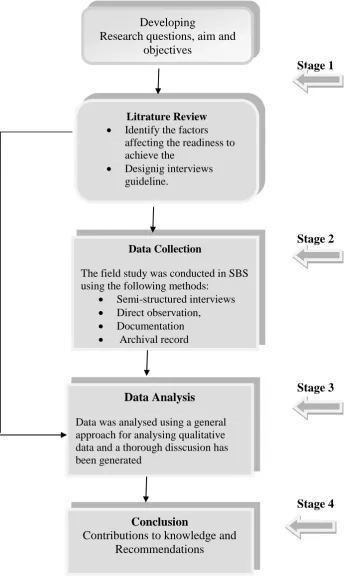
1.6 Research Process
In order to accomplish the aim and objectives of the study, four main stages to the research are identified, these being: a critical literature review, data collection, data analysis, and finaly research conclusion.
8
award model), service quality in banks, and the basic concepts of the EFQM Excellence Model.
Stage two: this comprises an empirical investigation of three case study organisations to collect data identified as appropriate after reviewing the literature and bearing in mind the theoretical framework associated with the EFQM Excellence Model. The data is gathered through semi-structured interviews, observation, archival material, and documentation.
Stage three: this involves an analysis of the data in the light of the literature to establish whether there are similarities and/or differences in the findings, and whether context is an important variable. The main focus for the findings will be to conclude which case study is more appropriate to implement the EFQM excellence modle.
Stage four: this includes conclusion of the research.It present the contribution of the
knowladage and reserch practical and acadmic recommendations.
9
Stage 1
Stage 2
Stage 3
[image:26.595.134.480.63.651.2]Stage 4
Figure 1.1: The Research Process
Developing
Research questions, aim and objectives
Litrature Review
Identify the factors affecting the readiness to achieve the
Designig interviews guideline.
Data Collection
The field study wasconducted in SBS using the following methods:
Semi-structured interviews Direct observation,
Documentation Archival record
Data Analysis
Data was analysed using a general approach for analysing qualitative data and a thorough disscusion has been generated
Conclusion
10 1.7 Expected Contributions to Knowledge
The main contribution of this study is its development of a framework embodying the factors affecting the excellence of service quality in the SBS. It is also expected that certain other unique factors will emerge as a result of the particularities of the Syrian context. Consequently, it is expected that the outcomes will enrich the literature, and will especially provide a comparative dimension through the use of a multi-case study design (state-owned, private, and Islamic) banks that allows for similarities and differences between three different types of bank in the readiness to implement the EFQM Excellence Model, and in the banks‘ understanding of quality perspectives and customer service orientation concepts.
The research narrows the gap in the literature that currently exists in respect of organisational readiness to implement the EFQM Excellence Model in the service sector, and specifically in banks in the developing countries.
To the best of the researcher‘s knowledge, this study is conducted in a country (Syria) where no previous research has been undertaken to investigate the key factors affecting the excellence of the SBS using the fundamental concepts of the EFQM Excellence Model as a theoretical framework. Hence, the study is original in its field.
1.8 Structure of the Thesis
This thesis is organised as follows:
Chapter One introduces the study, the need for the research, the research aim, the research questions, and the specific objectives that flow from those. Additionally, it outlines the intended contribution to knowledge, the proposed methodology, and the layout of the thesis.
Chapter Two Litrature Review are divided to three parts
Part (I) contains a critical review of the literature regarding quality
fundamentals, mainly presenting: a historical review of the quality concept, definition of the quality concept, a review of the concept of quality according to the quality gurus, quality characteristics, quality benefits, quality management concept, quality management evolution, and quality management award models.
Part (II) presents critical review regarding quality concepts in the service
11
manufacturing systems, service characteristics, benefits of service quality management, difficulties in managing the service quality, and service quality in the banking sector.
Part (III) clarifies the factors affecting the excellence of service quality
according to the fundamental concepts of the EFQM Excellence Model. The chapter covers in detail, the factors and sub-factors according to the views of quality gurus, quality award models, and the related empirical studies.
Chapter Three provides an overview of the context in which the study has been conducted, the country of Syria. It gives a brief description of the county in terms of geographical location and economy. The main focus is on the SBS.
Chapter Four discusses the research methodology used in this research. It describes the research philosophy, research approach, research strategy, and data collection methods. It sheds some light on the techniques of qualitative data analysis.
Chapter Fivepresents in detail, the research findings of each case study. The chapter highlights the data gathered from four different sources - interviews as the main source of evidence, documentation, archival records, and direct observations.
Chapter Six comprises an in-depth analysis and discussion of the findings presented in Chapter Seven. The findings are compared and contrasted to recognise the similarities and differences between the three case study organisations. Then, the results are linked with the literature, in order to investigate and establish their relationship to the existing theory.
12
CHAPTER TWO
LITERATURE REVIEW
2.0 Chapter Introduction
In the 21st century quality has become one of the most pressing issues in the world of business as technology and globalisation have changed the rules of competition. Different strategies such as manufacturing and design improvements, price reductions, effective logistics have been tried, but the most acclaimed strategy has been Quality Management (QM), which has essentially become compulsory for business survival.
It is widely accepted that the prime reason for Japanese success in leading and dominating the global markets during the last century is the fact that Japanese manufacturing adopted quality principles as a cornerstone of its management philosophy. Indeed, the Japanese were quick to grasp the significance of quality as a competitive advantage in a highly competitive world, and transferred their beliefs about quality to practical contributions represented by investment in people (training and education), continuous improvement, and customer satisfaction. International organisations now follow the Japanese experience in their commitment to quality, recognising that quality is not a goal in itself but the shortest way to achieve the ultimate goal of ‗customer satisfaction‘.
According to Feigenbaum (1961:22), ‗‗QM has been considered as the single most important force leading to economic growth of organisations in international markets‘‘.
This Chapter discusses the concept of quality in general, highlighting the various opinions
provided by the so-called ‗quality gurus‘. It also identifies the various characteristics of
quality, paying special attention to the benefits which effective QM is known to bring. The
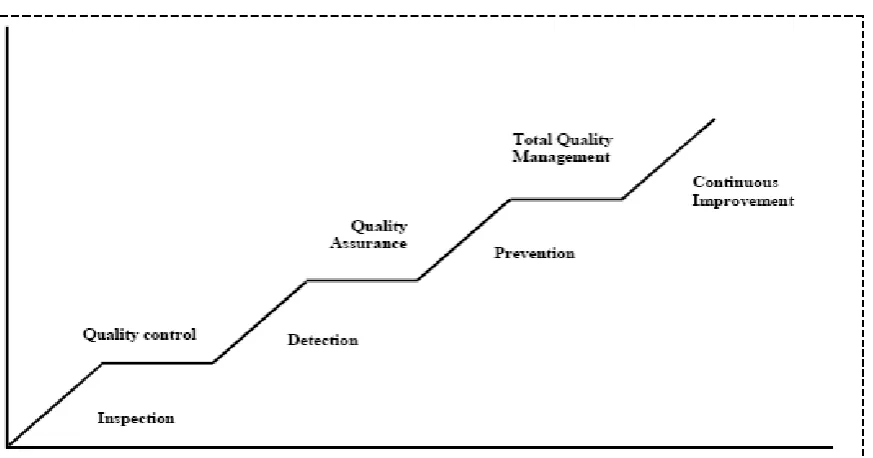
four stages of QM development are introduced, these being: inspection, quality control,
quality assurance, and total quality management. A brief description of the main features of
each stage is given before the most noted and significant QM models and their related
national awards are considered. The chapter also identifies the concept and characteristics of
service, distinguishing between service and manufacturing systems. In addition, it highlights
the benefits and difficulties of managing service quality, before considering the concept of
service quality in the banking sector. In addition, the chapter covers the readiness concept
with a crtical review for readiness studies in the literature. Finally, the chapter presents the
13 2.1 Historical Perspective on Quality
It is not easy to trace the history of the quality concept, since this is believed to have a very long history starting with early stages of humankind. Humans strive to enhance the quality of life in different ways by developing products and services, and historically these referred to hunting tools and means of communication. In fact, the ancient civilisations provide strong evidence about the development of quality. For example, in ancient Egypt, the Pharaohs used advanced techniques to construct the pyramids, and laws were codified in ancient Babylonia by Hammurabi. However, there was no formal framework for such achievements as these until 1919, when Frederick Taylor studied the physical effort of work and the role of workers. In this matter, Taylor introduced inspection to measure the work of people in the construction of buildings, and as noted by Martin (1993), this attempt is considered as the birth of the notion of the concept of quality in industry.
Flood (1993) stressed that quality was a serious issue during the First World War, and that as a result, the Technical Inspection Association was established in 1919. In the USA Harold Dodge (1893-1976) initiated the concept of statistical acceptance sampling in the 1920‘s while working at Bell Laboratories. His colleague H G Romig (1900-1989) continued with this work. In 1924 William Shewhart evolved these ideas by introducing the concept of statistical quality control - the idea that only a random sample of output needed to be inspected to ensure an acceptable quality level (Hart and Casserly, 1985). And in 1931 Shewart established the basic principles of modern control by publishing his work entitled Economic Control of Quality Manufactured Product. Shewart invented process control, using
control charts and the Plan-Do-Check-Act cycle of continuous improvement. Also in the 1930s, the British Standards Institute published its first standard on quality control.
During World War II, US industry used statistical process control, along with the sampling methods of Dr Demings, in the manufacturing of arms (Kelley et al., 1992).
14
Japanese manufacturing after World War II, the first being the devastation of the national economy which had to be rebuilt, and the second being that the Japanese understood the economics and were able to do it (English, 2000).
In the west, the US economy was booming after World War II, companies were able to sell all their products universally because of the universal lack of competition. Hence, the quality perspective was ignored, Quality Control being considered as merely an inspection activity. It is true that the concept of Company Wide Quality Control was first developed in the USA but it was never actually used (Hutchins, 1985).
By the 1970s and early 1980s, however, many western companies were losing their market share, being massively challenged by the Japanese companies with their ‗quality‘ philosophy Dean and Evans, 1994). Consequently, western business began to think seriously about quality improvement in the 1980s (Flood, 1993; Dean and Evans, 1994), and the International Standards known as the ISO 9000 series was established in that decade. So too was the Malcolm Baldrige Award (1987 in the US), and the European Foundation for Quality Management (EFQM) established the European Quality Award (EQA) in 1992. These awards are discussed in detail later in this chapter.
2.2 The Concept of Quality
‗‗The word ‗quality‘ is derived from the Latin ‗qualitas‘ meaning ‗what kind of‘. Cicero, and other ancient writers seem to have used the word in the sense of ‗nature‘ (Bergman and Klefsjo, l994:16)‘‘.
It has been accepted in the literature that the concept of quality is problematic to define because it is multidimensional. Many researchers identify the significance of quality as a competitive advantage in the markets, but there is still a big difficulty in introducing a universal definition for this term (Reeves and Bender, 1994; Seawright and Young, 1996; Yong and Wilkinson, 2002; Al-Marri 2005).
Oakland (1988) noted that many practitioners and scholars fail to articulate precisely what is meant by ‗quality‘, and Martin (1993) argues that there is no specific definition of the term ‗quality‘, although various proposals have been advanced. Likewise, Wilkinson et al. (1998)
confirm that quality remains a difficult concept to pin down.
15
quality. The first concerns thinking of the quality of a thing as an objective reality; the second concerns what we think, feel, or sense as a result of the objective reality. This subjective side of quality is closely linked to the concept of value.
Some other common definitions for quality are provided by for example, the Oxford Dictionary (2001): ―a feature of something, especially one that makes it different from something else‖, and the American Society for Quality (2009) which specifies the quality by
two meanings: (1) the characteristics of a product or service that bear on its ability to satisfy stated or implied needs and, (2) a product or service free of deficiencies.
Actually, quality has different meanings according to the perception, criteria and role of those defining it, who may be academics, consultants, or practitioners. The multiplicity of meanings for quality results in ambiguity in its use and implied meaning. For example, quality has been defined as value for money (Feigenbaum, 1956, 1961), fitness for use (Juran, 1974), conformance to requirements (Crosby, 1979), the losses of society caused by the product after its delivery (Taguchi, 1979), delighting the customer (Deming, 1986; Hand, 1992), meeting or exceeding the customer‘s expectation and requirements (Dean and Evans, 1994; Bergman and Klefsjo, 1994; Oakland, 2003), and as a strategic competitive tool for organisational success (Yong and Wilkinson, 2002).
It can be understood that much of the use of the ‗quality‘ term is misleading. It is also confusing to think about a comprehensive definition. However, Garvin (1984a) tries to diminish this vagueness by providing a classification of five definitions of quality: (i) transcendental: excellence of the highest standard, (ii) product-based: dependent on the attributes, (iii) user-based: satisfying or exceeding the wants of customers; (iv) manufacturing-based: conformance to requirements, and (v) value-based: value for money. Alternatively, Reeves and Bednar (1994) present a four–way classification of quality definitions incorporating excellence, value, conformance to specifications, and meeting and/or exceeding customer requirements
Accordingly, it is worth distinguishing between product quality and service quality. Product
quality can be defined by a set of tangible and unique characteristics adding value and
excellence to the product. While service quality can by defined by a set of intangible features
16
2.3 The Concept of Quality According to the Gurus’ Philosophies
A guru was originally a mystical teacher, to whom people went in order to have their thinking and their lives transformed. The word then came to describe any thinker or teacher who introduced transformational ideas. According to Kruger (2001), the quality gurus were a few ‗pioneers‘ from different countries (UK, Japan, US) who introduced ideas for developing activities that were based on quality issues such as quality control, quality assurance, quality audit, quality management, and total quality management.
There are numerous concepts of quality to be found in the literature. Academics, consultants, practitioners, industrialists, and engineers have proposed some in addition to the much-referenced quality gurus, who are regarded, as Oakland (2003) points out, as Joseph M. Juran, Edward Deming, Philip Crosby, Armand Feigenbaum, Kaoru Ishikawa among others. It is worth mentioning that the views of gurus are the most valuable perspectives to follow. This research primarily depends on the viewpoints of gurus and academics in understanding the quality theory while paying greater attention to the quality models. That said, there are many gurus in the literature who identify different views about quality perspectives and developments. The following are the most famous:
2.3.1 Dr W Edwards Deming
Dr. W. Edwards Deming is known as the father of the Japanese post-war industrial revival and was regarded by many as the leading quality guru in the United States. During World War II he used his experience in statistical quality control to help the US to improve the quality of war materials, and later, in 1950, he was invited to Japan to help the nation recover from its wartime losses (Kumar, 2009).
Deming suggested the primary concept of quality as being: a predictable degree of uniformity and dependability, at low cost and suited to the market. Then he developed this concept to include the quality of a product (article or service) by its ability to satisfy the needs and expectations of the customers. Ultimately, Deming went beyond meeting the requirements to delighting the customer (Deming, 1986a). He insisted that statistical sampling methods can be applied to both manufacturing and non-manufacturing industries to increase productivity by focusing on process variability (Deming, 1986 b).
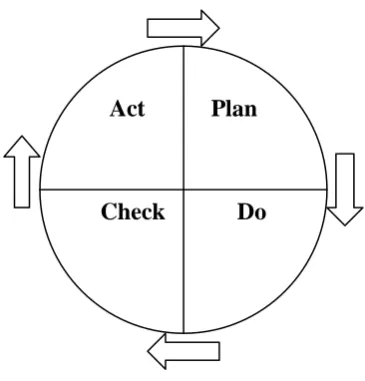
To meet his objectives, Deming proposed a systematic approach to problem solving which became known as the Deming Wheel or the Plan-Do-Check-Act cycle (See Figure 2.1).
17 Check the solution
Act on the results
[image:34.595.169.352.144.335.2]
Figure 2.1: The PDCA Cycle of Continual Improvement (Source: Deming, 1986a cited in Hoy et al, 2000:51)
Deming establishes his business philosophy, summarised in his famous ‗14 Points‘, (See Appendix1).The 14 points provide clear and practical guidance for adopting quality practices easily in the organisation. Deming‘s focus was on using statistical techniques, statistical training and statistical supervision. Deming did not ignore other management practices such as communication, continuous improvement or process control. The principles were comprehensive and the main core for other quality models was introduced later. Walton (1985) points out that Deming‘s 14 points are not a menu for managers to choose from, but an agenda to be closely followed. He describes the five deadly ‗diseases‘ for organisations in all countries, as:
Lack of constancy of purpose. Emphasis on short-term profits.
Evaluation by (individual) performance ratings, which destroys teamwork. Mobility of management – job hopping.
Running a company on visible figures alone.
Deming did not teach the Japanese the techniques of quality, but rather the art of managing it, and in recognition of his efforts, the Union of Japanese Scientists and Engineers (JUSE)
Act Plan
Check Do
18
created an annual national quality award, ―the Deming Application Prize‖ for competitive organisations which apply his principles in QM. More details of this Prize appear in a later section.
2.3.2Joseph Juran
Juran was another American who participated in the evolution of quality in Japan.He was also invited by the Union of Japanese Scientists and Engineers (JUSE) in the 1950s to give quality seminars to executive and middle management.
Juran‘s (1989) concept of quality is ‗fitness for use‘. The significance of this definition is that fitness is a judged by customers, for the specific use they intend (Fox, 1993). Juran (1964) also uses the terms ‗breakthrough‘ and ‗control‘ such that managers become attuned to the need to recognise levels of performance that are not acceptable, and about which they must take action to improve. He adds that performance levels should be always controlled by senior management.
Juran‘s main contribution was his approach to Cross-Functional Management (CFM), characterised by three managerial processes: planning, control, and improvement (Juran, 1989) (See Appendix 2 for more details).The three processes of Juran‘s Trilogy are supportive in designing a primary quality strategy in which each process is clarified through some broad steps.
Quality Planning: The process for preparing to meet quality goals Quality Control : The process for meeting quality goals during operations
Quality Improvement: The process for breaking through to unprecedented levels of performance.
Furthermore, Juran identified the major problems contributing to poor quality in organisations as the Seven Deadly Diseases (Flood, 1993):
1. Lack of constancy of purpose.
2. Emphasising short-term profits and immediate dividends. 3. Evaluation of performance, merit rating or annual review. 4. Mobility of top management.
5. Running a company on visible figures alone.
6. Excessive medical costs for employee health care, which increase the final cost of goods and services.
19
Like Crosby and Feigenbaum, Juran focuses on reducing the cost of quality, but Deming ignores this idea. Juran‘s approach to quality cost can be classified into three categories (Kumar, 2009):
Failure costs: Scrap, rework, corrective actions, warranty claims, customer
complaints and loss of custom.
Appraisal costs: Inspection, compliance auditing and investigations
Prevention costs: Training, preventive auditing and process improvement
implementation
Juran‘s philosophy is used worldwide; he developed ten practical steps to quality improvement (see Appendix 2). Juran was pioneer in pointing out the significance of recognision. As he focuses on teams (quality circles, self-management teams, and project work). Additionally, Juran like Deming believed in statistical quality control. He mentions that only 15% of quality problems are related to special causes involving workers, whilst 85% are related to management‘s handling of the system (Juran, 1988).
2.3.3 Philip Crosby
Quality has been defined by Crosby as ―conformance to requirements‖ (Crosby, 1979). Crosby is best known for the concepts of ‗zero defects‘, ‗do it right the first time‘, and ‗quality is free‘. He was less academic in his approach than Deming and Juran, but was just as effective as them in his exciting writing (Fox, 1993). Crosby (1984) identifies the Four Absolutes of Quality as:
The First Absolute: The definition of quality is conformance to requirements, not as goodness.
The Second Absolute: The system for causing quality is preventative, not appraisal.
The Third Absolute: The performance standard must be zero defects, not ‗that close enough‘. The Fourth Absolute: The measurement of quality is the price of non-conformance, That is, all the expenses of doing things wrong from the customer‘s perspective.
20
Despite Crosby‘s views harmonising with those of the other two gurus, Crosby was criticised by Deming for focusing on ‗zero defects‘, and ignoring the ‗continuous improvement‘ imperative, hence making his message less precise and practical (Will, 1993).
2.3.4 Armand Feigenbaum
Feigenbaum (1991:7), the Japanese pioneer, defines quality as ―the total composite product and service characteristics of marketing, engineering manufacture, and maintenance through
which the product and services in use will meet the expectations of the customers‖. He instigates the concept of Total Quality Control (TQC), which he says is ―an effective system for integrating the quality development, quality maintenance, and quality improvement efforts
of the various groups in an organisation so as to enable production and service at the most
economical levels which allow full customer satisfaction‖ (Feigenbaum, 1983, cited by
Beckford, 2002:85).
According to Beckford (2002), Feigenbaum‘s philosophy is built on the early concept of a ‗Total‘ approach, reflecting a systemic attitude of mind. He insists that all functions in the organisation should participate in the quality process, since quality that runs from inputs to outputs, and hence, permeates the organisation, has immense value (Beckford, 2002).
Feigenbaum considers statistical control as a part of the overall management system, but not the system itself, and therefore, statistical methods can be used as necessary. He also emphasises that management methods and human relations are the basic issues in quality control activities. Later, Feigenbaum included a focus on the customers‘ perceptions of quality (Feigenbaum, 1983). Feigenbaum‘s beliefs are summarised in his ‗ten benchmarks for quality success‘ (Feigenbaum, 1991; see Appendix 3)
21 2.3.5 Kaoru Ishikawa
Ishikawa is the other Japanese quality guru, who became involved in quality issues in 1949, when he developed the first basic quality control course for the Union of Japanese Scientists and Engineers (JUSE).
Ishikawa (1989:44) states that ―to practise quality control is to develop, design, produce and service a quality product which is most economical, most useful, and always satisfactory to
the customer‖.
According to Dale and Bunney (1999) there are three main areas where Ishikawa contributed to quality:
1. Quality circles
2. The company-wide quality movement, and
3. The simplification and widespread use of the seven basic quality control tools
In reality, Ishikawa is considered the ‗father of quality circles‘ (QCs), and at the same time also originated the concept of Company–wide Quality, basing his philosophy on that of Feigenbaum (Total Quality). Bendell (1989) suggests that Ishikawa‘s approach of quality is comprehensive. Indeed, it covers all quality aspects starting of the quality of product and also including after sale service, quality of management, the company itself and the human being (Beckford, 2002).
Similarly Flood (1993) describes Ishikawa‘s approach as involving ‗horizontal and vertical co-operation‘. The approach is based on a significant level of involvement, co-operation, and communication between different levels of managers, supervisors and workers, and from suppliers to customers.
As cited by Bendell (1989:18), Ishikawa himself mentions that the ―results of Company-Wide Control activities are remarkable, not only in ensuring the quality of industrial products, but also in their contribution in the company‘s overall business.‖
22
Figure 2.2: Ishikawa or Fishbone Diagram (Ishikawa, 1982:19)
2.4 Quality Characteristics
It has been argued that the concept of quality has different perspectives and is not easy to elucidate. Actually, quality characteristics try to reflect some quality meanings and help to make the term ‗quality‘ more objective. As mentioned previously, the American Society for Quality used the expression ‗characteristics‘ to define the quality of a product or service as something that satisfies stated or implied needs. Hill (1991a) specifies four typical features for the concept of quality, these being:
1. Function, which differs from product to service. For product, it means doing what it is supposed to, whereas for service, it means ―statements of what the service entails‖, including the ―less tangible statements‖;
2. Product/service characteristics, which relate to the physical characteristics of the product or service such as its dimensions, or what the service is comprised of;
3. Performance; and 4. Reliability.
Several other authors have also tried to identify the real characteristics of quality. Juran et al. (1988), for example, suggested five characteristics related to: technology (e.g. strength and hardness), psychology (e.g.taste, beauty, status) time-orientation (e.g. reliability and maintainability), contract (e.g. guaranteed provision), and ethics (e.g. courtesy of sales personnel, honesty).
Krajewski and Ritzman (1990) propose three categories: hardware (style and appearance of equipment or the product, ease of installation and use), product or service support
Quality
Cause Effect
Equipments Measurements
23
(responsiveness, accuracy, truthfulness), and psychological impressions (courtesy, sympathy, knowledge and reputation).
However, the most comprehensive classification of quality components was introduced by Garvin (1984b, 1987, and 1988), whose eight-dimensional model includes: performance, features, reliability, conformance, durability, serviceability, aesthetics, and perceived quality. He considers these dimensions as key for using quality as a competitive weapon, and explains them as follows (1994:29):
1) Performance. This refers to the primary operating characteristics of a product, for example, for a car these would be traits such as acceleration, handling, cruising speed, comfort, etc. Garvin claims that this dimension of quality combines elements of both the product and user-based approaches.
2) Features. Garvin describes these as the ―bells and whistles‖ of products. These secondary characteristics, he believes, supplement the product‘s basic functioning. Examples are free drinks on an aeroplane flight, and automatic tuners on a colour television set.
3) Reliability. This reflects the probability of a product‘s failure within a specified period of time.
4) Conformance. This is the degree to which a product‘ design and operating characteristics match pre-established standards, where both internal and external elements are involved. Garvin believes that both reliability and conformance are closely tied to the manufacturing-based approach to quality.
5) Durability. This is a measure of product life and has both economic and technical dimensions. Technically, durability can be defined as the amount of use one gets from a product before it physically deteriorates.
6) Serviceability. This is the speed, courtesy, and competence of repair.
24
8) Perceived Quality. This is also a subjective dimension. Garvin notes that consumers do not always possess complete information about a product‘s attributes, and must frequently rely on indirect measures when comparing brands. In these circumstances, products will be evaluated less on their objective characteristics than on their images, advertising, or brand names.
2.5 Quality Benefits
According to the European Foundation for Qualiy ManagementEFQM (1992), many companies in the 1980s had realised that survival is dependent upon paying much greater attention to quality. Peters and Waterman (1982) had previously identified in their book In Search of Excellence: Lessons from America‘s Best-run Companies, that the most consistent
factor among companies they rated as most successful, was an obsession with some form of quality, reliability and/or service. They also identified several studies that had demonstrated quality to have marvellous strategic importance to a firm.
In the same context, Coleman (1992) and Flood (1993) argue that Japan‘s success is evidence of the direct relationship between quality and the viability of organisations, and Dean and Evans (1994), and Bergman and Klefsjo (1994) insist that quality is a requirement for successful competition in the global market.
25
the selling price as a result of these productivity and quality improvements, thereby increasing sales.
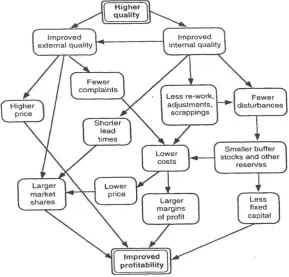
[image:42.595.137.427.261.538.2]Other research, as cited by Shetty (1987), has confirmed the same outcomes, i.e. that companies producing quality products charge more for those products and enjoy higher profit margins. Similarly, Garvin (1983), and Hendricks and Singhal (2001b) stress that managing quality produces strategic benefits such as lower manufacturing costs in the long run and improved productivity. Bergman and Klefsjo (1994) summarises the relationship between improved quality and profitability as shown in Figure 2.3.
Figure 2.3: Relationship between Improved Quality and Profitability Source: Bergman and Klefsjo (1994:38)
26
market share comes as the result of competitive edge, which both Garvin (1988) and Devaraj et al (2001) believe to be a further advantage of quality improvement.
Additionally, Juran (1988) suggests some other benefits of QM, such as: improved understanding of customer needs, improved customer satisfaction, improved internal communication, better problem-solving, greater employee commitment and motivation, and stronger relationships with suppliers.
In this context, much empirical research (Kanji, 1990; Sitkin et al., 1994; Spencer, 1994; Hackman and Wageman, 1995; Powel, 1995; Wicks, 2001; Kaynak, 2003) has confirmed Juran‘s beliefs about the role of QM in establishing a management system and an organisational culture that ensures customer satisfaction and continuous improvement.
2.6 Quality Management (QM)
Generally speaking, QM has been recognised as a comprehensive management philosophy for improving organisational performance and competitiveness. Kanji (1990:4) considers QM as ―the second industrial revolution‖
According to Reed et al. (1996), there is no consensus on the definition of QM, since its interpretation is based on the approach taken towards quality. For instance, Juran and Gryna (1993:13) refer to QM ―the process of identifying and administering the activities needed to achieve the quality objectives of an organisation‖.
While Flynn et al. (1994:342) suggest QM to be ―an integrated approach to achieving and sustaining high quality output, focusing on the maintenance and continuous improvement of processes and defect prevention at all levels and in all functions of the organization, in order to meet or exceed customer expectations‖. However, Anderson et al. (1994) suppose QM to be a holistic approach to organisation-wide quality, operationalised through leadership, internal/external co-operation, effective process management, product design, learning, customer focus and involvement, employee fulfilment, and continuous improvement.