© 2016, IRJET | Impact Factor value: 4.45 | ISO 9001:2008 Certified Journal
| Page 1051
Governor Controllers of Heavy-Duty Gas Turbine Performance
Comparison using PI-Controller and Fuzzy Logic Controller
T. Penchalaiah
1, M. Rama Sekhara Reddy
21 PG Scholar, Dept of EEE, JNTUACE, Anantapuramu, AP, India,
2 Assistant professor, Head of the Dept of EEE and In charger in JNTU, Kalikiri, AP, India
---
Abstract
– In gas turbine system, Governor controller plays an important role in the dynamic behavior of turbine system for automatically regulating the supply of fuel with respect to load and although to limiting the speed. Need of gas turbines and its applications nowadays more prominently increasing due to technology improvement towards their countries development is the main cause for it. So the controller system used in gas turbine system in various applications effective response must be required, for that concern governor system could be model with PI- controller. In which additionally another two methods are used such as Feed-forward and Back-tracing methods to improving the dynamic behavior and response time and also its load rejection response. In order to get better response to improving the stability and load rejection the Fuzzy Logic controller used in the place of PI-controller. So entirely in this paper the comparative response behavior of Heavy-Duty gas turbine system would be observe between PI-controller and Fuzzy Logic controller of governor system model design in MATALAB-SIMULINK platform.Key Words : Gas turbine, governor, PI-controller, Fuzzy logic controller, Turbine exhaust temperature(TET), Inlet guide vanes(IGV) controller.
1. INTRODUCTION
Generally gas turbine system has 3 components such as compressor, combustion chamber turbine and its shown in Fig -1. The operation gas turbine system is explained on the basis of Brayton cycle studied in [2]
Fig -1: Open cycle gas turbine engine.
Nowadays gas turbine system applications increases in various fields such as in aircrafts, trains, ships, industrial sector and also in power generating plants etc. For that concern the flexibility , reliability, efficiency are the main consideration values towards system performance improvement. So the control system techniques are used in the system is effectively working require to eliminating mal-operations. For this purpose, the gas turbine design model can be withstand for different modes of operations and also to maintain stability had required.
Basic design model of gas turbine studied in [2]-[4], in this describe about Rowens model (GAST2A) which is a GE company first initiating model on gas turbine system. The governor controllers especially studied in [1], in which various types of governor controllers described. The fuzzy logic controller design model studied in [5]. The dynamics of the gas turbine system studied in [6] and load frequency control method studied in [7]. The modeling of Heavy duty gas turbine system parameters consider in p.u values.
2. TURBINE SYSTEM
[image:1.595.246.387.469.523.2]© 2016, IRJET | Impact Factor value: 4.45 | ISO 9001:2008 Certified Journal
| Page 1052
2.1
Power Dynamics
The power dynamics of gas turbine system could be model with delay blocks of fuel flow in pipes, combustion chamber and gas flow in hot paths represented by time constant Tcc in sec and its transfer function is shown in Fig -2.
The turbine net power function is represented as
Here is referred as fuel flow, A is a constant, B is referred as power in full speed no load mode.
After substituting parameter values then obtain equation as
PGT
Fig - 2: Fuel flow transfer function
2.2
Turbine grid interaction system
According to Newton’s second law
Here J is he rotor moment of inertia in kg/m2, is rotor speed in rad/sec.
By multiplying on both sides by w then
and here
is the design value of the rotor speed in rad/sec,
,
Which is adjusting by using run up controller in governor system, in order to avoid critical speeds during starting conditions.
2.3
Temperature Dynamics
In order to increase the lifespan of gas turbine system, the TIT (turbine inlet temperature) should not be exceed its limits on the design value, otherwise turbine blades deteriorate to causing decrement of gas turbine lifespan. To avoid these obstacles or of its mal-operations by measuring TIT and TET (turbine exhaust temperature) using six thermocouples. The thermocouple transfer function in terms of TIT Fig shown below,
TIT TET
© 2016, IRJET | Impact Factor value: 4.45 | ISO 9001:2008 Certified Journal
| Page 1053
According to conservation of energy in gas turbine system using thermodynamics approach, the system equation can be written as
is the air mass flow, is the fuel mass flow, is the exact gas mass flow, , , units are in kg/s, , are air and exhaust gas enthalpy in J/k, LHV is the low value of fuel in J/kg, - is the turbine net power in watts, is the heat loss.
The above equation general simplified form as
Here a, b, c, d are constants.
Here IGV(inlet guide vanes) = output position of YIGV,
n=rotor speed
Speed impact air flow function =1+2(n-1)
is the air density which is the function of ambient temperature and pressure site conditions.
Generally ambient conditions for HDGT is
Temperature =15oc, Pressure=101.3kpa
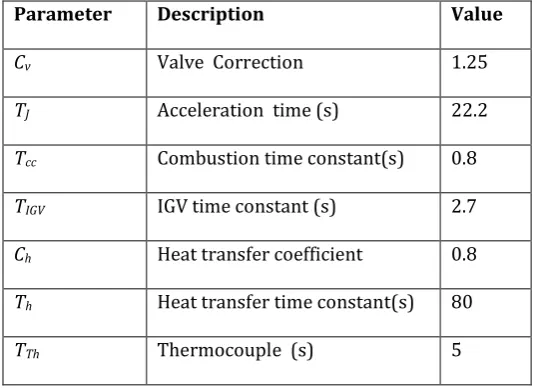
The TET function is mainly depends on the air mass flow and fuel mass flow function, so it can be modeled as multivariable system. The turbine model parameters is shown in table 1.
3. Governor System
3.1
Gas turbine governor system
Gas turbine governor system has three main important tasks such as load Control, frequency control, TET Control and also some sub tasks of controls, those are compressor output pressure gradient (COP) controller, Compressor pressure ratio controller, these are used for within reliable area of operation in gas turbine system. Various types of gas turbine governor system controllers are
1. Load/Speed controller (Main Controller)
It controls the frequency and load with respect to mode of operation. The main purpose this controller is to balancing the load requirement of power and frequency deviations. Deviation with respect to load is called the drooping of the system.
2. Load limit controller
This controller is used for limiting power permissible values
on the base of system rating. By this action will improving mechanical stress in the system.
3. Pressure Gradient Controller
Pressure gradient at the rate of valve opening is limited by this controller and although improving thermal stress in the system.
4. Pressure ratio controller
© 2016, IRJET | Impact Factor value: 4.45 | ISO 9001:2008 Certified Journal
| Page 1054
5. Temperature controller
This model generally suitable for base and peak load types of mode of operation. In its operation of control turbine inlet temperature could not be exceeding the maximum or minimum allowable values, which results deformation or creeping on turbine blades reduce, then system perform efficiently. The temperature controller is shown in Fig -6.
6. IGV controller
This controller is very important one among the above of them, because dynamic stability on the gas turbine system with respect load mostly depends on it. So its function is to balancing or controlling the required amount of fuel flow with respect to the load.
3.2
Main Controller
Main controller has operate in two modes
1. Load frequency controller
In this mode of operation input set values as load and speed. During in operation the deviation of load is the droop value to set in the system for maintaining stability, which is the load control mode of operation, it will convert into frequency mode of operation by setting very small dead band and droop values in the governor system.
2. Load-speed controller
During no-load condition speed deviation becomes zero, later while applying load the deviation is cause to retarding or accelerating on the rotor. So it will compensated by droop feedback to set it in the input of governor controller put into zero value, this action will accomplish by increasing the speed set point mechanically. This mode is generally used in load rejection , because it is frequency control mode of operation rather than the power variations in the system. The turbine governor model with PI-controller is shown in Fig -8 and its model parameters is shown in table 3.
3.3
Fuzzy logic controller (FLC)
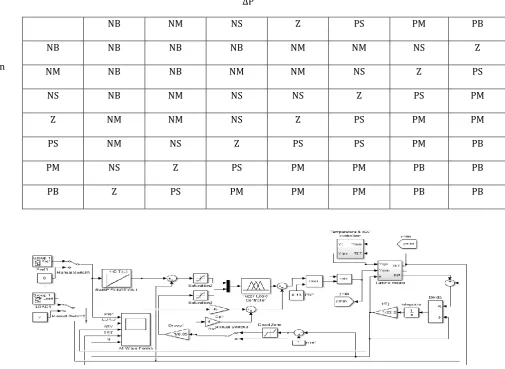
In FLC system process has mainly four stages such as fuzzifycation, rule base, inference engine, and defuzzyfication, is shown in Fig -9. In FLC has its input variables are change in speed(∆n) and change in load(∆P) and output parameter is change of fuel flow controller position. For each input variable 7-linguistic variables are take to completing the designing of FLC. Therefore, total 49 fuzzy sets obtaining with gas turbine operating conditions. Here used mechanism in FLC based on the Mamdani technique. The FLC input and output variables membership function are Gaussian type and triangular type of waves are used is shown in Fig -10, Fig -11, and Fig -12. The rule base controller mechanism table is shown in table 2.
The FLC of a heavy-duty gas turbine (HDGT) model system is shown in Fig -13, like PI-controller of HDGT model with feed-forward and back-tracing methods, in FLC of HDGT model with Feed-feed-forward method only used. This is a simplified model and effective system response has obtain with FLC. In FLC rule base, the control commands or linguistic variables are NB(negative big), NM(negative medium), NS(negative small), Z(zero), PB(positive big), PM(Positive medium), PS(positive small), these are all assigning with respect to ∆n and ∆P .
[image:4.595.169.405.643.704.2]© 2016, IRJET | Impact Factor value: 4.45 | ISO 9001:2008 Certified Journal
| Page 1055
Fig - Gaussian membership function for input variable of a change in speed
Fig - Gaussian membership function for input variable of a change in load
Fig - Triangular membership function for output variable of a change in fuel flow controller position
Table -1: Turbine Model Parameters
Parameter Description Value
Cv Valve Correction 1.25
TJ Acceleration time (s) 22.2
Tcc Combustion time constant(s) 0.8
TIGV IGV time constant (s) 2.7
Ch Heat transfer coefficient 0.8
Th Heat transfer time constant(s) 80
[image:5.595.182.414.235.346.2] [image:5.595.174.423.378.484.2] [image:5.595.164.433.535.729.2]© 2016, IRJET | Impact Factor value: 4.45 | ISO 9001:2008 Certified Journal
| Page 1056
Table -2: Rule Base Control Commands
∆P
∆n
Fig - Heavy duty gas turbine model with Fuzzy logic controller
4.SIMULSTION RESULTS
Fig : Reference power generation
NB NM NS Z PS PM PB
NB NB NB NB NM NM NS Z
NM NB NB NM NM NS Z PS
NS NB NM NS NS Z PS PM
Z NM NM NS Z PS PM PM
PS NM NS Z PS PS PM PB
PM NS Z PS PM PM PB PB
© 2016, IRJET | Impact Factor value: 4.45 | ISO 9001:2008 Certified Journal
| Page 1057
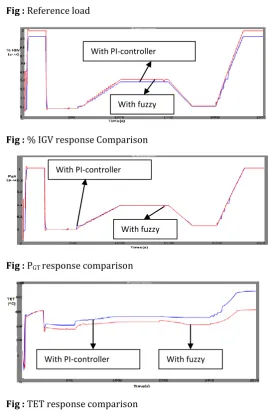
Fig : Reference load
Fig : % IGV response Comparison
Fig : PGT response comparison
Fig : TET response comparison
Fig : Speed response comparison
Fig : Speed response comparison during load rejection
With fuzzy With PI-controller
With PI-controller
With fuzzy
With PI-controller With fuzzy
With PI-controller
With fuzzy
[image:7.595.130.404.95.516.2] [image:7.595.132.401.429.725.2]© 2016, IRJET | Impact Factor value: 4.45 | ISO 9001:2008 Certified Journal
| Page 1058
5. CONCLUSION
HDGT design model is suitable for different modes of operation and also with reliable control mechanism used in the governor system. In this paper mainly describing on the comparison of PI-controller and FLC purposes used in governor system was discussed. In PI-controller of HDGT system studied with feed-forward and back-tracing methods, which are used for minimizing of speed overshoots and good IGV delay response purpose. Without using back-tracing method governor system should be handling with FLC to improving the system response. Entirely system physical mechanism also minimized with FLC rather than PI-controller in governor system.
REFERENCES
[1] Hossein Balaghi Enalou and Eshagh Abbasi Soreshjani,” A Detailed governor-turbine model for heavy-duty gas turbines with a careful scrutiny of governor Features,” IEEE Trans. Power Syst, pp. 1-7, 2016
[2] S. K. Yee, J. V. Milanivic and F. M. Hughes, “Overview and comparative analysis of gas turbine models for system stability studies,” IEEE Trans. Power Syst., vol. 23, no. 1, pp. 108-118, Feb. 2008.
[3] W.I Rowen, “Simplified mathematical representation of heavy-duty gas turbine,” ASME J. Eng. Power, vol. 105, pp. 865-1983. [4] W. I. Rowen, “Simplified mathematical representation of single shaft gas turbines in mechanical drive service,” presented at the Int. Gas Turbine and Aero engine congr. And Expo., cologne Germany, 1992.
[5] Jong-Wook Kim and Sang Woo Kim,”Design of incremental fuzzy PI controllers for a Gas-Turbine Plant,”
IEEE/ASME Trans. Mech. Vol. 8,no. 3, sept. 2003.
[6] S. Massucco, A. Pitto, and F. Silvestro,“A gas turbine model for studies on distributed generation penetration into distribution networks,” IEEETrans. Power Syst., vol. 26, no. 3, pp. 992–999, Aug. 2011.
[7] S. St. Iliescu, I. Făgărăşan, V. Popescu, and C. Soare, “Gas turbine modelling for load-frequency control, U.P.B. Sci. Bull., ser. C, vol.70, no. 4, 2008.
[8] MATLAB, The language of technical computing,simulink , dynamic system simulation for MATLAB,(R2015a),2015
AUTHORS PROFILES
T.Penchalaiah received B.Tech degree in Electrical and Electronics Engineering from N.B.K.R Institute of science and technology, Nellore in 2014. He is currently pursuing M.Tech degree in Electrical Power Systems from JNTUA Anantapuramu.
M.Rama Sekhara Reddy, M.Tech (Ph.D), working as HEAD of the E.E.E. Department and in charger at JNTU KALIKIRI, and he worked as Assistant Professor in Electrical and Electronics Engineering in 2016, JNTUA College of Engineering (Autonomous) Anantapuramu. He has authored 7 papers published in national and international journals. His area of interest includes Wind Energy, HVDC, FACTS, Microprocessors & Microcontrollers He has a 14 years of teaching experience.