ADVANTAGES AND DISADVANTAGES OF USING FOREIGN MANAGERS
IN IRAN OIL INTERNATIONAL PROJECTS
Mahmoud Gholipoor
1, Safoora Rashidinejad(Corresponding Author)
21
Project Manager at ICOFC (Iranian Central Oil Fields Company), Tehran, Iran
2M.Eng. Project Management, University of Calgary, Tehran, Iran
---***---
Abstract
-
Since several foreign managers’ work inIran Oil international projects, the impact of their participation on performance of execution of projects is going to be investigated in this research. Based on personal discussion with numbers of top managers in Iran Oil industry, they are keen to know the advantages and disadvantages of using foreign managers in Iran international Oil projects. In addition, the productivity of foreign managers in comparison with local managers is of interest. This paper describes the findings of the productivity of foreign and local managers as well as comparison between them. Also the strengths, weaknesses, opportunities, and threats of using foreign managers in Iran Oil international projects are identified.
A survey has been conducted in Aryasasol Polymer Company (ASPC), that is located in south of Iran, to collect the data about effectiveness and efficiency of foreign and local managers working in ASPC. To perform the survey, the authors have asked experienced employees, who have worked with both foreign and local managers, to fill out the questionnaires. In addition, the researcher has conducted interviews with highly experienced foreign and local managers to know their opinion about strengths, weaknesses, opportunities, and threats of foreign managers in ASPC. Based on the data analysis, various advantages and disadvantages of foreign managers are found out in this paper. For instance, high experience and expertise, teamwork ability, and time management are identified as advantages while communication problem and culture differences are recognized as disadvantages of foreign managers working in ASPC.
Keyword:
Foreign Managers, Aryasasol Polymer Company, Oil international projects, Iran1.
INTRODUCTION
International management has become a major challenge for governments and organizations due to increasing international projects in the world [9]. Companies are interested to cooperate in international projects in order to take the advantages of lower cost and improving quality in host countries. Foreign managers must be able to work with local managers and employees to achieve the benefits of global market [4]. It is a key decision for international or multinational companies whether to use foreign or local personnel to manage international projects [15].
According to unofficial information, it is realized that some senior managers in oil industry are concerned about beneficial of using foreign managers in Iran international projects. Also they think that employing foreign managers are costly for local multinational companies without showing any official documents to prove it. Furthermore, there is lack of information about the productivity of foreign managers in comparison with local managers in Iran international Oil projects.
This research has been found out that absence of the information is the main reason that recruiting foreign managers has become controversial. Hence, providing suitable information would be useful for strategic managers of Iran Oil industry to make appropriate decision whether to use foreign managers in future projects.
The main objective of this research is to identify whether using foreign managers in Iran international Oil projects is cost-effective. The sub objectives of this paper are to identify:
a) Advantages and disadvantages of using foreign managers in Iran Oil projects.
c)
Whether using foreign managers in Iran Oil projects are cost-effective.2.
LITERATURE REVIEW
2.1.
Global Market Needs
International companies are looking to capture the global markets advantages via taking part in international projects in foreign countries [4]. Nowadays, international organizations require competent managers who can “think globally, but act locally” [16].
2.2.
Cultural Diversity
The managers in international companies play a key role in the projects to achieve their goals. They should be able to work with host country employees to deliver the projects successfully. Cultural diversity is an obstacle to develop productive interaction between foreign managers and local employees [8]. The cooperative but not competitive goals will facilitate developing a productive relationship and interaction between foreign managers and local employees [4]. Knowing the culture and its effects on conflicts helps to develop a common culture in international projects and to provide a proper view to manage the conflicts [18].
Another research [5] shows that projects productivity will be enhanced if foreign managers could lead local employees successfully. This is achieved via developing an effective relationship between foreign managers and local employees. The results claimed that the effect of foreign managers' leadership is higher than local managers' according to Chinese employees viewpoints.
2.3.
Cross-Cultural Training
Training of foreign managers will assist them to develop cooperative goals, personal relationship, team building, and cooperation skills with local employees [19]. Cross-cultural training is an appropriate tool, which is required for foreign managers, to develop productive cross-cultural interactions with host country managers and employees [17].
2.4.
High Expenses vs. High Productivity
A common claim among Chinese managers and employees is about high cost of hiring foreign managers in international projects. one study[3] indicated that the salary of foreign managers is 20 to 50 times more than local Chinese managers in China projects.
In spite of global business belief, the predominant tendency looks to be ethnocentric in international
organizations [13]. The ethnocentric orientation has created many barriers like cultural and environmental nonconformity, high rates of failure, effect on moral and motivation of local employees, and high expenses. Furthermore, international organization has accounted a set of costs including selection, training, and performance costs when they want to decide whether to employ foreign or local manager in their international projects [15].
2.5.
Short Term Contract
Competent foreign managers from western countries are not willing to make long term contract to work in China and they mostly sign only one or two year’s contract. Based on interviews with local employees [1], it has indicated that foreign managers should stay longer time in the projects, since it takes time for them to adapt with different culture and working environment as well as to develop effective relationship with local managers and employees.
2.6.
Relationship
In several interviews with Finnish project leaders in different teams like Finnish–Chinese, Finnish–European, and Finnish–American groups, most of them indicated only task oriented leadership style. A few of them implied relationship orientation or both task and relationship orientation. Those few managers have realized that close relationship with local employees is essential to overcome on cross-cultural obstacles. It is apparent that both relationship and task orientation are characteristics that international managers should apply as leadership style in leading their projects [12].
2.7.
Competency
Many international organizations have had difficulty in identifying competent international managers for foreign assignments. Selecting the right candidates is one of critical success factors to deliver projects successfully [10]. The study [7] indicated that an average of 20% to 40% of all American foreign managers were not successful in their assigned projects and went back to their country soon. Almost half of them also had poor performance and low productivity in their assignment. Unsuccessful cross-cultural interactions of those managers were the main factor of their failure [17].
need international skills for foreign assignments [2]. the results of Twenty interviews were conducted among UK and Kenya senior managers state that building effective team in international projects require developing trust, communication, and sympathy in leadership [14].
2.8.
The Gap in the Literature
By reviewing previous researches, it has been found out that the main focus is on interactions between foreign managers and local employees, international managers’ competency and selection, cross-cultural leadership and training, and difficulties of using foreign managers in multinational projects. This shows that there is lack of relevant research about advantages and disadvantages of using foreign managers as well as productivity of foreign and local managers in international companies and projects. The main goal of this study is to examine these issues.
3.
METHODOLOGY
In this research, chosen methodologies for collecting the required information are questionnaire and interview conducted in ASPC as one of the Largest Multinational Petrochemical Companies in Iran , a 50/50 JV (Joint venture) between Iran National Petrochemical Company (NPC) and Sasol Polymer Company (SPC) of South Africa as a selected case in this research.
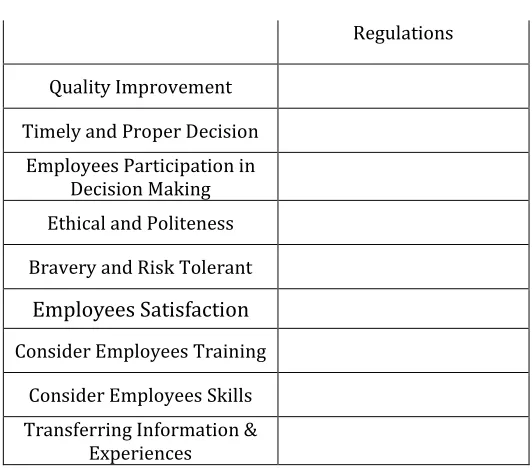
[image:3.612.317.583.82.317.2]To compare the productivity of foreign and local managers, some variables have been defined. Productivity means to do the right things in the right way, a combination of effectiveness and efficiency. So In this study, the variables of effectiveness and efficiency based on designed questionnaire are defined as Table 1. 63 questionnaires are distributed between ASPC employees who have worked with both local and foreign mangers. 60 out of 63 have been responded and returned. After collecting the data, SPSS software is used to analyze the data.
Table 1-Effectiveness and Efficiency of Variables
Effectiveness Variables Efficiency Variables
Expertise Time Management
Experience Responsibility
Culture Differences Monetary Viewpoints
Language Differences Direct Presence in Projects
Employees Motivation Disciplines, Rules and
Regulations
Quality Improvement
Timely and Proper Decision
Employees Participation in Decision Making
Ethical and Politeness
Bravery and Risk Tolerant
Employees Satisfaction
Consider Employees Training
Consider Employees Skills
Transferring Information & Experiences
Also 16 interviews with foreign and local managers conducted to find out the opportunities, threats, strengths, and weaknesses of foreign managers in Iran Oil Industry. Of these interviewees, 6 were foreign managers and 10 were local managers who have worked in different disciplines in ASPC. Based on collected data from interviews, the strengths, weaknesses, opportunities, and threats of using foreign managers in ASPC are obtained. SWOT analysis is a strategic method performed to evaluate the Strengths, Weaknesses, Opportunities, and Threats of a project, organization, or business. SWOT analysis uses SWOT matrix to evaluate both internal and external factors of organization. It is a main tool to compare the data and to prepare four strategies included SO, WO, ST, and WT for organizations. In this research, all four strategies of using foreign managers in ASPC are developed.
In order to develop SWOT matrix, it is required to create the Internal Factor Evaluation (IFE) Matrix and External Factor Evaluation (EFE) Matrix initially.
3.1.
SWOT Analysis Matrix
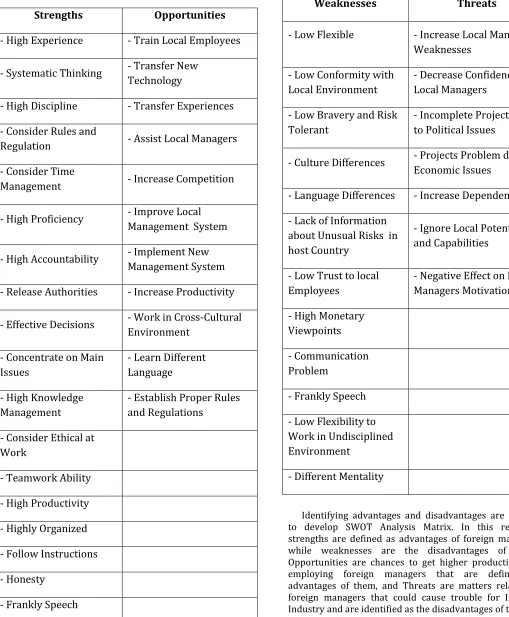
Table 2 - Advantages of Foreign Managers
Strengths
Opportunities
- High Experience
- Train Local Employees
- Systematic Thinking
- Transfer New
Technology
- High Discipline
- Transfer Experiences
- Consider Rules and
Regulation
- Assist Local Managers
- Consider Time
Management
- Increase Competition
- High Proficiency
- Improve Local
Management System
- High Accountability
- Implement New
Management System
- Release Authorities
- Increase Productivity
- Effective Decisions
- Work in Cross-Cultural
Environment
- Concentrate on Main
Issues
- Learn Different
Language
- High Knowledge
Management
- Establish Proper Rules
and Regulations
- Consider Ethical at
Work
- Teamwork Ability
- High Productivity
- Highly Organized
- Follow Instructions
- Honesty
[image:4.612.34.290.110.735.2]- Frankly Speech
Table 3- Disadvantages of Foreign Managers
Weaknesses
Threats
- Low Flexible
- Increase Local Managers’
Weaknesses
- Low Conformity with
Local Environment
- Decrease Confidence of
Local Managers
- Low Bravery and Risk
Tolerant
- Incomplete Projects due
to Political Issues
- Culture Differences
- Projects Problem due to
Economic Issues
- Language Differences
- Increase Dependency
- Lack of Information
about Unusual Risks in
host Country
- Ignore Local Potential
and Capabilities
- Low Trust to local
Employees
- Negative Effect on Local
Managers Motivation
- High Monetary
Viewpoints
- Communication
Problem
- Frankly Speech
- Low Flexibility to
Work in Undisciplined
Environment
- Different Mentality
In order to develop SWOT matrix, it is required to create the Internal Factor Evaluation (IFE) Matrix and External Factor Evaluation (EFE) Matrix initially. To create IFE matrix, the strengths and weaknesses of foreign managers are used. After categorizing them, weight from 0.00 to 1.00 is assigned to each factor. Zero indicates unimportant and one means very important. The sum of all weights should be equals 1.00.
Then, it is assigned rating from 1 to 4 to each factor according to table 4.
Table4- Rating for Factors
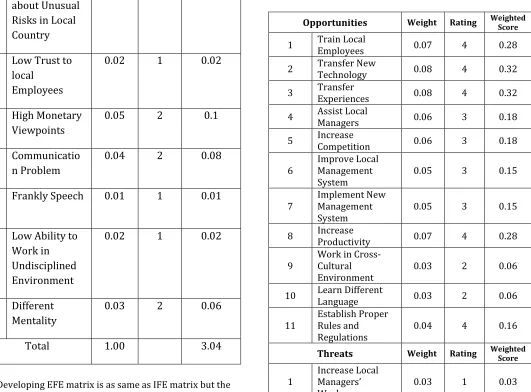
A weighted score for each factor is calculated by multiplying each factor’s weight by its rating. At last, total weighted score is the sum of the weighted scores of each factor [6]. The weight and rating of factors are identified by discussing with foreign and local managers of ASPC and the total weighted score is calculated as reported in Table 5. If the total weighted score becomes less than 2.5, it shows that the organization has weakness about its internal factors. But if the total weighted score becomes more than 2.5, it illustrates that the company has strengths in its internal factors [6]. According to Table 5, total weighted score in ASPC is 3.04, which could help ASAP to use the strengths of its foreign managers and to improve the weaknesses of them.
Table 5- Internal Factor Evaluation Matrix (IFE) – Strengths and Weaknesses
Strengths
Weigh
t
Ratin
g
Weighte
d Score
1
High
Experience
0.07
4
0.28
2
Systematic
Thinking
0.03
3
0.09
3
High Discipline
0.01
3
0.03
4
Consider Rules
and Regulation
0.02
3
0.06
5
Consider Time
Management
0.04
4
0.16
6
High
Proficiency
0.07
4
0.28
7
High
Accountability
0.04
4
0.16
8
Release
Authorities
0.03
3
0.09
9
Effective
Decisions
0.06
4
0.24
1
0
Concentrate on
Main Issues
0.05
3
0.15
1
1
High
Knowledge
Management
0.06
4
0.24
1
2
Consider
Ethical at Work
0.03
4
0.12
1
3
Teamwork
Ability
0.04
4
0.16
1
4
High
Productivity
0.05
4
0.2
1
5
Highly
Organized
0.02
3
0.06
1
6
Follow
Instructions
0.02
3
0.06
1
7
Honesty
0.02
3
0.06
1
8
Frankly Speech
0.01
3
0.03
Weaknesses
Weigh
t
Ratin
g
Weighte
d Score
1
Low Flexible
0.01
1
0.01
Weakness
Strength
Minor
Major
Minor
Major
2
Low
Conformity
with Local
Environment
0.03
2
0.06
3
Low Bravery
and Risk
Tolerant
0.04
2
0.08
4
Culture
Differences
0.03
2
0.06
5
Language
Differences
0.03
1
0.03
6
Lack of
Information
about Unusual
Risks in Local
Country
0.02
2
0.04
7
Low Trust to
local
Employees
0.02
1
0.02
8
High Monetary
Viewpoints
0.05
2
0.1
9
Communicatio
n Problem
0.04
2
0.08
1
0
Frankly Speech
0.01
1
0.01
1
1
Low Ability to
Work in
Undisciplined
Environment
0.02
1
0.02
1
2
Different
Mentality
0.03
2
0.06
Total
1.00
3.04
Developing EFE matrix is as same as IFE matrix but the
type of factors is opportunities and threats. Assigningweights to each factor in EFI is similar to IFE and the sum of all weights should be equals 1.00. Also rating to each factor is from 1 to 4 as; 1= poor response, 2= below average response, 3= above average response, and 4= superior response. Both opportunities and threats receive rating 1 to 4. The weight and rating of factors are
designated by interviewees. Weighted score and total weighted score in EFI matrix are calculated like IEF matrix as displayed in Table 6.
[image:6.612.50.581.329.721.2]If the total weighted becomes close to 1, it illustrates that the organization is not able to use the opportunities or to avoid from the threats factors in its strategies. But if the total weighted score becomes close to 4, it shows that the organization has reacted well about the opportunities and threats in its strategies [6]. The total weighted score of EFI is 3.24 that mean ASPC has utilized the opportunities of its foreign managers in a successful way and has reduced the threats.
Table 6- External Factor Evaluation Matrix (EFE)
Opportunities Weight Rating Weighted Score
1 Train Local
Employees 0.07 4 0.28
2 Transfer New
Technology 0.08 4 0.32
3 Transfer
Experiences 0.08 4 0.32
4 Assist Local
Managers 0.06 3 0.18
5 Increase
Competition 0.06 3 0.18
6
Improve Local Management System
0.05 3 0.15
7
Implement New Management System
0.05 3 0.15
8 Increase
Productivity 0.07 4 0.28
9
Work in Cross-Cultural Environment
0.03 2 0.06
10 Learn Different
Language 0.03 2 0.06
11
Establish Proper Rules and Regulations
0.04 4 0.16
Threats Weight Rating Weighted Score
1
Increase Local Managers’ Weaknesses
2
Decrease Confidence of Local Managers
0.04 2 0.08
3
Incomplete Projects due to Political Issues
0.06 4 0.24
4
Projects Problem due to Economic Issues
0.07 4 0.28
5 Increase
Dependency 0.05 3 0.15
6
Ignore Local Potential and Capabilities
0.06 3 0.18
7
Negative Effect on Local Managers Motivation
0.07 2 0.14
Totals 1.00 3.24
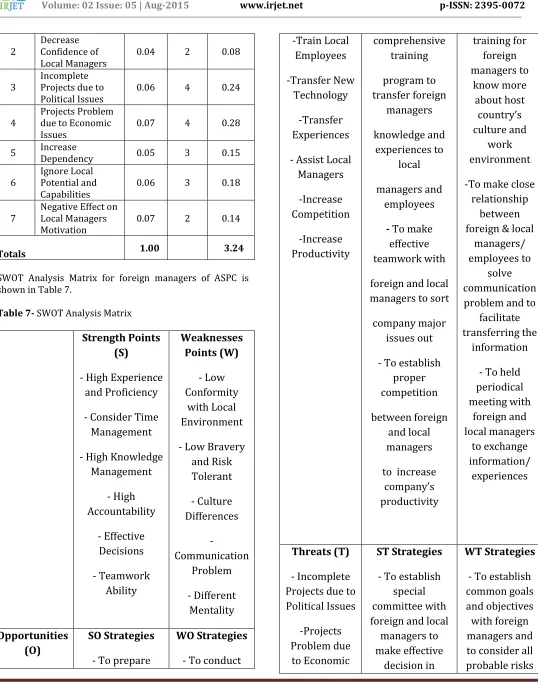
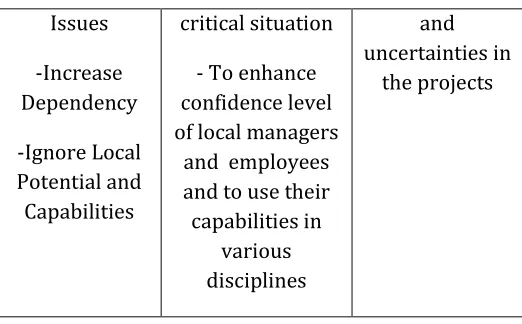
[image:7.612.39.577.59.741.2]SWOT Analysis Matrix for foreign managers of ASPC is shown in Table 7.
Table 7- SWOT Analysis Matrix
Strength Points
(S)
- High Experience
and Proficiency
- Consider Time
Management
- High Knowledge
Management
- High
Accountability
- Effective
Decisions
- Teamwork
Ability
Weaknesses
Points (W)
- Low
Conformity
with Local
Environment
- Low Bravery
and Risk
Tolerant
- Culture
Differences
-
Communication
Problem
- Different
Mentality
Opportunities
(O)
SO Strategies
- To prepare
WO Strategies
- To conduct
-Train Local
Employees
-Transfer New
Technology
-Transfer
Experiences
- Assist Local
Managers
-Increase
Competition
-Increase
Productivity
comprehensive
training
program to
transfer foreign
managers
knowledge and
experiences to
local
managers and
employees
-
To make
effective
teamwork with
foreign and local
managers to sort
company major
issues out
- To establish
proper
competition
between foreign
and local
managers
to increase
company’s
productivity
training for
foreign
managers to
know more
about host
country’s
culture and
work
environment
-To make close
relationship
between
foreign & local
managers/
employees to
solve
communication
problem and to
facilitate
transferring the
information
- To held
periodical
meeting with
foreign and
local managers
to exchange
information/
experiences
Threats (T)
- Incomplete
Projects due to
Political Issues
-Projects
Problem due
to Economic
ST Strategies
- To establish
special
committee with
foreign and local
managers to
make effective
decision in
WT Strategies
Issues
-Increase
Dependency
-Ignore Local
Potential and
Capabilities
critical situation
- To enhance
confidence level
of local managers
and employees
and to use their
capabilities in
various
disciplines
and
uncertainties in
the projects
4.
DISCUSSION AND VALIDATION
In this section, the results of SPSS Analysis and SWOT Analysis Matrix are discussed and Student t-test for SPSS validation is applied.
4.1.
SPSS Results
[image:8.612.32.293.88.250.2]Productivity (Effectiveness, Efficiency) of foreign and local managers of ASPC are identified based on a questionnaire included 35 different variables (Table 8). Chronbach’s alpha is used to measure the reliability of questionnaire and the content validity is applied to measure the validity of it. The required data is collected and analyzed using SPSS software. Consequently, the effectiveness and efficiency of both foreign and local managers are categorized and presented in this paper.
Table 8 -Variables Defined in SPSS
Variables in Questionnaire Variables
in SPSS
Foreign Managers Expertise V1
Foreign Managers Experience V2
Local Managers Expertise V3
Local Managers Experience V4
Culture Differences Effect to Foreign
Managers Relationship V5
Language Differences Effect to Foreign
Managers Relationship V6
Consider Employees Motivation by Foreign
Managers V7
Consider Employees Motivation by Local
Managers V8
Foreign Managers Effect on Tasks Quality V9 Proper and Timely Decision by Foreign
Managers V10
Proper and Timely Decision by Local
Managers V11
Employees Participation in Decision Making
by Foreign Managers V12
Employees Participation in Decision Making
by Local Managers V13
Ethical and Politeness of Foreign Managers V14
Ethical and Politeness of Local Managers V15 Bravery and Risk Tolerant of Foreign
Managers V16
Bravery and Risk Tolerant of Local Managers V17 Consider Employees Satisfaction by Foreign
Managers V18
Consider Employees Satisfaction by Local
Managers V19
Consider Time Management by Foreign
Managers V20
Consider Time Management by Local
Managers V21
Accountability of Foreign Managers V22
Accountability of Local Managers V23
Foreign Managers Monetary Viewpoints V24
Local Managers Monetary Viewpoints V25 Direct Presence of Foreign Managers in
Projects V26
Direct Presence of Local Managers in
Projects V27
Consider Disciplines, Rules and Regulations
at Work by Foreign Managers V28
Consider Disciplines, Rules and Regulations
at Work by Local Managers V29
Consider Employees Skills by Foreign
Managers V30
Consider Employees Skills by Local
Managers V31
Consider Employees Training by Foreign
Managers V32
Consider Employees Training by Local
Managers V33
Transfer Information and Experiences by
Foreign Managers V34
Transfer Information and Experiences by
Local Managers V35
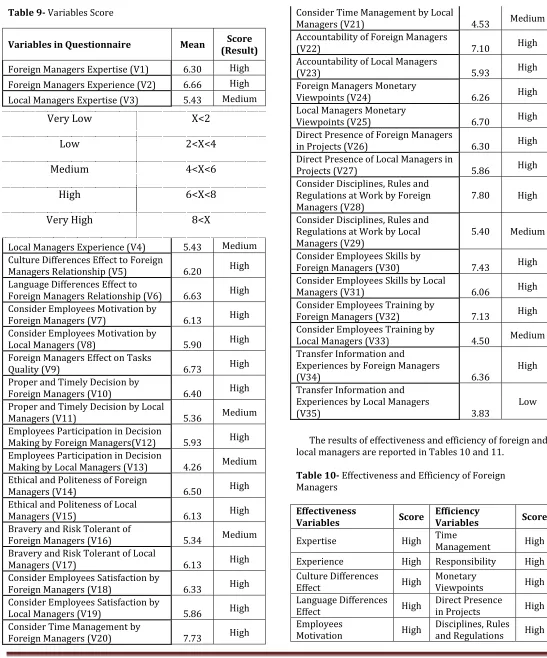
the answers in SPSS are defined as: Very Low: 1, Low: 3, Medium: 5, High: 7, and Very High: 9. Since most of SPSS calculated numbers are in between the defined numbers, to facilitate results analyzing, the following model are used:
[image:8.612.34.337.462.742.2]Table 9- Variables Score
Variables in Questionnaire Mean Score
(Result)
Foreign Managers Expertise (V1) 6.30 High Foreign Managers Experience (V2) 6.66 High Local Managers Expertise (V3) 5.43 Medium
Local Managers Experience (V4) 5.43 Medium Culture Differences Effect to Foreign
Managers Relationship (V5) 6.20 High Language Differences Effect to
Foreign Managers Relationship (V6) 6.63 High Consider Employees Motivation by
Foreign Managers (V7) 6.13 High
Consider Employees Motivation by
Local Managers (V8) 5.90 High
Foreign Managers Effect on Tasks
Quality (V9) 6.73 High
Proper and Timely Decision by
Foreign Managers (V10) 6.40 High
Proper and Timely Decision by Local
Managers (V11) 5.36 Medium
Employees Participation in Decision
Making by Foreign Managers(V12) 5.93 High Employees Participation in Decision
Making by Local Managers (V13) 4.26 Medium Ethical and Politeness of Foreign
Managers (V14) 6.50 High
Ethical and Politeness of Local
Managers (V15) 6.13 High
Bravery and Risk Tolerant of
Foreign Managers (V16) 5.34 Medium
Bravery and Risk Tolerant of Local
Managers (V17) 6.13 High
Consider Employees Satisfaction by
Foreign Managers (V18) 6.33 High
Consider Employees Satisfaction by
Local Managers (V19) 5.86 High
Consider Time Management by
Foreign Managers (V20) 7.73 High
Consider Time Management by Local
Managers (V21) 4.53 Medium
Accountability of Foreign Managers
(V22) 7.10 High
Accountability of Local Managers
(V23) 5.93 High
Foreign Managers Monetary
Viewpoints (V24) 6.26 High
Local Managers Monetary
Viewpoints (V25) 6.70 High
Direct Presence of Foreign Managers
in Projects (V26) 6.30 High
Direct Presence of Local Managers in
Projects (V27) 5.86 High
Consider Disciplines, Rules and Regulations at Work by Foreign Managers (V28)
7.80 High
Consider Disciplines, Rules and Regulations at Work by Local Managers (V29)
5.40 Medium
Consider Employees Skills by
Foreign Managers (V30) 7.43 High
Consider Employees Skills by Local
Managers (V31) 6.06 High
Consider Employees Training by
Foreign Managers (V32) 7.13 High
Consider Employees Training by
Local Managers (V33) 4.50 Medium
Transfer Information and
Experiences by Foreign Managers
(V34) 6.36
High
Transfer Information and Experiences by Local Managers
(V35) 3.83
Low
[image:9.612.28.575.86.744.2]The results of effectiveness and efficiency of foreign and
local managers are reported in Tables 10 and 11.Table 10- Effectiveness and Efficiency of Foreign Managers
Effectiveness
Variables Score
Efficiency
Variables Score
Expertise High Time Management High
Experience High Responsibility High Culture Differences
Effect High
Monetary
Viewpoints High Language Differences
Effect High
Direct Presence
in Projects High Employees
Motivation High
Disciplines, Rules
and Regulations High
Very Low
X<2
Low
2<X<4
Medium
4<X<6
High
6<X<8
Quality Improvement High Timely and Proper
Decision High
Employees Participation in Decision Making
High
Ethical and
Politeness High
Bravery and Risk Tolerant
Medi um Employees
Satisfaction High Consider Employees
Training High
Consider Employees
Skills High
Transferring Information and Experiences
High
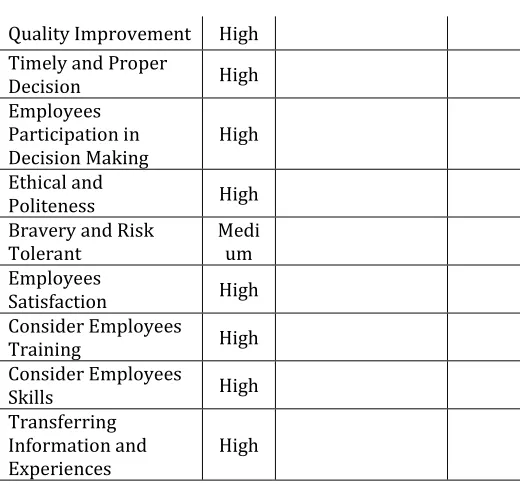
[image:10.612.32.292.84.329.2]Table 10 shows the effectiveness and efficiency of
foreign managers working in ASPC. It indicates that most of effectiveness variables of foreign managers such as expertise, experience, and employees’ motivation are obtained high score but the bravery and risk tolerant variable is acquired medium score. However, cultural and language differences effect have obtained high scores, which are considered as negative points for foreign managers. In addition, all efficiency variables of foreign managers such as time management and responsibility have gotten high score.Table 11- Effectiveness and Efficiency of Local Managers
Effectiveness
Variables Score
Efficiency
Variables Score
Expertise Mediu
m
Time Management
Mediu m
Experience Mediu
m Responsibility High Employees
Motivation High
Monetary
Viewpoints High Timely and
Proper Decision
Mediu m
Direct Presence
in Projects High Employees
Participation in Decision Making
Mediu m
Disciplines, Rules and Regulations
Mediu m
Ethical and
Politeness High
Bravery and Risk
Tolerant High
Employees
Satisfaction High
Consider Employees Training
Mediu m
Consider
Employees Skills High Transferring
Information and Experiences
Low
Table 11 reports the effectiveness and efficiency of local
managers working in ASPC. It shows that some of effectiveness variables such as employees’ motivation, bravery and risk tolerant are acquired high score, some others like expertise, experience, and timely and proper decision making are obtained medium score, and transferring information and experiences is obtained low score. Efficiency variables of local managers are also obtained high and medium scores. For instance, time management has medium score while responsibility has high score. It is also considerable that both foreign and local managers have obtained high score in monetary viewpoints factor.4.2.
SWOT Matrix Results
uncertainties in the projects are proposed as ASPC WT strategies.
4.3.
Student’s T-Test
In this study, the obtained results are quantitative and therefore the Student’s t-test is a proper method to use here. The formula of Student’s t-test with considering 95% level of confidence is as:
[image:11.612.315.579.85.461.2]
Where t is Student’s t-test,
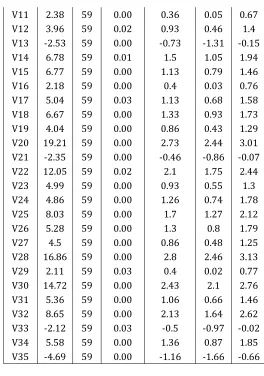
is the mean of each variable, is Standard mean that is considered 5 in this study, s is the sample standard deviation of each variable, and n is the sample size that is 60 in this research. SPSS software is used in this research to assess Student’s t-test. Table 12 displays the Student’s t-test calculated by SPSS for this study. The important item to be considered in Table 12 is the level of significant (Sig) that is calculated by subtracting the level of confidence from one. Since the level of confidence is considered 0.95% in this research, therefore Sig should not exceed 0.05. Table 12 displays that all Sig tabulated values in this research is less than 0.05 and thus the confident level of the results is acceptable. For instance, as per Table 12 the biggest Sig is 0.039, so the minimum confident level of Variables is 0.961%, which belongs to V29 in this research. In addition, Sig in most of Variables is 0.00 that indicates the confidence level of those Variables is 100%. Consequently, the Student’s t-test shows that the results of this research are applicable in ASPC and other international companies in Iran Oil Industry as well.Table 12- Student’s t-test (One Sample Test)
Test Value=5
t df Sig.(2-tailed)
Mean Difference
95% Confidence
Interval of the Difference
Lower Upper
V1 7.63 59 0.00 1.3 0.95 1.64 V2 10.05 59 0.00 1.66 1.33 1.99 V3 2.86 59 0.00 0.43 0.13 0.73 V4 2.42 59 0.01 0.43 0.07 0.79
V5 4.75 59 0.11 1.2 0.69 1.7
V6 7.59 59 0.00 1.63 1.2 2.06 V7 4.12 59 0.00 1.13 0.58 1.68 V8 4.98 59 0.00 0.9 0.53 1.26 V9 9.27 59 0.00 1.73 1.35 2.1
V10 7.08 59 0.00 1.4 1 1.79
V11 2.38 59 0.00 0.36 0.05 0.67 V12 3.96 59 0.02 0.93 0.46 1.4 V13 -2.53 59 0.00 -0.73 -1.31 -0.15 V14 6.78 59 0.01 1.5 1.05 1.94 V15 6.77 59 0.00 1.13 0.79 1.46 V16 2.18 59 0.00 0.4 0.03 0.76 V17 5.04 59 0.03 1.13 0.68 1.58 V18 6.67 59 0.00 1.33 0.93 1.73 V19 4.04 59 0.00 0.86 0.43 1.29 V20 19.21 59 0.00 2.73 2.44 3.01 V21 -2.35 59 0.00 -0.46 -0.86 -0.07 V22 12.05 59 0.02 2.1 1.75 2.44 V23 4.99 59 0.00 0.93 0.55 1.3 V24 4.86 59 0.00 1.26 0.74 1.78 V25 8.03 59 0.00 1.7 1.27 2.12
V26 5.28 59 0.00 1.3 0.8 1.79
V27 4.5 59 0.00 0.86 0.48 1.25 V28 16.86 59 0.00 2.8 2.46 3.13 V29 2.11 59 0.03 0.4 0.02 0.77 V30 14.72 59 0.00 2.43 2.1 2.76 V31 5.36 59 0.00 1.06 0.66 1.46 V32 8.65 59 0.00 2.13 1.64 2.62 V33 -2.12 59 0.03 -0.5 -0.97 -0.02 V34 5.58 59 0.00 1.36 0.87 1.85 V35 -4.69 59 0.00 -1.16 -1.66 -0.66
5.
CONCLUSION
[image:11.612.32.305.499.741.2]senior managers of international or multinational companies in Iran Oil Industry to develop appropriate strategic plan in order to utilize the strengths and opportunities, to improve the weaknesses, and to reduce the threats of foreign managers working in their organization.
6.
RECOMMENDATIONS FOR FUTURE WORKS
Based on SWOT Analysis Matrix shown in Table 7, the authors has given some recommendations regarding SO, WO, ST, and WT strategies that are applicable for ASPC and other companies in Iran Oil Industry, which use foreign managers in their organization and projects. The strategies provide the instructions that how to use strengths to take advantage of opportunities, how to take advantage of strengths to escape from actual and potential threats, how to use opportunities to overcome the weaknesses, and how to minimize weaknesses and escape from threats. The recommendations are listed as following:
To conduct practical training program through special support from foreign managers to enhance the proficiency and skills of local managers and employees.
To develop QCC (Quality Control Circles) team comprised of foreign and local managers for resolving major issues of organization.
To build proper competition between foreign and local managers for increasing the company or project’s productivity via allocating bonus or other motivation tools to higher productive team.
To conduct appropriate instructing for foreign managers to know more about the culture, work environment, and other important issues related to Iran.
To make close relationship with foreign managers to facilitate transferring the information.
To held periodical meeting with foreign managers for exchanging information and experiences.
To found special Committee composed of foreign and local managers to be prepared for making effective decisions in critical situations.
To enhance confidence level of local managers by using their capabilities in various disciplines particularly in critical circumstances.
To build common goals and objectives with foreign managers and to consider all expected risks and uncertainties in the projects.
REFERENCES
[1] Bjorkman, I. & Schaap, A. (1994). Outsiders in theMiddle Kingdom: Expatriate Managers in Chinese-Western Joint Ventures. European Management Journal, 12, 147-153.
[2] Brooklyn Derr, C. & Oddou, G. (1993). Internationalizing Managers: Speeding Up the
Process. European Management Journal, 11, 435-442.
[3] Chen, C. C., Choi, J., & Chi, S. (2002). Making Justice Sense of Local-Expatriate Compensation Disparity: Mitigation by Local Referents, Ideological Explanations, and Interpersonal Sensitivity in China-Foreign Joint Ventures. Academy of Management Journal, 45, 807-817.
[4] Chen, Y., Tjosvold, D., & Su, S. F. (2005). Goal interdependence for working across cultural boundaries: Chinese employees with foreign managers. International Journal of Intercultural Relations, 29, 429–447.
[5] Chen, Y. F. & Tjosvold, D. (2005). Cross-cultural leadership: Goal interdependence and leader– member relations in foreign ventures in China. Journal of International Management, 11, 417– 439. [6] David, F. R. (1997). Strategic Management ( 7th
Edition. ed.).
[7] Deshpande, S. P. & Viswesvaran, C. (1992). Is cross-cultural training of expatriate managers effective? A meta analysis. International Journal of Intercultural Relations, 6, 295-310.
[8] Earley, P. C. & Gibson, C. B. (2002). Multinational Teams: New Perspectives: Routledge.
[9] Faria, A. & Guedes, A. (2008). What is international management? A critical analysis. Stream 3: Critical Perspectives on International Business.
[10] Harvey, M. (1997). The selection of Managers for Foreign Assignments: A Planning Perspective. The Columbia Journal of World Business, 31, 102-118. [11] Harvey, M. & Novicevic, M. M. (2002). The
hypercompetitive global marketplace: the importance of intuition and creativity in expatriate managers. Journal of World Business, 37, 127-138. [12] Makilouko, M. (2004). Coping with multicultural
projects: the leadership styles of Finnish project managers. International Journal of Project Management, 22, 387–396.
[13] Mayrhofer, W. & Brewster, C. (1996). In praise of ethnocentricity: expatriate policies in European multinationals. International Executive, 38, 749– 778.
[14] Ochieng, E. G. & Price, A. D. F. (2010). Managing cross-cultural communication in multicultural construction project teams: The case of Kenya and UK. International Journal of Project Management, 28, 449–460.
[16] Selmer, J. (2001). Coping and adjustment of Western expatriate managers in Hong Kong. Scandinavian Journal of Management, 17, 167-185.
[17] Selmer, J. (2005). Cross-cultural training and expatriate adjustment in China: Western joint venture managers. Personnel Review, 34, 68-84. [18] Swierczek, F. W. (1994). Culture and conflict in joint
ventures in Asia. International Journal of Project Management, 12, 39-47.
[19] Tjosvold, D. (1995). Effects of power to reward and publish in cooperative and competitive contexts. Journal of Social Psycholog, 135, 723– 736.
WEB REFERENCES
Aryasasol Polymer Company. 2010. Retrieved from www.aryasasol.com
Azardashti, A. H. 2010. Characters of a successful project manager. Retrieved from http://modirestan.mihanblog.com/post/23
Barrett, J. 2010. The information needs of elderly, disabled elderly people, and their careers. Retrieved from
http://freespace.virgin.net/julie.barrett/WebPart5/ WebPart5.htm.
Blank., C. 2010. What is SPSS software? Retrieved from http://www.ehow.com/about_5459472_spss-software.html.
Data Analysis Australia. What Are You Really Measuring? 2010. Reliability and Validity in Questionnaire Design. Retrieved from
http://www.daa.com.au/analytical-ideas/questionnaire-validity
EFE Matrix (External Factor Evaluation Matrix). 2010. Retrieved from http://www.maxi-pedia.com/SWOT.
Flinders University. 2010. Retrieved from http://www.flinders.edu.au.
Gheybi, S. M. 2010. Retrieved from http://www.manemovaffag.blogfa.com/8701.aspx.
Habibi, M. 2010. Retrieved from http://behandish.blogfa.com/post-1030.aspx
IFE Matrix (Internal Factor Evaluation Matrix). 2010. Retrieved from http://www.maxi-pedia.com/IFE.
Kuter, U., &Yilmaz, C. 2010. Survey Methods: Questionnaires and Interviews. Retrieved from http://otal.umd.edu/hci-rm/survey.html.
Questionnaire construction. 2010. Retrieved from http://en.wikipedia.org/wiki/Questionnaire.
SWOT Analysis Matrix. 2010. Retrieved from http://www.maxi-pedia.com/SWOT.
Using SWOT Matrix. 2010. Retrieved from