Comprehensive Solution for Inattentiveness While
Driving Using Auto-alert and Auto-call system
B. Shruthi1, S. Sivaranjani2, T. Sunitha Biji3
1, 2, 3
Electronics and Communication Department, Jeppiaar SRR Engineering College
Abstract: The lack of alertness while driving has been a prevailing problem in this smartphone era. The lack of attention leads to
numerous fatalities that could be prevented by simple measures. The existing systems for alerting the drivers fail to address the main problem of inattentiveness and full-on unconsciousness in which case mere sound alert is not sufficient. Our system is designed to not only alert the driver but also use the automatic braking mechanism to stop the vehicle. The most important feature of the proposed system is the auto-alerts sent to the emergency services like an ambulance or the police in case of total unconsciousness of the driver by utilizing the Bluetooth Low Energy iBeacon technology. The frames captured by the camera focused on the eyes and mouth of the driver in real time are processed using Viola-Jones face detection algorithm and Sobel edge detection algorithm in MATLAB. Frame-by-frame comparison is done to take a binary decision by the Support Vector Machine classifier machine learning algorithm. The appropriate signal is sent to the ARDUINO UNO development board. The commands are sent to the motor driver circuit to stop the vehicle , the voice playback module to awaken the driver and the BLE iBeacon to alert the emergency services. Such a system provides a holistic solution wherein the driver is made aware of his negligence and facilitates the help to arrive quickly under the dire circumstances.
Keywords: Viola-Jones face detection, Haar features, Ada Boost training, Sobel edge detection, Support Vector Machine, ARDUINO UNO R3, Bluetooth Low Energy Beacons
I. INTRODUCTION
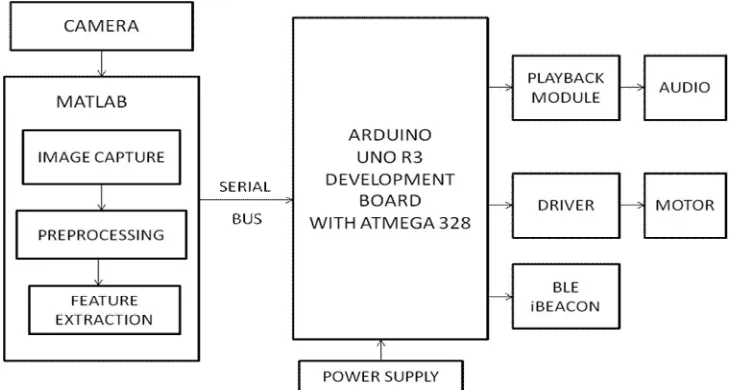
The comprehensive solution suited to modern day drivers must also be non intrusive with no sensors attached to their body. A simulation of this model can be created by processing the real time images captured at a minimum rate of four frames per second in an image processing software like MATLAB and then interfacing the system with the ARDUINO UNO R3 development board using a serial bus. The ATMEGA 328 microcontroller in the ARDUINO board with digital and analog communication pins is used to then communicate with the motor driver IC L293D, voice playback module ISD1820, Bluetooth Low Energy(BLE) iBeacon module. Efficient algorithm with high accuracy rates like Viola-Jones face detection algorithm is used to detect the face of the driver. The system is trained using Adaptive Boost or AdaBoost technique to achieve lowest error rate required for the real time applications. A binary decision making algorithm like Support Vector Machine (SVM) is used to decide the state of the driver. The frames are classified into either fatigue or non-fatigue and if found to be fatigue for a considerable amount of time, the signals are sent to the ARDUINO to take the desired action.
II. SYSTEMDESIGN
Fig. 1 Block diagram of the proposed system
III. VIOLA-JONESFACEDETECTION
The Viola-Jones algorithm is a widely used face detection algorithm since it is time efficient and has a high accuracy rate. After pre-processing the image taken at the vehicle by filtering, smoothening and de-blurring, the RGB image is converted to grayscale[2]. The converted grayscale image is further segmented into sub-windows and processed by Viola-Jones algorithm.
A. Haar Features
The Haar features on the driver's face are detected. Haar features map out the facial features with differences in pixel intensities and help the system to detect the driver's face. Then the integral image is calculated by summing all the pixel intensities[3]. For a point (x,y) in an integral image, the value is the sum of pixels to the left and above in the original image:
ii(x,y) = ∑ i(x‘ , y‘) x‘<=x y‘<=y
where i(x,y) is original image and ii(x,y) is an integral image.
B. AdaBoost Training
Adaptive boost algorithm or AdaBoost algorithm is a machine learning algorithm which is used to train the software to identify the right feature according to a given template. Initially, a set of images with both false and true sets are given with equal weights. As the classifiers identify weak features, then the weight of those are increased i.e., these error prone samples are given again and again to train the classifier. Finally all the trained results of such weak classifiers are combined to form the strong classifier which may detect the important features. The detection rate is now increased to a 95% and it only causes error in every 1 of 14,084 samples given to it[4].
The accuracy rate needs to be improved some more to be used in real time applications but this might in turn increase the execution time of the program. In order to address this trade-off issue between run time and accuracy, we must cascade the classifiers. When the classifiers are arranged in the order of their complexities, it is much more efficient to pass the image through each stages with the first stage being a basic classifier to the Nth stage being the most complex one. The error rate is now drastically improved to only 1 of 1,000,000 frames which is more suited for our intended purpose[5].
IV. SUPPORTVECTORMACHINE
Fig. 2 Segregation of features using Haar rectangles
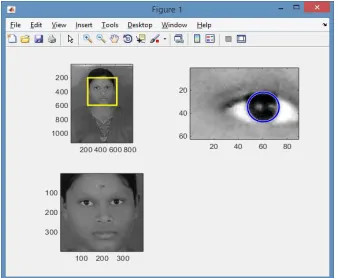
Fig. 3 MATLAB output of eye detection and eyeball tracking
V. HARDWARECOMPONENTS
The hardware components are chosen keeping in mind the ease of interface, support with all modern operating systems in mobile and laptop computers, good security and support system. The ARDUINO UNO R3 development board with ATMEGA 328 microcontroller, ISD1820 chip for playback of alert message, L293D IC for motor driver and the iBeacon for bluetooth transfer of location are chosen for the intended purpose.
A. Arduino Uno R3 Development board
[image:4.612.189.367.553.708.2]ARDUINO UNO is the combination of many microcontrollers in series, USB port, 5V voltage regulator, LED, Burners, Crystal oscillators (16MHz), serial communication port and a header in a single board. The hardware consists of a board designed around an 8-bit microcontroller, or a 32-bit ARM. Current models feature things like a USB interface, analog inputs, and GPIO pins which allows the user to attach additional boards [10],[12],[13].
B. ATMEGA328 microcontroller
[image:5.612.219.406.454.606.2]The Atmel picoPower ATmega328/P is a low-power CMOS 8-bit microcontroller based on the AVR enhanced RISC architecture. By executing powerful instructions in a single clock cycle, the ATmega328/P achieves throughputs close to 1MIPS per MHz. This empowers the system designer to optimize the device for power consumption versus processing speed[11].
Fig. 5 Pin diagram of ATMEGA 328
C. Voice playback Module
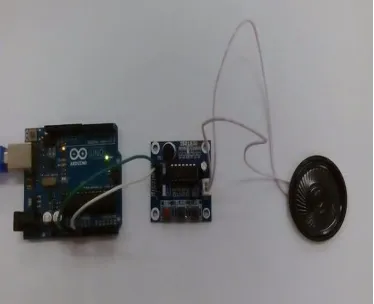
The intended function is to quickly playback an alert message to wake the driver up in case of they fall asleep. For this intended purpose, a voice recording and playback module with integrated microphone based on the ISD1820 chip is used. It comes with 0.5 W speaker. Voice Record Module is base on ISD1820, which a multiple message record/playback device. It can offer true single chip voice recording, no volatile storage, and playback capability around 10 seconds. This module is easy to use which you could direct control by push button on board or by microcontroller.
Fig. 6 Voice playback module with speakers interfaced with ARDUINO
D. Motor driver L293D
Fig. 7 IC L293D connected to stepper motor
E. BLE iBeacon
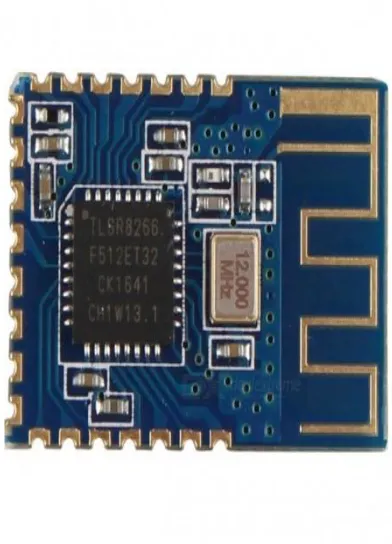
Bluetooth Low Energy is a wireless Personal Area Network(PAN) technology. The major characteristic of BLE is the low power consumption in the range of 2-10µA as opposed to 15mA of classic Bluetooth[14],[15]. The compelling reason to chose BLE as the means for alerting the emergency services is the low cost, high accuracy compared to GPS. It also supports all popular OS on both mobile and computers. BLE beacons are hardware transmitters that broadcast their identifier to nearby portable electronic devices[16]. This identifier known as Universally Unique Identifier or UUID is a byte sequence used to transmit location of the beacon module to nearby devices via Bluetooth. When picked up by a compatible application, it can be used to track the location and trigger location-based action like messaging the location to other devices[17]. It works within the range of 100 m. In our proposed system, Apple's BLE beacon known as iBeacon is utilized to send the driver's location to his/her mobile phone in the vicinity. A simple Android or iOS mobile application installed in the driver's phone will be triggered to further relay this location via SMS[18].
[image:6.612.190.386.438.710.2]Fig. 9 UUID packet of iBeacon
VI. MATLAB-ARDUINOINTERFACE
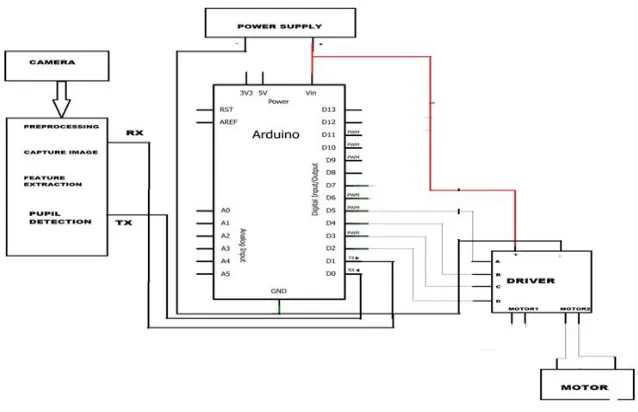
The ARDUINO UNO R3 development board can be given commands from .m extension MATLAB files. This communication is possible through a serial communication port like Universal Serial Bus (USB) ports. The MATLAB Support Packages for ARDUINO Hardware lets you use MATLAB to communicate with your board through USB cable. It contains assembler and library files that could easily convert the commands give by MATLAB m file to digital or analog output to the ARDUINO[19]. In case of successful connection, this MATLAB command will then return the port on which your board is connected, the model of your ARDUINO board and available pins and libraries for the board[20].
After establishing the connection, the MATLAB files are written in order to send signals to ARDUINO only if the driver's eyes are found to be closed for consecutive frames above a certain threshold. Once the driver is determined to be asleep, the command is immediately sent to the ARDUINO. The ATMEGA 328 microcontroller which is the most vital component of the ARDUINO R3 board will be activated. The microcontroller then simultaneously send signals to motor driver, voice playback module and BLE iBeacon to perform their respective functions.
.
Fig. 10 schematic diagram of MATLAB-ARDUINO interfacing
VII. CONCLUSIONS
[image:7.612.152.471.419.625.2]REFERENCES
[1] C. C. Liu, S. G. Hosking, "Predicting driver drowsiness using vehicle measures, recent insights and future challenges," J. safety Res, 40 (4) , pp 239 -245.2009. [2] G. Hosseini, H. Hossein-Zadeh, A "Display driver drowsiness warrning system", International Conference of the road and traffic accidents, Tehran University,
2006.
[3] L. M. Bergasa, J. Nuevo, "Real-Time system for monitoring driver vigilance," IEEE Transactions on Intelligent Transportation Systems, 7(1) , pp 63-77. 2006. [4] M. J. Flores, 1 M. Anningll and A Escalera "Real-Time Warning System for Driver Drowsiness Detection Using Visual Information", J Intell Robot System,
DOT 10.100 7 /sI0846 -009 -9391 -1 , pp 10 -33. 18 N. 2009.
[5] M. Rizon and T. Kawaguchi, "Automatic eye detection using intensity and edge information”, Proceedings IEEE TENCON, vol. 2, pp. 415- 420, 2000. [6] P. Gejgus, M. Sparka, Face Tracking in Color Video Sequences, The Association for Computing Machinery Inc., New York, 2003.
[7] RG Gonzales, and RE. Woods, Digital Image Processing, Second Edition, Prentice Hall, 2002. [8] Holly Moore, MATLAB for Engineers, Pearson, 2012.
[9] T. Azim, M.A. Jaffar, AM. Mirza. "Automatic Fatigue Detection of Drivers through Pupil Detection and Yawning Analysis." In: Proc. Fourth International Conference on Innovative Computing, Information and Control, 2009, pp. 441 -445.
[10] ARDUINO UNO R3development board, Farnell Inc., 2007. [11] ATMEGA328, Microchip Inc., 2016.
[12] Michael Margolis, Arduino Cookbook, 2nd Edition, O'Reilly Media, 2011.
[13] John Boxall, Arduino Workshop: A Hands-On Introduction with 65 Projects, No Starch Press, 2013. [14] iBeacon v1.0,Apple Inc.,2014.
[15] (2017) iBeacon developer website. [Online]. Available: http://developer.apple.com/ibeacon/
[16] Blackstone Egineering. (2015) Understanding Types of BLE Beacons-armMBED. [Online]. Available: http://os.mbed.com/blog/entry/BLE-Beacons-URIBeacon-AltBeacons-iBeacon/
[17] Craig Gilchrist, Learning iBeacon, Packt Publishing, 2014.