Georgia State University
ScholarWorks @ Georgia State University
Economics Dissertations Department of Economics
12-11-2018
Essays on Medical Marijuana Laws, Health
Insurance and Health Care Utilization
Pelin Ozluk
Follow this and additional works at:https://scholarworks.gsu.edu/econ_diss
This Dissertation is brought to you for free and open access by the Department of Economics at ScholarWorks @ Georgia State University. It has been
Recommended Citation
Ozluk, Pelin, "Essays on Medical Marijuana Laws, Health Insurance and Health Care Utilization." Dissertation, Georgia State University, 2018.
ABSTRACT
ESSAYS ON MEDICAL MARIJUANA LAWS, HEALTH INSURANCE AND HEALTH
CARE UTILIZATION
BY
PELIN ¨OZL ¨UK
AUGUST 2018
Committee Chair: Charles Courtemanche
Major Department: Economics
National Health Expenditures Accounts estimates that U.S health care spending grew
4.3 percent from the previous year to reach $3.3 trillion, or $10,338 per person in 2016.
The overall share of gross domestic product (GDP) related to health care spending was 17.9
percent in 2016, up from 17.7 percent in 2015. Moreover, increased use of opioid prescriptions
led to excessive use and abuse of these drugs, resulting in nationwide “opioid epidemic”. This
dissertation examines how different policy interventions contributed to the rise in health care
utilization and prescribed opioids in U.S.
The first chapter examines how medical marijuana laws changed utilization of prescription
drugs with a special emphasis on prescribed opioids. More than half of the US population
lives in a state that has adopted medical marijuana laws (MMLs). Studies show that most
medical marijuana patients use marijuana for managing their pain with the overwhelming
majority of them preferring it to opioids. Despite ongoing pro-marijuana policies and the
growing trend of public acceptance, the evidence on how people change their prescription
use due to the availability of marijuana as an alternative treatment is limited. Using the
variations across state MMLs between 1996 and 2014 of Medical Expenditure Panel Survey
focus on opioids. I find that MMLs lead to a $2.47 decrease in per person prescribed opioid
spending among young adults (ages 18-39) over a year. Most of this decrease results from
the intensive margin of use and MML states that allow home cultivation experience even
larger decreases. Furthermore, the decreasing effects are persistent over time and they get
stronger following the years of implementation. MMLs also decrease the number of opioid
pill use among young adults. I do not find any discernible impact on older populations'
opioid utilization. I then investigate the effects on other prescriptions for which marijuana
can be a potential substitute and find the allowance of dispensaries is generally associated
with decreases, although the effects depend on the type of MML, the margin of use and age.
The second chapter examines how universal insurance coverage affects health care
utiliza-tion drawing evidence from the health reform of Massachusetts in 2006. This law reformed
insurance markets, mandated that all residents in the state would be required to take up
health insurance, and provided subsidies for lower-income individuals to purchase it. Using
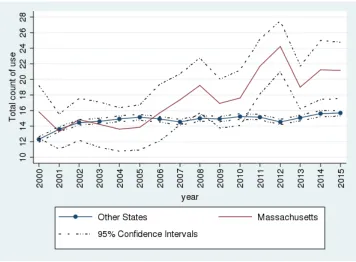
data from MEPS between 2000 and 2015, I provide evidence that the Massachusetts health
care reform increased counts of hospital and office-based medical provider visits significantly.
The results were robust to using alternative control groups and different functional form
as-sumptions. I find the reform's effects grew over time, reaching its maximum after 2010. The
reform also increased health care expenditures and probability of health care service use
significantly. Finally, I use the reform to instrument for health insurance and estimate large
impacts of insurance on health care utilization.
The third chapter examines the impact of the Affordable Care Act on health care
uti-lization. The Affordable Care Act (ACA) aimed to achieve nearly universal health insurance
coverage in the United States through a combination of regulations, mandates, subsidies,
exchanges, and Medicaid expansions. We use data from the Medical Expenditure Panel
Survey (MEPS) to investigate the impacts of the ACA on the health care utilization and
identifies the effects of the ACA's expansions of private and Medicaid coverage by leveraging
variation in states'Medicaid expansion decisions and individuals'pre-ACA insurance status.
Intuitively, impacts of the ACA's insurance expansions should be concentrated among those
who lacked insurance prior to the law, and such individuals are more likely to be affected
in states that participated in the Medicaid expansion. Similar methods have been used to
study the ACA's effects on outcomes such as health insurance coverage, access to care, risky
health behaviors, and self-assessed health. However, they have not been previously used to
investigate impacts on health care spending. Theoretically, the net effect on spending is
ambiguous. On one hand, insurance lowers the effective price of care, which should increase
utilization across-the-board. On the other hand, insurance improves access to primary and
preventive care, which could potentially reduce use of expensive emergency services. The
results suggest that the ACA increased health care utilization in some dimensions –
in-cluding counts of inpatient hospital visits, medical-provider office visits and total counts of
prescription fills, inpatient, outpatient, medical-provider office and ER visits combined on
its first year. However, these increases in health care utilization in counts were not observed
in ACA's second year. We also found that the ACA increased coverage and led to significant
gains in both expansion and non-expansion states consistent with what has been found by
prior studies. This significant gain in insurance was not limited to ACA's first year but it
ESSAYS ON MEDICAL MARIJUANA LAWS, HEALTH INSURANCE AND HEALTH
CARE UTILIZATION
BY
PELIN ¨OZL ¨UK
A Dissertation Submitted in Partial Fulfillment
of the Requirements for the Degree
of
Doctor of Philosophy
in the
Andrew Young School of Policy Studies of
Georgia State University
GEORGIA STATE UNIVERSITY
Copyright by Pelin ¨Ozl¨uk
ACCEPTANCE
This dissertation was prepared under the direction of Pelin ¨Ozl¨uk’s Dissertation Committee. It has been approved and accepted by all members of that committee, and it has been accepted in partial fulfillment of the requirements for the degree of Doctor of Philosophy in Economics in the Andrew Young School of Policy Studies of Georgia State University.
Dissertation Chair: Charles Courtemanche
Committee: James Marton
Shiferaw Gurmu Jason Hockenberry
Electronic Version Approved:
Sally Wallace, Dean
Andrew Young School of Policy Studies Georgia State University
DEDICATION
ACKNOWLEDGMENTS
I would like to express my deepest appreciation to my advisor, Chuck Courtemanche for
guiding and supporting me over the years. Without his guidance this dissertation would not
have been possible. He has set an excellent example of a mentor, and role model for me. I
would also express my gratitude to my dissertation committee members Jim Marton, Shif
Gurmu and Jason Hockenberry for all of their guidance through this process; their discussion,
ideas, and feedback have been invaluable. I would also like to thank Tom Mroz for always
being available to discuss and guide my research, and Garth Heutel for his support.
I am extremely grateful to my mom, Vicdan Din¸c for her endless love, support and
protection. I would not have been who I am without her by my side. I am deeply grateful to
my sister, Ekin ¨Ozl¨uk for being my best friend and my guide in life. I am incredibly lucky
to have her as my sister. I would also extend my deepest gratitude to my brother in law
Jason Neymeyer who has been an excellent role model and my support system for me over
the years. I also owe many thanks to my father Kenan ¨Ozl¨uk for always being on my side.
I would like to extend my thanks to my best friends in life, Lale Se¸cginli and Aylin Kertik
for their endless love and friendship. I am very grateful to have met you earlier in life so I
could grow with you. I am deeply thankful to all the other great friends I have made in the
program. They have been incredibly supportive and made my experience at Georgia State
fun. I want to specifically thank Rhita Simorangkir for her genuine friendship.
Last but not least, I would like to express my gratitude to Kuzu, Koko, Buck and Teddy
Table of Contents
ACKNOWLEDGMENTS v
List of Figures viii
List of Tables ix
Chapter 1 :The Effects of Medical Marijuana Laws on Utilization of
Pre-scribed Opioids and Other Prescription Drugs 1
1.1 Introduction . . . 1
1.2 Background . . . 4
1.2.1 Medical uses of marijuana and substitutability with opioids . . . 4
1.2.2 Effects of MMLs and contribution of this study . . . 6
1.3 Theoretical Framework . . . 9
1.4 Estimation . . . 13
1.4.1 Data characteristics and two-part model . . . 15
1.5 Primary Results . . . 19
1.6 Additional Analyses . . . 22
1.6.1 Event studies . . . 22
1.6.2 Effects on total number of opioid pills . . . 23
1.6.3 Effects on the utilization of other prescription drugs . . . 24
1.6.4 Placebo tests . . . 26
1.7 Conclusion . . . 27
Chapter 2 :The Impact of Universal Coverage on Health Care Utilization: Evidence from Massachusetts 29 2.1 Introduction . . . 29
2.2 Literature Review . . . 32
2.3 Data . . . 34
2.4 Regression Analysis . . . 36
2.5 Results . . . 39
2.6 Robustness Checks . . . 41
2.6.1 Event Study . . . 42
2.6.3 Instrumental Variables . . . 44
2.7 Conclusion . . . 46
Chapter 3 :The Impact of the Affordable Care Act on Health Care Utiliza-tion 48 3.1 Introduction . . . 48
3.2 Literature Review . . . 50
3.2.1 Effects of Health Insurance on Health Care Utilization . . . 50
3.2.2 Effects of the 2014 Affordable Care Act . . . 52
3.3 Data . . . 55
3.4 Econometric Analyses . . . 58
3.5 Sensitivity and Other Checks . . . 59
3.6 Results . . . 61
3.7 Conclusion . . . 65
Appendix 103
References 112
List of Figures
1.1 Distribution of opioid expenditures - Ages 18+ . . . 67
1.2 Results from event study analyses on opioid expenditures . . . 68
2.1 Changes in Health Care Service Use Counts 2000 to 2015 . . . 69
List of Tables
1.1 Medical marijuana laws and provisions by state, 1996-2014 . . . 70
1.2 Summary statistics for outcome variables . . . 71
1.3 Summary statistics for control variables . . . 72
1.4 Ages 18-39 - Average marginal effects on opioid spending . . . 73
1.5 Ages 40-64 - Average marginal effects on opioid spending . . . 74
1.6 Ages 65+ - Average marginal effects on opioid spending . . . 74
1.7 Effects of different policy combinations on opioid expenditures . . . 75
1.8 Average marginal effects on opioid pills . . . 75
1.9 Other medicines Ages 18-39 . . . 76
1.10 Other medicines Ages 40-64 . . . 77
1.11 Other medicines Ages 65+ . . . 78
1.12 Placebo Test Ages 18-39 . . . 79
1.13 Placebo Test Ages 40-64 . . . 80
1.14 Placebo Test Ages 65+ . . . 81
2.1 Means of control variables . . . 82
2.2 Means of outcome variables . . . 83
2.3 Effects of the reform on health care utilization of counts: Average marginal effects from negative binomial . . . 84
2.4 Effects of the reform on health care utilization of counts: Average marginal effects from hurdle model . . . 84
2.5 Effects of the reform on health care utilization on spending: Average marginal effects from two-part model . . . 85
2.6 Effects of the reform on health care utilization on the extensive margin: Av-erage marginal effects from probit . . . 85
2.7 Effects of the reform on health care utilization on the intensive margin: Av-erage marginal effects from GLM . . . 86
2.8 Match on pretreatment levels: Average marginal effects from negative binomial 86 2.9 Match on pretreatment trends: Average marginal effects from negative binomial 87 2.10 Match on pretreatment coverage: Average marginal effects from negative bi-nomial . . . 87
2.11 New England states: Average marginal effects from negative binomial . . . . 88
2.13 Event study: Average marginal effects from negative binomial . . . 89
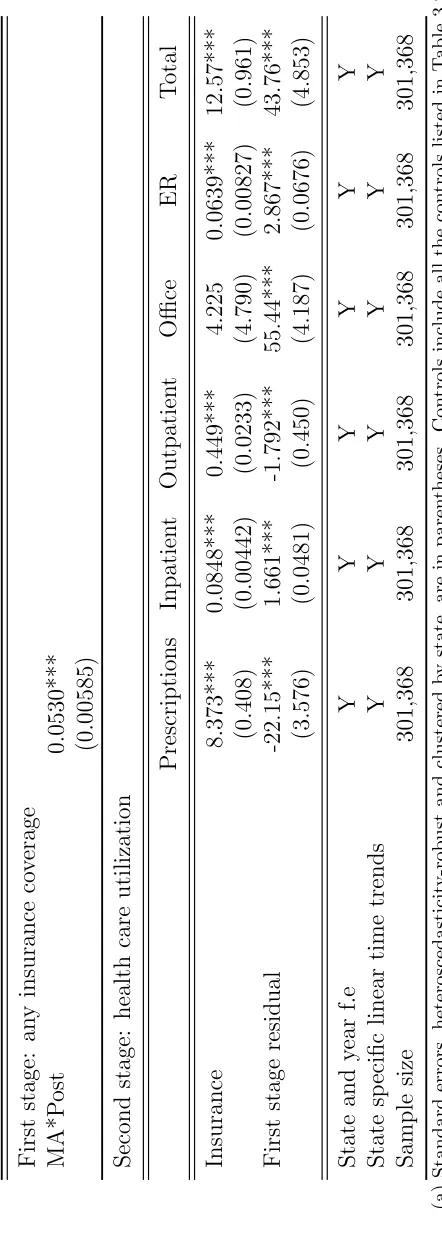
2.14 Instrumental variables . . . 90
3.1 Summary statistics for outcome variables for all the samples . . . 91
3.2 Summary statistics for control variables . . . 92
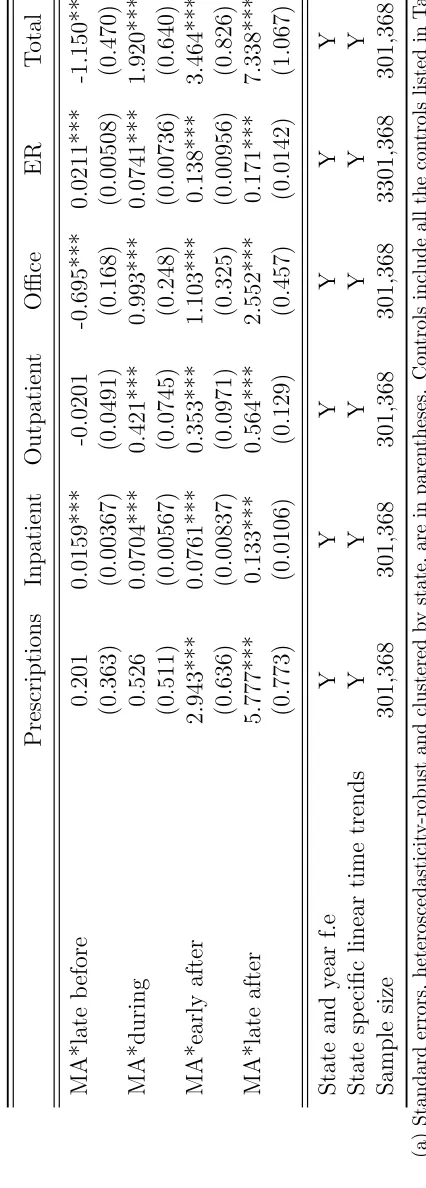
3.3 Effects of ACA on probability of having insurance coverage: LPM results . . 93
3.4 Effects of ACA on health care utilization of counts between 2013-2014: Aver-age marginal effects from negative binomial . . . 94
3.5 Effects of ACA on health care utilization of counts between 2014-2015: Aver-age marginal effects from negative binomial . . . 95
3.6 Effects of ACA on health care Utilization of Counts Between 2013-2014: Av-erage marginal effects from poisson . . . 96
3.7 Effects of ACA on health care utilization of counts between 2014-2015: Aver-age marginal effects from poisson . . . 97
3.8 Effect of ACA on health care expenditures 2013-2014: Average marginal ef-fects from two-part model (First part: Probit, Second part: GLM with a log link and gamma family) . . . 98
3.9 Effect of ACA on probability of health care utilization 2013-2014: Average marginal effects from probit model . . . 99
3.10 Effect of ACA on probability of health care expenditures on the intensive margin 2013-2014: Average marginal effects from GLM . . . 100
3.11 Effect of ACA on health care utilization of counts 2011-2012: Average marginal effects from negative binomial . . . 101
3.12 Effect of ACA on health care utilization of counts 2012-2013: Average marginal effects from negative binomial . . . 102
A1.1 Other medicines Ages 18-39 (Extensive margin) . . . 104
A1.2 Other medicines Ages 40-64 (Extensive margin) . . . 105
A1.3 Other medicines Ages 65+ (Extensive margin) . . . 106
A1.4 Other medicines Ages 18-39 (Intensive margin) . . . 107
A1.5 Other medicines Ages 40-64 (Intensive margin) . . . 108
A1.6 Other medicines Ages 65+ (Intensive margin) . . . 109
A2.1 Effects of the reform on health care utilization of counts: Average marginal effects from poisson . . . 110
A2.2 Regressions with aggregated data . . . 111
Chapter 1
The Effects of Medical Marijuana
Laws on Utilization of Prescribed
Opioids and Other Prescription Drugs
1.1
Introduction
Between 1996 and 2017, 29 states and the District of Columbia enacted laws that
legalized the medical use of marijuana. Eight states and D.C. legalized recreational use and
19 states and D.C. have operating dispensaries. The total estimated value of legal marijuana
sales in the United States was $5.7 billion in 2015 and $7.1 billion in 2016 (Arcview, 2017).
The market is projected to grow as more than half of the U.S population now lives in
a state where marijuana is legalized either medically or recreationally. Understanding the
consequences of legalizing marijuana as a medicine is important as more states are discussing
new medical marijuana laws (MMLs) in the near future. However, all these ongoing
pro-marijuana policies are founded on limited scientific evidence on pro-marijuana's effects on health
due to the federal government's classification of marijuana as a Schedule 1 substance, which
imposes significant barriers to conducting randomized controlled trials with human subjects
Despite the limitations, there is some evidence suggesting that marijuana can
im-prove several health conditions and symptoms like nausea and vomiting, loss of appetite,
depression, anxiety, chronic pain, and muscle spasms, as well as regulate sleep.1 Prior
stud-ies generally find that the most reported reason for using medical marijuana among medical
marijuana patients is the relief of pain, and most of those who use it for pain relief use it
to-gether with their opioid-based prescriptions.2 According to a recent survey from a database
of medical marijuana patients conducted by Reiman et al. (2017), 63% of participants
re-ported using marijuana for pain-related conditions. 30% rere-ported using an opioid-based drug
and of those 61% reported using it with marijuana. In addition, more than 97% of their
sample agreed they were able to decrease the amount of opioids they consume when they
also used marijuana. 53% of their participants were between 20 and 39 years old.
Allowing marijuana as an option to treat pain and other symptoms can have two
opposing effects on people's prescription opioid and other drug utilization. First, it can
reduce utilization by inducing people to substitute away from prescriptions to marijuana.
Second, MMLs can act like direct-to-consumer prescription drug advertising, inducing people
to seek medical help for their conditions, which in turn increases demand for prescriptions.
This paper examines if MMLs influence prescription drug utilization with a
partic-ular focus on opioids; a category of powerful pain-reducing medicines with severe risks of
addiction, abuse, overdose and death.3 Using Medical Expenditure Panel Survey (MEPS)
household and prescribed medicine files, I estimate the effects of MML implementation and
1Whiting et al. (2015); Borgelt et al. (2013); Jensen et al. (2015); Institute of Medicine (1999), Amar
(2006), National Academies, (2017).
2Reinerman et al. (2011), Reiman et al. (2017).
3According to Centers for Disease Control (CDC), half of all U.S. opioid deaths involve a prescription
its provisions on utilization of prescribed opioids by exploiting the variations in MMLs across
states over time. For my main analysis, I show results from two-part models, jointly
estimat-ing the extensive and intensive margins of prescribed opioid expenditures and their effects
on each part of the model separately. I then examine MMLs' effects on utilization of other
categories of drugs for which medical marijuana is a plausible substitute. Studying the
ef-fects on these other prescriptions is also important because they make up a large portion of
overall health care expenditures.
My main results indicate that MMLs significantly decrease expenditures on opioids
among young adults (ages 18-39) by $2.47 per person over a year. This decreasing effect
results from the significant decrease on the intensive margin, implying that rather than
quit-ting opioids altogether, young adults continue to use them with marijuana. States allowing
home cultivation of marijuana experience even larger decreases in opioid expenditures.
Fur-thermore, these decreasing effects of MMLs on opioid expenditures are persistent over time
and they get stronger following the years of MML implementation. The results are similar
when we consider the effects on the total amount of prescribed opioid pills. Namely,
imple-mentation of a MML decreases the total amount of prescription opioid pills by 2.16 pills per
person over a year among young adults. I find no discernible effect of MMLs on the opioid
utilization of older populations.
I then estimate MML's effects on utilization of other prescription drugs and find that
MML states which allow retail dispensaries generally experience decreases on spending for
the drugs which marijuana can substitute among young adults. MML is also associated with
significant decreases in sedatives among elderly population (ages 65+). The results from
other prescription drugs mostly depend on age and the level of access MMLs provide to
marijuana.
Based on my findings MMLs can potentially alleviate the problems associated with
looser restrictions, especially those that allow greater access by legalizing dispensaries and
allowing home cultivation, can reduce excess medical costs associated with adverse drug
events4, which cause more than 1 million emergency department visits and cost$3.5 billion
each year (Aspden et al. 2007). The third reason why MMLs can be useful is because it can
reduce the costs on the insurance pool. Medical marijuana is not covered by insurance like
prescription drugs. If people switch to marijuana they pay it out of pocket. If MMLs turn a
public health care cost into a private cost this can be welfare increasing by internalizing an
externality.
The paper proceeds as follows. Section 2 summarizes the existing literature and
provides background information on prevalence of marijuana on health and the evidence on
its substitutability with opioids. Section 3 outlines the theoretical framework by laying out a
simple patient-physician interaction in an MML state and gives some testable implications.
Section 4 describes the data, variable measurement, and identification strategy. Section 5
shows primary results of the effects of MML on opioids and Section 6 presents sensitivity
analyses and examines effects on other prescriptions. I conclude with a summary of my
findings and implications for future medical marijuana policy design in Section 7.
1.2
Background
1.2.1
Medical uses of marijuana and substitutability with opioids
The National Sciences report of 2017 systemically reviewed the most recently
pub-lished studies since 2011 that were “fair-and-good quality” in reaching conclusions on the
4An adverse drug event (ADE) is an injury resulting from medical intervention related to a drug. This
health effects of cannabis.5 The report finds: 1) conclusive evidence that cannabis is effective
in reducing chronic pain in adults, cancer-induced nausea and vomiting and patient-reported
spasticity symptoms, 2) moderate evidence that cannabis is effective in improving short-term
sleep outcomes, and 3) limited evidence that cannabis is effective in improving symptoms of
anxiety and post-traumatic stress disorder.
Whiting et al. (2015) did a meta-analysis from a total of 79 trials (6462 participants)
and reported the following findings: 1) moderate-quality evidence to suggest cannabis was
beneficial for the treatment of chronic neuropathic or cancer pain and spasticity due to
mul-tiple sclerosis, 2) low-quality evidence to suggest cannabis was associated with improvements
in cancer-induced nausea and vomiting, weight gain in HIV and sleep disorders, and 3) very
low-quality evidence to suggest cannabis was associated with improvement in anxiety.
Given the risks and problems associated with opioid use and the growing acceptance
of using marijuana as a medicine it is natural to ask two questions: 1) Can marijuana be
a substitute for opioid-based medicines, and if so 2) do people really substitute away from
opioids to marijuana? The literature from clinical studies and with selected samples from
medical marijuana patients suggests that medical marijuana patient may substitute opioids
for marijuana.
Abrams et al. (2011) study the cannabis-opioid interaction drawing evidence from 21
patients with chronic pain. They conclude that cannabis augments the pain relieving effects
of opioids and their combination may allow for opioid treatment at lower doses with fewer
side effects. Drawing evidence from an open-label clinical research trial, Haroutounian et al.
(2016) found treatment of chronic pain with medicinal cannabis resulted in improved pain
outcomes and a significant reduction in opioid use.
5Scientific literature refers to marijuana as cannabis. I use the terms “marijuana” and “cannabis”
In addition to the clinical results above, there is suggestive evidence that medical
marijuana patients change their opioid use in response to medical marijuana use. Studies
involving surveys of medical marijuana patients report that the most common reason patients
cited for using medical marijuana was the relief of pain (Reinerman et al. 2011; Reiman et
al. 2017). Reinerman et al. (2011) find 79.3% of the medical marijuana patients reported
having tried other medicines presented by their physicians and almost half of them were
opioids. Reiman et al. (2017) find 30% of their sample reported using an opioid-based
medication currently or in the past six months and out of those 61% reported using it with
cannabis. More strikingly, they report that 92% of the sample “strongly agreed/agreed”
that they prefer cannabis to opioids and 93% “strongly agreed/agreed” that they would be
more likely to choose cannabis for opioids to treat their condition. Boehnke et al. (2017)
find medical cannabis use was associated with a 64% decrease in opioid use among medical
marijuana patients with chronic pain between 2013 and 2015 in Michigan.
Although there is some evidence that availability of marijuana decreases the use of
opioids, it is hard to extrapolate these results from the above studies to wider populations
since their conclusions are based on small and selected samples that rely on self-reported
outcomes.
1.2.2
Effects of MMLs and contribution of this study
Although the literature on MMLs is rich, the effects studied are mostly focused on
their unintended consequences, such as recreational marijuana use, alcohol consumption,
initiation by youth, drunk driving, cigarettes and other substance use. Lynne-Landsman et
al. (2013) show no effects of MMLs on adolescent marijuana use in the first few years after
their enactment using the National Youth Risk Behavioral Surveys (YRBS). Anderson et
Episode dataset, and National Longitudinal Survey of Youth 1997. They find MMLs were not
associated with an increase in marijuana use among teenagers. Anderson et al. (2013) found
a significant and negative relationship between MML and traffic fatalities, especially for
those involving alcohol. Pacula et al. (2015) re-examine the effects of MMLs on recreational
marijuana use by adult and youth populations and they also examine different provisions
of MMLs. They report that treating MMLs as one dichotomous variable hide the effects of
different provisions of MMLs. They show that not all MMLs are the same and the provisions
of the law matter. In particular, they find that the MMLs that legally protect dispensaries
can increase recreational marijuana use and abuse among adults and youth compared to
MMLs that do not protect this supply source. Wen et al. (2015) show estimates from
the National Survey on Drug Use and Health (NSDUH) and report that MMLs increase
marijuana use and abuse among people who are 21 and older and initiation in younger
populations. They also find MMLs increase binge drinking for 21 and above but have no
effect on psychoactive substance use in either age group.
The MML literature on problematic opioid use is less comprehensive. Bauchhuber
et al. (2014) examined state-level death certificates in the U.S. between 1999 and 2010
and found that states with MMLs had lower mean annual opioid overdose mortality rates
compared with states without them. Powell et al. (2015) studied the effects of MML on
problematic opioid use and found that broader access to marijuana reduced the abuse of
highly addictive painkillers. Smart (2015) finds that growth in the supply of medical
mar-ijuana decreases opioid poisonings for adults between 45 and 64 by 12-16%. Yuan (2017)
finds MMLs were associated with 23% and 13% reductions in hospitalization related to
opi-oid abuse and overdose respectively. These studies all involve outcomes of people on the
margins of abusive and possibly non-medical use. In this paper, I will show the effects on
outcomes involving prescribed opioid use from a sample which represents the U.S population
The literature examining the effects on prescription drug use more broadly is very
limited. Bradford and Bradford (2016) examined data on all prescription drugs filled by
physicians for the Medicare Part D enrollees from 2010 to 2013. They find that MML
implementation led to significant reductions in daily doses filled per physician in seven drug
categories for which marijuana can serve as an alternative. These conditions include anxiety,
depression, nausea, pain, psychosis, seizures and sleep disorders. In another paper Bradford
and Bradford (2017) find significant negative associations between the presence of MML
and quarterly logged average prescription units filled for the aforementioned drug categories
among the Medicaid population from 2007 to 2014.
I extend the studies from the Bradford and Bradford articles in several ways. First,
my analyses span 1996 to 2014, giving me a richer source of policy variation. During those
19 years, 23 states and D.C implemented MMLs and this relatively longer time horizon also
enables me to estimate the long run effects of MMLs. Second, my observations are
represen-tative of the U.S population instead of consisting of patients on Medicaid and Medicare with
positive spending. I will show the effects of MMLs on the extensive and intensive margins
separately. It is plausible that MMLs affect prescription use differently on these two margins
since the decisions on the probability of use and amount of use are decided by different
agents. Third, this paper will investigate isolated effects of different MML provisions. Prior
research suggests heterogeneity in MMLs lead to different effects which indicates that the
design of these laws is essential in analyzing the costs and benefits of MMLs. Lastly, I focus
explicitly on the utilization of opioids, defining utilization in terms of expenditures and pills
both. Knowing how MMLs change the utilization of prescribed opioids and other
prescrip-tion drugs is not only important for the analysis of MMLs but also important within the
context of the growing trend of prescription drug costs and the costs associated with their
1.3
Theoretical Framework
There are many mechanisms through which MMLs and their provisions can affect
the demand of prescription drugs for which marijuana can be a substitute. The first and
most obvious effect would be that patients with these conditions will seek their physicians'
recommendation to substitute their prescriptions with marijuana. However, having a MML
in place may also encourage a fraction of people who also had the conditions/symptoms but
for some reason did not visit a physician before a MML was enacted. Enactment of a MML
may serve to inform these people about their existing conditions and to seek medical help
just like how direct-to-consumer advertising of prescription drugs would. Due to
informa-tion asymmetry, the physician is the agent of the patient and she will make the decision
whether to and if so, how much to prescribe/recommend an FDA-approved prescription or
medical marijuana. Given marijuana's classification as a Schedule 1 drug, and the resulting
absence of scientific evidence and incentives that the physician would have if she prescribed
prescriptions supplied by the pharmaceutical firm (low cost of information due to heavy
advertising/detailing/scientific evidence/habit formation, less risk), some physicians will be
reluctant to substitute it.
Following Brekke et al. (2006), I assume there is a continuum of patients with a
condition in a therapeutic drug market which marijuana can have a potential to treat on
the line segment [0, 1]. The location of the patient x ∈[0,1] is associated with his condition
and personal characteristics. They all need either a prescription drug (Rx=0) or medical
marijuana (m=1). Rx and m are located at the either ends of a unit interval [0, 1] and
are indexed as i. This classification of 0 and 1 only reflect their chemical compounds and
the treatment effects. I assume the patient's utility takes the following linear form when he
takes the treatment i:
where the parameter υ represents the effectiveness of drug i. I assume that both treatments
Rx and m have the same effectiveness but they differ in their treatment effects to a given
x. τ represents the weight given to the utility loss that is realized due to the mismatch
between the condition x and the treatment choice (the distance between the condition and
the treatment choice). These can be thought of as side effects. I assume that v and τ are
both positive. Ci represents the out-of-pocket cost for the treatment.
Consider a population of people who have a condition and letz ∈[0,1] be the fraction
of patients who already saw a doctor related with their condition and (1-z) the fraction of
patients who have the condition but did not see a doctor yet (potential patients). When
states adopt MMLs this can serve as a marijuana advertisement inducing some of these
potential patients to be aware of their conditions and encourage them to go to the doctor's
office. Letφ∈[0,1] be the fraction of patients who receive information about the legalization
of medical marijuana in their state. I assume all patients need a treatment, whether medical
marijuana or a prescription drug. Only potential patients who have not heard about MMLs
will not go to a doctor's office. The fraction of patients who go to the doctor's office for
treatment is then N=z+(1-z)φ.
I assume all physicians face the same distribution of patients. Once the patient goes
to the physician, the physician asks questions to determine the patient's type; his location
x ∈ [0,1]. After observing the patient's type the physicians can either recommend medical
marijuana or prescribe a drug. I assume there are two type of physicians. The first physicians
who will not recommend medical marijuana no matter how much the patient insists; I call
them “Type 1 physician” and denote their share as θ. The second is physicians who are
willing to recommend marijuana if the patient insists. I call them “Type 2 physicians” and
Consider a type 1 physician who will not recommend marijuana in any case. I assume
her utility function takes the linear form below;
Uphysician(x, Rx) =bRx+γUpatient (1.2)
wherebRx denotes the private benefit she receives from prescribing the prescription drug and
γ denotes the weight she puts on her patient's utility. Plugging the patient's utility given in
equation (1) type 1 physician will prescribeRx to the patientx only if the following is true:
Uphysician(x, Rx)≥0 ⇐⇒ bRx+γυ−γτ x−γCRx ≥0 (1.3)
If Uphysician(.)<0, then the physician will recommend a different treatment or no
treatment at all. Consider a type 1 physician who is indifferent between prescribing and not
prescribing. Solving (3) we get
˜
x= bRx+γυ−γCRx
γτ (1.4)
She will prescribe the drug if the patient x is on the interval [0,˜x] and not prescribe if the
patient is between [˜x,1].
Now consider a type 2 physician who considers marijuana as an alternative to Rx.
She will recommend marijuana (m) instead of Rx only if the following condition holds:
Uphysician(x, m)≥Uphysician(x, Rx) ⇐⇒ bm+γ(υ−τ(1−x)−Cm)
≥bRx+γ(υ−τ x−CRx)
(1.5)
wherebmdenotes the private benefit (or cost – e.g., her time cost of searching for information
recommending medical marijuana andCm denotes the financial cost of medical marijuana to
the patient. Let ˜xdenote the patient for whom the physician is indifferent in recommending
m vs. prescribingRx. By solving (4) we get;
ˆ
x= 1
2−(
γ(CRx−Cm) +bm−bRx
2γτ )
This means the physician will recommend marijuana if the patient x is located on [ˆx,1] and
prescribe Rx if he is on [0,ˆx]. Since the physician will not recommend m or prescribe Rx if
her utility is not positive the condition
bm+γ(υ−τ(1−xˆ)−Cm) =bRx+γ(υ−τxˆ−CRx)≥0
must hold. This is satisfied when ˜x≥xˆ.
Proposition 1 Entrance of medical marijuana as another treatment option will decrease
the ‘mismatch’ between a given therapeutic condition and the prescription drug substituting
marijuana with prescription drugs.
Proposition 2 Substitution effect; x˜-xˆ≥0 will be higher for more expensive drugs and/or
for drugs which treat conditions that are not a good match with the prescription drug (or
drugs with more severe side effects).
Proposition 3 In states where the patient's cost of obtaining marijuana is lower (small
Cm) and physician's benefit of recommending it is higher (or lower cost of recommending,
From the physician's choices above we can derive the shares of patients who get Rx
and m respectively,
MRx = [z+ (1−z)φ]∗[θx˜+ (1−θ)ˆx] and,
Mm = [z+ (1−z)φ]∗[(1−θ)(1−xˆ)].
If a MML was not enacted the share of the patients who would be onRx would simply
be zx˜. The difference between the share of prescription drugs after and before the MML
then would be ˜x[θφ(1-z)+z(θ-1)]+ˆx(1-θ)[z+(1-z)φ]. A high enough θφ (the fraction of new
patients who visit the type 1 physician) could increase the prescription drug shares after the
MML.
Proposition 4 If the share of new patients that visit the type 1 physician (θφ) is high enough
prescription drug utilization can increase after the MML.
Proposition 5 For prescription drugs which are already a good match with a given condition
(less severe side effects), utilization can increase after the MML.
1.4
Estimation
To determine the effects of MMLs on prescription drug spending I use prescribed
medicine event-level data linked to person level data from the Medical Expenditure Panel
Survey (MEPS) spanning 1996 to 2014. Starting from 1996, MEPS collects detailed
in-formation for each person in selected households. This inin-formation includes demographic
characteristics, health insurance coverage and income. MEPS Prescribed Medicine Files
contain pharmacy-provided information on names of prescribed medicines obtained, their
therapeutic class and sub-class, total amount paid for the prescribed medicines and source
The MEPS is a nationally representative panel survey and it has an overlapping panel
design. A new panel of sample households is selected each year and they are surveyed for
two years. I acquired the unrestricted version of MEPS with state identifiers and merged the
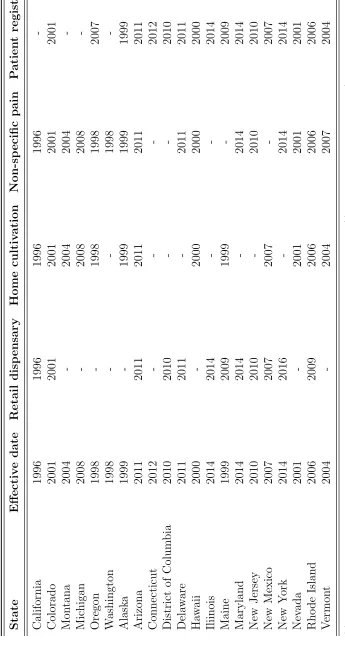
state-and year-level MML variables. As seen in Table 1.1, 23 states and D.C implemented
MMLs during the study period.
Since the literature suggests that there is relatively stronger evidence of marijuana
as a painkiller and the fact that the majority of medical marijuana patients use it for their
pain, specifically preferring it to opioid-based painkillers, I choose the main outcome variable
as the total amount of dollars spent on opioid-based medicines. Focusing on opioids is also
important from a policy perspective considering the costs associated with opioid misuse.
The key independent variables are indicators for MML implementation (effective
dates) in a given state and year and its individual components. As noted by Pacula et
al. (2015), MML states differ highly in how they allow medical marijuana and ignoring
the heterogeneities in these policy dimensions that exist both across time and states can
mask their heterogeneous effects and the mechanisms through which MMLs affect
utiliza-tion. Following Pacula et al. (2015) and Wen et al. (2015), I analyze the effects of four
key components that can lead to heterogeneity in prescription drug utilization: i) a “retail
dispensary” provision, an indicator of whether the state's MML explicitly allows/protects
dispensaries to dispense marijuana to medical marijuana patients, ii) a “home cultivation”
provision, an indicator of whether a state's MML allows the medical marijuana patient to
cultivate a certain amount of marijuana, iii) a “non-specific pain” provision, an indicator
of whether the state's MML lists any chronic pain or intractable pain in the eligible
condi-tions for medical marijuana instead of specifically listing the condicondi-tions associated with the
pain, and iv) a “patient registry” provision, an indicator for whether a state's MML requires
costs of obtaining medical marijuana of the patient as well as marijuana's perceived risk and
appropriateness for recommendation from the physician's view.
I control for individual and state level factors that are correlated with prescription
drug spending and with state decisions about MMLs. Individual-level covariates include a
rich set of sociodemographic and economic characteristics. State-level covariates include four
time-varying measures reflecting the variations in state economic conditions between 1996
and 2014: i) state unemployment rate, ii) state median household income, iii) state average
personal income, and iv) state uninsured rate. I include two policy variations during the
study period that can affect prescription drug spending and MML implementation. These
state-level policy variables include indicators for operational prescription drug monitoring
programs (PDMPs) and the implementation of a marijuana decriminalization/depenalization
in a state.
After pooling all the year, collapsing the prescribed opioid transactions at the
year-and person-level year-and excluding people under the age of 18, I have a sample of 435,035
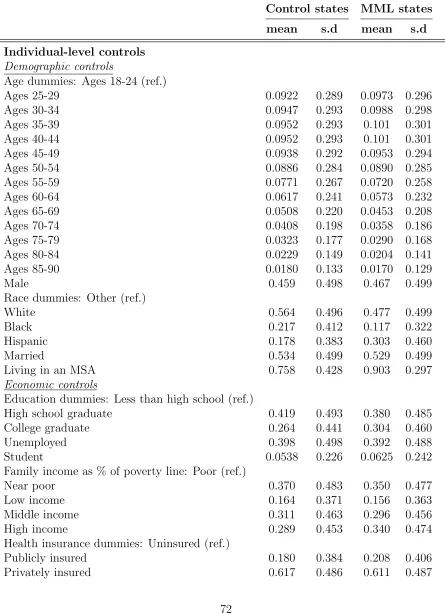
person level observations. Tables 1.2 and 1.3 show the summary statistics for dependent and
independent variables.
1.4.1
Data characteristics and two-part model
Like other health care utilization data, prescription drug utilization distributions tend
to be skewed because 1) there cannot be negative spending, 2) there is a mass at point zero
for non-users, 3) patients with more severe conditions use substantially more on prescription
drugs than those with less severe conditions, and 4) there can be a small number of patients
with astronomical spending due to catastrophic health conditions. Health economists often
use log-transformed models to deal with these types of skewed outcomes. Other approaches
Certain transformations such as logging are not appropriate, especially when there is a large
mass of zeros. First, adding an arbitrary constant to observations is not recommended, and
second, using one-part models implicitly assume that observations with zero outcomes are
similarly affected by covariates as nonzero outcomes. These models are shown to behave
poorly compared to multi-part models (Duan et al. 1983; Mihaylova et al. 2011).
Due to the presence of the zero mass of non-users in the data, I use a two-part model
approach. The two-part model splits the prescription spending into two parts and applies
the basic rule of probability in estimating the parameters in the conditional mean function
E(y|x)=Pr(y>0|x)×E(y|y>0,x).
Figure 1.1 shows the nonlinearities in the distribution of opioid spending. There is a
large mass of non-users (approximately 90%), and the spending from users is skewed to the
right even after logging.
Since health care utilization data show heteroscedasticity, a re-transformation that
assumes homoscedastic, normally distributed log-scale error terms will give biased results.
Due to the complications that can arise with estimating the correct form of
heteroscedas-ticity, I avoid using OLS on logged outcomes with heteroscedastic retransformation and use
GLM for consistent estimation instead. The advantages of using GLM compared to models
with transformations are more broadly discussed in Manning and Mullahy (2001) and Jones
(2000).
GLM extends the classical linear models in two ways. First, it allows the dependent
variable to be distributed with any exponential family. Second, it allows for any monotonic
differentiable function of the dependent variable to vary linearly with the covariates (the link
function), rather than requiring the dependent variable itself to respond linearly (McCullagh
and Nelder 1989). Another advantage of using GLM is that it gives predictions on the raw
health care utilization and costs with GLM is a common approach in the literature (e.g.
Goda et al. 2011; Chandra et al. 2014; Strumpf et al. 2017).
For the baseline model, I use probit estimation, shown below, to estimate the
proba-bility of being a prescription drug user:
P r(Yiast>0|X) = Φ(Xβ)
where Yiast is the binary variable equal to one if the consumption for a person i living in
state s in year t for the drug category a is positive and zero otherwise. X is a vector of
explanatory variables including all the control variables in Table 3, state and year fixed
effects and state-specific linear time trends to capture the state-level factors that evolve over
time at a constant rate.
For the intensive margin, I use GLM models with log-link and gamma family to
estimate the amount of spending conditional on being a user as shown below:
E(Yiast|Yiast >0, X) = exp(Xγ)
where Yiast denotes the prescription drug spending for person i for drug categorya in state
s and year t, whileX denotes the same vector of covariates as in the first part.
As suggested by Manning and Mullahy (2001), I used modified Park tests to determine
the relationship between the conditional variance and the conditional mean functions, namely
the parameter δ in Var[Yiast|Yiast>0,X]=α[E(Yiast | Yiast >0, X)]δ. In all drug cases, ˆδ was
closest to 2 implying the gamma family.
Standard errors in all regressions are robust to heteroscedasticity and they are
the errors to be correlated within states while allowing them to be independent across states
(Bertrand et al. 2004).
As the main results, I report the combined marginal effects from both parts of the
model6
E(Yiast|X) = P r(Yiast|X >0)×E(Yiast |Yiast>0, X)
This setup models the difference in utilization on the original scale of the dependent
variable (dollar amount) yielding estimates that are readily interpretable. It also allows
for heteroscedasticity where Var(Expenditure|X) depends on the mean level of conditional
expenditures,E(Expenditure|X).
I also report the results from probability of use and amount of use separately. It
is possible that MMLs (and their provisions) have opposite effects on each margin of use,
especially if they act as an advertisement and encourage people to visit doctors who then
prescribe them drugs, increasing the probability of utilization, while decreasing the amount
of utilization by the users that are already on these drugs. If MMLs have opposite signs in
different parts, then it would be possible for the marginal effect to be significant in isolated
parts of the model along with the combined marginal effect being insignificant.
According to the CDC, prescription drug utilization is highest for people age 65 and
older, and there are substantial differences in utilization based on age. I stratified the sample
into three age groups because prescription drug utilization varies largely depending on age,
and lumping everyone in the same sample obscures this heterogeneity (Kantor et al. 2015).
The samples are ages 18-39 (N=186,144), 40-64 (N=180,723) and 65 and older (N=68,168).
Because there are stricter barriers for minors to obtain medical marijuana and the fact that
they are much less likely to have the conditions for which marijuana can be beneficial, I
exclude people younger than 18 from the sample.
6I used STATA's twopm command developed by Belotti et al. 2015 to obtain the combined marginal
1.5
Primary Results
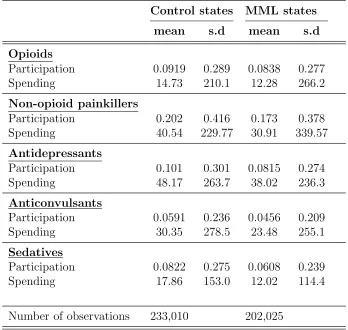
Table 2 presents the means of the main outcome variable of opioid spending along
with the drug categories that marijuana can potentially replace for the full sample. Both the
probability of any spending and the amount of spending conditional on positive spending on
opioids and other potentially marijuana substitutable prescriptions are lower in MML states
compared to control states.
To determine whether these differences are driven by MMLs, I estimate two different
models. First, I show results from the models that only include any MML, and in the second
I report the results from the model which only include its provisions. I also report a model
that simultaneously estimates all provisions and MML, but due to collinearity when the fixed
effects are included, I do not report these results as main findings.7
For my analyses I show results from two-part models instead of OLS on the whole
sample for three reasons. First, many people in these samples do not use these prescription
drugs, and part models explicitly model this large mass of non-users. Second, the
two-part model yields lower Akaike information criterion. Third, the two-two-part model gave better
out-of-sample predictions compared to OLS. I also run joint significance tests where the null
hypothesis is the coefficients from the four provisions of MMLs are jointly equal to zero
and report their p-values. I perform these tests for the models that include indicators for all
provisions and an indicator for existence of any MML. The motivation is to test whether these
provisions jointly explain variations which are not captured by a generic MML indicator.
Tables 4 through 6 show the effects of a MML and its provisions on the different
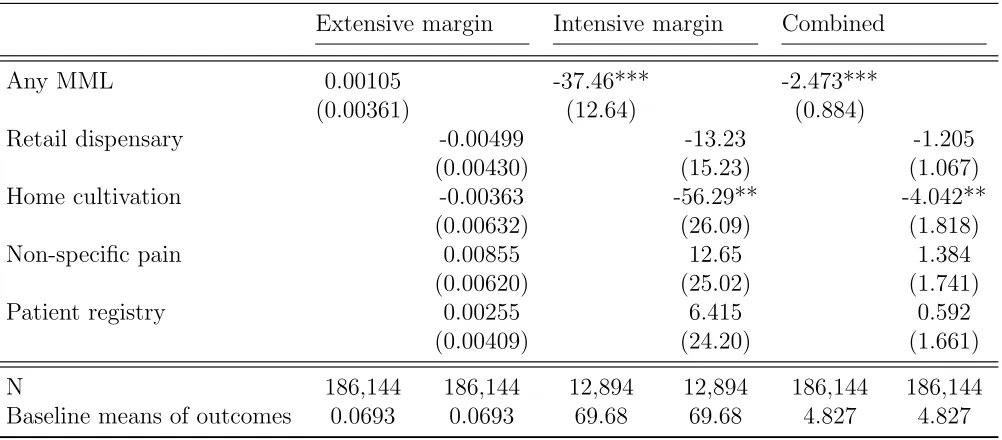
margins of opioid spending among different age groups. According to the results in Table
4, a MML has no discernible effect on the probability of using opioids in young adults (ages
18-39). Although the coefficient on “any MML” is positive, it is insignificant. Similarly,
7Also, the interpretation of “any MML” becomes difficult in this model. These results are available upon
none of the provisions show any discernible effects. However, there is a significant decrease
in opioid spending on the intensive margin. Namely, among young adult users of opioids
there is a decrease of $37.46 per person over a year associated with the passing of MML,
which translates to a 53.7% decrease from the baseline mean of opioid expenditures. Looking
at the model which includes its provisions we can see that “home cultivation” is the main
driver of this decrease with an even larger and significantly negative effect. Although “retail
dispensary” has negative effects, its coefficient is not precisely estimated. The last two
columns in Table 4 report the combined effects of MML and its provisions on the overall
population bringing the two parts together. Implementation of a MML significantly lowers
opioid spending in the overall population of young adults by $2.47 per person over a year.
Focusing on the effects of individual provisions in states where home cultivation is allowed,
young adults use $4 less of opioids per person holding all other provisions constant. The
“home cultivation” provision appears to be the main driver of the decreasing effect of MML
on opioids among young adults and these effects result from the intensive margin of use.
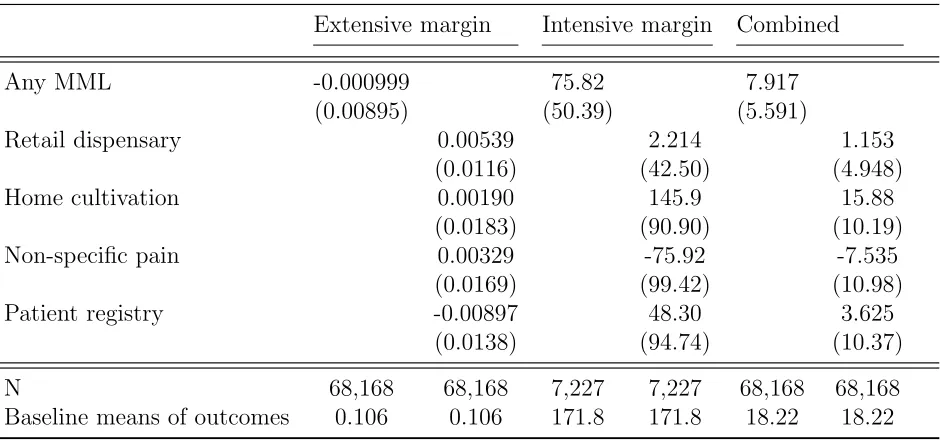
Tables 5 and 6 show there is not much evidence that a MML and its provisions significantly
change opioid spending among middle age (ages 40-64) and elderly people (ages 65+). The
only significant effect is found among middle age people. Namely, in states where the law
allows retail dispensaries, there is a 1.4% point drop in the probability of using opioids among
this group when we hold the other provisions fixed (a 14% decrease from the baseline mean).
As pointed out by earlier literature, most medical marijuana patients are younger adults so
it makes sense that we see a significant drop in opioid spending among younger populations
and almost no effect among older people.
The above analyses show independent effects of the four provisions, but states have
combinations of these provisions. Table 7 shows linear combinations of the marginal effects
from various combinations of the four provisions for each age group on the overall spending
effects of “home cultivation,” “non-specific pain” and “retail dispensary” provisions.
Cali-fornia is a state with this type of MML. CaliCali-fornia's type of MML is effective in reducing
opioid spending among young adults by $3.86 per person over a year and has no effect on
older populations. Second, I examine the effects of “retail dispensary,” “home cultivation,”
“non-specific pain” and “patient registry” provisions. Colorado is an example of a state with
such a MML. Colorado's type of MML is effective in reducing opioid spending among young
adults by $3.27 per person over a year. Next, I examine the combined effects of “retail
dispensary,” “non-specific pain” and “patient registry” provisions (New Jersey-type) and
combined effects of “home cultivation,” “non-specific pain” and “patient registry”
(Alaska-type). Both New Jersey's and Alaska's types of MML are not associated with any significant
decreases in reducing opioid spending.
A California-type MML which allows home cultivation, legalizes and protects
dispen-saries, and imposes no restrictions such as having a specific type of pain to be eligible or
requiring a registry of the patient is one of the least strict types of MML.8 It is also the
type of MML that reduces opioid spending the most among young adults, as measured by
the amount of dollar reduction in this study. Although not as loose as California's MML,
Colorado's type of MML is also one of the loosest models and associated with decreases in
opioid spending comparable to California's.
These results from the combined effects of provisions indicate the effects of MML
are not uniform but depend on the different combinations of provisions, consistent with
Pacula et al. (2015). The types of MMLs with the most generous provisions, which include
the protection and allowance of dispensaries with home cultivation, seem to be the most
effective types of MMLs in decreasing spending on opioid prescriptions.
8I also check whether the overall reductions in opioids were driven by California alone. The estimates
1.6
Additional Analyses
Up to this point I have shown that the response of total prescription opioid
expendi-tures to MMLs depends on the age of the users and the margin of use. The point estimates
from combined marginal effects point decreases in spending on prescription opioids
associ-ated with MMLs among young adults. To further assess the validity of this finding, I perform
two types of sensitivity and two other additional analyses by exploring (i) the timing of the
policy implementation and policy endogeneity, (ii) the effects of MMLs on the number of
total opioid pills acquired instead of expenditures, (iii) the effects of MMLs and their
provi-sions on spending on other prescription drugs for which marijuana can potentially be used
as a substitute and (iv) the effects of MMLs and their provisions on prescription drugs for
which MMLs are not supposed to have any effect.
1.6.1
Event studies
Here I replicate my baseline specification with two-part models for expenditures on
opioids adding lead and lag indicators. This flexible event study approach enables me to
investigate whether there are any pre-existing trends in opioid expenditures which are
en-dogenous to MML adoption. Furthermore, it shows if the law has differential effects over
time after a MML is adopted. I exclude the indicator for the last year prior to MML adoption
and set it equal to zero for normalization.
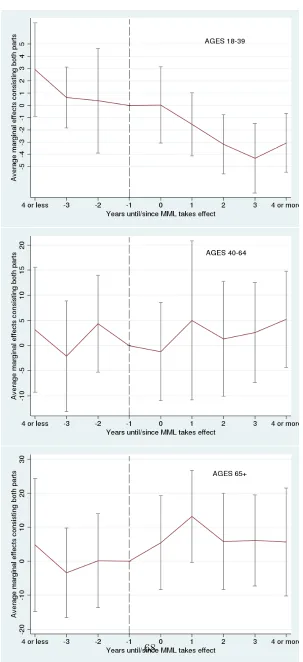
Figure 2 shows the estimated average marginal effects of the timing of the intervention
within four or more years before and after for each age group. The results for young adults
indicate there is a drop in prescription opioid expenditures after a year following the MML
adoption (relative to the year prior to adoption). The decreasing effect of a MML becomes
statistically significant after two years following the year it takes effect and continues to
maximum after three years. The decreasing impact of MML on opioids among young adults
is persistent over time with the long run difference being even larger than its instantenous
effect. There is not evidence of pre-existing trends: prior to intervention the effect of a MML
is indistinguishable from zero.
Turning to middle age and elderly populations there is not much evidence supporting
the hypothesis that a MML changes prescribed opioid expenditures over time. Among the
elderly population, a MML increases the opioid utilization after the first year of its adoption
(relative to the year prior to adoption), but this estimate is barely significant and it dissipates
the following years. There is not evidence of pre-trends before MML implementation in either
of these age groups.
These results from event study analyses support the main findings that MML
imple-mentation decreases the spending of prescription opioids among young adults but does not
have any discernible effect on older populations.
1.6.2
Effects on total number of opioid pills
So far, all the analyses were concerned with the expenditure outcomes for prescription
opioids. Although total expenditure is an important outcome from a government budget
spending perspective, it is not the only or the most complete measure of utilization. To
investigate whether the spending decreases in opioids associated with MMLs are attributed
to use rather than heterogeneous prescription drug prices, I perform analyses on total number
of prescribed opioid pills purchased using MEPS prescribed medicine files. Despite being an
imperfect measure of utilization, total number of prescribed opioid pills obtained can provide
some insights for the mechanisms of the effects found in main results.
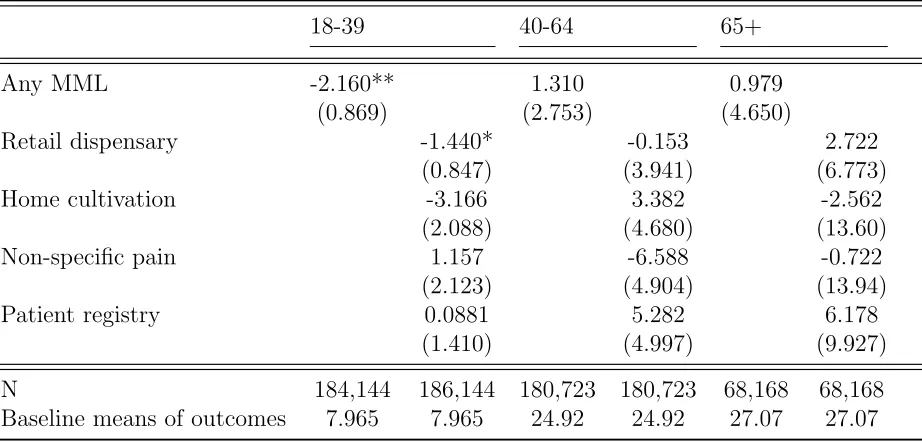
Table 8 shows the average marginal effects of MMLs from two-part models on total
decreasing effect of “any MML” on opioid utilization remains. Namely, the mere adoption of
MML decreases the number of prescription opioid pills in the young population by 2.16 pills
per person over a year, which is a 27% decrease from the baseline mean. We can see that
decreases from “any MML” on opioids among young adults mainly result from the effects
from “home cultivation” and “retail dispensary” provisions. The effects of MML and its
provisions are null among the older populations when the outcome variable is number of
pills instead of total expenditures.
Comparing these results we see that the effects of MMLs found on opioid pills support
the primary results found on the opioid expenditures: implementation of MML decreases
opioid utilization among young adults.
1.6.3
Effects on the utilization of other prescription drugs
Although the majority of medical marijuana patients report using marijuana for pain,
there exists suggestive evidence on marijuana's effects on other health conditions.
Further-more, Reinerman et al. (2011) report the other common reasons patients cite for using
medical marijuana were muscle spasms, headache and anxiety. Reiman et al. (2017) report
mental health conditions were the second most common reason for using medical marijuana
after pain. In the light of these findings I study the effects of MMLs on other prescription
drugs for which marijuana can be a potential substitute.
The non-opioid prescription drugs I examine fall under four major groups: non-opioid
painkillers, antidepressants, anticonvulsants and sedatives. These categories of drugs are
commonly prescribed and they treat the conditions medical marijuana states render eligible.
They are also examined by earlier studies (Bradford and Bradford 2016 and 2017). If MMLs
are causing people to switch from their prescriptions to medical marijuana, utilization of
analyses only include Medicaid and Medicare recipients who incurred positive expenditures
of prescriptions. Here, l extend the analyses to a broader population.
Tables 9 through 11 show the combined marginal effects of “any MML” and MMLs'
four main provisions on expenditures for other marijuana-substitutable prescriptions for each
age group. The mere implementation of a MML has no impact on other drugs, except a
barely significant spending decrease in sedatives among young adults by $1.47 per person
over a year and a significant decrease in sedatives among the elderly by $6.75 per person
over a year.
Focusing on the effects of the four main provisions of MMLs, “retail dispensary” and
“home cultivation” provisions are generally associated with significant decreases on
antide-pressant and anticonvulsant expenditures among young adults and the elderly. Having a
“non-specific pain” provision in a state's MML is associated with a significant increase in
sedative spending among young adults. This increase in sedative spending results from the
increase in the extensive margin: having a “non-specific pain” provision increases the
proba-bility of sedative use significantly. This could be attributed to “non-specific pain” provision's
creation of ambiguities in eligibility criteria and extension of the patient base to people with
relatively milder pain (or no pain), who later end up being prescribed other prescriptions
upon seeing the physician. In fact, a “non-specific pain” provision also significantly increases
the probability of using antidepressants and anticonvulsants among young adults.9
Having a “patient registry” provision offsets the increasing effects of a “non-specific
pain” provision in young adults' sedative spending by decreasing it by $4.51 per person
over a year. It also decreases the elderly's sedative spending by $10.18 per person over a
year. The decreasing effect of a “patient registry” provision seems odd at first, but it could
be due to three reasons. First, requiring the registration of the patient could make the
recommendation of marijuana less risky from the physician's viewpoint, decreasing her cost
of recommending it. Similarly, being registered by the state and having a medical marijuana
patient identification card can decrease the patient's risk of arrest from carrying marijuana.
Looking at tables 9 and 11, it is natural to ask why sedatives are the drug category that is
most sensitive to these provisions in young adults and elderly. As pointed out in Proposition
5 MMLs' effects depend on the “mismatch” (or side effects) associated with a prescription
drug class and the health condition it treats. Sedatives along with opioids are reported to be
a class of drugs with the most severe side effects.10 Furthermore, mental health conditions
and anxiety are found to be the second most commonly reported reason for using medical
marijuana among medical marijuana patients (Reinerman et al. 2011 and Reiman et al.
2017). Therefore, a MML and its provisions can decrease sedative utilization more relative
to other categories of drugs with less severe side effects for which marijuana can substitute.
1.6.4
Placebo tests
Here, I check the effects of MMLs on drug classes for which marijuana has no potential
to substitute. I perform these analyses to demonstrate that negative effects of MML only
exist for the drug classes for which marijuana can be a substitute and not for the other drugs.
Tables 12 through 14 show results for some of the other commonly prescribed drugs on which
MMLs should not have any negative effect. The commonly prescribed placebo drugs include
hormones, hypertension drugs, cardiovascular agents and acid reducers. The results generally
support the hypothesis that MMLs and their provisions do not decrease expenditures on other
drugs, although there are some statistically significant increases, especially with middle age
and elderly people. “Patient registry” is linked with decreasing spending in one of the tests,
although it is only marginally significant at the 10% significance level.
10According to the CDC, sedatives were involved in 31.7% of drug-poisoning ER visits between 2008 and
1.7
Conclusion
This paper shows that implementation of a MML by itself decreases opioid utilization
among young adults significantly, whether utilization is defined as spending or the number of
pills. Most of these reductions result from the intensive margin of utilization. The decreasing
effects of MMLs on opioids among young adults are persistent over time. They continue to
decrease opioid spending among young adults even four or more years after the year of their
implementation. The decreasing effects of MMLs are only observed among young adults
except for the allowance of retail dispensaries which decreases the probability of use among
middle age adults. MMLs also decrease sedative spending among the elderly. Given that
opioids and sedatives are the drug classes associated with the most severe cases of addiction
and adverse drug events, MMLs can be useful in alleviating the problematic use of these
prescriptions. Consistent with the prior literature, ignoring the heterogeneity in MMLs
can mask important effects of their individual provisions. States with the loosest MMLs
experience the biggest reductions in opioid utilization.
Despite growing trends of pro-marijuana policies, there remains a lack of scientific
evidence and consensus as to what extent marijuana affects health in the short and long
terms. Unlike prescription drugs, there are almost no guidelines on how to use marijuana
for medicinal purposes regarding its dosage, type, frequency and the method of its
consump-tion. Although states have been experimenting with different MMLs since 1996, conducting
randomized controlled experiments on marijuana with human subjects remains challenging
given its Schedule 1 categorization by the federal government.
There are several policy implications from this study. First, non-MML states with
high rates of opioid abuse and adverse drug events especially stemming from young adults
should look more carefully into adopting MMLs. Second, MML states should consider the
less likely to experience utilization reductions in prescribed opioids or other prescription
drugs, while less restrictive supply policies increase recreational use and abuse as found
by Pacula et al. (2015). This implies states should weigh the pros and cons of different
provisions when they design their MMLs according to their needs. Lastly, more research
is needed to inform policy makers on identifying the characteristics of medical marijuana
patients and why and how they use and substitute it. More randomized clinical trials are
also needed to assess the effects of marijuana on health so that physicians and patients are
Chapter 2
The Impact of Universal Coverage on
Health Care Utilization: Evidence
from Massachusetts
2.1
Introduction
The price elasticity of health care utilization is a great concern for economists and
pol-icymakers. Although there are a few randomized controlled trials investigating the impact
of cost sharing on health care utilization like the RAND and Oregon health insurance
ex-periments, these studies are outdated or limited to certain populations. Moreover, recent
reforms in health care markets raise questions about the impact of these insurance
expan-sions on utilization and health in the long term. The most recent insurance expansion is the
Affordable Care Act (ACA) which was enacted nationwide in 2014. However, years before
the ACA a very similar health insurance expansion reform took place in Massachusetts in
2006. The goal of the Massachusetts health care reform of 2006 was to achieve universal
health insurance by “incremental universalism”, which meant it would reduce the
uninsur-ance rate by filling the gaps in the existing system rather than ripping up the system and