Teachers’ Questioning Strategies in an English
Classroom
Theresia Sri Nuryani, S.Pd., Prof. Dr. Sri Samiati Tarjana, Dr. Hersulastuti, M.Hum.
SMK Katolik St. Mikael Universitas Sebelas Maret Universitas Widya Dharma
DOI: 10.29322/IJSRP.8.11.2018.p8322 http://dx.doi.org/10.29322/IJSRP.8.11.2018.p8322
Abstract - To maximize language learning, questions are used to provoke talks which are meant to stimulate learning both the content
and the language. Teachers as initiators and sustainers of classroom talk must understand how they manage classroom in such ways that students have chances to speak. The study was aimed at discovering the kinds of questions that are difficult to respond and the strategies that the teacher uses in classroom talk practice. Observations were video-taped and interviews were conducted. The writer also distributed questionnaire to 66 students and a teacher participant. The study was qualitative descriptive in nature, in the form of case study design. The result of the study answered the two questions that the study posed: the questions that were difficult to respond and strategies the teacher participant used in the question-answer talk. The study presents a list of 20 questions considered difficult by the students. Other result showed strategies the teacher used during learning. Some strategies were absent, they were: encouraging students to direct questions to other students, being the devil’s advocate, changing the perspective, imagining and transforming the response in some way. These strategies were considered of higher-level skills that students need extra effort and thinking in responding.
Index Terms - difficult questions, English language classroom, questioning strategies, question types,
I. INTRODUCTION
E
very English teacher must expect that their students talk a lot. Through interaction in the classroom – when students are engaged on doing tasks or joining discussions, students have chances to increase their language store[3]. This interaction depends very much on the teachers as initiators and sustainers of interaction, and the teachers can make use of series and sequenced questions to do so [3]. A lot of research has been written on questions practices, on the questions types [7] or teachers’ questioning skills enhancement [9] When dealing with classroom talk and questioning, we cannot avoid the fact that what we focus on is participation, in which participation is less seen in non-native English classrooms. They are reluctant to express themselves or ideas. One of the things that hinders participation is less confidence. One of the students joining in the study, when asked why such questions like “do you agree?, is her (your friend’s) answer correct?, what do you think of her answer?, Any other opinion?” preferred to stay silent. She said that she was not sure her answer was correct in terms of the language used. She was afraid she made mistakes. Brookfield [1] wrote about this in his book that “Some students won’t talk because they’re afraid of making a mistake by saying something that’s considered draft, unintelligent, or poorly expressed.” Therefore, it is important that students are made confident in English class so that the level of participation increases. Since questions are seen as one of the best tool to increase participation [4], the study was intended to see how the teacher apply certain questioning strategies, especially those which help solve participation problem.Questioning practice is also seen as central to learning and an effective way to effective teaching [7]. Based on several researches, indeed, questions are believed to have positive impact in learning. It is important in a way that questions can stimulate thinking, learning and class participation. Further, Hill [8], wrote that teachers must develop questions that stimulate reflective thinking. In sum, it is the teachers that bear the responsibilities to give reflective-thinking-stimulating-questions which will also enhance learning and class participation and in the end, aims of leaning are achieved. Therefore, the writer wanted to see what really happened in the classroom during the learning process. The questions that the writer would like to study are:
a. What questions are difficult to respond according to students?
II. LITERATURE REVIEW
Classroom interaction is built from many aspects. One of the tools to build interaction is question. Making adjustment to language use is something language teachers must be aware of. Teachers might need to modify their language to balance the dialogue between teachers and students. Richards and Lockhart named this as “teacher talk” [11]. The further clarified the term by stating that “When teachers use teacher talk they are trying to make themselves as easy to understand as possible, and effective teacher talk may provide essential support to facilitate both language comprehension and learner production.” Therefore, it is a complex task for language teacher to ask questions, since they need to consider the kind of language they use, the syntax of the questions and the content of the learning to be taught, beside the language itself. Hard-to understand questions might lead to confusion and resistance from low achievers. That is why teachers need to adjust question-language, clarify difficult term and ask questions in a different way if needed [12]. Brown [1] posed how questions are important as conversation starters, especially in language classroom where students might not have the initiatives to begin to talk or maintain talk. Besides, questions serve various purposes, among them are (a) they stimulate and maintain students’ interest, (b) they encourage students to think and focus on the content of the lesson, (c) they enable a teacher to clarify what a student has said, (d) they enable a teacher to elicit particular structures of vocabulary items, (e) they enable teachers to check students’ understanding, and (f) they encourage student participation in a lesson (Gall in Richards and Lockhart) [11]. Gibbs in Crawford’s et.al [4] posed effective strategies for questioning in the classroom: (a) Ask questions that invite more than one plausible answer, (b) Provide wait time after asking a questions to give less confident students an opportunity to formulate their responses, (c) Ask follow-up questions, (d) Provide feedback that neither confirms nor denies student responses, for the discussion to remain open, (e) Request a summary, (f) Survey the other students, (g) Encourage students to direct questions to other students, (h) Be the devil’s advocate, (i) Use think-aloud, (j) Call on students, not only those who raise their hands, but move on quickly if a student chooses not to answer, (k) Alert the students to possible answers, (l) Change the perspective, (m) Imagine, (n) Relate the response to something else, and (o) Transform the response in some way.
When we talk about teachers’ questioning practice, we cannot avoid the need to talk about the responses. In the context of language classroom, students’ responses might reflect language acquisition and content knowledge. Thus, teachers’ feedback should respond to these occurrences, both content and form [10]. Feedback on content might be done by: (1) acknowledging a correct answer, (2) indicating an incorrect answer, (3) praising, (4) expanding or modifying a student’s answer, (5) repeating, (6) summarizing, (7) criticizing [11].
Teachers often find that students spend more time in answering questions than what the teachers expect when given questions. In a language classroom, the reasons for not directly answering the teacher’s questions might also be because of the limited capacity of the target language. Students might not be able to express it in the target language, especially for questions which require opinions, in which students need to construct their own sentences to answer the questions. Mary Budd Rowe in Wilen [12], in her article “Using Wait Time to Stimulate Inquiry” wrote about wait time and the explanation emphasizes the importance of wait time; the longer time given for students to answer the question, the more qualified the answer will be. The responded answer will reflect the higher level of thinking system the student has involved. When students are given the questions “How can you conclude that a character is good or bad?”, they will activate their thinking by first, making standards of good and bad in terms of manner, way of speaking, or any other categorization, and then select which character is good, and which is not. The answers given by the students might open chances for further discussions or even debates, because the standards set for good or bad might be different from one student to another regarding their social background.
III. FINDINGS AND DISCUSSIONS
The writer conducted a qualitative descriptive research in the form of a case study design to help get data from the participants. Creswell [5] gave clear description on how to conduct the research. The information and data are attained by several means to make detail and thorough description of the phenomenon which is studied to get new insight of what to make better in the future. The writer distributed questionnaire to 66 students and an English teacher of a vocational high school; she has been teaching for 28 years. Only 56 student questionnaires were returned. Observations were video-taped, and interviews were conducted. There were only 4 students joined the interview. The teacher participant was also interviewed. The classes observed are of Office Administration Program, Class 1 and 2, consisting of 33 students in Class 1 and 33 students in Class 2. Most of the students are female.
Data collection procedure
As indicators for the questionnaire had been identified, items were made. They were written in Bahasa Indonesia to make them easier to comprehend. The questionnaire was group-administered to make it well-responded. It was distributed in the classroom during the free session after the second semester lesson ended. Interviews were conducted before and after the video-taping.
Instruments
questions more understandable, they were written in Bahasa Indonesia. Questionnaire items were derived from the theories mentioned about questions and questioning strategies. Interviews used semi-structured format. Indicators for strategies are:
Code Item
S1 Ask questions that invite more than one plausible answer
S2 Provide wait time after asking a questions to give less confident students an opportunity to formulate their responses
S3 Ask follow-up questions
S4 Provide feedback that neither confirms nor denies student responses. Then the discussion remains open
S5 Request a summary S6 Survey the other students
S7 Encourage students to direct questions to other students S8 Be the devil’s advocate
S9 Use think-aloud
S10 Call on students, not only those who raise their hands. But move on quickly if a student chooses not to answer
S11 Alert the students to possible answers S12 Change the perspective
S13 Imagine
S14 Relate the response to something else S15 Transform the response in some way
Data analysis technique
The observation videos and interviews were transcribed and the questionnaire data were put into themes. Using simple mathematical operation, the list of difficult question were made into percentage and ranked from the top most difficult. Marked questions were then put into categories of questioning strategies to find the number of occurrence.
Procedure of the research
The study was intended to see difficult questions present in a language classroom and the questioning strategies the teacher used. The writer followed the following steps: (1) identifying problem, (2) reviewing literature to determine indicators, (3) defining the population, (4) developing instrumentation plan, (5) collecting data, (6) analyzing data, (7) writing report.
Findings and Discussion Findings
The table below shows the list of questions considered difficult by 56 students of OA Class 1 and 2. These questions were present during learning process, as seen in the 4 taped-observations.
Table 1. List of Difficult Questions
No ITEM %
1 What does the word slump mean? Anybody? 60
2 What is the main idea of paragraph 2? 57
3 What is the suitable title for the text? 39
4 How many arguments are there, to support the thesis statement of the text? 36
5 In your opinion, which paragraph will be the first argument? 34
6 What can we conclude form the text? What is the conclusion? 28
7 What is your reason for choosing? 28
8 How many arguments should be in an analytical exposition text? 28
9 In your opinion, which should be the thesis statement? 28
10 Do you have difficulty to understand the text? 26
11 Do you have any difficult words? 26
12 Do you still remember the purpose of analytical exposition text? 26
14 Do you get the content of this text? 25
15 What is the topic of the text? 25
16 What is the purpose of the text? 23
17 So, what do you think about our class today? 23
18 Do you enjoy the class? 23
19 What does this text talk about? 23
20 Any other opinion? 23
[image:4.612.80.536.224.472.2]Among the 20 questions, some are categorized as comprehension questions (number 2,3,5,6,7,9,13,15,16,17,18,19). Some others belong to knowledge level (number 4,8), others are of managerial purpose. One question is of vocabulary item and it is considered the most difficult.
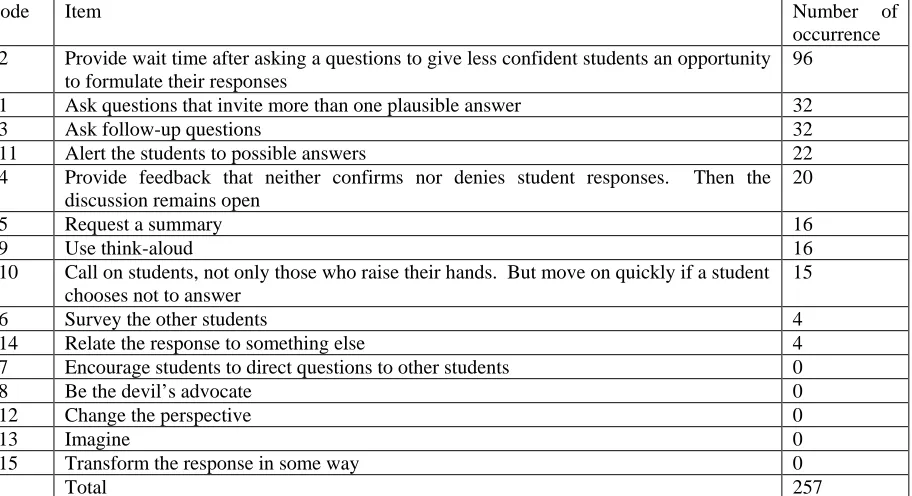
Table 2. Teacher’s Strategies
Code Item Number of
occurrence S2 Provide wait time after asking a questions to give less confident students an opportunity
to formulate their responses
96
S1 Ask questions that invite more than one plausible answer 32
S3 Ask follow-up questions 32
S11 Alert the students to possible answers 22
S4 Provide feedback that neither confirms nor denies student responses. Then the discussion remains open
20
S5 Request a summary 16
S9 Use think-aloud 16
S10 Call on students, not only those who raise their hands. But move on quickly if a student chooses not to answer
15
S6 Survey the other students 4
S14 Relate the response to something else 4
S7 Encourage students to direct questions to other students 0
S8 Be the devil’s advocate 0
S12 Change the perspective 0
S13 Imagine 0
S15 Transform the response in some way 0
Total 257
It is obvious that the teacher gave wait time after she gave questions. The classroom observation also revealed that there were no talks of the teacher encouraging students to direct questions to other students, being the devil’s advocate, changing the perspective, imagining, and transforming the response in some way.
Discussions
The result of the study showed a surprising fact that an item of vocabulary was considered the most difficult question. Firman Rahman [10] in his study found that students difficulties in getting the meaning of a certain vocabulary items were because they used to look them up at the dictionary. Dictionary might help when allowed. However, students need to practice using context to find out the meaning of certain vocabulary item. It is a matter of analysis, the same as getting main ideas. Susan M. Brookhart [2] wrote about the complexity of getting the main idea of texts. She wrote “This kind of task is “analysis” because to identify the main idea, students have to break the text into parts and see what the parts have in common and what message they point to or support”. Getting main ideas of the texts can be considered as a matter of comprehending activity when the thing done is only picking up a sentence as the main idea, but when students have to use the context, meaning all the information in the paragraph to find what they have in common, then it is considered an analysis.
The following is an excerpt of the transcript showing a simple practice of giving follow-up question. T : What about you? What is your hobby?
S : Swimming
T : Swimming. Where do you usually swim? In the river? Ss : (Laugh)
T : Swimming pool? S : (nods)
T : Yes, swimming pool
The following excerpt showed how the teacher responded to the student’s answer. She stayed neutral and then she used “survey other student” strategy by asking “Do you agree with her?”
T : Ok, number 2 What is the topic of the text? What is the topic of the text? Apa tadi? Ss : Exercise
T : Exercise, OK. Do you agree with her?
Despite the fact that these two classes had different characteristics, one was a quiet one, the other was more active, when they were given a topic which was interesting enough for them, they seemed stimulated. Both classes got more crowded when discussing “cosmetic surgery” in small groups. Choosing topics which are contextual, those of students’ interests, would benefit the teacher. It increases motivation. At least, the students are interested in the topic. This will increase their awareness of the prior knowledge they have had and make recall easier to do.
The last five strategies were not present in the observation because those strategies refer to open-questions. Open questions are difficult to answer, since students need to use their background knowledge of both the content and the language. They might also lack of vocabulary bank which can support making questions to other fellow students.
The observation also showed some facts about the teacher’s other strategies were present. The teacher often repeated questions, or made questions in different wordings (paraphrasing). When interviewed to see the reason why she did so, she said that students needed more exposure in language. The teacher participant was also seen using sentences in the native language. She code switched. She reasoned that she avoided conversation-clog. She believed that when questions and instructions were translated, she was sure she made herself clearer, to avoid misunderstanding. Wragg [13]posed some tactics that teacher can practice in classroom questioning session. They are: structuring, pitching and putting clearly, directing and distributing, pausing and pacing, prompting and probing, listening to replies and responding, and sequencing. These strategies are similar to the above.
The following excerpt might give clearer picture of what strategies that the teacher participant used in her classroom talk. (1) T : Yuk, who will propose the suitable title
Yuk, come on, raise your hand. What is it? Come on. Raise your hand. (walks to a student, ask her to answer) T : What does this text talk about?
S3 : exercise
T : Ok, so give the title based on the text (2) T : What is the title, in your opinion? hmm?
S3 : Exercise (3) T : Exercise what?
S3 : Exercise majority T : Exercise Majority
(4) T : What do you mean by majority? S3 : Exercise
T : What’s the matter with exercise? Should we do exercise? Is it important? Or…It doesn’t matter,
It has no meaning for us. We should not do exercise.
So, in your opinion, what is the suitable title for the text? Yuk… What do you think about the title? (pointing a student)
Mbak (an address in Indonesia), yuk, come on, please propose (5) Aulia?
S4 : Why you should do exercise T : Other title? Other title?
Who wanna propose other title? Yuk, come on Don’t be afraid, don’t be shy
T : (approaching to a student) T : What’s the matter with exercise? Yuk, yang lain…
What do you think about the suitable title?
T : No idea? You do not know? Yuk, yang lain? (move) (6) T : Just that one? Do you agree with these titles?
Ss : Yes T : Yes, Ok?
(7) Why you should do exercise? You see that the purpose is to persuade someone to do something. The purpose is to persuade someone to do something, it means that the writer persuades you to do exercise. So, the title, ya? Should talk about the exercise. Why we should do exercise, should we exercise, is exercise important. Or the title should concern the topic. If you have known about the topic, you can give the suitable title.
T : Ok, number 2 What is the topic of the text? What is the topic of the text? Apa tadi? Ss : Exercise
T : Exercise, that’s right. Now, what is the main idea of each paragraph? What is the main idea of paragraph one?
Ss : (mumbling) ….
(8) T : Paragraph 1, what is the main idea? Apa tadi? Look at number 3: The majority of us claim that we do not have time to exercise. We feel too busy to do that. However, many expert said thatexercise has great role in making our body healthy. Yuk, what is the main idea?
What does this paragraph talk about? Intinya tentang apa paragraph ini? What does this paragraph talk about? Ya...Mbak? (pointing a student)
T : the thesis, of the text. The main idea of the thesis. The thesis means that it’s your proposal ya...your proposal. You want someone to do something ok? What you want people do? What you want people do? Hmmm? You ask them to do what?...to do what? You ask people to do what?
S1 : exercise
(9) T : Exercise. So, the main idea is about exercise. Look at paragraph 1. Ok, find sentences related to exercise. Which sentence? Paragraph 1. Find which sentences related to exercise. Kalimat yang mana?
S1 : (read) Exercise has a great role in making our body healthy
T : That’s right. So, the main idea is exercise has a great role in making our body healthy. So, that’s the way, how you find main idea, OK?
Number 1 showed how the teacher proposed a question inviting various answer (S1), followed by making the questions in different words (Wragg’s prompting and probing). Next (number 3 and 4) the teacher asked follow up question. When the teacher found that the class tended to keep silent, she called out a name (S5). She observed the class and thought that she needed to survey other student (number 6). When it seemed that the students got confused, she structured the talk to gather information that the students can find the gist of the information. Number 9 provides an example of neutral feedback so that she can survey other response. At the end, teacher can make conclusion of what these efforts were really aiming at “So, that’s the way, how you find main idea, OK?”.
IV. CONCLUSION
The study had presented some information that can be used for further research in exploring teachers’ questioning practices. Although there are categories that are not represented in the responses, the result of the study can give a piece of picture of what has been going on in an English classroom of a vocational high school. The practice of questioning is indeed a complex thing. It should be practiced and reflected. By seeing what teachers have done in the classroom, all parties can gain insight into what improvements should be made to better vocational education. Teachers can use this kind of study as reflection to their own learning. The video-tapes can give information of the pre-dominant feature of classroom talk. Classroom talk should give higher portion to students. Therefore, when proofs show that teacher-talk-time is more, there should be remedies to the situation. The writer also found a fact that students’ questions were absent. This might not be a good practice of the method outlined in Indonesian 2013 Curriculum, which stated that questioning (menanya) should give chances for students to raise questions. This study had presented a good practice of questioning session led by an experienced teacher. However, more classroom videos might give more common pattern of classroom question-answer talks
REFERENCES
[1] Brookfield, Stephen. (2006). The Skilfull Teacher: on Technique, Trust and Responsiveness in the Classroom. San Francisco: John Willey and Sons, pp. 134 [2] Brookhart, Susan M. (2010). How to Assess Higher-Order Thinking Skills in Your Classroom. Virginia: ASCD. p. 43
[3] Brown, H. Douglas. 2001. Teaching by Principles: An Interactive Approach to Language Pedagogy. White Plains, New York: Longman, pp. 165-171
[4] Crawford, Alan; Saul, Wendy; Mathews, Samuel R; Makinster, James. (2005). Teaching and Learning Strategies for the Thinking Classroom – A publication of the reading and writing for critical thinking project. New York: The International Debate Education Association, p. 6
[5] Creswell, John W. 2007. Qualitative Inquiry and Research Design: Choosing among Five Approaches. London: Sage Publication. [6] Davis, Barbara Gross. 2009. Tools for Teaching. San Francisco, California: Jossey-Bass, p.118
[7] Hamiloglu, Assist. Prof. Dr. Kamile. 2012. The Impact of Teacher Questions on Student Learning in EFL. Journal of International and Instructional Studies in the World. Vol. 2, Issue: 2, Article: 01. May 2012. ISSN: 2146-7463.
[8] Hill, Jane D and Flynn, Kathleen. Aksing the Right Questions. National Staff Development Council. Winter 2009. Vol.29, No.1
[9] Mauigoa-Tekene, Lila. 2006. Enhancing Teachers’ Questioning Skills to Improve Children’s Learning and Thinking in Pacific Island Early Childhood Centers.
New Zealand Journal of Teachers’ Work, Volume 3, Issue 1, 12-23, 2006. Manukau Institute of Technology
[10] Rahman, Firman. 2016. An Analysis of Students’ Difficulties in Vocabulary Mastery: A Survey Study at Second Gade Students of SMPN 19 Mataram in Academic Year 2015/206. A Journal Submitted as a Partial Fulfilment of the Requirements for Bachelor Degree in English Department Faculty of Teacher Training and Education University of Mataram.
[12] Wilen, William W. (Ed). 1987. Questions, Questioning Technique, and Effective Teaching. Washington DC: National Education Association of the United States.
[13] Wragg, E.C and Brown, G. 2001. Questioning in the Secondary School. London: RoutledgeFalmer, pp. 28-32 AUTHORS
First Author – Theresia Sri Nuryani, teacher, SMK Katolik St.Mikael, [email protected]
Second Author – Prof. Dr. Sri Samiati Tarjana, lecturer, Universitas Sebelas Maret, [email protected]