Georgia State University
ScholarWorks @ Georgia State University
Marketing Dissertations Department of Marketing
4-30-2018
Essays on Alternative Perspectives on Cross-Border
B2B Trust and Commitment
Yen-Hung Liu
Follow this and additional works at:https://scholarworks.gsu.edu/marketing_diss
This Dissertation is brought to you for free and open access by the Department of Marketing at ScholarWorks @ Georgia State University. It has been accepted for inclusion in Marketing Dissertations by an authorized administrator of ScholarWorks @ Georgia State University. For more information, please [email protected].
Recommended Citation
Liu, Yen-Hung, "Essays on Alternative Perspectives on Cross-Border B2B Trust and Commitment." Dissertation, Georgia State University, 2018.
ESSAYS ON ALTERNATIVE PERSPECTIVES ON CROSS-BORDER B2B TRUST AND COMMITMENT
BY
Yen-Hung Steven Liu
A Dissertation Submitted in Partial Fulfillment of the Requirements for the Degree
Of
Doctor of Philosophy
In the Robinson College of Business
Of
Georgia State University
GEORGIA STATE UNIVERSITY ROBINSON COLLEGE OF BUSINESS
i Copyright by Yen-Hung Steven Liu
ii
ACCEPTANCE
This dissertation was prepared under the direction of the Yen-Hung Steven Liu Dissertation Committee. It has been approved and accepted by all members of that committee, and it has been accepted in partial fulfillment of the requirements for the degree of Doctor of Philosophy in Business Administration in the J. Mack Robinson College of Business of Georgia State
University.
Richard Phillips, Dean
DISSERTATION COMMITTEE
Dr. Salih Tamer Cavusgil Dr. Leigh Anne Liu Dr. Naveen Donthu Dr. Wesley J. Johnson Dr. Seyda Deligonul
iii
ABSTRACT
ESSAYS ON ALTERNATIVE PERSPECTIVES ON CROSS-BORDER B2B TRUST AND COMMITMENT
BY
YEN-HUNG STEVEN LIU
APRIL 15th, 2018
Committee Chair: Dr. Salih Tamer Cavusgil & Dr. Leigh Anne Liu
Major Academic Unit: Marketing and International Business
The relationship marketing literature suggests trust and commitment are two central facets in business-to-business (B2B) relationships. However, extant studies criticize how relationship marketing literature theorizes B2B trust and commitment. This dissertation aims to draw various perspectives from disciplines of Sociology, Psychology, and Management Sciences to examine the cultivation of B2B trust and commitment to shed lights on the literature.
In Essay 1, I reported empirical findings on 202 international buyer-seller relationships. Essay 1 reveals that, within bilateral asset specificity, (1) achieving goodwill reciprocity always enhances trust, regardless of the duration contingency; (2) violating equivalence reciprocity impairs trust over the duration. Essay 1 resolves inconsistent findings of how relationship duration influence on B2B trust in the relationship marketing literature. Indeed, another contribution of Essay 1 is to extend the field’s understandings on bilateral asset specificity by proposing the underlying reciprocity in addition to economic-based explanation.
In Essay 2, I argued that, in the triadic business relationship among exporter, importer, and host market buyers, importers are threatened by the risk of disintermediation and face the conundrum between to support and to against the supplier’s global marketing in the host market. I reported findings from 164 triadic business. Essay 2 empirically identifies that, from the importer’s view, the three focal dyadic business relationships (i.e. exporter-importer, importer-buyer, and
exporter-buyer) are interconnected with each other. Importers employ the reference point approach to manage the multi-dyadic business relationships. The results reveal that, importers holistically evaluate the buyer’s relative commitment to the importer themselves than to the upstream exporter to form their host market strategies.
iv
ACKNOWLEDGEMENTS
I wish to express my deepest gratitude for the following important people in regards to
their guidance and support, not only for the dissertation, but throughout my Ph.D. journey.
It is very fortunate for me to have two mentoring advisors, Dr. Salih Tamer Cavusgil and
Dr. Leigh Anne Liu. First, I would like to thank my mentor and co-chair of my dissertation
committee, Dr. Cavusgil, for his great guidance. I still remember the first time I met Dr. Cavusgil
during an international academic conference. At the conference, I was deeply inspired by Dr.
Cavusgil’s unique insights about International Business theory as well as his enthusiasm on
academic research. Dr. Cavusgil encouraged me to pursue my Ph.D. degree and an academic
career in the business administration. This is a great honor and privilege to have the opportunity
to be his doctoral student and to closely learn from him. His generosity, guidance, and
knowledge over the years has had one of most profound impacts on my life.
In addition, I would like to thank my advisor and dissertation committee co-chair Dr.
Leigh Anne Liu. I have learned a lot from her brilliant insights and inspirational guidance. The
enthusiasm she has for her research is contagious and motivational for me, even during tough
times in my Ph.D. journey. I am extremely grateful and indebted to Dr. Liu for her continuous
support for my Ph.D. study and related research. During the Ph.D. pursuit, Dr. Liu’s enduring
trust in me encouraged my confidence to overcome the difficulties and challenges. I am also
grateful for her modelling of an excellent international professor for furthering my thinking
about my academic career.
I would like to give my special thanks to my dissertation committee. To Dr. Naveen
v
dissertation. To Dr. Wesley Johnson, I am grateful for his insightful sharing on concurrent B2B
literature and suggestions for follow-up studies. I must also thank Dr. Seyda Deligonul for
having been advising my academic writing, research methods, and theorization, ever since the
first year I entered the program.
I wish to express my appreciation to Dr. Daniel Bello, for his genius support and
guidance. Dr. Bello’s doctoral seminar in interorganizational relationships significantly prepare
me the theoretical foundations needed in this dissertation. I am also grateful for Dr. Bello’s
suggestions on research method used. As the Chair of the Institute of International Business, Dr.
Bello also creates a positive learning environment for IB Ph.D. students that I greatly benefited
from.
I am also grateful for the tremendous support from a group of outstanding professors
from National Chengchi University (NCCU), Taipei, Taiwan. I would like to pay my special
gratitude for Dr. Jyh-Shen Chiou, for his immense help in data collections and instructions for
SEM method. I also thank the valuable support and guidance from Dr. Bryan Jean, Dr. Danchi
Tan, Dr. Lei-Yu Wu and Dr. Weichieh Su.
I am appreciative for having Yimai Zhang as my same-year colleague in the IB Ph.D.
program. We have taken most doctoral seminars together. I am very fortunate to have such a
great teammate to complete most course tasks with. She certainly helped me a lot during the
Ph.D. journey. I also appreciate the time spent and work with my fellow GSU Ph.D. students,
Ayse Ozturk, Tuba Koc, Leslie Zheng, Jingting Liu, Elizabeth Napier, Elena Polyakova, Kubilay
Ozkan and Sarah Ku, as well as AJ Corner, Tawfiq Alashoor, Roberto Cortez, Bei Shi, Ta-Tung
Cheng. I am also thankful for having my NCCU colleagues, Wan-Chien Lien, Szu-Yu Zhou,
vi
friends. I have learned a lot during our discussions and exchange of ideas. I wish to maintain our
lasting friendship after graduation.
To my family, thank you all for the encouragement and support during my pursuits for
Ph.D. degree. To my mother, Mei-Chi Liao (廖美琪), and my brother, Yen-Pei Liu (劉彥霈), I
always knew that you both believed in me and wanted the best for me. For my father,
Shuang-Hua Liu (劉雙華), I know you are watching me. I know that, the very first reason I am interested
in B2B relationship research, are those childhood talks you shared with me about how you build
connection and manage relationship with business stakeholders of your company. Even you are
not around, I feel close to you for researching on the area where you spent your whole career
with. Also, thank you for teaching me that my job in life was to learn, to be happy, and to
understand myself. I hope I didn’t let you down in this Ph.D. journey.
I dedicated this dissertation to my wife and children. To my lovely twin daughters, Alexia
Yo-Jun Liu (劉宥君) and Ivy Yo-Yu Liu (劉宥妤), you both are the pride and joy of my life. I
have learned valuable life lessons from both of you. Thank you both for making me a better
person and reminding me the value and importance of constant learning. I appreciate all your
warming support and patience during Daddy’s Ph.D. studies.
Most of all, my greatest debt is to my wife and my dearest friend, Ting-Shiuan Huang (黃
庭瑄). She has been so supportive, caring, and understanding with countless sacrifices
throughout this entire Ph.D. journey. Without her standing beside me and encouraging me during
vii
TABLE OF CONTENTS
INTRODUCTION TO ESSAYS ... 1
Motivation of the Study ... 1
Significance of Essay 1 ... 2
Significance of Essay 2 ... 3
Essay1: Always Trust in Old Friends? Effects of Reciprocity within Bilateral Asset Specificity on Trust in International B2B Partnerships ... 5
1. Introduction ... 5
2. Theoretical Background ... 9
2.1 Interorganizational Trust ... 9
2.2 Asset Specificity ... 10
2.3 Social Exchange Theory ...11
2.4 Reciprocity: The Focal Norm in Trust-Building ... 13
3. Research Framework & Hypotheses ... 14
4. Method ... 17
4.1 Measuring Goodwill and Equivalence Reciprocity within Bilateral Asset Specificity ... 17
4.2 Scales & Measurements ... 20
4.3 Data and Research Subjects ... 22
viii
5. Results ... 25
5.1 Measurement Model Results. ... 25
5.2 Structural Model and Hypothesis Testing ... 26
5.3 Common Method Variance ... 28
6. Discussion ... 29
6.1 The Contingency Role of Relationship Duration in B2B Trust-Building ... 29
6.2 Reciprocity within Bilateral Asset Specificity: A Proposed Typology ... 31
7. Implications and Directions for Future Research ... 33
7.1 Theoretical Contributions ... 33
7.2 Managerial Implications ... 36
7.3 Limitations and Future Research ... 37
ESSAY 2: A Conundrum for Importers: To Support or to Against the Exporting Supplier’s Marketing in the Host Market? A Multi-Dyadic View. ... 40
1. Introduction ... 40
2. Theoretical Backgrounds and Research Framework ... 44
2.1 Expanding from Dyadic to Multi-Dyadic Relationships: Insights from Supplier-OEM Relationships ... 45
2.2 The Triadic Relationship among Exporters, Importers, and Host Market Buyers ... 47
ix
2.4 The Conundrum for Importers: to Support or to Against the Exporting Supplier’s
Marketing in the Host Market ... 51
2.5 Exporting Supplier’s Marketing Advantages ... 53
2.6 Importers’ Advantages in Shielding the Intermediate Position ... 55
3. Methods... 57
3.1 Sampling Frame and Data Collection ... 57
3.2 Measurement Scales ... 58
4. Analyses and Results ... 61
4.1 Measurement Model Results ... 61
4.2 Structural Model Results ... 62
5. Discussions and Conclusions ... 63
5.1 Theoretical Contributions ... 63
5.2 Limitations and Future Studies ... 65
References ... 67
Figures... 88
Figure 1. Research Framework of Essay 1 ... 88
Figure 2. Interdependences between Buyer and Seller’s Asset Specificity on Trust (Model 2 in Table 3) ... 89
x
Figure 4. A Proposed Typology of Reciprocity within Bilateral Asset Specificity (Buyer’s
Perspective) ... 91
Figure 5. Multi-dyadic Structure of Cross-Border Industrial Marketing Channels (Essay 2) .. 92
Figure 6. Research Framework of Essay 2 ... 93
Tables ... 94
Table 1. Conceptualization and Measurements of Reciprocity Elements of Essay 1 ... 94
Table 2. The Country Bases of Sampling Dyads of Essay 1 ... 95
Table 3 CFA Results and Reliability Tests for Reflective Measures of Essay 1 ... 96
Table 4 Correlation Matrix and Discriminant Validity of Essay 1. ... 97
Table 5. PLS Hypotheses Testing and Model Goodness-of-Fit of Essay 1 ... 98
Table 6. Summary of Hypotheses Testing of Essay 1 ... 99
Table 7. CFA Marker: the CMV Check of Essay 1 ... 100
Table 8. Measurement Scales of Essay 1. ... 101
Table 9. Scales and Measurement Model Results of Essay 2 ... 104
Table 10. Correlation Matrix and Discriminant Validity of Essay 2. ... 106
Table 11. Structural Model Results of Essay 2. ... 107
1
INTRODUCTION TO ESSAYS Motivation of the Study
Business-to-Business (B2B) relationship is important in improving relational task
performances and values (Jap and Ganesan 2000; Palmatier 2008; Zhang et al. 2016). Extant
studies suggest trust and commitment are the two focal factors in B2B relationships (Heide 1994;
Doney and Cannon 1997; Dyer and Chu 2000; Heide and Wathne 2006). Morgan and Hunt
(1994) suggested that B2B trust and commitment are the dual relationship factors in facilitating
information sharing, reconciling conflicts, and enhancing efficient cooperation. A meta-analysis
on interorganizational relationship management literature in 1987–2004 also reveals that trust
and commitment are the two critical variables across most published works (Palmatier et al.
2006).
Given the widely-acknowledged importance of B2B trust and commitment, however, extant
studies criticize on how literature theorize B2B trust and commitment. One of the most prevalent
critiques is that B2B relationship management literature adopts the view that neglects the
dynamics of social exchanges, changing interorganizational climate, and relationship stages
(Chiles and McMackin 1996; McEvily et al. 2003; McEvily and Zaheer 2006). This paper
accordingly intends to draw various bodies of literature from Sociology, Psychology, and
Management Sciences to examine the formation of B2B trust and commitment to shed lights on
international B2B relationship literature.
Responding to the “under-socialized” critics (Granovetter 1985; McEvily et al. 2003), this
paper plans to offer examinations on two levels of cross-border B2B relationships. The first
2
relationship level. Based on an examination on dyadic B2B relationships, the first essay
identifies the underlying social exchanges within bilateral asset specificity to extend the
conventional Transaction Cost Analysis (TCA) perspective, which is one of the mostly used
theoretical lens in exporter-importer relationships (Leonidou et al. 2014). The second essay
expands to the triadic business relationships among home market exporters, the intermediate
importers bridging between home and host markets, and host market industrial buyers. The
second essay offers investigation beyond the one-to-one dyad to address the importer’s
exhaustive configurations in developing relationship marketing strategies in the host market.
Significance of Essay 1
Grounded in Social Exchange Theory (SET), the first essay is motivated by two unresolved
issues. First, scholars find mixed results on how relationship duration facilitates B2B trust (e.g.
Vanneste et al. (2014)). Building on the Dwyer et al. (1987) conceptual framework, empirical
studies follow the assumption that relationship duration is a proxy measure of prior trust-building
efforts. In the view of SET, this assumption overlooks that trust-building lies in the exchange
process between B2B parties during relationship. The first essay offers clarifications that,
trust-building lies in bilateral exchange efforts, and relationship duration is rather a contingency factor
that moderates the effects of reciprocal exchanges. Second, although Transaction Cost Analysis
(TCA) is one of the most used theoretical lens in B2B trust, TCA is often criticized for
neglecting the exchange process in B2B trust-building. To provide clarity to these issues, the first
essay empirically validates that bilateral asset specificity constitutes social exchange processes,
which communicate goodwill reciprocity and equivalence reciprocity.
In essay 1, empirical findings on 202 international buyer-seller relationships report that,
within bilateral asset specificity, (1) achieving goodwill reciprocity always enhances trust,
3
the duration. A major contribution of this essay is to extend the field’s understandings on
bilateral asset specificity by proposing the sociological meanings in addition to solely
economic-based explanation.
Significance of Essay 2
The second essay will examine B2B commitment at the triadic business structure level.
Specifically, we examine the multi-dyads in a global channel, including three parties of exporting
suppliers, importing agents, and host market industrial buyers. Aiming at an extension from the
current exporter-importer relationship literature, this essay focuses on the importer’s perspective
to address the mutual-contingencies between following two dyadic business relationships:
exporter-importer and the importer-buyer business links.
Our in-depth interviews reveal a conundrum for importers between to support or to against
the supplier’s global marketing. On the one hand, importers are motivated to leverage and
promote their upstream supplier’s industrial brand to achieve better performances in the host
market. That is, the exporting supplier’s global marketing is a remarkable privilege for importers
to take advantage of. On the other hand, importers fear of the threats of disintermediation. For
the importers, promoting the exporting supplier’s brand in the host market might create the host
market buyer’s excessively commitment to the supplier, without likewise level of commitment to
the importer themselves. To secure their intermediate position in the global value chain,
importers might adopt non-cooperation strategy in the host market to attenuate the influences of
supplier’s global marketing on host market buyers.
Although the conundrum for importers is a critical issue in practice, academic discussions
are limited in literature. Based on Organizational Reference Point and Aspiration Theory
(Fiegenbaum et al. 1996; Hsieh et al. 2015), we propose that, importers would regard the link
4
identifies that importers would regard buyer’s relative commitment to the importer than to the
exporting supplier as a central determinant in deciding the importer’s host market strategy. Essay
2 suggests that, as the frontier bridging between the home market and the host market, importers
take advantage of their boundary-spanning position to access comprehensive information in the
global value chain. The findings confirm that, to decide the strategy between to support and to
against to the supplier’s global marketing in the host market, importers rely on their
advantageous information access to draw exhaustive observations to evaluate the triadic
relationships.
In essay 2, based on findings from 164 triadic business relationships among home market
exporter, importer, and host market buyer, we empirically identify that (1) from importer’s view,
the three focal dyadic business relationships (i.e. exporter-importer, importer-buyer, and
exporter-buyer) are interconnected with each other, and importers employ the reference point
approach to manage the multi-dyadic business relationships; (2) faced with the conundrum
between to support and to against the supplier’s global marketing in the host market, importers
evaluate the buyer’s relative commitment to the importer than to the supplier to form their host
market strategies.
5
Essay1: Always Trust in Old Friends? Effects of Reciprocity within Bilateral Asset Specificity on Trust in International B2B Partnerships
1. Introduction
Grounded in Social Exchange Theory (SET), this research addresses two unresolved
theoretical issues in interorganizational trust literature. The first observation is that empirical
works report inconsistent findings regarding how relationship duration facilitates
business-to-business (B2B) trust. We thus aim to offer a clarification on the role of relationship duration in B2B trust-building process. The other theoretical puzzle is from the Transaction Cost Analysis
(TCA). The article seeks to fill a gap in theory regarding social aspects of exchange and its
development process, specifically related to asset specificity in the context of B2B trust. Our
effort is directed to a widely lamented issue (Granovetter 1985; McEvily et al. 2003; McEvily
and Zaheer 2006) that TCA downplays social foundations of transactions (e.g., meta-analysis
evidence from Palmatier et al. (2006); Leonidou et al. (2014); Zhong et al. (2017)). Heeding the
warnings in the literature, we empirically focus on bilateral asset specificity and its role in
underlying social exchange process that triggers goodwill reciprocity and equivalence
reciprocity.
The conventional view asserts that adequate relationship duration strengthens
interorganizational trust through connecting two parties beyond the discrete transaction,
enhancing mutual understanding, and aligning them to pursue common goals (Dwyer et al. 1987;
Morgan and Hunt 1994). For example, Ganesan (1994) states “…such periods provide both
parties with a greater understanding of each other and their idiosyncrasies. Thus, experience with
the vendor is likely to increase a retailer's trust in the vendor's credibility and benevolence (p.5).”
This theme repeats itself in relationship marketing studies as they underline with the same tone
6
Cannon 1997; Zhang et al. 2016). However, empirical findings are mixed. Scholars find that the
connection between relationship duration and interorganizational trust varies from positive
effects (Brashear et al. 2003; Zhang et al. 2016; Dong et al. 2017), to insignificant effects (Heide
1994; Palmatier et al. 2006; Ekici 2013; Vanneste et al. 2014), to negative effects (Gulati and
Nickerson 2008). Therefore, the role of relationship duration on interorganizational
trust-building remains unclear.
Building on the Dwyer et al. (1987) conceptual framework, empirical studies attribute a
constructive role in developing a mutual understanding and maturity of relationship (Anderson
and Weitz 1989; Gulati 1995; Bejou et al. 1996; Sa Vinhas and Heide 2014). Despite such
optimism, the length of relationship does not guarantee mutual reliance and relationship bonding
(Fichman and Levinthal 1991). Instead, relationships mature during the social exchange process
along with the complex experience of shared ideas, and form a mutual identity over bonding
between two parties. (Blau 1964; Cropanzano and Mitchell 2005; Cook et al. 2013). In other
words, what matters is not how long the relationship lasts, but what has been done in the
exchange dynamics within the course of the relationship. Responding to inconsistent empirical
findings, scholars call for process-based perspectives on interorganizational trust rather than
directly viewing relationship age as a proxy for accumulated trust-building efforts (Heide and
Wathne 2006; Möllering 2006; Akrout and Diallo 2017; Zhong et al. 2017). Thus, our first
research question is: How does relationship duration affect the trust-building process in
international B2B partnerships?
Based on SET, this article posits the contingency role of relationship duration in
interorganizational trust-building. The process lies in the relationship dynamics between two
7
they ensure both predictability and stability to facilitate trust (Blau 1964; Cropanzano and
Mitchell 2005; Cropanzano et al. 2016). As such, repeated mutual understandings and
expectations on certain norms are incrementally communicated, learned, and internalized
through continuing interactions (Cook et al. 2013). Over time, the fog gradually clears in
partners’ behavior, norms get established, compliance leaves a track record. Alongside with
growing compliance, predispositions also multiply, the partners’ expectations turn sharper and
stricter to ensure sustainable exchange and reduced relational risk. (Blau 1964; Cook et al. 2013).
Hence, the importance of norm-complying exchanges on trust increases over time. With this
view, one notable contribution of the current study is to identify relationship duration as a
contingent moderator between norm-complying exchanges and trust.
Second, another issue within interorganizational trust-building studies is a void left by the
Transaction Cost Analysis (TCA). Although the most widely used theoretical lens (i.e.,
Leonidou et al. (2014) meta-analysis), TCA often receives critical scrutiny in the examination of
interorganizational trust. The reasons include neglect of social context, path dependencies, and
the interactive process in relationship bonding (Granovetter 1985; McEvily et al. 2003). McEvily
et al. (2003) state “the Williamsonian view reflects an under-socialized view of the organization
and coordination of economic activity and the relationship between economic actors, based on a
limited understanding of how trust really works (p.99).” Responding to the critiques on applying
TCA to interorganizational trust-building, we address the underlying reciprocity within bilateral
asset specificity.
The present study draws from the Social Exchange Theory to propose a more socialized,
context-oriented, and path-dependent investigation on the usage of TCA framework in
meta-8
analysis suggest that TCA and SET could be complementary perspectives in understanding trust
across organizational boundaries. Each party interprets the opponent’s move depending on
whether or not the move complies with the reciprocity norm (Blau 1964; Emerson 1976;
Cropanzano and Mitchell 2005; Cook et al. 2013). Given that TCA-based studies claim asset
specificity to be one of the most influential factors in interorganizational relationships (Geyskens
et al. 2006; Palmatier et al. 2006), we investigate how reciprocity within bilateral asset
specificity would influence interorganizational trust. Accordingly, our second research question
is: Does reciprocity within bilateral asset specificities play a role in the trust-building process in
international B2B partnerships?
Building on SET insights, any form of ‘give-and-take’ interaction constitutes a social
exchange process. Accordingly, we contend that bilateral asset specificity consists of an
underlying social exchange process between the parties, a process that affirms the opponent’s
goodwill, strengthens the reciprocity beliefs, and indeed elevates trust. The reciprocity is also
constitutive. It facilitates an expectation that a good-deed engenders the return of the good-deed
(Blau 1964; Molm et al. 2007). In the mutual exchange of positive behavior, reciprocity emerges
in two components (Gouldner 1960; Hoppner and Griffith 2011; Hoppner et al. 2015; Swärd
2016). In the one, the concept of reciprocity is construed on exchanges of latent goodwill
intentions (partner’s actions in the dyad are more mutual-interest driven than self-interest
driven). In the other, reciprocity is built on the equivalence of contributions (the level of
investment in comparison to that of the partner). The present investigation contributes to the
literature by identifying goodwill reciprocity and equivalence reciprocity within bilateral asset
specificity to extend the field’s understandings.
9
literature on relationship marketing and describe how applying the SET extends our knowledge.
Next, we illustrate our conceptual framework and hypotheses. We then report an empirical study
of 202 international buyer-seller relationships. Methodology and empirical results are also
presented. Finally, we conclude with theoretical extensions and managerial implications.
2. Theoretical Background
2.1 Interorganizational Trust
Trust is a focal factor in interorganizational relationship studies (Ganesan, 1994; Morgan &
Hunt, 1994). For example, Heide (1994) delineates trust as an inter-organization governance
mechanism that improves cooperation and reduces opportunism in interorganizational exchange.
Doney, Cannon and Mullen (1998) define interorganizational trust as "… as a willingness to rely
on another party and to take action in circumstances where such action makes one vulnerable to
the other party” (page 4). McEvily et al. (2003) state that mutual trust creates favorable
conditions for partners to cooperate and generate improved performance. Extant studies
empirically verify that trust-based international B2B relationships enjoy superior relationship
performance (Zhang et al. 2003; Cavusgil et al. 2004; Katsikeas et al. 2009).
Although the importance of interorganizational trust is widely acknowledged, two questions
remain unanswered. First, the role of the relationship duration is unclear. Conceptual works
explore the role of relationship duration in trust but differ on the question of why and how. For
example, Dwyer et al. (1987) propose a conceptual model to differentiate between discrete
transactions and relational exchanges, suggesting that relationship duration transforms economic
transactions into social exchanges. Anderson and Weitz (1989) posit that the age of the
relationship represents the level of bilateral relationship inertia in repeated interactions that
signify established communications and reliable routines. Similarly, empirical findings are
10
that relationship duration fails to influence interorganizational trust (Palmatier et al. 2006), but
another meta-analysis suggests the relationship duration augments interorganizational trust
(Zhong et al. 2017).
2.2 Asset Specificity
Asset specificity is a central piece in TCA. In particular, the TCA posits a strong and purely
calculative view of the concept. Put simply, TCA considers the difficulty of redeployment of
assets outside the relationship due to specificity. The resulting lock-in condition requires the
safeguarding control and places the investing party in an unfavorable position (Williamson 1985;
1991). Bilateral asset specificity lock-in both the parties in the relationship and reduce the
concern on opportunism (e.g. Ganesan (1994); Poppo et al. (2015)). TCA-based studies in
interorganizational relationship employ the calculative view that bilateral asset specificity
stabilizes relationship by creating a “mutual hostage” condition (Heide 1994; Sa Vinhas and
Heide 2014).
This above view of asset specificity draws criticism as an under-socialized explanation. The
void in the explanation, the scholars argue, emerges from a static framework neglecting attitude
changes (Chiles and McMackin 1996); assumption of calculative bounded rationality regardless
of the relationship context (Ghoshal and Moran 1996; Bachmann and Zaheer 2008); and a strong
assumption of behavioral opportunism across early and mature relationships (Rindfleisch and
Heide 1997). Moreover, relationship stage and contingencies of past exchanges alter the social
meanings to the relationship-specific investments perceived by each party (Cropanzano and
Mitchell 2005; Cook et al. 2013; Cropanzano et al. 2016).
Recognizing the warnings from extant research, we deploy a more socialized angle to
11
McEvily et al. 2017). In our view, the SET is a useful companion to serve in augmenting the
theoretical arguments of TCA. SET studies suggest that any form of bilateral interaction in the
ongoing ‘give-and-take process’ constitutes a social exchange process (Blau 1964; Cropanzano
and Mitchell 2005; Cook et al. 2013). Accordingly, we investigate the underlying social
exchange process within bilateral asset specificity.
2.3 Social Exchange Theory
Social Exchange Theory (SET) explores social interaction within the exchange process
(Blau, 1964; Emerson, 1976). As one of the prominent views in interorganizational relationships
(Cropanzano & Mitchell, 2005), SET regards trust as the crucial factor that stabilizes a
relationship because trust induces partners to be less calculating and more collaborative to
achieve mutual goals (Blau, 1964, Emerson, 1976). In agreement with Zhong et al. (2017) that
TCA and SET could be complementary perspectives in understanding interorganizational trust,
this research provides a fresh perspective by integrating related research streams.
We borrow from the SET to shed light on multiple theoretical puzzles. First, we propose a
model which employs the contingency approach to examine interorganizational trust-building.
According to SET, trust cultivation lies in an exchange process where both partners fulfill their
mutual expectations on focal norms such as reciprocity. Affirming experiences, in turn, foster
stronger reciprocity expectations and future reciprocating behaviors (Cook et al., 2013). We aim
to understand how the links between reciprocating activities and trust are dependent on the
relationship duration, as the shared beliefs of reciprocity norms evolve through the history of
interactions. SET asserts that norms in a continued social exchange root deeper and get
sanctioned over time (Blau, 1964; Cook et al., 2013). This learning process gradually reinforces
12
basis for theorizing duration as a contingency in interorganizational trust-building.
Second, the SET extends our knowledge by identifying reciprocity within bilateral asset
specificity. The TCA explanations of asset specificity are purely calculative and forward-looking.
Based on SET, the TCA rationale overlooks the exchange process in the dynamics of
relationship-specific inputs between parties. For example, Blau (1964) states: “individuals and
groups are interested in, at least, maintaining a balance between inputs and outputs and staying
out of debts in their social interactions; hence the strain toward reciprocity.” Because reciprocity
is bilateral, SET asserts that the level of complying with reciprocity to one party’s relational
inputs would depend on the other’s level of relational inputs (Cook et al. 2013). Therefore, we
integrate TCA and SET perspectives, offering a discussion of inherent social meanings across
different scenarios within bilateral asset specificity to address the neglected social
contextualization in TCA.
Extant studies from other disciplines support the idea of underlying reciprocity within
bilateral asset specificity. For example, behavioral economists suggest that game players’
reciprocity expectations deepen along accumulated practice of bilateral behavior in repeated
games (Dufwenberg and Kirchsteiger 2004; Falk and Fischbacher 2006). Evidence from
behavioral economists suggests that reciprocities can be operated through certain strategic
interactions between two economic sectors. The idea that reciprocity would be signified,
operated, and performed within bilateral asset specificity is also mentioned in a meta-analytical
review of relationship marketing studies (Palmatier et al. 2006). After an examination in the
interorganizational relationship management literature, Palmatier et al. (2006) suggest:
“integrating reciprocity into the relational-mediating framework may also explain the large,
13
repay ‘debts’ generated by sellers’ investments may lead to performance-enhancing behaviors
(p.152).” We follow this suggestion and empirically examine how reciprocity can be signified,
operated, and performed within idiosyncratic bilateral asset specificity.
Finally, extending the SET literature, we identify certain interorganizational activities within
the bilateral asset specificity that fulfill reciprocities. Cropanzano et al. (2016) review the SET
theoretic remedies in business research and indicate that SET scholars emphasize hedonic value
but overlook the exhibited activities. Cropanzano et al. (2016) suggest future SET studies should
further examine how the initiating and responding activities in a relationship shape the
participants’ attitude and future behaviors (page 46). In response, the present investigation
identifies how social norms evolve through exhibited activities (the bilateral asset specificity in
our research context) at the interorganizational level.
2.4 Reciprocity: The Focal Norm in Trust-Building
Reciprocity is a critical element in interorganizational exchanges (Dwyer et al. 1987;
Rokkan et al. 2003; Zhang et al. 2016). Bagozzi (1995) identifies reciprocity as “the core of
marketing relationships (p. 275).” Palmatier et al. (2006) suggest “The classic mediating model
of relationship marketing should be adapted to include alternative mediated pathways (e.g.,
reciprocity) (p.150 in Table 6).” Empirical studies also examine the virtue of reciprocity in
relationship marketing (Dwyer et al. 1987; Heide and John 1992; Bello et al. 2003; Hoppner et
al. 2015). Palmatier et al. (2009) address the role of customer gratitude in relationship marketing
based on the rationale of reciprocity. Overall, the importance of reciprocity in interorganizational
relationship management has been widely acknowledged.
In the interorganizational relationship management area, reciprocity is generally defined as
14
Paswan et al. 2017). Conceptualization of unidimensional reciprocity in interorganizational
studies ranges from increasing interdependences in collaboration (Dwyer et al. 1987), exchange
of favors in the mutual give-and-take process (Serva et al. 2005), to reciprocation of relational
benefits (Lioukas and Reuer 2015).
To resolve inconsistencies in conceptualizing reciprocity in the literature, recent research
regards reciprocity to be a multi-faceted concept in interorganizational partnerships. Pervan et al.
(2009) investigate sales relationships in industrial marketing and find that reciprocity evolves
with both partner’s communication affirming goodwill and equity/balance of the relationship.
Hoppner and Griffith (2011) empirically verify two sub-facets of reciprocity in the context of
international B2B relationships: immediate exchange of goodwill and return of favors in
equivalence. Swärd (2016) conducts in-depth interviews and finds that interorganizational trust
lies in both small actions that incrementally contribute to the expression of goodwill and large
actions that strongly signify and invoke reciprocal reactions for equivalence.
Accordingly, we follow Gouldner (1960), Hoppner and Griffith (2011), and Swärd (2016),
examining two facets of reciprocity in bilateral asset specificity: goodwill and equivalence.
Goodwill reciprocity refers to the exchange and affirmation of each other’s good-deed toward
mutual-interest motivations, which is evaluated through the mutually contingent exchange of
gratifications. Equivalence reciprocity is fulfilled when the level of effort or return is equivalent
to that of the partner (Gouldner 1960; Hoppner and Griffith 2011; Hoppner et al. 2015).
3. Research Framework & Hypotheses
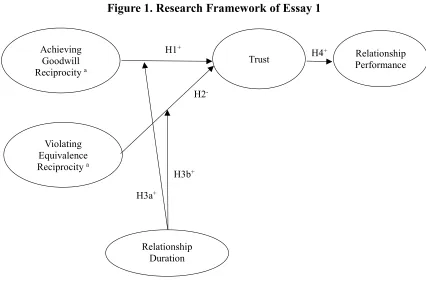
Our conceptual framework is depicted in Figure 1. Achieving goodwill reciprocity lies in
the interdependent exchange process: one party’s reciprocating action would align with the
other’s past action. Continuing dyadic exchange is interdependent and contingent on the
15
exchange party is more likely to have the higher level of trust in the relationship(Blau 1964;
Cook et al. 2013). Homans (1958) suggests that the opponent’s responding actions with
reciprocating gratitude could be viewed as a social reward that brings the sense of satisfaction
and reliability to the relationship. Blau (1964) specifies that such exchanges secure the
relationship with more predictability toward the future, and relational factors related to long-term
oriented attitudes such as trust, commitment, and loyalty would evolve through the social
rewarding process. More recent SET studies verify that the interactive process of exchanging
goodwill is the micro-foundation of forming social exchanges (Rao et al. 2005; Molm et al.
2007). The goodwill exchanges provide the lasting momentum in building trust in ongoing
relationships. Therefore, we propose:
Hypothesis 1: Achieving goodwill reciprocity within bilateral asset specificity enhances
trust in international B2B partnerships.
In SET, the concept of equivalence suggests that the distribution of effort is approximately
equivalent across the participants (Cook et al. 2013). Following SET, we suggest that breaching
equivalence reciprocity harms the participant’s trust since equivalence reciprocity implies
reliability and stability of the exchange (Gouldner 1960; Hoppner et al. 2015; Swärd 2016).
Based on SET, equivalence is crucial in sustaining long-term relationships as it signifies a
balanced structure between participants that neither participant perceives being unfairly exploited
(Emerson, 1976). Violating equivalence reciprocity sends out negative signals. An imbalanced
structure creates uncertainty about long-term sustainability. The partner being exploited may
seek out alternative relationships if available (Blau 1964). Not adhering to equivalence
reciprocity reflects instability, lack of predictability, and creates greater vulnerability for each
16
partner firm’s future strategies and thus undermines trust (Cook et al., 2013). Therefore, we
propose:
Hypothesis 2: Violating equivalence reciprocity within bilateral asset specificity harms trust
in international B2B partnerships.
We assert that the importance of reciprocity on trust becomes more prominent over the
relationship duration. SET suggests that reciprocity norms can be more understood, internalized,
and emphasized in longer relationships, amplifying the impact of reciprocity on trust. In
accordance with Homans (1958), reciprocity requires a generalized exchange where equivalent
returns are not necessarily immediate but, over time, a balance of exchange must be achieved.
Accordingly, trust accrues as the relationship evolves. The reciprocating process can create a
self-reinforcing cycle, as the norm of reciprocity becomes more accepted, established, and
internalized. As such, each partner demands more reciprocated efforts in the relationship. That is,
higher expectations evolve after both parties have cooperated and attained mutual reliance.
Hence, we contend that both goodwill and equivalence reciprocity within bilateral asset
specificity become more salient in mature interorganizational relationships. Because relationship
duration implies higher mutual expectations on reciprocity, reciprocity within bilateral asset
specificity that achieve or violate the norm would become more impactful on trust over the
relationship duration. Thus, we propose:
Hypothesis 3a: Achieving goodwill reciprocity within bilateral asset specificity more
strongly enhances trust over the duration of international B2B partnerships.
Hypothesis 3b: Violating equivalence reciprocity within bilateral asset specificity more
17
In harmony with the extant literature, we contend that interorganizational trust enhances
relationship performance in international partnerships (Delbufalo 2012; Zhong et al. 2017).
Relationship performance refers to the effectiveness and efficacy of the collaborative relationship
(Selnes and Sallis 2003; Katsikeas et al. 2009; Katsikeas et al. 2016). Trust enables smooth
bilateral communication and coordination that maximize the relationship’s potential. Empirical
studies have demonstrated that international trust-based B2B relationships lead to better
relational performance through forming and reshaping long-term oriented behaviors and attitudes
(Chiou and Droge 2006; Zaheer and Zaheer 2006; Katsikeas et al. 2009). Trust brings beneficial
effects in interorganizational collaboration such as information sharing (Bachmann and Zaheer
2008) and fewer concerns for opportunism (Dyer 2002). Based on these arguments, we propose:
Hypothesis 4: Trust in international B2B partnerships enhances relationship performance.
--- Insert Figure 1 About Here ---
4. Method
4.1 Measuring Goodwill and Equivalence Reciprocity within Bilateral Asset Specificity
Three theoretical and technical reasons support our decision to measure reciprocity in
bilateral asset specificity. First, responding to critiques of TCA (Granovetter 1985; Ghoshal and
Moran 1996; Zhong et al. 2017), this study directly examines reciprocity within bilateral asset
specificity. Second, studies in interorganizational relationship management share the convention
of using bilateral asset specificity to measure a variety of focal constructs in SET, such as
accumulated invested costs in a relationship (Gulati and Nickerson 2008), level of embeddedness
(Gulati and Sytch 2007), and power structure (McEvily et al. 2017). Our analysis aligns with
previous SET studies and proposes the meaning of reciprocity within bilateral asset specificity.
Finally, our measurement design is widely used and verified in other well-established studies
18
the methodological robustness of our construct operationalization. As such, we investigate how
bilateral asset specificity communicate goodwill reciprocity and equivalence reciprocity. An
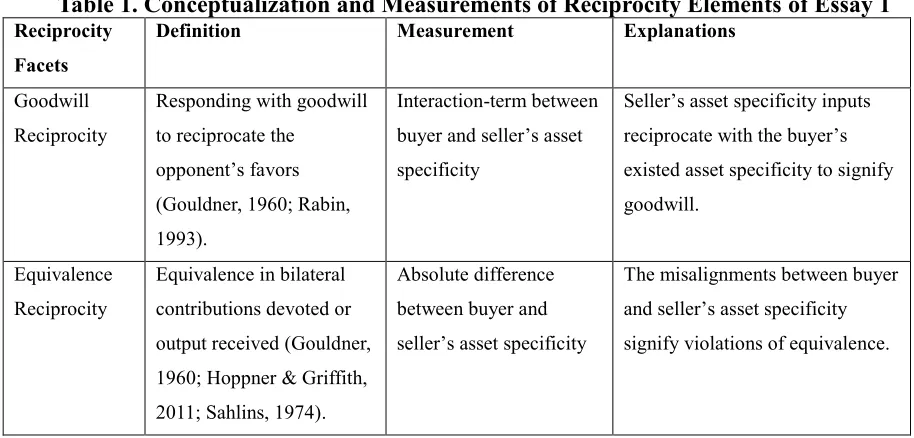
overview of reciprocity elements is presented in Table 1.
--- Insert Table 1 about here ---
In our model, we employ the interaction-term between buyer and seller’s asset specificity to
measure goodwill reciprocity. Interaction-term measures how the impact of one independent
variable on the dependent variable is contingent on the moderator (Hair et al. 2009). As
discussed, goodwill reciprocity is bilateral. It refers to the exchange and affirmation of each
other’s good-deed through the mutually contingent interaction of gratifications. When the buyer
has invested asset specificity and the seller reciprocates with corresponding asset specificity
commitments, the buyer would perceive goodwill in seller’s compliance with reciprocity to
reinforce trust. Therefore, for the buyer, the level of the perceived goodwill to the seller’s asset
specificity is associated with the buyer’s own invested level of asset specificity. Accordingly, we
measure the interaction terms between the buyer and seller’s asset specificity to evaluate
goodwill reciprocity. Empirical studies offer reasonable support for the operationalization. Jap
and Ganesan (2000) conceptualize the interaction between bilateral asset specificity as reciprocal
actions that facilitate commitment in a B2B relationship. De Vita et al. (2010) mention that
bilateral investments (interaction-term) can be regarded as a credible signal of self-enforcing
commitment in an exchange relationship.
TCE-based relationship marketing studies employ the interaction-term between buyer and
seller’s asset specificity to measure the relationship stability created by “mutual hostage”
condition (Artz 1999; Joshi and Stump 1999). Williamson (1985) suggests mutual investments of
19
However, follow-up empirical studies employ the interaction-term between buyer and seller’s
asset specificity to measure “mutual hostage” condition do not find consistent empirical support.
Artz (1999) finds that the interaction-term of bilateral asset specificity does not significantly
increase relationship performance. Joshi and Stump (1999) report interaction-term of bilateral
asset specificity even undermines joint actions.
Commenting on the insignificance of proposed reciprocal asset specificity on performance,
Artz (1999) comments “ … it may be that certain governance mechanisms, e.g., relational norms,
can effectively moderate the impact of these factors thereby allowing interfirm exchanges to
continue (page 11).” Responding to the call, we testify the underlying social exchanges within
bilateral asset specificity that performs reciprocity. Regarding the interaction-term between
bilateral asset specificity, our framework suggests that SET-based explanation of reciprocity is a
more robust conceptualization than the TCA-based logic of mutual hostage. The reason is that
we identify trust as the focal mediator that connects the interaction-term of bilateral asset
specificity with relationship performance. As Blau (1964) states ”only social exchange tends to
engender feelings of personal obligations, gratitude, and trust; purely economic exchange as such
does not.” Our identification of the trust mediator supports the underlying social exchanges and
explains the unsupported hypotheses presented by TCA-based investigations (Artz 1999; Joshi
and Stump 1999).
The proposed model also considers the effect of equivalence reciprocity through observing
the inequality between the buyer and seller’s asset specificity. To measure inequality, we adopt
absolute difference, which is an adequate measure to capture the level of inequality between two
variables (He and Wong, 2004). SET has two explanations regarding inequality in bilateral
20
demand the opponent sacrifice unilateral contributions and take advantage of the opponent’s
excessive efforts (Emerson 1962; Ebers and Semrau 2015). Because power structure is controlled
in our model, we believe inequality within bilateral asset specificity reflects the other SET
explanation that participants fail to fulfill the norm of equivalence (Cropanzano & Mitchell,
2005). We justify this conclusion noting that any distortion in bilateral asset specific
contributions will impede the trust between the parties involved.
4.2 Scales & Measurements
We employed scales established in the literature. Additionally, modified scales are
employed to accommodate to address the needs of our model. All scales are listed in the
Appendix. The measurement of the supplier and buyer’s asset specificity is adapted from
Katsikeas et al. (2009), Heide and John (1990), Rokkan et al. (2003). The scale for trust is
adapted from Doney and Cannon (1997). The relationship performance construct is modified
from Selnes and Sallis (2003). Control variables include industry, firm age, firm size,
dependence, contact frequencies, and psychic distance between the buyer and seller.
To capture the effect of cross-national variation, we use psychic distance as a subjective
measure of dissimilarity between the international buyer and seller in the context of culture,
language, and legal systems (Johanson and Vahlne 1977; 1990). Psychic distance is a
well-developed concept in the international business literature. It refers to “the sum of factors
preventing the flow of information from and to the market.” (Johanson and Vahlne 1977) Also,
we contend that using a self-reported measure better fits the assertions of the SET. Social
Exchange Theory suggests that interpretations of the social signals are subjective (Blau 1964).
Using self-reported psychic distance measures appropriately controls the respondent’s subjective
21
allows us to capture the overall influences caused by cross-national differences (Katsikeas et al.
2009; Obadia et al. 2015).
Aligning with the interorganizational relationship management literature, we follow the
definition proposed by Doney and Cannon (1997) and argue interorganizational trust as “the
perceived credibility and benevolence of a target of trust” (p.2). In accordance with a review
article on interorganizational trust measures (Seppänen et al. 2007), this is one of the mostly used
definitions in the interorganizational relationship management literature.
To rule out alternative explanations other than reciprocity in trust-building, we capture and
control the effect of the power structure in each interorganizational relationship. Specifically, the
SET suggests that power structure is an alternative motive driving each participant’s
relationship-specific investments (Blau, 1964), and dependence imbalances in each relationship
is a strong proxy for power structure (Emerson 1962). Thus, we control the level of dependencies
to address the effect of our focused reciprocity norm.
To check for common method variance (CMV), we employed the CFA marker approach.
The subjects are questioned about their perceived goal importance in attending trade shows with
items adapted from Godar and O'Connor (2001). CFA marker technique requires a marker
variable that is theoretically unrelated to the focal variables, for which its expected correlation
with the focal variables is zero (Lindell and Whitney 2001). After consulting with two
knowledgeable scholars, we conclude that the proposed CFA marker (the buyers’ goals of
attending the trade show) has no confounding effect on our study.
Overall, all items used were reviewed by two expert academics as well as two experienced
22
4.3 Data and Research Subjects
The present study employs SET to analyze a relationship with the unilateral focus on the
buyer’s viewpoint. A unilateral data collection is carried out. There are two reasons for the
research design. First, a unilateral focus allows us to simplify the reciprocity interpretations.
Although an exchange is embedded within the dyad, SET assesses the role of interpretation of
social outcomes (i.e. social reward minus social cost) as a determinant of norm compliance and
perceived relational bond ( Blau, 1964; Granovetter, 1985; Holmes, 1981). For our research,
considering interpretations from both bilateral sides may require massive controls on other
unrelated issues between the dyad, such as misalignments in perceptions caused by information
asymmetry. As a pioneer study investigating sociological meanings underlying asset specificity,
we contend that a unilateral focus on the buyer’s side avoids excessive ambiguity. Therefore, a
unilateral focus on the buyer’s perspective fits our research purpose in addressing the contextual
meaning of asset specificity.
Second, reciprocity in social exchanges is typically based on subjective assessments. Before
reciprocating, a partner must sense, read, and interpret the other side’s actions. The effectiveness
of this process depends on the receiver’s visceral interpretations of such actions (Blau, 1964;
Holmes, 1981). The proposed empirical analysis based on primary data is consistent with the
tenets of SET. Overall, a unilateral focus concurs with the SET in providing a compelling
analysis.
Research Subjects. The data used in this investigation is from a large-scale survey of senior
procurement executives representing international buyers in the global electronics industry. The
sampling scope includes very different companies without particular focus on region or country.
In the electronic OEM–supplier context, buyers have alternative options to partner up with
23
that partners hold the discretion of choosing alternative partnerships (Emerson, 1972, 1976). In
addition, the electronics industry is not immune to high uncertainty and risk. Firms in this
industry must learn to cope with short product life cycles, technological uncertainty, and
difficulties in negotiations for better margins. Business cycles in the electronics industry mature
fast, making it a suitable industry to examine relationship development. As such, the global
electronics industry is an ideal choice for the present investigation.
To access the senior procurement executives of buyer firms in the electronics industry, the
sampling frame comprised of registered buyers in the annual convention of Computex Taipei.
This event is Asia’s largest, and the world’s second-largest, ICT (Information and
Communications Technology) trade show. The event attracts a large cross-section of senior
procurement executives in the industry. It is a meeting place for manufacturers of notebooks,
tablet PCs, motherboards, servers, wafer OEMs, LCD monitors, WLAN (Wireless Local Area
Network, and PND (Portable Navigation Devices). Since 1981, Computex Taipei has come to be
known as an elite gathering of innovators and entrepreneurs who showcase the most advanced
and innovative ICT products. As such, this trade show provides an ideal venue for both a wide
spectrum of subjects and gaining access to electronics industry senior executives.
We randomly selected 1,300 cases among the buyer firms registered in Computex 2014.
Executives at each firm were contacted and asked whether they would be willing to participate in
the survey. After eliminating invalid cases, complete survey data were secured from 202
respondents. The final response rate was 15.5 percent. The countries of origin for the buyers and
sellers are summarized in Table 2. A rich variety of sub-industries are represented: software/IT:
25.25 %; electronics: 30.69 %; chemicals: 1.5 %; telecommunications: 7.9 %; engineering: 8.9
24
CFOs, CMOs and the like (17.3%), middle managers (36.6%), purchasing and sales account
managers (20.7%) from global buyer companies. The average tenure (years of service) of
respondents is 7.4 years. Each informant was asked to respond concerning the buying
relationship they considered the most critical to their firm.
--- Insert Table 2 about here ---
4.4 Structural Equation Modelling Analysis
For the analysis, we followed the approach suggested by Hair et al. (2012). These authors
point to the complementary characteristics of covariance-based sequential equation modeling
(CB-SEM) and partial least square sequential equation modeling (PLS-SEM). Following their
suggestion, we first used the CB-SEM technique to conduct a CFA to check the measurement
model validity including all of our used variables measured with reflective scales. Then,
PLS-SEM is used to test the structural model where we have variables with both formative and
reflective measures. Psychic distance, one of our control variables, is a predefined formative
latent variable. Using PLS-SEM to conduct the structural model analysis allows us to benefit
from PLS’s flexibility in specifying both formative and reflective measures without loss of
information in the data set (Hair et al. 2012). The PLS analysis was conducted using SmartPLS
version 3.1.9 software with the defaulted bias-corrected and accelerated bootstrap method and
500 subsample settings. The CFA was conducted using LISREL ver. 8.54.
We assessed the convergent validity of constructs by examining the average variance
extracted (AVE) and the significance of item loadings. The AVE attempts to measure the level of
explained variance that a latent variable component captures from its indicators relative to the
amount due to measurement error. The AVE values should be greater than the 0.50 cut-off level
25
developed by Werts et al. (1974). Acceptable values of CR statistic should exceed 0.70 (Fornell
and Larcker 1981). To evaluate the discriminant validity, we compared the square root of AVE
with the correlations among the latent variables (Fornell and Larcker 1981).
To contend with both interaction and inequivalence between buyer and seller’s asset
specificity, we followed the method used by a series of empirical studies from another
established literature stream (He and Wong 2004; Cao et al. 2009; Raisch et al. 2009). Our
two-way and three-two-way interaction terms (i.e. interaction-term between bilateral asset specificity,
interaction-term between bilateral asset specificity × duration, and inequivalences between
bilateral asset specificity × duration) were generated based on the two-stage approach in
SmartPLS with mean-centered interaction terms to avoid multicollinearity. Because our
measures of buyer and seller’s asset specificity are paralleled items, we generated our
inequivalence measures with absolute difference values across pairs of matched items. The
reliability and validity checks empirically support the appropriateness of this approach.
Finally, we conducted a CMV post check with a comprehensive CFA marker technique
presented by Williams et al. (2010). Compared with the partial correlation CFA marker technique
proposed by Lindell and Whitney (2001), the comprehensive CFA marker technique accounts for
the measurement error; therefore it is a superior statistical test for CMV effects in an SEM
setting (Williams et al., 2010).
5. Results
5.1 Measurement Model Results.
The CFA results are reported in Table 3. The CB-SEM technique was employed to conduct
the CFA to ensure robustness of our measurement model. All item loadings reach statistical
significance, indicating convergent validity. The CFA model goodness-of-fit (CFI=0.97.
26
reliability is supported by composite reliability statistics above 0.7. The AVE statistic is above
0.5, indicating convergent validity (Hair et al., 2009).
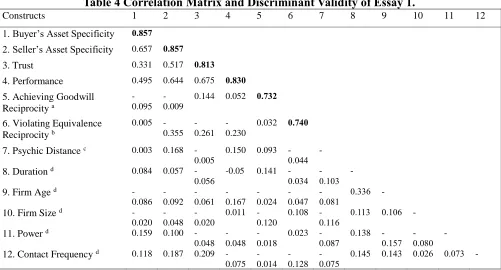
The correlation matrix and discriminant validity check are presented in Table 4. All square
roots of the AVEs are greater than the off-diagonal elements in the corresponding rows and
columns, demonstrating discriminant validity (Fornell & Larcker, 1981). Overall, these results
show that all statistics in the measurement model reach the requisite threshold suggested in the
literature. We thus confirm the measurement models’ validity using multiple indicators:
reliability, convergent validity, and discriminant validity.
--- Insert Tables 3 and 4 about here ---
5.2 Structural Model and Hypothesis Testing
The PLS structural model checks are summarized in Table 5. He and Wong (2004)
recommend two separate examinations of the interaction-term and absolute difference in two
models to avoid ambiguity in the interpretation of the results. Accordingly, we examined five
PLS structural models by stepwise addition of focal independent variables to ensure robustness
of the results. The Model 1 is the baseline model including only control variables. Because H4 is
the widely accepted hypothesis in literature, we firstly added H4 (trust --> performance) and H1
(goodwill reciprocity --> trust) to Model 2 to incrementally check the validities of the added
hypothesis. The increase in R2 and a minor decrease in SRMR between Model 2 and Model 1
indicates the appropriateness of adding two variables. The significance of coefficients in Model 2
empirically supports H4 and H1. Compared to Model 2, in Model 3 includes Hypothesis 3a
(goodwill reciprocity × duration --> trust). The statistical insignificance of the corresponding
coefficient and increased SRMR denote that Hypothesis 3a is not supported.
Model 4 examines the main effect of violating equivalence reciprocity between asset
27
However, H2 is not supported. In Model 5, we add Hypothesis 3b, which argues that relationship
duration moderates the link between violating equivalence reciprocity and trust. Hypothesis 3b is
confirmed. Model 6 indicates the robustness of results with all variables included. Overall, Three
of five hypotheses are empirically supported (Table 6).
--- Insert Tables 5 and 6 about here ---
Figure 2 illustrates the interaction effect within bilateral asset specificity (Model 2)
presented in Table 4. In Figure 2, scenario A in the upper-right side on the dotted line reflects the
practice of equivalence reciprocity (high in both buyer and seller’s asset specificity), where the
corresponding trust value on the vertical axis is the highest. Scenario B over the middle-right
side on the solid line implies the buyer’s indebtedness of reciprocal acts (high in seller’s asset
specificity but low in buyer’s), where the corresponding trust value on the vertical axis is the
second highest. The middle-left side of the dotted line, Scenario C, denotes practices of the
discrete transaction (both low in buyer and seller’s asset specificity), where the corresponding
trust value on the vertical axis is the third highest. The practice of priming trust with favors is
described in scenario D over the bottom-left side on the dotted line (high buyer’s asset specificity
but low in seller’s), where the corresponding trust value on the vertical axis is the lowest.
Figure 3 illustrates how relationship duration serves as a moderator variable. With short
durations (the dotted line with negative slope, given duration equals to mean duration -1×
standard deviation), an increase in inequivalence within bilateral asset specificity would not
significantly decrease trust. In contrast, the solid line with a negative slope denotes long
durations (given duration equals mean duration +1×standard deviation), where an increase in the
magnitude in asset specificity inequivalence significantly diminishes the level of trust.
28
5.3 Common Method Variance
The results were examined for common method variance (CMV), concluding that the
results are not biased by CMV. First, two of the hypotheses are moderating effects, and the
results indicate statistical significance. According to Siemsen et al. (2010), CMV does not
severely bias if the moderating hypothesis reaches statistical significance. Hence, the statistical
significance of Hypotheses 3b indicates that CMV is not problematic.
Second, in our questionnaire design, we varied the format of measurement items, from a
7-point scale (e.g., trust) to open-ended numbers (e.g., duration). The anchor labels of 7-7-point
scales also vary from construct to construct. These are measurement designs recommended for
avoiding CMV (Podsakoff et al. 2003; Podsakoff et al. 2012).
Finally, we followed the procedures recommended by Williams et al. (2010) and included a
CFA marker in our questionnaire for statistical post check. The results are summarized in Table
7. We first added the marker items into our item pools and conducted an additional CFA analysis.
The results provide reference values for conducting the baseline model parameters. We then
added the marker to conduct the baseline model with the orthogonal approach suggested by
Lindell and Whitney (2001). Next, we allowed the other items to be loaded on the marker with
the equality constraint to build the Method-C model. The insignificant Chi-square difference
between baseline model and Method-C model indicates a lack of congeneric method variance
(Williams et al., 2010). Finally, we let the items used to be freely loaded on the marker to
conduct the Method-U model. The insignificant Chi-square difference between Method-C and
Method-U indicates the results are not biased by non-congeneric method variance (Williams et
al., 2010).
29
6. Discussion
Our empirical findings shed light on the two unresolved issues that motivated the present
study. First, the results offer clarifications on the moderating role of relationship duration in
interorganizational trust cultivation. Second, based on the empirical findings, we verify
reciprocity in bilateral asset specificity. A proposed typology is offered to identify four scenarios
in bilateral asset specificity, and we address the buyers’ corresponding level of trust across the
four possible conditions.
6.1 The Contingency Role of Relationship Duration in B2B Trust-Building
We find empirical support for the view that inequivalences within bilateral asset specificity
impair trust over the relationship duration (H3b). Results suggest that violating equivalence
reciprocity becomes more harmful to trust over time. Indeed, as can be seen in Table 5,
relationship duration does not directly influence trust (as a control variable), but significantly
moderates the impact of inequivalent asset specificity on trust (H3b). The findings align with our
contention that relationship duration is the contingency in interorganizational trust-building
rather than an antecedent to measure overall trust-building efforts.
Interestingly, some empirical findings are contrary to expectations. Hypothesis 3a, where
we propose goodwill reciprocity becomes more influential on trust over the duration, is not
supported. Likewise, Hypothesis 2, proposing that violating equivalence reciprocity harms trust
is not supported. However, the findings support another associated proposition that violating
equivalence reciprocity becomes more harmful to trust over relationship duration (Hypothesis
3b).
Plausible explanations for the unsupported hypotheses lie in the different level of strictness