www.ijsrp.org
A Novel Framework for Face Recognition in Real-Time
Environments
Tmt.Maithili Easwaran
*, Dr.B.Poorna
** *Department of Computer Applications, S.A.Engineering College, TN, INDIA** Department of Computer applications, Shankarlal Sundarbai Shasun Jain College for Women, TN, INDIA Abstract--In this paper we propose a novel frame work for
face recognition in real-time environments using the Principal component Analysis (PCA)-based face recognition methodology. The proposed frame work is developed by three schemes namely, nonlinearity clustering, eigen vector mapping and relationship learning. In the beginning, a clustering algorithm is proposed as a preprocessing step. After clustering, the very low resolution (VLR), High resolution (HR), illuminated image (IL) pairs in every cluster is approximate nonlinear, i.e., the relationship will be approximately represented by a matrix. Then second resultant matrix spaces are converted into eigen vectors mapping for supporting nonlinear problem in real face images. Finally a kernel PCA model is used to learn relationship mapping, with completely different constraints. We develop a new information constraint is designed for human-based recognition and machine-based recognition to adopt real-time environment. The system proceeding the relationship learning between VLR images to the HR image space as well as IL image space for nonlinear problem. Based on learning map SR algorithm can reconstruct the image space and so measures the reconstruction error, rather than the existing algorithms that perform error the VLR space.
Index Terms-- Face recognition, Kernel PCA, Very Low Resolution (VLR), Illuminate Images (IL), and Relationship Learning
I. INTRODUCTION
Biometrics is used within the method of authentication of a person by verifying or distinguishing that a user requesting a network resource is who he, she, or it claims to be, and vice versa. It uses the property that a person's attribute related to a person itself like structure of finger, face details etc. By comparing the existing information with the incoming information we are able to verify the identity of a specific person [1]. There are many types of biometric system like finngerprint recognition, face detection and recognition, iris recognition etc., these traits are used for human identification in surveillance system, criminal identification. Advantages of using these traits for identification are that they can't be forgotten or lost. These are distinctive options of a person's being that is being used wide [2].
Face recognition is an integral part of biometrics. In biometrics basic traits of human is matched to the prevailing knowledge and looking on results of matching identification of a person's being is traced. Facial features are extracted and enforced through algorithms that are efficient and a few modifications are done to improve the prevailing algorithm
models. Computers that detect and recognize faces can be applied to a large type of practical applications together with criminal identification, security systems, identification etc. Face detection and recognition is used in several places today, in websites hosting images and social networking sites. Face recognition and detection will be achieved using technologies related to computer science.
Features extracted from a face are processed and compared with equally processed faces present within the database. If a face is recognized it's better-known or the system might show the same face existing in database else it's unknown. In surveillance system if an unknown face appears more than one time then it's kept in database for more recognition. These steps are very helpful in criminal identification. In general, face recognition techniques may be divided into two groups based on the face representation they use appearance-based, that uses holistic texture options and is applied to either whole-face or specific regions in an exceedingly face image and feature-based, that uses geometric facial features (mouth, eyes, brows, cheeks etc), and geometric relationships between them.
Face recognition has become a vital issue in several applications like security systems, credit card verification, criminal identification etc. Even the flexibility to just detect faces, as opposed to recognizing them, can be important.
Based on Sirovich and Kirby’s findings, that projections on eigenpictures can be used as classification features to acknowledge faces. They used this reasoning to develop a face recognition system that builds eigenfaces, which correspond to the eigenvectors related to the dominant eigenvalues of the known face (patterns) covariance matrix, and so acknowledges particular faces by comparing their projections on the eigenfaces to those of the face images of the known individuals. The eigenfaces define a feature space that drastically reduces the dimensionality of the initial space, and face identification is carried out during this reduced space.
www.ijsrp.org that are found out projecting every and each trained image to the
set of eigen faces obtained. PCA is applied on eigen face approach to reduce the dimensionality of a large information set.
Many approaches are developed and proposed for in face recognition systems. Generally, the proposed face recognition approaches can do good performance under controlled conditions. However, there still remain several issues that must be overcome for a strong face recognition system under varied conditions like pose, expression, very low resolution (VLR) and illumination variations. Once the person is not close to the camera, the face region are going to be smaller than 16 pixels. Working on such a very low resolution (VLR) face image is named a VLR face problem. Especially, illumination variation that happens on face images degrades the performance of face recognition systems under practical environments. Plenty of learning-based face SR algorithms have been proposed within the last decade. The existing approaches use constant criterion to perform error evaluation for the reconstructed HR images that is named a data constraint [15]. The data constraint is used to match the images by calculating the distance within the low-resolution (LR) image space for SR processing. As an example, Baker and Kanade’s technique [1] copies the high-resolution (HR) details from HR training images that are the best match within the corresponding LR training images, because the missing details within the input query LR image. This technique works well if the distance metric within the VLR image area reflects the particular face similarity within the HR image space.
A Robust Face Recognition scheme should have the following desirable features:
The system will perform the different lighting
condition of face image.
It’s supports low resolution image for detecting face
and recognize it.
It will provide enhanced training and testing results for
face recognition.
Here we are proposing a kernel PCA based Relation-learning PRLSR algorithm for face recognition. The proposed frame work is developed by three schemes. The relationships between HR, VLR image and illuminated image spaces are learned within the training phase and are used to reconstruct the hr images in testing phase. The training phase consists of three steps, namely, non linearity clustering, eigen vector formation and relationship learning. in the beginning, a clustering algorithm is proposed as a preprocessing step. After clustering,
the VLR, HR, illuminated image pairs in every cluster are nearly linear, i.e., the relationship can be approximately represented by a nonlinear matrix. Then second resultant matrix spaces are converted into eigen vectors.
Finally A nonlinear kernel model is used to learn relationship mapping, with completely different constraints. We develop a new data constraint is designed for human-based recognition and machine-based recognition to adopt real-time environment. The system proceeding the relationship learning between VLR images to the HR image space similarly as IL image house for nonlinear drawback. Based on learning map SR algorithm can reconstruct the image space and then measures the reconstruction error, instead of the existing algorithms that perform error the VLR image space. It uses relationship mapping to map the VLR images into the illuminated image space. Details of every step are described in the following sections.
Section 2 describes the Linearity Clustering and section 3 describes the eigenvector formation of a matrix .More details about relationship learning by kernel PCA are given in Section 4. Implementation and some results are shown in Section 5.
II. RELATED WORK
Kyungnam Kim discussed a number of limitations and questions on his approach that eigenface system to perform face recognition on the fundamental idea of PCA and more in depth study of the course material. Though the face recognition results were acceptable, the system only using eigenfaces might not be applicable as a real system. That has to be additional robust and to have different discriminant options [1]. Sang-Heon Lee, Dong-Ju Kim and Jin-Ho Cho proposed the illumination-robust face recognition system comprising new D2D-PCA feature and a fusion approach integrating two half-face images for varied consumer applications. Within the proposed system, whole-face images are divided into two sub-images to minimize illumination effects and therefore the D2D-PCA is applied to each of those sub-images. The individual matching scores obtained from two sub-images are combined using a weighted-summation operation, and therefore the fused-score is used to classify the unknown user [2].
www.ijsrp.org relationship between the high-resolution image space and
therefore the VLR image space for face SR. based on this approach, two constraints, namely, new information and discriminative constraints, are designed for good visuality and face recognition applications under the VLR problem, respectively [4].
Leonardo franco, Alessandro obtained a generalization rate of 84:5% on unseen faces, similar to the 83:2% rate obtained once employing a similar system but implementing PCA processing at the initial stage that they train and check with images from the Yale Faces database [5]. Jisnu Bhattacharyya found that a additional significant segmentation could be achieved by compensating images for illumination using the strategy proposed in that thesis. Furthermore, the accuracy of skin detection, a set of color image segmentation, was found to improve once this illumination compensation method was first applied. Finally, compensating images for illumination increased the accuracy of face recognition [6]
Rabia Jafri and Hamid R. Arabnia summary of a number of the well-known methods in each of those categories is provided and some of the advantages and drawbacks of the schemes mentioned therein are examined. Furthermore, a discussion outlining the incentive for using face recognition, the applications of this technology, and a few of the difficulties plaguing current systems with respect to this task has also been provided [7]. V. Radha and N. Nallammal present neural network classifier (Radial Basis function Network) to detect frontal views of faces. The curvelet transform, Linear Discriminant Analysis (LDA) ar used to extract features from facial images first, and Radial Basis function Network (RBFN) is used to classify the facial images based on features [8].
Mayank Agarwal, Nikunj jain, Mr. Manish Kumar and Himanshu Agrawal present a technique for face recognition based on information theory approach of coding and decoding the face image and proposed methodology is connection of two stages – Feature extraction using principle component analysis and recognition using the feed forward back propagation Neural Network [9].
Debabrata Chowdhuri, Sendhil Kumar K.S, M Rajasekhara babu and Ch. Pradeep Reddy has defined and discussed the VLR face recognitionin in that paper. to resolve the problem, feature extraction technique is used and to enhance the performance parallel environment is used. For machine-based face recognition applications, a discriminative constraint was designed and parallel environment is integrated with the new data constraint [11]. SenthilSingh .C and Dr. Manikandan. M proposed an approach to find out relationship between the high resolution space and therefore the VLR image space for face.
Based up on the approach the face recognition applications under the VLR problem is designed for good visuality [12].
Xudong Xie and Kin-Man Lam aim to reduce or remove their effect. In their technique, a local normalization technique is applied to an image, which might effectively and with efficiency eliminate the effect of uneven illuminations while keeping the local statistical properties of the processed image the same as within the corresponding image under normal lighting condition [13].
Emil Bilgazyev, Boris Efraty, Shishir K. shah and Ioannis A. Kakadiaris proposed a new method for super resolution by first learning the high-frequency parts within the facial data that can be added to a low-resolution input image to form a super-resolved image. Their method is totally different from typical methods as we estimate the high-frequency components, which are not used in other methods, to reconstruct a higher-resolution image, instead of studying the direct relationship between the high- and low resolution images [14]. P.S.Hiremath and Prabhakar C introduced a novel symbolic kernel PCA method for face recognition that symbolic data representation of face images as symbolic faces, using interval variable s, yield fascinating facial features to cope up with the variations attributable to illumination, orientation and facial expression changes[17].
III. SYSTEM MODEL
The proposed frame work consists of three phases, namely, linearity clustering, eigen vectors with relationship learning and PCA based recognition. In the initiative, linearity clustering is executed and also it’s a preprocessing step. During this step it considers training section and here three completely different kind of images pairs are used to clustering as linear. The images pairs are VLR images, HLR images and illuminated images. Fig 1(a) shows the proposed system model.
{R}
{R}
VLR Eigen Vector
L
HR Eigen Vector
H
IL Eigen Vector
www.ijsrp.org Fig. 1 Proposed New Constraints to Learn Relationship Mapping.
After clustering, the VLR, HR, IL image pairs in every cluster are nearly linear, by eigen vector formation i.e., the relationship may be approximately represented by a eigen matrix and eigen values. A linear regression model is used to learn relationship mapping, with completely different constraints further. We develop two constraints for various applications. As shown in Fig. 1(a), a new data constraint is designed for human-based recognition. It uses relationship mapping to map the VLR images into the HR image space and then measures the reconstruction error, instead of the existing algorithms that perform error measure within the VLR space. On the other hand, relationship mapping to map the VLR images into the IL image space and then measures the illuminated image reconstruction is developed for machine-based recognition purposes. Details of every step are given here.
IV. PREPROCESSING
A. Non-Linearity Clustering
Non-Linearity clustering is utilized to ensure that clustered training image pairs have a linear relationship. This clustering method reduces the complexness of the relationship learning such the nonlinear model can learn the relationship in every cluster. Alone this line, we design sparse based clustering algorithm that employs nonlinearity as a clustering criterion. In this paper, we outline the non linearity of a group of information pairs (i.e., the LR–HR-IL image pairs) as follows:
Given a group of data pairs P = {( xi,yi,zi)} I = 1, 2,…,N the linearity of data pairs is defined as
L(P) = exp ( - minA,b,c max xi|| zi – yi (Axi + b – c) ||2) (1)
We would prefer to maximize the linearity of every cluster as follows:
̃
| | ∑
s.t | | (2)
Where is the set of clusters of data pairs, | | is the number of clusters in , and is the maximum number of clusters. From a machine learning perspective, is used to prevent overlearning.
Since (2) involves a complex nonlinear non differentiable function and parameters and are not known before clustering, (2) is an ill-posed and NP-hard problem. Instead of solving (2) directly, we use another method to maximize linearity. Kim and Kwon [11] showed that the relationship mapping from the LR to HR spaces will be represented as a fusion of many multivariable real-valued functions. Without loss of generality, we denote the relationship between data pairs in as a multivariable real-valued function , which satisfies
f ( xi = yi = zi ) (3)
Where ( xi,yi,zi) is a data pair. To clearly present the concept of the proposed method to be converting the Covariance matrix of the data pair (x, y, z), and Ω f(x) is named the “eigen vector” of the data pair.
the ei’s and ¸λi’s are given by the eigenvectors and
eigenvalues of the covariance matrix
C = f(x)f(x)T (4)
For the case of learning relationship mapping, let (xi, yi, zi) be the the LR–HR-IL training image pair and be relationship mapping. The clustering algorithm based on linearity is given in Algorithm 1.
Algorithm 1 Clustering based on nonlinearity
www.ijsrp.org Condition , parameters and , number of clusters
1: for each image pair do
2: Calculate the image sparse of , denote by
3: end for
4: Let E
{ | ( ) }
5: Initialize with random cluster centers chosen from , denote
by { ̅ | }
6:
7: repeat
8:
9: Classify to its nearest cluster according to the sparse
distance between and ̅
10: Update the cluster centers
11: until ‖ ‖
12: Merge the clusters that have the similar linear | |
13: return Merged result { ̅ | }
V. EIGEN FACES FOR NONLINEAR
The eigenvectors of a square matrix are the non-zero vectors that, after being multiplied by the matrix, remain proportional to the original vector, i.e. any vector x that satisfies the equation:
,
x
Ax
Where A is the matrix in question, x is the eigenvector and is the associated eigenvalue.
As will become clear later on, eigenvectors are not unique within the sense that any eigenvector can be multiplied by a constant to form another eigenvector. For every eigenvector there is only one associated eigenvalue, however.
If you consider a matrix as a stretching, shearing or reflection transformation of the plane, you can see that the eigenvalues are the lines passing through the origin that are left unchanged by the transformation .
Note that square matrices of any size, not just matrices, can have eigenvectors and eigenvalues.
In order to find the eigenvectors of a matrix we should begin by finding the eigenvalues. To do this we take everything over to the LHS of the equation:
,
0
x
Ax
then we pull the vector x outside of a set of brackets:
A
I
x
0
.
The only way this will be solved is if does not have an inverse, thus we find values of such that the determinant of is zero:
.
0
I
A
Once we have a set of eigenvalues we are able to substitute them back into the original equation to find the eigenvectors.
A. Eigen Vector Mapping
The eigenvectors corresponding to nonzero eigenvalues of the covariance matrix produce an orthonormal basis for the subspace within that most image data can be represented with a little amount of error. The eigenvectors are sorted from high to low per their corresponding eigenvalues. The eigenvector associated with the largest eigenvalue is one that reflects the greatest variance within the image. That is, the smallest eigenvalue is related to the eigenvector that finds the least variance.
www.ijsrp.org where vi = eTiwi . vi is the ith coordinate of the facial eigen
image within the new space, that came to be the principal component. The vectors ei are images, so called, eigenimages, or eigenfaces. They can be viewed as images and indeed look like faces.
VI. KERNAL PCA
The kernel PCA [17] is capable of deriving low dimensional options that incorporate higher order statistics. Higher order dependencies in an image include nonlinear relations among the pixel intensity values, like the relationships among three or additional pixels in an edge or a curve, which can capture necessary information for recognition.
In this paper, we present a kernel PCA method based relationship learning for real-time face recognition. The proposed PRLSR, that is extension of kernel PCA method [13] to relationship mapping, is employed to extract nonlinear eigen face features from nonlinear faces in a very high dimensional space, which is nonlinearly associated with the input space. Normally, the face recognition techniques use just one test image for every trial [17]. However, the proposed method uses test face class instead of test check face image for classification. Such situations arise in some real time applications where more than one test image of a similar subject are captured. The test face class, consisting of the images of same subject with totally different orientation, lighting condition and expression, is used for construction of test symbolic face.
A. Kernal PCA Based Face Recognition System
The kernel matrix and also the kernel PCA features are both defined on dot products within the high dimensional feature space, whose computation might be prohibitively expensive. Kernel PCA, however, manages to compute the dot products by means of a kernel function [17]:
K ( x, y) = (Ф(x) . Ф( y) )
Two classes of kernel functions widely used in kernel classifiers are polynomial kernels defined, as:
k ( x, y) =(x .y )d
B. Relationship Learning by Kernel PCA
For each cluster, we denote the training image pairs by D = {(Ωli, Ωhi, Ωili
)}, and also the training image pairs are centered by shifting the mean of the VLR–HR-IL training images. Let Ф: Rp -> F be a nonlinear mapping between the input space and
also the feature space. For kernel PCA, the nonlinear mapping, F, Ф usually defines a kernel function.
Let K € Rpdefine a kernel matrix by means of dot roduct in the feature space:
Kij = (Ф(Ωhi). Ф(Ωili))
Assume the mapped data is centered. , the eigenvalues, A = [a1,a2,..am l , and also the eigenvectors V = V1,V2,..Vm], of kernel matrix K can be derived.
The simplest technique for determining which face class provides the most effective relationship description of an input facial image is to find the face class k that minimizes the Euclidean distance
K €k = Ф[Vi – Vk]
where k is a vector describing the kth reconstructed class. If Vk is less than some predefined threshold ө, a reconstructed image is classified as belonging to the class k. Let R be the relationship mapping from the VLR to HR, IL Eigen image spaces within the cluster, then we have
Їli ≈ R(Kh
i , Kil
i )
After determining R, the HR image can be recovered by applying on the VLR image. Therefore, the SR problem is converted to the learning of relationship mapping R. So, Ω describes the contribution of every eigenface in representing the facial image by treating the eigenfaces as a basis set for facial images.
VII. IMPLEMENTATION AND RESULTS
www.ijsrp.org sets per their class label. In the CAS-PEAL database, images
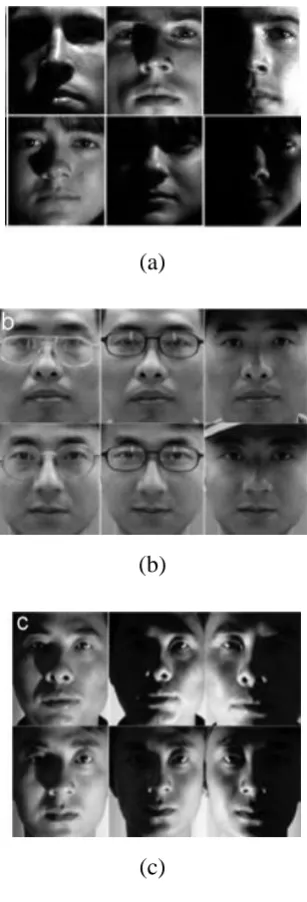
from 500 persons (one per person) are randomly selected as the training data, and for the YaleB database, images of 19 persons (64 per person) are randomly selected as the training set. The rest of images are used as the testing (probe) set.
As shown in Fig. 3, the training data pairs will be clustered using linearity clustering, so that the relationship between the data pairs in every cluster can be linearly approximated by Eigen faces vectors. One relationship is PRLSR learned for
(a)
(b)
[image:7.612.93.247.226.678.2](c)
Fig. 2 Training Image pairs a) VLR Image Pairs b) HR Image Pairs c) IL Image Pairs
each cluster by PCA. In the testing phase the VLR testing image will be classified into one among the clusters, and then, the reconstructed image is obtained by applying on the input testing image
(a)
(b)
(c)
www.ijsrp.org Fig. 3 Reconstructed images a) Input VLR image b) RLSR image c) PRLSR
[image:8.612.41.299.115.263.2]Image d) Original Image
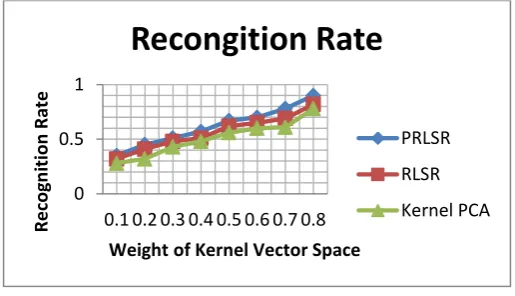
Fig. 4 Recognition Accuracy
We also performed the relationship learning experiment against different weights, and the proposed kernel PCA approach using PRLSR showed the best recognition accuracy of 96%. Consequently, we confirmed the effectiveness of the proposed face recognition system under real-time-variant environments from the experimental results.
VIII. CONCLUSION
The VLR nonlinear face recognition problem has been defined and discussed in this paper. To solve the problem, a piecewise nonlinear kernel PCA model was used, and a novel relationship-based SR was proposed. Based on this idea, for good visual quality applications, a new data constraint that measures the error in the HR and IL image space was developed, and PCA-RLSR was proposed. To evaluate the
performance of the proposed system, experiments were performed with the extended Yale face database B, and CAS-PEAL the results confirmed that the proposed approach achieves the best recognition rate of 96%. Our algorithms can be easily utilized in a real-time face recognition system under illumination-variant, VLR, and nonlinear future space
environments. Further analysis of the proposed system to be concentrate the non-faces real-time recognitions.
REFERENCES
[1] Kyungnam Kim, “Face Recognition using principal component analysis”, USA, June 2000.
[2] Sang-Heon Lee, Dong-Ju Kim and Jin-Ho Cho, “Illumination-Robust Face Recognition System Based on Differential Components” IEEE Transactions on Consumer Electronics, 2012.
[3] Andrew Wagner and Arvind Ganesh, “Toward a Practical Face Recognition System: Robust Alignment and Illumination by Sparse Representation”. IEEE Transactions On Pattern Analysis And Machine Intelligence, Vol. 34, No. 2, February 2012
[4] Wilman W. W. Zou, and Pong C. Yuen, “Very Low Resolution Face Recognition Problem” IEEE Transactions On Image Processing, Vol. 21, No. 1, January 2012.
[5] Leonardo Franco, Alessandro Treves, “A Neural Network Facial Expression Recognition System using Unsupervised Local Processing” on Image and Signal Processing and Analysis, 2001. ISPA 2001. Proceedings of the 2nd International Symposium.
[6] Jisnu Bhattacharyya, “Detecting and Removing Specularities and Shadows in Images” on McGill University in partial fulfillment of the requirements of the Degree of Master of Engineering, June 2004
[7] Rabia Jafri and Hamid R. Arabnia, “A Survey of Face Recognition Techniques” in Journal of Information Processing Systems, Vol.5, No.2, June 2009
[8] V. Radha and N. Nallammal, “Neural Network Based Face Recognition Using RBFN Classifier” in Proceedings of the World Congress on Engineering and Computer Science 2011 Vol I WCECS 2011, October 19-21, 2011, San Francisco, USA
[9] Mayank Agarwal, Nikunj Jain, Mr. Manish Kumar and Himanshu Agrawal, “Face Recognition Using Eigen Faces and Artificial Neural Network” in International Journal of Computer Theory and Engineering, Vol. 2, No. 4, August, 2010 1793-8201
[10] M. Turk and A. Pentland, “Eigenfaces for Face Detection/Recognition” in Journal of Cognitive Neuroscience, vol. 3, no. 1, pp. 71-86, 1991. [11] Debabrata Chowdhuri, Sendhil Kumar K.S, M Rajasekhara Babu and Ch.
Pradeep Reddy, “Very Low Resolution Face Recognition in Parallel Environment” in (IJCSIT) International Journal of Computer Science and Information Technologies, Vol. 3 (3) , 2012,4408-4410
[12] SenthilSingh .C and Dr. Manikandan. M, “DESIGN AND IMPLEMENTATION OF AN FPGA-BASED REAL-TIME VERY LOW RESOLUTION FACE RECOGNITION SYSTEM” in International Journal of Advanced Information Science and Technology (IJAIST) Vol.7, No.7, November 2012
[13] Xudong Xie and Kin-Man Lam,” An efficient illumination normalization method for face recognition” in Elsevier Pattern Recognition Letters, Volume 27, Issue 6, 15 April 2006
[14] Emil Bilgazyev, Boris Efraty, Shishir K. Shah and Ioannis A. Kakadiaris, “Improved Face Recognition Using Super-Resolution” on Biometrics (IJCB), 2011 International Joint Conference, 11-13 Oct. 2011
[15] Xin Chen, B.S., “PCA-BASED FACE RECOGNITION IN INFRARED IMAGERY: BASELINE AND COMPARATIVE STUDIES” on Analysis and Modeling of Faces and Gestures, 2003. AMFG 2003. IEEE International Workshop, 17-17 Oct. 2003
[16] Hakan Cevikalp and Bill Triggs,” Face Recognition Based on Image Sets” on Computer Vision and Pattern Recognition (CVPR), 2010 IEEE Conference, 13-18 June 2010
0 0.5 1
0.1 0.2 0.3 0.4 0.5 0.6 0.7 0.8
R
e
co
gn
ition
R
ate
Weight of Kernel Vector Space
Recongition Rate
PRLSR
RLSR
www.ijsrp.org [17]. P.S.Hiremath1, Prabhakar C. , “Acquiring Non Linear Subspace for Face
Recognition using Symbolic Kernel PCA Method” JSDA Electronic Journal of Symbolic Data Analysis - Vol. 4, N. 1 - ISSN 1723-5081.
AUTHORS
First Author – Tmt.Maithili Easwaran, MCA, S.A.
Engineering College, TN, INDIA. E-mail: [email protected]
Second Author – Dr.B.Poorna, Ph.D, Shri Shankarlal