African-American Studies Theses Department of African-American Studies
8-9-2016
THICK SKIN: THE HISTORY OF THE BLACK
TATTOO COMMUNITY IN ATLANTA
Danielle Rosenthal
Follow this and additional works at:https://scholarworks.gsu.edu/aas_theses
This Thesis is brought to you for free and open access by the Department of African-American Studies at ScholarWorks @ Georgia State University. It has been accepted for inclusion in African-American Studies Theses by an authorized administrator of ScholarWorks @ Georgia State University. For more information, please [email protected].
Recommended Citation
Rosenthal, Danielle, "THICK SKIN: THE HISTORY OF THE BLACK TATTOO COMMUNITY IN ATLANTA." Thesis, Georgia State University, 2016.
by
DANIELLE ROSENTHAL
Under the Direction of Akinyele Umoja, PhD
ABSTRACT
As a rapidly growing, multibillion dollar industry, tattooing is quickly becoming a
mainstream art form and commodity. Although the ancient art form, originates from
civilizations all over the world, the modern history in the United States has largely limited Black
individuals from receiving the recommended training (apprenticeship) until about the last
twenty-five years. The purpose of this study is to explore the history of the Black Tattoo
Community in Atlanta. The following questions will guide the study: What is the history behind
the Black Tattoo Community in the Atlanta area? What are the experiences of Black artists
apprenticing and learning to tattoo? What are the differences, if any, when tattooing people of
color? What impact has television, the internet, and social media had on the tattoo industry, and
in particular on Black tattoo artists? This study utilizes an oral historical interview method to
answer these questions.
INDEX WORDS: Tattoo, Black Artists, Tattoo Culture, Atlanta, Tattoo History, Black Tattoo
by
DANIELLE ROSENTHAL
A Thesis Submitted in Partial Fulfillment of the Requirements for the Degree of
Masters of Arts
in the College of Arts and Sciences
Georgia State University
Copyright by Danielle Rosenthal
by
DANIELLE ROSENTHAL
Committee Chair: Akinyele Umoja
Committee: Lia Bascomb
Maurice Hobson
Electronic Version Approved:
Office of Graduate Studies
College of Arts and Sciences
Georgia State University
DEDICATION
ACKNOWLEDGEMENTS
First and foremost, I would like to acknowledge my grandmother, Thelma Mulick.
Although she left this life during my first semester, she has invaluably provided me with a
peaceful home to live in throughout my career as a graduate student.
I would also like to acknowledge all of the professors in the African-American Studies
Department at Georgia State University. In particular, my committee chair, Dr. Akinyele Umoja
and those professors on my committee, Dr. Maurice Hobson and Dr. Lia Bascomb for pushing,
guiding, and encouraging me through my work. Additionally, I want to acknowledge Dr. Sarita
Davis and Dr. Jonathan Gayles for mentoring me and providing me with teaching assistant and
research assistant opportunities during this process.
I acknowledge the tattoo artists who were gracious enough to participate in my research
and their clients who allowed me to sit in while they were being tattooed.
Finally, I acknowledge my family, friends, fellow students, and clients for providing me
TABLE OF CONTENTS
ACKNOWLEDGEMENTS ... v
LIST OF TABLES ... viii
1 INTRODUCTION... 1
1.1 Purpose of Study And Research Questions ... 1
1.2 Key Terms Defined ... 2
1.3 Significance of Study... 3
1.4 Methodology ... 4
1.5 The Researcher... 7
1.6 Chapter Synopsis ... 8
2 A HISTORICAL OVERVIEW OF TATTOOING ... 12
2.1 A Brief World History of Body Modification and Tattooing ... 12
2.2 HISTORY OF TATTOOING IN THE UNITED STATES ... 17
2.3 The Tattoo Community, Culture of Tattooing, and Apprenticeships... 22
2.4 The Normalization and Popularization of a Deviant Art Form ... 24
2.5 Documentary: Coloring Outside the Lines and Related Black Tattoo Artists ... 27
2.6 Gaps ... 30
3 THE HISTORY OF BLACK TATTOO ARTISTS IN ATLANTA ... 35
3.1 The Black Mecca ... 35
3.2 West End Tattoo and the Rise of Atlanta as a Mecca for Black Tattoo Artists 36 3.3 The Present ... 41
3.4 Summary ... 43
4 APPRENTICING AND LEARNING TO TATTOO AS A BLACK ARTIST ... 46
4.1 Apprenticeships ... 46
4.2 Tattooing as a Black Artist... 50
4.4 Mentoring Other Artists... 55
4.5 Summary ... 56
5 TATTOOING PEOPLE OF COLOR ... 59
5.1 Understanding the Science ... 61
5.2 Color ... 63
5.3 CONTRAST AND COMPOSITION ... 65
5.4 Summary ... 67
6 TATTOOING, THE MEDIA AND BLACK POPULAR CULTURE ... 69
6.1 Tattoos on Television ... 69
6.2 Hip-Hop Culture ... 73
6.3 Scratchers ... 75
6.4 Tattooing, the Internet and Social Media ... 79
6.5 Summary ... 80
7 CONCLUSION ... 83
7.1 Answering Research Questions ... 83
7.2 Limitations ... 85
7.3 Areas for Further Research ... 86
7.4 Implications ... 88
BIBLIOGRAPHY ... 89
APPENDECES ... 93
Appendix A: Informed Consent Form ... 93
Appendix B: Questionnaire... 94
LIST OF TABLES
1 INTRODUCTION
Grossing over 2.3 billion dollars annually, the tattoo industry is growing at a rapid rate in
the United States and providing artists with an opportunity to make a living creating art.1
Although it is an ancient art form, originating from civilizations all over the world, including
Africa, the modern history in the United States has largely restricted Black artists from
apprenticing until about the last twenty years due to racial prejudices. As the industry changes
and grows, it offers a greater opportunity for Black artists to enter, make a living, and even own
their own shops. Exploration of this subject is significant as it is a multibillion dollar industry,
quickly growing in popularity, and becoming recognized as a fine art form.2 This study seeks to
provide a voice and a history for a few individuals, allowing them the opportunity to share their
experiences in the industry as a Black artist. Furthermore, this research attempts to offer a
written history of the tattoo industry with a specific focus on the history of the Black Tattoo
Community in Atlanta, Georgia.
1.1 Purpose of Study and Research Questions
This study seeks to answer the following questions about the Black Tattoo Community and
its history in the greater Atlanta area:
1. What is the history behind the Black Tattoo Community in the Atlanta area?
a) How does this history situate itself within the Black Mecca schema?
2. What are the experiences of Black artists apprenticing and learning to tattoo?
a) How does the intersection of race and gender impact Black women in the industry?
b) Have the experiences of these artists impacted their decision to mentor other artists?
4. What impact has television, the internet, and social media had on the tattoo industry, and in
particular on Black tattoo artists?
a) How has Black popular culture impacted the tattoo industry?
1.2 Key Terms Defined
Apprenticeship: The term apprenticeship references the traditional process of an artist
learning to tattoo from an experienced tattoo artist. Though traditional and respected amongst
the tattoo community, apprenticeships are not legally required in order to obtain a license as a
tattoo artist. However, most reputable tattoo shops/studios do not employ tattoo artists that have
not completed an apprenticeship.
Scratcher: A scratcher is the term generally given to artists who are untrained or who have
not completed a formal apprenticeship. This term is associated with a negative connotation and
is generally looked down upon within the tattoo community. This is because “scratchers”
typically lack the knowledge and equipment to tattoo in sanitary conditions and in some
circumstances disobey age restriction laws.
Tattooist v. Tattoer v. Tattoo Artist: While some individuals may feel that the terms
differentiate between someone skilled in the trade of tattooing and someone who considers
themselves to be an artist, there is no definitive definition to differentiate the terms. For the
purpose of this study, these descriptors may be used interchangeably and considered to be
synonymous of one another.
Black artist: For the purposes of this study, the term Black artist will refer to individuals
who self-identify as Black or African-American and also consider themselves to be artists of
some form (e.g. drawing, painting, tattooing, etc.). This term does not refer to, unless otherwise
Tattoo Community: For the purposes of this study, the broad definition of the term tattoo
community will be defined according to Margo DeMello, the author of Bodies of Inscription: A
Cultural History of the Modern Tattoo Community. DeMello states that the tattoo community
“may refer to any and all tattooed people” as well as “those individuals who actively embrace the
notion of community and who pursue community-oriented activities” (e.g. tattoo conventions).3
The term also acknowledges that within the larger “community” there are “broadly defined class
groups, and within each larger group there are also numerous subcommunities.”4
Black Tattoo Community: The Black Tattoo Community refers to the subcommunity of
individuals within the tattoo community that self-identify as Black or African-American and/or
those who tattoo or get tattooed by Black/African-American individuals and/or work in and/or
support Black-owned tattoo shops.
1.3 Significance of Study
This study is significant to the academic community and to the Black community for
numerous reasons. To begin, there is limited scholarly research around the present history of the
art of tattooing or the culture of the tattoo community. Furthermore, Black artists in the United
States have historically been prevented from acquiring the necessary apprenticeships to grant
them notoriety and licensure as tattoo artists. As previously mentioned, tattooing is a
multibillion dollar industry and constantly growing. This makes tattooing economically
significant to the Black community, as well as significant from a creative and expressive
standpoint. This study provides a voice for Black tattoo artists in and around Atlanta as well as
an understanding of their unique history. Furthermore, this study gives tattoo patrons and the
1.4 Methodology
Oral history is the predominate method of research. The decision to do so is based on the
limited written information available on the subject.
Participants
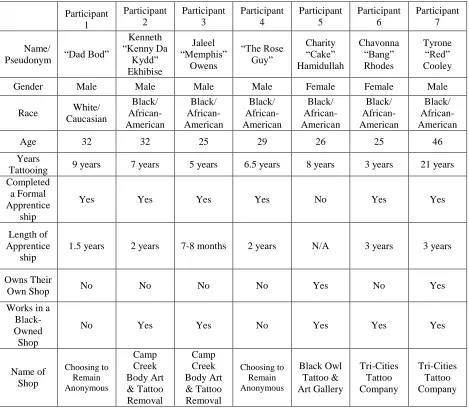
Seven individuals were interviewed. The interviews lasted anywhere from one to three
hours. Further information about the participants is included in Error! Reference source not
found. below. For the purposes of this study the participants selected met the following criteria:
1. Must be currently or previously working in the tattoo industry as a fulltime (meaning that
tattooing affords them the necessary income to provide for themselves) artist for 3 or more years.
2. Must currently or previously have worked in the tattoo industry in the greater Atlanta area.
3. Must self-identify as Black/African-American or have experience tattooing on Black
clientele.
The focus of the research for this study is on the Black Tattoo Community in Atlanta. The
other selection criteria determined whether or not the individuals have the lived experiences
necessary to answer the research questions.
Participant recruitment was largely done through connections that already existed with the
researcher and using the snowball method of recruitment. Once participants that met the criteria
were selected, they were asked to sign a consent form. The consent form offered them the option
to use their name or choose to remain anonymous, in which case they were assigned a
Table 1 Participants
Data Collection Techniques
The data collection techniques used for this included a preliminary questionnaire and
interviews. The data was transcribed and coded from the audio taped semi-structured interviews.
Following transcription and coding, a small group of peers (other graduate students) were asked
to review all coding in order to further ensure the validity of the research.
Participant 1 Participant 2 Participant 3 Participant 4 Participant 5 Participant 6 Participant 7 Name/
Pseudonym “Dad Bod”
Kenneth “Kenny Da Kydd” Ekhibise Jaleel “Memphis” Owens “The Rose Guy” Charity “Cake” Hamidullah Chavonna “Bang” Rhodes Tyrone “Red” Cooley
Gender Male Male Male Male Female Female Male
Race White/
Caucasian Black/ African-American Black/ African-American Black/ African-American Black/ African-American Black/ African-American Black/ African-American
Age 32 32 25 29 26 25 46
Years
Tattooing 9 years 7 years 5 years 6.5 years 8 years 3 years 21 years
Completed a Formal Apprentice
ship
Yes Yes Yes Yes No Yes Yes
Length of Apprentice
ship
1.5 years 2 years 7-8 months 2 years N/A 3 years 3 years
Owns Their
Own Shop No No No No Yes No Yes
Works in a Black-Owned
Shop
No Yes Yes No Yes Yes Yes
Questionnaire
The questionnaire consists of questions about whether or not the participant meets the
selection criteria for the study (Appendix B). If participants met the criteria, further demographic
and background information was collected.
Interview Procedure
The interview procedure was as follows:
1. Contact the potential participants to determine if they are interested in participating in the
study.
2. The participants read and sign the informed consent forms.
3. A time was scheduled for the interview with each participant.
4. Questionnaire was completed by the participants (Appendix B).
5. An interview guide was used to facilitate the interview (Appendix C).
6. The interviews were audio recorded.
7. Participants were asked if they knew anyone who would be a valuable participant to the study
(Snowball Method of participant recruitment).
8. The interviews were transcribed and coded.
9. A small group of peers reviewed coding to ensure reliability/validity.
Reliability/Validity
In order to address reliability and validity, the interview questions sought to ask vital
questions in various ways in order to receive the information needed to create the narrative. A
ensure the validity of the research. While it must be acknowledged that oral interviews are not
always the most reliable source of data, outside documentation and resources, (e.g. business
registration, etc.) were used to corroborate the information collected from interviewees.
Limitations of the Study
In order to reduce limitations brought forth by any preconceived observations as the
researcher, it is important to choose questions that are open-ended and do not lead the
participants in a particular direction. One limitation of this study is that it does not lead to
generalizable information. However, the intentions of this study are not to create generalizable
or replicable information, but rather to explore the lives, experiences, and history of the Black
Tattoo Community in the greater Atlanta area. Finally, this study will hopefully begin a richer
conversation in the scholarship around Black tattoo artists and tattooing on people of color.
1.5 The Researcher
As an artist myself, I have found interest in tattooing for many years, even before I really
understood it or the community. In the midst of some soul searching, it suddenly made sense to
me to let go of any fear of judgement, and commit to becoming a tattoo artist. Being in graduate
school does not allow for the time needed to apprentice, and so my apprenticeship will have to
wait. In the meantime, I have chosen to immerse myself, in whatever way possible, in the
culture and community. While watching an episode of Ink Master, I heard Craig Foster mention
the struggle he had finding an apprenticeship in the 1990s, in part, because of his race.
Immediately this intrigued me, and I decided to do more research. I quickly came across Miya
Bailey’s documentary and watched it in its entirety. However, after the documentary ended, I
struggled to find any more information on the topic. It occurred to me that this was the perfect
artists with a voice in the literature that does not seem to exist. Being from Atlanta presents an
opportunity to focus specifically on artists here. After watching Bailey’s documentary, it
became clear to me that Atlanta was important for Black tattoo artists and had a unique history.
As a White student in African-American Studies, I am accustomed to feeling like an
outsider sometimes. However, walking into a tattoo studio and asking people who do not know
me to let me interview them was incredibly intimidating at times. Nevertheless, this research
provided me with an opportunity to further get to know those artists that I already had contact
with, and to develop a relationship with those I had never met. I am grateful for that opportunity,
and hope that my research accurately tells their stories.
1.6 Chapter Synopsis
The historical overview of tattooing examines a brief world history of body modification
and tattooing. Chapter Two offers insight on the ancient history around body art and body
modification, including information from ancient Africa, Japan, the Polynesian Islands, and
Russian Prison culture. This chapter also examines the history of tattooing in the United States
from the 1800s through the present. Using existing literature, I provide insight on the “tattoo
community,” the culture of tattooing amongst both tattoo patrons and the artists themselves, and
tattoo apprenticeships. Additionally, I explore the normalization of a deviant art form.
Throughout history, negative perceptions of tattoo adorners plagued the mainstream across many
cultures. Adorners were thought only to have served time in prison, belonged to a gang, or
fought in a war. However, an examination of the mainstreaming and popularity of tattooing in
Finally, this chapter summarizes the documentary Coloring Outside the Lines (2012), by
Miya Bailey and briefly discusses Black tattoo artists. This documentary contains interviews
with Black artists from all over the United States, providing historical insight, for both the local
(Atlanta) and national history, of Black tattoo artists. In this way, this documentary offers an
excellent base from which to begin the study. Overall, this chapter seeks to deliver a historical
understanding of the marginalization of Black artists in the industry. This section concludes with
a discussion of the gaps that exist within current literature.
Chapter Three, A History of the Black Tattoo Community in Atlanta, I use the Black
Mecca schema to explain why Atlanta arose in the mid-1990s as a major hub for Black tattoo
artists to find valuable apprenticeships and work in the industry. West End Tattoo played a
major role in this process. Finally, I provide an overview of the genealogy of some of the most
professional and well-known Black tattoo artists and Black-owned tattoo shops in the Atlanta
area.
In Chapter Four, Apprenticing and Learning to Tattoo as a Black Artist, I utilize
interviews from participants and other data to explore how Black artists currently working in the
Atlanta area have attained apprenticeships and learned to tattoo. First, this chapter will present
the apprenticeship experiences of participants. Secondly, I uncover how the older generation of
tattoo artists, behaving as gatekeepers to the industry, have helped to provide a greater space for
younger Black tattoo artists. Third, the experiences that Black tattoo artists in the Atlanta area
have had in the industry are used to offer some understanding of where and how Black tattoo
artists feel they fit into the tattoo community. Furthermore, the intersection of race and gender
and the resulting impact on Black women in the tattoo industry is discussed. Finally, this chapter
Chapter Five, titled, Tattooing People of Color, begins by explaining the science behind
tattooing. This provides an understanding of why tattoos are permanent and why the shade of a
person’s skin might impact how a tattoo looks after it has healed. I employ interviews from
participants and other data to examine the differences between tattooing on different skin tones.
Additionally, I attempt to debunk misunderstandings in the industry and amongst patrons about
tattoos and dark skin. The use of color, contrast and composition may need to vary depending on
each client’s skin tone. Finally, this chapter will discuss some of the artists, particularly those in
Atlanta, who have revolutionized techniques for tattooing on people of color, challenging
previous beliefs and limitations.
Chapter Six, Tattooing, the Media and Black Popular Culture, explores how the media,
particularly television, the internet and social media, have impacted the tattoo industry on a
global level. Throughout each section, I discuss the impact that these media outlets have had on
tattoo artists and in particular, Black tattoo artists. This chapter provides insight on the changes
that have occurred in the industry since the creation of tattoo based reality-TV and competition
shows. Furthermore, I examine the influence of Hip-Hop culture on the tattoo industry, with a
particular focus on Atlanta. I also discuss how the media may be contributing to the number of
scratchers tattooing people and the impact that this has on the industry. Finally, this chapter
explores the employment of social media and the internet as a primary source for tattoo artists
and patrons to promote, research, and share with one another.
Chapter Seven concludes this study, taking another look at the research questions and to
briefly demonstrate how the previous chapters answer these questions. Furthermore, I discuss
the limitations of this study, any possible areas for related further research, and conclude with the
1 Bruce Kennedy, “In Tattoo Business, Profits are Hardly Skin Deep: Quintessential Experience Keeps
Customers Coming and Operators Plugging Along.”NBC News, last modified October 15, 2010,
http://www.nbcnews.com/id/39641413/ns/business-us_business/t/tattoo-business-profits-are-hardly-skin-deep/#.Vu9QufkrLIV.
2 Helen Lewis, “Will A Tattoo Ever Hang in the Louvre?” New Statesman. (2013) :32-37. Accessed March
22, 2016.
3 Margo DeMello, Bodies of Inscription: A Cultural History of the Modern Tattoo Community. (Durham,
NC: Duke University Press, 2000), 3.
4 Ibid.
2 A HISTORICAL OVERVIEW OF TATTOOING
This chapter delivers a historical overview of tattooing and insight on how and why Black
artists have been marginalized in the industry. I examine a brief world history of body
modification and tattooing, and offers insight on the ancient history around body art and body
modification. This section includes information from ancient Africa, Japan, the Polynesian
Islands, and Russian Prison culture. Additionally, the history of tattooing in the United States
from the 1800s through the present is examined. I also explore the criminalization and waves of
popularity of tattoos and the development and impact of the tattoo machine. This chapter
provides insight on the “tattoo community,” the culture of tattooing amongst both tattoo patrons
and the artists themselves, and tattoo apprenticeships. Additionally, the normalization of a
deviant art form is explored. Throughout history, negative perceptions of tattoo adorners
plagued the mainstream across many cultures. Adorners were thought only to have served time
in prison, belonged to a gang, or fought in a war. However, this section examines how tattoos
have become more mainstream and popular in present times.
Finally, this chapter summarizes the documentary Coloring Outside the Lines (2012), by
Miya Bailey and briefly discusses Black tattoo artists. This documentary contains interviews
with Black artists from all over the United States, offering historical insight for both the local
(Atlanta) and national history of Black tattoo artists. In this way, this documentary provides an
excellent base from which to begin the study. This chapter concludes with a discussion of gaps
that exist in the current literature around tattooing.
Archeological remains reveal instruments of tattooing dating back to somewhere between
10,000 and 38,000 B.C.E. Furthermore, mummified bodies adorning tattoos have been
identified all over the world, including, but not limited to remains from ancient Kemet, South
America, and Russia.1 It is estimated that ritual practices of tattooing and scarification in
humans may date back as far as 200,000 years ago.2 Evidence demonstrates that tattooing was
widely practiced and respected as an art form in many ancient cultures. In fact, John A. Rush,
author of, Spiritual Tattoo: A History of Tattooing, Piercing, Scarification, Branding, and
Implants, argues that “almost all cultures at one time or another practiced tattooing” and
therefore, arguably, some form or another of body modification.3 Rush further posits that body
modification has ranged from tattooing and piercings to modifications of the teeth, breast
implants, facial reconstruction, etc.4 While it appears that many ancient cultures including those
located in South America, North America, Africa, Europe, and various parts of Asia practiced
some form of tattooing and/or body modification at one time, Europeans appear to be the first to
lawfully prohibit the practice.
Ancient Africa
According to Rush, ancient Kemet provides the first written documentation of tattooing.5
In the, “Ancient Tattoos,” by Jarrett A. Lobell and Eric A. Powell, ancient Kemetians appear to
be one of the only known ancient cultures where tattoos were solely done on women.
Furthermore, Lobell and Powell argue that enough evidence suggests that in ancient Kemet,
tattoos may have been “considered one element of a woman’s sexuality.”6 The first known
examples of scarfication on parts of her body.8 Scarification is another form of body
modification that involved either branding or cutting, and is more common amongst cultures of
African descent because the skin is more likely to keloid.9 It should also be noted that
scarification practices were commonly found amongst peoples found in modern day Sudan.10
Japan
Evidence of tattooing in Japan dates back to prior to 5000 BC. Similar to Europe, tattooing
in Japan became a social taboo after contact with the Chinese in the 700s. Around this time, the
Japanese began using tattoos as a form of punishment, used to identify criminals and other
outcasts of society.11 Although tattooing resurfaced in popularity amongst members of the
underclass, it was banned as a “threat to the established order” during the Tokugawa Regime
(1603-1867). Despite the strict government ban on tattooing, members of underclass (labor
workers, criminals, members of the Yakuza (an organized crime unit), lower-class individuals)
continued to get tattooed, viewing tattooing as a sign of courage and loyalty.12 During the late
1800s, though still illegal, Japanese tattooing attracted attention from European and American
sailors and travelers. While Japan’s laws against tattooing changed following World War II, it
was the interest of Europeans and Americans that reinvigorated interest in traditional Japanese
tattooing. This was likely due to the past criminalization and subversive nature of tattooing in
Japanese culture.13
Traditional Japanese tattooing consists of a series of “specific designs representing
legendary heroes and religious motifs” in conjunction with symbolic elements of nature (e.g.
certain kinds of flowers, waves, clouds, and certain animals).14 A few popular examples of
traditional Japanese tattoos include dragons, koi fish, tigers, samurai, wind bars, cherry
tattooing is also different form Western tattooing in that Japanese tattoos usually consist of one
large design that covers the entire body.15 Japanese becomes relevant to this study because it
offers insight on the criminalization of tattooing and because Japanese style tattooing is now
extremely popular world-wide, including amongst the Black Tattoo Community, and still
consists of the same designs, images, and elements.
Polynesian Islands
Of the ancient cultures that practiced tattooing, Polynesian cultures arguably created and
ordained some of the most detailed, creative and complex tattoos.16 Ancient legend suggests that
two women tattooists from Fiji brought the art of tattooing to Tonga and Samoa. In ancient
Tonga, warriors were covered in intricate geometric patterned tattoos from their waist to their
knees that were created by well-trained priests.17 Similarly, in ancient Samoa, tattooing played
an important cultural role. Overtime, voyagers and warriors of Samoa and Tonga traveled to and
settled in other islands in the Pacific, such as the Marquesas and Hawaii, spreading their
language, art, culture, and tattooing. During the 1700s, Captain James Cook of the British Navy,
began traveling throughout the Polynesian Islands, and his naturalist, Joseph Banks, began the
first written account of Polynesian tattoos. According to Banks, the ink for tattoos in Tahiti was
created from the smoke of the candlenut mixed with water in coconut shells. The instruments
used for embedding the ink into the skin consisted of pieces of bone and shell that were
sharpened into various sizes and attached to a handle for use. The handle was then “struck” with
“sharp blows” from a stick to drive the ink deep into the skin.18
Although some Europeans took interest in Polynesian art and tattooing, the later groups of
missionaries that began settling the islands did not approve of tattooing and their colonial
previously taken interest both got tattooed and learned to tattoo in the Polynesian islands,
bringing the art and skill back to the United States and Europe.19 Understanding this history is
pertinent to this study because tattooing in the United States directly results from the exploration
and colonization of the Polynesian Islands and the appropriation of their tattooing culture.
Russian Prison Tattoos
Though existing in a much more modern history, the culture of tattooing in Russian prisons
is equally relevant. Beginning in 1846, criminals in Russia were branded on their face with the
word “KAT,” meaning “hard labor criminal.”20 However, despite the negative connotations,
overtime, convicts became proud of their markings. By the 1900s, prisoners began marking
themselves and often used portraits of Joseph Stalin and Lenin, believing that the images would
protect them from being killed by prison guards.21
According to the documentary, Marked: Pure Evil, criminal activity in Moscow leaves
“Russia ranked second, only to the U.S., in the number of prisoners per capita.”22 However,
prisons in Russia are often far more crowded and dangerous than those in the United States. As
a result, the criminal organization known as Thieves in Law created a complex hierarchal system
within the prison system, and tattoos are used to convey rank and demonstrate status. Placement
is as important as the image depicted and is also used to convey rank. For example, one of the
most important symbols, stars, when worn on the knees, implies that the convict commands
respect, while wearing stars on the chest can only be worn by those of the highest ranks.
Individuals who entered prison for the first time with tattoos, particularly those with stars, would
be severely punished and often killed. Other important symbols included epaulets (symbolizing
rank), snarling tigers, leopards, or wolves (Oskals demonstrate “hostility towards authority”),
with a sewing needle, thread and ink, however, others created homemade tattoo machines from
materials that could be gathered in the prison (e.g. toothbrush, pen caps, guitar string, etc.).
Women’s prisons had a similar hierarchal system with tattoos.23
Since the fall of the Soviet Union, prisons are no longer ruled by the Thieves in Law and
prisoners now tattoo whatever images they want. Many of the more modern day prison tattoos in
Russia consist of satanic images or representations. While it is now common for Russian
civilians to get tattooed, their tattoos differ greatly from those of convicts.24 The relevance of
Russian prison tattoos to this study is in the criminalization of tattooing. Starting in the 1800s,
tattooing/branding was utilized as a method of permanently branding convicts as outcasts of
society. The result is the branding of tattooing as a deviant activity across many cultures and
societies. The resulting perception has only begun to change in the past twenty-five or so years.
2.2 HISTORY OF TATTOOING IN THE UNITED STATES
Polynesian Influence
Early tattooing amongst Americans was done almost strictly by sailors, who traveled
looking for customers.25 The predecessors of North American tattooing are argued to be Pacific
Island Cultures, such as those from “Tahiti, Samoa, and Hawaii.”26 Although, as previously
discussed, Europeans practiced tattooing long before the United States was colonized, tattooing
in the United States is the result of travel to the Polynesian Islands in the 1700s.27 In 1769,
Captain James Cook, of the British navy, recorded the “first accounts of Polynesian tattooing” in
Tahiti and again in 1778 in Hawaii.28 Sailors began getting tattooed overseas in the 1780s,29 and
subsequently brought the practices and methods back to the United States with them.30
In 1846, Martin Hildebrandt became the “first known professional tattoo artist in the
that during the American Civil War, tattooing became acceptable for soldiers, and often
projected their political allegiance.32 During the 1880s, the main patrons of tattoos in the United
States included criminals, sailors, and the working lower-class; however, tattooing experienced
an increase in popularity amongst the upper classes during the late 1880s. During this time, all
tattoos were created by hand, as learned and appropriated from Polynesian cultures.33
The Invention of the Tattoo Machine
Likely as a result of the increase in popularity, in 1891, Samuel O’Reilly, a New Yorker,
patented the first tattoo machine that would move the needles up and down automatically,
speeding up the tattooing process and improving the quality of tattoos.34 This invention
increased the access of tattoos to the greater public, and tattooists began frequenting circuses and
carnivals.35 Furthermore, the “true Americana style of tattooing was born” from this
development and consisted of bold black outlines, thick black shading, and minimal color (black,
red, green, and blue).36 O’Reilly is also credited for having been the first tattoo artist to
The Golden Age of Tattooing
According to Jill A. Fisher in “Tattooing the Body, Marking Culture,” during the following
few decades there was a class divide amongst tattoo patrons. The upper-class intended their
tattoos to impress and demonstrate affluence, while the lower class patrons got their tattoos as a
means of self or political expression.38 DeMello considers the time between World War I and
World War II the “Golden Age of Tattooing,” because tattooing had “perhaps the highest level of
social approval due to its link with patriotism.”39 As previously mentioned, tattoos during this
time consisted of bold black lines, minimal color, and heavy shading. Tattoos were also readable
and typically consisted of basic patriotic imagery such as eagles, or anchors, names (typically of
mom or wife), etc.40 Most people at the time picked their tattoos from “flash,” which is
predesigned artwork that is typically displayed in the front of tattoo shops.41
Post World War II
Nevertheless, following World War II, tattooing became increasingly taboo again as a
result of the lack of sanitary conditions and regret from tattooed veterans.42 Specifically, in
1944, Charlie Wagner, of New York City, was the first tattooist to be fined for not sterilizing his
needles.43 At this time, health and age regulations were developed and enforced and tattooing
was even banned in some cities. It has also been suggested by Govenar that “knowledge about
the Nazi practice of tattooing Jews in concentration camps” may have, in part, “contributed to
tattooing’s downfall in the United States.44 During the 1940s through the early 1960s, tattoo
shops were “often situated in “bad” neighborhoods near bus depots, train stations, and lower
class communities.”45 Due to this transition, the connotations around tattoos in America became
greatly linked with the likes of sailors, bikers, gang affiliates, convicts, the working lower-class,
as a subcultural group viewed with fear by the middle class in the late forties” and “convicts and
Chicano gang members” who were “practicing homemade tattooing, moved into the public
eye.”47 This perpetuated to the progressively taboo image of tattooing as well as the
“splintering” of the culture into subcultures.48 Finally, supposedly scientific studies done on
tattooing served to further solidify the connection between tattooing and deviance.49
During the 1960s, bikers became the predominate group associated with tattooing in the
United States. Unlike American Traditional tattoos, biker tattoos did not deliver patriotic or
military themes, but were rather anti-establishment in nature, consisting of motorcycles,
swastikas, skulls, “club” logos and phrases, marijuana leaves, and were typically more dense and
located in more publically viewable areas.50
Ushering in the Tattoo Renaissance
It was during the late 1960s that the “West Coast had established itself as a new center of
tattooing” and California was amongst the first states to issue licensure to tattoo artists.51 Many
of the existing tattoo scholars refer to this time period as The Tattoo Renaissance. According to
the article “Culture in Transition: The Recent Growth of Tattooing in America,”written in 1981
by Alan B. Govenar, a great portion of the rise in popularity in tattooing in the 1970s and 1980s
is attributed to Sailor Jerry, Ed Hardy and related artists in the California area52, as well as the
“hippie and rock star subcultures.”53 Hardy was a well-respected tattoo artist, who studied
under many “Old School masters” including, Sailor Jerry, Phil Sparrow, Doc Webb, and Paul
Rogers, as well as with Hory Hide, a Japanese tattoo artist.54 Hardy was known for reinventing
and popularizing American traditional and Japanese traditional styles of tattooing.55 In addition,
in 1982, Hardy started the first tattoo magazine designed for a middle-class audience, called
tattoo artists of that time.57 Tuttle tattooed many celebrities and utilized this exposure to increase
media interest and public exposure to tattoos.58 According to Govenar, tattoo patronage during
the late 1960s through the 1970s can be attributed to the cultural emphasis on “individuality in
dress, sexuality, art, and religion” seen amongst hippies, rock stars, motorcyclists, etc.59
Furthermore, a “counterculture” developed during this time in “resistance to heterosexual, white,
middle-class values,” and tattoos, particularly in styles appropriated from “exotic cultures”
became appealing to this new audience.60 In particular, DeMello argues, that the rise in
popularity of the aesthetic of traditional Japanese style of full-body tattooing may have helped to
“sustain” the interest of middle-class Americans in tattooing.61 The rising popularity of tattoos at
this time may also be attributed, in part, to artists opening shops in local business districts of
major cities.62 Finally, scholars may also refer to this time as a renaissance due to the increase in
the number of tattooists with artistic backgrounds and the rise in popularity of custom artistic
designed tattoos.63
Due to the previously discussed factors impacting the gradual acceptance of tattooing, and
the cultural influences of tattoos from other parts of the world, the art of tattooing has changed
greatly. While randomly placed “flash” work used to dominate tattooing, custom artwork and
collaborations are now sought after amongst tattoo collectors.64 Much more attention to
placement, design, style, and composition now exists as well. Furthermore, DeMello argues that
tattooing has greatly transformed since the 1980s.65 She suggests that during the 1980s tattooing
moved from a predominately working-class to a predominately middle-class community, and
2.3 The Tattoo Community, Culture of Tattooing, and Apprenticeships
The Tattoo Community
As previously mentioned, Margo DeMello defines the tattoo community as “any and all
tattooed people” and also those who “embrace” and participate in “community-oriented
activities” (e.g. attending tattoo conventions).67 DeMello further explains that the tattoo
community is broken up into larger groups that contain sub-groups within them.68 Furthermore,
she describes the community as being subject to an “oppressive class system.”69 Terms such as
“biker” and “scratcher” are used to describe and differentiate from those who are considered a
part of the “professional” or “fine art” class.70 In addition to the class system, DeMello posits
that status within the community may be dictated by “the type of one’s tattoos (custom or flash);
who created one’s tattoos (i.e., the status of the artist); the number of tattoos one has; how much
media coverage one has received (in the tattoo magazines); and what kinds of links one has to
high-status tattooists.”71 Finally, the status of tattoo artists is also differentiated based on
“artistic credentials (including training, skill, and degree of innovation); professional credentials
(who was the artist’s mentor; whether one runs a custom shop or a street shop); shop locale
(urban or rural, West Coast versus East Coast); and relationships with the factions that develop
around certain tattooists and tattoo organizations.”72
While men who had been a part of the military or were involved with biker gangs
historically made up the majority of Americans with tattoos, a shift has occurred where women
now make up a greater percentage of tattoo patrons. Tattooing has proven itself to frequently be
a peer activity, and has also been linked to impulsive decision making and rebellious behavior.
Scholars have acknowledged four primary functions of the tattoo for patrons: ritual,
Tattoo Culture
David Wicks and Gina Grandy attempted to create a framework for the cultures that exist
amongst Canadian tattoo artists in their article, “What Cultures Exist in the Tattooing
Collectivity? Ambiguity, Membership and Participation.”74 According to their work, there
appears to be a culture around apprenticed tattoo artists that embodies “professionalism,
tradition/respect, and sacrifice.”75 Although apprenticeships vary in length and experiences,
many people consider only the apprenticed tattoo artist to truly be a professional. Furthermore,
the tattoo artists that have gone through formal apprenticeships are often perceived by their peers
as deserving respect.76 Finally, having completed an apprenticeship appears to be a sign of great
sacrifice amongst tattoo artists. According to The Alliance of Professional Tattooists, the
industry “places heavy emphasis on respect; respect for the history and traditions and for those
that have come before.”77 Clearly, then the professionalism, respect, tradition, and sacrifice of
having gone through a formal apprenticeship is sought after and valued by many tattoo artists in
the industry.
Apprenticeships
During the mid-1900s, tattooists, mostly consisting of working-class men, could learn to
tattoo by attending tattooing schools, paying a seasoned tattooist to train them, or by apprenticing
under a reputable tattooist. At the time, most tattooists were not great artists, and most tattoos
were selected from flash designs that were already created and could be selected from the walls
of the tattoo shop.78 In the last thirty or so years, more and more tattooists with fine arts training
Finding an apprenticeship as a tattoo artist can be a competitive and nearly impossible task.
Because a tattoo master is essentially training his/her competition during an apprenticeship,
many tattoo artists are exceedingly particular about who they are willing to apprentice, if they
apprentice any other artists at all.79 Many artists even require apprentices to be in his/her
employment for a set number of years following the apprenticeship and/or ask his/her
apprentices to sign a non-compete clause.80 During the early 2000s, it was estimated that 85
percent of tattoo artists were men. This is in part due to the nature of tattooing as a traditionally
apprentice-based craft, because women are often subjected to more rejection from potential
tattoo masters.81 It would seem reasonable to conclude that those individuals from other
marginalized groups, such as Black Americans, might experience similar rejection.
In Miya Bailey’s film, Coloring Outside the Lines: A Tattoo Documentary (2012), one
tattoo veteran of 20+ years, Roni Zulu, of Zulu Tattoo in Austin, Texas, states, “When I first
started tattooing it was pretty rough. Being a Black tattooist I couldn’t find an apprenticeship, no
one would teach me. I actually got laughed at when I walked into certain shops, here, of all
places, Southern California, I’m not talking about the Deep South.”82 The film will be further
discussed in a later section, but the aforementioned example demonstrates some of the difficulty
and rejection that Black tattoo artists faced in trying to break through into the tattoo culture in the
United States.
2.4 The Normalization and Popularization of a Deviant Art Form
The Criminalization of Tattooing
Historically, tattoos have been considered taboo and morally unacceptable amongst
Americans, Europeans, and throughout many other parts of the world the world. However, as
rituals, health treatments, and adornment. How then has tattooing become a socially forbidden
art form? Ancient civilizations such as Greece and Rome, who had previously valorized religious
tattoos, began tattooing criminals and slaves in an effort to brand and “[stigmatize] them.”83
Furthermore, frequently referenced in the Old Testament is the scripture in Leviticus 19:28:
“You shall not make any cuttings in your flesh on account of the dead or tattoo any marks upon
you.”84 Even though there are other vague and accepting references to tattooing in the Bible,
tattooing frequently became associated with idolatry amongst the Judeo-Christian religions.
Additionally, in 325 A.D. Constantine banned facial tattooing within the Holy Roman Empire
because it “disfigured that which was fashioned in “God’s image.”85 Finally, in 487 A.D., the
Empire strictly prohibited tattoos of any kind. Even though many other cultures were still using
tattoos for religious ritual and rites of passage at this time, as the West began colonizing and
converting other cultures to Christianity, they fought to stop the tradition in indigenous
populations.86
As discussed previously, tattooing was an important practice amongst countercultures
across the world, including the Yakuza in Japan, Thieves in Law in Russia, and the sailors and
biker gangs in the United States. This contributed to the perspective of “deviance” associated
with tattooing within mainstream cultures across the world. Although tattooing had been
outlawed and used as punishment in many societies, these countercultures embraced tattooing.
Only in the last forty or so years has this begun to really change.
From a Taboo Craft to the Mainstream
Although tattoos were considered taboo for the better part of the twentieth century, the
tattooed community now “transcends age, class, and ethnic boundaries.”87 Researcher, Mary
observed by examining the popularity amongst actors, musicians, athletes, and the use of
tattooed individuals in advertisements.88 The rise of reality television and social media as stages
for tattoo artists has also greatly contributed to the growing popularity of tattooing.89 These
platforms have not only contributed to the growing demand for ink in the United States, but
globally.
As tattoos become more acceptable in the mainstream, research estimates that nearly 40%
of young adults now wear tattoos. However, it appears that 70% of individuals with tattoos get
them in places that can be hidden by clothing.90 Although the general public still appears to
perceive tattooed individuals stereotypically, researchers have found that there are no significant
differences in the grade point averages of university students with tattoos and those without
them. Much of these negative perceptions of tattooed individuals appear to be held by those of
older generations, particularly those with higher incomes.91 This is likely due to the
aforementioned popular beliefs about tattooing that existed in the couple of decades post World
War II.
DeMello explains that the mainstream media, tattoo magazines and tattoo organizations
have the greatest impacts on the industry.92 She further illuminates the influence that tattoo
magazines have on the tattoo community and the ways in which they perpetuate the
aforementioned caste system that exists. DeMello divides tattoo magazines into two major
categories “biker and nonbiker” or “lowbrow and highbrow.”93 The categories are distinguished
based on “editorial content” and the publisher, rather than on patronage.94 The “highbrow”
magazines, such as Ed Hardy’s previously mentioned, Tattoo Time, ultimately seek to situate
articles. Furthermore, tattoo suppliers are not allowed to advertise in these magazines in an
effort to discourage “scratchers” or untrained tattooists from purchasing tattoo supplies.95
Trade or Fine Art Form
Despite the decriminalization and increase in popularity of tattoos that has occurred over
the last 50 or so years, there still remains ambiguity around tattooing as an art form versus
tattooing as a commodity. As one artist explains in an interview, many people observe athletes,
musicians, and actors with tattoos, and automatically want to get tattooed. For these people, the
artist states, “tattoo is an object of consumption and has nothing to do with art.”96 Another artist
and tattoo historian states that she is inclined to view tattooists as tradesmen and women, rather
than artists, because they are “constrained by their client’s choices and that even the most
successful ones rarely get full creative control over their work.”97 However, as the popularity of
tattooing rises, and more and more tattooists have educational backgrounds in the fine arts, there
remains a debate around the topic.
2.5 Documentary: Coloring Outside the Lines and Related Black Tattoo Artists
Color Outside the Lines: A Tattoo Documentary (2012), the documentary, conceived and
produced by Miya Bailey, includes interviews from artists all over the country and world
discussing their experiences in the tattoo industry. The film opens with veteran tattoo artist,
Zulu, stating,
other cultures have learned from what we’ve done in our culture and unfortunately so many times that has been stolen from us and been acquired and represented in other cultures as if it’s theirs when in fact it came out of the roots of who we were.98
While this was the only time in the documentary that the ancient history of tattoos was
mentioned, Zulu brings home a valuable point. While the modern history of tattooing in the
United States has been laced with racism, people of color, from Africa and around the world,
have contributed to the development and various styles of tattooing since ancient times. This film
is a great resource and provides interviews from Black tattoo artists across the United States.
Furthermore, this film offers insight on the marginalization of Black tattoo artists from the tattoo
industry.
One of the most important artists in the film, Jacci Gresham, is credited for being the first
Black tattoo artist in the United States. She was born in Flint, Michigan and she studied
architecture and engineering, putting her drawing skills to use.99 She states in the film that a
white Englishman taught her how to tattoo.100 Eventually, Gresham moved to New Orleans and
opened a tattoo shop in 1976. At the time, there were only five female tattoo artists in the
country.101 When asked what made her want to get into tattooing, she said “’cause it’s fun!”102
She also explains that her inability to get a job in the field of architecture and engineering
because of her race and gender led her to tattooing.103
A few standout references were made in the documentary about the history of tattooing in
the United States prior to the mid-1990s. Christopher “Duel” Hall, an artist working in Atlanta,
Georgia, said, “In the ‘80s, there was no Black tattoo artists.”104 Duel also makes reference to
Jacci Gresham and Ed Hardy, arguing that any tattoo artist should know “the oral history of what
electric tattooing means” and how these important artists have influenced the styles.105 Damon
there was a “huge art explosion” that became known as “New School,” but he explains that this
style was “just a new generation of artists.”106 Conklin also explains that most American tattoos
prior to this time period were a biker style or the styles brought from other countries, like Ed
Hardy and traditional Japanese work. Another artist, Twig Sparks, of Hart and Huntington
Tattoo in Orlando, Florida, refers to tattooing as having gone from “a street shop, biker gang
type situation, to a universal” and mainstream industry.107 These references to biker gangs
makes sense considering the previously discussed history that shows that most tattooing between
the 1940s until the late 1960s was practiced almost exclusively by white members of the
American underclass (sailors, bikers, gang affiliates, convicts, the working lower-class, and
carnival goers).108
It is important to note that many of the artists interviewed in this documentary own their
own shops. Tyrone “Red” Cooley owner of West End Tattoo (now Tri-Cities Tattoo Company)
in Atlanta, Georgia discusses how Black-owned tattoo shops are still far from the norm. He
explains that people often question him and have gone as far as asking him if his shop is “a
reputable business.”109 Red bought West End Tattoo from its original owner, Julia Alphonso, a
White woman with 40+ years of tattooing experience. Alphonso’s shop was known in the 1990s
for being one of the only places that would apprentice and hire Black tattoo artists. Alphonso
hired and apprenticed many, including the shop’s last owner, Red, as well as Miya Bailey, the
film’s producer, and Tuki Carter, Bailey’s business partner at City of Ink in Atlanta, Georgia.110
A few important things can be gathered from Bailey’s film. First, with the exception of
Gresham, most of the aforementioned artists got into tattooing within the last twenty-five years
(or less). This indicates that it was around the mid-1990s when Black artists first seemed to be
differences between working on dark and light skin. Thirdly, the video addresses the concept of
scratchers. Many of the artists in the video started out scratching, but eventually underwent a
full apprenticeship. As a result, most artists explained the importance of apprenticing and the
downfalls of scratching without any training or progression. The film also briefly demonstrated
some of the inappropriate behavior and poor technique that occurs when a tattooist is not
properly trained. It also explains why paying for a highly-trained and skilled tattoo artist is a
better decision than going to a scratcher. Fourthly, the film echoes some of the same themes that
were indicated as part of tattoo culture in the Canadian study done by Wicks and Grandy.111 The
collective sentiment appears to be that being a fully-apprenticed tattoo artist is a career that
requires great sacrifice, but that sacrifice is rewarded with respect and the unique experiences
and travel that come as a skilled artist. Finally, the film emphatically demonstrates that tattooing
is a highly-skilled art form that requires great sacrifice, time, effort, and natural talent to be
successful. The film will further be used within this study to discuss the history of Black tattoo
artists in Atlanta, apprenticeships, and the differences between working on black and white skin.
Information from the film will be corroborated with my interviews, interviews conducted by
others for online magazines, and data from the Georgia Corporations Division in order to provide
better reliability.
2.6 Gaps
According to David C. Lane at the University of South Dakota, “the emphasis in the
majority of accumulated literature has been on the consumers of tattoos rather than the
producers.”112 He further explains that many researchers have spent time examining the purpose
and meaning of tattoos by the wearer and even the psychological and social reasons for getting
literature discusses the various and distinct styles of tattooing.114 Because people of color and
women having historically had limited access to tattoo apprenticeships in the United States, their
voice in relevant scholarship and in mainstream media has also been limited. This research aims
to provide a voice and history in the literature for Black tattoo artists, particularly those working
in the greater Atlanta area.
1 Steve Gilbert, Tattoo History: A Source Book. (New York, NY: Juno Books and RE/Search Publications,
2000), 11-16
2 John A. Rush, Spiritual Tattoo: A Cultural History of Tattooing, Piercing, Scarification, Branding, and
Implants. (Berkley, CA: Frog, Ltd, 2005), 3.
3 Ibid., 18.
4 Ibid.
5 Ibid., 19.
6 Jarrett A. Lobell and Eric A. Powell, “Ancient Tattoos: As Adornment, Status Symbol, or Declaration of
Religious Belief, Body Art has been a Meaningful Form of Expression Throughout the Ages and Across
the World,” Archeology, (2013) : 42.
7 Gilbert, Tattoo History, 18.
8 Ibid., 19.
9 Terrence A. Cronin Jr., “Tattoos, Piercings, and Skin Adornments.” Dermatology Nursing, 13, no. 5
(2001) : 380-383.
10 Gilbert, Tattoo History, 19.
11 Ibid., 77.
12 Ibid., 78.
13 DeMello, Bodies of Inscription, 73.
14 Gilbert, Tattoo History, 78.
15 Ibid.
16 Ibid., 21.
17 Ibid., 22.
18 Gilbert, Tattoo History, 37.
19 Ibid., 23.
20 Philip Boag, “Marked” Pure Evil, Documentary, (2009), video retrieved from
https://www.youtube.com/watch?v=zHbqsO6mctA.
21 Ibid.
22 Ibid.
23 Ibid.
24 Boag, “Marked” Pure Evil.
25 Alan B. Govenar, “Culture in Transition: The Recent Growth of Tattooing in America,” Anthropos, 76
(1981) : 218, http://www.jstor.org/stable/40460298.
26 DeMello, Bodies of Inscription, 44.
27 Ibid., 45.
28 Ibid.
29 Jill A. Fisher, “Tattooing the Body, Marking Culture,” Body & Society, 8, no. 4 (2002) :93.
30 DeMello, Bodies of Inscription, 45.
31 Ibid., 49.
32 Fisher, “Tattooing the Body, Marking Culture,” 94.
33 DeMello, Bodies of Inscription, 50.
34 Rush, Spiritual Tattoo, 127.
35 Govenar, “Culture in Transition,” 218.
36 DeMello, Bodies of Inscription, 50.
37 Fisher, “Tattooing the Body, Marking Culture,” 96.
38 Ibid., 95.
39 DeMello, Bodies of Inscription, 63.
40 Ibid., 65.
41 Maureen T. Schwarz, “Native American Tattoos: Identity and Spirituality in Contemporary America,”
Visual Anthropology, 19 (2006) :224, doi: 10/1080/08949460500297398.
42 Govenar, “Culture in Transition,” 218.
43 DeMello, Bodies of Inscription, 66.
44 Ibid.
45 Govenar, “Culture in Transition,” 217-218.
46 Schwarz, “Native American Tattoos,” 224.
47 DeMello, Bodies of Inscription, 67.
48 Ibid.
49 Ibid.
50 Ibid., 68.
51 Govenar, “Culture in Transition,” 217.
52 Ibid., 216.
53 Fisher, “Tattooing the Body, Marking Culture,” 97.
55 Ibid.
56 DeMello, Bodies of Inscription, 80.
57 Govenar, “Culture in Transition,” 217.
58 DeMello, Bodies of Inscription, 76.
59 Govenar, “Culture in Transition,” 217.
60 DeMello, Bodies of Inscription 72.
61 Ibid., 75.
62 Govenar, “Culture in Transition,” 218.
63 Clinton R. Sanders with D. Angus Vail, Customizing the Body: The Art and Culture of Tattooing (Revised
and Expanded Edition), (Philadelphia, PA: Temple University Press, 2008), p. 19.
64 Schwarz, “Native American Tattooing,” 224.
65 DeMello, Bodies of Inscription, 10.
66 Ibid., 11.
67 Ibid., 3.
68 Ibid.
69 DeMello, Bodies of Inscription, 6.
70 Ibid., 5-6.
71 Ibid., 8.
72 Ibid.
73 Fisher, “Tattooing the Body, Marking Culture,” 99-101.
74 David Wicks and Gina Grandy, “What Cultures Exist in the Tattooing Collectivity? Ambiguity,
Membership and Participation,” Culture and Organization, 13, no. 4 (2007) :349-363, doi:
10.1080/14759550701659052.
75 Ibid., 357.
76 Ibid., 358.
77 Ibid., 358-359.
78 DeMello, Bodies of Inscription, 52.
79 Fisher, “Tattooing the Body, Marking Culture,” 98.
80 Sanders and Vail, Customizing the Body, 19.
81 Ibid., 97.
82 Miya Bailey, Coloring Outside the Lines: A Tattoo Documentary, Documentary, Artemus Jenkins. (2012).
83 Govenar, “Culture in Transition,” 218.
84 Ibid.
85 Ibid.
86 Ibid.
87 Mary Kosut, “An Ironic Fad: The Commodification and Consumption of Tattoos,” The Journal of Popular
88 Ibid. 1038-1039.
89Alejandra Walzer and Pablo Sanjurjo, “Media and Contemporary Tattoo,” Communication & Society, 29
no. 1 (2016) :73, doi: 10.15581/003.29.1.69-81.
90 Kristen A. Foltz, “The Millennial’s Perception of Tattoos: Self Expression or Business Faux Pas.” College
Student Journal, 589, accessed October 28. 2015.
91 Ibid., 590.
92 DeMello, Bodies of Inscription, 97.
93 Ibid., 101.
94 Ibid.
95 Ibid., 101-102.
96 Walzer and Sanjurjo, “Media and Contemporary Tattoo,” 29.
97 Lewis, “Will A Tattoo Ever Hang in the Louvre,” 36.
98 Bailey, Coloring Outside the Lines.
99 Jeanie Riess, “The Oldest Tattoo Shop in New Orleans,” Best of New Orleans, last modified May 5, 2014,
http://www.bestofneworleans.com/gambit/a-life-of-ink/Content?oid=2430395.
100 Bailey, Coloring Outside of the Lines.
101 Riess, “The Oldest Tattoo Shop in New Orleans.”
102 Bailey, Coloring Outside of the Lines.
103 Ibid.
104 Ibid.
105 Ibid.
106 Bailey, Coloring Outside the Lines.
107 Ibid.
108 Schwarz, “Native American Tattoos,” 224.
109 Bailey, Coloring Outside the Lines.
110 Ibid.
111 Wicks and Grandy, “What Culture Exists in the Tattooing Collectivity?” 349-363.
112 D. C. Lane, “Tat’s All Folks: An Analysis of Tattoo Literature. Sociology Compass, 8 no. 4 (2014) : 398.
doi: 10.1111/ soc4.12142.
113 Ibid., 405-406.