Business Administration Dissertations Programs in Business Administration
Spring 4-21-2016
Dynamic Capabilities to Evolve an Ambidextrous
IT Organization
Douglas Redden
Follow this and additional works at:https://scholarworks.gsu.edu/bus_admin_diss
This Dissertation is brought to you for free and open access by the Programs in Business Administration at ScholarWorks @ Georgia State University. It has been accepted for inclusion in Business Administration Dissertations by an authorized administrator of ScholarWorks @ Georgia State University. For more information, please [email protected].
Recommended Citation
In presenting this dissertation as a partial fulfillment of the requirements for an advanced degree from Georgia State University, I agree that the Library of the University shall make it available for inspection and circulation in accordance with its regulations governing materials of this type. I agree that permission to quote from, copy from, or publish this dissertation may be granted by the author or, in her absence, the professor under whose direction it was written or, in his absence, by the Dean of the Robinson College of Business. Such quoting, copying, or publishing must be solely for scholarly purposes and must not involve potential financial gain. It is understood that any copying from or publication of this dissertation that involves potential gain will not be allowed without written permission of the author.
All dissertations deposited in the Georgia State University Library must be used only in accordance with the stipulations prescribed by the author in the preceding statement.
The author of this dissertation is:
Doug Redden
The director of this dissertation is:
Karen Loch
J. Mack Robinson College of Business Georgia State University
P.O. Box 4015
By
Doug Redden
A Dissertation Submitted in Partial Fulfillment of the Requirements for the Degree
Of
Executive Doctorate in Business
In the Robinson College of Business
Of
Georgia State University
GEORGIA STATE UNIVERSITY
J. MACK ROBINSON COLLEGE OF BUSINESS
Copyright by
Doug Redden
2016
This dissertation was prepared under the direction of the Dissertation Committee for Doug Redden. It has been approved and accepted by all members of that committee, and it has been accepted in partial fulfillment of the requirements for the degree of
Executive Doctorate in Business in the J. Mack Robinson College of Business of Georgia State University.
Richard Phillips, Dean
DISSERTATION COMMITTEE
TABLE OF CONTENTS
LIST OF FIGURES ... VI
ABSTRACT ... VII
I CHAPTER 1: INTRODUCTION ... 1
II CASE BACKGROUND ... 8
III THEORETICAL BACKGROUND ... 10
III.1 Ambidextrous Management of IT Resources ... 10
III.1.1 Overview ... 10
III.1.2 Ambidexterity Approaches ... 13
III.1.3 Structural Ambidexterity ... 14
III.1.4 Contextual Ambidexterity ... 16
III.2 Dynamic Capability Theory ... 17
III.3 Bridging OA to DC ... 20
IV METHODOLOGY ... 23
IV.1 Qualitative Case Study ... 23
IV.2 Data Collection ... 24
IV.3 Shifting Stories ... 26
V CASE RESULTS ... 28
V.1 Orchestrate Transformation ... 28
V.1.1 Orchestrating transformation evidence ... 30
V.2 Driving Common Intent ... 31
V.2.1 Driving common intent evidence ... 36
V.3.1 Reconfiguring decision making and organizational change evidence .... 41
V.4 Exploiting Existing Capabilities ... 42
V.4.1 Exploiting existing capabilities evidence ... 45
V.5 Exploring New Options ... 46
V.5.1 Exploring new options evidence ... 52
V.6 Evolving Culture through Context ... 53
V.6.1 Evolving culture through context evidence ... 57
VI DISCUSSION ... 58
VI.1 DC reconfiguration: manifestation of OA ... 59
VI.2 An integrated OA to DC grounded model ... 61
VI.3 Managerial Insights ... 62
VIICONCLUSION ... 65
VII.1 Implications ... 65
VII.2 Limitations ... 66
VII.3 Closing ... 66
REFERENCES ... 68
APPENDIX ... 82
LIST OF FIGURES
Figure 1: IT PharmaCo organizational structure pre-transformation ... 9
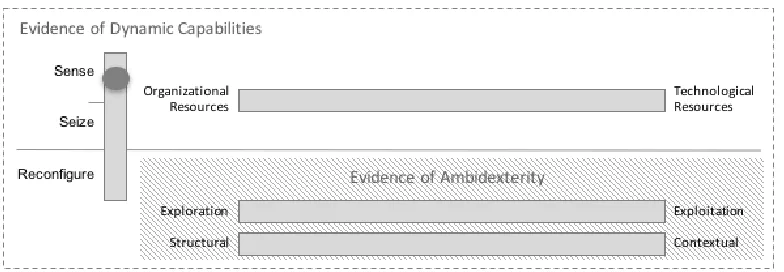
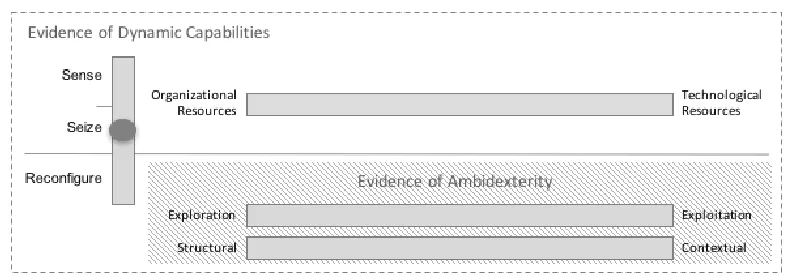
Figure 2: Analytical Model for DC and OA Evidence ... 22
Figure 3: Data Collection ... 25
Figure 4: Shifting Stories approach, secondary data, and informants ... 26
Figure 5: Resource reconfiguration decision events ... 28
Figure 6: Orchestrating Transformation evidence ... 31
Figure 7: Strategic shifts ... 32
Figure 8: Four-quadrant model investment shift ... 34
Figure 9: Three-horizon innovation model ... 35
Figure 10: Driving common intent evidence ... 36
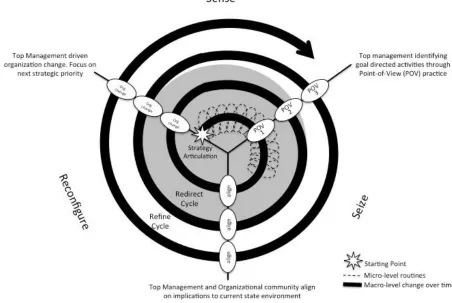
Figure 11: Iterative decision making through Point of View development ... 40
Figure 12: Decision types against the Four-Quadrant model ... 41
Figure 13: IT PharmaCo organization structure post transformation ... 41
Figure 14: Reconfiguring decision making and organizational change evidence ... 42
Figure 15: Exploiting existing capabilities evidence ... 46
Figure 16: Exploring new options evidence ... 53
Figure 17: Evolving culture through context evidence ... 57
ABSTRACT
Dynamic Capabilities to Evolve an Ambidextrous IT Organization
By
Doug Redden
May 2016
Committee Chair: Karen Loch
Major Academic Unit: J. Mack Robinson College of Business
Digital disruptions are changing the healthcare ecosystem, requiring organizations
to rethink IT strategies and develop new IT competencies. This study focuses on the
exploitation and exploration tension that managers face within an IT organization of a
global pharmaceutical company, and their response to the related environmental
exigencies in healthcare. Dynamic capability theory (DC) provides the overall framing,
while ambidexterity provides an understanding of top management’s response to the
exploit–explore tensions that arise. This engaged scholarship longitudinal case study
takes a shifting stories methodological approach to elicit participants’ reflections and
interpretations of significant events, including their own role in evolving the
ambidextrous posture of the IT organization. Through rich description stories, process
related decisions have been revealed, and have provided an understanding into
organizational reconfiguration of IT resources. Subsequently, this resulted in a situated
grounded model for understanding DC and OA for this case. Practical insights are offered
on how dynamic capability theory could be applied for IT management to be smarter at
I CHAPTER 1: INTRODUCTION
“Success in the future will be measured not only by production but also by the ability to adapt. Changes in the health care environment and a global
economy that assert new pressures on our business require a nimble, scalable, and adjustable organization. . .” (Chairman and CEO, PharmaCo.)1
Digital disruptions are changing business landscapes, requiring organizations to
reconsider IT (Information Technology) strategies and develop new competencies in
order to obtain some level of competitive advantage. The healthcare industry is
experiencing this challenging phenomenon at an extraordinary pace. Particularly within
the United States, policy change such as the Affordable Care Act (ACA), optimizing
patient outcomes, and electronic health records are fundamentally redesigning the
delivery of healthcare, with a tight connection to IT competencies, and consequently
pushing pharmaceutical companies to develop dynamic IT capabilities that will endure
and be competitive over the long haul. The CEO of PharmaCo unmistakably stated the
context, and therein the task at hand for the leadership team of its IT organization. IT
PharmaCo’s strategic response to this challenge provides the focal point for this
dissertation.
This dissertation draws on two streams of research, both of which contribute to
the prevailing thinking on how organizations survive in the face of change, applying a
process perspective to zero in on how top management contributes to becoming more
ambidextrous.
The first stream of research is organizational ambidexterity. The generic use of
organizational ambidexterity simply means the capacity to do two things simultaneously.
1 Quote made by the Chairman and CEO of a major global pharmaceutical company. PharmaCo is a
Interest in ambidexterity refers to the capacity of the firm to exploit existing resources for
the good of the firm while simultaneously exploring new opportunities, technologies and
markets as examples, and reconfiguring its resources to, at minimum, survive, and
optimally to obtain competitive advantage (Helfat and Raubitschek, 2000; March, 1991;
Holmqvist, 2004). It is arguably March’s (1991) seminal work on exploration and
exploitation that spurred interest in ambidexterity. Exploitation focuses on efficiency,
increasing productivity, defending and extending core operations. Exploration focuses on
search, discovery, and innovation resulting in building emerging capabilities and creating
viable options for the future. Ambidexterity is about doing both, exhibiting the capability
to resolve the tension between exploration and exploitation in the quest for
competitiveness and firm survival (March, 1991; O’Reilly and Tushman, 2004, 2008;
Nosella et al., 2012).
In managing these tensions, it is also necessary for organizational culture to
evolve and be grounded in promoting both innovation and discipline (Ghoshal & Bartlett,
1994; Gibson & Birkinshaw, 2004; Jelinek & Schoonhoven, 1993; Simsek, Heavey,
Veiga, & Souder, 2009). Cultural evolution is necessary to address the dual demands of
exploration–exploitation tensions and provide cohesion among the organization
(Eisenhardt & Schoonhoven, 1990) and introduces contextual ambidexterity as a
mechanism for managing resource reconfiguration. This is particularly relevant in the IT
realm where it is necessary to exploit software products for existing customers and
simultaneously explore innovative, new technology options (Napier, Mathiassen, &
Robey, 2011). Successful IT companies have demonstrated development of coping
activities while also addressing flexibility and agility when faced with important external
environmental changes (G. Lee, Delone, & Espinosa, 2006).
The second stream of research is the dynamic capabilities framework. Dynamic
capabilities are defined as “the firm’s ability to integrate, build, and reconfigure internal
and external competencies to address rapidly changing environments” (Teece, Pisano,
and Shuen, 1997, p. 516) or “the capacity of an organization to purposefully create,
extend, or modify its resource base” (Helfat et al., 2007, p. 4). The dynamic capabilities
construct is intended to answer the question of how firms can achieve, and maintain,
competitive advantage in the context of rapid technological change (Teece et al., 1997).
There is a clear separation between operational capabilities, ongoing tasks for making a
living, and the processes that help bring about change and require managerial action in
order to do so (Helfat, 2007). Interest lies in examining the strategic response of IT
PharmaCo in light of its environmental challenge.
Organizations that have a certain level of dynamic capability can lead to
becoming more ambidextrous. In Nosella et al.’s (2012) review of this body of work,
they found almost all studies agreed that dynamic capability and organizational
ambidexterity co-exist. O’Reilly and Tushman (2008) reported over 40 studies on
organizational ambidexterity and a deeper examination on the content and process of
change in organizations. Several studies explicitly acknowledge the linkage between
organizational adaptation and dynamic capabilities (e.g. Harreld et al., 2007; He and
Wong, 2004; Tushman et al., 2007; Venkatraman, Lee, and Iyer, 2006) while others
focus more on outcomes such as organizational performance associated with
as a whole (see O’Reilly and Tushman, 2008, p. 192-193), they provide strong support
for the linkage between organizational ambidexterity and dynamic capabilities. They
report that organizations are adaptive systems and in continuous interaction with their
opposing demands in their environment, an aspect that is particularly relevant in IT
software functions.
As a result, organizations must continuously reconfigure and rebalance their
activities in order to adapt to the external challenges and resolve the tensions that
continuously re-present themselves. Therefore, it is the combination of the organizational
ambidexterity and the dynamic capabilities framework that set the boundaries for this
study with common elements of survival and competitiveness, and the adroit
management of its IT resource base in the face of rapid change. IT PharmaCo is situated
in a rapidly changing environment with its strategy involving integration, building, and
reconfiguration of its resources in order to transform itself from a core–operations, cost–
focused model to a nimble, scalable, adjustable, differentiated organization as described
by the CEO. At the same time, it is possible to obtain and offer insight on how dynamic
capability theory could be applied for IT managers driving exploitation and exploration
activities, the two opposing sides of organizational ambidexterity capability.
Therefore, the research objective is to further understand how an IT
organization’s dynamic capability leads to increasing organizational ambidexterity in a
rapidly changing environment. What renders this study distinct is its use of the
ambidexterity conceptual framework to unwrap the resource configuration decisions
occurring at IT PharmaCo. Focus is placed on “how” IT leaders adjust the organization’s
orchestrate resource allocation between routine and innovation, there is little
understanding on “how” they actually do this. Organizations rely on leaders, managers,
to orchestrate resource allocation, successfully demonstrating ambidexterity, by
addressing the routine and opportunistic new business domains. However, how managers
actually go about doing this, and identification of the decisions has not been addressed
(Adler, Goldoftas, & Levine, 1999; Gibson & Birkinshaw, 2004). This study adopts a
qualitative, engaged scholarship methodology that includes a longitudinal, single case
study. The case study permits a deep dive to investigate how ambidexterity emerges as
explained by the strategists–management team. As a longitudinal study, it affords the
opportunity to provide an understanding on how a certain level of dynamic capability
leads to increasing ambidexterity, while co-evolving with the changes in the
environment.
This research provides an in-depth look into an IT function within a global
pharmaceutical company faced with a changing healthcare industry landscape, that has
determined that its survival rests on redefining itself as more than just a pharmaceutical
company, but rather transforming2 itself into a healthcare company. A key tenet for this
shift is a dependency on IT capabilities for future products and services. This leads to the
research question “How does an IT organization build and reconfigure its resources3 over
time to become ambidextrous in the way it services the firm?” Therefore, the research is
intended to peer into leadership–management teams’ decision-making processes and
2The term “transformation” is defined as “a major change occurring along three possible dimensions:
changes in goals, boundaries, and activities” (p.16) (Aldrich, 1999)
3This research has adopted Barney’s (1991) definition ofresources. Resources include all assets,
interactions to contribute to the strategy of ambidexterity as well as the processes and
activities used while reconfiguring organizational–human resources needed in the
production of new output configurations (Avital & Te’eni, 2009), and technological–IT
systems intended to offer innovation opportunities (Zittrain, 2005).
To provide a jumping-off point, this case begins with the IT organization and its
leadership–management team in the throes of their transformation effort seeking an
adjustment from primarily a structural–exploitation disposition to one which attempts to
re-balance the exploit–explore structural disposition. This dissertation has been generated
by using engaged scholarship in its purest form, with the author having been on the core
team responsible for driving resource reconfiguration decisions. In addition, this
dissertation takes advantage of Lanzara’s Shifting Stories approach (p. 285) (Schön,
1991) and adapts its participant observation approach to provide an in-depth account of
event–sequence recounting over a two and a half-year period, beginning in 2012. The
contextual nature of the method elicited six stories that provide a deep understanding as
to how managers reconfigure resources to become more ambidextrous in the way they
service the firm. Finally, lessons are offered for IT managers faced with addressing
tensions of exploration–exploitation, with ambidexterity informing how these changes
occur, and the decisions involved in organizational reconfiguration.
This dissertation proceeds in the following manner. The next section provides the
case background of PharmaCo and the challenge set forth for IT PharmaCo. Then, the
existing literature on organizational ambidexterity and dynamic capabilities are reviewed
in order to provide theoretical background for this dissertation. Subsequently, the
single case study and data collection process. Then, the results are presented as six
interdependent stories chronicling the two-and-a-half-year process of reconfiguration. In
closing, a discussion of the key findings, study limitations, and implications for future
II CASE BACKGROUND
PharmaCo is a global pharmaceutical company with a mission to develop
innovative products and services that save and improve lives globally. In order to deliver
on this mission, the organization has been adapting its strategy to the changing healthcare
ecosystem. External factors such as patient outcomes, real-world evidence, digitization of
information, electronic health records (EHR), and public policy enactments (Affordable
Care Act) have fundamentally reshaped the delivery of healthcare. Consequently,
pharmaceutical companies have looked to redirect themselves and become more a
developer and manufacturer of drugs. PharmaCo’s response was to redefine itself as a
healthcare company–existing to serve the needs of patients and healthcare providers
across many channels and in times of both sickness and health, consistent with their
mission. Stated by the CEO of PharmaCo, information will be the competitive
differentiator in the marketplace, thereby placing increased importance on the IT
capabilities the company possesses. Beginning in 2012, IT PharmaCo began a deep,
fundamental transformation to support PharmaCo’s redirection to that of a healthcare
company.
Chief Information Officer (CIO): “We are competing in an IT-intensive industry. This means that information and technology are increasingly embedded as part of our products, services, and top-line growth initiatives…We care because we know that companies who learn to leverage information and technology to drive better decision-making are leaders, creating uncommon profit gaps with their closest competitors.”
Prior to 2012, IT PharmaCo had already begun setting the foundation for its
transformation journey. Beginning in 2006, the rationalization and consolidation of
storage, processing, and network capacity had begun. This effort led to the launch of a
supported the implementation of a single instance of SAP, an Enterprise Resource
Planning (ERP) capability, delivering central management of PharmaCo’s business
processes. In 2009, PharmaCo acquired an equally sized organization as its own, meaning
system and team integrations between the two companies were top order for the IT group.
The acquisition resulted in both cost and efficiency gains once completed in 2011.
Coming into 2012, IT PharmaCo (roughly 3,000 employees out of 80,000) was wired for
efficiency and consolidation. IT had been configured such that the majority of the
organization was focused on activities driving efficiency and responding to functional
organization demands (Figure 1), while a very small portion was exploring innovative,
[image:19.612.93.523.352.436.2]game-changing, opportunities.
Figure 1: IT PharmaCo organizational structure pre-transformation4
With the retirement of the CIO in early 2012, PharmaCo leadership promoted the
Vice President of Research IT, a leader regarded as delivering innovation within a core
division of the company, to interim CIO. The importance of this announcement was
two-fold: it was disruptive to a long, relatively stable episode of consolidation and integration;
and, it signaled to the IT organization that success would rely not only upon operational
excellence, but innovation as well. These shifts would necessitate a new strategic course.
III THEORETICAL BACKGROUND
III.1 Ambidextrous Management of IT Resources
III.1.1 Overview
Ambidexterity is a topic that has been studied extensively over the past two
decades. Organizational ambidexterity (OA) is defined as: “The ability to simultaneously
pursue both incremental and discontinuous innovation...from hosting multiple
contradictory structures, processes, and cultures within the same firm”(p.24) (M.
Tushman & O’Reilly, 1996) which is required for long-term firm survival. Anchored in
this definition, literature has been gathered through the use of empirical studies (Nosella,
Cantarello, & Filippini, 2012), proposed theory papers (O’Reilly III & Tushman, 2008;
Simsek et al., 2009), special journal issues (Academy of Management, August 2006, and
Organizational Science, July-August 2009), as well as review articles (Lavie, Stettner, &
Tushman, 2010; Raisch & Birkinshaw, 2008; Turner, Swart, & Maylor, 2013).
A longstanding idea within organizational research has focused on a firm’s
long-term success and ability to exploit current capabilities while concurrently exploring new
opportunities as it reconfigures its resources to obtain competitive advantage (Helfat &
Raubitschek, 2000; Holmqvist, 2004; March, 1991). Exploitation focuses on efficiency,
increasing productivity, defending, and extending core operations. Exploration focuses on
search, discovery, and innovation resulting in building emerging capabilities and creating
viable options for the future. OA is about doing both, exhibiting the capability to resolve
the tension between exploration and exploitation in the quest for competitiveness and
firm survival (March, 1991; Tushman and O'Reilly, 1996; Nosella et al., 2012; O’Reilly
clarification, stating that ambidexterity capability “embodies a complex set of routines
and the ability of senior leadership to orchestrate the necessary trade-offs while in
simultaneous pursuit of exploration and exploitation. . . “ (2011, p. 6).
Organizations seek different strategies based on the environmental conditions
being imposed on them (Jensen, 2006; Lawrence & Lorsch, 1967). This is demonstrated
by Burns & Stalker (1961), who observe that firms operating in stable environments
developed what they referred to as “operational management systems” with
organizational hierarchy, clearly defined roles, job descriptions, and responsibilities. In
contrast, firms operating in environmental turbulence create “organic” systems lacking
formally defined tasks, little formal coordinated processes, and less reliance on formal
mechanisms. Research has confirmed that different organizational configurations are
associated with different strategies and environments (Aldrich, 1999; Sine, Mitsuhashi, &
Kirsch, 2006; M. Tushman & O’Reilly, 1997). In their book, Tushman and O’Reilly
(1997) provide a central thesis that organization success requires a balance between
stability and change, both incremental and discontinuous, illustrating this based on
examples from the Semiconductor industry, FedEx, G.E., RCA, and others.
Additional studies on ambidexterity have documented the effects at the firm,
business unit, project, and individual level that have been positively associated with (1)
sales growth (Auh & Menguc, 2005; Geerts, Blindenbach-Driessen, & Gemmel, 2010;
Han & Celly, 2008; He & Wong, 2004; Nobeoka, Cusumano, & Program, 1994); (2)
innovation (Adler et al., 1999; Burgers, Jansen, Van den Bosch, & Volberda, 2009;
Eisenhardt & Tabrizi, 1995; Katila, 2002; McGrath, 2001; Phene, Tallman, & Almeida,
2009; M. Tushman & O’Reilly, 1997); and (3) firm survival (Cottrell & Nault, 2004; Hill
& Birkinshaw, 2012; Kauppila, 2010; Mitchell & Singh, 1993; Piao, 2010).
A recent study pointed to the positive effect of firm growth, but also demonstrated
the differences in ambidexterity between manufacturing and service firms (Geerts et al.,
2010). Other studies have shown ambidexterity to be more valuable when under
environmental uncertainty (Jansen, Bosch, & Volberda, 2005; Jansen, Vera, & Crossan,
2009; Sidhu, Volberda, & Commandeur, 2004; Siggelkow & Rivkin, 2005; Uotila,
Maula, Keil, & Zahra, 2009; Wang & Li, 2008). The firm’s ability to adapt has been
demonstrated through cases like Polaroid, IBM, NCR and others (Boumgarden,
Nickerson, & Zenger, 2012; Holmqvist, 2003; Lovas & Ghoshal, 2000; O’Reilly,
Harreld, & Tushman, 2009; Rosenbloom, 2000; Tripsas & Gavetti, 2000). These studies
capture the complexities of ambidexterity and help ground the concept in reality.
Honing in on OA based literature for IT organizations, prior studies have
demonstrated strategies for coping with necessary consistency and control while also
offering flexible and agile characteristics based on external exigencies (G. Lee et al.,
2006). IT firms were also able exploit software products for existing customers and
simultaneously explore innovative, new technology options (Napier et al., 2011).
Despite OA having received an outpouring of study over the past several decades
(O’Reilly & Tushman, 2013), the extant literature remains unclear on the role of
leadership teams and behaviors in attending to the contradictory demands of exploration
and exploitation (O’Reilly & Tushman, 2013). It is intuitive to believe that the managers
and their firms that successfully manage the exploit–explore tension are said to be
level, there is some evidence to show that managing these tensions requires leaders who
can properly balance competing pressures of different organizational architectures. For
instance, Jansen, Vera and Crossan (2009) found that transactional leadership was more
associated with exploitative innovation, while transformational leadership was more
likely to be associated with exploratory innovation. Other studies linking leadership and
ambidexterity have demonstrated that leadership practices can affect the success of
exploration and exploitation (Alexiev, Jansen, Van den Bosch, & Volberda, 2010;
O’Reilly & Tushman, 2011). Leadership literature is outside the boundaries of this
dissertation, however interdependence on leadership characteristics may surface
throughout the case results.
III.1.2 Ambidexterity Approaches
Significant attention has been placed on ambidexterity over the past 15 years, and
has resulted in extensive research for sequential, structural, and contextual approaches.
Firms look to resolve alignment between innovation and efficiency when required to
adjust their structures over time and align to the firm’s strategy (Duncan, 1976). Duncan
argued that structures shift sequentially over time, whereas Tushman and O’Reilly (1996)
argued that organizations shift in a simultaneous fashion, looking to rebalance by
establishing autonomous subunits for ‘explore and exploit’ that are structurally separated.
Each subunit has an independent alignment of people, structure, processes and cultures,
with a targeted integration that helps to ensure the use of the two types of resources and
capabilities. Gibson and Birkinshaw (2004) build on this and subsequently argue that
their time between exploratory and exploitative activities, known as contextual
ambidexterity.
Complementarity in structural and contextual approaches is likely within
organizations. For instance, structural boundaries may be implemented while at the same
time, shared meaning and new contextual characteristics may be imposed to evolve the
culture in understanding when and how to leverage explore-exploit entities and for what
value to the organization. For the purposes of this research a deeper dive into structural
and contextual ambidexterity are necessary in explaining this complementarity
phenomenon within IT PharmaCo.
III.1.3 Structural Ambidexterity
Structural ambidexterity relates to explore and exploit through necessary
separation (Tushman and O’Reilly, 1996). This manifests itself within an organization as
having distinct divisions or groups that by design only focus on efficiency or innovation.
By having structurally separated units, incentives and metrics for success are more
clearly understood. Without structural separation, priorities remain unclear, management
philosophies become ambiguous, and productivity is expected to wane.
To date, the research on structural ambidexterity is concentrated toward the role
of top management teams (TMT) as intermediaries between competing frames of
references. Gilbert (2006) demonstrated this when studying USA Today as it entered the
digital business. Likewise, Tushman and O’Reilly (1997) explain the importance of
special separation integration that occurred at Ciba Visions for top management to
management must play in integration. This has proven difficult for management to
harness the role of intra–firm knowledge transfer liaison (Szulanski, 1996).
IBM seized an opportunity to move from a maker of hardware to software to
services (O’Reilly et al., 2009) by addressing the tension of fulfilling current customer
demand through sufficient exploitation while, at the same time, driving future success
through activities that were explorative through structural separation. Another example is
how Fuji moved from a maker of camera film to a provider of fine chemicals by having
separate R&D activities. In contrast, once great companies like Polaroid and Kodak have
shown a failure to adapt, and unable to make these transitions (Danneels, 2011; Sull,
2000; Tripsas & Gavetti, 2000).
In recent years, structural ambidexterity has come under scrutiny due to
organizational isolation (Gibson & Birkinshaw, 2004). Having separate exploration–
exploitation units can put an innovation group for example, completely out of tune with
the required needs of the organization. This compromises the ability to monetize any
innovation that may come out of the exploration unit due to an inability to appropriately
transfer the innovation to a group that can scale it for the organization. In addition,
Gibson & Birkinshaw (2004) note another negative consequence known as “country club
culture” that occurs within the explore groups, resulting in lowering expectations on
results while having a high level of social support for the greater good of the
organization. The gap in structural ambidexterity is the stickiness required among the
management teams across organizational units of explore-exploit to produce effective
III.1.4 Contextual Ambidexterity
More recently, the antecedents of contextual ambidexterity have come to the
forefront. Initially Adler, Goldoftas, and Levine (1999) describe workers balancing
efficiency (exploitation) and innovation (exploration) in a car plant setting. This example
describes the adjustment between different tasks throughout the workday, continually
adjusting to conflicting demands. Then, building on Ghoshal and Bartlett (1994), Gibson
and Birkinshaw (2004) coined the term “contextual ambidexterity” as a form of
ambidexterity that is different from “structural ambidexterity” as structural deals with
implementing separate structures. Gibson and Birkinshaw describe contextual
ambidexterity as being achieved “by building a set of processes or systems that enable
and encourage individuals to make their own judgments about how to divide their time
between conflicting demands for alignment and adaptability” (Gibson and Birkinshaw
(2004, 211)). In contrast to activities related to structural ambidexterity, contextual
ambidexterity requires collective mental-models, a common mindset, and mutual
absorptive capacity5 that share a common set of background knowledge. This becomes a
requirement for being able to alternate between exploration and exploitation.
Noted examples of organizations demonstrating contextual ambidexterity are
Toyota, IDEO, and TelSoft (Napier et al., 2011). The Toyota production system
described by Adler, Goldoftas and Levine (1999) provides a first hand look at how
production workers on the production line floor are continually faced with driving highly
efficient and high-quality assembly, but also encouraged to voice innovative ideas that
5Absorptive capacity is defined as "ability to recognize the value of new information, assimilate it, and
may drive savings, increase safety, and customer satisfaction. IDEO, a product design
firm, embeds alignment and adaptability into their cultural fabric by emphasizing
creativity and implementation (Andrew B. Hargadon & Robert I. Sutton, 1997). An
example within the IT software development space is that of TelSoft. This multi-year
action research study demonstrates how TelSoft built contextual ambidexterity capability,
and thus improved its firm level coordination of products, projects, and innovation
(Napier et al., 2011).
An identified shortcoming of contextual ambidexterity lies in its inability to adjust
to discontinuous or disruptive markets. This is illuminated in a case where the print
market moved to more digital channels based on customer preferences (Gilbert, 2005).
The ability for newspaper companies to compete in the digital world requires reallocation
of resources (Gilbert, 2005; O’Reilly & Tushman, 2013). This required management to
make decisions around resource allocations and investment in technology-related
capabilities necessary to compete.
III.2 Dynamic Capability Theory
In order to fully comprehend the nature of dynamic capabilities, it is important to
begin with the resource-based view of the firm (RBV) as its rooted beginnings. The RBV
framework provides an influential understanding as to how competitive advantage is
attained within firms along with how it is sustained over time (Barney, 1991; Nelson,
1991; Penrose, 2009; Peteraf, 1993; Prahalad & Hamel, 1990; Schumpeter, 1934; Teece,
Pisano, & Shuen, 1997; Wernerfelt, 1984). RBV’s primary focus is concerned with the
possible determinants of competitive advantage (Henderson & Cockburn, 1994; Porter,
1979).
Conceptually, RBV perceives firms as a bundle of resources, distributed over time
to provide competitive advantage (Amit & Schoemaker, 1993; Mahoney & Pandian,
1992; Penrose, 2009; Wernerfelt, 1984). These assumptions have driven researchers to
theorize that having valuable, rare, inimitable, and non-substitutable (i.e., so-called VRIN
attributes) resources can achieve sustainable competitive advantage, not easily copied
(Barney, 1991; Conner & Prahalad, 1996; Nelson, 1991; Peteraf, 1993; Wernerfelt, 1984,
1995). RBV however, does not help codify competitive advantage where rapid change is
occurring. This brings dynamic capabilities into the mix as an extension of RBV for
dynamic situational markets (Teece et al., 1997). Additional criticisms of RBV include its
conceptual imprecision for explaining competitive advantage (Mosakowski & McKelvey,
1997; Priem & Butler, 2001; Williamson, 1999), empirical grounding (Priem & Butler,
2001; Williamson, 1999), as well as sustainable competitive advantage in more dynamic
environments (Daveni, 1994), creating a boundary condition for RBV.
Dynamic capabilities help explain a shifting competitive landscape as
organizational managers ‘integrate, build, and reconfigure internal and external
competencies to address rapidly changing environments’ (Teece et al., 1997: 516).
Managerial routines that strategically reconfigure the resource base, either by
acquiring new talent or through functional integration activities, looking to create new
value (Grant, 1996; Pisano, 1994), provide early indicators to competitive advantage
Dynamic Capabilities is broad in its applicability, however the focus of this
dissertation is on a firm’s capabilities to drive strategic change within an IT organization.
More specifically, this dissertation focuses on the organizational and technological
resource reconfiguration changes. The DC literature related to IT offers a key portfolio of
such dynamic capabilities that are useful for this case (Teece et al., 1997). Teece et al.
(1997) articulated dynamic capabilities as having three foundational elements: sensing,
seizing, and reconfiguration. Sensing applies to the organization’s capacity to identify
and measure opportunities and threats in the competitive environment as well as within
its own capabilities. Seizing is the ability of the firm to develop resources and identify
opportunities and threats and respond to them. Reconfiguration is the ability of the firm
to organize existing as well as new resources for maximum value. Managerial discretion
drives all three activities.
Turbulent markets require firms to be highly adaptable. As market boundaries
continue to blur in healthcare, the pace of change has made the path to a successful
business model unclear to the market players. There is regulatory scrutiny, rightfully
imposed on healthcare organizations, which limit the pace of product development and
market entry directly into pharmaceuticals. Nevertheless, healthcare is seeing a faster
pace of change than seen in the past, with information communication technologies
helping to facilitate this and creating turbulence that is forcing organizations to adapt at a
rate not seen within the healthcare sector in years prior.
Such conditions support driving for competitive advantage through dynamic
capabilities as a firm integrates, builds, and reconfigures its internal and external
Teece et al., 1997). Managers must therefore adjust to new information and changing
conditions in order to support new value creation for their company. By engaging in
experiential actions to learn quickly and thereby to compensate for limited relevant
existing knowledge, managers are able to create new knowledge about the current
situations. The repeated process of sensing, seizing, and reconfiguration allows the
organization to continuously renew itself in light of its changing landscape, exploring
innovative, sometimes uncertain, opportunities for future viability while engaging in
appropriate exploitation to ensure current viability. Dynamic capabilities manifest
themselves through managers leading re-configuration of resources to exploit existing
capabilities while developing new viable options (Benner & Tushman, 2003; O’Reilly &
Tushman, 2008; Taylor & Helfat, 2009).
III.3 Bridging OA to DC
Various scholars have argued the connection between DC and OA. Teece (2007)
emphasize the role of coordination, reconfiguration, and learning as “orchestrative
processes”, and building on this, O’Reilly and Tushman (2008) develop an explanation
that links dynamic capabilities and ambidexterity conceptually, by observing how firms
learn and adapt to shifting environmental contexts. O’Reilly and Tushman argue that this
occurs in two ways. One, by reconfiguring assets and capabilities, DC emerges and
supports long-term competitive advantage. And two, by designing the organization to
explore and exploit simultaneously, offering adaptability, which in turn makes the
organization ambidextrous. This study offers an understanding between DC and OA as it
relates to organizational transformation, and offers indication toward competitive
resource decisions are taken that impact the adaptability of the organization as it
determines whether to exploit existing resources or to explore and build-out new
opportunities.
Returning to PharmaCo’s case, IT PharmaCo is very clear about what it needs and
wants to do. The PharamCo Chairman and CEO stated it clearly; they need to adapt and
adjust, and develop a capability to be nimble, scalable . . . with a [new] culture that values
innovation. IT PharmaCo articulates its intended response as the following: “adjust IT
from primarily exploitation, or efficiency, to one which attempts to re-balance the
exploit–explore disposition for innovation and revenue opportunities” (Town Hall,
February 2012 transcription) which is to say OA. Bringing the research question back
into perspective, this study must fundamentally answer: “How does an IT organization
build and reconfigure its resources over time to become ambidextrous in the way they
service the firm?”
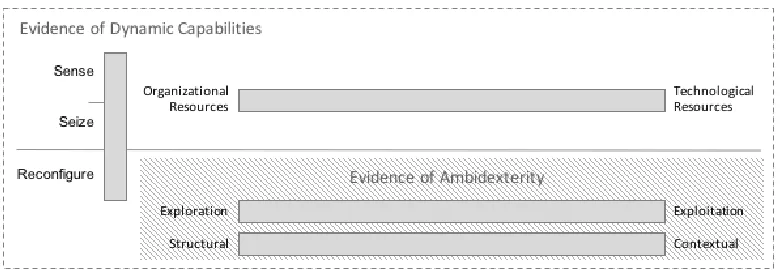
An analytical model has been developed to facilitate the results for each case
study story (Figure 2). For DC, the stage of Sense->Seize->Reconfigure is captured, as
well as the resource type, either organizational or technological. Evidence of
ambidexterity is identified based on explore-exploit, and structural-contextual
IV METHODOLOGY
IV.1 Qualitative Case Study
To appropriately understand how the IT organization reconfigures and evolves its
resources, a single longitudinal case study approach was chosen. This research design
further enhances the understanding of managers making resource re-allocation decisions
that position the group to exhibit dynamic capabilities, while managing conflicting
exploration-exploitation tensions. The aim is to expose critical resource decisions by
describing and explaining the sequence of events involved in re-balancing the
ambidextrous nature of the organization (Van De Ven & Huber, 1990). This supports the
longitudinal case study method, using the nature of tracing activities in its natural
contexts (Pettigrew, 1992; Van De Ven, 1992; Yin, 2009).
In terms of analytic generalization, multiple cases have been predominantly the
accepted method, but single case studies have been used to advance theory building
(Narasimhan & Jayaram, 1998) as well as theory refinement (Hyer, Brown, &
Zimmerman, 1999). The importance of single case study research, as described by Yin
(2009), therefore helps to confirm and extend current understanding or falsifies an
existing rationale. Additionally, Siggelkow (2007) posits that research involving case
data can usually get much closer to theoretical constructs and provide a much more
persuasive argument about causal forces than can broad empirical research.
Generalizability, particularly within the information systems realm, but also more
broadly, identifies opportunities for empirical findings to lay claim to generalizability (A.
The organization under study is a global pharmaceutical IT organization. Their
transformation journey began in the fourth quarter of 2012 and is expected to last through
2017, with several organizational design changes having occurred in the first 18 months.
This topic was also chosen for topical relevance given the rapid IT–related changes
occurring in the healthcare industry.
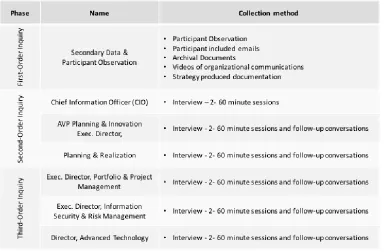
IV.2 Data Collection
Data for the case was obtained from the author’s place of employment. Data
collection comprised of participant observation, semi-structured interviews, and
secondary data sources that included IT Annual Reports for 2013 and 2014, IT strategy
documentation, organizational announcements, transcripts and videos of important IT
meetings, and executive presentation materials. Six interviews were conducted with
senior members of the IT leadership team. The individuals chosen for interviewing have a
deep understanding of available resources as well as the competitive pressures to which
they need to respond in an urgent manner for this transformation period of fourth quarter
2012 to March 2015. These individuals voluntarily engaged in face-to-face interviews, 60
Figure 3: Data Collection
The interviews followed a semi-structured question guide designed to identify and
deduce the key decisions made throughout the first twenty-four months of the
transformation. The questions were adapted from Klein’s “Intuition at Work” (Klein,
2002) recommended set of questions that aim to fully tease apart aspects of leadership
actions to further understand the underlying motivation.
The interview guide consists of three sections and is provided in the Appendix.
The first section gathers basic information regarding the interviewee’s organizational role
and their involvement in this transformation. The responses provide validation that the
individual had relevant experience, and in fact had a deep understanding of the IT
transformation. The second section asks the interviewees to elaborate in detail on the
transformation process, including but not limited to their identification and evaluation of
key events, allocation of resources and explanations for those (re)-allocations,
the transformation within the coming months. The final section asks the interviewees if
there were additional items worth discussing to help inform about the process, which may
not have been specifically covered.
IV.3 Shifting Stories
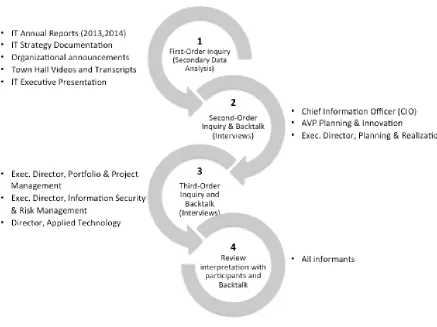
The data collection process included participant observation as well as an adapted
method from Lanzara’s Shifting Stories (p. 285) (Schön, 1991), intended to capture
multiple views and perspectives about the same event and capture shifting interpretations
[image:36.612.95.532.323.650.2]from multiple participants (Figure 4).
Beginning with the assembly of an event timeline, based on secondary data and
participant observation, the event timeline became the focal point for conducting
interviews. The timeline allowed for the creation of a heavy description of the storyline
during the second-order inquiry phase. Participants would reflect on the timeline of
events, including the resources needed to support the strategy, while generating backtalk.
This process was guided by the interview protocol as well. As Lanzara describes,
backtalk provides reflexivity for the participant and empowers participants by allowing
them a greater role in the research development, a sort of fingerprinting that occurs by
modifying the timeline based on participants’ observations. Through the discussion and
backtalk, many events that have been lived through and many behaviors that have been
acted out unreflectively become objects of analysis and reflection, providing an iterative
build-out and baked in validation for a complete story. The method is carried out to
facilitate further validation with a second set of participants in the third-order inquiry
phase, while the final phase brought the informants together to review decisions around
resources and the sequence of events timeline, allow for additional and final backtalk.
The method of shifting stories allows for an interesting instance of transient
constructs, having an important reflective function built into the process. The stories
heard by discussing the resource decisions and their evolution across time as management
dealt with obtaining the best possible organizational outcomes embody transient
knowledge — what the actors know about the transformation and the actions taken to
execute the strategy. Once created and told, a story becomes a reference entity and a tool
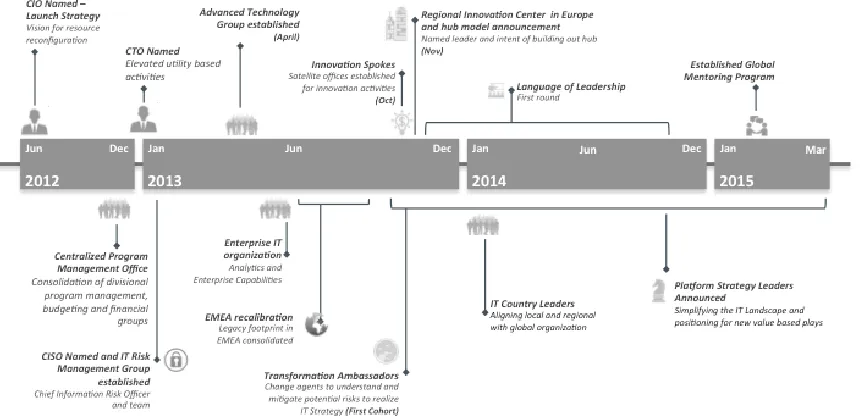
V CASE RESULTS
The case results are presented as six stories offering thick descriptions (Lanzara,
1991) and occur in the following order: key managers orchestrating the transformation;
IT strategy developed to drive common meaning and intent; reconfiguration process
employed for decision-making and organizational change; organizational events related
to exploiting existing capability; organizational events driving exploration of new value
[image:38.612.94.524.270.480.2]options; contextual changes required for cultural evolution.
Figure 5: Resource reconfiguration decision events
V.1 Orchestrate Transformation
In direct response to the CEO’s stated challenge, the new CIO needed to create a
strategy for the IT organization that identified a set of appropriately timed, specific
activities that were actionable, measurable, and attainable. Given the size of the IT
organization, this began with appointing an Associate Vice President (AVP) of IT
Planning and Innovation. This individual reported directly to the CIO and focused on
change. The intent of the group was to operate as a small, independent team, that would
imbue the cultural elements of the future IT organization. Initially, the IT Planning and
Innovation group was very small and had an Executive Director of Strategy Realization
that was instrumental in transformation activities, and over time allowed for other groups
that were deemed central to the IT functions to move under the Planning and Innovation
umbrella. One such group was Portfolio & Project Management. This group was started
in late 2012 with the goal of driving central portfolio prioritization and governance.
Chief Information Officer: “IT PharmaCo delivers a diverse family of business services, and choosing where we make investments requires a new strategic framework to guide us in enabling and leading the business.”
By centralizing the financials and project related activities, there would be
opportunity to have one “single source” of IT spend, work, resources, and results. The
Executive Director that led the Portfolio & Project Management group recognized the
importance of his role in shaping strategic activities. He not only focused on making his
area successful, but worked closely with others in the Strategy & Planning team to ensure
IT was on the right path. This also included regular meetings with the CIO to stay abreast
to the latest thinking around the mechanics of realizing the strategy.
Like other functions within an organization, IT investments must be prioritized,
and good business practices require an objective and consistent prioritization process.
This central portfolio team prioritizes programs and projects objectively, providing a
holistic picture of which IT investments will be made based on the available budget in a
given investment cycle.
By the second quarter of 2013, an additional central group was formed to drive
AVP IT Planning & Innovation: “We must focus on building emerging capabilities and experimenting—figuring out new sources of productivity and the adjacencies to disrupt and create new businesses.”
The creation of this group helped to solidify the investment becoming a
high–performance IT organization, intended to help create new businesses
supported by a foundation of technology and deliver innovative solutions
strategically aligned to business needs. The leader of the group came from the
high–tech industry, and was an expert in innovation, and creating enterprise value.
In addition to internal managers driving the strategy forward, management
consultants were brought in to provide thought leadership in areas such as IT
transformation, analytics, change management, and enterprise architecture.
Getting outside industry opinions, external case studies, and literature pertinent to
the ongoing changes, helped to prevent IT PharmaCo from falling into the trap of
groupthink.
V.1.1 Orchestrating transformation evidence
The managerial focus required to orchestrate the organizational transformation
was exemplified in the story as being within the sense phase of DC, while setting the
stage for re-positioning organizational resources that would help centralize necessary
activities for the CIO to carry out a new strategic agenda as well as drive new innovative
activities. By implementing the new structure and role that would focus on strategy and
innovation, exploration would be vital for the success of this group and is integral for
Figure 6: Orchestrating Transformation evidence
V.2 Driving Common Intent
Sessions with all of IT were vital for the CIO to expand on his strategic intent,
and to introduce the new head of IT Strategy and Planning. The two would work together
closely to articulate what the future IT organization would need to do in order to answer
the CEO’s call to action. This occurred over several weeks meeting with internal leaders
in the business, IT groups, as well as external firms that could share market trends,
perspective on organizational readiness, and thoughts on execution plan. As the strategy
began to firm up, communications were ramped up to share with IT. The CIO shared with
IT organization that they must fundamentally redirect effort into being a healthcare
company, and asserted:
“Today, we are industry leaders in leveraging the cloud and mobilizing applications. But the digerati are playing a different game—90% of the data collected by Twitter is on the context of the message (metadata), rather than the content, and all of it used to fuel new services and improve the customer experience. In relative terms, we are providing dial tone in the midst of a revolution.”
In order to help convey the redirection in strategic priority, a set of five guiding
principles was developed by the CIO and the AVP of Planning & Innovation to convey
conduct business in the future. The definition of these five guiding principles emerged
through a set of strategy sessions with the CIO’s direct reports and the Strategy
Realization lead. Referred to as the Five Shifts, these were meant to provide a concrete
understanding as to what would need to change to rebalance from primarily a
bottom-line, operational efficiency model, to realize a much greater contribution from
higher-value IT work.
AVP, Planning & Innovation: “These strategic shifts have far-reaching and very real implications for the business by driving revenue and ROI across divisions.”
The “Strategic Shifts” (Figure 7) have five identified guiding shifts. These shifts
were descriptors for IT PharmaCo to understand the magnitude of the change required.
Figure 7: Strategic shifts
The first shift recognized that the technology development process positioned all
projects to be risk-averse. Moving forward, IT PharmaCo would enable two-speed IT,
offering risk-intelligent options for development. The second shift looked to reduce
division-specific IT programs and increase investment in enterprise-based programs that
was familiar with, requiring development of information and analytic capabilities for the
organization. The fourth shift was meant to drive new thinking into the organization.
With a culture of “invented-here” for technology solutions, this shift recognized the need
to be plugged-in to the outside high-tech ecosystem in order to compete in the future. The
final shift was directed toward the economics of IT. IT PharmaCo did not intend to be
purely a cost-center for the organization, but rather also to provide technology that was
much more closely supporting the top-line growth of the organization and even direct
revenue contribution.
Managers also sought to create a broad, common understanding of how IT would
look at investments and the underlying economics of the organization as necessary. A
simple model that could represent PharmaCo’s IT’s portfolio holistically and account for
the Five Shifts was developed and depicted as a two-by-two model. Referred to as the
Four Quadrant model (Figure 8), it defined four opportunity spaces for IT PharmaCo to
be competitive within the rapidly changing environment. Central to this model was the
recognition that the contributions from IT would be to the financial bottom-line in the
forms of productivity enablement and utility, and also for IT to contribute to top-line
growth through revenue enablement and higher-value IT work. This model served to
provide an economic representation of investments and reinforce moving from an
integration agenda to that of an innovation agenda with a targeted disposition of
Figure 8: Four-quadrant model investment shift
Third, as communication and interaction of the IT strategy was occurring with the
IT community in the third quarter of 2012, an additional lens became necessary to codify
the change and provide a more sufficient understanding related to the strategy. For this,
the leadership team adopted a McKinsey model of innovation – known as the
Three-horizon innovation model (Figure 9), which was adapted to provide clear alignment to
OA. This lens was in the representation of technology innovation to help disperse
understanding to the greater IT PharmaCo community over time and its value for both the
individual employees at the micro level and the firm at the macro level. From a cultural
perspective, the Three-horizon innovation model was widely accepted due to the ability
for IT PharmaCo community to see themselves and their work in the broader picture.
By having the three distinctly defined levels, resource allocations could be
determined that closely matched the commitment to delivering current and future value to
the organization. Horizon One represented work to extend and defend the existing
environment: simply, solving for what’s happening now. Horizon two intends to look at
what’s next, one to two years out, and looks to either exploit current technologies for
further value creation, or provide incremental innovation in the form of generating
insights from current data through advanced analytics. This requires looking at the
existing environment in new ways to create integrations, unlock, or even generate new
data that have not been accessible in the past. Horizon three is completely untapped, and
focuses on identifying disruptive trends within the healthcare IT environment that could
impact the business within the next three to five years.
[image:45.612.116.505.380.602.2]
Figure 9: Three-horizon innovation model6
With these three practices (Four-Quadrants, Five-Shifts, and Three-Horizons) in
place, the key managers set out to communicate the strategy to the greater IT PharmaCo
community and engage in interactive dialogs across the organization, reaffirming the new
mission of IT.
AVP of Planning and Innovation: “It is only by shifting the foundation and speed of IT, and weaving innovation into the fabric of our culture, that we will be prepared to meet the future as generators of new insights across divisions, functions, and business perspectives for the company and for the ecosystem.”
V.2.1 Driving common intent evidence
Managerial focus is exemplified in the common intent story as being primarily in
the seize stage. No resource configuration decisions occurred, however the strategy
related artifacts were developed and communicated broadly to IT and necessary business
constituents. This was a preamble for what is to come and important to understand as it
provided the intended direction of future resource decisions. The implications of the
Five-Shifts, Four-Quadrants, and Three Horizons, put leadership on a path toward
resource reconfiguration impacting organizational and technological resources,
explorative and exploitative change, as well as structural and contextual adjustment.
[image:46.612.110.504.551.690.2]Therefore, it is identified as impacting all of these areas.
V.3 Reconfiguring Decision Making and Organizational Change
With the strategy having been socialized with the CEO and gaining full support in
December of 2012, the interim CIO was named and announced as permanent CIO.
Officially at the helm for IT, a meeting with his direct reporting team was held to answer
a fundamental go-forward question: Given the Five-Shifts, Four-Quadrants, and
Three-Horizons, how should we take action on this? Simply, what are all of the execution
activities to realize the strategy? This question prompted the leadership team to identify
areas where change was necessary and could be communicated procedurally with other
areas that required more interactive strategizing.
Questions addressed included the following: How do we manage risk of
operations, business programs and organizational transformation?; How do we modernize
infrastructure and consolidate operations to deliver on end-user experience, world-class
service levels and IT productivity?; How do we extract new value from enterprise
business platforms enabling robust data, analytics and collaboration to drive
year-over-year productivity, as well as data-driven decision-making to drive top-line growth?; How
do we optimize the footprint of IT, positioning ourselves for added client engagement,
customer value and maximizing access to talent?
As a leadership team, they faced the daunting task of addressing these ambitious
questions, many of which fundamentally questioned the “status quo” within PharmaCo’s
existing IT culture.
The search for a completely new approach resulted in a practice that was referred
to internally as “Point-of-View (POV) development”. This practice was employed for
each strategic question listed above. POV development bundled information gathering,
change management, and business case development into an iterative 10-12 week effort
with a team of 12-15 initial members that generally grew in size as it neared completion.
The team members represented one or two levels below top management, all being
deeply intimate with the question subject matter. The purpose of each POV was to drive
recommendations on how to reconfigure the current organization based on the questions
identified by the leadership team that were congruent with realizing the strategy. The
POV team engaged external industry thought leaders to help round out their perspective
on topics, share views of other companies facing similar situations, and provide guidance
to the teams. The fluidity of the process provided consensus building within the POV
team but also through engagement more broadly as the POV teams closed in on
recommendations. In addition, the process required educating and gaining support from
IT top management. Poster sessions were leveraged where top management and other key
constituents from other areas of the business would join for 60-90 minutes, hear about the
team’s perspective, and allow each session participant to weigh in on the progress and
recommendations thus far. These methods of rapid socialization often resulted in deep
debates between the many members and ultimately led to adjustments to the POV teams’
recommendations. In addition, true buy-in on the recommendations was obtained,
meaning stronger sponsorship and endorsement by top management.
group, which also set the foundations for managing the change the organization was going to go through.”
In effect, each POV team created its own self-reinforced learning, as argued by
Jarzabkowski (2002) that led to simultaneous recursive or exploitative, and adaptive or
explorative activities. While each of the POV teams alone might be viewed as a
micro-level activity, the cumulative effect of the POV teams’ activities were situated, socially
accomplished flows of activity that were consequential for effectively advancing the
macro-level organizational change. Furthermore, the insights and recommendations from
one POV team frequently served as the starting point for another POV team’s activity,
iteratively moving to the next level of detail of the strategy, as noted by the Executive
Director for Planning & Realization. The POV approach effectively created a stream of
activity that interconnected the micro actions of each POV team and its individual
members with the different levels of management and organization. It is this connection
between and across levels that POV’s provided necessary shared meanings for the
organization, meanings that ultimately resulted in decisions occurring between 2012 and
2015, thereby driving the reconfiguration of IT PharmaCo (Figure 5 - Resource
Figure 11: Iterative decision making through Point of View development
Throughout the reconfiguration, three types of decisions emerged and strictly
aligned the strategic intent (Strategic shifts, Four-quadrant model investment shift,
Three-horizon innovation model). Resources directly aligned to investments made and were
intended to advance the IT agenda of innovation. Therefore, the Four-Quadrant model
(Figure 8) is best suited to plot decisions when looking at the new disposition of the
organization. Figure 12 (Decision types against the Four-Quadrant model) represents how
events since strategy inception (identified in Figure 5 - Resource reconfiguration decision
events) plot against the Four-Quadrants. Evident in this is the direct alignment of
explore-exploit to top-line and bottom-line growth respectively, but also the necessary decisions
and subsequent interaction of functions is necessary. Each decision is explained in detail
[image:51.612.92.496.125.301.2]within the following results sections.
Figure 12: Decision types against the Four-Quadrant model
In addition, the organization structure of IT PharmaCo changed as a result of the
decisions with new groups identified in red in Figure 13, with two new exploit groups –
IT Risk & Compliance and Enterprise IT, and two new explore groups – Planning &
Innovation (Advanced Technology Group resides in this new group) and the Regional
Innovation Center.
Figure 13: IT PharmaCo organization structure post transformation
V.3.1 Reconfiguring decision making and organizational change evidence
By addressing how decisions were being made, managerial focus exemplified in