S T U D Y P R O T O C O L
Open Access
A phase II trial for the efficacy of physiotherapy
intervention for early-onset hip osteoarthritis:
study protocol for a randomised controlled trial
Joanne L Kemp
1,2*, Kate Moore
2, Marlene Fransen
3, Trevor G Russell
4and Kay M Crossley
4Abstract
Background:Early-onset hip osteoarthritis is commonly seen in people undergoing hip arthroscopy and is associated with increased pain, reduced ability to participate in physical activity, reduced quality of life and reduced range of motion and muscle strength. Despite this, the efficacy of non-surgical interventions such as exercise therapies remains unknown. The primary aim is to establish the feasibility of a phase III randomised controlled trial investigating a targeted physiotherapy intervention for people with early-onset hip osteoarthritis. The secondary aims are to determine the size of treatment effects of a physiotherapy intervention, targeted to improve hip joint range and hip-related symptoms in early-onset hip osteoarthritis following hip arthroscopy, compared to a health-education control.
Methods:This protocol describes a randomised, assessor- and participant-blind, controlled clinical trial. We will include 20 participants who are (i) aged between 18 and 50 years; (ii) have undergone hip arthroscopy during the past six to 12 months; (iii) have early-onset hip osteoarthritis (defined as chondrolabral pathology) at the time of hip arthroscopy; and (iv) experience hip-related pain during activities. Primary outcome will be the feasibility of a phase III clinical trial. Secondary outcomes will be (i) perceived global change score; (ii) hip-related symptoms (measured using the Hip disability and Osteoarthritis Outcome Score (HOOS) pain subscale, activity subscale, and sport and recreation subscale); (iii) hip quality of life (measured using the HOOS quality of life subscale and International Hip Outcome tool; (iv) hip muscle strength and (v) hip range of motion. The physiotherapy intervention is semi-standardised, including joint and soft tissue mobilisation and stretching, hip and trunk muscle retraining and functional and activity-specific retraining and education. The control intervention encompasses individualised health education, with the same frequency and duration as the intervention. The trial primary end-point is the conclusion of the 12-week intervention, and follow-up measures will be collected at the 12-week post-baseline assessment.
Discussion:The findings of this study will provide guidance regarding the feasibility of a full-scale phase III randomised controlled trial, prior to its undertaking.
Trial registration:The trial protocol was registered with the Australian Clinical Trials Registry (number: 12614000426684) on 17 April 2014.
Keywords:Osteoarthritis, Hip joint, Hip arthroscopy, Randomised controlled trial, Physiotherapy
* Correspondence:[email protected]
1
Australian Centre for Research into Injury in Sport and its Prevention (ACRISP), Federation University Australia, PO Box 663, Ballarat 3350, VIC, Australia
2Bodysystem Physiotherapy, 38 Collins St, Hobart, 7000, TAS, Australia Full list of author information is available at the end of the article
Background
Hip pathology is a common cause of hip pain [1,2], and is associated with considerable morbidity in people aged between 18 and 50 years [3,4]. In recent years, arthroscopic surgery has contributed to advancements in assessment and management of hip pain [5]. Recently, the number of hip arthroscopic procedures performed in the United States [6-8], United Kingdom, Australia [9] and Asia [10] has increased dramatically. In Australia, Medicare data indicate that between 2010 and 2013 the number of people undergoing hip arthroscopy increased by over 50% [9], while in the United States the rate of hip arthroscopic surgery increased six-fold between 2006 and 2010 [7]. Despite good results at between five and 10 years post-arthroscopy years, those with osteoarthritis (OA) at arthroscopy consistently report less favourable outcomes when compared to those without OA [11]. In addition, we recently observed that early-onset hip OA is associated with worse outcomes in people who have undergone hip arthroscopy [12].
Musculoskeletal conditions are second only to mental and behavioural disorders, as global contributors to years lived with disability [13]. Due to its negative impact on individual functioning and health service expenditure, OA has been designated a National Health priority area [14]. The hip joint is a common site for OA [15], affecting approximately 12% of adults in the United Kingdom [16] and the United States of America [17]. As there is no cure for hip OA, the identification of non-surgical interven-tions that can reduce the progression of hip-related symp-toms is important, as this will reduce disease burden [18].
We recently reported that chondrolabral pathology, a marker of early-onset hip OA, is common in people who undergo hip arthroscopy for hip pain, and is associated with worse pain, difficulty participating in physical activity and reduced quality-of-life compared to healthy controls [19]. Moreover, it appears that early onset hip OA has a significant impact on young and middle-aged people being able to participate in physical activities without difficulty, which could ultimately lead to physical inactivity. Inactivity is associated with adverse health outcomes, which include type two diabetes, ischaemic heat disease, stroke, depres-sion and certain cancers [20]. If the progresdepres-sion of hip OA symptoms can be slowed in its early stages, people with hip OA may participate in greater levels of physical activity, limiting the public health burden of this disease [21,22].
A full-scale phase III randomised controlled trial (RCT) is costly, and before undertaking such a study it is import-ant to establish its feasibility [23,24]. In Australia, hip arth-roscopy is mostly conducted in the private sector and such patients may be unwilling to participate in an RCT. In addition, no RCT examining the effects of a physiother-apy intervention has been undertaken in this population, and adherence with the intervention is unknown. The
treatment algorithm has not been tested within the con-straints of a clinical trial and the adverse events are not known. Therefore, before committing to a full-scale RCT, the feasibility of such a study should be established by undertaking a phase II RCT [24].
The primary aim of this study is to establish the feasibility of a phase III RCT investigating a targeted physiotherapy intervention for people with early-onset hip OA. The sec-ondary aims are to determine the size of treatment effects of a physiotherapy intervention, targeted to improve hip joint range and hip-related symptoms in early-onset hip OA following hip arthroscopy, compared to a health-education control.
Methods/Design Experimental design
This protocol describes a randomised, assessor- and participant–blind, controlled clinical trial conforming to Standard Protocol Items: Recommendations for Inter-ventional Trials (SPIRIT) [25] guidelines. The trial protocol was registered with the Australian Clinical Trials Registry (ACTR number: 12614000426684) on 17 April 2014. Ethics approval was obtained through the University of Queensland Medical Research Ethics Committee (number: 2013001553).
Participants
A total of 20 participants will be recruited through a single orthopedic surgeon (MGP) in Hobart, Australia, with extensive expertise in hip arthroscopy. This number of participants was chosen in order to determine the feasibility of recruitment into a larger scale phase III trial, as we estimate that 20 participants represents 30% of eligible patients from a single surgeon. In addition, 20 participants will allow for observation of sample variability and any possible adverse responses to the intervention. A project investigator (KM) will screen for eligibility based on history and examination.
Inclusion criteria
The inclusion criteria are as follows: (i) aged between 18 and 50 years; (ii) arthroscopy for intra-articular hip path-ology during the past six to 12 months; (iii) evidence of early-onset hip OA (defined as chondrolabral pathology) at time of hip arthroscopy; (iv) hip-related pain during activities such as sitting, squatting, stair ambulation or twisting on the leg and (v) hip-related pain score of over 30 on a 100 mm visual analogue scale (VAS).
Exclusion criteria
lower limb surgery in the following 12 months (such as an arthroplasty); (v) physical inability to weight-bear fully or undertake testing procedures and (vi) inability to under-stand written and spoken English.
Procedure
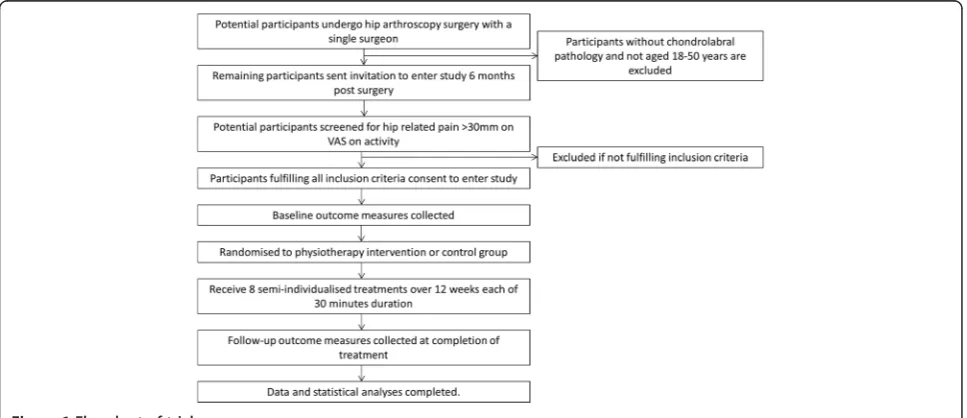
Potential participants will be identified by the surgeon and invited to contact the project coordinator (JK). (Figure 1) The project coordinator will contact potential participants by phone if they do not respond to the initial invitation. Volunteers will be screened via telephone interview, followed by a clinical examination to confirm eligibility (KM). The randomisation schedule will be generated and maintained centrally by the University of Queensland, School of Health and Rehabilitation Sciences, and will be revealed to the project coordinator (JK) via telephone following the baseline assessment. The blinded researcher (KM) will obtain informed consent (Additional file 1) and will perform outcome assessments at baseline and three months. Participants will be instructed not to divulge their group allocation to the assessor. While physiotherapists cannot be blinded to group allocation, participants will be informed that they can receive one of two possible interventions. Thus, participants will remain blinded to treatment allocation. Participants will be asked to refrain from other treatments, but stable drug doses will be per-mitted. Physiotherapists will record per protocol treatment. Participants will record adherence with home exercises, adverse events and any co-interventions in a log book.
Outcome assessment
Outcomes will be assessed at baseline and at the trial primary end-point, which is at the conclusion of the 12-week intervention.
Primary outcome measure: feasibility of a full-scale randomized controlled trial
Feasibility will be assessed by evaluating the willingness of participants to enrol; the number of eligible participants; the recruitment rate; adherence to the intervention, home exercises and log-book completion and the drop-out rate. Adverse events will be recorded.
Secondary outcome measures: perceived global change score Participants will rate their perceived change following treatment on a six-point ordinal scale (completely recov-ered, much improved, improved, no change, worse and much worse) [28]. Measuring patient-perceived change using such scales has been shown to be clinically relevant and a stable concept for interpreting meaningful improve-ments from an individual perspective [29].
Secondary outcome measure: hip-related symptoms The Hip disability and Osteoarthritis Outcome Score HOOS-pain [30] will measure hip-related symptoms. The HOOS was evaluated in younger adults with OA [30], and incorporates the Western Ontario MacMaster Universities Osteoarthritis Index (WOMAC) 3.0LK [31]. The HOOS-pain subscale is equivalent to the WOMAC HOOS-pain subscale. We have determined that the HOOS-pain subscale is reli-able (intraclass correlation coefficient (ICC) = 0.96; 95% confidence interval (CI): 0.93 to 0.98), with a low standard error of measurement (SEM) of four points out of 100, and is valid and responsive, with a minimal clinically important change (MCIC) of nine points [32].
[image:3.595.57.541.513.722.2]Secondary outcome measures: hip-related quality of life The International Hip Outcome tool (iHOT-33) and HOOS quality of life subscale (HOOS-Q) will measure
hip-related quality of life. The iHOT-33 is a composite score that was developed for specific use in the hip arthroscopy population [33]. We determined that it is reliable (ICC = 0.93; 95% CI: 0.87 to 0.96), with a low SEM of six points out of 100, and is valid and responsive, with an MCIC of 10 points [32]. The HOOS-Q [30] is reliable (ICC = 0.95; 95% CI: 0.84 to 0.97), with a low SEM of five points out of 100, and is valid and responsive, with an MCIC of 11 points [32].
Secondary outcome measures: other hip-related symptoms Other hip-related symptoms will include the HOOS activity of daily living subscale (HOOS-A), the HOOS sport and recreation subscale (HOOS-Sp) and HOOS symptoms and stiffness subscale (HOOS-S). We determined these subscales were reliable (ICC: 0.93 to 0.96), with low SEMs of three to six points, and have MCICs ranging from six to 10 points [34].
Secondary outcome measures: hip muscle strength and hip joint range
Hip abduction, extension and external rotation strength and hip flexion range will be measured using our previously published methods [35,36], with high reliability (ICC: 0.87 to 0.95). Briefly, all strength tests will be performed with a Commander Power track II (J-Tech medical, Salt Lake City, Utah, USA) hand-held dynamometer. The tester will match the force generated by the participant performing an isometric muscle contraction (the‘make’test) [37] and the best of three tests will be recorded. Strength will be recorded as a torque measure, calculated by multiplying the force (measured in Newtons (N)) by the length of the moment arm (measured in metres (m)), and then data will be normalized for body weight (measured in kilograms ((kg) Nm/kg). Specifically, abductor strength will be measured in the supine position, with stabilisation of the contra-lateral thigh, and external rotation strength will be measured in the prone position, with stabilisation of the contra-lateral thigh [35]. Hip flexion range will be mea-sured in the supine position as an active range of motion measure, with stabilisation of the contra-lateral thigh. It will be measured using a Plurimeter inclinometer (Dr Rippstein, La Conversion, Switzerland) as the mean of three measures [36].
Other measures
Potential covariates for statistical analyses
The potential covariates for statistical analyses are body anthropometry: weight, height, body mass index and waist girth.
Interventions
Each participant will be treated by experienced physio-therapists who will be trained and proficient in both
interventions (physiotherapy and control). The physio-therapists will receive two training sessions prior to the commencement of the study. Monthly meetings between the treating physiotherapists and the project coordinator (JK) will occur throughout the trial to ensure that the physiotherapy intervention remains consistent. The intervention is a face-to-face physiotherapy interven-tion, which will be delivered in eight sessions over three months (once per week for four weeks, then once per fortnight for eight weeks). This semi-standardised type of intervention has been described previously in an RCT protocol for post-operative physiotherapy in patients with femoro-acetabular impingement [38]. Participants will be asked to refrain from other physiotherapy interventions during the trial. All participants will be able to discuss concerns regarding their condition with the project coord-inator (JK) throughout the trial if needed.
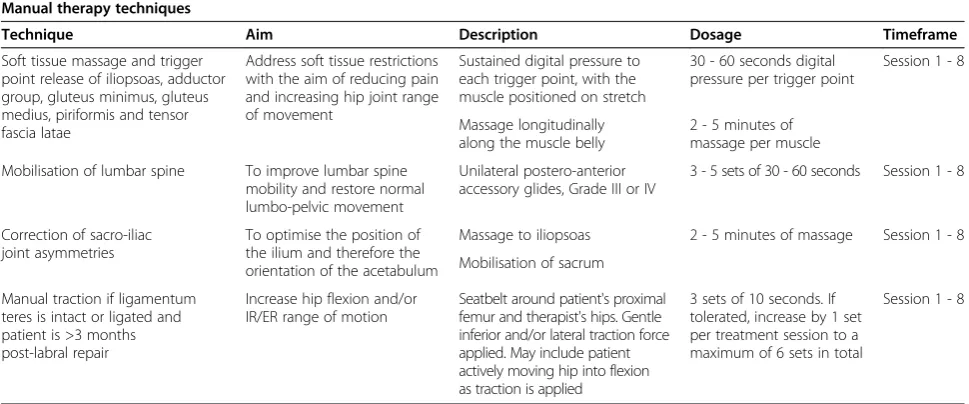
Physiotherapy intervention Physiotherapy interventions are detailed in Tables 1, 2 and Additional file 2. These consist of (i) manual hip joint and soft tissue mobilisation and stretching; (ii) hip muscle retraining; (iii) trunk muscle retraining; (iv) functional, proprioceptive and sports- or activity- specific retraining; (v) enhancing physical activity and (vi) education. The treatment will be tailored ac-cording to each patient’s clinical presentation (such as strength, pain severity, sporting and functional needs), the presence of co-morbidities (such as back and other lower limb pain or pathology), and progressed based on response to exercise load, thus maximising the training effects. The physiotherapist will supervise exercises dur-ing each visit. A home exercise program will be performed independently at home four times per week. An exercise manual will be made accessible to each participant.
Specific aspects of the treatment include:
1. Manual hip joint and soft tissue mobilisation and stretching to provide optimal joint range and facilitate control of movement patterns. Within each treatment session, the therapist will measure range of motion (with an inclinometer), and monitor the immediate effects of treatment modalities.
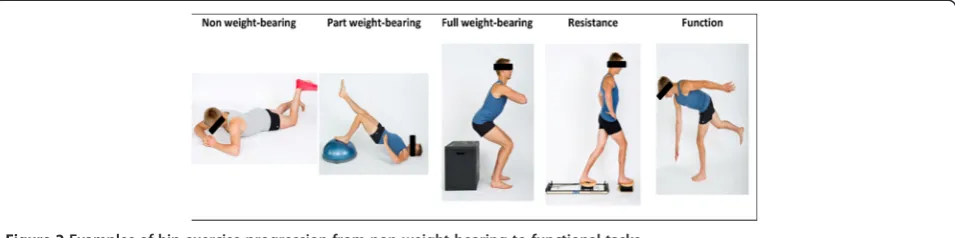
2. Hip muscle retraining, including exercise to improve hip abduction, extension and external rotator coordination and strength. In order to accommodate a heterogeneous cohort, the hip muscle retraining may be performed statically and/or dynamically in various functional activities (for example, step up and down, squat and/or sit to stand). Resistance will be progressed based on individual responses, and is detailed in Figure2.
exercise selection and progression will follow similar principles to the hip muscle retraining.
4. Functional, proprioceptive and sports-specific retraining. The exercise selection and progression will follow similar principles to the hip and trunk muscle retraining. For example, a person aiming to return to football may perform single leg activities with direction change and pain-free, graduated return to kicking, whilst maintaining good movement control.
ControlIn order to control for the psychosocial contact inherent with the physiotherapy treatment, the control treatment will encompass individualised health education sessions covering topics such as exercise, diet, weight loss and appropriate stretching, in a similar fashion to previ-ously published clinical trials looking at physiotherapy
management in older people with advanced hip OA [39,40]. The information sheets have been modified to be appropriate for this younger age group. The control sessions will be provided with the same frequency and duration as the physiotherapy sessions.
Data management, monitoring and statistical analyses
[image:5.595.56.541.103.305.2]Treatment efficacy will be evaluated by comparing change on primary outcome measures between groups. Baseline characteristics of participating patients of the two groups will be evaluated for their influence on outcomes and included as covariates in statistical analyses if required. Outcomes of interest will be analysed on an intention-to-treat basis for all participants. SPSS software (Version 21, SPSS Inc, Chicago, IL, USA) will be used for all analyses, and significance will be set at P <0.05. Data monitoring
Table 2 Home exercise program for hip muscle retraining, trunk muscle retraining, functional and activity specific retraining and stretching: a semi-standardised approach
Home exercise program
Exercise Aim Description Timeframe
Deep hip rotator strengthening Optimize hip neuromuscular control and improve dynamic stability of hip
See Additional file2 Session 1 - 4
Hip extensor muscle strengthening Optimize hip neuromuscular control and improve dynamic stability of hip
See Additional file2 Session 1 - 6
Hip abductor muscle strengthening Optimize hip neuromuscular control and improve dynamic stability of hip
See Additional file2 Session 2 - 8
Functional strengthening Improve gluteal and lower limb strength. Practice movement patterns required for optimal daily function
See Additional file2 Session 3 - 8
Balance exercises Improve proprioception and dynamic
stability of hip and pelvis
See Additional file2 Session 2 - 8
Anterior hip stretch Assist in regaining full hip extension range of movement
[image:5.595.61.539.560.733.2]See Additional file2 Session 2 - 8 Table 1 Manual therapy techniques: a semi-standardised approach
Manual therapy techniques
Technique Aim Description Dosage Timeframe
Soft tissue massage and trigger point release of iliopsoas, adductor group, gluteus minimus, gluteus medius, piriformis and tensor fascia latae
Address soft tissue restrictions with the aim of reducing pain and increasing hip joint range of movement
Sustained digital pressure to each trigger point, with the muscle positioned on stretch
30 - 60 seconds digital pressure per trigger point
Session 1 - 8
Massage longitudinally along the muscle belly
2 - 5 minutes of massage per muscle
Mobilisation of lumbar spine To improve lumbar spine mobility and restore normal lumbo-pelvic movement
Unilateral postero-anterior accessory glides, Grade III or IV
3 - 5 sets of 30 - 60 seconds Session 1 - 8
Correction of sacro-iliac joint asymmetries
To optimise the position of the ilium and therefore the orientation of the acetabulum
Massage to iliopsoas 2 - 5 minutes of massage Session 1 - 8
Mobilisation of sacrum
Manual traction if ligamentum teres is intact or ligated and patient is >3 months post-labral repair
Increase hip flexion and/or IR/ER range of motion
Seatbelt around patient's proximal femur and therapist's hips. Gentle inferior and/or lateral traction force applied. May include patient actively moving hip into flexion as traction is applied
3 sets of 10 seconds. If tolerated, increase by 1 set per treatment session to a maximum of 6 sets in total
Session 1 - 8
will be conducted by an independent investigator (KC), and data will be stored in a locked cabinet and password-secured server. Adverse events will be recorded by the treating physiotherapists who will inform the project coordinator (JK). Trial results will be made available to participants and will be published in a peer-reviewed journal.
Consent
Written informed consent was obtained from the patients for publication of this manuscript and accompanying images. A copy of the written consent is available for review by the Editor-in-Chief of this journal.
Discussion
This study provides detail of the protocol for a phase II RCT investigating the efficacy of a physiotherapy interven-tion for early-onset hip OA [24]. This phase II study will identify the willingness of patients to enter a phase III RCT, adherence to the interventions and possible drop-out rates. In addition, this study will provide information regarding the treatment effects sizes of the semi-individualised physiotherapy intervention described, and assist in power calculations which will inform future larger scale RCTs.
The physiotherapy intervention described herein is semi-individualised, wherein a standardised program is tailored to the individual patient’s needs, based on assess-ment and reassessassess-ment undertaken at each physiotherapy session. Impairments in hip range of motion and hip muscle strength have been identified previously in people with chondropathy of the hip [41]. Therefore we have in-cluded therapeutic interventions targeted to address these impairments in the physiotherapy intervention.
The control intervention is an alternative physiotherapy intervention, focussing on education and guidance, rather than a ‘wait and see’control group. This will control for both the attention and advice provided by physiotherapists during individual treatment sessions and may facilitate recruitment, since all patients will receive an active intervention regardless of treatment allocation.
The findings of this study will provide guidance regard-ing the feasibility of a full-scale phase III RCT, prior to its
undertaking [24]. It will also provide pilot data on the effi-cacy of the physiotherapy intervention described herein.
Trial status
This trial is ongoing. At the time of submission of this protocol, 17 patients had been recruited into the study over a four-month recruitment period, and 16 patients had completed the follow-up period. There have been no reported adverse events, drop-outs or patients lost to follow-up to date.
Additional files
Additional file 1:A randomized clinical trial of physiotherapy intervention for early-onset hip osteoarthritis.
Additional file 2:Specific examples of exercises included in home exercise program.
Abbreviations
HOOS:Hip disability and osteoarthritis outcome score; ICC: Intraclass correlation coefficient; iHOT: International Hip Outcome tool; MCIC: Minimal clinically important change; N: Newton; OA: Osteoarthritis; RCT: Randomised controlled trial; SEM: Standard error of measurement; VAS: Visual analogue scale; WOMAC: Western Ontario MacMaster Universities Osteoarthritis Index.
Competing interests
The authors declare that they have no competing interests.
Authors’contributions
[image:6.595.60.538.90.209.2]JK contributed to conception and design of the trial, the acquisition of data, and will contribute to the analysis and interpretation of data; has been involved in drafting the manuscript and revising it critically for important intellectual content; and has given final approval of the version to be published. KM contributed to conception and design of the trial, the acquisition of data, and will contribute to the analysis and interpretation of data; has been involved in revising the manuscript critically for important intellectual content; and has given final approval of the version to be published. MF contributed to conception and design of the trial and will contribute to the interpretation of data; has been involved in revising the manuscript critically for important intellectual content; and has given final approval of the version to be published. TR contributed to conception and design of the trial and will contribute to the interpretation of data; has been involved in revising the manuscript critically for important intellectual content; and has given final approval of the version to be published. KC contributed to conception and design of the trial, the acquisition of data, and will contribute to the analysis and interpretation of data; has been involved in drafting the manuscript and revising it critically for important intellectual content; and has given final approval of the version to be published.
Acknowledgements
We would like to acknowledge Mr Michael Pritchard for assistance with participant recruitment.
This trial was funded by the Australian Physiotherapy Research Foundation Beryl Haynes Memorial Grant (grant number T13-BH007), and Bodysystem Pty Ltd. Funders will not play a role in the publication or dissemination of study findings.
Author details 1
Australian Centre for Research into Injury in Sport and its Prevention (ACRISP), Federation University Australia, PO Box 663, Ballarat 3350, VIC, Australia.2Bodysystem Physiotherapy, 38 Collins St, Hobart, 7000, TAS, Australia.3School of Physiotherapy, University of Sydney, 75 East St, Lidcombe, Sydney, 2141, NSW, Australia.4School of Health and Rehabilitation Sciences, University of Queensland, St Lucia, Brisbane 4067QLD, Australia.
Received: 21 August 2014 Accepted: 23 December 2014
References
1. Ganz R, Parvizi J, Beck M, Leunig M, Nötzli H, Siebenrock KA (2003) Femoroacetabular impingement: a cause for osteoarthritis of the Hip. Clin Orthop Relat Res 417:112–20
2. Parvizi J, Bican O, Bender B, Mortazavi SMJ, Purtill JJ, Erickson J et al (2009) Arthroscopy for labral tears in patients with developmental dysplasia of the hip: a cautionary note. J Arthroplasty 24(Suppl 6):110–3
3. Burnett RSJ, Della Rocca GJ, Prather H, Curry M, Maloney WJ, Clohisy JC (2006) Clinical presentation of patients with tears of the acetabular labrum. J Bone Joint Surg Am 88(7):1448–57
4. Philippon MJ, Weiss DR, Kuppersmith DA, Briggs KK, Hay CJ (2010) Arthroscopic labral repair and treatment of femoroacetabular impingement in professional hockey players. Am J Sports Med 38(1):99–104
5. Bradshaw CJ, Bundy M, Falvey E (2008) The diagnosis of longstanding groin pain: a prospective clinical cohort study. Br J Sports Med 42(10):551–4 6. Clohisy JC, Baca G, Beaulé PE, Kim Y-J, Larson CM, Millis MB et al (2013)
Descriptive epidemiology of femoroacetabular impingement: a North American cohort of patients undergoing surgery. Am J Sports Med 41:1348–56 7. Bozic KJ, Chan V, Valone FH 3rd, Feeley BT, Vail TP (2013) Trends in hip
arthroscopy utilization in the United States. J Arthroplasty 28(Suppl 8):140–3 8. Montgomery SR, Ngo SS, Hobson T, Nguyen S, Alluri R, Wang JC et al (2013)
Trends and demographics in hip arthroscopy in the United States. Arthroscopy 29:661–5
9. Medicare Australia. Medicare Item 49366 processed from July 2007 to June 2010. 2014. http://www.medicareaustralia.gov.au/cgi-bin/broker.exe?_PROG RAM=sas.mbs_item_age_gender_report.sas&_SERVICE=default&_DEBUG=0& VAR=services&STAT=count&PTYPE=finyear&START_DT=200707&END_D T=201006&RPT_FMT=by+state&GROUP=49366. Accessed 13 Jan 2014. 10. Lee YK, Ha YC, Yoon BH, Koo KH (2014) National trends of hip arthroscopy
in Korea. J Korean Med Sci 29(2):277–80
11. Kemp JL, MacDonald D, Collins NJ, Hatton AL, Crossley KM (2014) Hip arthroscopy for hip osteoarthritis: a systematic review of outcomes and factors influencing outcomes. Osteoarthritis Cartilage 22 Suppl:S182 12. Kemp JL, Collins NJ, Makdissi M, Schache AG, Machotka Z, Crossley K (2012)
Hip arthroscopy for intra-articular pathology: a systematic review of outcomes with and without femoral osteoplasty. Br J Sports Med 46(9):632–43 13. Vos T, Flaxman AD, Naghavi M, Lozano R, Michaud C, Ezzati M et al (2012)
Years lived with disability (YLDs) for 1160 sequelae of 289 diseases and injuries 1990–2010: a systematic analysis for the Global Burden of Disease Study 2010. Lancet 380(9859):2163–96
14. March L, Bagga H (2004) Epidemiology of osteoarthritis in Australia. Med J Aust 180(Suppl 5):S6–10
15. Busija L, Bridgett L, Williams SRM, Osborne RH, Buchbinder R, March L et al (2010) Osteoarthritis. Best Pract Re: Clin Rheumatol 24(6):757–68 16. Odding E (1998) Associations of radiographical osteoarthritis of the hip
and knee with locomotor disability in the Rotterdam Study. Ann Rheum Dis 57(4):203–8
17. Lawrence RC, Helmick CG, Arnett FC, Deyo RA, Felson DT, Giannini EH et al (1998) Estimates of the prevalence of arthritis and selected musculoskeletal disorders in the United States. Arthritis Rheum 41:778–99
18. Zhang W, Moskowitz RW, Nuki G, Abramson S, Altman RD, Arden N et al (2008) OARSI recommendations for the management of hip and knee
osteoarthritis, Part II: OARSI evidence-based, expert consensus guidelines. Osteoarthritis Cartilage 16(2):137–62
19. Kemp JL, Makdissi M, Pritchard MG, Schache AG, Pollard TCB, Crossley KM (2014) Chondropathy of the hip at arthroscopy: prevalence and relationship to labral pathology, femoro-acetabular impingement and patient-reported outcomes. Br J Sports Med 48:1102–7
20. Pratt M, Norris J, Lobelo F, Roux L, Wang G (2014) The cost of physical inactivity: moving into the 21st century. Br J Sports Med 48(3):171–3 21. Almeida OP, Khan KM, Hankey GJ, Yeap BB, Golledge J, Flicker L (2014) 150
minutes of vigorous physical activity per week predicts survival and successful ageing: a population-based 11-year longitudinal study of 12 201 older Australian men. Br J Sports Med 48(3):220–5
22. Ekblom-Bak E, Ekblom B, Vikström M, de Faire U, Hellénius M-L (2014) The importance of non-exercise physical activity for cardiovascular health and longevity. Br J Sports Med 48(3):233–8
23. Palmer AJR, Thomas GER, Pollard TCB, Rombach I, Taylor A, Arden N et al (2013) The feasibility of performing a randomised controlled trial for femoroacetabular impingement surgery. Bone Joint Res 2(2):33–40 24. National Health and Medical Research Council clinical trials centre. Clinical
trial designs and sample size. Sydney: University of Sydney; 22 September 2009. Report No.
25. Chan AW, Tetzlaff JM, Gotzsche P, Altman DG, Mann H, Berlin JA et al (2013) SPIRIT 2013 explanation and elaboration: guidance for protocols of clinical trials. BMJ 346:e7586
26. Kemp JL, Crossley KM, Schache AG, Pritchard M (2012) Hip-related pain. In: Brukner PD, Bahr R, Blair S, Cook JL, Crossley KM, McConnell J et al (eds) Clinical sports medicine, 4th edn. McGraw-Hill, Sydney, pp 510–44 27. Sims K (1999) The development of hip osteoarthritis: implications for
conservative management. Man Ther 4(3):127–35
28. Bisset L, Beller E, Jull G, Brooks P, Darnell R, Vicenzino B (2006) Mobilisation with movement and exercise, corticosteroid injection, or wait and see for tennis elbow: randomised trial. BMJ 333(7575):939–41
29. ten Klooster PM, Drossaers-Bakker KW, Taal E, van de Laar MA (2006) Patient-perceived satisfactory improvement (PPSI): interpreting meaningful change in pain from the patient's perspective. Pain 121(1–2):151–7 30. Nilsdotter A, Bremander A (2011) Measures of hip function and symptoms.
Arthritis Care Res 63(Suppl 11):S200–7
31. Bellamy N, Buchanon WW, Goldsmith CH, Campbell J, Stitt L (1988) Validation study of WOMAC: a health status instrument for measuring clinically-important patient-relevant outcomes following total hip or knee arthroplasty in osteoarthritis. J Rheumatol 15:1833–40
32. Kemp JL, Collins NJ, Roos EM, Pritchard MG, Crossley KM (2013) Patient-reported outcome scores for hip arthroscopy demonstrate adequate psychometric properties. Osteoarthritis Research Society International, Philadelphia
33. Mohtadi NGH, Griffin DR, Pedersen ME, Chan D, Safran MR, Parsons N et al (2012) The development and validation of a self-administered quality-of-life outcome measure for young, active patients with symptomatic hip disease: the International Hip Outcome Tool (iHOT-33). Arthroscopy 28(5):595–610 34. Kemp JL, Collins NJ, Roos EM, Crossley KM (2013) Psychometric properties of patient-reported outcome measures for hip arthroscopy. Am J Sports Med 41:2065–73
35. Kemp JL, Schache AG, Makdissi M, Sims K, Crossley KM (2013) Greater understanding of normal hip physical function may guide clinicians in providing targeted rehabilitation programmes. J Sci Med Sport 16:292–6 36. Hatton AL, Kemp JL, Brauer SG, Clark RA, Crossley KM (2014) Dynamic
single-leg balance performance is impaired in individuals with hip chondro-pathy. Arthritis Care Res 66(5):709–16
37. Thorborg K, Serner A, Petersen J, Madsen TM, Magnusson P, Hölmich P (2011) Hip adduction and abduction strength profiles in elite soccer players: implications for clinical evaluation of hip adductor muscle recovery after injury. Am J Sports Med 39:121–6
38. Bennell K, O'Donnell J, Takla A, Spiers L, Hunter D, Staples M et al (2014) Efficacy of a physiotherapy rehabilitation program for individuals undergoing arthroscopic management of femoroacetabular impingement–the FAIR trial: a randomised controlled trial protocol. BMC Musculoskelet Disord 15:58 39. Poulsen T, Christensen H, Roos EM, Vach W, Overgaard S, Hartvigsen J
40. Juhakoski R, Malmivaara A, Kiviniemi V, Anttonen T, Arokoski JP (2011) A pragmatic randomized controlled study of the effectiveness and cost consequences of exercise therapy in hip osteoarthritis. Clin Rehabil 25:370–83 41. Kemp JL, Schache AG, Makdissi M, Pritchard MG, Crossley KM (2013) People
with chondropathy have greater physical impairments than those without following hip arthroscopy. Osteoarthritis Cartilage 21 Suppl:S274
Submit your next manuscript to BioMed Central and take full advantage of:
• Convenient online submission
• Thorough peer review
• No space constraints or color figure charges
• Immediate publication on acceptance
• Inclusion in PubMed, CAS, Scopus and Google Scholar
• Research which is freely available for redistribution