Scaling Studies of Effecting Factors* on Large Scale
Production of Medicinally Active Compound in Garlic
(Allium sativum)
*“AGRO-CLIMATIC VARIATION LIKE TEMPERATURE AND SOIL AND IDENTIFICATION OF HIGH MEDICINALLY ACTIVE COMPOUND (ALLIIN/ALLICIN) CONTAINING VARIETY”
Rajesh Kumar Singh *, Dr. S.N Hiremath**,
`
* Department, of Pharmacy (Pharmaceutical Chemistry), Monad University, Panchshil Nagar, Hapur (U.P.) India. ** Principal, Pravara College of Pharmacy, Pravara Nagar, Loni, Dist. Ahmadnagar, (MH) India
Abstract- Garlic contains medicinally active compounds like Alliin/Allicin, Di-allyl Disulfide, 2-vinyl-4H-1, 3-dithiin, Ajoene.
Alliin (Allicin) is cholesterol lowering and antihypertensive (Ref. see Sukhdev, 1997, Sculz et al, 1998 and Hung, 1999).
Alliin is an amino acid, in presence of enzyme Alliinase, Alliin converted into Allicin and it has produce characteristic smell of garlic.
Various samples of Garlic (varieties) collected from various locations (Climatic Condition) and Alliin is estimated from different parts of the plant.
Index Terms- Garlic (Allium sativum L.) Alliin, Allicin I. INTRODUCTION
he Objective of this study was “To identify the reason of medicinally active compound i.e. Alliin/Allicin content variations in various Alliums species which was cultivated in different region of Indian states.
Earlier it was estimated medicinally active content i.e. Alliin/Allicin in various samples of Alliums’ species which was cultivated in different regions of Indian States (Ref. comparative study of Alliin content in different varieties of garlic’s by Rajesh Kumar Singh and Dr. S .N .Hiremath, ijsrp December-2013). The purpose for continuation of the study was to identify high medicinally active compound (Alliin / Allicin) containing variety and affecting factors (Ecotype or Genotypes) are responsible for Alliin/Allicin content variations in Garlic.
Key word: Garlic, Alliin, Allicin, Dialyl cysteine etc.
Garlic contains Alliin (
S-allyl-l-cysteine sulfoxide), Alliin is an amino acid, which converted into Allicin (Di allyl sulphide) in presence of enzyme Alliinase, Allicin produce characteristic smell of garlic while garlic is injured or Crushed.It is organo-sulphur compound that contributes to its therapeutic value and pharmacological importance.
Alliin production in different varieties of Garlic plant organ (leaf), which was grown under similar conditions were evaluated after 8 weeks.
II. MATERIALS AND METHODS
A. Soils preparations for Garlic cultivation B. Pots selection for Garlic cultivation
C. Collection of Garlic Seeds samples for cultivation D. Monitoring of Agro-climatic conditions.
E. Analytical Method F. Sample collection
G. Testing of collected samples
A. Soil Preparation for Garlic cultivation
About 50 square feet Soil was collected from agro-field of a farmer from Manpura Village, Tehsil Nalgarh Distt. Solan, State- Himachal Pradesh, country India. The earlier crop of this farming field was Maize.
It was blended with about 15 square feet rotted cow dung and one kg chemical fertilizer i.e. DAP (Di-ammonium phosphate). After proper blending, it was moisturized with five liter of potable water.
Soil Preparation snap shot A-1
Soil Preparation Rotted Dung mixing (snap shot A-2)
B. Pot selection for Garlic Cultivation
Soil Pots Height -12” inch, top diameter-15” inch, bottom diameter-4.5” inch were purchased from local market
Selected Pots (Snap shot B-1)
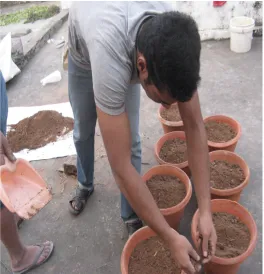
Equal quantities of blended soil (Step A) were loaded into each pot up to similar level. Refer soil loading in Selected Pots (Snap shot B-2) and equal soil level in selected pots (snap shot B-3)
Final Soil Level in Selected Pots (Snap shot B-3)
C. Collection of Garlic Seed samples for cultivation
Different variety of garlic collected from different market sown as mentioned below in Table No 1:-
Sr No.
Local Name
Variety Collection Point
1 Lahsun White hard neck (Yamuna)
Sabji Mandi Pinjore 2 Lahsun Silk Soft
Neck(Agrifood-1)
M/S Kheti Sewa Centre Pinjore 3 Desi
Lahsun
Silk Soft Neck (Kumaoni)
Sabji Mandi Kalka 4 Desi
Lahsun
White hard neck Sabji Mandi Kalka 5 Pahadi
Lahsun
Silk Soft Neck (Elephant Garlic)
Sabji Mandi Kalka 6 Lahsun Silk Soft Neck Sabji Mandi
Pinjore 7 Pahadi
Lahsun
White hard neck (Agrifood Parvati)
[image:3.612.36.300.57.331.2]Sabji Mandi Kalka
Table No:1 Garlic Seed Samples.
Different varieties of Garlic were collected from different regions of the country along the states of Haryana, Himachal Pradesh and Utrakhand. Refer samples snap shots (C-1) as agro-climatic
conditions (soil fertility and Temperature) vary from state to state.
The Medicinally active compounds (Alliin/Allicin) from collected sample of garlic were estimated and reported by 6Rajesh Kumar Singh and Dr. S. N. Hiremath, [ijsrp-p2442 volume 3 Dec2013 titled as “Comparative study of Alliin containing different Varieties of Garlics (Allium sativumL.)”].
From above samples few variety were eliminated and rest were cultivated in similar agro-climatic conditions for finding the medicinally active compound content variations in above samples of Garlic Refer Fig 1.0
[image:4.612.313.569.105.226.2]Various treatments were given to all pots plant like watering, thinning and dressing and time to time aeration of soil.
Fig 1.0: Schematic Diagram of Plantation
D. Monitoring of Agro-climatic conditions
Temperature (Minimum and Maximum) was recorded on daily basis of that area. Refer Table No 2.
Temperature 0C
Date Minimum Maximum
3rd Week of October 10-14 25-30 4th Week of October 8-13 24-28
1st Week of Nov 8-11 23-27
2nd Week of Nov 8-11 24-27
3rd Week of Nov 8-10 24-26
4th Week of Nov 8-10 21-25
Table No 2 :( Average Temperature of different weeks)
E. Analytical Method
The active secondary metabolite Alliin was estimated from bio-mass of Garlic (leaves) and Quantified chemically by using nitrite titration method. Reference: USP 29-NF24 <451> Nitrite Titration.
F. Sample collection for estimation of Alliin:
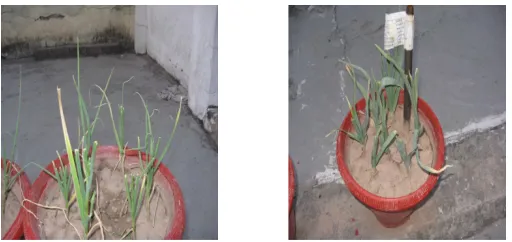
Watering was done in each pot on alternate days, and samples (leaves) were collected for analysis of Alliin/Allicin content after 45 days. Ref. image below:
Image: Garlic plant after 45 days of Sowing:
G. Testing of collected samples
Samples (Fresh leaves) were cut from Harvested plants of all type of Garlic from all pots separately and Alliin were estimated from above biomass of Garlic by using of Nitrite titration.
Each ml of 0.01 M Sodium Nitrite solutions equivalent to 0.001722 g of Alliin.
Analytical results were tabulated in Table No.3
.
III. Analytical Results of Garlic Bio mass (leaves)
Observed Results were tabulated in Table No. 3
Variety Content of Alliin (%) in Leaves
Agrifood– I (Seed Shop
Pinjore 0.21
Sabji Mandi Kalka 0.29
Kumaoni Garlic(Nainital) 0.16
Elephant Garlic(Pahadi
Lahsun) 0.35
Table 3: Content of Alliin in different varieties of Garlic
IV. DISCUSSION
[image:4.612.41.295.163.343.2]V. CONCLUSION
From the obtained results it is clear that Content of Alliin varies in different plant varieties of Garlic grown in similar agro climatic conditions, hence it can be concluded that content of Alliin is due to Genotypic variations rather than Ecotype variations.
ACKNOWLEDGEMENT
In performing our research, we had to take help and guideline of some respected persons who deserve our sincere gratitude. The completion of our research gives us much pleasure. So I would like to thank Mr. Ulhās Dhuppad, Executive Vice President-CMC for helping through numerous consultations and guidance for the completion of above research.
In addition we would like to thank, Mr. Ashutosh Tripathi Research Officer, Mr. Mahesh Saruk Research Associate, Formulation Development and entire team of Glenmark Pharmaceuticals Ltd, Research Centre, Sinner (Maharashtra) where we got necessary help and support.
Lastly we must acknowledge the efforts of Mrs. Punam Rajesh Kumar Singh, Rajat Kumar, Smriti Kumari and Aparna without whose support the extensive travelling & the outbound stays required for the above research would not have been possible.
REFERENCES
[1] Biotechnology of the micro propagation of medicinal and aromatic PlantsIn: Bajaj Y.P.S. (ed.) Biotechnology in Agriculture and Forestry 4: medicinal and Aromatic plants I. Springer-verlag Co. New Yark. PP. 60-103.
[2] U.S.P-24, NF- 19 PP. 2445 Garlic (official monograph) Estimation of Alliin by HPLC method.
[3] USP 29 <451> Nitrite Titration -NF24 Page2578.
[4] Abo.Ei.Nil MM (1977) organogenesis and embryogenesis in callus culture of Garlic (Allium sativum L.)Plant Science Lett.9:259:224
[5] International pharmacopoeia.
[6] Ali A. Metwally EE91992), Somatic embryogenesis and Plant Regeneration as a tool for Garlic Improvement. Egypt j Appl.7:727.73
[7] Rajesh Kumar Singh, Dr. S.N Hiremath - Comparative study of Alliin containing different Varieties of Garlics (Allium sativum L.) - published at: "International Journal of Scientific and Research Publications (IJSRP), Volume 3, Issue 12, December 2013 Edition".
AUTHORS
First Author - Rajesh Kumar Singh, Department, of Pharmacy (Pharmaceutical Chemistry), Monad University, Panchshil Nagar, Hapur (U.P) India.
Email ID – [email protected]
Second Author - Dr. S. N. Hiremath, M. Pharm., Ph.D. Principal, Pravara Rural College of Pharmacy, Pravara Nagar , Loni,Dist.Ahmadnagar, (Maharashtra) India.