Practicality of Science Learning Instruments
in Junior High School Based On GIMUR
(Guided Inquiry by Multi Representation)
Ridha Fitri Andansari*, Zainul Arifin Imam Supardi*, Bambang Sugiarto* *
Postgraduate Study of Science Education, Postgraduate, State University of Surabaya, Indonesia
DOI: 10.29322/IJSRP.9.09.2019.p9353 http://dx.doi.org/10.29322/IJSRP.9.09.2019.p9353
Abstract- This research aims to: (1) analyze implementation of Learning Implementation Plan (RPP); (2) analyze students’s activities during implementation of learning instruments using GIMUR; and (3) analyze obstacles were encountered during teaching and learning process carried out with this learning instruments. The type of this research is quasi experimental research. The research population is all of the students in this competence. Therefore, the research samples are the students of Class VIII-B and VIII-C at SMPN 1 Trawas. The researcher analyzed the data using observation by two observers who are two science teachers. The practicality of the learning insruments developed produces: (a) the implementation of lesson plans in grades VIII-B and VIII-C at SMPN 1 Trawas produces very excellent results, (b) student's activities are carried out well with an average grade of 3,62 and 3,57, with the percentage of follow-up approval of 94,57% and 93,43%, which shows that students carry out the learning process excellent, and (c) the obstacles or constraints found during the research process exceed the time limit specified in the RPP.
Index Terms- Practicality, Science Learning Instruments, GIMUR, Guided Inquiry by Multi Representation.
I. INTRODUCTION
At the end of 2015 there was a sign that the era of Masyarakat Ekonomi ASEAN (MEA) began, requiring high educational qualifications and competencies for each workforce. Preparation of qualified and highly competitive human resources is the key to survival. Therefore, the realization of quality human resources comes through quality formal education as well. The most important thing in learning is that students can use their knowledge flexibly to master basic concepts [1]. Inquiry learning seems like a shift between conventional teaching and student-centered learning. Understanding of student’s concepts can be overcome with the right model using guided inquiry models [2]. The inquiry model is also very helpful for students to link their knowledge [3]. The difficulty of students to be directed to manage time is also a finding in the study. This is in accordance with the results of the study [4], the implementation of guided inquiry is hampered by teacher assistance, teachers have difficulty directing conclusions to students and there are no guidelines for learning to run effectively. Provides a significant influence with the use of guided inquiry learning towards the science process skills of students[5]. The learning process with guided inquiry is also successful in equipping students to solve problems in long-term competence [6].
The essence of inquiry learning is to involve students in real terms in a problem [7]. With inquiry, students learn to be a scientist in compiling science. Inquiry learning involves the maximum ability of students to find and investigate something (objects, people, or events) mathematically, critically, logically, and analytically. Representation is to explain concepts by using different ways to find solutions based on interpretations of the mind so that the concepts become meaningful [8]. In physics, multi representations represent concepts in more than one way, consisting of verbal representations, physical representations, and mathematical representations. In the learning science concepts, modes of multi-representation can be categorized into analogies, modeling, diagrams, and multimedia [9]. Multirepresentation learning helps to understand physics concepts better [10].
Practicality of the application of learning instruments is the level of achievement of a learning instruments successful or not based on aspects of the assessment of the implementation of lesson plans, the percentage of student activity, and obstacles or constraints experienced during the learning process. The implementation of the lesson plan is assessed from the average score of observations of the implementation of GIMUR conducted by two observers, the science teacher during the teaching and learning process in the classroom. Student’s activities are observations of student activities during the whole learning process. The frequency of observations of student’s activities when conducting the teaching and learning process is then multiplied by 100%. Obstacles in learning are the causes of problems that occur when the learning process is evaluated to find where it came from and analyzed to find a solution.
II. EXPERIMENTAL METHOD
2.1 General Background of Research
The main purpose of this research to analyze practicality of science learning instruments using Guided Inquiry by Multi Representation (GIMUR). This research was conducted in students at SMPN 1 Trawas, East Java, Indonesia, academic year 2018/2019. Practicality consist of: the implementation of Learning Implementation Plan (RPP), students’s activities during the implementation of learning instruments using GIMUR, and obstacles were encountered during teaching and learning process carried out with this learning instruments.
2.2 Sample of Research
The sample in this research was 64 students of class VIII-B and VIII-C at SMPN 1 Trawas, East Java, Indonesia, academic year 2018/2019.
2.3 Instrument and Procedures
The implementation of Learning Implementation Plan (RPP) is carried out by two observers who are science teachers at SMPN 1 Trawas. Observations were made with an observation sheet for the implementation of Learning Implementation Plan (RPP), students’s activities, and obstacles were encountered during teaching and learning process carried out with this learning instruments. The material used in this study is vibration, waves and sound.
2.4 Data Analysis
a. Analysis of the implementation of Learning Implementation Plan (RPP)
The implementation of Learning Implementation Plan (RPP) is carried out by two observers who are two science teachers at SMPN 1 Trawas. Observations were made with an observation sheet for the implementation of Learning Implementation Plan (RPP). Instrument reliability is expressed in percentage of agreement with the equation:
𝑅𝑅=�1−𝐴𝐴 − 𝐵𝐵𝐴𝐴+𝐵𝐵� 𝑥𝑥100% Information:
R: instrument reliability (percentage of agreement) A: higher score from validator
B: lower score from validator
These results can then be categorized based on the available percentages as in the table below [11]. Table 1. Categories of Learning Implementation Plan (RPP)
No. Score Category
1. 1.00 - 1.49 Less (K)
2. 1.50 - 2.49 Fair (C)
3. 2.50 - 3.49 Good (B)
4. 3.50 – 4.00 Very Good (BS)
The percentage of the implementation of the learning steps, can be calculated with the following formula: % percentage =numbertotalnumberoflearningoflearningstagescarriedstagesoutx100%
b. Student’s activities
Student activities were observed by observers who were science teachers at SMPN 1 Trawas. Data accumulation is calculated based on the overall percentage of the five meetings. Learning devices are said to be reliable if the reliability value is more than equal to 75 [12]. Instrument reliability is expressed in percentage of agreement with the equation:
𝑅𝑅=�1−𝐴𝐴 − 𝐵𝐵𝐴𝐴+𝐵𝐵� 𝑥𝑥100% Information:
R: instrument reliability (percentage of agreement) A: higher score from validator
B: lower score from validator
Student activity categories are classified into four aspects of scoring, which are very good, good, sufficient, and lacking. c. Obstacles in learning process
Barriers or obstacles when teaching and learning process takes place were analyzed by qualitative analysis. The results are then described so that solutions can be found to fix obstacles in learning process.
III. RESULT AND DISCUSSION
The instruments that has been validated and revised according to the suggestions of the validator is then tested at class VIII-B and VIII-C of SMPN 1 Trawas with 64 students. The activity was carried out five times with a time allocation of 13 x 40 minutes.
a. Analysis of the implementation of Learning Implementation Plan (RPP)
Table 2. Recapitulation of Observation Results
on the Implementation of Learning Implementation Plan (RPP) in Class VIII-B and VIII-C
No. The observed aspect
VIII-B VIII-C
Implementation Average Category R(%) Implementation Average Category R(%)
1.
Average preliminary
aspects
√ 3,93 BS 97,86 √ 3,85 BS 95,71
2.
Average aspects of core
activities
√ 3,63 BS 92,53 √ 3,62 BS 92,09
3. Average
closing aspect √ 3,93 BS 97,86 √ 3,90 BS 97,14
4.
Average aspects of time
management
- 3,40 B 94,28 - 3,40 B 94,28
5.
Average aspects of class
atmosphere
√ 3,90 BS 99,05 √ 3,87 BS 98,09
Percentage of
implementation (%) 96 96,32 96 95,46
Implementation
category TSB BS TSB BS
Information: SB: excellent B: good
TSB: very excellent
R: instrument reliability (percentage of agreement)
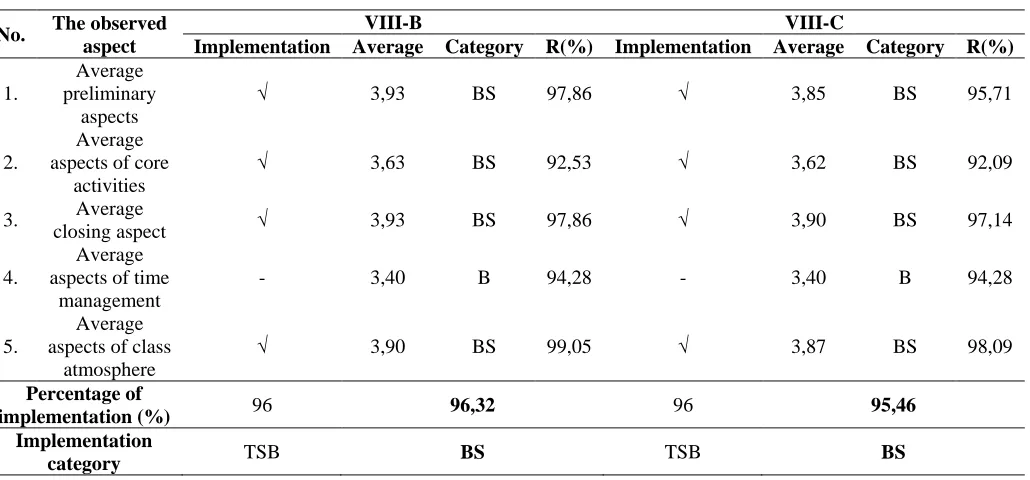
The implementation of the Learning Implementation Plan (RPP) is carried out by two observers who are two science teachers at SMPN 1 Trawas. Observations were made with an observation sheet for the implementation of the Learning Implementation Plan (RPP). The material used in this study is vibration, waves and sound. The implementation of the RPP with the guided inquiry model with multi representations can be seen in table 2.. The lesson plans given to observations have a score range of 1-4 which includes assessments on preliminary aspects, aspects of core activities, closing aspects, aspects of time management, and aspects of classroom atmosphere.
In the preliminary activities, Trial II in class VIII-B, the average aspect resulting from observations at the first to fifth meeting was 3.93 and the percentage of agreement was 97.86%. Whereas in class VIII-C obtained 3.85 with a very good category with a percentage of agrement of 95.71%. In this phase between classes VIII-B and VIII-C get the same results in the excellent category and all phases are done well.
In the core activities there are four learning phases, namely the second phase of sequences and hypotheses, the third phase of representation, and the 5th phase of evaluation and reflection. The average aspect in the core activities of the five meetings in class VIII-B was 3.49 and a percentage of agreement was obtained at 94.09%. In class VIII-C get an average of 3.63 and the percentage of agreement of 92.53%. The core activities in both classes were well implemented and categorized excellent.
In the closing activity, the average observations of all observations in class VIII-B were 3.93 with a very good category and the percentage of agreement was 97.86%, while VIII-C was 3.90 with a percentage of agreement 97.14%. In the closing activity the teacher gives awards to groups that perform well in their groups. After that the teacher guides students in summarizing the material that has been learned by referring to the learning objectives and encourages students to always be grateful for all God's creations that are beneficial to life. The teacher closes the learning activity by praying and saying hello.
The aspects of time management get an average score of 3.40 in class VIII-B and class VIII-C. During the first and second meetings for classes VIII-B it was still difficult to be on time according to the lesson plan. Whereas class VIII-C management at the first, second, and third meetings was the same ie not carried out properly. Class VIII-B and VIII-C in the aspect of time management get a 94.28% precentage of agreement having a good category. The good category shows that teachers can manage learning activities based on the syntax of guided inquiry models with multi representations so that lesson plans can be implemented well.
The average atmosphere of class VIII-B is 3.9 with a percentage of agreement 96.32%. Class VIII-C 3.87 with a very good category and produces a precentage of agreement of 98.09%. If the class is treated properly, it makes students become motivated to learn and better understand the lesson [13].
b. Student’s activities
[image:4.612.84.527.98.256.2]Observations on student’s activities were made by two observers during five meetings with guided inquiry with multi representations. Based on the analysis the results shown in table 3 are obtained:
Table 3. Analysis os student’s activities in class VIII-B and VIII-C
Activity VIII-B VIII-C
Vrtotal Category R(%) Vrtotal Category R(%)
1 4,00 Excellent 100,00 3,80 Excellent 94,28
2 3,60 Excellent 88,57 3,60 Excellent 88,57
3 3,80 Excellent 94,28 3,80 Excellent 94,28
4 3,80 Excellent 94,28 3,60 Excellent 94,28
5 3,50 Excellent 91,43 3,50 Excellent 91,43
6 3,60 Excellent 94,28 3,60 Excellent 94,28
7 3,40 Good 94,28 3,40 Good 94,28
8 3,70 Excellent 94,28 3,70 Excellent 91,43
9 3,80 Excellent 94,28 3,70 Excellent 91,43
10 3,00 Good 100,00 3,00 Good 100,00
Average 3,62 Excellent 94,57 3,57 Excellent 93,43
Learning activities must involve active students in the learning process so that they can improve their learning achievements. Observers observe students' activities based on the observation sheet which includes: (1) listening or paying attention to the teacher's explanation, (2) reading or searching for teaching material information in accordance with the content, (3) conducting an experiment in accordance with LKPD guidelines, (4) conducting data collection according with instructions in LKPD, (5) conducting data analysis, (6) communicating the results of the experiment, (7) preparing practicum reports in accordance with the results of the practicum, (8) actively discussing in groups to solve problems, (9) asking questions or opinions and answering question, and (10) make conclusions. Based on table 3 that have been presented, it states that the activities of students are carried out excellent in both classes. The average assessment of two observers during five meetings was 3.62 with a percentage of agreement of 94.57% in class VIII-B and 3.57 with a percentage of agreement of 93.43% in the excellent category.
c. Obstacles in learning process
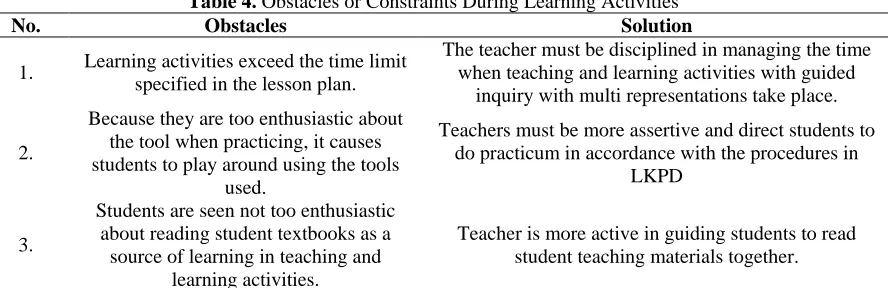
During teaching and learning activities, researchers find obstacles when applying learning with guided inquiry by multi representations. The obstacles are presented in the table below.
Table 4. Obstacles or Constraints During Learning Activities
No. Obstacles Solution
1. Learning activities exceed the time limit specified in the lesson plan.
The teacher must be disciplined in managing the time when teaching and learning activities with guided
inquiry with multi representations take place.
2.
Because they are too enthusiastic about the tool when practicing, it causes students to play around using the tools
used.
Teachers must be more assertive and direct students to do practicum in accordance with the procedures in
LKPD
3.
Students are seen not too enthusiastic about reading student textbooks as a
source of learning in teaching and learning activities.
Teacher is more active in guiding students to read student teaching materials together.
[image:4.612.88.532.402.546.2]IV. CONCLUSION
The practicality of the learning insruments developed produces: (a) the implementation of lesson plans in grades VIII-B and VIII-C at SMPN 1 Trawas produces very excellent results, (b) student's activities are carried out well with an average grade of 3,62 and 3,57, with the percentage of follow-up approval of 94,57% and 93,43%, which shows that students carry out the learning process excellent, and (c) the obstacles or constraints found during the research process exceed the time limit specified in the RPP.
ACKNOWLEDGMENT
Authors wishing to acknowledge assistance or encouragement from supervisor, colleagues and Acknowledgments section immediately following the last numbered section of the paper.
REFERENCES
[1] Reif F 1995 Milikan Lecture: understanding and teaching important scientific thought processes Am J Phys 63 (1) Januari 1995
[2] Koksal E A & Berberoglu G 2014 The Effect of Guided-Inquiry Instruction on 6th Grade Turkish Students’ Achievement, Science Process Skills, and Attitudes Toward Science International Journal of Science Education 36(1) 66–78
[3] Pedaste M & Kori K 2014 When Students Benefit from Analyzing their Inquiry Springer International Publising Switzerland HCII 2014 Posters Part II CCIS 435 [4] Fatmaryanti S D Suparmi Sarwanto & Ashadi 2015 Profil of guided inquiry in physics learning at Purworejo’s senior high school International Conference on
Mathematics Science and Education UNNES
[5] Ilham M 2018 Pengaruh Pembelajaran Inkuiri Terbimbing Terhadap Keterampilan Proses Sains Siswa Kelas VII MTs Nurul Falah Juai Pada Konsep Saling Ketergantungan Dalam Ekosistem Jurnal Pendidikan Hayati 4(3)
[6] Elnada I W Mastuang M & M A S 2018 Meningkatkan Keterampilan Proses Sains Dengan Model Inkuiri Terbimbing Pada Siswa Kelas X PMIA 3 DI SMAN 3 Banjarmasin Berkala Ilmiah Pendidikan Fisika 4(3) 228
[7] Joyce B Weil M & Calhoun E 2000 Models of Teaching (6th Edition) Boston: Allyn& Bacon
[8] Aminudin D Sutiadi A & Samsudin A 2013 Profil Konsistensi Representasi Dan Konsistensi Ilmiah Siswa SMP Pada Konsep Gerak WePFi Vol 1 No 3 Desember 2013
[9] Gilbert J K & Treagust D 2008 Multiple Representations in Chemical Education: Models and Modeling in Science Education Dordrecht: Springer pp 251-283 [10] Yusup M 2009 Multirepresentasi Dalam Pembelajaran Fisika Seminar Nasional Pendidikan FKIP Unsri, 1–7
[11] Riduwan 2012 Skala Pengukuran Variabel-variabel Penelitian Bandung Alfabeta
AUTHORS
First Author – Ridha Fitri Andansari, M.Pd., Postgraduate Study of Science Education, Postgraduate, State University of Surabaya, Indonesia, and [email protected]
Second Author – Zainul Arifin Imam Supardi, Ph.D., Postgraduate Study of Science Education, Postgraduate, State University of Surabaya, Indonesia, and [email protected]