2018 2nd International Conference on Modeling, Simulation and Optimization Technologies and Applications (MSOTA 2018) ISBN: 978-1-60595-594-0
Influence Analysis of Typical Operational Environment on the Use of
Projectile-carried Communication Jammer on the OPNET Platform
Jie ZHANG
1,*, Qing-wen YANG
2and Dong CHEN
21Team Two of Postgraduate Brigade, Army Academy of Artillery and Air Defense, Hefei, China
2Army Academy of Artillery and Air Defense, Hefei, China
*Corresponding author
Keywords: Projectile-carried communication jammer, Operational environment, Meteorological factors, OPNET simulation platform.
Abstract. On the basis of summarizing the typical operational environment’s characteristics of projectile-carried communication jammer, taking meteorological factors as an example, the influence of meteorological conditions on the operational process of short-wave and ultra-short-wave projectile-carried communication jammer was analyzed. The model and simulation parameters established and setup to quantify the meteorological factors by using OPNET simulation platform were briefly described.
Introduction
[image:1.595.54.535.432.492.2]The projectile-carried communication jammer is a kind of communication device which is launched by conventional artillery and rockets, and uses the projectile as a carrier to carry the jammer to the enemy target area quickly to complete the communication jamming task[1]. The brief workflow flowchart is shown in Figure 1,
Figure 1. Brief workflow flowchart of projectile-carried communication jammer.
As data display, the jamming target of the active communication jamming shell is mainly the enemy tactical frequency hopping radio. The jamming frequency band is 1.5-120MHz, which covers the whole short-wave band and part of the ultra-short-wave band. Therefore, the core component of jamming shell, i. e. the projectile-carried communication jammer, will be affected by operational environment factors in the process of operation. With the help of certain simulation tools, combing and analyzing the impact of typical operational environment factors on the use of active communication jamming shell will play an important role in the commander's more efficient use of jamming shell.
Typical Operational Environment of Projectile-carried Communication Jammer and Its Influence
Southeast Coastal Operational Environment
difficulties; secondly, the use of shielding is less, the difficulty of concealed protection is great, and the pressure of air defense is great.
In the meteorological aspect, the main affecting factors consist of the shooting airspace and sea area’s temperature, humidity and high-altitude meteorological conditions and so on. Because the southeast coastal area belongs to the subtropical oceanity monsoon climate, the annual average temperature is 20.8 degrees, the extreme minimum temperature and the highest temperature are -15 degrees and 44.9 degrees respectively, the impact is often more obvious, mainly reflected in: perennial high temperature and humidity easily lead to insufficient power and mechanical failure of weapons and equipment, but also very easy to cause mildew of electronic equipment, such as command information system, meteorological detection system, fire control system, etc. At the same time, the southeast coastal areas are windy and rainy, the air and water vapor with high salinity, adhere to the surface of vehicles, easily cause corrosion.
Electromagnetic Network Environment. Electromagnetic network environment, also known as information environment, in which the electromagnetic environment can be divided into natural electromagnetic environment and human electromagnetic environment.
Southeast coastal combat area has vast oceans, numerous lakes, and high air humidity; dense vegetation, continuous mountains, and complex geomagnetism; a changeable climate, frequent thunderstorms, and more ionospheric scintillation. In addition, southeast coastal area is located in low latitude of subtropical zone. When encountering sudden phenomena such as cosmic radio, sunspots and flares, frequency equipment is often more affected than other areas. Because of special natural electromagnetic environment in southeast coastal area, radio communication will be disturbed.
In terms of the human electromagnetic environment, the southeastern coastal areas are economically developed and highly populated. Civil radar, satellite television and radio stations, civil aviation, transportation and other departments, as well as industrial and medical equipment, will generate a large amount of electromagnetic radiation when they are in operation. This will have an adverse effect on the frequency equipment and electronic devices susceptible to electromagnetic interference. In addition, under the condition of future informationization, when participating in joint landing operations or large-scale island fencing operations within the superior formation, it will not only face the impact of frequency equipment of several groups of troops in a small space, but also face the various forms of electromagnetic interference adopted by the enemy. It also makes human electromagnetic environment more complex and severe.
Southwest Border Operational Environment
Natural Geographical Environment. Southwest frontier region, with typical plateau and alpine mountain characteristics, the average elevation of more than 4000 meters, the average height difference of 200 meters, the lowest temperature below -15.9 degrees. The mountains here are dangerous, the terrain is complex, the physical and geographical environment is extremely bad, and the impact on our army's operations is obvious, mainly reflected in four aspects:
Firstly, southwest frontier area is cold and hypoxic;big temperature difference between day and night easily leads to brittle fracture of metal parts of vehicle equipment.
Secondly, in the plateau wide valley area, because of the high altitude, it will cause the equipment power to drop, the speed to slow down, the failure rate to increase.
Thirdly, it mainly distributes in high mountains and deep valleys in the middle and part of the border’s eastern part. The mountains are high and steep, the terrain fluctuates sharply, the valleys are deep and narrow. Because of sparse vegetation and thick permafrost layer, it will bring influence to our army's construction and concealed deployment.
Electromagnetic Network Environment. In the direction of southwest frontier, the capability of information acquisition, processing and transmission must be fully considered, especially in cold, high mountains, bad weather and actual combat environment of enemy electronic interference and anti-interference, destruction and anti-destruction, the equipment will face a major test. Complex and diverse topography will greatly affect acquisition and transmission of equipment command information. It will produce blocking, refracting, reflecting and shielding effects on short-wave and ultra-short-wave. Radio communication will be disturbed greatly, electromagnetic wave action scope is small. It will be very likely that the situation is close but can not be contacted. In the canyon dense forest area where vegetation and forests are widely distributed, the electromagnetic wave propagation distance will usually shorten 40-70%. At the same time, the harsh and changeable weather environment will also have a greater impact on the electromagnetic information spread and the network equipment’s use. Frequent rain, fog, snow, thunder and lightning, as well as frequent changes in ionosphere, will also have a serious interference and hindrance to information spread, or even a complete interruption. For the purpose of analyzing specific problems, this paper took meteorological factors as an example to illustrate.
Influence of Different Meteorological Factors on Jamming Efficiency of Projectile-carried Communication Jammer[2]
From the above analysis, it can be seen that the influence of meteorological factors on the jamming efficiency of projectile-carried communication jammer is mainly manifested in: bad weather conditions on the attenuation of jamming electromagnetic wave energy is very large, will greatly shorten the jamming distance, reduce the jamming intensity.
Influence of Meteorological Conditions on Short Wave Band Jammer
Influence of Meteorological Conditions on Ultra-short Wave Band Jammer
When jammer works at a high frequency and is in ultra-short wave band, transmission distance is usually line-of-sight distance. It is less affected by day, night, season and weather, less electrical interference, and it works stably and reliably.
However, it should be noted that when jammer operates in a higher frequency band, its propagation mode is mainly direct wave propagation mode, which requires no obvious obstacles in the transmission path. In addition, when jammer works in ultra-short wave band near 120MHz, it can also achieve scatter propagation. Scattering propagation is that electromagnetic waves are projected onto inhomogeneous medium in ionosphere of lower atmosphere, or onto meteor trails, resulting in scattering phenomena, so that part of electromagnetic wave energy reaches receiving point. Therefore, jammer will also produce jamming effect at a longer distance, but the jamming effect will not be very obvious.
Meteorological Factor Analysis of Jamming Efficiency of Projectile-carried Communication Jammer Based on OPNET Platform in Typical Operational Environment
Simulation Platform
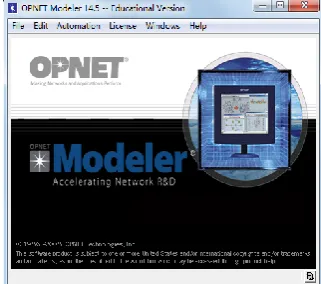
OPNET Modeler provides developers with an integrated environment for modeling, simulation, and analysis, greatly reducing the workload of programming and data analysis with its superior flexibility for the design and research of communication networks, equipment, protocols and applications[3].As shown in Figure 2.
[image:4.595.86.247.370.512.2] [image:4.595.331.506.380.511.2]
Figure 2. OPNET software interface. Figure 3. Radio model in OPNET.
Radio Modeling[4]
Figure 4. Interface of technical and tactical parameters for transmitter.
[image:4.595.211.388.554.733.2]As shown in Figure 3, the radio transceiver combination model built in OPNET is mainly composed of antenna model, transceiver model, traffic generation model, data processing model and so on. The traffic generation model mainly produces interference signals, the antenna model is mainly used to set the antenna gain, and the radio transceiver model plays an important part in the node model. Take the transmitter as an example: as shown in Figure 4, according to actual index parameters of a certain type of projectile-carried communication jammer, bandwidth, data rate, frequency, transmission power, modulation and demodulation mode can be set.
Antenna Model. Antenna editors can be used in OPNET to describe the antenna gain in all directions, including the transmitter antenna gain (TIMS_VHF_Radio_tagain) and the receiver antenna gain (TIMS_VHF_Radio_ragain). Both HF and VHF tactical radios use whip antennas, and gain values can be set according to specific parameters.
Radio Propagation Loss and Receiving Power Model. OPNET has free space transmission loss, Longley-Rice, TIREM and other models. Users can develop and implement the models according to their needs.
Noise Power Model. Noise power model is composed of background noise model (TIMS_VHF_Radio_bkgnoise) and interference noise model (TIMS_VHF_Radio_innoise). In fact, the meteorological influence factors of the projectile-carried communication jammer in operation can be regarded as a mixture of background noise and interference noise. When analyzing and quantifying the influence of meteorological factors, we can reflect the meteorological factors through the establishment of noise models.
SNR and BER Model. The signal to noise ratio (TIMS_VHF_Radio_snr) model describes the reception of signals in different modulation modes.For example, for projectile-carried communication jammer, we hope that the greater the signal-to-noise ratio of enemy receiver, the better, so when the greater the impact of meteorological factors, that is, the smaller the signal-to-noise ratio, the greater the BER of the receiver, the worse the jamming effect.
Conclusions
From the above analysis, it is feasible to quantify and analyze the influence of typical operational environment factors on active communication jamming shell’use via OPNET simulation platform through the establishment of military radio station model.
References
[1] J.F. Zhao, G.C. Wang, H. Zhang,“ Blindness Weapon in Information Battlefield- Communication Jamming Bomb,” Journal of National Defense, issue 12, pp. 69-70, 2006.
[2] M.S. Wang, Principles of communication countermeasure. Beijing, PLA press, 1999.
[3] Network simulation based on OPNET
[EB/OL].https://max.book118.com/html/2017/0104/80031421.shtm, 2017-01-04.