2018 International Conference on Computer, Communications and Mechatronics Engineering (CCME 2018) ISBN: 978-1-60595-611-4
Image Semantic Segmentation Based on Depth Parallel
Convolutional Networks
Zi-yang QIN
*Chengdu Jiaxiang Foreign Languages School Pidu Campus, Chengdu, China
*Corresponding author
Keywords: Image semantic segmentation, Fully convolutional networks, Parallel network structure,
Residual learning.
Abstract. Fully convolutional network can effectively learn the task of centrally predicting pixels,
such as semantic segmentation. However, FCN has the problems of spatial invariance and non-real time, which limits its performance and application. We propose an improved structure that preserves the basic shape of the FCN while extracting high-level features in the input section and introduces a separate residual learning module. On the other hand, we also introduce sub-networks that exist in parallel and reduce the size of the original FCN structure by proportional random discarding. Experiments show that the proposed method, which increases the residual network and parallel FCN and random discarding has better evaluation index than the traditional FCN method, and can further reduce the computational cost of the system with ensuring performance.
Introduction
Since the 21st century, deep convolutional neural networks (DCNN) have been the preferred method of document recognition and have recently become the mainstream of advanced visual research. DCNN has pushed the performance of computer vision systems to the peak, including image classification, object detection, and fine-grained classification. A common theme of these works is that DCNN trains in an end-to-end manner, providing better results than systems that rely on well-designed features such as SIFT or HOG. This success can be partly attributed to the built-in invariance of DCNN to local image transformation, which is the basis for their ability to learn hierarchical abstractions. While this invariance is clearly desirable for high-level vision, it can hinder low-level tasks such as pose estimation and semantic segmentation - we want to pinpoint rather than abstract spatial details [1].
A fully convolutional network can effectively learn to intensively predict pixelated tasks such as semantic segmentation. The literature [2] proves that Fully Convolutional Networks (FCN) surpasses the traditional technology in the pixel-to-pixel semantic segmentation task through the well-trained end-to-end.
The main advantage of the FCN-based approach is that the network accepts the entire image as input and performs fast and accurate inferences, but there are some limitations. First, the network has a predefined fixed-size perceptual field. Therefore, objects that are substantially larger or smaller than the receptive field may be fragmented or mislabeled. The most recent method uses conditional random field CRF to improve this problem [3].
prominent objects in the scene. Humans are worse than machines in classifying small image patches, but people will be much better when there is more contextual information [4].
In particular, we consider the application of DCNN to three challenges in semantic image segmentation: 1) reduced feature resolution, 2) multi-scale object presence, and 3) reduced positioning accuracy due to DCNN invariance. The first challenge is caused by the repeated combination of the maximum pool and down sampling performed by the continuous DCNN layer originally designed for image classification. This results in a feature map where the spatial resolution is significantly reduced when the DCNN is used in a fully convolutional manner. The second challenge is caused by the presence of objects of multiple dimensions. A standard way to solve this problem is to present a rescaled version of the same image to the DCNN and then aggregate the feature or score map. The third challenge involves the fact that object-centric classifiers need to be invariant to spatial transformations, thus inherently limiting the spatial precision of the DCNN [5].
Based on the spatial accuracy problem of the last DCNN, we propose an improved structure, which retained the basic shape of the FCN and adding a Residual learning module for extracting high-level features in the input part, and adding independence under the premise of the basic shape of the FCN. The sub-networks that change the data depth, these sub-networks exist in parallel, and reduce the size of the original FCN structure by proportional random discarding without further reducing the recognition rate, thereby further reducing the computational cost.
The structure of this paper is as follows: Firstly, the architecture and scheme of FCN are given in this paper. Then our improved FCN architecture method is proposed. The feasibility of this method is proved by testing on the actual image semantic segmentation task. Finally, the summary is given.
Fully Convolutional Networks
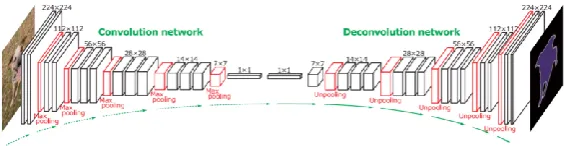
A common family of deep networks for object detection can be divided into two subnets by the Region of Interest (RoI) pooling layer: independent "completely convolved" sub-networks RoIs, and RoI-wise subnets that do not share computations. This decomposition, such as AlexNet and VGG Nets, consists of two subnets: a convolutional subnet ending in a spatial pool, followed by several fully connected layers. Therefore, the spatial pool layer in the image classification network naturally becomes the RoI pooling layer in the object detection network. Image classification networks, such as Residual Nets and GoogLeNets, are completely convolutional in design. By analogy, it is natural to build a shared convolution subnet in the object detection architecture using all convolutional layers, so that there is no hidden layer in the RoI-wise subnet, but the detection accuracy is quite low, which does not match the network's superior classification accuracy.
Figure 1. Overall architecture of the FCN deconvolution network.
To further diversify the features representing the encoding, the multi-region CNN model can be extended so that it also learns the semantic segmentation-aware CNN features. The motivation for doing so comes from the close connection between segmentation and detection, and the fact that knowing that segmentation-related clues often help the object to detect. In the context of a multi-region CNN network, the combination of semantic segmentation sensing features, namely "activation-map" and "region adaptation", is accomplished by adding appropriate adapted versions of the two main modules of the network. The activation mapping module is used for semantic segmentation sensing. In order to serve the purpose of using semantic segmentation sensing features, for this module, we use a trained full convolutional network (FCN) to predict class-specific foreground probabilities. Weak supervision training. For training this FCN, we only use the provided bounding box annotation for detection without using any other segmentation annotations. To do this, we follow a weakly supervised training strategy [6, 7].
Improved Fully Convolutional Networks
Full Convolutional Network (FCN) is an effective end-to-end method for semantic image segmentation. The FCN generates a score map of a size proportional to the input image, where each pixel represents a classifier of the object. Although accuracy and ease of use are good, FCN is not directly applicable to generating instance segments. An end-to-end fully convolutional network capable of segmenting candidate instances was developed in literature [8]. Each pixel still represents a classifier, but unlike the FCN that generates a score map, is a classifier that computes a set of instance-sensitive score graphs, where each pixel is the relative position of the object instance. Using this set of score maps, we were able to generate an object instance segment in each sliding window by combining the output of the score graph. This procedure enables the full convolution of the generated segmentation instance.
Segmentation is a highly relevant task in image analysis. It is often desirable to automatically depict portions of interest to perform tasks such as visual enhancement, computer-aided diagnosis, intervention, and extraction of quantitative indicators from images. However, for some tasks, classical image segmentation techniques are difficult to handle. For example, compared to 2D images primarily used for computer vision, segmentation of 3D images requires segmentation in 3D by considering the entire content [9].
...
...
Input
Image SegmentOutput
Ave. Pooling Unpooling
Ave. Pooling Unpooling
Residual learning
[image:4.595.172.427.73.172.2]proportional random discarding
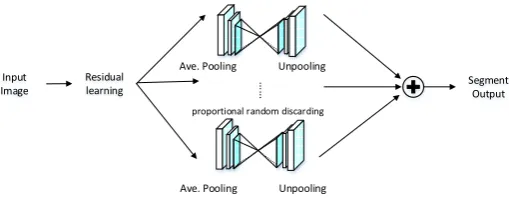
Figure 2. Improved Fully Convolutional Networks structure.
We propose an improved structure, which is shown in Fig.2, preserves the basic shape of the FCN and adds a residual learning module that extracts the high-level features from the input section and adds independence under the premise. The basic shape of the FCN. Subnets that change the depth of data, these subnets exist in parallel, and the size of the original FCN structure is reduced by proportional random discarding without further reducing the recognition rate, thereby further reducing the computational cost.
In our scheme, the independent residual learning module is introduced into the FCN, which can further extract high-level features from the original image data, which helps to get a better description for segmentation. In addition, through the parallel existence of subnet FCN and introduce a certain proportion of random Discarding the super-explanatory method can ensure the stability of the recognition rate and increase the calculation speed, which is of great significance for many real-time offline applications, such as robots, unmanned vehicles and drones.
Experiments
To evaluate the performance of the improved FCN structure described above, we first performed experiments based on partial PASCAL VOC data, trained the model on the training set, evaluated it on the validation set, and tested it on the test set. The segmentation recommendation method is evaluated by the mask-level intersection-over-union (IoU) indicator between the predicted value and the true value. IoU is the intersection of the candidate proposal and the ground truth annotation, divided by their joint area. This metric can be applied to segments and box proposals. We evaluated the performance of the proposed method, taking into account a fixed number of proposals, Average Recall AR between IoU 0.5 and 1.0). AR has proven to be very relevant to detector performance [10].
Table 1. The box proposals results of two methods.
Methods
Box Proposals
Train Test
AR@10% AR@100% AR@1000
%
FCN fully conv. fully conv. 14.8 16.5 23.7
Improved FCN Parallel conv. + random discard
Parallel conv. +
[image:4.595.79.517.540.718.2]random discard 16.3 19.3 25.0
Table 2. The segmentation proposals results of two methods.
Methods
Box Proposals
Train Test
AR@10% AR@100% AR@1000
%
FCN fully conv. fully conv. 38.9 45.5 50.1
Improved FCN Parallel conv. + random discard
Parallel conv. +
true for the Segmentation Proposals indicator, and the proposed method is more obvious than the FCN method at AR@10%, AR@100%, and AR@1000%. Therefore, we believe that the proposed improvement adds residual network and parallel FCN and random discarding methods with better segmentation performance than traditional FCN methods.
Conclusion
This paper proposed one method of adding residual network and parallel FCN and random discarding to solve the problem of the spatial invariance and non-real-time processing of traditional FCN. This scheme adds a residual learning module to the FCN, and improves the FCN structure into a parallel self-network, and reduces the size of the structure by proportional random discarding. Experiments show that the proposed improvement has added a residual network and parallel FCN and random discarding methods have better evaluation indicators than the traditional FCN method, and can further reduce the computational cost of the system under the premise of ensuring performance.
We will further study the method of serial parallel mixing to further improve the image segmentation accuracy of FCN and the overall performance of the system.
References
[1] Chen L C, Papandreou G, Kokkinos I, et al. Semantic image segmentation with deep convolutional nets and fully connected crfs[J]. arXiv preprint arXiv:1412.7062, 2014.
[2] Long J, Shelhamer E, Darrell T. Fully convolutional networks for semantic segmentation[C]. Proceedings of the IEEE conference on computer vision and pattern recognition. 2015: 3431-3440.
[3] Noh H, Hong S, Han B. Learning deconvolution network for semantic segmentation[C]. Proceedings of the IEEE international conference on computer vision. 2015: 1520-1528.
[4] Mottaghi R, Chen X, Liu X, et al. The role of context for object detection and semantic segmentation in the wild[C]. Proceedings of the IEEE Conference on Computer Vision and Pattern Recognition. 2014: 891-898.
[5] Chen L C, Papandreou G, Kokkinos I, et al. Deeplab: Semantic image segmentation with deep convolutional nets, atrous convolution, and fully connected crfs[J]. IEEE transactions on pattern analysis and machine intelligence, 2018, 40(4): 834-848.
[6] Dai J, Li Y, He K, et al. R-fcn: Object detection via region-based fully convolutional networks[C]. Advances in neural information processing systems. 2016: 379-387.
[7] Wang L, Ouyang W, Wang X, et al. Visual tracking with fully convolutional networks[C]. Proceedings of the IEEE international conference on computer vision. 2015: 3119-3127.
[8] Dai J, He K, Li Y, et al. Instance-sensitive fully convolutional networks[C]. European Conference on Computer Vision. Springer, Cham, 2016: 534-549.
[9] Milletari F, Navab N, Ahmadi S A. V-net: Fully convolutional neural networks for volumetric medical image segmentation[C]. 3D Vision (3DV), 2016 Fourth International Conference on. IEEE, 2016: 565-571.