http://dx.doi.org/10.4236/am.2014.54069
On Classification of k-Dimension Paths in
n-Cube
G. G. Ryabov, V. A. Serov
Research Computer Center of Moscow State University, Moscow State University, Moscow, Russia Email: [email protected]
Received 28 December 2013; revised 28 January 2014; accepted 5 February 2014
Copyright © 2014 by authors and Scientific Research Publishing Inc.
This work is licensed under the Creative Commons Attribution International License (CC BY). http://creativecommons.org/licenses/by/4.0/
Abstract
The shortest k-dimension paths (k-paths) between vertices of n-cube are considered on the basis a bijective mapping of k-faces into words over a finite alphabet. The presentation of such paths is proposed as
(
n− + ×k 1)
n matrix of characters from the same alphabet. A classification of thepaths is founded on numerical invariant as special partition. The partition consists of n parts, which correspond to columns of the matrix.
Keywords
n-Cube; Bijection; Cubant; k-Face; k-Path; Partition; Numerical Invariant; Hausdorff-Hamming Metrics
1. Introduction
Discovery of n-cube combinatoric properties remains a relevant topic, which extends the connections of mathe-matical fields [1]-[4]. The bijective mappings play an important role in enumerative combinatorics as broad alighted in classical works of G.-C. Rota and R. P. Stanley [5] [6]. Bijective form for some constructive world [7]
could be considered not only as suitable for enumerative problems, but also with point of view of effective compu-ting synthesis (algorithms and operations with the potential large parallelism) in such frame. Such approach is considered in the article on the base of constructions (computing) for k-paths as complexes of k-faces in n-cube.
2. Shortly on Cubants
One of bijections for k-faces of n-cube was proposed in [8]. Let be B=
{
0, ,e e1 2,,en}
—reper in n , alpha-bet A=
{
0,1, 2}
and the set An*={
d1,,dn}
,di∈A of all n-digits words. So some word of the set is1, , n
1
i∈B ⊂B
e and translation
( )
T along the rest basis such, that ej∈B2⊂B B(
2=B B\ 1)
. So the bijection for k-face fnk(
B B1, 2)
can be written as next:(
)
( )
( )
[ ]1:11, 2
T
1, , ,nk i j n
n k k
f B B d d
−
=
∏
I e + e ←→ where di =2 for ei∈B1 and dj∈
{ }
0,1 for ej∈B2. dj =1 for translation along ej and dj =0, whentranslation is out. Such representation allows to store traditional coding for n-cube vertex coding (vertice is 0-face). Let character ∅ be supplement and then A′ = ∅
{
, 0,1, 2}
. Character-oriented operation multiplication (intersection) is determined on An*′ (all quaternary n-digital words) with next rules:0 0 0, 0 1 1 0 , 0 2 2 0 0, 1 1 1,1 2 2 1 1, 2 2 2,
, .
x x x A
× = × = × = ∅ × = × =
× = × = × = × =
′ ∅× = ×∅ = ∅ ∀ ∈
(1)
Really it’s intersection of sets: “0, 1”—endpoints of unit-segment and “2” corresponds full unit-segment. For short all words from *
n
A′ are titled as cubants. So we can say the set of cubants forms monoid with unit-cubant 222(n-face in n-cube, i.e. itself n-cube).
The character-oriented operation of addition for cubants is prescribed by next rules: 0 0 0, 0 1 1 0 2, 0 2 2 0 2, 1 1 1,1 2 2 1 2, 2 2 2,
, .
x x x x A
+ = + = + = + = + =
+ = + = + = + =
′ ∅ + = + ∅ = ∀ ∈
(2)
Result of the operation is cubant for convex hull face and therefore one can write:
(
)
1 2 conv 1, 2
D +D = D D .
Short-list of operations on cubants is outlined below:
1) #
( )
x D—counting of character x∈A′ in cubant D. Result is from .2) ¬ =D D1—exchanging of all “0” to “1” and all “1” to “0” in cubant D. Result D1 is cubant for
antipo-dal (a.p.) face.
3) D1×D2—operation multiplication. Result is cubant D3 for common face, if #
( )
∅ D3=0. In case( )
3# ∅ D ≠0 it’s Lmin
(
D D1, 2)
—length of shortest path along edges between faces with cubants D1 and D2,in accordance with (1).
4) D1+D2=D3. Result is cubant D3=conv
(
D D1, 2)
in accordance with (2).5) µ
(
D D1 2)
=D3. Exchanging letters “2” on “0” in such d1i of D1, for which d2i=1, and “2” on “1”,for whichd2i =0. Result D3 has got properties D3∈D1 and #
( )(
∅ D3×D2)
=max(
Lmin(
D D3, 2)
)
.6) ρHH
(
D D1, 2)
=max #{
( ) (
∅(
µ D D1 2)
×D2)
; #( ) (
∅(
µ D D2 1)
×D1)
}
.Calculation of Hausdorff-Hamming (HH) distance for faces with cubants D1,D2 [9].
7) ∂D—boundary for face with cubant D. Result is a set of cubants corresponding the all hyperfaces. Algorithm of HH-distance calculation was proposed in [9] and all k-faces of n-cube form finite metric HH-space. Simplicity of the algorithm gives foundation to add it to operations for cubants. By the way the same algorithm realized calculation of Gromov-Hausdorff (GH) distance between cubes (as finite metric spaces) of different dimensions.
3. Matrix Representation of k-Path
Below we consider complexes of k-faces (here k-dimension of face in contrast to [4], where k-length along edges as shortest paths between vertex). Now we will give definition of k-path between two of antipodal (a.p.) vertices in terminology of cubants. No limits of common we can consider cubants 00...0 and 11...1 for a.p. vertices. Then the set of cubants
{
D D1, 2,,Ds}
, s≤n is bijectivial form of shortest k-path such, that nextconditions are satisfied for mins:
( )
( )(
)
1
1
00 0 11 1
# 2 , 1, ,
# 2 1, 1, , 1
s
i
i i
D D
D k i s
D D+ k i s
∈ , ∈
= =
× = − = −
We represent set of such cubants in more visible form of n s× matrix T:
1 11 12 1
2 21 22 2
1 2
.
n
n
s s s sn
D d d d
D d d d
T
D d d d
= =
It’s easy to check next matrix corresponds to k-path for available n and k:
22 200 00 12 220 00 . 112 220 0
11 1112 2
T = (4)
The columns of the matrix are denoted by Dj,j 1, ,n
∗ =
. Then available permutation of columns stores sa-tisfying of conditions (3) and λj # 2
( )
Dj∗
= . All such matrices (under permutations from symmetric group Sn)
represent the isomorphic k-paths with partition λ: λ = k n k
(
− +1)
. For case (4):{
}
{
2( 1)(
)
2 2 2}
1, 2, , , 1 , , 2 ,1 , for 3.
n k
n k k k
λ= λ λ λ = − − − >
Evidently the matrices with different partitions cor-respond non-isomorphic k-paths. Therefore we can define the such partitions as numerical invariants, which al-low one to distinguish among non-isomorphic k-paths, i.e. to classify k-paths. Now we must remark a specific property of Dj
∗
. Here the columns are written as horizontal rows. So each Dj ∗
can have view only of four types:
222, 22211 1, 00 0222, 00022211 1.
Roughly speaking the sequence of the same characters in Dj ∗
denies “gaps”, since otherwise the condition of mins is not satisfied.
The specific property leads to situation, when some partitions are not represented in frame of T. For example the number of non-isomorphic k-paths classes K k n
( )
, for k=3, n=6 is equal 4, though #λ(
4, 6,12)
=7,(
4, 6,12) {
441111; 432111; 422211;333111;332211;322221; 222222}
λ = :
{
T T T1, 2, 3, ,T4, ,}
λ→ − − − , 1
222000 221200 221120 221112 T =
, 2
222000 221200 221120 211122 T =
, 3
222000 212200 211220 211122 T =
, 4
222000 122200 . 112220 111222 T =
At that time K
( )
2, 6 =#λ(
5, 6,10)
=5, λ(
5, 6,10) {
= 511111; 421111;331111;322111; 222211}
:{
T T T T T5, 6, 7, 8, 9}
λ→ , 5
220000 212000 211200 211120 211112 T =
, 6
202000 201200 201120 221110 121112 T =
, 7
202000 201200 221100 121120 121112 T =
, 8
200200 200120 220110 122110 112112 T =
, 9
220000 122000 . 112200 111220 111122 T =
So K k n
( )
, ≤#λ(
n− +k 1, ,n k n(
− +k 1)
)
.Now we consider common form of n s× matrix T of special type (conditions (3) are satisfied):
2 2 2 20 0 2 2 12 20 0
. 2 2 112 20 0
2 2 1 12 2
Number of vertical columns with “2” (VC) can lay in interval from 0 to k−1 and each of them corresponds to “2-stairs” (SC) from n k− to 1, for k≤
[ ]
n 2 . The case k>[ ]
n 2 must be analyze separately. So( )
,K k n ≥k for k≤
[ ]
n 2 and common bounds of classes number are next:( )
, #(
1, ,(
1 , for 2 .)
)
[ ]
k≤K k n ≤ λ n− +k n k n− +k k≤ n (6)
Now about case k>
[ ]
n 2 . Set SC columns includes such, which have k character 2, i.e. coincide with one of VC-column. The number of such SC columns is equal to k−[ ]
n 2 . Therefore:( )
, #(
1, ,(
1 , for 2 .)
)
[ ]
n− ≤k K k n ≤ λ n− +k n k n− +k n> >k n (7)
One can combine (6) and (7) in single result:
{
}
( )
(
(
)
)
min k n, −k ≤K k n, ≤#λ n− +k 1, ,n k n− +k 1 . (8)
One can give title the staircase for T of type (5).
We considered above k-paths for antipodal (a.p.) vertices 000 and 11 1 . Now let available two vertices in n-cube are given and hamming distance between them is equal to r
(
0< <r n)
. Then computing of matrixT for k-path is reduced to a.p. case. Therefore we delete in pares the same n r− digits. So the rest r digits correspond a.p. vertices in face-convex hull for these cut vertices. Our previous techniques may be successfully here with addition of deleted n r− digits in columns of Dj
∗
. Shortly speaking the sequence of steps looks like this: extraction of a.p. part in given vertices (deleting of differing in pairs digits)→ the choice of matrix T of type (5)→inserting of columns Dj
∗
with deleted digits in T.
More general problem is to construct of k-path, when two a.p. vertices v1=000, v2 =111 and k-face
( )
D1 are given(
v1∈D1)
. Without loss of generality let left digit of D1 is “2”. So the first row of matrix Tis D1. Algorithm consists of sequential generations Di+1, which follows Di in matrix T. For case D2 and 1
D we assign d21=1 and shift character 2 in nearest digit d2j, for which d1j≠2. In common case if such
digit in D1 is absent, the procedure is completed. Let here j<n then we assign for digits d22,,d2j
cha-racter “2” and the same chacha-racters from D1 for d2j+1,,d2n.
In common case for Di,Di+1 we produced in analogous fashion, beginning with duplicating in Di+1 the
same characters of Di before first meeting “2”. Then we assign “1” for next digit of Di+1 and further digits
are determined in accordance with rules for D2. One can represent the digit-wise rules as next scheme:
,1 ,2 , 1 , , 1 , 1 , , 1 ,
1 1,1 1,2 1, 1 1, 1 1,
1 1 1 2 2 2 0
1 2 2 2
i i i i j i j i j i j m i j m i j m i n
i i i i j i j m i n
x x
D d d d d d d d d d
D d d d d d
− + + − + + +
+ + + + − + + + +
=
↓ ↓ ↓ ↓ ↓ ↓ ↓ ↓ ↓
=
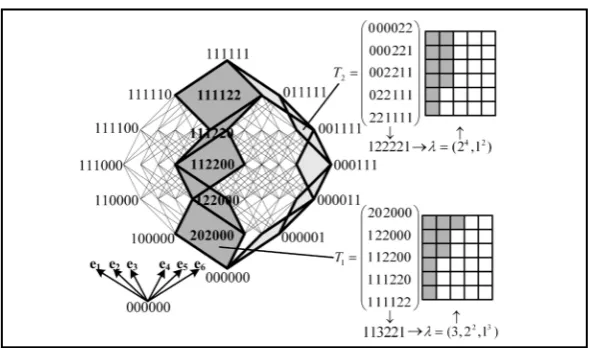
[image:4.595.165.460.524.698.2]One can give title of the procedure as pressing characters “2” with single inversion 0 - 1. Examples of 2-paths in 6-cube is represented step by step below (Figure 1).
HH-distance may be taken in account constructing some k-paths (operation 6)). So 5 5× table
(
1, 2)
HH D Di j
ρ for T1 and T2 (2-paths in 6-cube) is following:
11
12
1 13
14
15
202000 122000 112200 111220 111122
D D
T D
D D
= =
,
21
22
2 23
24
25
000022 000221 002211 022111 221111
D D
T D
D D
= =
,
(
1 2)
21 22 23 24 25 1112
13
14
15
,
2 3 3 4 4
3 4 4 4 4
4 4 4 4 4
4 4 4 4 3
4 4 4 3 2
HH D Di j D D D D D
D
D
D
D
D
ρ
It follows: ρHH
(
T T1, 2)
=4 (Figure 1).To remark although our exposition is short, the most of operations for cubants are realized digitwise, i.e. in parallel. It’s clearly visible, if we’ll use for computer the bitwise mapping∅ →00, 0→01, 1→10, 2→11.
4. Conclusions
In conclusion, we give the main statement of the article.
Minimal number s of k-faces in k-path between a.p. vertices in n-cube is equal to n k− +1. The bounds for number of non-isomorphic k-path classes are min
{
k n, −k}
≤K k n( )
, ≤#λ(
n− +k 1, ,n k n(
− +k 1)
)
, where λ are partitions integer k n k(
− +1)
in n parts with constraint n k− +1 for maximal part. Lower bound k is always realized by staircase matrix.References
[1] Mollard, M. and Ramras, M. (2013) Edge Decompositions of Hypercubes by Paths and by Cycles. http://arxiv.org/pdf/1205.4161.pdf
[2] Mundici, D. (2012) Logic on the n-Cube. http://arxiv.org/pdf/1207.5717.pdf
[3] Leader, I. and Long, E. (2013) Long Geodesics in Subgraphs of the Cube. http://arxiv.org/pdf/1301.2195.pdf
[4] Erde, J. (2013) Decomposing the Cube into Paths. http://xxx.tau.ac.il/pdf/1310.6776.pdf
[5] Rota, G.-C. and Metropolis, N. (1978) Combinatorial Structure of the Faces of the n-Cube. SIAM Journal on Applied Mathematics, 35, 689-694. http://dx.doi.org/10.1137/0135057
[6] Stanley, R.P. (1999) Enumerative Combinatorics. Cambridge University Press, Cambridge. http://dx.doi.org/10.1017/CBO9780511609589
[7] Manin, Y.I. (1999) Classical Computing, Quantum Computing, and Shor’s Factoring Algorithm. http://arxiv.org/pdf/quant-ph/9903008.pdf
[8] Ryabov, G.G. (2009) On the Quaternary Coding of Cubic Structures. (in Russian) http://num-meth.srcc.msu.ru/zhurnal/tom_2009/pdf/v10r138.pdf