Munich Personal RePEc Archive
The vulnerability of enterprise and the
operating financial balance
Caruntu, Genu Alexandru and Romanescu, Marcel Laurentiu
University of Constantin Brancusi Targu Jiu, Romania
10 October 2008
Online at
https://mpra.ub.uni-muenchen.de/11237/
The vulnerability of enterprise and the operating financial balance
Căruntu Genu Alexandru Romanescu Marcel Laurenţiu
Abstract
In the light of functional analysis, the company is vulnerable if used, for the most time part, to financing through bank loans in the short term. This item is highlighted by the study compared of variation of the operating revolving fund, with the variation of revolving fund need.
In the frame of operating balance, it believes that the need for floating capital is the most important indicator whereas place in the record those cyclical needs not covered financial from temporary resources and permanent renewable in the same cycles of operation. Achieving this balance is put into evidence of the 4 levels of functional balance, namely: working capital fund (FRF) or stable level of funding, the need for capital funds for operating (NFRE), on the one hand and the need to revolving fund outside exploitation (NFRAE) on the other hand, and the level of treasury securities.
Keywords: liquidity, accounting net, treasury, imbalance, balance
The appreciation of the situation in terms of an undertaking requires confronting the financial balance between revenue and expenditure provisions, which can be achieved in the preparation of a budget of treasury. Develop such a budget assumes the access to information which allow the establishment and operation of a mechanism for managing estimate consistently. To the extent that financial analysts do not have the data necessary for a direct confrontation between provision revenues and expenditures, shall be an indirect confrontation permitted by the study of the balance sheet.
Comparison between the liquidity of assets and liabilities chargeability is the traditional analysis in solvency, from the balance sheet. Maintaining solvency is subject to synchronize the rapid pace of revenue funds, related to currency conversion of assets maturing and the rapid pace/rhythm of payments reasons, related to the liquidation of debts falling due.
Maintaining financial balance is a permanent objective of the financial policy and can be considered achieved when the financial year ends in positive treasury.
This basic indication of the financial balance means not to achieve the objective of full financial equilibrium because it occurs some questions whose answers may question/doubt the initial conclusion, such as:
• to what extent in the financial policy were considered opportunity costs?
• what limits of the treasury considers it positive that has been achieved financial equilibrium? (it is known that an over positive treasury can be regarded as a financial imbalance).
In conclusion it must be stressed that:
• financial equilibrium is a basic condition for conducting a profitable activity; • striking a financial balance is a "perpetuum mobile" for financial policy; • the financial balance is achieved by adjusting a long series of disturbances that are manifested in the current activity of the company.
The appreciation of financial balance can be achieved, mainly on account of these following elements :
• accounting net assets (the net situation, net patrimony); • revolving fund;
• the need for floating capital; • treasury.
The balance between the revolving fund and capital needs of the revolving fund represents short-term financial balance.
Commitments to be taken in the calculation of solvency are:
- repayment of interest on debts previously underwritten and come forward;
- costs which makes the continuity of business and originating either from a legal obligation previously contracted, or from an economic imperative;
-compulsory levies in tax or social.
The category of sustainable resources from functional balance is important in terms of ensuring stable balance of the company.
At first glance it may believe it is the "minimum financial balance" of liquidity-maturity analysis.
The notion of "stable equilibrium" of the concept is a different category because the stable uses category includes a part of the need for floating capital.
Being equivalent of a fixed asset, the need for floating capital should be financed from sustainable resources, and more specifically from working capital fund which is equivalent to "stable funding of NFR (FRNG positive).
Not constant, this indicator (NFR) vary during the financial year and could gather either cash surplus that appear temporarily in the form of treasury securities-active, or a failure of the treasury, which will be covered from bank loans in the short term.
This situation reveals the financial vulnerability of the enterprise and treasury
Operational balance sheet
NFR> 0 NFR< 0
TN= Res. FRNG< 0
TN= Nevoi TN= Res. FRNG> 0
TN= Res. TN= Nevoi
FRNG< 0
[image:4.612.74.551.81.359.2]TN= Nevoi FRNG> 0
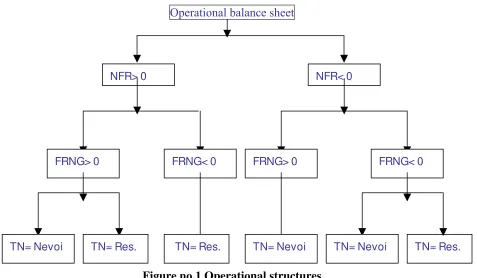
Figure no.1 Operational structures
Detailing the six categories of functional structures, we will highlight the various ways of achieving financial balance :
1. Needs of the revolving fund are financed entirely from stable resources set ( positive floating capital) or partly from the stable resources and cycle resources, whose total value allows the release of a positive net cash;
2. Stable and cyclical resources finance partially the needs of the revolving fund, the difference being covered by loans from the treasury. But NFR is a constant need to be funded, in this case, the treasury resources, resources that will acquire a stable, structural character, if the plant fails to reconstitute FR and / or to limit NFR. In this situation must be evaluated importance of the current credit risk. As has been pointed out, this situation can be valid if the company continues to benefit from the resources of treasury from its financial partners (which is dependent);
3. Banks' current resources but also the resources in the revolving fund, fund a part of fixed assets, the needs of floating capital and cash. The situation of full funding of floating capital needs from the treasury loans is critical, if not has an occasional character, and requires reconsideration of financial structure;
4. Resources induced by cycle operation add to extra resources standing (FR positive), in order to finance the needs of cyclical and emit a significant surplus of liquidity; 5. Resources to fund capital partially cover fixed assets (FR negative), the needs of floating capital and generating a net positive treasury. In this case, suppliers and advances from customers funding cycle and production of a fixed, it is necessary to review and strengthen sustainable resources;
External financial dependence of the company is large, the structure of financing should be reviewed.
It is interesting to present several scenarios that lead to functional degradation balance conduct to enterprise vulnerability :
1. Increase very fast and uncontrolled of turnover. The enterprise knows a growing need for a revolving fund parallel with the turnover. The fund capital increase more slowly than the need for floating capital, automatically generating a crisis of the treasury.
2. Insufficient growth of turnover. Over several years, the benefit of a treasury is satisfactory. As a reaction to increasing lack of turnover, the company supports new regulatory requirements to its customers, resulting in increasing its claims. This entails a sudden increase in the need for floating capital, which degrades the treasury's situation.
3. Delayed execution of investments. Although the company benefits from a balanced financial structure, does not promote a political investment to maintain the rate of growth. Due the development of poor turnover, she decides to recover the delays in the level of investment. Will take place, on that occasion, a decrease in gross working capital fund which will involve a net negative treasury
4. The paradox of reducing activity. Turnover falls on a regular basis. Decreased turnover rises to a decrease in claims of exploitation and sometimes even stocks, thereby reducing the need for floating capital. Will result a temporary improvement of the treasury. But the decrease of results quickly leads to a reduction in working capital fund, which is materialized, also in a negative net treasury.
5. Accumulating losses. Accumulated losses of more exercises diminishes the regular functioning of the revolving fund, conduct to a net negative treasury.
In the light of working, achieving financial balance of the enterprise not only assume the existence of a revolving fund as a positive safety margin, but a coating of the revolving fund for the financing needs of the cycle of exploitation (stocks + claims of exploitation – debts of exploitation).
The surplus of resources development in relation to the fixed fund represents working capital or fund net overall capital (FRNG), available for financing operations cycle of exploitation.
References:
1. Bătrâncea M. - „Financial monetary analysis”, Ph.Dacia, Cluj-Napoca, 2000;
2. Bistriceanu Gh. Andochiţei M., Negrea E. - Company finance, Ph. Didactică şi Pedagogică R.A. Buharest 2001
3. Cărunt C., Căruntu G., Tănăsoiu G., Financial Management. Theory and applications. Ph. Academica Brâncuşi, Tg-Jiu, 2003;
4. Căruntu C., Lăpăduşi L.,Căruntu G., - Economic-financial analysis to micro-economic level , Ph. Universitaria, Craiova, 2005;
5. Popescu V. L., Tănăsoiu G. L., Căruntu G. A., - Administration and financial management of the enterprise, Ph. Sitech, Craiova, 2006;
6. Popescu V. L., Tănăsoiu G. L., Căruntu G. A., - Administration and financial management of the enterprise – synthesis, practical applications -, Ph. Sitech, Craiova, 2006;