http://dx.doi.org/10.4236/ijcns.2014.71003
Asynchronous Secret Reconstruction and Its Application
to the Threshold Cryptography
Lein Harn1, Changlu Lin2* 1
Department of Computer Science Electrical Engineering, University of Missouri-Kansas City, Kansas City, USA 2
School of Mathematics and Computer Sciences, Fujian Normal University, Fuzhou, China Email: *[email protected]
Received October 26, 2013; revised November 26, 2013; accepted December 3, 2013
Copyright © 2014 Lein Harn, Changlu Lin. This is an open access article distributed under the Creative Commons Attribution Li- cense, which permits unrestricted use, distribution, and reproduction in any medium, provided the original work is properly cited. In accordance of the Creative Commons Attribution License all Copyrights © 2014 are reserved for SCIRP and the owner of the intel- lectual property Lein Harn, Changlu Lin. All Copyright © 2014 are guarded by law and by SCIRP as a guardian.
ABSTRACT
In Shamir’s
( )
t n, threshold of the secret sharing scheme, a secret s is divided into n shares by a dealer andis shared among n shareholders in such a way that (a) the secret can be reconstructed when there are t or more than t shares; and (b) the secret cannot be obtained when there are fewer than t shares. In the secret
reconstruction, participating users can be either legitimate shareholders or attackers. Shamir’s scheme only con- siders the situation when all participating users are legitimate shareholders. In this paper, we show that when there are more than t users participating and shares are released asynchronously in the secret reconstruction, an attacker can always release his share last. In such a way, after knowing t valid shares of legitimate share- holders, the attacker can obtain the secret and therefore, can successfully impersonate to be a legitimate share- holder without being detected. We propose a simple modification of Shamir’s scheme to fix this security problem. Threshold cryptography is a research of group-oriented applications based on the secret sharing scheme. We show that a similar security problem also exists in threshold cryptographic applications. We propose a modified scheme to fix this security problem as well.
KEYWORDS
Shamir’s
( )
t n, Secret Sharing Scheme; Secret Reconstruction; Threshold Cryptography; Threshold Decryption; Asynchronous Networks1. Introduction
Secret sharing schemes (SSs) were first introduced by both Blakley [1] and Shamir [2] separately in 1979 as a solution for safeguarding cryptographic keys and have been studied extensively in the literature. SS has become one of the most basic tools in cryptographic research. In Shamir’s
( )
t n, SS, a secret, ,s is divided into nshares by a dealer and shares are sent to shareholders secretly. The security requirements of a
( )
t n, SS satis- fy that (a) the secret can be reconstructed when there aret or more than t shares; and (b) the secret cannot be obtained when there are fewer than t shares. Shamir’s
( )
t n, SS is based on the linear polynomial and is un-conditionally secure. There are other types of SS. For example, Blakely’s scheme [1] is based on the geometry, Mignotte’s scheme [3] and Asmuth-Bloom’s scheme [4] are based on the Chinese Remainder Theorem (CRT).
In the secret reconstruction, participating users can be either legitimate shareholders or attackers. Shamir’s scheme only considers the situation when all participat- ing users are legitimate shareholders. When there are more than t users participating and shares are released asynchronously in the secret reconstruction, an attacker can always release his share last. In such a way, after knowing
t valid shares, the attacker can obtain the secret and therefore, can successfully impersonate to be legitimate shareholder without being detected. One simple way to overcome this security problem is to authenticate every
participating user to be a legitimate sharesholder before reconstructing the secret. Since all user authentication schemes are one-to-one type of interactions between one
prover and one verifier, this approach may slow down
the secret reconstruction significantly especially when there are a large number of users who participated in the process.
In this paper, we propose a simple modification of Shamir’s scheme to fix the security problem in the secret reconstruction. Our solution does not use any user au- thentication. The secret can be reconstructed successfully only when all participating users are legitimate share- holders and release their shares honestly. If there are any attackers among participating users, the secret cannot be reconstructed by users since the attacker does not own any valid share. Furthermore, the attacker cannot obtain the secret from partially released valid shares of legiti- mate shareholders.
In Shamir’s
( )
t n, SS, every share can only be used for one time to recover the secret. This is because once the secret has been recovered, then all shares are released and the secret is no longer secret. Therefore, the( )
t n, SS is not very efficient. To improve its efficiency, the( )
t n, SS has been incorporated with public-key crypto- graphy in the threshold cryptography. The group-oriented threshold cryptosystem was first introduced by Desmedt [5] in 1987. In such a system, each group, instead of each individual group member, publishes a single group pub- lic key. The corresponding private key of the group’s public key is divided into n shares and is shared among ngroup members following a
( )
t n, SS [1-4], where t is a predefined threshold value. Threshold cryptography is the study of efficient multiparty computation protocols for cryptographic functions (e.g. signing or decrypting), in which each group member has a share of the private key which allows the computation of such function. Threshold cryptography utilizes some computational as- sumptions, such as factoring a composite integer or solv- ing the discrete logarithm, to enable shares of group members to be reused for multiple times. Similar to the( )
t n, SS, participating users in a threshold crypto- graphic application can be either legitimate group mem- bers or attackers. All threshold cryptographic applica- tions only consider the situation when all participating users are legitimate group members. When there are more than t users participating and values of users are released asynchronously in a threshold application, an attacker can always release his computed values last. In such a way, after knowing t valid values of legitimate group members, the attacker can obtain the valid output of the cryptographic function and therefore, can success- fully impersonate to be a legitimate group member with- out being detected. We also propose a modified scheme to fix this security problem.Related Works. The security of cryptographic sche-
mes/protocols can be classified into two types, computa- tional security and unconditional security. Computational security assumes that the adversary has bounded compu- ting power that limits the adversary to solving hard ma- thematical problem, such as factoring a large composite integer into two primes. Unconditional security means that the security holds even if the adversary has un- bounded computing power. Research on developing cryptographic schemes/protocols with unconditional se- curity has received wide attention recently. Shamir’s
( )
t n, SS scheme is based on a linear polynomial and is unconditionally secure.Shamir’s
( )
t n, SS is very simple; but if the secret reconstruction is performed over networks, possible threats make the secret reconstruction very complicate. In fact, attackers who do not own valid shares may im- personate to be shareholders who participated in the se- cret reconstruction. In 1985, Chor et al. [6] proposed the notion of verifiable secret sharing (VSS). VSS enables shareholders to verify that their shares are valid without revealing their shares. There are vast research papers on VSS [6-8] in the literature. VSS is a complicate process which requires additional information and processing time.How the secret should be reconstructed fairly is another research problem. When all other participating shareholders honestly present their shares in the secret reconstruction process, a dishonest shareholder can al- ways exclusively get the secret by presenting a fake share and thus the others get nothing but a fake secret. Al-though protocols have been developed to detect fake shares [9-12], they do not prevent a dishonest sharehold- er from gaining this advantage. Even if the cheater is detected, this problem still persists as the cheater has already obtained the secret. The first protocol to solve this problem is proposed by Tompa et al. [10]. Most fair secret reconstruction proposals share one basic idea that utilizes a process where information is revealed slowly [13]. Chaum et al. [14], and Beaver et al. [15] considered the general problem of fair multiparty computation. Most of these works are based on a computational model, i.e., some computational assumptions are used like the exis- tence of an oblivious transfer protocol or the quadratic residuosity assumption. In 1995, Lin et al. [16] proposed the first fair secret reconstruction protocol in which the real secret can be reconstructed as a whole entity without simultaneously releasing constraint. Cheating immune SSs through which the cheaters gain no advantage over honest participants by submitting invalid shares, are proposed in [17,18]; but secret and shares are limited to be either binary or from GF p
( )
.to prevent attackers from obtaining the secret and shares are not protected in the secret reconstruction. Further- more, our proposed scheme cannot prevent a dishonest shareholder from presenting a fake share last in the secret reconstruction. In such a way, the dishonest shareholder can always exclusively get the secret but others get nothing but a fake secret. How the secret should be re- constructed fairly is a different research problem.
In a threshold signature scheme [19], when there are t
or more than t group members, a group signature can be generated successfully. The group signature can be veri-fied by any verifier using the group public key. On the other hand, in a threshold decryption scheme [20,21], any sender of a secret message can generate a cipher-text to the group using the group public key. When there are t or more than t group members, the group cipher-text can be decrypted successfully. All existing threshold crypto- graphic algorithms [19-26] only consider the situation when all participating users are legitimate group mem- bers. In this paper, we point out that when there are more than t participating users and computed valued are re- leased asynchronously in a threshold application, an at- tacker can obtain the valid output of the application and therefore, can impersonate to be a legitimate group mem- ber without being detected.
We summarize the contributions of this paper in the following.
• We point out a security problem in Shamir’s
( )
t n, SS when there are more than t participating users and shares are released asynchronously in the secret re- construction.• A modified
( )
t n, SS based on Shamir’s( )
t n, is proposed to fix the security problem.• We point out a similar security problem in all existing threshold algorithms when there are more than t par- ticipating users in threshold applications.
• A modified threshold decryption is proposed to fix the security problem.
The rest of this paper is organized as follows. In Section 2, we review Shamir’s
( )
t n, SS scheme and point out a security problem in Shamir’s( )
t n, SS. In Section 3, we present a modified SS to fix the security problem when there are more than t participating users and shares are released asynchronously in the secret re- construction. In Section 4, we point out the similar secu- rity problem and propose a solution to fix the security problem of a threshold decryption scheme. We conclude in Section 5.2. Review of Shamir’s (t, n) SS [2]
In Shamir’s (t, n) SS based on a linear polynomial, the dealer D is responsible to select a secret and generate shares of the secret to n shareholders,
{
1, 2, , n}
.U = U U U The scheme consists of two algo-
rithms as illustrated in Figure 1.
Shamir’s SS satisfies security requirements of the (t, n) SS, that are, (a) the secret can be reconstructed with t or more than t shares; and (b) no information about the se- cret can be obtained with fewer than t shares. In other words, if there are exactly t legitimate shareholders parti- cipated in the secret reconstruction, Shamir’s scheme can recover the secret. Shamir’s secret reconstruction scheme can be generalized to take more than t shares. For exam- ple, if there are j (i.e., t≤ ≤j n) participated sharehold- ers with their shares,
{
f x( ) ( )
1 ,f x2 ,,f x( )
j}
, in thesecret reconstruction, the secret can be recovered as fol- lows.
( )
( )
1 1,
0 mod .
j j
v r
r v v r r v
x
s f f x p
x x
= = ≠
−
= =
−
∑
∏
During secret reconstruction, participated users can be either legitimate shareholders or attackers. Shamir’s scheme only considers the situation when all participated users are legitimate shareholders. When there are more than t users participated in the secret reconstruction and shares are released asynchronously, an attacker can al- ways release his share last. After knowing t valid shares of legitimate shareholders, since the secret polynomial,
( )
,f x having degree t−1, the attacker can reconstruct the secret. Furthermore, the attacker can successfully forge a valid share on the polynomial, f x
( )
, without being detected. Thus, Shamir’s (t, n) SS is no longer se- cure if there are more than t users participated in the se- cret reconstruction.3. Proposed (t, n) Secret Sharing Scheme
In this section, we propose a (t, n) SS to fix the security problem of Shamir’s (t, n) SS when there are more than t
participated users and shares are released asynchronously
Share generation
Dealer D picks a random polynomial f(x) of degree t−1:
( ) 1
0 1 1 mod ,
t t
f x =a +a x+ + a x− − p such that the secret is
( )0 0,
s=f =a and coefficients, a ii, =0,1,,t−1, are in ( ),
GF p with p > s and p is a prime. D computes n shares,
( ), 1, 2, , ,
r r
y =f x r= n where xr is the public information
associated with shareholder, Ur. Then, the dealer distributes each share, yr, to corresponding shareholder Ur secretly.
Secret reconstruction
Assume that t shareholders, {U U1, 2,,Ut}, work jointly to
recover the secret, s. Shareholders release their shares and use the Lagrange interpolating formula,
( ) ( )
1 1,
0 mod ,
t t
v l
l v v l l v
x
s f f x p
x x
= = ≠
−
= =
−
∑
∏
to recover the secret.in the secret reconstruction. The outcome of our pro- posed secret reconstruction is either (a) the secret if all participated users are legitimate shareholders; or (b) not the secret if there are attackers. The basic idea is that the dealer in Shamir’s (t, n) SS scheme selects k (i.e.,
1,
kt> −n for example, if t=2, n=5, then k=3.
We will prove this condition in Theorem 1) random po- lynomials, fl
( )
x l, =1, 2,,k, having degree t−1 each, and generates shares, fl( )
xr ,l=1, 2,,k, for each shareholder, Ur, where xr is the public informa-tion of shareholder, Ur. For the secret, s, the dealer can always find integers, w d ll, l, =1, 2,, ,k in GF(p), such that
( )
1
,
k
l l l l
s d f w
=
=
∑
where wi ≠wj, for every pair of i and j, and wi∉{
x x1, 2,,xn}
. The dealermakes these integers, w d ll, l, =1, 2,, ,k publicly known.
We assume that there are j (i.e., t≤ ≤j n) partici- pated shareholders,
{
U U1, 2,,Uj}
, in the secret re-construction. Each shareholder Ur uses his shares,
( )
, 1, 2, , ,l r
f x l= k to compute and release one La-
grange component,
( )
1 1,
mod ,
j k
l v r l l r
l v v r r v
w x
c d f x p
x x
= = ≠
− =
−
∑
∏
to other participants. After knowing c rr, =1, 2,, ,j each shareholder can recover the secret as
1
mod .
j r r
s c p
=
[image:4.595.314.531.175.246.2]=
∑
We outline this scheme, Scheme 1, inFigure 2.
Share generation
The dealer D selects k (i.e., kt> −v 1) random polynomials,
( ), 1, 2, ,
l
f x l= k , having degree t−1 each and generates
shares, f xl( )r ,l=1, 2,,k, for each shareholder, Ur, where i
x is the public information for shareholder, Ui. For the secret,
s, the dealer can always find integers, w d ll, l, =1, 2,, ,k in
GF(p), such that ( )
1
,
k
l l l
l
s d f w
=
=
∑
where wi≠wj for everypair of i and j, and wi∉{x x1, 2,,xn}. The dealer makes
these integers, w d ll, l, =1, 2,, ,k publicly known. The dealer generates shares, f xl( )r ,l=1, 2,, ,k of shareholder, Ur. Secret reconstruction
We assume that there are j (i.e., t≤ ≤j n) shareholders,
{
U U1, 2,,Uj}
, participated in the secret reconstruction. 1) Each shareholder Ur uses his shares, f xl( )r ,l=1, 2,, ,kto compute and release one Lagrange component,
( ) 1 1,
mod ,
j k
l v
r l l r
l v v r r v
w x
c d f x p
x x
= = ≠
− =
−
∑
∏
to other shareholders secre- tly.2) After knowing c rr, =1, 2,, ,j each shareholder computes
1
mod .
j r r
s c p
= =
∑
Figure 2. Scheme 1—Proposed (t, n) SS.
Theorem 1.The outcome of Scheme 1 is either (a) the secret when all participated users are legitimate share- holders; or (b) not the secret when there are attackers.
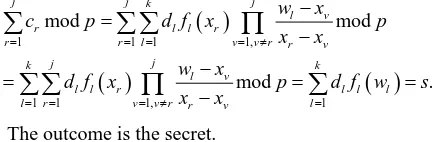
Proof. In Scheme 1, if all participated users are legiti-
mate shareholders and act honestly to compute their La- grange components, cr, in Step 1, then in Step 2, we get
( )
( )
( )
1 1 1 1,
1 1 1, 1
mod mod
mod .
j
j j k
l v
r l l r
r r l v v r r v j
j
k k
l v
l l r l l l
l r v v r r v l
w x
c p d f x p
x x
w x
d f x p d f w s
x x
= = = = ≠
= = = ≠ =
− =
− −
= = =
−
∑
∑∑
∏
∑∑
∏
∑
The outcome is the secret.
On the other hand, if there are attackers in the secret reconstruction, since attackers do not know any valid shares, the outcome of Scheme 1 is not the secret.
In the following discussion, we want to determine whether attackers can still recover the secret from par- tially released Lagrange components, cr, of legitimate shareholders. We analyze the security of the scenario which gives an attacker the most information to recover the secret. We assume that there are n users participated in the secret reconstruction and among them, there are
1
n− legitimate shareholders and the attacker is the last one to release his Lagrange component. Since each re- leased Lagrange component is a linear function of kt
coefficients of polynomials, fl
( )
x l, =1, 2,, ,k having degree t−1, the attacker can obtain n−1 Lagrange components to form n−1 equations. The condition,1
kt> −n (i.e., kt is the number of unknown coefficients of polynomials, fl
( )
x l, =1, 2,, ,k having degree1
t− each), prevents the attacker solving the secret po- lynomials, fl
( )
x l, =1, 2,, .k Thus, the attacker can- not recover the secret in Scheme 1. We have come to this conclusion without making any computational assump- tion. Thus, the proposed scheme is unconditionally se- cure.■Remark 1.For the secret, s, the dealer needs to select
,
i j
w ≠w for every pair of i and j and the secret is
( )
1
.
k
l l l l
s d f w
=
=
∑
If w=wi =wj, for every pair of i andj, the attacker can still recover the secret after knowing t
partially released Lagrange components, cr, of legiti-
mate shareholders. This is because in this case, the se-
cret,
( )
1
,
k l l l
s d f w
=
=
∑
is a share of the additive sum ofpolynomials,
( )
1
,
k l l l
d f x
=
∑
having degree t−1. Eachparticipated shareholder, U needs to use his shares to i
compute and release the Lagrange component,
( )
1 1,
mod .
j k
v
r l l r
l v v r r v
w x
c d f x p
x x
= = ≠
−
=
−
recover the additive sum of shares,
( )
1
,
k
l l r l
d f x
=
∑
fromeach released Lagrange component ci. Thus, after
knowing t additive sum of shares, the attacker can re-
cover secret as,
( )
( )
1 1, 1 mod mod . t k v l l rl v v r r v k
l l l
w x
d f x p
x x
d f w p s
= = ≠ = − − = =
∑
∏
∑
4. Proposed Threshold Decryption Scheme
In this section, we present two
( )
t n, threshold decryp- tion schemes; one is a basic scheme and the other one is a modified scheme, in which the security of both schemes is based on the computational difficulty of solving the discrete logarithm problem. We use the basic scheme to point the security problem when there are more than t users participated in a threshold application. The threshold decryption scheme is one of the group- oriented threshold cryptographic algorithms. In this ap- plication, a group manager (GM), instead of each indi- vidual group member, publishes a single group public key. The corresponding private key of the group’s public key is divided into n shares and is shared among n group members. Then, any t or more than t group members can enable a threshold application.4.1. Basic Scheme
We assume that there are n members, Ui, for
1, 2, , ,
i= n forming a group.
Initialization
The GM selects two large public primes, p and q, such that q divides p−1, GF q
( )
is a unique sub- group of GF p( )
with order q, and one public gene- rator, g, from GF q( )
. GM selects a private key,( )
,s∈GF q and computes the public key of the group, mod .
s
y=g p GM acts like a dealer in Shamir’s
( )
t n, SS to select a random polynomial f x( )
of degree1
t− :
( )
10 1 1 mod ,
t
i t
f x =a +a x+ + a x− − q such that
the private key is s= f
( )
0 =a0, and all coefficients,,
i
a for i=0,1,,t−1, are in GF q
( )
with q>s.GM computes n shares, f x
( )
r ,r=1, 2,, ,n wherer
x is the public information associated with group member Ur. Each share, f x
( )
r , is sent to groupmember, Ur, secretly.
Generation of a cipher-text
We adopt the ElGamal’s encryption scheme [27]. With access to the group public key, y, the sender can gen- erate a cipher-text,
(
c c1, 2)
, of message m by computing1 mod , k
c =g p where k is a random integer in
( )
,GF q and c2 = ⋅m Kmod ,p where mod . k
K =y p
The sender sends the cipher-text,
(
c c1, 2)
, to the group.Decryption of a cipher-text
Let us assume that j (i.e., t≤ ≤j n) group members,
{
U U1, 2,,Uj}
, work together to decrypt a cipher-text.Each group member, Ui, uses his private share,
( )
i ,f x to compute a partial session key,
( ) 1,
mod
1 mod .
j r i
i r r r i
x
f x q
x x i
s c = ≠ p
− −
∏
= The value, ,si is sent to
other group members participated in the decryption. Af- ter collecting all partial session keys, the session key,
,
K can be computed as
( ) 1 1, mod 1 mod . j j r i i r i r r i
x
k f x q
j
x x ks k
i r
K s g = = ≠ g y p
− − = ∑ ∏ =
∏
= = =Each participated group member can decrypt the cipher- text as m c2 K 1mod .p
− = ⋅
Security discussion
In a practical application, participated users in a thre- shold decryption can be either legitimate group members or attackers. We assume that an attacker has collected t
valid partial session keys,
( ) 1,
mod
1 mod , 1, 2, , ,
j r i
i r r r i
x
f x q
x x i
s c = ≠ p i t
− −
∏
= =
of legitimate group members. Then, the attacker can compute
( ) 1 1, 1, 1, mod mod
1 mod ,
1, 2, , .
j t r r i r i r r r i r r i
t r i
i r r r i
x x
q
x x x x
i i
x
f x q
x x s s c p i t − = ≠ = ≠ = ≠ − − − − − − ∏ ∏ ∏ ′ = = =
The real session key, K, can be obtained by computing
( ) 1 1, mod 1 mod . t t r i i r i r r i
x
k f x q
t
x x ks k
i i
K s g = = ≠ g y p
− − = ∑ ∏ ′ =
∏
= = =Thus, the attacker can decrypt the cipher-text as
1 2 mod .
m= ⋅c K− p Furthermore, the attacker can suc- cessfully forge a valid partial session key of other legiti- mate group member, say Ut+1, as
( )
( ) 1
1
1, 1, 1, 1
1 mod
1 1, 1, 1
1 1, 1 mod 1 mod 1 1 mod ,
j t j t r
r r
i r i r i r r r i r r i r r t
j t
t xt xr xr k f xi x x x x q
i r i r i r r i r r t
j r t
i r r r t
x x
x x
q t
x x x x x x i
i
x
f x q
x x t s g c p s − + = ≠ = ≠ = ≠ + +− − ∑ ∏ ∏ = = ≠ − = ≠ + − + = ≠ + − − − − − − = − − + ∏ ∏ ∏ ∏ = = =
∏
without being detected in this process. The security problem of this basic scheme is caused by the fact that the modular exponentiation of each share, 1( )mod ,
i
f x
c p
any t modular exponentiations of shares, the attacker can successfully recover the modular exponentiation of the constant term of the polynomial and to recover the session key, K. In the following subsection, we pro- pose a simple modification to fix this security problem.
4.2. Modified Scheme
Initialization
GM selects two large public primes, p and q, such that q divides p−1, GF q
( )
is a unique subgroup of( )
GF p with order q, and one public generator, g,
from GF q
( )
. GM selects a private key, s∈GF q( )
, and computes the public key of the group,mod .
s
y=g p GM acts like a dealer in Shamir’s
( )
t n, SS to select two random polynomials, f x( )
and( )
,g x having degree t−1 each:
( )
10 1 1 mod
t t
f x =a +a x+ + a x− − q and
( )
10 1 1 mod ,
t t
g x =b +b x+ + b x− − q such that the pri-
vate key, ,s is divided into s= +a bmod ,q with
( )
0 0 ,f =a =a and g
( )
1 =b, all coefficients, ai and ib for i=0,1,,t−1, are in GF q
( )
, with q>a b, . GM computes a pair of shares, f x( )
i and g x( )
i , foreach shareholder, Ui, where xr is the public informa-
tion associated with Ur. Each pair of shares, f x
( )
iand g x
( )
i , is sent to group member, Ui, secretly.Generation of a cipher-text
This part of process is the same as the basic scheme. A group cipher-text,
(
c c1, 2)
, of message m is generatedby computing 1 mod k
c =g p and c2 = ⋅m Kmod ,p
where k is a random integer from GF q
( )
and mod .k
K =y p The sender sends the cipher-text,
(
c c1, 2)
, to the group.Decryption of cipher-text
Let us assume that j (i.e., t≤ ≤j n) group members,
{
U U1, 2,,Uj}
, work together to decrypt the cipher-text. Each group member, Ui, uses his pair of private shares, f x
( )
i and g x( )
i , to compute a partial ses-sion key,
( ) ( )
1, 1,
1 mod
1 mod .
j j r r i i
i r i r r r i r r i
x x
f x g x q
x x x x
i
s c = ≠ = ≠ p
− + −
− −
∏ ∏
= The
value si is sent to other participated shareholders. After
collecting all partial session keys from other group members, the member can decrypt the cipher-text as
1 2 mod .
m= ⋅c K− p We outline this scheme, Scheme 2, in Figure 3.
Theorem 2.In Scheme 2, if all participated users are
legitimate group members and act honestly, the cipher-
text,
(
c c1, 2)
, of the message m can be decrypted suc-cessfully.
Proof. If all group members act honestly, the real ses-
sion key, K, can be obtained as
( ) ( )
( ) ( )
( )
1 1, 1 1,
1 mod
1
0 1
mod .
j j
j j
r r
i i
i r i r i r r i i r r i
x x
k f x g x q
j
x x x x i
r
k f g ks k
s g
g g y p K
= = ≠ = = ≠
− −
+
− −
=
+
∑ ∏ ∑ ∏
=
= = = =
∏
Initialization
GM selects two large public primes, p and q, such that q divides p−1, GF q( ) is a unique subgroup of GF p( ) with order q, and one public generator, g, from GF q( ). GM selects a private key, s∈GF q( ), and computes the public key of the group, smod .
y=g p GM selects two random polynomials, f x( ) and g x( ), having degree t−1 each:
( ) 1
0 1 1 mod
t t
f x =a +a x+ + a x− − q and
( ) 1
0 1 1 mod ,
t t
g x = +b b x+ + b x− − q such that the private key s
is divided into s= +a bmod ,q with f( )0 =a0=a, and
( )1 ,
g =b all coefficients, ai and bi for i=0,1,,t−1, are
in GF q( ) with q>a b, . GM computes shares, f x( )i and ( )i ,
g x for each shareholder, Ui, where xr is the public
information associated with Ur.
Generation of cipher-text
A group cipher-text, (c c1, 2), of message m is generated by
computing 1 mod
k
c =g p and c2= ⋅m Kmod ,p where k is
a random integer from GF q( ) and kmod .
K=y p He sender sends the cipher-text, (c c1, 2), to the group.
Cipher-text decryption
Let us assume that j (i.e., t≤ ≤j n ) group members,
{
U U1, 2,,Uj}
, work together to decrypt the cipher-text.1) Each group member, Ui, uses his pair of private shares, ( )i
f x and g x( )i , to compute a partial session key,
( ) ( )
1, 1,
1 mod
1 mod .
j j
r r
i i
r r ii r r r ii r
x x f x g x q
xx xx i
s c = ≠ = ≠ p
− + −
− −
∏ ∏
= The value si is sent to other participated group members.
2) After collecting all partial session keys from other group members, the session key is computed as
1
mod . j
i i
K s p
=
=
∏
Each participated member can decrypt the cipher-text as
1 2 mod .
[image:6.595.315.534.99.510.2]m= ⋅c K− p
Figure 3. Scheme 2—Proposed (t, n) threshold decryption
scheme.
The session key can be used to recover the message as
1 2 mod .
m= ⋅c K− p■
Security discussion
In this modified scheme, the partial session key is
( ) ( )
1, 1,
1 mod
1 mod .
j j r r i i
i r i r r r i r r i
x x
f x g x q
x x x x
i
s c = ≠ = ≠ p
− + −
− −
∏ ∏
= Since the ex-
ponent of each partial session key is a linear combination of two shares, f x
( )
i and g x( )
i , attackers cannotseparate these two shares to obtain the modular exponen- tiation of each share. In other words, attackers need to collect all partial session keys to be able to decrypt the cipher-text of the group. Therefore, if there are attackers participated in the decryption, the cipher-text cannot be decrypted.
sion keys which are released from legitimate group members. There are 2t coefficients in polynomials,
( )
if x and g x
( )
i , having degree t−1 each. If an at- tacker can obtain v′ (i.e., v′ >2t) additive sum ofshares,
( )
( )
1, 1,
1
mod ,
j j
r r
i i
r r i i r r r i i r
x x
f x g x q
x x x x
= ≠ = ≠
− −
+
− −
∏
∏
from released partial session keys, the attacker is able to solve both polynomials, f x
( )
and g x( )
. However, this attack is computational infeasible due to the diffi- culty of solving the discrete logarithm problem.Remark 3. For any secret, s, the dealer needs to select
two different points on the polynomials, f x and
( )
( )
,g x for example, f
( )
0 and g( )
1 . If two points are the same such as s= + =a b f( ) ( )
0 +g 0 , the se-cret, ,s is a share of the additive sum of polynomials,
( ) ( )
,f x +g x having degree t−1. Thepartial session
key of U is i
( ) ( )
( )
1,
mod
1 mod .
j r i i
i r r r i
x
f x g x q
x x i
s c = ≠ p
− +
−
∏
= If one
attacker has obtained t partial session keys,
( ) ( )
( )
1,
mod
1 mod , 1, 2, , ,
j r i i
i r r r i
x
f x g x q
x x i
s c = ≠ p i t
− +
−
∏
= = of legi-
timate group members, the attacker can compute
( ) ( )
( )
1
1, 1,
1,
mod
mod
1 mod , 1, 2, , .
j t r r i r i r r r i r r i
t r i i
i r r r i
x x
q
x x x x
i i
x
f x g x q
x x
s s
c p i t
−
= ≠ = ≠
= ≠
− −
− −
− +
−
∏ ∏
∏
′ =
= =
Therefore, the session key, K, can be obtained by
computing
( ) ( )
( )
1 1,
mod
1
mod .
t t
r i i
i r i r r i
x
k f x g x q
t
x x i
i
ks k
s g
g y p K
= = ≠
−
+
−
=
∑ ∏
′ =
= = =
∏
5. Conclusion
We pointed out security problems of a (t, n) SS and a threshold algorithm. The security problems occurred when there are more than t participated users and shares/ values that are released asynchronously in the secret re-construction/threshold application. Since all existing net- works are asynchronous networks and we cannot exclude the probability that with more than t users participating in a secret reconstruction/threshold application, our paper has made significant contributions to addressing the se- curity problems and proposing solutions. We believe that we have opened a new research direction in both the se- cret sharing and the threshold cryptography.
Acknowledgements
This research is supported by the National Natural Scien- ce Foundations of China under Grant No. 61103247.
REFERENCES
[1] G. R. Blakley, “Safeguarding Cryptographic Keys,” Pro- ceedings of Americian Federation of Information Pro-
cessing Societies (AFIPS’79) National Computer Confe-
rence, 25-28 February 1979, California, pp. 313-317.
[2] A. Shamir, “How to Share a Secret,” Academic Common
Market, Vol. 22, No. 11, 1979, pp. 612-613.
http://dx.doi.org/10.1145/359168.359176
[3] M. Mignotte, “How to Share a Secret,” Cryptography-
Proceedings of the Workshop on Cryptography, Burg
Feuerstein, 29 March-2 April 1982, pp. 371-375.
[4] C. A. Asmuth and J. Bloom, “A Modular Approach to Key Safeguarding,” IEEE Transactions on Information
Theory, Vol. IT-29, No. 2, 1983, pp. 208-210.
http://dx.doi.org/10.1109/TIT.1983.1056651
[5] Y. Desmedtm, “Society and Group Oriented Cryptogra- phy: An New Concept,”Advances in Cryptography—7th
Annual International Cryptology Conference (CRYPTO ’87),
Santa Barbara, 16-20 August 1987, pp. 120-127.
[6] B. Chor, S. Goldwasser, S. Micali and B. Awerbuch, “Ver- ifiable Secret Sharing and Achieving Simultaneity in the Presence of Faults,” Proceedings of the 26th IEEE Sym-
posium on the Foundations of Computer Science, Port-
land, 21-23 October 1985, pp. 383-395.
[7] M. H. Dehkordi and S. Mashhad, “New Efficient and Practical Verifiable Multi-SSs,” Information Sciences, Vol. 178, No. 9, 2008, pp. 2262-2274.
http://dx.doi.org/10.1016/j.ins.2007.11.031
[8] J. C. Benaloh, “Secret Sharing Homomorphisms: Keeping Shares of a Secret Secret,” Advances in Cryptology—6th
Annual International Cryptology Conference (CRYPTO
‘86),Santa Barbara, 17-21 August 1987, pp. 251-260. [9] E. F. Brickle and D. R. Stinson, “The Detection of Chea-
ters in Threshold Schemes,” Advances in Cryptology—9th
Annual International Cryptology Conference (CRYPTO
‘88),Santa Barbara, 21-25 August 1988, pp. 564-577. [10] M. Tompa and H. Woll, “How to Share a Secret with
Cheaters,” Journal of Cryptology, Vol. 1, No. 3, 1988, pp. 133-138. http://dx.doi.org/10.1007/BF02252871
[11] T. Rabin and M. Ben-Or, “Verifiable Secret Sharing and Multiparty Protocols with Honest Majority,” Proceedings
of the 21st ACM Symposium on the Theory of Computing,
Seattle, Washington DC, 14-17 May 1989, pp. 73-85. [12] D. Chaum, C. Crepeau and I. Damgard, “Multipary Un-
conditionally Secure Protocols,” Proceedings of the 20th
ACM Symposium on the Theory of Computing, Chicago,
2-4 May 1988, pp. 11-19.
[13] J. He and E. Dawson, “Shared Secret Reconstruction,”
Designs, Codes and Cryptography, Vol. 14, No. 3, 1998,
pp. 221-237. http://dx.doi.org/10.1023/A:1008200702849
[14] D. Chaum, I. Damgard and J. van de Graaf, “Multiparty Computations Ensuring Privacy of Each Party’s Input and Correctness of the Result,” Advances in Cryptography—7th
Annual International Cryptology Conference (CRYPTO ’87),
Santa Barbara, 16-20 August 1987, pp. 87-119.
Symposium on the Foundations of Computer Science,
Research Triangle Park, North Carolina, 30 October-1
November 1989, pp. 468-473.
[16] H. Y. Lin and L. Harn, “Fair Reconstruction of a Secret,”
Information Processing Letters,Vol. 55, No. 1, 1995, pp.
45-47. http://dx.doi.org/10.1016/0020-0190(95)00045-E
[17] J. Pieprzyk and X.-M. Zhang, “Cheating Prevention in Secret Sharing over GF(pt),” Progress in Cryptology—
2nd International Conference on Cryptology, Chennai,
16-20 December 2001, pp. 79-90.
[18] J. Pieprzyk and X.-M. Zhang, “On Cheating Immune Secret Sharing,” Discrete Mathematics and Theoretical
Computer Science, Vol. 6, No. 2, 2004, pp. 253-264.
[19] L. Harn, “Group-Oriented (t, n) Threshold Digital Signa- ture Scheme and Digital Multisignature,” IEE Proceed-
ings—Computers and Digital Techniques, Vol. 141, No. 5,
1994, pp. 307-313.
http://dx.doi.org/10.1049/ip-cdt:19941293
[20] C. Delerablee and D. Pointcheval, “Dynamic Threshold Public-Key Encryption,” Advances in Cryptography—28th
Annual International Cryptology Conference (CRYPTO ’08),
Santa Barbara, 17-21 August 2008, pp. 317-334.
[21] R. Bendlin and I. Damgard, “Threshold Decryption and Zero-Knowledge Proofs for Lattice-Based Cryptosys- tems,” Proceedings of 7th Theory of Cryptography Con-
ference (TCC ‘10),Zurich, 9-11 February 2010, pp. 201-
218.
[22] L. Ertaul and W. Lu, “ECC Based Threshold Cryptogra-
phy for Secure Data Forwarding and Secure Key Ex- change in MANET (I),” Proceedings of the 4th IFIP-TC6
International Conference on Networking Technologies,
Services, and Protocols; Performance of Computer and
Communication Networks; Mobile and Wireless Commu-
nication Systems, Waterloo, 2-6 May 2005, pp. 102-113.
[23] Y. Desmedt, “Some Recent Research Aspects of Thresh- old Cryptography,” Proceedings of the 1st International
Workshop (ISW ‘97), Tatsunokuchi, 17-19 September
1997, pp. 158-173.
[24] Y. Desmedt, “Threshold Cryptosystems,” Proceedings of the Workshop on the Theory and Application of Crypto-
graphic Techniques (AUSCRYPT ‘92), Gold Coast, Queens-
land, 13-16 December 1992, pp. 1-14.
[25] M. Abdalla, S. Miner and C. Namprempre, “Forward- secure Threshold Signature Schemes,” Topics in Cryp-
tology—The Cryptographer’s Track at RSA Conference
(CT-RSA ‘01),San Francisco, 8-12 April 2001, pp. 441-
456.
[26] J. Baek and Y. Zheng, “Identity-Based Threshold Signa-ture Scheme from the Bilinear Pairings,” Proceedings of
the International Conference on Information Technology:
Coding and Computing (ITCC ‘04),Las Vegas, 5-7 April
2004, p. 124.
[27] T. A. ElGamal, “A Public-Key Cryptosystem and a Sig- nature Scheme Based on Discrete Logarithms,” IEEE
Transactions on Information Theory, Vol. 31, No. 4, 1985,
pp. 469-472.