Tool selection during foraging in two species of funnel ants
István Maák1, Gábor Lőrinczi1, Pauline Le Quinquis2, Gábor Módra1, Dalila Bovet3, Josep Call4, Patrizia d’Ettore2
1
Department of Ecology, University of Szeged, Közép fasor 52, H-6726 Szeged,
Hungary, [email protected]
2
Laboratory of Experimental and Comparative Ethology, University Paris 13 –
Sorbonne Paris Cité, France
3
Laboratoire Ethologie Cognition Développement, Université Paris Ouest Nanterre
La Défense, France
4
School of Psychology & Neuroscience, University of St Andrews, UK
Corresponding authors:
István Maák – Department of Ecology, University of Szeged, Közép fasor 52, H-6726
Szeged, Hungary, e-mail: [email protected], tel: +36-70-2793398
Patrizia d’Ettore – Laboratory of Experimental and Comparative Ethology, University
Paris 13, Sorbonne Paris Cité, 99 Avenue J.-B. Clément, 93430 Villentaneuse, France
e-mail: [email protected], tel: +33-1-49403196
Tool selection during foraging in two species of funnel ants
Highlights
• Some ant species use debris as tools to transport liquid food to the nest.
• When given the choice between different kinds of potential tools ants are selective.
• They show preference for materials with optimal handling and/or soaking properties.
• They can employ artificial materials novel to them, thus tool use is flexible in ants.
Tool selection during foraging in two species of funnel ants
1
ABSTRACT
2
Tool use by non-human animals has received much research attention in the last couple of 3
decades. Nonetheless, research has focused mostly on vertebrates, particularly primates and 4
corvids, even though tool use has also been documented in insects. One of the best-5
documented examples involves ants using debris (e.g., sand grains, mud, leaf fragments) to 6
collect and transport liquid food to their nest. However, little is known about the factors that 7
determine the selection of materials to be used as tool. We investigated tool selection in two 8
species of Aphaenogaster ants by giving them the choice between different kinds of potential 9
tools (natural and artificial objects). Ant workers showed a clear preference for certain 10
materials to be used as tool objects. Tool selection was also shaped by familiarity with the 11
material as ants developed a preference for artificial tools with a good soaking capacity that 12
cannot be found in their natural environment. Our results indicate that ants of this genus 13
evolved unique foraging strategies and show plasticity in their behaviour. 14
Keywords: ants, Aphaenogaster, foraging, food transport, tool use 15
*Non-highlighted revised manuscript
INTRODUCTION
16
Once considered unique to humans, tool use is now known to be widespread in the animal 17
kingdom (Bentley-Condit & Smith, 2010; Shumaker, Walkup, & Beck, 2011). Moreover, in 18
the last two decades our general understanding of the mechanisms underlying flexible tool use 19
has significantly increased (Sanz, Call, & Boesch, 2013). Some species can make tools to 20
meet specific task demands (e.g., Auersperg, Szabo, von Bayern, & Kacelnik, 2012; Bird & 21
Emery, 2009; Sanz, Call, & Morgan, 2009), use multiple tools in succession to fulfil the sub-22
goals required to complete a task (Martin-Ordas, Schumacher, & Call, 2012; Mulcahy, Call, 23
& Dunbar, 2005; Wimpenny, Weir, Clayton, Rutz, & Kacelnik, 2009) or select appropriate 24
tools depending on their physical attributes or functional properties (Bird & Emery, 2009; 25
Chappell & Kacelnik, 2002; Manrique, Gross, & Call, 2010; Visalberghi et al., 2009). 26
Although these findings are concerned with vertebrates, mostly primates 27
(chimpanzees, orangutans and capuchin monkeys) and passerine birds (New Caledonian 28
crows, rooks, woodpecker finches) (Sanz et al., 2013), tool use also occurs in invertebrates. 29
For instance, a recently compiled catalogue reports about 50 cases of tool use in insects, 30
involving 30 different genera (Bentley-Condit & Smith, 2010). However, little is known about 31
the occurrence of flexible tool use in invertebrates. For instance, weaver ants use the silk 32
produced by their larvae in nest building but this is not considered “true” tool use because 33
ants use an animate object (Pierce, 1986). Antlions and wormlions throwing out sand to make 34
small prey fall inside their conical pits does qualifies as tool use. Although it is a fairly 35
stereotyped behaviour, it is not completely fixed: antlions modify the characteristics of their 36
trap according to hunger level, prey availability, predation threat and other environmental 37
conditions such as light and temperature; however, the influence of experience upon this 38
flexibility is unclear (Scharf, Lubin & Ovadia, 2011). Antlions and wormlions also prefer 39
specific substrates for pit building or ambushing prey (Devetak & Arnett, 2015). The use of 40
pebbles to close burrows containing eggs and prey in some apoid wasps (Ammophila, Sphex) 41
is flexible because it requires the selection of suitable pebbles (Evans & Eberhard, 1970). 42
One of the best documented examples of tool use by insects involves using debris to 43
transport food by some species of ants including the harvester ant Pogonomyrmex badius 44
species of Aphaenogaster (Agbogba, 1985; Fellers & Fellers, 1976; McDonald, 1984; Tanaka 46
& Ono, 1978), all belonging to the subfamily Myrmicinae. Many of the species from this 47
subfamily are characterised by a very chitinous gaster (abdomen) and by the lack of a 48
distensible crop, which prevents the transportation of large amounts of liquid food inside their 49
bodies, a feature very common in other subfamilies, such as Formicinae or Dolichoderinae 50
(Davidson, Cook, & Snelling, 2004; Hölldobler & Wilson, 1990). Furthermore, some 51
myrmicine genera, namely Aphaenogaster, do not perform trophallaxis (Delage & Jaisson, 52
1969) (i.e., mouth-to-mouth exchange of liquid food, also common in other subfamilies) and 53
as a consequence the foragers of these species cannot exchange liquids stored in their crops 54
with in-nest workers performing other tasks, such as feeding the larvae. The characteristic 55
anatomy of the digestive tract in myrmicine ants, in particular the absence of an expandable 56
crop, may have favoured the evolution of tool using behaviour, which allows for an efficient 57
gathering, transport and sharing of liquid food (Fellers & Fellers, 1976; Tanaka & Ono, 58
1978). 59
When foragers of these myrmicine species encounter liquid food sources (e.g., fruit 60
pulp, body fluids of dead arthropods) they drop debris of various kinds (e.g., sand grains, soil 61
particles, leaf fragments) into the food source and then transport the food-soaked debris back 62
into the nest. Furthermore, some evidence suggests that these ants do not drop debris into non-63
food substances (Agbogba, 1985; Banschbach, Brunelle, Bartlett, Grivetti, & Yeamans 2006). 64
Tool-assisted food transportation has been observed in both field and laboratory experiments 65
with artificial baits (Agbogba, 1985; Banschbach et al., 2006; Barber et al., 1989; Fellers & 66
Fellers, 1976; Fowler, 1982; Lőrinczi, 2014; McDonald, 1984; Morrill, 1972; Tanaka & Ono, 67
1978). Ants use as tools different objects found near the food source including mud clods, leaf 68
fragments, pine needles, sand grains, or any particles of a suitable size (Banschbach et al., 69
2006; Fellers & Fellers, 1976; Lőrinczi, 2014; Morrill, 1972; Tanaka & Ono, 1978). So far, 70
however, only one comprehensive study has been carried out on tool selectivity in these ants 71
(Tanaka and Ono, 1978). Other studies have reported limited observations that might indicate 72
selectivity in use of tools in Aphaenogaster species (e.g., Banschbach et al., 2006; Fellers & 73
This putative material selectivity is important because it may indicate that ants choose 75
materials flexibly, something that has been mainly documented in vertebrates. However, little 76
is known about the factors that determine ants’ preference for various materials as suitable 77
tools for liquid transportation. The aim of this study was to comprehensively investigate 78
material selectivity in liquid food transportation in two Aphaenogaster ant species in the 79
laboratory to assess their flexibility and establish a possible link with the literature on tool use 80
in vertebrates. We adopted Bentley-Condit and Smith’s (2010) definition of tool use, which in 81
turn closely followed that of St Amant and Horton’s (2008): “the exertion of control over a 82
freely manipulable external object (the tool) with the goal of (1) altering the physical 83
properties of another object, substance, surface or medium (the target, which may be the tool 84
user or another organism) via a dynamic mechanical interaction, or (2) mediating the flow of 85
information between the tool user and the environment or other organisms in the 86
environment” p.1203. We chose this definition instead of Beck’s (1980) or Pierce’s (1986) 87
because it provided a good balance between specificity and generality and crucially, it fully 88
captured the behaviour that we investigated here. 89
We confronted ants with a liquid food source away from the nest and a set of natural 90
or artificial (novel) objects with different weight/soaking properties. One might expect that 91
tools with more efficient soaking properties would be preferred over alternative choices. 92
Additionally, we expected that ants would preferentially drop debris in nutritious baits. The 93
presentation of natural objects allowed us to link this study with previous ones while the 94
inclusion of the artificial objects allowed us to explore the ants’ flexibility in learning to use 95
the most efficient novel materials.
96
METHODS
97
Study species and housing 98
We studied two monogynous Mediterranean ant species belonging to the subfamily 99
Myrmicinae, Aphaenogaster subterranea and Aphaenogaster senilis (Czechowski, 100
Radchenko, Czechowska, & Vepsäläinen, 2012; Stukalyuk & Radchenko, 2011). 101
A. subterranea (Latreille, 1798) is a highly thermophilous species distributed in southern and 102
deciduous and pine forests, and builds nests under stones, in the soil, litter or occasionally in 104
fallen branches. Colony size can vary from several hundred up to 2000 workers (Czechowski 105
et al., 2012; Seifert, 2007; Stukalyuk & Radchenko, 2011). A. senilis (Mayr, 1853) inhabits 106
open, sunny locations such as forest edges, lawns, fields and sand dunes. The nests are built 107
into the soil, often sheltered by stones. Workers forage individually mostly at the ground 108
level, but they can occur on shrubs and trees. Since these habitats have scarce food sources, 109
workers can cover large areas with the help of their long legs. Colony size can vary between a 110
few hundred to a few thousand workers (Boulay et al., 2007). 111
Eight medium sized colonies of A. subterranea (two queenright and 6 queenless, 112
between 500-1500 workers) were collected in a black pine forest near the village of Litér 113
(Hungary) and kept under standard conditions (temperature 244 ºC; relative humidity 42-114
43%; 12 L: 12 D cycle) in the laboratory. Together with some material coming from the 115
original habitat (soil, dried pine needles and leaf fragments), the colonies were kept in plastic 116
boxes (44 cm × 31 cm × 23 cm) with their cover cut in a circular shape (diameter 15 cm) and 117
covered with a fine-wired metal mesh for ventilation and easy moistening of the nest. Every 118
box containing a colony was connected with a 10 cm long plastic tube to an arena (60 cm × 119
30 cm × 15 cm). They were watered daily, and fed every second day with a commonly used 120
artificial diet (Bhatkar & Whitcomb, 1970) in a distant location of the foraging arena. During 121
the experimental period the colonies were not fed, to increase motivation for food found on 122
the baits. Water was always provided ad libitum. 123
Three queenright colonies of A. senilis (colony size 500-1500 workers) were collected 124
at Banyuls-sur-Mer (France) in a sandy area and kept in the laboratory under standard 125
conditions (temperature 24 4 °C; relative humidity 50–60%; 12 L: 12 D cycle). They were 126
housed in artificial nests, each consisting of a cylindrical plastic box (diameter 12.5 cm) with 127
regularly moistened plaster floor, and a hole giving access to the foraging area, which was 128
represented by the space left in a larger plastic box (18 cm × 25.5 cm × 7.7 cm) containing the 129
circular nest. The standard diet for each colony consisted of five dead crickets (Acheta 130
domestica) and about 5 g of apple/honey mix two times per week. During the experimental 131
Experimental setup 134
Ant colonies were presented with food baits and different types of potential tools in the 135
foraging arena (Fig. 1, 2). The methodology used in A. subterranea and A. senilis and 136
described below is slightly different because this study is the combined output of two initially 137
separate studies conducted independently in two different laboratories. 138
Aphaenogaster subterranea 139
The duration of the experiments was 3 hours, which was enough time to observe the transport 140
of tools into the nests. Each observation period lasted one minute, repeated every four minutes 141
until the end of the experiment. During this time we noted the number of tools transported to 142
the bait and from the bait into the nests. Tool preference was tested for tools found and used 143
in nature: small soil grains (diameter 1 mm), large soil grains (diameter 2-3 mm), and 144
fragments of pine needles and leaves. Additionally, we also used a fifth tool type of 145
anthropogenic origin with good soaking/weight ratio: small pieces of sponges (diameter 5 146
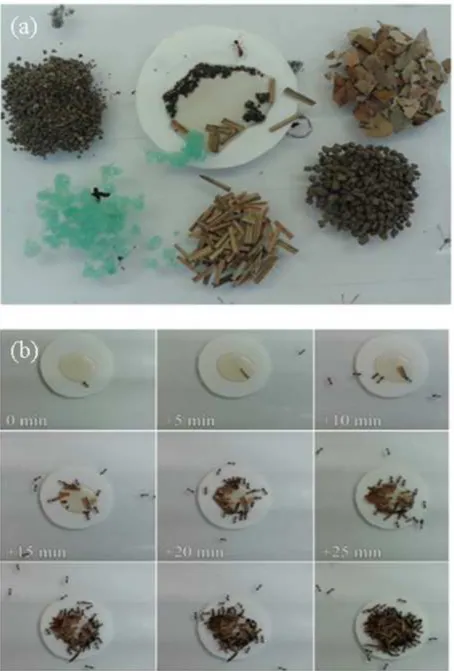
mm) (Fig. 1 and Fig. A1, appendix). Tools were placed at a distance of 12 cm from the baits 147
in a random order. To estimate the soaking properties, the weight of 10 tools of each type was 148
measured with a precision analytical balance (10 mg accuracy) before and after soaking them 149
in the different types of baits (Table 1). The objects were placed on the surface of the baits 150
and left there for 10 minutes. Three different baits were tested: water, honey diluted in water 151
(1:3 ratio; further honey-water) and honey (condensed with sugar powder; further honey) 152
placed in plastic plates (diameter 4 cm, Fig. 1 and A1). The baits were given to the colonies in 153
a random order. 154
155
Aphaenogaster senilis 156
The experiments lasted 3 hours, during which the activity of the colonies was videotaped. The 157
tapes were analysed as for A. subterranea. The experiments with the same setup were 158
repeated 10 times per each colony. 159
Tool use preference was tested for a total of 6 different, novel potential tools, such as pieces 160
each type (average weight for each tool: 2.5 mg) were placed 12 cm from the food source 162
(diluted honey on a piece of aluminium foil). The soaking properties were estimates by 163
measuring the weight of 10 tools of each type with a precision analytical balance (10 mg 164
accuracy) before and after soaking them in diluted honey (Table 2). 165
Ethical Note. 166
Ant colonies were collected with care in the field and maintained in nearly natural conditions 167
in the laboratory. Ants were provided with suitable nesting sites, food and water thus 168
minimizing any adverse impart on their welfare. Our experimental designs include only 169
beahvioural observations, no insect was harmed or stressed during the experimental procedure 170
and all ant colonies were healthy at the end of the experiments. 171
Statistical analysis 172
In A. subterranea, we did not observe any transport of tools into the nests in the case of water 173
baits; furthermore, the transport rate towards the water baits was much lower than towards the 174
other baits, so we focused on the analysis of tool use in honey-water and honey baits. The 175
effect of the bait type on the total number of tools dropped into the baits was analysed using a 176
GLMM model (Poisson errors, maximum likelihood fit, log link). In the full model, bait type 177
was included as a factor and colony ID as a random factor (N = 12) to account for within 178
colony similarities. Differences in the number of tools dropped into baits by different colonies 179
according to different tool types were analysed with GLMM models (Poisson errors, 180
maximum likelihood fit, log link). In the full model, tool type was included as a fixed factor 181
and colony ID as a random factor (NA.su= 30, NA.se= 18).
182
The transport rate of tools towards the baits for the colonies of both species was analysed with 183
the help of Log-rank test with Montecarlo (100.000) simulations (NA.su= 60 corpses, NA.se=
184
30). The removal rate was tested until at most the 10th piece of tools was removed. The 185
different tool types were included as dummy variables, while colony ID was included as a 186
random factor. The transport rate of the different tools into the nests was analysed with the 187
In A. subterranea, the transport of tools to the different baits was analysed in separate 189
models, and because 2 colonies did not transport anything to the baits, only 6 colonies were 190
used for the analysis. In A. senilis, the same model constructions were used for the analysis of 191
the 1st, the 5th and 10th experiment. The three-hour experimental period was enough in the 192
case of both species to observe the transport of tools into the nests. In A. subterranea, 3 193
colonies in the case of honey-water, and 6 colonies in the case of honey baits were actively 194
transporting tools into their nests, so only these colonies were used in the analysis with the 195
same model constructions as described before (Nhoney-water= 15, Nhoney= 30). All statistical
196
analyses were carried out in R (version 3.0.2, The R Foundation for Statistical Computing, 197
Vienna, Austria, http://www. r-project.org). GLMMs were performed using glmer function in 198
lme4 package (Bates, Maechler, Bolker, & Walker, 2013). In the analyses, all tools used were 199
included. Log Rank Test was carried out with the surv_test function in coin package 200
(Hothorn, Hornik, van de Wiel, & Zeileis, 2008). Pairwise comparisons were performed with 201
separate Log Rank Tests and the Relevel function was used to carry out post-hoc sequential 202
comparisons among factor levels when performing GLMM analyses. We applied table-wide 203
sequential Bonferroni-Holm correction to reveal the exact significance levels in these cases. 204
RESULTS
205
Aphaenogaster subterranea: transport to the baits 206
Workers of A. subterranea dropped significantly more tools into honey-water (GLMM: z = 207
12.5, N = 24, P < 0.001) and honey (z = 11.97, P < 0.001) than into water, but no difference 208
was observed between the honey-water and honey (z = -0.96, NS). We therefore concentrate 209
on honey-water and honey baits in the following analyses. 210
Overall, small soil grains were the most frequently transported tool to the honey-water, 211
0.001) and leaf fragments (Fig. 3), with the latter being the least frequently dropped tools 213
compared to every other tool type (z < -3.22, P < 0.01). Furthermore, leaf fragments were 214
transported at the lowest rate (Log Rank Test: 13 < χ2
< 29.76, P < 0.001) while sponges were 215
transported at a slower rate than small soil grains (χ2
= 29.76, P < 0.01) (Fig A2). 216
In the case of honey baits, the preferred tools were the small soil grains and pine 217
needles, which were transported in significantly higher numbers than leaf fragments (z < -218
3.07, P < 0.001) and large soil grains (z < -2.65, P < 0.05); sponges were also used more 219
frequently than leaf fragments (z = -2.83, P = 0.03) (Fig. 3). Every tool type was transported 220
at a faster rate than leaf fragments (11.5 < χ2
< 40.29, P < 0.003) (Fig. A2). 221
Aphaenogaster subterranea: transport into the nests 222
In the case of honey-water baits, small soil grains were transported into the nest in 223
higher numbers than pine needles (z = 3.43, N = 24, P < 0.001), leaf fragments (z = 3.56, P < 224
0.001) and sponges (z = 2.91, P < 0.001) (Fig 4). Small soil grains were transported also at a 225
faster rate than every other tool type (11.43 < χ2
< 29.26, P < 0.003) (Fig. A3). 226
In the case of honey baits, sponges were transported into the nest in highest numbers, 227
which differed significantly from every other tool type (z < -4.02, P < 0.001). The second 228
most preferred tools were small soil grains, which were transported significantly more often 229
than leaf fragments (z = -2.79, P = 0.03) (Fig 4). Sponges were transported at a faster rate than 230
every other tool type (8.56 < χ2 < 37.39, P < 0.01). Leaf fragments were transported at the 231
slowest rate, which significantly differed from the small (χ2
= 22.31, P < 0.001) and large soil 232
grains (χ2
= 7.07, P < 0.05) (Fig A3). 233
Aphaenogaster senilis: transport to the baits 234
Overall, the number of tools used by A. senilis workers significantly changed across 235
trials (from the 1st, to the 5th and the 10th trials: GLMM: z = 3.09, N = 36, P < 0.01), and there 236
was no significant difference between the 5th and the 10th trial (z = 0.95, NS), therefore the use 237
In the 1st and 5th trials, there was no significant difference in the number of different 239
tools transported to the bait (between every tool type 1st z > 0.2, N = 18, NS; 5th z > -2.2, N = 240
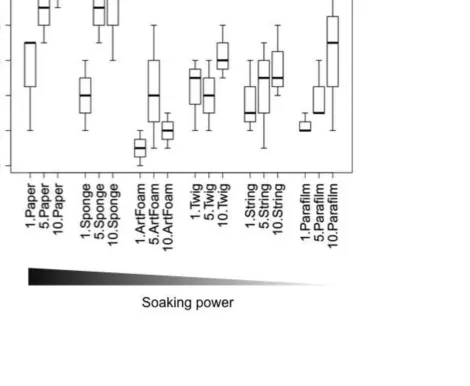
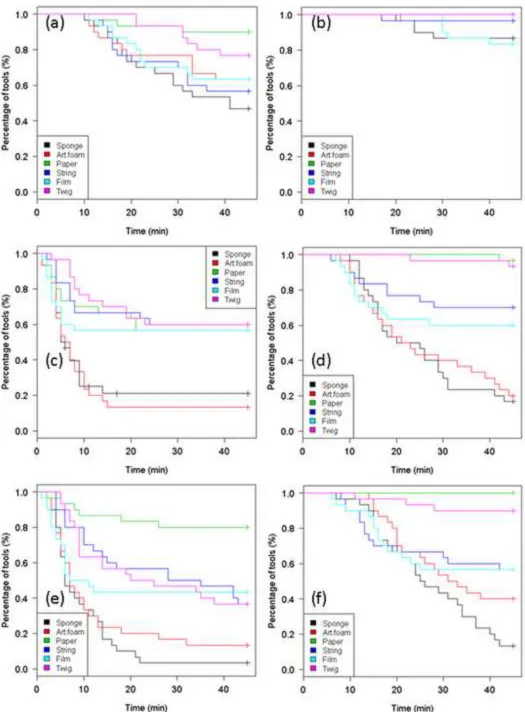
18, NS) (Fig. 5), although in the 1st trial paper was transported at a significantly faster rate 241
than the artificial foam (Log Rank Test: χ2 = 12.72, P < 0.01; Fig. A5). In the 5th trial, the 242
sponges (Log Rank Test: χ2 = -4.33, P < 0.05; Fig. A5) and the pieces of paper (Log Rank 243
Test: χ2
= -3.82, P < 0.05) were transported significantly faster than every other tool types, but 244
there was no significant difference between these two tool types (Log Rank Test: χ2 = -0.28, 245
NS), and paper did not differ significantly from string (Log Rank Test: χ2 = -2.33, NS; Fig. 246
S5). 247
In the 10th trial, the preferred tools were paper and sponges (χ2
= 0.89, NS), which 248
were used more frequently than artificial foam (z > 3.24, N = 18, P < 0.01, Fig. 5) and 249
transported at a significantly faster rate than parafilm and twigs (respectively: χ2 > 8.66, P < 250
0.05 and χ2 > 8.22, P < 0.05, Fig. A5). Artificial foam was transported at a significantly 251
slower rate than every other tool type (χ2
=9.3, P < 0.05, Fig. A5). 252
Aphaenogaster senilis: transport into the nest 253
Overall, the number of tools transported into the nest by A. senilis workers 254
significantly changed across trials (GLMM: z = 2.79, N = 36, P < 0.01), and there was no 255
significant difference between trial 5th and 10th (z = 1.01, NS), therefore the use of artificial 256
tools was analysed separately for the 1st, 5th and 10th trials (Fig. A4). 257
In the first trial, there was no significant difference in the number (GLMM: 1.82 > z 258
>0.001, NS) and transport speed (Log Rank Test: 0 > χ2 > 1, NS) of different tools brought 259
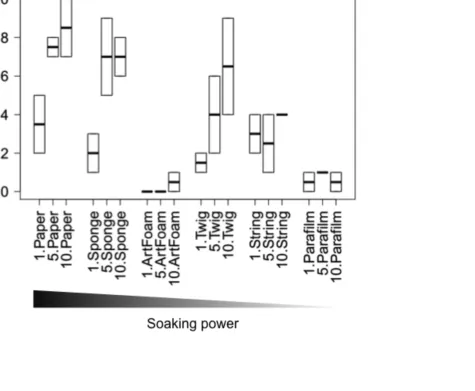
into the nest (Fig. 6 and Fig. A5). In contrast, in the 5th trial the pieces of papers and sponges 260
were transported in a significantly higher number than the foam (z > -3.16, P < 0.05) and 261
parafilm tools (z > -3.38, P < 0.01; Fig. 6). Moreover, paper and sponge (Log Rank Test: χ2
= 262
0.29, NS) were transported at a higher rate than every other tool type (χ2
> 2.85, P < 0.05; 263
Fig. S5). Strings and twigs (χ2 = -0.91, NS) were transported at a higher rate than foam (χ2
> -264
6.24, P < 0.01) and parafilm (χ2
In the 10th trial, paper was the most frequently transported tool to the nest, differing 266
significantly from the number of artificial foam (z = 2.73, P < 0.05) and parafilm tools (z = 267
2.73, P < 0.05) (Fig. 6). The fastest transport rate was observed for paper tools, which differed 268
significantly from every other tool type (χ2
> 8.2, P < 0.05, Fig. A5) except for sponges and 269
strings (χ2 > 6.78, NS, Fig. A5). Parafilm and artificial foam (χ2
= 3.35, NS) were transported 270
at a significantly slower rate than every other tool type (χ2
> 8.66, P < 0.05). 271
DISCUSSION
272
We observed the occurrence of tool use to transport liquid food in two ant species of the 273
genus Aphaenogaster thus confirming previous observations (Agbogba, 1985). More 274
importantly, ant workers were selective in both the materials they chose and the baits that they 275
exploited. A. subterranea was mainly tested with natural materials. Small soil grains were the 276
most preferred item and leaf fragments, despite having a superior soaking power than soil 277
grains, the least preferred item. Ants showed a remarkable preference for sponges despite 278
being novel (they were the only artificial material tested in this species). Interestingly, ant 279
workers in more than 80% of the trials broke the sponges into smaller fragments, presumably 280
to facilitate handling. Once tools were dropped into the baits, ants behaved differently 281
depending on the bait’s viscosity (honey-water or pure honey). Imbibed small soil grains were 282
transported to the nest in the highest numbers and faster than other tool types from honey-283
water baits, while sponges were the preferred transported tools from the honey baits (small 284
soil grains were the second preferred tool to be brought to the nest). Additionally, ants threw 285
much fewer items into water baits compared to those baits that contained honey. 286
A. senilis could choose among six materials that differed in terms of soaking power 287
(paper, sponges, artificial foam, twigs, sting and parafilm). It is likely that ants of this species, 288
which live in sandy areas, were unfamiliar with most of these materials. Initially, A. senilis 289
showed no preference for any of the tools for dropping them into the baits, although paper 290
was transported faster to the bait compared to the artificial foam. However, along trials, ants 291
significantly preferred dropping paper and sponges into the baits, thus choosing in accordance 292
the nest: ants developed a preference for paper, followed by sponges, thus optimizing their 294
foraging effort by using the tools with the best soaking properties and ease of grasping 295
compared to other tool types. 296
Our results suggest that tool use to transport liquid to the nest in the two studied ant 297
species is not behaviourally fixed. Ants incorporated novel tools, many of them made of 298
artificial materials, into their foraging activities. Moreover, A. senilis learned within 10 trials 299
to select the best tool options available based on their soaking properties and A. subterranea 300
chose tools in relation to the characteristic of the food itself, e.g., food viscosity. This means 301
that ants can select tools according to both food and tool properties. Nevertheless, other 302
factors (besides a tool’s soaking properties) may have played a role in determining ants’ 303
preferences. One possibility is that the low density of some materials in the natural habitat 304
(e.g., leaf fragments are not abundant in the pine forest inhabited by these A. subterranea 305
colonies) may have been the reason for largely ignoring this item. However, a lack of 306
familiarity with potential tools cannot explain why A. subterranea used sponge pieces, which 307
were totally novel objects. Even more compelling are the data on A. senilis, which developed 308
a preference for unfamiliar materials during testing. 309
310
Handling effort is another factor that could have played an important role in tool 311
selection, perhaps in combination with the tool’s soaking properties. During our observations 312
we noticed that A. subterranea workers had problems with grasping, handling and orienting 313
the leaf fragments, while the pieces of sponges could be grasped more easily. In fact, ants may 314
have torn apart sponges to reduce their size and facilitate handling. Although the soaking 315
power of sponges was lower when dropped into honey than into honey-water, their relatively 316
low weight made them more buoyant than other tool types and their irregular texture 317
increased their potential for being grasped. We found that the preference for particular items 318
often depended on the type of task that ants carried out. In particular, sponges may have been 319
preferentially transported to the nest, but small soil grains were the most dropped tools into 320
the baits. This suggests that selection among different tool types occurred both when first 321
encountered and also at the food source after the tools had been dropped into the baits. This 322
two-stage selection process might be especially important in the case of novel tools whose 323
the bait in the first trial but subsequently increased their transportation during the 5th trial. 325
Nevertheless, foam fragments were rarely transported from the bait to the nest and by the 10th 326
trial ant workers even reduced their transportation to the baits. This suggests that tool 327
selection, after familiarization with novel material, may have also occurred at the baits. Other 328
authors observed that not all the tools dropped into the baits were transported into the nest 329
(Fowler, 1982; McDonald, 1984), corroborating our interpretation that further tool selection 330
can occur once the tools have been dropped into the liquid food source. 331
Availability, weight, soaking properties, easy handling and the possibility of shaping 332
the material to a desired form are therefore important factors in tool selection. The assessment 333
of these characteristics appears to be the result of a familiarization and learning process, at 334
least for the novel objects offered to the ants in our experiments. As the natural availability of 335
certain kinds of tools varies both spatially and seasonally, plasticity in tool selection is likely 336
to be adaptive. Tool use behaviour in ants may have evolved from the tendency shown by 337
many species to cover with debris liquid or viscous substances, which may otherwise cause 338
drowning or entanglement of workers near their nest (Fellers & Fellers, 1976; McDonald, 339
1984). Note, however, that it has been experimentally shown that Aphaenogaster ants 340
typically drop debris in food substances (Agbogba 1985; Banschbach et al., 2006) and our 341
experiments confirm this. The adaptive advantage of tool use in Aphaenogaster ants is that, 342
by using tools, foragers are capable of efficiently exploiting ephemeral food sources by 343
transporting much larger quantities of liquid nutrients than they could do by internal transport 344
(Fellers & Fellers, 1976; Tanaka & Ono, 1978), given the non-expandable crop characteristic 345
of myrmicine ants. Tool use might help these ants to compete with more dominant ant species 346
which are able to monopolize food sources by numbers: if the food is quickly covered by 347
debris, other ant species cannot exploit it and tool users can take the necessary time to bring 348
the soaked debris back to their nest (Banschbach et al., 2006; Fellers & Fellers, 1976). 349
We began our paper by referring to the research on flexible tool use in vertebrates 350
hoping to establish a link with the existing observations on invertebrate tool use. Our 351
experiments showed some indication that ants preferred materials with good soaking power 352
they use to extract liquid from crevices (Goodall, 1986). It is unknown, however, whether 355
chimpanzees select certain plant species for their high soaking power. In a liquid extraction 356
task in the laboratory, Lehner, Burkart and van Schaik (2011) reported that captive orangutans 357
developed liquid extraction techniques based on materials with high soaking power (e.g., 358
wood wool, paper) over those with low soaking power (e.g., leafless branch). Although this 359
may indicate that orangutans, like ants, were sensitive to the properties of such materials, the 360
lack of a direct and systematic comparison between different kinds of materials considerably 361
reduces the conclusions that one may be able to draw from that study. Nevertheless, other 362
studies with vertebrates in non-liquid extractive foraging tasks have systematically varied the 363
materials presented and have found evidence of selectivity in terms of hardness and weight 364
(Visalberghi et al., 2009), weight (Bird & Emery, 2009) or rigidity (Manrique et al., 2010). 365
Our findings with ants are in some ways comparable to those studies although admittedly, our 366
results are less clear than those reported in vertebrates. This is partly understandable because 367
our study is only the second systematic study on material selectivity in ants (besides Tanaka 368
and Ono, 1978) and we may have not fully considered a number of factors. For instance, 369
dropping a substantial number of tools (e.g., pine needles) inside the liquid and abandoning 370
them there may seem puzzling from the point of view of efficiency. Note, however, that 371
dropping those materials on the liquid may have accomplished another function (e.g., 372
preserving the liquid food against exploitation from other species). Also, the absorbed liquid 373
may have altered the potential for grasping the potential tool object or increased its weight in 374
excess.Another possibility is that ants can only identify suitable materials after observing its 375
effect on the substance to be collected instead of selecting them prior to their use (e.g., 376
artificial foam). Although selecting materials to collect liquid has not been described in 377
corvids or primates, selecting and manufacturing tools prior to their use is well-documented in 378
those taxa (e.g., Manrique et al., 2010; Sanz , Call & Morgan, 2009; Visalberghi et al., 2009; 379
Wimpeny et al., 2009). Whether ants (or any other species) can also select new materials prior 380
to experiencing its absorbent properties is an open question that future studies should address. 381
Some authors may question our use of the term tool use to describe the behaviour of 382
the ants. Tool use is after all a contentious term in the literature typically characterized by 383
disagreement (see Bentley-Condit & Smith, 2010; Shumaker et al., 2011). Although we 385
would be ready to accept a less contentious terminology such as ‘material use’, it is difficult 386
to do so when chimpanzees using leaves to extract liquid from crevices is considered a 387
classical example of tool use (Goodall, 1986). More importantly, we think that the behaviour 388
of the ants meets one of the most important criteria that define tool use in foraging contexts 389
(Beck, 1980; Bentley-Condit & Smith, 2010; St Amant & Horton, 2008), i.e., the use of an 390
external object to affect the position or location of another object or substance. Obviously 391
one could argue that nest building materials affect the position of other nesting materials, 392
which is why some authors object to the idea of tool use and would perhaps like to see either a 393
more restricted use of the term, or its complete abandonment for a wider term such as 394
construction behaviour (Hansell & Ruxton, 2008). Although we understand this position and 395
the reasons for it, given the above considerations, we still prefer to refer to the behaviour of 396
the ants as tool use, or the similar denomination of object use. 397
In conclusion, we observed A. senilis and A. subterranea using natural and artificial 398
debris to collect and transport liquid food to their nests. We also documented the development 399
of a preference for materials with optimal soaking properties in A. senilis although other 400
factors such as familiarity and ease of grasping may have played a role in determining ants’ 401
choices. Additional studies are needed to better characterize the extent and limits of this form 402
of flexible tool use particularly in relation to the existing forms of flexible tool use displayed 403 by vertebrates. 404 405 406 REFERENCES 407
Agbogba, C. (1985). Observations sur la récolte de substances liquids et de sucs animaux chez 408
deux espèces d’Aphaenogaster: A. senilis et A. subterranea (Hym. Formicidae). 409
Insectes Sociaux, 32, 427–434. 410
Auersperg, A. M. I., Szabo, B., von Bayern, A. M. P., & Kacelnik, A. (2012). Spontaneous 411
innovation in tool manufacture and use in a Goffin's cockatoo. Current Biology, 22, 412
Banschbach, V. S., Brunelle, A., Bartlett, K. M., Grivetti, J. Y., & Yeamans, R. L. (2006). 414
Tool use by the forest ant Aphaenogaster rudis: ecology and task allocation. Insectes 415
Sociaux, 53, 463–471. 416
Barber, J. T., Ellgaard, E. G., Thien, L. B., & Stack, A. E. (1989). The use of tools for food 417
transportation by the imported fire ant, Solenopsis invicta. Animal Behaviour, 38, 550– 418
552. 419
Bates, D., Maechler, M., Bolker, B., & Walker, S. (2013). lme4: Linear mixed-effects models 420
using Eigen and S4. R package version 1.0-5 http://CRAN.R-421
project.org/package=lme4, published online 25 October 2013. 422
Beck, B.B. (1980). Animal tool behavior: the use and manufacture of tools by animals. New 423
York, Garland Publishing STPM Press. 424
Bentley-Condit, V. K., & Smith, E. O. (2010). Animal tool-use: current definitions and an 425
updated comprehensive catalog. Behaviour, 147, 185–221. 426
Bird, C. & Emery, N., J. (2009). Insightful problem solving and creative tool modification by 427
captive nontool-using rooks. Proceedings of the National Academy of Sciences USA, 428
106, 10370–10375. 429
Bhatkar, A. & Whitcomb, W. H. (1979). Artificial diet for rearing various species of ants. 430
Florida Entomologist, 53, 229–232. 431
Boulay, R., Hefetz, A., Cerdá, X., Devers, S., Francke, W., Twele, R., & Lenoir, A. 432
(2007). Production of sexuals in a fission-performing ant: dual effects of queen 433
pheromones and colony size. Behavioral Ecology & Sociobiology, 61,1531–1541. 434
Chappell, J. & Kacelnik, A. (2002). Tool selectivity in a non-mammal, the New Caledonian 435
crow (Corvus moneduloides). Animal Cognition, 5, 71–78. 436
Czechowski, W., Radchenko, A., Czechowska, W., & Vepsäläinen, K. (2012). The ants 437
(Hymenoptera, Formicidae) of Poland with reference to the myrmecofauna of Europe. 438
Warszawa, Poland: MIZ PAS. 439
Davidson, D. W., Cook, S. C., & Snelling, R. (2004). Liquid feeding performances of ants 440
Delage, B. & Jaisson, P. (1969). Etude des relations sociales chez des Fourrnis du genre 442
Aphaenogaster. Comptes Rendus de l'Académie des Sciences Paris, 268, 701–703. 443
Devetak, D & Arnett, A. (2015). Preference of antlion and wormlion larvae (Neuroptera: 444
Myrmeleontidae; Diptera: Vermileonidae) for substrates according to substrate particle 445
sizes. European Journal of Entomology, 112, 500-509. 446
Evans, H. E. & Eberhard, M. J. W. (1970). The wasps. Ann Arbor, USA: The University of 447
Michigan Press. 448
Fellers, J. H. & Fellers, G. M. (1976). Tool use in a social insect and its implications for 449
competitive interactions. Science, 192, 70–72. 450
Fowler, H. G. (1982). Tool use by Aphaenogaster ants: a reconsideration of its role in 451
competitive interactions. The Bulletin of New Jersey Academy of Science, 27, 81–82. 452
Goodall, J. (1986). The chimpanzees of Gombe. Patterns of behavior. Cambridge, MA: The 453
Belknap Press of Harvard University Press 454
Hansell, M. & Ruxton, G. D. (2008). Setting tool use within the context of animal 455
construction behaviour. Trends in Ecology & Evolution, 23, 73-78. 456
Hothorn, T., Hornik, K., van de Wiel, M. A., & Zeileis, A. (2008). Implementing a class of 457
permutation tests: the coin package. Journal of Statistical Software, 28, 1–23, 458
http://www. jstatsoft.org/v28/i08/. 459
Hölldobler, B. & Wilson, E. O. (1990). The ants. Cambridge, USA: Belknap Press of Harvard 460
University. 461
Hunt, G. R. & Gray, R. D. (2002). Species-wide manufacture of stick-type tools by New 462
Caledonian crows. Emu, 102, 349–353. 463
Lehner, S.R., Burkart, J.M., & van Schaik, C.P. (2011). Can captive orangutans (Pongo 464
pygmaeus abelii) be coaxed into cumulative build-up of techniques? Journal of 465
Comparative Psychology, 125, 446-455. 466
Manrique, H. M., Gross, A. N., & Call, J. (2010). Great apes select tools based on their 469
rigidity. Journal of Experimental Psychology: Animal Behavior Processes, 36, 409– 470
422. 471
Martin-Ordas, G., Schumacher, L., & Call, J. (2012). Sequential tool use in great apes. PLoS 472
One, 7, e52074. 473
McDonald, P. (1984). Tool use by the ant, Novomessor albisetosus (Mayr). Journal of New 474
York Entomological Society, 92, 156–161. 475
Morrill, W. L. (1972). Tool using behaviour of Pogonomyrmex badius (Hymenoptera: 476
Formicidae). Florida Entomologist, 55, 59–60. 477
Mulcahy, N. J., Call, J., & Dunbar, R. I. M. (2005). Gorillas and orangutans encode relevant 478
problem features in a tool-using task. Journal of Comparative Psychology, 119, 23– 479
32. 480
Pierce, J. D. (1986). A review of tool use in insects. Florida Entomologist, 69, 95–104. 481
Sanz, C., Call, J., Boesch, C. (2013). Tool Use in Animals: Cognition and Ecology. New 482
York, USA: Cambridge University Press. 483
Sanz, C., Call, J., & Morgan, D. (2009). Design complexity in the tool use of chimpanzees 484
(Pan troglodytes) in the Congo basin. Biology Letters, 5, 293–296. 485
Scharf, I., Lubin, Y. & Ovadia, O. (2011). Foraging decisions and behavioural flexibility in 486
trap-building predators: a review. Biological Reviews, 86, 626–639. 487
Seifert, B. (2007). Die Ameisen Mittel- und Nordeuropas. Görlitz, Germany: Lutra Verlags 488
und Vertriebsgesellschaft. 489
Shumaker, R. W., Walkup, K. R., & Beck, B. B. (2011). Animal tool behavior: The use and 490
manufacture of tool by animals. Baltimore, USA: The Johns Hopkins University Press. 491
St. Amant, R. & Horton, T. (2008). Revisiting the definition of animal tool use. Animal 492
Stukalyuk, S. V. & Radchenko, V. G. (2011). Structure of multispecies ant assemblages 494
(Hymenoptera, Formicidae) in the Mountain Crimea. Entomological Review, 91, 15– 495
36. 496
Tanaka, T. & Ono, Y. (1978). The tool use by foragers of Aphaenogaster famelica. Japanese
497
Journal of Ecology, 28, 49–58. 498
Visalberghi, E., Addessi, E., Spagnoletti, N., Truppa, V., Ottoni, E., Izar, P., & Fragaszy, D. 499
(2009). Selection of effective stone tools by wild capuchin monkeys. Current Biology, 500
19, 213–217. 501
Wimpenny J. H., Weir A. A. S., Clayton L., Rutz C., & Kacelnik, A. (2009). Cognitive 502
Processes Associated with Sequential Tool Use in New Caledonian Crows. PLoS One, 503
4, e6471. 504
Table 1. Soaking properties of the different tools used by Aphaenogaster subterranea. 506
Imbibed /Initial weight (weight ratio)
Tool type
Honey-water
Honey
Sponges 7.45 1.29
Leaf fragments 1.94 11.9
Pine needles 1.33 1.85
Small soil grains 1.1 1.48
Large soil grains 0.7 0.64
Table 2. Soaking properties of the different tools used by Aphaenogaster senilis. 507
Imbibed /Initial weight (weight ratio)
Tool type
Honey-water
Paper 28.37
Sponges 23.31
Artificial foam 6.37
Twigs 3.06
String 2.00
Parafilm 1.47
Figure legends
509
Figure 1. Experimental setup and tool types offered to Aphaenogaster subterranea. 510
Figure 2. Experimental setup and tool types offered to Aphaenogaster senilis. 511
Figure 3. Number of different tools transported to honey-water (a) and honey (b) baits by 512
Aphaenogaster subterranea workers. Box plots show the median (internal line), quartiles and 513
range (whiskers). Different letters above boxes represent groups that differ significantly from 514
each other. 515
Fig. 4. Number of different tools transported into the nest from the honey-water (a) and honey 516
(b) baits by Aphaenogaster subterranea workers. Box plots show the median (internal line), 517
quartiles and range (whiskers). Different letter s above boxes represent groups that differ 518
significantly from each other. 519
Figure 5. Number of different tools transported to the baits in the 1st, 5th and 10th trials by 520
Aphaenogaster senilis workers. Box plots show the median (internal line), quartiles and range 521
(whiskers). 522
Figure 6. Number of different tools transported into the nest in the 1st, 5th and 10th experiment 523
by Aphaenogaster senilis workers. Box plots show the median (internal line), quartiles and 524
range (whiskers). 525
Appendix - Figure legends
526
Figure A1. Different tool types used for experiments with Aphaenogaster subterranea (a) 527
from left to right: small soil grains, sponges, pine needles, large soil grains, leaf fragments; (b) 528
the dynamics of bait covering with tools. 529
Figure A2. Estimated functions of tool transport time to honey-water (a) and honey (b) by 530
Figure A3. Estimated functions of tool transport time into the nest from the honey-water (a) 533
and honey (b) baits by Aphaenogaster subterranea workers (Log-rank test). Different tool 534
types are depicted by different colours. 535
Figure A4. Summed number of tools transported on the baits and into the nest during the 536
three trials (box plots show: median, quartiles and range). Different letters above boxes 537
represent groups that differ significantly from each other. 538
Figure A5. Estimated functions of tools transport time on the baits (a; c; e) and into the nests 539
(b, d, f) in the 1st (a, b), 5th (c, d) and 10th (e, f) experiment by Aphaenogaster senilis workers 540
ACKNOWLEDGEMENTS
Supported by European Commission (FP7-MC-ERG-2009-256524 to PdE). We thank
Paul Devienne for technical advice and support and Christophe Féron for statistical
advice. We are grateful to anonymous reviewers for their comments and suggestions.
Figure
Figure 2
Figure 3
Figure 4
Figure 5
Figure 6
Figure 1A
Figure 2A
Figure 3A
Figure 4A
Figure 5A
Publicity Photograph (Optional)