Munich Personal RePEc Archive
Vector autoregression with varied
frequency data
Qian, Hang
Iowa State University
October 2010
Online at
https://mpra.ub.uni-muenchen.de/34682/
Vector Autoregression with Varied Frequency Data
Hang Qian1
Abstract
The Vector Autoregression (VAR) model has been extensively applied in
macroeconomics. A typical VAR requires its component variables being
sam-pled at a uniformed frequency, regardless of the fact that some macro data
are available monthly and some are only quarterly. Practitioners invariably
align variables to the same frequency either by aggregation or imputation,
regardless of information loss or noises gain. We study a VAR model with
varied frequency data in a Bayesian context. Lower frequency (aggregated)
data are essentially a linear combination of higher frequency (disaggregated)
data. The observed aggregated data impose linear constraints on the
au-tocorrelation structure of the latent disaggregated data. The perception of
a constrained multivariate normal distribution is crucial to our Gibbs
sam-pler. Furthermore, the Markov property of the VAR series enables a block
Gibbs sampler, which performs faster for evenly aggregated data. Lastly,
our approach is applied to two classic structural VAR analyses, one with
long-run and the other with short-run identification constraints. These
ap-plications demonstrate that it is both feasible and sensible to use data of
different frequencies in a new VAR model, the one that keeps the branding
1
of the economic ideas underlying the structural VAR model but only makes
minimum modification from a technical perspective.
Keywords: Vector Autoregression, Bayesian, Temporal aggregation
1. Introduction
The Vector Autoregression (VAR) proposed by Christopher Sims (1980)
is a workhorse model for forecasting as well as studying cause and effect in the
macroeconomy. An autoregression model implicitly assumes data are
sam-pled at the same frequency since variables at datetare regressed on variables
dated at t−1, t−2, etc. However, macroeconomic data are not always
ob-served at a uniformed frequency. First, each series can be sampled at its own
frequency. For example, the best available data of GDP is quarterly, while
that of the CPI is monthly, that of financial asset returns might be daily or
more frequent. Second, for a given variable, recent data may be observed
at a higher frequency while historical data may be coarsely sampled. For
instance, quarterly GDP data are not available until 1947. In the presence
of varied frequency data, a VAR practitioner aligns the variables either by
aggregating the data to a lower frequency or imputing the high frequency
data with heuristic rules. The former method discards valuable information
in the fine data while the latter introduces noises to the data.
By far the most popular model that handles mixed frequencies data is
the Mi(xed) Da(ta) S(ampling), or MIDAS, regression introduced by Ghysels
et al. (2007), Andreou et al. (2010). The MIDAS regression projects high
fre-quency data onto low frequencies data with a tightly parameterized weighing
volatil-ity prediction (e.g., Ghysels et al., 2006), it quickly gains popularvolatil-ity among
macroeconomists for improving real-time forecast of key economic variables.
See Clements and Galvao (2008, 2009), Marcellino and Schumacher (2010),
and Kuzin et al. (2011) for applications.
In the MIDAS regression, the parsimonious declining weights, such as
Almon lag polynomial or normalized Beta density, impose a priori structure
on the decaying pattern of the regression coefficients. It is true that such a
structure is necessary when the aggregation periods are long, say using daily
variables to predict quarterly outcomes. Otherwise there will be parameter
proliferation. However, for many macroeconomic data aggregation periods
are relatively short, say monthly-quarterly, or quarterly-annual aggregation.
It is both feasible and sensible to adopt a fully data-driven dynamic model like
VAR. We name our model as the Var(ied) Da(ta) S(ampling), or VARDAS,
regression, implying we follow the tradition of using the established VAR
model in macroeconomic studies.
The MIDAS regression is raised mainly in the context of economic
fore-casting. The VARDAS model, however, can be used for both forecasting and
characterizing dynamic nexus among macroeconomic variables. In fact, the
VARDAS model is analogue to a reduced-form VAR. Once its parameters
are routinely estimated, it can be restored to a structural model for the
im-pulse response analysis. The economic insights used for identifying structural
shocks remain unchanged. In fact, it effectively weakens many short-run
identification assumptions such as zero contemporaneous effects, since our
VARDAS model operates on an autoregression with higher frequency data
The VARDAS model is built upon the VAR model, but also takes the
temporal aggregation into consideration. The effects of temporal aggregation
have been extensively studied in literature over decades. Amemiya and Wu
(1972), Tiao (1972), Tiao and Wei (1976), Marcellino (1999), Breitung and
Swanson (2002) discuss, as a result of temporal aggregation, the change of
lag orders of ARMA models, information loss in estimation and prediction,
dynamic causality and integration relations among aggregated variates, etc.
Silvestrini and Veredas (2008) provide a comprehensive review on the theory
of temporal aggregation of time series models. The focus of our paper is
not on the relationship between the aggregated model (estimated by low
frequency data) and the disaggregated model (estimated by high frequency
data, if available), but instead on an empirical concern: how to estimate a
disaggregated model if some data are aggregated?
This question itself is not new. Under the frequentist framework, the
mixed frequency VAR and a related factor model have been explored by
Zadrozny (1988), Mittnik and Zadrozny (2004), Mariano and Murasawa
(2003, 2010), Hyung and Granger (2008). The wisdom is to recast the VAR
model with temporally aggregated variates into a state space model so that
the likelihood function can be recursively evaluated by the Kalman filter.
However, the main difficulty is that a VAR model typically contains many
coefficients and numerical algorithms such as the quasi-Newton have limited
ability to implement the maximum likelihood estimation.2
2
As is noted by Chen and Zadrozny (1998), Kalman filter method may perform poorly
or not at all on a larger model. In applications, variables included need to be carefully
The mixed frequency VAR with the Kalman filter is essentially the
fre-quentist version of the VARDAS model. The VARDAS model is raised in a
Bayesian framework mainly because the Gibbs sampler with data
augmenta-tion is ideal for latent variable models. The large number of parameters does
not pose major computational difficulties in that conditional on the latent
disaggregated data it is a standard VAR model, with its parameters sampled
in a way analogue to the linear regression model. The crux of our Gibbs
sampler is a constrained multivariate normal distribution characterizing the
posterior conditionals of the latent disaggregated variables. Furthermore, a
blocking strategy that takes advantage of the Markov property of the VAR
series accelerates the sampler, making the algorithm feasible even for a larger
scale model.
Compared with the mixed frequency VAR with the Kalman filter, the
VARDAS model is flexible and friendly to practitioners. It allows each
com-ponent series in the VAR system being sampled at its own frequency and
may change its frequency at any time. Though it is possible to redesign the
state space representation of the frequentist model to reach this level of
gen-erality, the design must be tailored and finished by the practitioners, with
no guarantee of numerical feasibility of maximizing the likelihood. However,
values need to be carefully set. Many authors find it crucial to demean the data before
applying the Kalman filter. Mittnik and Zadrozny (2004, p.7) report that “the MLE
was not automatic and needed intervention”. Aruoba and Scotti (2009) discuss in detail
the two steps they use to select the initial values before applying the BFGS numerical
maximzation. Mariano and Murasawa (2010) use the EM algorithm to obtain an initial
the VARDAS model only requires users to provide the data and specify the
aggregation structure, while the estimation is as routine as a standard VAR
model.
Our research is closest to a Bayesian estimation of the VAR model with
mixed or irregular spaced data proposed by Chiu, Eraker, Foerster, Kim,
and Seoane (2011, hereafter CEFKS). However, our econometric model and
sampling techniques have two genuine differences from those in CEFKS.
First, CEFKS assume the lower-frequency data are the result of sampling
everykperiods from the high frequency variable. For example, quarterly data
are treated as variables sampled at the end of March, June, September and
December. However, most macroeconomic data do not seem to be generated
in that fashion. Flow variables such as quarterly GDP is the sum of the
latent “monthly GDP”in a quarter. Stock variables such as the monthly
CPI are more reasonably viewed as an average of the latent “weekly CPI”
in a month instead of the price level in the last week of a month.3 Even if
some variables are really sampled only once in a month, there is no reason to
expect it realizes in the last week. If the realized date is the first week,
auto-correlations and cross-auto-correlations imply a different posterior distribution of
3
in the literature, stock variables are defined as those sampled every k periods from the latent high frequency variables. The examples provided for stock variables are “rates
and indexes” such as interest rate, unemployment rate and CPI (Silvestrini and Veredas,
2008). However, all of them seem to be generated by averaging the latent variables in the
k periods. Some financial data such as the S&P 500 index and exchange rates in a week or month do have their last-trading-day data available, but the averaged data are offered
the latent variable.
CEFKS address the missing disaggregated data in the VAR system. Data
aggregation problems bear some similarities to the traditional missing data
problems, but a genuine difference is that data aggregation imposes
lin-ear temporal constraints on the disaggregated variates, which exhibit
auto-correlations and cross-auto-correlations as well. So the posterior latent variables
follow a constrained, conditional multivariate normal distribution.
Second, in the CEFKS sampler, single-period (say, date t) latent
disag-gregated data are drawn conditional on all other latent values. In the VAR(1)
model, two neighbors (that is, values in date t−1 and t+ 1) are relevant.
Though this is a valid sampler, the excessive length of the MCMC chain
might result in its slow mixing. Our method is to sample latent variables of
all periods at one time, which reduces the nodes and improve the mixing.
We also propose a block Gibbs sampler, which does increase the nodes on
the MCMC chain, but the block size is at the discretion of the user so as to
reach a balance between the sampling efficiency and speed.
The rest of the paper is organized as follows. Section 2 specifies of the
VARDAS model. Section 3 explains the Gibbs sampler and Section 4
pro-poses an alternative block sampler. Section 5 extends the baseline
econo-metric model to various aggregation types other than simple summation and
averaging. Section 6 illustrates our approach by two classic applications of
structural VAR model, one with long-run and the other with short-run
2. The model
Assume the k dimensional latent {Yt∗}Tt=1 follow a covariance-stationary
reduced-form VAR(p) process:
Y∗t =c+
p
X
i=1
ΦiYt−i∗ +εt,
where εt∼N(0,Ω). The reference time unit is t, which indexes the highest
frequency data in the VAR system. The (column) vector Y∗t is unobservable since some of the component series may be observed at some lower frequencies
and are allowed to change sampling frequencies at any time. The
book-keeping convention of observed data is specified as follows. Let {Y∗ t }
T t=1 be
a component series (say, the first variable) in the VAR system. Suppose in
some time interval [a, b], 1≤a≤b≤T,a, b∈N, disaggregated latent values
Ya∗, Ya∗+1...Yb−∗1, Yb∗ are aggregated into a single observable variate Ya,b ≡
Pb−a
j=0Ya∗+j. We then construct a data series{Yt}Tt=1 such that Ya=Ya+1...=
Yb−1 =N.A.andYb =Ya,b. As a special case,a =bimplies the disaggregated
value (highest frequency data) is observed. The data series {Yt}Tt=1 contains
all the available information with respect to the latent {Y∗ t }
T
t=1. Though
data of various frequencies may be present in {Yt}Tt=1, there is no ambiguity
since counting a run of N.A. preceding a data point reveals the aggregation
structure. Sometimes high frequency data are grouped into low frequency
data by averaging instead of summation, sayYa,b≡ b−a1+1Pb−aj=0Ya∗+j. In that
case, we simply record Yb = (b−a+ 1)Ya,b so that it becomes equivalent
to aggregation by summation. More complicated data averaging types, such
as weighed, noisy, missing and nonlinear aggregation, will be discussed in
Repeat the above process for each of the k component variables in the
VAR system, we obtainkdata series. Ak-by-T data matrixYis constructed by pooling all the data series. Each row is a component data series and
each column is the data of k variables at a given time. Clearly Y contains many N.A. entries, and we define a k-by-T logical matrix E such that the
(i, j) entry of E equals zero if the corresponding entry of Y is N.A., and equals one otherwise. The notation −→E vectorizes the matrix E column by
column, which will be used to select entries of a matrix (vector) to form a
submatrix (subvector). Similarly, the operator −→Y vectorizes the matrix Y.
Let Y∗ = (Y∗
1, ...,YT∗), and
−→
Y∗ vectorizes the matrixY∗.
Essentially our task to estimate model parametersΘ≡ {c,Φ1, ...,Φp,Ω}
and recover the latentY∗ with the observation matrixY. A Bayesian frame-work is adopted since the Gibbs sampler with data augmentation can
conve-niently handle models with latent variables. The Gibbs sampler only requires
the full posterior conditionals of model parameters as well as latent
disag-gregated variables. Clearly, conditional on the latent Y∗, this is a standard VAR model. By convention, treat the initial Y1∗, ...,Yp∗ as given, so the VAR
model is equivalent to a seemingly unrelated regression model.4
4
Strictly speaking, the VAR model is reduced to a multiple-equation linear regression
model only if we neglect the contribution of the initial p observations to the likelihood. Otherwise the posterior conditionals of c,Φ1, ...,Φp do not have a closed form.
How-ever, conditioning on initial values is also commonly applied in the frequentist framework. Hamilton (1994, p. 291) notes that “Vector autoregressions are invariably estimated on the
basis of the conditional likelihood function ... rather than the full-sample unconditional
likelihood”, so that maximizing the conditional likelihood is equivalent to OLS regressions
Denote a 1-by-(kp+ 1) vector xt =
1 Yt−∗′1 ... Y∗′t−p
, and a k
-by-(kp+ 1)k block-diagonal matrix Xt = xt . .. xt .
Letβ = (c,Φ1, ...,Φp)′. With a conjugate proper prior
− →
β ∼N(µβ,Vβ),
Ω−1 ∼W ishart(Ω, ν), where the operator −→β vectorize β, we have
− →
β |· ∼N(Dβdβ,Dβ) ,
Ω−1|· ∼W ishart Ω, ν,
where
Dβ =
T
X
t=p+1
X′tΩ−1Xt+V−β1 !−1
,
dβ =
T
X
t=p+1
X′tΩ−1Yt∗+V−β1µβ,
Ω= "
Ω−1+
T
X
t=p+1
Yt∗−Xt−→β Yt∗−Xt−→β′
#−1 ,
ν =T −p+ν.
3. Posterior disaggregated variables
In this section, we describe how to sample the latent−Y→∗ from its posterior
conditional distribution. Before presenting our sampler formally, we motivate
our approach by a highly simplified scenario in which the system contains
only one variable following an monthly AR(1):
Yt∗ =φYt−∗1+εt, εt ∼N 0, σ2
Suppose we only have one quarterly observation Y1,3 = Y1∗ +Y2∗ +Y3∗
and one monthly observation Y4 = Y4∗. Conditional on φ, σ2, Y1,3, Y4 we
are interested in the posterior distribution of Y−→∗ ≡ (Y1∗, Y2∗, Y3∗, Y4∗)′. For
notational conciseness, we leave conditioning onφ, σ2 implicit. By our
book-keeping convention, −→Y = N.A., N.A., Y1,3, Y4 ′
, −→E = (0,0,1,1)′.
First note that ifY∗
1 comes from the stationary distribution of the AR(1)
process, then −Y→∗ ∼ N(0,Γ), where the (i, j) entry of Γ equals σ2
1−φφ |i−j|.
However, −Y→∗ is binded by two linear constraints. First, Y∗
1 +Y2∗+Y3∗ must sum up to the known Y1,3. Second, Y4∗ must equal to the known Y4. That
implies−Y→∗ follows a constrained multivariate normal distribution, which can be represented as the product of a conditional normal and a degenerated
distribution. To this end, construct a transformation matrix such that
A=
1 0 0 0
0 1 0 0
1 1 1 0
0 0 0 1 .
ThenA−Y→∗ = Y1∗, Y2∗, Y1,3, Y4 ′
∼N(0,AΓA′).
It follows that
(Y1∗, Y2∗)′Y1,3, Y4 ∼N h
Γ01Γ−111· Y1,3, Y4 ′
,Γ00−Γ01Γ−111Γ10 i
,
where Γ01 is the submatrix of AΓA′ with rows selected by 1 −
− →
E, and columns selected by−→E, andΓ00,Γ11,Γ10are defined similarly. Practically, in a matrix-based computational environment such as MATLAB, R or GAUSS,
Lastly, (Y3∗, Y4∗)′Y1∗, Y2∗, Y1,3, Y4 are degenerated sinceY3∗ =Y1,3−Y1∗−
Y∗
2 andY4∗ =Y4. The posterior distribution of
−→
Y∗is completely characterized by the product of (Y1∗, Y2∗)′Y1,3, Y4 and (Y3∗, Y4∗)
′
Y1∗, Y2∗, Y1,3, Y4, so the
problem is resolved.
This example demonstrates our idea of sampling the latent −Y→∗. The
disturbances εt are multivariate normal, so
−→
Y∗ also follows kT dimensional multivariate normal. If we use a kT-by-kT matrix A to linearly transform
−→
Y∗, the resulting matrix A−Y→∗ is multivariate normal as well. The purpose of this transformation is to relate the disaggregated and aggregated data.
The latter is known so that the former follows a conditional normal
distribu-tion. Recall that the logical vector −→E indicated which entries in −→Y contain
aggregation information and which do not. So −→E will be used to construct our conditional normal distribution. Our procedure is formally presented as
follows.
If the initialY∗′1, ...,Yp∗′come from the stationary distribution of the VAR
system, then−Y→∗ ∼N(µ,Γ), whereµ= (µ′
1, ..., µ′1)
′
,µ1 = (Ik−Ppi=1Φi)−1c.
The kT-by-kT covariance matrix Γ is given by
Γ=
Γ0 Γ′1 ... Γ′T−1
Γ1 Γ0 ... Γ′T−2
...
ΓT−1 ΓT−2 ... Γ0 ,
where the autocovariance matrixΓj =E(YT −µ) (YT−j −µ)′,j = 0,1,2, ...
can be recursively computed by
Γj =
p
X
i=1
As for the initial Γ0, ...,Γp−1, we compute a kp-by-kp matrix G such that
− →
G = [Ik2p2 −(F⊗F)]−1
− →
∆, where F = Φ
C
, Φ= (Φ1, ...,Φp), C =
Ik(p−1) 0k(p−1),k
, and ∆is akp-by-kpmatrix of zeros except for its first (northwest)k-by-k submatrix beingΩ. The firstk rows ofGis (Γ0, ...,Γp−1).
ThekT-by-kT transformation matrixAcan be constructed by examining the logical matrix E. First, let the main diagonal of A be ones and other
elements be zeros. Second, examine each row of the logical matrix E. Sup-pose we are reading row i and column j of E (i = 1, ..., k;j = 1, ..., T). If
the (i, j) entry is zero, skip and proceed to column j + 1 (or conclude this
row). Otherwise, (i, j) entry being one implies a temporally aggregated data
is observed. So we search column j−1, j−2, ... for a run of zeros. Suppose
there are M zeros (M ≥ 0) in a row immediately before column j; we then
add M ones to A. For M >0, the locations inA are row (j−1)k+i, col-umn (j −1)k+i−mk, m = 1, ..., M. Note that M = 0 implies one-period
trivial aggregation.
The new series A−Y→∗ transforms the original series −Y→∗ in such a way
that for a (M + 1)-period temporal aggregation, the first M disaggregated
variates are retained, while the last disaggregated variate is replaced by the
sum of the disaggregated variates in the M + 1 periods. As a special case,
for a one-period aggregation, the variate is simply retained. Clearly, A−Y→∗
can be classified into two blocks: the latent disaggregated variates block
and the observed variates block. The latter have their realizations contained
A−Y→∗ ∼N(Aµ,AΓA′), and
−→
Y0∗
−→Y,Θ ∼N
h
η0+Γ01Γ−111 −→
Y1−η1
,Γ00−Γ01Γ−111Γ10 i
,
where Y−→∗0 is the subvector of AY−→∗ selected by the logical vector 1 −−→E,
namely the latent disaggregated variates block. The vector −Y→1 has double identities: as a random vector, it is the subvector of A−Y→∗ selected by −→E,
namely the observed variates block; as a realization of that random vector,
it is exactly the subvector of −→Y selected by −→E (simply the non- N.A. part
of our data −→Y). η0 and η1 are two subvectors of Aµselected by 1−
− →
E and
− →
E respectively. Γ01 is the submatrix of AΓA′ with rows selected by 1−
− →
E, and columns selected by −→E, andΓ11,Γ00,Γ10 are defined similarly.
Lastly, Note that in the transformation we squeezed out one
disaggre-gated variate at the end of the aggregation periods, and replaced it with an
aggregated data. Treat one period aggregation as squeezing out and filling in
the same variate. Those squeezed-out variates, denoted as −−→Y∗
−1, correspond
to the subvector of−Y→∗ selected by−→E. However,−−→Y∗−1
−Y→0∗,−→Y, θ is degenerate, since it must equal to the difference between the aggregated value and the
sum of the rest disaggregated values. Note that −Y→∗0 has another identity,
namely the subvector of −Y→∗ selected by 1−−→E, which implies the two
vec-tors −Y→0∗ and −−→Y∗−1 cover all the elements in the latent −Y→∗. In other words,
by sampling in turn −Y→∗
0
−→Y, θ from a conditional normal distribution and
−−→
Y∗−1
−Y→∗0,−→Y, θ from a degenerated distribution, we obtain the posterior con-ditional sample of −Y→∗. That finishes the cycle of the Gibbs sampler to the
4. Gibbs sampler with Blocks
The sampling procedure in the previous section allows us to draw the
latent disaggregated values all at once. For macroeconomic data with
sev-eral hundred observations, the sampler is workable on an ordinary desktop
computer. However, if we need to handle a large dataset which contains ten
thousand observations, the above procedure requires handling large matrixes
and their inversion, which slow down the sampling speed and create burden
on the computer memory. In this section we propose an alternative sampler
which divide latent variables into blocks. It is fast and memory-efficient, at
the price of increasing nodes on the MCMC chain.
The idea of this approach is to explore the Markov property of the series
to simplify conditional distributions and thus reduce the size of matrixes.
To fix ideas, consider again the simple scenario in Section 3. The system
contains only one variable following a monthly AR(1):
Yt∗ =φYt−∗1+εt, εt ∼N 0, σ2
.
Suppose we observe two quarterly observations Y1,3 = Y1∗ +Y2∗ +Y3∗,
Y4,6 = Y4∗ +Y5∗ +Y6∗ and one monthly observation Y7 = Y7∗. Conditional
onφ, σ2, Y1,3, Y4,6, Y7 we are interested in the posterior distribution of
−→
Y∗ ≡
(Y∗
1, ..., Y7∗)
′
. If we sample the latent variates all at once, we need to work on
a 7-by-7 transformation matrix and covariance matrix.
Now we partition the seven latent variables into three blocks and
need to specify the posterior conditional of
(Y1∗, Y2∗, Y3∗)′Y1,3, Y4,6, Y7, Y4∗, Y5∗, Y6∗, Y7∗ ,
(Y4∗, Y5∗, Y6∗)′Y1,3, Y4,6, Y7, Y1∗, Y2∗, Y3∗, Y7∗ ,
Y7∗Y1,3, Y4,6, Y7, Y1∗, ..., Y6∗ .
The last block has a degenerate distribution, so we focus on the first
two blocks. To sample (Y∗
1, Y2∗, Y3∗)
′
conditional on all other disaggregated
values, we note that the Markov property of an AR(1) process implies that
once we know Y∗
4, further knowledge on Y5∗, Y6∗, Y7∗ is irrelevant. So it is equivalent to work on (Y1∗, Y2∗, Y3∗)′Y1,3, Y4∗. By a linear transformation,
Y∗
1, Y2∗, Y1,3, Y4∗ ′
follows a multivariate normal, so we first sample (Y∗
1, Y2∗)
′
conditional on Y1,3, Y4∗, and then sample the degenerated Y3∗, a procedure
essentially the same as that in the previous section. Note that this process
only requires us to construct a 4-by-4 transformation matrix and covariance
matrix.
Similarly, to sample (Y4∗, Y5∗, Y6∗)′ conditional on all other disaggregated
values, we work on (Y∗
4, Y5∗, Y6∗)
′
Y4,6, Y3∗, Y7, with a 5-by-5 transformation
matrix A which takes (Y3∗, Y4∗, Y5∗, Y6∗, Y7∗)′ into Y3∗, Y4∗, Y5∗, Y4,6, Y7 ′
with
the distributionN0,1σ−φ2 AΓA′, where the (i, j) entry ofΓequalsφ|i−j|. So
we first sample (Y4∗, Y5∗)′Y4,6, Y3∗, Y7 from a conditional normal distribution
and then sample the degenerated Y∗
6.
This example illustrates the ideas of our block Gibbs sampler, though the
computational saving is mild in that we only have two quarterly observations.
However, if we instead have 100 quarterly observations, the computational
need to construct an at least 300-by-300 transformation matrix. However,
we can group 3 latent monthly variables in a block, say Y∗
t , Yt∗+1, Yt∗+2 ′
,
t = 1,4,7, ...,298, with the quarterly observation Yt,t+2. The Markov
prop-erty implies that Y∗
t , Yt∗+1, Yt∗+2 ′
conditional on all the other disaggregated
variates is equivalent to that conditional on Yt−∗1, Yt∗+3 (with proper
modi-fications to the two ends of the series). Once we build a 5-by-5 matrix A that transforms Yt−∗1, Yt∗, Yt∗+1, Yt∗+2, Yt∗+3′ into Yt−∗1, Yt∗, Yt∗+1, Yt,t+2, Yt∗+3
′
,
we can sample Y∗ t , Yt∗+1
′
from a conditional normal andY∗
t+2 from a
degen-erated distribution. Furthermore, the stationarity of the series implies the
co-variance matrix of Y∗
t−1, Yt∗, Yt∗+1, Yt,t+2, Yt∗+3 ′
is time invariant, which offers
another major computational advantage in addition to the reduced matrix
dimensions.
Also note that the size of the block is not necessarily equal to an
ag-gregation cycle. For example, it is legitimate to partition the series as
Yt∗, ..., Yt∗+5′, t = 1,7,13...,295. Larger block size increases computation
time, but reduces the nodes on the MCMC chain as well and thus improves
the mixing of the chain. If the entire series are treated as one block, we go
back to the sampler specified in Section 3.
In a general VAR(p)-based VARDAS model, the blocking strategy still
applies. Let Y,E,A, µ,Γ as defined in Section 3. Suppose we intend to sample Y∗t,Yt∗+2...,Y∗t+j in one block, conditional on disaggregated draws
of all other blocks. The integerj should be picked such that all the
aggrega-tion constraints in the time interval [t, t+j] does not involve disaggregated
variates outside that time interval. For example, if monthly, quarterly,
the actual size might be 12,18,24, and so on. The Markov property of the
VAR(p) model suggest that we only need to use the joint distribution of
Y∗t−p, ...,Y∗t...,Yt∗+j, ...,Y∗t+j+p to formulate the conditional normal distri-bution. Let ee be ak-by-(j+ 1) submatrix of E using its columns t to t+j. Lete= (ι,ee, ι), whereιis ak-by-pmatrix of ones. Then we can use the
vec-torized−→e to select submatrixes to form the conditional normal distribution.
−→
Y∗0
−→Y, θ ∼N
h
η0 +Γ01Γ−111 −→
Y1−η1
,Γ00−Γ01Γ−111Γ10i,
where Y−→∗0 is the subvector of AY−→∗ selected by the logical vector 1 − −→e,
namely all the unobserved disaggregated variates within Y∗t,Y∗t+2...,Y∗t+j. The vector −Y→1 is the subvector of
− →
Y selected by −→e. η0 and η1 are two subvectors ofAµselected by 1− −→e and−→e respectively. Γ01is the submatrix of AΓA′ with rows selected by 1 − −→e, and columns selected by −→e, and
Γ11,Γ00,Γ10 are defined similarly.
Of course, practitioners does not necessarily need to start from those giant
matrixY,E,A, µ,Γand use−→e to select submatrixes. The joint distribution of Yt−p∗ , ...,Yt∗...,Y∗t+j, ...,Yt∗+j+pcan be worked out directly by examining
the VAR(p) covariance structure. Furthermore, in a balanced aggregation
the transformation matrix and covariance matrix are time invariant, so that
it only needs to be computed once per Gibbs sampler cycle.
5. Other aggregation types
Macroeconomic data may exhibit more complicated aggregation types
other than summation and simple average. In this section, we extend the
VARDAS model to various aggregation types that an empirical researcher
5.1. Weighed aggregation
In the baseline model, the time interval [t, t+ 1] is equidistant over time.
However, calender days vary in a month, and working days are affected by
holidays. Suppose latent daily values of some variable are simple-averaged to
generate latent quarterly data and observable annual data. Assume 66,66,66,60
working days in the four quarters, and then the latent quarterly values
{Y∗ t }
T
t=1 are linked to the annual data
Y4i+1,4i+4
T /4−1
i=0 by the relation
Y4i+1,4i+4 = 25266Y4∗i+1+25266Y
∗
4i+2+25266Y
∗
4i+3+25260Y
∗
4i+4.
In a general setting, let {Y∗ t }
T
t=1 be a component series in the VAR
system. Suppose in some time interval [a, b], disaggregated latent values
Y∗
a, Ya∗+1...Yb−∗1, Yb∗ are grouped into an aggregated observed data Ya,b ≡
Pb−a
j=0ωa+jYa∗+j, where {ωt}Tt=1 is a deterministic weight series. In the above
example, the weight series looks like ...,25266,25266,25266,25260, ... . The data
se-ries {Yt}Tt=1 and the matrixesY,Y∗,Eare constructed in the same way as in
Section 3, but the transformation matrixA needs to incorporate the weights information. The matrix A can be constructed based on a kT-by-kT
iden-tity matrix. Then we examine the logical matrix E row by row to modify
A as appropriate. Suppose we are reading row i and column j of E. If the (i, j) entry is zero, skip and proceed to column j+ 1 (or conclude this row).
Otherwise, we search columnj−1, j−2, ...for a run of zeros. Suppose there
are M zeros in a row (M ≥0) immediately before column j. By reading the
weight series{ωt}Tt=1 of variablei, we extractωj, ωj−1, ..., ωj−M and add them
to A. The locations in A are row (j −1)k+i, column (j−1)k+i−mk,
5.2. Differenced data and weighed aggregation
The VAR model in use is covariance stationary. However, many
macroe-conomic variables contain unit roots. It is common to put the first-differenced
variables in the VAR system, though in the current model cointegration
rela-tions and error correction terms are not included. The VARDAS model with
cointegration is left for future research.
Consider an example. Let {Y∗ t }
T
t=1 be the latent monthly GDP series
and we actually put ∆Y∗
t ≡ Yt∗−Yt−∗1 as a component variable in the VAR model. We observe the quarterly GDP series Yt,t+2 =Yt∗+Yt∗+1+Yt∗+2, t=
1,4,7, .... Define the quarterly-differenced data ∆3Y
t,t+2 =Yt,t+2−Yt−3,t−1.
The observable quarterly-differenced data and the unobservable
monthly-differenced data are linked by the relation
∆3Yt,t+2 = 3 X
j=1
Yt∗−Yt−∗3
= 3 X
j=1
∆Yt∗+ ∆Yt−∗1+ ∆Yt−∗2
= ∆Yt∗+2+ 2∆Yt∗+1+ 3∆Yt∗+ 2∆Yt−∗1+ ∆Yt−∗2.
In other words, the observed quarterly GDP growth series is a weighed sum
of the unobserved monthly GDP growth series. Similarly, suppose the
ag-gregated value is formed by taking average instead of summation, that is,
Yt,t+2 = 13 Yt∗+Yt∗+1+Yt∗+2
. The quarterly-monthly differenced data are
linked by the relation
∆3Yt,t+2 = 1 3∆Y
∗ t+2+
2 3∆Y
∗
t+1+ ∆Yt∗+
2 3∆Y
∗ t−1+
1 3∆Y
∗ t−2.
In principle, the approach handling weighed averaged data in the previous
data in the data series {Yt}Tt=1 every three entries (with other entries being
N.A.). As for the transformation matrix A, suppose we are reading row
i and column j of E and (i, j) is a non-zero entry. Then for summation-type aggregation we add (1,2,3,2,1) to A at row (j −1)k+i and column (j−1)k+i−mk, m = 0, ...,4. The rest sampling procedure remains the
same.
In practice, it is preferable to estimate the differenced-data VARDAS
model using a block Gibbs sampler.5 However, in this case the block sampler
differs slightly from the previous one. If we define an aggregation cycle as the
periods that level data aggregate (say 3 months in the above example), the
aggregation of differenced data spans across two aggregation cycles, which
implies that two aggregated data are relevant when we sample a block of
variables in an aggregation circle.
5
It seems that there are some numerical issues if the disaggregated, differenced data
are sampled all at once. Consider a univariate AR(1) with φ = 0.5, σ2
= 1. Let the
covariance matrix of T observations be Γ, where the (i, j) entry of Γ equals 1σ2
−φφ
|i−j|.
Construct the transformation matrixAwith weights (1,2,3,2,1) assigned as appropriate. The transformed covariance matrixAΓA′ is positive definite in theory. However, it seems
that when T is larger than 100, MATLAB cannot perform the cholesky decomposition and produces a non-positive definite error, though we know theoretically the cholesky
factor in this case is AL, where LL′ =Γ. The puzzle is that regardless of T MATLAB can always cholesky decompose Γ and AΓA′ for level-data aggregation specified in the
previous section. We are not aware of the source of this numerical problem, so currently we
estimate the differenced-data model using the blocking strategy, in which the transformed
For illustration, consider again a monthly AR(1) model such that
∆Yt∗ =φ·∆Yt−∗1+εt,
while only quarterly-differenced variables ∆3Y
t,t+2, t = 4,7,10, ... are
ob-served. Suppose we intend to sample the block ∆Y∗
t ,∆Yt∗+1,∆Yt∗+2
condi-tional on all the other monthly-differenced data as well as quarterly-differenced
data. In this case, two aggregated values ∆3Y
t,t+2, ∆3Yt+3,t+5 binds disag-gregated ∆Yt∗,∆Yt∗+1,∆Yt∗+2 such that
∆Yt∗+2+ 2∆Yt∗+1+ 3∆Yt∗ = ∆3Yt,t+2−2∆Yt−∗1−∆Yt−∗2,
2∆Yt∗+2+ ∆Yt∗+1 = ∆3Y
t+3,t+5−∆Yt∗+5−2∆Yt∗+4−3∆Yt∗+3.
In others words, ∆Yt∗,∆Yt+1∗ ,∆Yt∗+2 follows a condition normal
distribu-tion subject to two linear constraints. So we first explore the Markov
prop-erty of AR(1) process and use the (unconditional) joint normal
distribu-tion of ∆Yt−∗1,∆Yt∗,∆Yt∗+1,∆Yt∗+2,∆Yt∗+3 to find out the distribution of
∆Yt∗,∆Yt∗+1,∆Yt∗+2 conditional on all the other disaggregated data. Then
we build a transformation matrix with the purpose of taking ∆Yt∗,∆Yt∗+1,∆Yt∗+2
into ∆Yt∗+2+ 2∆Yt∗+1+ 3∆Yt∗,∆Yt∗+1,2∆Yt∗+2+ ∆Yt∗+1. Note that the first
term has a realized value ∆3Y
t,t+2 −2∆Yt−∗1 −∆Yt−∗2, and the third term has its realization ∆3Y
t+3,t+5−∆Yt∗+5−2∆Yt∗+4−3∆Yt∗+3, so we first sample ∆Yt∗+1 ∆Yt∗+2+ 2∆Yt∗+1+ 3∆Yt∗, 2∆Yt∗+2+ ∆Yt∗+1 and then sample the
degenerated ∆Yt∗+2, 3∆Yt∗.
In a general VAR(p)-based VARDAS model with differenced data, the
blocking strategies still applies. First, choose a block size. Second, use
variables within the block conditional on all the other disaggregated
vari-ables. Third, find out all the aggregation constraints that bind the variables
within the block. Fourth, make linear transformations to accommodate those
constraints. Fifth, sample disaggregated variables from a conditional normal
distribution and degenerated distribution.
5.3. Data revision and noisy aggregation
If the VAR model is mainly used for real-time forecasting, it is
neces-sary to incorporate all the recent data. However, some latest macroeconomic
data might be less accurate and subject to revision. In that case the most
recent aggregated data might be viewed as the summation of the latent
dis-aggregated values plus a noise. The noisy aggregation can be modeled as
follows. Let {Y∗ t }
T
t=1 be a component series. Suppose in some time
inter-val [a, b] disaggregated latent values Ya∗, Ya∗+1...Yb−∗1, Yb∗ are grouped into an
aggregated observed data Ya,b ≡ ua +
Pb−a
j=0Ya∗+j, where ua follows an
in-dependent N(0, η) regardless of the time script a. At a later stage, the
authority revises the aggregated data so as to remove the noise ua. In other
words, historical noises are known, leaving only the latest noise unknown.
Suppose a researcher has realizations of historical noises {ua}Ja=1 in hand.
With a conjugate priorη∼IG(c1, c2), the posterior conditional distribution
is η ∼ IG
J
2 +c1,
c−21+ 1 2
PJ a=1u2a
−1
. To sample the latent
disaggre-gated values from their posterior conditional distribution, we take the
previ-ous draw of η as given. The data series {Yt}Tt=1 are constructed by filling in
the corresponding entries with revised data except for the most recent one
with noise-ridden data. Transformation matrix is constructed as usual, but
Sup-pose this noise-ridden data happens to variable i at date j. By adding the
((j−1)k+i,(j−1)k+i) entry of AΓA′ by η, we obtain the new covari-ance matrix of A−Y→∗. The rest sampling procedure remains the same.
5.4. Missing data and no aggregation
Though the missing data problem is more common in survey, industrial
or regional data at micro level, missing macroeconomic data may be present
in the oldest or latest data. Consider the real-time forecasting again. Many
economic indicators are published with a time lag. At the time when a
forecasting must be made, some latest variables may be available while some
are not, hence the missing data. Our model can conveniently handle missing
data by classifying them into latent disaggregated variates block. In the data
matrix Y, record the missing data as, say,M.S.. Then define logical matrix
E such that the (i, j) entry in E equals zero if the corresponding entry inY is N.A., and equals one if that in Y contains data, and equals two if that
in Y is M.S.. The construction of the transformation matrix A still starts from an identity matrix and we modify it by examining E. If the (i, j) entry
of E entry is zero or two, skip and proceed to column j + 1 (or conclude this row). Otherwise, we search column j −1, j −2, ... for a run of zeros
and insert ones into A in the same way as before. Once the transformation matrix is constructed, replace all the twos with zeros inE and use it to select
a submatrix or subvector. The rest sampling procedure remains the same.
5.5. Logarized data and nonlinear aggregation
Using logarized variables in the VAR has many merits, but it also
model that handles temporal aggregation by exploring the fact that
normal-ity is preserved under linear transformations. Suppose three monthly data
are averaged into a quarterly data such that Y1,3 = 13(Y1∗+Y2∗+Y3∗). If
logarized monthly variable (lnY∗
1,lnY2∗,lnY3∗) are used in the VAR system, they follow multivariate normal but conditional on Y1,3 they do not, for
lnY1,3 6= 13 (lnY1∗+ lnY2∗+ lnY3∗) due to Jensen’s inequality. Mariano and
Murasawa (2003, 2010), in a similar state-space model, document this
nonlin-ear aggregation problem and suggest redefining the disaggregated data as the
geometric mean (instead of the arithmetic mean) of the disaggregated data
such that lnY1,3 = 13(lnY1∗∗+ lnY2∗∗+ lnY3∗∗), where {lnYt∗∗} T
t=1 are used
as a component series in the VAR system. Under this definition the
disag-gregated data cannot be interpreted as the calendar monthly data. They
only bear a statistical interpretation such that the geometric average of
latent lnY∗∗
1 , lnY2∗∗, lnY3∗∗ equals to the observed lnY1,3. Camacho and
Perez-Quiros (2010) argue that the approximation error is almost
negligi-ble if monthly changes are small and the geometric averaging works well in
practice.
6. Two applications
In this section, we consider two classic structural VAR models, one with
long-run identification constraints proposed by Blanchard and Quah (1989)
and the other using short-run constraints to identify monetary shocks as in
Christiano et al. (1998). We want to show a better estimate can be obtained
Blanchard and Quah (1989) consider a VAR model consisting of the real
GNP growth and unemployment rate. The demand and supply shocks are
identified by the assumption that the demand shock has no long-run effects
on the output level. GNP data are quarterly while the unemployment data
are monthly. In their paper, “the monthly unemployment data are averaged
to provide quarterly observations” (p. 661). We use data of the same sample
period (1950:2 to 1987:4) and follow their methods to filter the data and
remove the effects of trend and structural breaks. The only difference is that
we mix quarterly GNP growth and monthly unemployment rate, allowing for
16 lags.6 Once the parameters are estimated, the VARDAS model becomes
a standard VAR model and the structural shocks can be identified with the
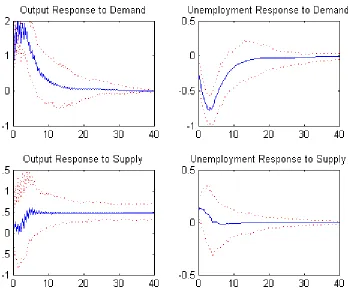
long-run constraint without modification. The responses of output and
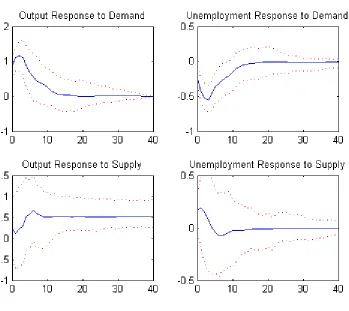
un-employment to the demand and supply shocks are plotted in Figure 2. For
comparison, the results of a Bayesian version of the quarterly data VAR are
shown in Figure 1, which is essentially a replication of Blanchard and Quah
(1989). Note that in their paper the confidence interval is based on one
stan-dard deviation, while we plot the Bayesian 95% credible interval with highest
posterior density (HPD). The dynamic patterns are consistent with those in
the original paper but the HPD bands are narrower, which demonstrates
efficiency gains due to making full use of the monthly unemployment data.
The second application is a structural VAR model with short-run
restric-tions. Christiano et al. (1998) propose a block diagonal recursiveness
assump-tion to identify monetary policy shocks. The variables in the VAR system are
6
Estimation with 8, 12, 24 lags produces little difference in the shape of the impulse
classified into three groups. The second group consists of only one monetary
policy instrument, whose innovations reflect monetary policy shocks. The
identification assumption is that the policy instrument has no
contempora-neous effect on the variables in the first group, and the third group has no
contemporaneous effect on the previous two groups. This assumption enables
a partial identification of monetary shocks by cholesky decomposition,
leav-ing other shocks unidentified. We put GDP and the CPI in the first group,
federal funds rate (FF) as the policy instrument and the money stock M1 in
the third group. Monthly data of the CPI, FF and M1 are available while
GDP data are quarterly. The sample period is chosen as 1974:01 to 2006:12
since there might be structural breaks before and after that time interval.
Data are Hodrick-Prescott filtered for we are interested in the cyclical
com-ponent of the data. There is a tradeoff between richer dynamics with more
lags and harder estimation with more parameters. In a four-variable VAR,
an additional lag means 16 more parameters. We allow 4 lags in the
quar-terly data VAR (by averaging the monthly data other than GDP) and 6 lags
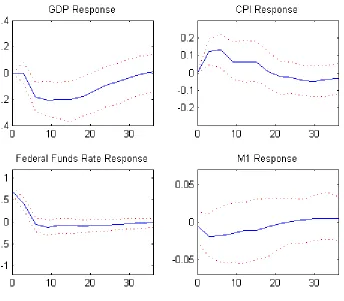
in the monthly VARDAS model. Impulse response functions using quarterly
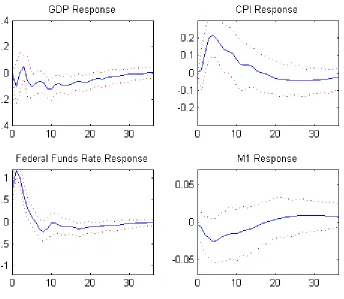
data are reported in Figure 3 and the results with mixed data are plotted in
Figure 4. Unlike the case of long-run identification, Figure 3 and 4 are not
directly comparable in that the short-run identification constraints, though
in the same format, should be interpreted differently. In the quarterly data
VAR, to identify the monetary shocks we require monetary shocks have no
effects, so there are grounds for believing Figure 4 presents a more reliable
dynamic picture on how the economy responds to monetary shocks. This
is a major advantage of the VARDAS model in structural shocks
identifica-tion with short-run economic constraints. After a contracidentifica-tionary monetary
shock, GDP and M1 react negatively as expected, but the CPI rises steadily,
a phenomenon long documented in the literature as the price puzzle (Sims,
1992; Eichenbaum, 1992). Christiano et al. (1998) suggest including an index
of sensitive commodity prices can resolve the anomaly, a topic beyond the
Figure 1: The dynamic effects of demand and supply shocks with the quarterly GNP
growth and quarterly unemployment data. The solid line plots the posterior mean of the
impulse-response function and the dotted lines are the 95% HPD credible bands. Figure
Figure 2: The dynamic effects of demand and supply shocks with the quarterly GNP
growth and monthly unemployment data. The solid line plots the posterior mean of the
impulse-response function and the dotted lines are the 95% HPD credible bands. It is
estimated by the monthly VARDAS model, but the unit of the horizontal axis is adjusted
Figure 3: The dynamic effects of monetary policy shocks with the quarterly data. The
identification constraints are monetary shocks have no contemporaneous effects on the
Figure 4: The dynamic effects of monetary policy shocks with the monthly data except
for quarterly GDP, estimated by the VARDAS model. The identification constraints are
monetary shocks have no contemporaneous effects on the output and price in a month. The solid line plots the posterior mean of the impulse-response function and the dotted
7. Conclusion
The structural VAR model has been fruitfully applied in macroeconomics
to unveil the dynamic paths of economic variables responding to nominal or
real shocks. Such an analysis involves two stages in general. The first stage
is to estimate a reduced-form VAR model and invert to its moving
aver-age representation. In the second staver-age, restrictions are imposed to identify
structural shocks so as to conduct impulse response analysis. The second
stage embodies scientific insights of the macroeconomists and is
undoubt-edly the core of the VAR analysis, while the first stage is largely statistical
and mechanical. However, a better estimate of the reduced-form VAR model
translates to a more accurate impulse-response curve, and thus presents a
more transparent picture of dynamic relations in the macroeconomy. The
VARDAS model only operates on the first stage. Varied frequency data
are reconciled neither in an aggregated model by averaging nor in a
disag-gregated model by imputation. They are harmonized in one Bayesian model
that makes full use of the available information to sample the latent variables.
Technical details aside, the VARDAS approach just provides a more precise
estimate of the model parameters, leaving intact the economic insights that
hallmark the structural VAR analysis.
Amemiya, T., Wu, R. Y., 1972. The effect of aggregation on prediction in
the autoregressive model. Journal of the American Statistical Association
67 (339), 628–632.
Andreou, E., Ghysels, E., Kourtellos, A., 2010. Regression models with mixed
Aruoba, S. B.and Diebold, F. X., Scotti, C., 2009. Real-time measurement
of business conditions. Journal of Business & Economic Statistics 27 (4),
417–427.
Blanchard, O. J., Quah, D., 1989. The dynamic effects of aggregate demand
and supply disturbances. American Economic Review 79 (4), 655–73.
Breitung, J., Swanson, N., 2002. Temporal aggregation and spurious
instan-taneous causality in multiple time series models. Journal of Time Series
Analysis 23 (6), 651–665.
Camacho, M., Perez-Quiros, G., 2010. Introducing the euro-sting: Short-term
indicator of euro area growth. Journal of Applied Econometrics 25 (4),
663–694.
Chen, B., Zadrozny, P., 1998. An extended yule-walker method for estimating
a vector autoregressive model with mixed-frequency data. In: NBER/NSF
Time Series Conference.
Chiu, C., Eraker, B., Foerster, A., Kim, T. B., Seoane, H., 2011. Estimating
var sampled at mixed or irregular spaced frequencies: A bayesian approach
(manuscript).
Christiano, L. J., Eichenbaum, M., Evans, C. L., 1998. Monetary policy
shocks: What have we learned and to what end? (6400).
Clements, M. P., Galvao, A. B., 2008. Macroeconomic forecasting with
mixed-frequency data. Journal of Business and Economic Statistics 26,
Clements, M. P., Galvao, A. B., 2009. Forecasting us output growth using
leading indicators: an appraisal using midas models. Journal of Applied
Econometrics 24 (7), 1187–1206.
Eichenbaum, M., 1992. Comment on interpreting the macroeconomic time
series facts : The effects of monetary policy. European Economic Review
36 (5), 1001–1011.
Ghysels, E., Santa-Clara, P., Valkanov, R., 2006. Predicting volatility:
get-ting the most out of return data sampled at different frequencies. Journal
of Econometrics 131 (1-2), 59–95.
Ghysels, E., Sinko, A., Valkanov, R., 2007. Midas regressions: Further results
and new directions. Econometric Reviews 26 (1), 53–90.
Hyung, N., Granger, C. W., 2008. Linking series generated at different
fre-quencies. Journal of Forecasting 27 (2), 95–108.
Kuzin, V., Marcellino, M., Schumacher, C., 2011. Midas vs. mixed-frequency
var: Nowcasting gdp in the euro area. International Journal of Forecasting
27 (2), 529–542.
Marcellino, M., 1999. Some consequences of temporal aggregation in
empir-ical analysis. Journal of Business & Economic Statistics 17 (1), 129–136.
Marcellino, M., Schumacher, C., 2010. Factor midas for nowcasting and
fore-casting with ragged-edge data: A model comparison for german gdp.
Mariano, R. S., Murasawa, Y., 2003. A new coincident index of business
cycles based on monthly and quarterly series. Journal of Applied
Econo-metrics 18 (4), 427–443.
Mariano, R. S., Murasawa, Y., 2010. A coincident index, common factors,
and monthly real gdp. Oxford Bulletin of Economics and Statistics 72 (1),
27–46.
Mittnik, S., Zadrozny, P. A., 2004. Forecasting quarterly german gdp at
monthly intervals using monthly ifo business conditions data.
Silvestrini, A., Veredas, D., 2008. Temporal aggregation of univariate and
multivariate time series models: A survey. Journal of Economic Surveys
22 (3), 458–497.
Sims, C. A., 1980. Macroeconomics and reality. Econometrica 48 (1), 1–48.
Sims, C. A., 1992. Interpreting the macroeconomic time series facts: The
effects of monetary policy. European Economic Review 36 (5), 975–1000.
Tiao, G. C., 1972. Asymptotic behaviour of temporal aggregates of time
series. Biometrika 59 (3), 525–531.
Tiao, G. C., Wei, W. S., 1976. Effect of temporal aggregation on the dynamic
relationship of two time series variables. Biometrika 63 (3), pp. 513–523.
Zadrozny, P., 1988. Gaussian likelihood of continuous-time armax models
when data are stocks and flows at different frequencies. Econometric