Munich Personal RePEc Archive
Attributes and Dynamic Development
Phases of ICT Standards Consortia
Pohlmann, Tim
Technical University Berlin, Cerna, Centre d’économie industrielle.
MINES ParisTech,
1 March 2010
Online at
https://mpra.ub.uni-muenchen.de/47264/
Attributes and Dynamic
Development Phases of ICT
Standards Consortia
Tim Pohlmann
1Abstract
Standards consortia are private industry alliances that serve a certain purpose and gather
likeminded companies that share the same interest to sponsor and develop technologies for
standardization. Compared to formal standard setting, participation in consortia is less
bureaucratic, more efficient in reacting to market needs and allows, in respect to the tiered
membership structures, a strategic influence of standard setting outcomes. Formal
standardization is in contrast an often protracted process of development and negotiation.
This paper tries to provide a broad and comprehensive picture of standards consortia and
their dynamic development in the past ten years. Analyses show that consortia have distinct
characteristics which help to explain and justify their presence in the standard setting context.
The observation of consortia existence over time identifies relationships between the
formation, termination and merger of consortia with respect to market and technology
development. Furthermore the paper seeks to measure consortia performance with respect to
organizational structures and market position. Therefore we test the likelihood of consortia
termination. Results of a survival analysis reveal that the probability of consortia success is
especially connected to structures that determine coordination among members. Additionally
the scope and focus on technology and markets also influences if consortia remain in business
over time.
1
1
1.
Introduction
In the past years the complexity and speed of technological development has constantly been
increasing. Especially in the field of information and communication technologies (ICT),
markets show evidence of a higher variety of products and solutions in a more frequent
manner (David, 1996). The need for technological standardization is growing (Blind et al.,
2010), but the complexity and speed challenge companies in their coordination activities.
Standard setting is a complex process, which is dependent on consensus agreements between
often competing organizations. These processes can take several years. Especially formal
standard bodies are sometimes not able to keep up with the market pace (Cargill, 2002). Since
fast changing markets required more flexible solutions to set standards, the standardization
landscape has changed over the past twenty years (Updegrove, 2008). Today not only formal
standard developing organizations (SDOs), but also informal industry driven standard setting
organizations such as consortia, produce widely adopted and important standard solutions.
Other than formal organizations, which produce so called “de jure standards”, informal
consortia create and promote mostly “de facto standards” (Jakobs, 2004). For the latter we can
further distinguish between a “de facto standard” developed by a single firm and a “consortia
standard”, where the standard is set by a group of firms (Bunduchi et al., 2008).
Formal standardization is often time consuming and can take several years, whereas
informal consortia are more flexible and able to anticipate technological development and
thus set the standard right in time (Cargill, 2002). Even though informal standard
specifications are agreed on without a formal accreditation, they can still be widely accepted
and of great importance or even follow up a certain formal standard (Blind et al., 2010). Yet,
there is no common definition for a standards consortia and the consortia landscape has
developed to be very heterogeneous in characteristics such as technical issues, structure,
members, transparency or IP policies (Hawkins, 1999). Updegrove (2008) defines consortia
as being “anything from a loose, unincorporated affiliation of companies, to an incorporated
entity with offices, marketing, technical and administrative staff and a multi-million dollar
budget”. He distinguishes between specification groups which agree to promote an industry
standard, research consortia with the main intent of creating and developing a technologic
solution and strategic consortia which focus on the adoption of a technology or the
formulization of a yet informal common practice (Updegrove, 1995).
In this article we consider standards consortia which meet the criteria set by the ISSS
2
- The organization must be international in outlook and scope, not simply an instrument
of single-nation policy,
- must have an active and international membership,
- must not be set-up specifically as a single vendor, government, or proprietary
technology advocacy group,
- must be of importance to the areas of standardization or its processes (CEN/ISSS,
2009).
In Europe (Council of the European Union, 2000) and in the US (Center for Regulatory
Effectiveness, 2000) standards consortia are recognized as being organizations that influence
standard setting processes, but which are not officially recognized (Egyedi, 2001). So far
there has not been much empirical work on the role of consortia. Earlier work mostly focuses
on theoretical explanations for the existence of consortia (Cargill, Weiss 1992: Updegrove
1995; Axelrod et al., 1995; Hawkins, 1999; Bunduchi et al., 2008). More current research
uses a case study approach and characterizes and compares the processes of informal
consortia such as Updegrove (1995): X Consortium and Open GIS Consortia, Egyedi (2001):
W3C and ECMA, Coulon (2004): Symbian Alliance, Anderson (2008): ECMA, IETF, OASIS,
OMG and W3C, Koenig (2008): FlexRay, Autosar and Jaspar, Grotnes (2009): Open Mobile
Alliance (OMA). A first comprehensive analysis on the evolution of standards consortia was
done by Blind & Gauch (2008). They accessed a dataset of more than 250 consortia to map
the change of consortia between 2000 & 2004 and found evidence for a complimentary
relationship of formal and informal standard setting activities. Other empirical contributions
rather focus on the effects of consortia in terms of coordination outcomes and efficiency
(Leiponen, 2008; Delcamp and Leiponen; 2012; Baron et. al., 2012).
This paper presents a unique dataset of over 400 standards consortia. Consortia are
analyzed by characteristics, attributes, membership, active markets and industries as well as
by the dynamics of consortia evolution over the last 10 years. The article uses 14 editions of
the ISSS CEN survey on ICT standards consortia. Further information was added exploiting
the consortia database of Andrew Updegrove (http://www.consortiuminfo.org/). To retrieve
historical membership information on consortia activity as well as memberships, the paper
3
2.
Theoretical Considerations
In many literature sources, standards consortia are described as explicit alliances or groups,
which are especially formed when the fast evolution of technology requires coordination
mechanisms (Axelrod et al., 1995). Such alliances are further defined as groups of companies
where the benefits of the collective activity arise from a commonly produced public good
(Olson, 1971; Cargill and Weiß, 1992). Irrespective of the costs of producing the public good,
the good is equally available to all members. However, members’ benefits and incentives to
invest may differ (Kindleberger, 1983). Groups emerge when a single firm is incapable of
producing a certain good itself. Firms thus join groups when the collective activity is
beneficial and exceeds the costs of membership. Incentives to join or leave the group are
simply related to a cost-benefit analysis, though groups may scale costs to counteract
defection (McGuire, 1972). The size of the group matters as a factor of effective coordination.
As to Olson (1971), coordination failures such as “cheating” or “free-riding” diminish when
the group is held respectively small. Furthermore, the costs of coordination increase with the
size of the group. Groups are characterized as “exclusive” groups when the collective good
increases by excluding others. In comparison “inclusive” groups are these, where it is more
beneficial to include as many market participants as possible.
Group formation in standard setting postulates a special case of coordination and
collective benefits. Standards are subject to network externalities since users of a standard
obtain benefits not only from the technology itself but furthermore depend on the share of
users in the market. Thus, the success of a standard always depends on the installed base of
users (David and Greenstein 1990). When network externalities are significant, firms have to
coordinate in product development processes. This coordination can be reached by
standard-writing committees such as standard consortia (Weiss, Sibru, 1990). Besen and Johnson
(1986) list several conditions for successful coordination in standard setting. In this sense, the
consortia should gather a certain market share of the industry, the group should not be subject
to antitrust objections and members should reduce the number of technological alternatives to
reach consensus while further eliminating subjective disputes.
In conclusion, standards consortia are subject to network externalities, while also
inhibiting coordination failures of a group. Oslen (1971) argued that small groups benefit
from coordination efficiencies. In comparison Axelrod (1995) states that consortia are
especially successful when they gather most market players. The latter argument is further
4
sponsoring the standard (David and Greenstein, (1990). To a certain extent standards
consortia are inclusive, since a common standardization project is only reasonable when a
sufficient number of market players participate. However, standards consortia pursue a
particular approach to standardization compared to formal standard bodies. While formal
standardization seeks consensus decisions and is open to all market participants, standards
consortia are more closed in their membership rules. Membership fees, more regular meetings
and a certain interest to influence technologies in early stages differentiate consortia from
formal bodies. A consortium can thus be seen as an exclusive group of firms that are more
committed to standardization or have a particular interest in a technology. However, consortia
are inclusive to the limits of likeminded companies that share the same interests.
3.
Methodology
This paper uses a broad approach to illustrate the dynamic landscape of ICT consortia over
the past ten years. The research is based on the use of two data bases that have assembled
more than 700 informal standards consortia since 1998. The CEN survey provides
information on 435 informal ICT standardization consortia. These consortia have been
selected based on transparent and objective selection criteria, which are stated above. The
survey by Andrew Updegrove2 provides information on 555 consortia, 276 of which are not
covered by the CEN survey. Both data sources indicate the tiering of membership, the
consortium scope, technical categories, industry sectors, IP policies and years of existence.
The number and identification of consortium members (including 20,000 independent entities
in more than 35,000 consortium memberships), was retrieved by an internet search using data
from historic homepages from the internet archive waybackmachine (http://archive.org). To
get a complete picture of the informal standard setting landscape, information from all
databases were matched. However, to guarantee database compliance, time series analysis
only uses information from fifteen editions of the ISSS CEN survey from 1998 until 2009.
Furthermore, not all consortia could be classified in their respective attributes, since some
consortia do not provide distinct information. Attributes such as industry sector, technical
category, business spectrum and IP policy were only assessed from the CEN survey data.
Finally, we build up a data panel over the time span of 1998-2009 to better assess
organizational effects on consortia survival. We apply one year periods and use consortia
termination as our event of failure.
2
5
4.
Empirical Analysis
4.1 Consortia Characteristics and Attributes
In contrast to formal standard bodies where structures are fixed and default, the formation
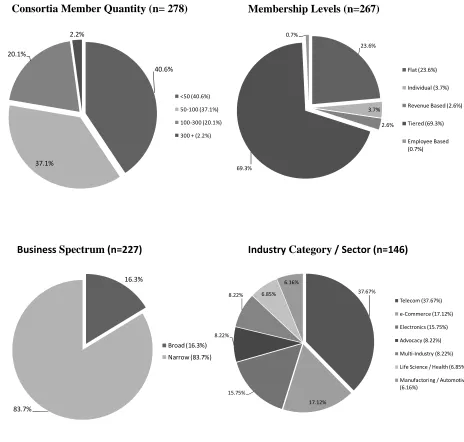
process of informal consortia allows a variety of organizational choices. The four charts in
figure 1 give a vivid picture of informal ICT consortia characterized by member quantity,
membership levels, business spectrum and industry sector. The two former attributes reveal
information on specific member information such as quantity and member levels. The latter
two charts illustrate the sector and the scope of involvement.
[image:7.595.67.531.285.727.2]
Figure 1 Characteristics and attributes of informal ICT standards consortia
Membership Levels (n=267) Consortia Member Quantity (n= 278)
Business Spectrum (n=227) Industry Category / Sector (n=146)
16.3% 83.7% Broad (16.3%) Narrow (83.7%) 37.67% 17.12% 15.75% 8.22% 8.22% 6.85% 6.16% Telecom (37.67%) e-Commerce (17.12%) Electronics (15.75%) Advocacy (8.22%) Multi-Industry (8.22%)
Life Science / Health (6.85%)
Manufactoring / Automotive (6.16%) 40.6% 37.1% 20.1% 2.2% <50 (40.6%) 50-100 (37.1%) 100-300 (20.1%) 300 + (2.2%)
6
Most consortia have a considerably low amount of members, since 77.7% have less than 100
participants, 20.1% have 100-300 members and only 2.2% list more than 300 members. To
illustrate the scope of involvement in standard setting among consortia, the business spectrum
was classified into broad and narrow. Only 16.3% of the consortia follow a broad spectrum of
standardization, which is comparable to structures in formal standard bodies. The so called
“one purpose consortia” usually pursue only one standard or specification and their business
can therefore be classified as narrow (83.7%). These findings can be related to the quantity of
memberships. The data shows that most narrow consortia tend to have a lower amount of
members. A possible assumption is that this leads to more effective and flexible decision
making processes within consortia. Both attributes are distinct characteristics to differentiate
consortia from formal standard bodies, since the latter mostly follow a broad business
spectrum and tend to have a higher number of members. The evaluation of the CEN survey
further provides information on the primary and secondary industry sector where a particular
consortium is active in. These findings indicate a very heterogeneous picture of the consortia
landscape. In order to better frame these results, data was aggregated into seven categories.
Over a third of the consortia produce standards for the telecommunication industry (37.67%).
E-Commerce (17.2%) and electronics (15.75%) also make up one third of the consortia target
industry. Less ICT related industries such as advocacy, life-science, manufacturing and
multi-industry summarize the last third of consortia target industries. These results are in line with
most researchers’ assumptions that especially ICT industries rely on more flexible and quick
standard solutions developed by informal consortia.
The chart of membership levels illustrates the hierarchical structures of consortia. A
flat membership structure can only be found in 23.6% of the regarded consortia. The findings
indicate that informal standard setting is in many cases strategically dominated by market
power and revenue of commercial entities and vendors. Organization types and shares per
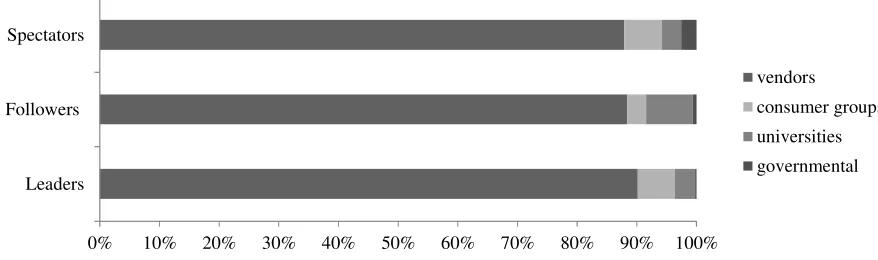
member level can be consulted in figure 2. The graph shows that 93.56% of the members are
vendors and other commercial entities, whereas universities and colleges account for only
7
Figure 2 Consortia membership structure
As to the results of the survey, 69.3% of the standards consortia have tiered membership
structures, where the member levels can in general be differentiated into Leaders, Followers
and Spectators.
Figure 3 Consortia membership structure as to shares in tiered levels
Using this classification by Updegrove (2008) data analyses indicate that the Leader level is
dominated by commercial entities, most universities can be found in the Follower and Leader
level and governmental entities and consumer groups mostly choose the Spectator level
(figure 3). However, all member levels are strongly dominated by vendors. In most cases
membership fees are scaled, since Leaders usually pay higher dues. Thus they have more
voting or veto power and are able to strategically influence the standard setting process. In
consequence membership levels often reflect the balance of member power (Updegrove,
2008).
A very political and lately often discussed topic is the interplay of IPR and standards.
In comparison to formal standard bodies, the IP policies of consortia are not always
transparent and distinct. Thus only 95 consortia could be classified appropriately.
93,56 % 3,75 %
2,52 % 0,17 %
0 20 40 60 80 100
vendors and other commercial entities
consumer groups universities and
colleges governmental entities
0% 10% 20% 30% 40% 50% 60% 70% 80% 90% 100%
Leaders Followers Spectators
vendors
consumer groups
universities
[image:9.595.74.513.325.455.2]8
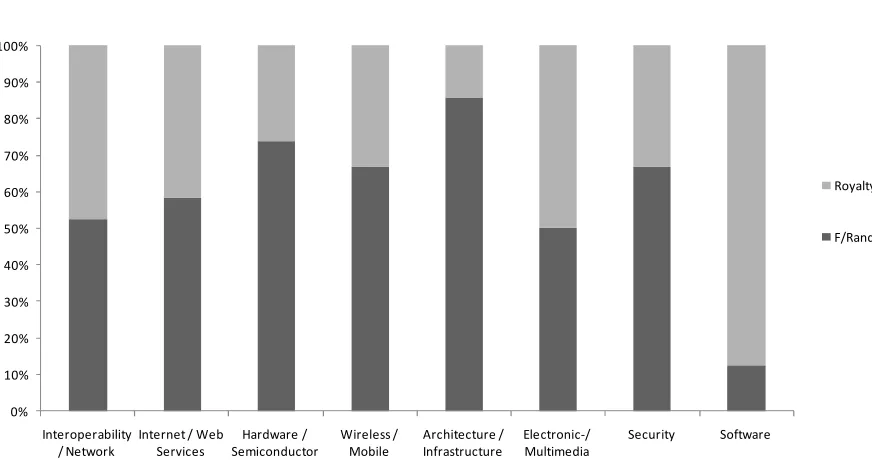
Figure 4 IP policy statements of consortia per technical class
The survey differentiates between royalty free and FRAND (Fair Reasonable and
Non-Discriminatory) IP policies. Standard setting organizations often mandatorily require firms
participating in standard setting to disclose any patent that might turn out to be essential for
the standard in question. Furthermore holders of such patents have to submit a declaration on
whether they accept to commit on fair, reasonable and non-discriminatory terms for licensing
these patents (FRAND commitments). If a firm discloses a patent and refuses to commit on
such licensing terms, the standard organization will usually set the standard excluding the
protected technology. Even though standardization may be accompanied by complex
licensing agreements, the rules for licensing of complementary patents essential for a common
standard are often unclear and can be subject to complex discussions. Nevertheless, FRAND
commitments are commonly seen as an important instrument to curb anticompetitive and
abusive strategies. In situations of royalty free commitments firms may include patents into
standards but commit upfront to not charge royalties (Layne-Farrar et al. 2007; Farrell et al.
2007).
As to the CEN survey 54.7% of the consortia follow a FRAND policy, whereas
43.3% of the consortia use royalty free IPR regulations. To better assess these results,
consortia were also classified in their technical classes. Figure 4 illustrates the IP Rules of
consortia per technology. The graph shows that IP policies differ between technologies and it
thus seems presumable that the technical topic determines the pursued IPR rules. The high
number of royalty free consortia in software is on the one hand due to several open source 0% 10% 20% 30% 40% 50% 60% 70% 80% 90% 100% Interoperability / Network
Internet / Web Services Hardware / Semiconductor Wireless / Mobile Architecture / Infrastructure Electronic-/ Multimedia
Security Software
Royalty Free
F/Rand
9
consortia which can be found within this class and can on the other hand be explained by the
fact that IPR on software is restricted in several countries. Explanations of other technological
classes are not always obvious and have to be assessed on a lower level of aggregation, since
IPR rules differ between specific products and companies involved. However, one has to
consider that F/RAND policies may also allow to license essential patents royalty free.
4.2 Consortia Development Phases
There are several articles that describe the development of standardization with respect to the
formation and evolution of informal consortia (Hawkins, 1999; Cargill 2002; Jakobs, 2003;
Updegrove 2008). However, there is yet no comprehensive quantitative approach to examine
the survival of standards consortia over time. Using the CEN survey editions between 1998
and 2009 the data assembles a current list of ICT consortia for every year and even twice a
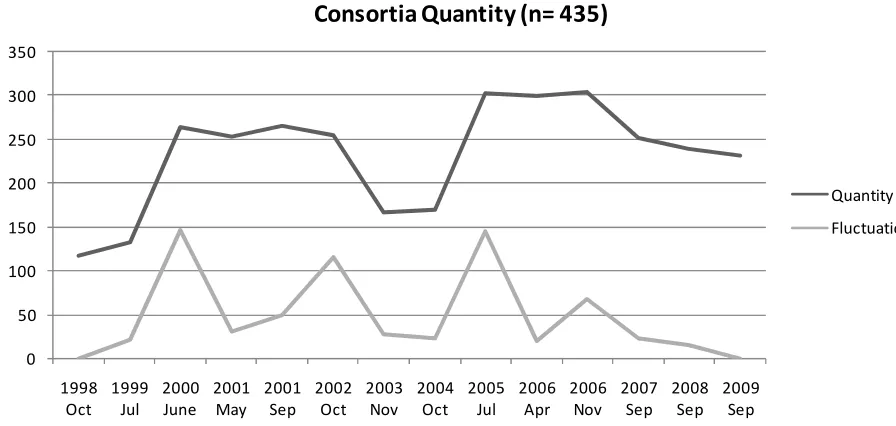
year in 2001 and 2006. Figure 5 shows the quantity of consortia at the respective point of
time, also indicating the fluctuation rate, which is the sum of new and terminating consortia.
To consider consortia evolution with respect to the standardized technologies, figure 6
[image:11.595.77.525.428.641.2]illustrates the consortia development assigned to the respective technology class.
Figure 5 Evolution of ICT standards consortia 1998-2009
Since the mid-1990ies the increasing formation of consortia can be explained by the rise of
the internet market, where the first peak of development is in June 2000, counting 123 new
consortia compared to July 1999. This period is characterized by strong standard battles
(Microsoft Explorer vs. Netscape Navigator) and the rise of future influential consortia in the
0 50 100 150 200 250 300 350 1998 Oct 1999 Jul 2000 June 2001 May 2001 Sep 2002 Oct 2003 Nov 2004 Oct 2005 Jul 2006 Apr 2006 Nov 2007 Sep 2008 Sep 2009 Sep
Consortia Quantity (n= 435)
Quantity
10
internet infrastructure such as the Internet Engineering Task Force (IETF) or the World Wide
Web Consortium (W3C) (Cargill, 2002; Updegrove, 2008). Figure 6 shows that the class
Internet / Web Services increased from a share of 14.47% in July 1999 to 20.16% in May
2001.
The next fluctuation peak can be found in 2002, where 107 consortia were
terminated compared to May 2001. Taking a closer look at the technology class development,
especially the percentage of Internet / Web Service consortia decreased from 20.44% in
October 2002 to 16.67% in November 2003. Also Security and Wireless / Mobile decreased
in their shares between 2-3%. A deeper look at the data also shows a consolidation process.
Several consortia were not dissolved but merged with other consortia. The consortia amount
remained stable in other technology classes and thus gained an increase of share.
Taking into account the burst of the “dot-com bubble” between 2000 and 2001 where
the NASDAQ Composite had a historical decrease, these economic developments also led the
consortia formation into a recession. The results are evidence for the close relation of market
development and consortia formation. Thus the findings show how quickly consortia standard
[image:12.595.78.504.424.659.2]setting activities are able to react to economic developments and changing market needs.
Figure 6 Consortia technology development 1998-2009
A significant period of consortia formation started in 2005. Between October 2004 and July
2005 the CEN Survey data identifies an amount of 133 new consortia. The technical class
development shows that the share of software orientated consortia tripled within one year. Software
Interoperability / Network Internet / Web Services Hardware / Semiconductor
Wireless / Mobile Architecture / Infrastructure Electronic Media / Multimedia
Security
0% 10% 20% 30% 40% 50% 60% 70% 80% 90% 100%
1998 Oct 1999 Jul 2000 June 2001 May 2001 Sep 2002 Oct 2003 Nov 2004 Oct 2005 Jul 2006 Apr 2006 Nov 2007 Sep 2008 Sep 2009 Sep
11
This development was especially due to a new awareness of open standards in general and the
rise of the open source consortia in particular. One third of the software consortia can be
distinctly identified as open source projects. Except for Internet / Web Services a new
formation of consortia in all technical classes has taken place. This gives evidence for an
increasing broader appreciation of standard setting consortia.
Since the highest peak level in 2006, counting a quantity of 304 consortia, the
formation of new consortia remained on a constantly low level in the years to come. In
contrast between September 2006 and 2007 the second highest peak of consortia termination
took place, as 50 consortia ended their business or merged with others. Again these findings
can be linked to economic events, as the US subprime mortgage crises took place in 2007,
which later triggered the worldwide financial crises starting in 2008. The findings are able to
reflect the close connection of consortia development and industry performance. The timing
of consortia formation and termination again indicates that consortia formation is more
flexible and dynamic and thus able to react immediately to ups and downs of market
development.
4.3 Consortia Performance
In order to measure the performance of standards consortia we apply a survival analysis over
the whole sample of our survey. The survival or termination of consortia may be subject to
multiple occurrences. In our preceding section we have discussed consortia termination as a
result of technology or market shocks. Consortia termination may consequently be the
implication of technology obsolescence or economic recession. However, reasons for
dissolving a consortium may also be connected to organizational structures or performance.
In some cases the purpose to form a consortium is to standardize a specific
technology without the intention to continue development once the project is finalized.
Consortia termination would thus be the consequence of previous decisions. Furthermore,
consortia often operate similar to commercial corporations with permanent employees, a
budget, income streams and customers. If business goals cannot be achieved anymore
consortia may dissolve and go bankrupt. Since the purpose of standardization is always
connected to coordination of firms, disputes and discrepancies may be another reason why a
consortium is dissolved. We have discussed that consortia are special interest groups that
pursue a common goal. If these interests and goals diverge, collective activities may be ended.
In the following we seek to measure which consortia structures would survive longer
12
the probability that a consortium terminates. Survival estimates are the likelihood that an
observation will “survive” for a specific time. At each time in our analysis, only consortia that
have been observed are taken into account. The following statistics are therefore not subject to
truncation problems. Downward steps of the survival function represent failures. The y axis
[image:14.595.71.519.188.343.2]denotes the percentage of consortia that survive over time as to years on the x axis.
Figure 7 Kaplan-Meier survival estimates of consortia termination by consortia focus and IP
policy
Results from figure 7 represent the survival functions of consortia as to consortia focus and IP
policy. The left graph shows that standards consortia which pursue a broad focus in their
standards projects survive respectively longer compared to narrow purpose consortia. Results
indicate that after 10 years almost 50% of narrow focused consortia are terminated. This
finding may confirm the notion that consortia are in some cases formed to solve a very
specific problem over a limited period of time. Survival of these so called “one purpose
consortia” would thus be subject to planned termination. However one could also argue that
consortia which are able to extend their business focus to additional standards projects are
more successful and thus survive respectively longer.
In the right graph in figure 7, we estimate whether the differences of IP polices have
an influence on consortia survival. To make results of the Kaplan-Meier survival test visible
we changed the scale of our y axis. However, survival developments seem to show no
significant differences between the two licensing schemes. Only in periods after seven years
consortia with a royalty free policy seem to survive longer, while the survival rate decreases
after ten years to the same level as FRAND policy consortia. These developments may
furthermore be connected to the technology that is developed (figure 4). We argued earlier
that FRAND commitments also include royalty free agreements. Yet analysis is far from
13
Consortia size is a crucial factor that influences both; consortia coordination among
members and market power. The costs of coordination increase with the number of members.
Large groups may inhibit coordination failures such as “free riding” or “war of attrition”
(Olson, 1971; Farrell and Simcoe, 2012). This may result in disputes and in cases of hardship
lead to consortia termination. In comparison, we argued that the success of a standard is
connected to a large group of companies that sponsor the standardized technology (David and
Greenstein, 1990; Axelrod et al., 1995). Figure 8 compares five categories of consortia
membership quantity and observes the survival curve over time. Again we adjusted the scale
of survival rates in our y axis to make results visible. Large consortia with 200-300 and
300-1000 members survive the longest over the years. Rather small consortia in comparison <50
and 100-200 terminate in earlier periods. These results support the argument that consortia
which gather a larger number of industry players are more successful and seem to operate
significantly longer than small consortia. However, we have to keep in mind that narrow “one
[image:15.595.154.441.376.571.2]purpose consortia” with a planned termination are considerably smaller than others.
Figure 8 Kaplan-Meier survival estimates of consortia termination by membership size
Consortia membership may influence termination not only by size but also by membership
structures. We conduct another survival analysis and estimate if different membership
arrangements influence survival rates. Figure 9 illustrates that for consortia with individual
membership structures termination is more likely compared to others. Individual members
participate not as a corporation but as individual persons. Members may still serve the interest
of a group or company but participate in meetings and conferences individually. These
14
subject to corporate strategies. Again we assume these consortia to be limited in time and
[image:16.595.152.441.128.323.2]scope which would result in earlier termination.
Figure 9 Kaplan-Meier survival estimates of consortia termination by membership tiers
In consortia where membership fees are revenue based or tiered, members which pay higher
dues obtain more rights than others. As to the categorization of member levels in figure 3,
leader firms may get full and early access to information, may participate in all meetings, may
have certain veto or voting rights and may be part of the organizational management of the
consortia (Updegrove, 2008). Tiered member levels thus ensure that strong market players
can better influence standardization outcomes and bypass smaller entities which only
participate as spectators or followers. Compared to flat membership and founder based
membership, consortia with tiered structures more likely terminate over time (figure 9).
However, we would expect that coordination failures would be solved by hieratical tiered
structures. In comparison, in flat membership structures all members have the same rights,
which may lead to discrepancies. Even though theoretical considerations are opposed to our
finding, we could argue that tiered member structures are subject to a selection effect.
Companies that pursue certain interests or seek to sponsor technologies that are not shared by
other market participants may rather choose to join consortia where they can suppress others.
Thus consortia with tiered structures would experience participation of companies that would
15
5.
Conclusion and Discussion
This paper intends to give a broad overview of standards consortia, its characteristics,
organizational structures, policies and developments in the past ten years. Even though
empirical analysis is rather descriptive, results already introduce coherences in terms of the
consortia features and survival. Several characteristics differentiate the consortia phenomenon
from other standard setting activities. By combining the assessed consortia information,
relationships are revealed to deliver a more transparent picture of the consortia landscape. The
stereotypical consortium could hence be described as having usually less than 100 members,
following only one purpose of business, being hierarchical in its decision making structures
and due to tiered membership fees, is often dominated by vendors and commercial entities.
The stated IP policy is strongly connected to the produced technology. In contrast to formal
standard bodies, consortia are very flexible and react to market developments. This either
results in a formation as well as termination of businesses or mergers with other consortia.
Involvement in consortia standard setting enables members to gain quick and flexible
participation to influence the standardization process. Especially solvent vendors and
commercial entities can use their strong membership positions to strategically direct a certain
standard or specification.
This article further estimates survival rates to assess which consortia are successful
and stable and how consortia features correlate with termination and continuity of business. In
consideration of theoretical implications we show that especially structures of member
coordination as well as focus and positioning on markets determines consortia survival over
time. While termination may be planned for some consortia, others may close their business
due to problems that can be connected to a consortium’s organizational approach. We show
that larger consortia survive significantly longer compared to smaller consortia. However,
when membership levels are tiered termination is more likely. Furthermore a narrow focus on
certain technologies also leads to earlier termination, while the adopted IP policy seems to
16
References
Anderson, P. (2008). Evaluation of Ten Standard Setting Organizations with Regard to Open
Standards, Prepared for I T - o g Telestyrelsen, IDC Special Study.
Axelrod, R., S. Bennett, E. Bruderer, W. Mitchell, R. Thomas. 1995. Coalition formation in
standard-setting alliances. Management Sci. 41(9) 1493–1508.
Baron, J., Ménière Y., Pohlmann, T. (2011) "R&D Coordination for Standardization: the Role
of Consortia", Cerna Working Paper.
Blind, K.; Gauch, S. (2008).Trends in ICT standards in European standardization bodies and
standards consortia. Telecommunication Policy, 32, 503–513.
Blind, K.; Gauch, S.; Hawkins, R. (2010): How stakeholders view the impacts of international
ICT standards, Telecommunications Policy, 34, No.3, 162-174.
Bunduchi, R.; Graham, I.; Smart, A.; Williams, R. (2008). Homogeneity and heterogeneity in
information technology private standard settings – the institutional account, Technology
Analysis & Strategic Management Vol. 20, No. 4, July 2008, 389–407.
Cargill, C.; Weiss, M. (1992). Consortia in the Standards Development Process, Journal of the
American Society for Information Science, Volume 43 Issue 8, 559 – 565.
Cargill, C. (2002). Intellectual Property Rights and Standards Setting Organizations: An
Overview of failed evolution, A Report Issued By the U.S. Department of Justice and the
Federal Trade Commission, March 2002.
CEN/ISSS (2009). CEN/ISSS survey of standards-related fora and consortia, 15th edition,
Brussels, October 2009.
Coulon, F. (2004). Proprietary standardisation in consortia –the case of the Symbian alliance,
Research Design 9th EURAS Workshop on Standardisation, May 13-14th, 2004.
David, P. A., Greenstein, S., 1990. The economics of compatibility standards: An introduction to recent research. Economics of Innovation and New Technology 1, 3-42.
David, P. A. (1996). Formal standard-setting for global telecommunications and information
services. Telecommunications Policy, 20, 789–815.
Delcamp, H., Leiponen, A., 2012. Innovating Standards Through Informal Consortia: The
17
Egyedi, T.M. (2001), Beyond Consortia, Beyond Standardisation? New Case Material and
Policy Threads. Final Report for the European Commission. Delft. The Netherlands.
Farrell, Joseph; Hayes, John; Shapiro, Carl; Sullivan, Theresa (2007): Standard Setting,
Patents, and Hold-Up; 74 Antitrust L.J. 603.
Farrell J., Simcoe, T., 2012. Choosing the Rules for Consensus Standardization. Unpublished
manuscript. Electronic copy available at: http://ssrn.com/abstract=1396330.
Grotnes, E. (2009). Standardization as open innovation: two cases from the mobile industry,
Information Technology & People, Volume 22, Number 4, 367-381.
Hawkins, R. (1999). The rise of consortia in the information and communication industries:
emerging implications for policy. Telecommunication Policy, 23, 159–173.
Jakobs, K. (2003). Information Technology Standards, Standards Setting and Standards
Research. Presented at: Stanhope Centers Roundtable on systematic barriers to the
inclusion of a public interest voice in the design of ICT, Cotswolds Conference, December
2003.
Jakobs, K. (2004). ICT Standards Development — Finding the Best Platform, Enterprise
Interoperability, Springer London, 543-552.
Kindleberger, C. P. (1983). Standards as public, collective, and private goods. Kyklos, 36, 377-397.
Koenig, R. (2008). New ways of standard-setting in technology-driven industries: the case of
automotive electronics in Japan and Germany, DRUID-DIME Academy Winter 2008 PhD
Conference.
Layne-Farrar, Anne; Padilla, A. Jorge; Schmalensee, Richard (2007): Pricing Patents for
Licensing in Standard-Setting Organizations: Making Sense of Fraud Commitments; 74
Antitrust Law Journal 671.
Leiponen, A., .2008. Competing Through Cooperation: The Organization of Standard Setting
in Wireless Telecommunications. Management Science 54-11,1904-1919.
McGuire, M.. 1972. Private Good Clubs and Public Good Clubs: Economic Models of Group
Formation. The Swedish Journal of Economics. Vol. 74, No. 1, Economics of Location:
Theory and Policy Aspects, pp. 84-99.
Olson, M. (1971). The logic of collective action: Public goods and the theory of groups.
18
Updegrove, A. (1995). Consortia and the Role of the Government in Standard Setting, in B.
Kahin & J. Abbate (Eds.). Standards Policy for Information Infrastructure, Cambridge:
MIT Press, 321-348.
Updegrove, A. (2008). The Essential Guide to Standards, Handbook of Consortium Info in: