Munich Personal RePEc Archive
Strategic asset allocation and
intertemporal hedging demands: with
commodities as an asset class
Su, Yongyang and Lau, Marco Chi Keung
1 October 2010
Online at
https://mpra.ub.uni-muenchen.de/26518/
Strategic Asset Allocation and Intertemporal Hedging
Demands: with Commodities as an Asset Class
Yongyang Su
*and Marco Lau Chi Keung
October, 2010
[Abstract]
This paper analyzes the role of commodities in the process of strategic asset
allocation, with an attempt of computing the weight of commodities relative to
traditional assets in a multi-period portfolio choice problem and understanding the
economic interpretations to its importance. We find U.S. investors have a
significantly stable intertemporal hedging demand for commodities in the long
horizons, even when they have access to foreign equity markets, for example,
foreign stock market. Our results provide support to institutional investors
attempting to include commodities into their strategic asset allocation decision.
1. Introduction
The idea of commodities as an investable asset class has been around since the
1970s. For example, Geer's (1978) study states that commodity future is a unique
and conservative asset which is as liquidity, but less risky than common stocks and
can be used to hedge inflation risk. Bodie and Rosansky's (1980) found that
portfolios of commodity futures have similar risk-return characteristics to
Standard and Poor's 500 stock indexes. However, strategic asset allocation in the
past century still consists primarily of allocations to the three traditional asset
classes: stocks, bonds and cash, while commodities receive little attention from
investors. As the equity and fixed income market keep deteriorating, the returns of
portfolios consisting of traditional asset classes are far lower than those during
1990s. To improve the risk-return characteristics of a strategic asset portfolio,
institutional investors are expanding the investable universe beyond the three
traditional asset classes and commodities have gained much prominence during
the past few years.
The purpose of this paper is to study the role of commodities in strategic
asset allocation and investors' portfolio choices. According to conventional
wisdom, commodity futures returns have been especially effective in providing
diversification of both stock and bond portfolios. Based on this, some observers
view the commodity market as an attractive asset class to diversify traditional
quantitative estimates of the percentage of portfolio allocation across commodities,
stocks, and bonds. In this paper we have three principal objectives. First, we
measure and analyze, in some detail, the demands for commodities as well as the
traditional asset classes in asset allocation. Second, we try to gain some insights
into the reasons for commodity's importance in portfolio choice. Third, we also
compare the utility benefits with and without including commodities as an asset
class.
Estimating the demands for asset classes in a multi-period portfolio
choice problem is complicated by the fact that exact analytical solutions are
generally not available. Finding a closed-form solution is, therefore, essential for
discerning the demands for various asset classes. One representative stream of
financial economists use discrete-state approximations to approximate the
solutions to multi-period portfolio choice problems in the Merton model; for
example, Balduzzi and Lynch (1999), Barberis (2000), Brennan et al. (1997, 1999),
Cocco et al. (1998), Lynch (2001), and Lynch and Tan (2010). The other stream
uses analytical approach to solve for multi-period portfolio choice problems by
assuming long-lived investors have various form of utility functions (e.g.,
Campbell and Viceira, 1999, 2001, 2002; Schroder and Skiadas, 1999). The most
recent stream by Campbell, Chan and Viceira(2003,; henceforth, CCV) combines
the analytical method of Campbell and Viceira (1999, 2001, 2002) with a simple
numerical method, vector autoregression (VAR). This approach has two
multi-period portfolio choice problems with large number of asset classes and (ii)
it can decompose intertemporal hedging demands into components associated with
individual asset classes. CCV uses this approach to analyze optimal dynamic asset
allocation across U.S. bills, stocks, and bonds and find significant intertemporal
hedging demands for U.S. stocks. Rapach and Wohar (2009) extend the analysis to
the G7 countries as well as the U.S. by allowing domestic investors to access
foreign equity markets. The analysis in this paper takes the advantage of this
approach and tries to detect the importance of commodity asset class in the
strategy asset allocation decision.
Both the implementation and empirical results are atypical in several
aspects. Our first novel result is that, in addition to the mean total demand and
hedging demand for stocks, the mean total and hedging demands for commodities
are also large in magnitude for an U.S. investor. The demands are stable in
magnitude, even when an investor can access to international stocks. The second
singular result is that the mean intertemporal hedging demand for commodities are
always significant according to the 90% confidence intervals, though its
magnitude is generally smaller than those for domestic stocks. Another novel
result is that there are large and significant mean myopic demands for foreign
stocks, whenever an U.S. investor has access to international stock market. This is
possibly the result of the better risk-return characteristics of the international stock
market compared with U.S.
the dynamic strategic asset allocation across the non-traditional commodity and
the traditional stocks and bonds. A few papers have tried to show that
commodities could be an attractive asset class to diversify traditional portfolios of
stocks and bonds. One effort along this line is that of Gorton and Rouwenhorst
(2006) who created an equally-weighted paper portfolio of commodity futures, in
which they studied the simple properties of commodity futures as an asset class,
rather than to investigate strategic asset allocation and portfolio choice directly,
however.
The rest of this paper is organized as follows: Section 2 describes our
empirical methodology, the CCV framework; Section 3 presents our empirical
results; Section 4 tries to explain the sources of the importance of commodities;
Section 5 presents the utility benefits by including commodities as an asset class;
and Section 6 presents our conclusions.
2. Empirical Methodology
The investor in our multi-period portfolio choice problem can allocate
after-consumption wealth among one benchmark asset and n additional risky
asset classes. The expanded investment set includes bills, bonds, stocks, as well as
commodities. To be consistent, we summarize the empirical approach using the
same symbols as CCV; detailed discussion of the methodology is in Section 2 and
3 of CCV. By defining the real return on a benchmark asset as R1.t 1, the
, 1 1. 1 , , 1 1. 1 2
( ),
n
p t t i t i t t
i
R R R R
where n is the number of risky asset classes available for investment; i t, is the
portfolio weight on the ith risky asset class; In this paper, the benchmark asset is
a 3-month treasury bill. The vector of log excess returns for the n risky assets
1
t
x can thus be defined as
2, 1 1, 1 3, 1 1, 1 4, 1 1, 1 1
, 1 1, 1
t t
t t
t t
t
n t t
r r
r r
r r
x
r r
where ri t, 1 log(Ri t, 1) for i 1,2,...,n. In addition to the n risky asset
returns, the system includes k 3 instrumental variables, for instance, nominal
Treasury bill yield, log dividend yield and yield spread. These instrumental
variables are put in the vector st 1. Thus, the who system of variables can be
stacked into an m 1 vector zt 1 and
1 1 1 1 , t t t t r z x s
excess returns for the risky asset classes; st 1 contains instrumental variables.
CCV assumes that zt 1 can be captured by a m 1 first-order vector
autoregressive system:
1 0 1 1,
t t t
z z v
where vt 1 is the unexpected shocks to the state variables and is assumed to be
homoskedastic and independently distributed with a variance-covariance matrix
v:
2
1 1 1
1
1
,
x s
x xx sx
v
s xs ss
CCV assumes that the investor has a recursive Epstein-Zin utility
function, which can be written as
(1 )/ 1 1/ /(1 )
1 1
( ,t t( t )) [(1 ) t ( (t t )) ] ,
U C E U C E U
where Ct is the investor's consumption at time t. (0,1) is the time discount
factor. is the coefficient of constant relative risk aversion.
1
(1 )/(1 ) and 0 is the elasticity of intertemporal substitution.
(.)
t
E is the expectation operator.
At timet , the investor makes optimal consumption and portfolio
decisions by maximizing the Epstein-Zin utility function, subject to the
1 ( ) , 1,
t t t p t
W W C R
where is Wt wealth at time t .
CCV assumes that the optimal portfolio and consumption rules have the
following form
0 1 ,
t A A zt
0 1 2 ,
t t t t t
c w b B z z B z
where A0, A1, b B B0, 1, 2 are scalar coefficient matrices to be solved. Following
Merton (1969), CCV solves the portfolio rule and partitioned the total demand for
the assets into myopic and intertemporal hedging demand:
1 2 1
0 (1/ ) xx[ x 0 0.5 x (1 ) 1x] [1 (1/ )] xx 0/(1 )],
A H
1 1
(1/ ) [1 (1/ )] /(1 )],
1 1 1
A xxHx xx
where Hx is a selection matrix that selects xt from zt . 0 and 1 are
coefficient matrices. The first component on the right-hand-side of equations (10)
and (11) are represents the myopic demand for assets; the second component on
the right-hand-side of the two equations represents the intertemporal hedging
demand for assets.
Then, by solving for the optimal consumption-wealth ratio, the value
function - the maximized utility function can be expressed as
0 1 2
exp{ log(1 ) }
1 1 1 1
t t t t
b B B
We can derive the unconditional mean of the value functionE V( )t , which is later
used to calculate the utility of long-term investors under combinations of various
asset classes.
3. Empirical Results
3.1. Commodity Futures as a Proxy of Commodities
Unlike financial assets such as stocks and bond, there are no well-accepted
methods to measure the direct exposure to commodities. Traditional wisdom on
commodities mainly uses three ways to approximate the exposure to commodities:
(i) direct physical investment; (ii) a weighted index of commodity-related stocks;
and (iii) commodity futures (Idzorek, 2006). However, a direct physical
investment in commodities is not a good measurement, since it is hard to keep in
the long time horizon. The weighted index of commodity-related stocks represents
more of the traditional equity, instead of commodity itself, as it has high positive
correlations with other equities. Commodity future contracts, though not perfect,
provides better exposure to commodities through its direct connections with spot
and expected future spot prices and its relationship with unexpected inflation
shocks. In this paper, we use the Reuters/Jefferies Commodity Research Bureau
(CRB) index, which a portfolio of commodity futures contracts. This index was
originally created by the Commodity Research Bureau in 1957.
3.2. Data Description
return on Treasury bills is defined as the log return on a 3-month Treasury bill
minus the log difference of the consumer price index. The log excess stock return
is the log return on the S&P 500 stock index minus the log return on the 3-month
Treasury bills. The log excess bond return is the log return on the 10-year
government bonds minus the log return on the 3-month Treasury bills. The
nominal yield on Treasury bills is the log yield on a 3-month Treasury bill and the
term spread is the difference between the yields on a 10-year government bond
and 3-month Treasury bill. Log excess commodity return is defined as the log
difference of the Reuters/Jefferies Commodity Research Bureau (CRB) index.
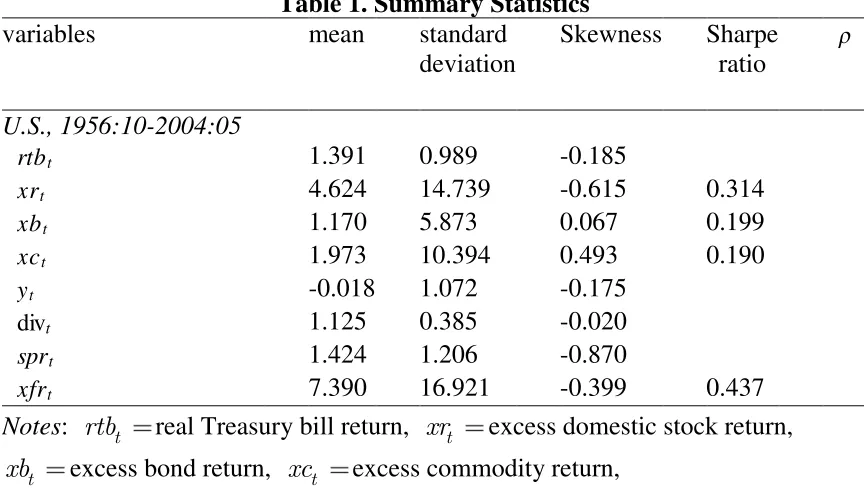
Table 1 reports the mean, variance, and skewness for the bill, bond,
stock and commodity returns and three instruments. The entries for mean and
standard deviations are expressed in percentage. The Sharpe ratios for the bond,
stock and commodity returns are reported in the last column. As expected,
Treasury bill has low return as well as low volatility. The mean excess returns for
stocks, bonds and commodities are 4.62%, 1.17% and 1.98%, respectively, and the
standard deviations of them are 14.74%, 5.87% and 10.39%, respectively. Both
the mean returns and volatility for stock and commodity are higher than for bond.
The Sharpe ratio for stock, bond, and commodity are 0.31, 0.19 and 0.20. That is,
Stock has the highest Sharpe ratio. Although commodity has higher volatility than
bonds, its Sharpe ratio is almost the same as for bonds.
[Insert Table 1 Here]
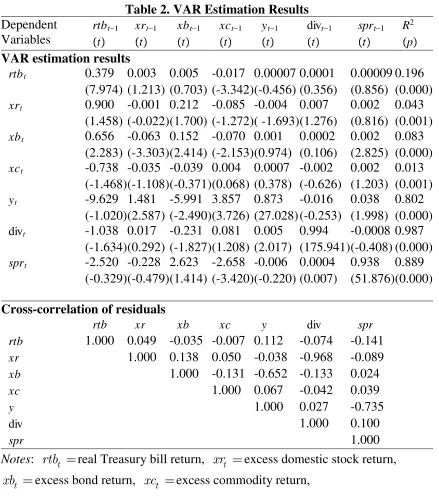
Table 2 reports the estimation results for the VAR system. The top section of the
table reports coefficients estimates and the R2 statistics (with the p-value in the
parentheses) for each equation in the VAR system. The bottom section of the table
reports the cross-correlation matrix of the innovations.
The first row of the table corresponds to the real bill return equation.
The lagged real bill return and commodity return have significant positive and
negative coefficients, respectively. The second row corresponds to the equation for
the excess stock return. None of variables are significant. This confirms that
predicting stock returns is difficult. The third row is the equation for the excess
bond return. The coefficients for the lagged bond return, excess stock return,
commodity return, and yield spread are all significant. The fourth row reports the
results for the equation of commodity. All the coefficients are insignificant, which
implies that there are few correlations between commodities and other risky assets.
This possibly implies commodity could be an important component of portfolio
choice.
The bottom section reports the covariance structure of the innovations in
the VAR system. Unexpected log excess stock returns has very low correlation
with commodity returns, but are highly negatively correlated with shocks to the
log dividend yield, which is consistent with previous empirical evidence
(Campbell, 1991; Stambaugh, 1999). Unexpected log excess bond returns are
negatively correlated with shocks to nominal bill rate, log dividend yield and
Altogether, the correlations between commodity and stock and bond returns
suggest that commodity could play an important role in the process of strategic
asset allocation. We will further explore their implications for optimal
multiple-period portfolio choice.
[Insert Table 2 Here]
3.4. Demands for Domestic Assets
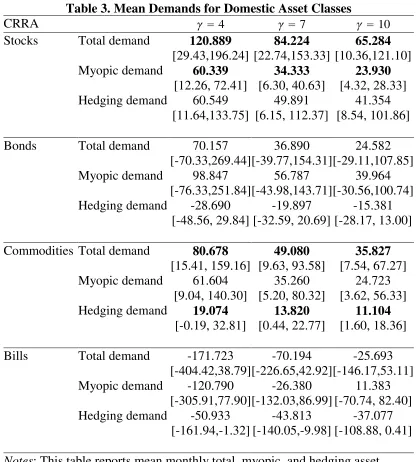
Table 3 reports the mean total, myopic, and intertemporal hedging demands (in
percentage) for domestic bills, stocks, bonds, and commodities for a U.S. investor.
The intertemporal elasticity of substitution is 1. The entries in each column
are mean asset demands when the coefficient of relative risk aversion equal to
4, 7, and 10, respectively. Both the total mean demands and the mean myopic
demands across the four assets sum to 100, while the mean hedging demands sum
to 0. By comparing numbers within each column, we can study how the portfolio
is allocated across the four risky assets and how much is the mean total demand,
myopic demand, and hedging demand for each of the asset classes. By comparing
numbers within each row, we can examine the incremental effects of relative risk
aversion on asset allocation. In addition, the numbers in brackets under each
entry are the 90% confidence intervals for the mean asset demands.
From the table, one can see that the total and myopic demand allocation
is holding a long position on stocks, bonds and commodities, while shorting bills.
commodities. The significant mean total and myopic demand for stocks is
consistent with the theory that there is higher demand for the asset with the largest
Sharpe ratio. In addition, there are positive mean hedging demands for stocks and
commodities. The mean hedging demand for commodities is significant in the
90% confidence interval, though the mean hedging demand for stocks is larger in
magnitude. Both the mean hedging demands for bonds and bills are negative,
which is consistent with the findings in Campbell, Chan, and Viceira (2003) and
Rapach and Wohar (2009). By comparing each row, as we would expect, the mean
total, myopic and hedging demands for all the risky assets decrease as relative risk
aversion increase.
The large mean demands for stocks can be explained by the negative
correlation between innovations to log excess stock returns and the log dividend
yield. As the stock returns have large positive Sharpe ratio, investors usually take
long positions in stocks. An increase in expected stock returns represents an
improvement in the investment opportunity set, while a decrease in expected
stocks returns represents a worsening of the investment set. In addition, the VAR
estimation results suggest that lagged dividend yield has a positive effect on the
expected stock returns. Given the negative correlation between innovations to
excess stock returns and dividend yield, one should expect that a negative shock to
excess stock return next period are accompanied by a positive shock to the
dividend yield next period. In turn, a positive shock to the log dividend yield next
use stocks to hedge against the negative shocks to futures returns.
[Insert Table 3 Here]
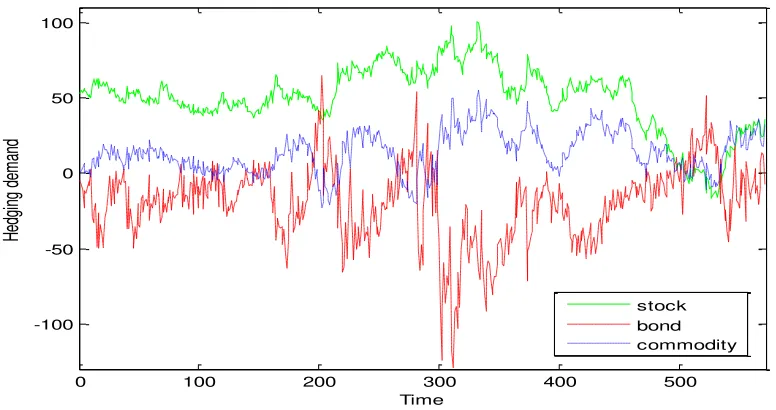
Figure 1 plots the estimated hedging demands for domestic stocks,
bonds, and commodities in order to show more intuitive picture of the
intertemporal hedging demands for each of the three asset class. Overall, the
hedging demand for commodity appears to be the most stable compared with those
for stocks and bonds. And the hedging demand for commodity and stock are well
above the hedging demand for bonds over most of the sample period.
[Insert Figure 1 Here]
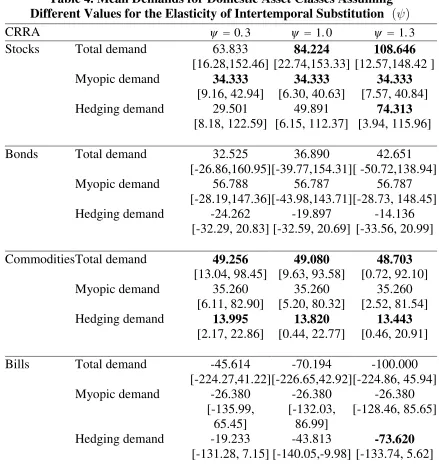
A recent theoretical work by Bhamra and Uppal (2006) suggests that the
elasticity of intertemporal substitution can affect the magnitude, but not the
sign, of the intertemporal hedging demand for the risky asset. Here we compute
the mean demands for stock, bond, and commodity by setting values of
intertemporal substitution equal to 0.3, 1, and 1.5 and the results are presented
in Table 4. The mean total and hedging demands for stocks increase largely as the
intertemporal substitution increases and gradually becomes positively
significant. That is, investors are becoming more willing to make a trade-off
between contemporary and future consumption by taking more long positions on
stocks. Both the mean total and hedging demand for commodities do not change
very much, but are always positively significant as the value of increases. The
provide support for the argument that commodity is an attractive asset class for
multi-period portfolio choice. In addition, our results are also consistent with
Bhamra and Uppal's theoretical results that only affects the magnitude, but not
the sign, of the mean hedging demands for risky assets.
[Insert Table 4 Here]
3.5. What Explains the Demands for Commodities?
What explains the striking and significant mean total and intertemporal hedging
demand for commodities? One explanation might be based on modern portfolio
theory which states the interaction of asset classes with each other provides
diversification. The commodity future return is negatively correlated with bond
return by -0.13 and a very low correlation with the most risky asset, stock return.
These findings suggest commodities have the ability to help diversify stock and
bond portfolios. Furthermore, the low correlation between innovations to stock
and commodity returns is 0.05, which almost approaches zero. Consequently, the
large positive intertemporal hedging demand for stocks does not reduce the
demand for commodities, which may explain why the positive demand for
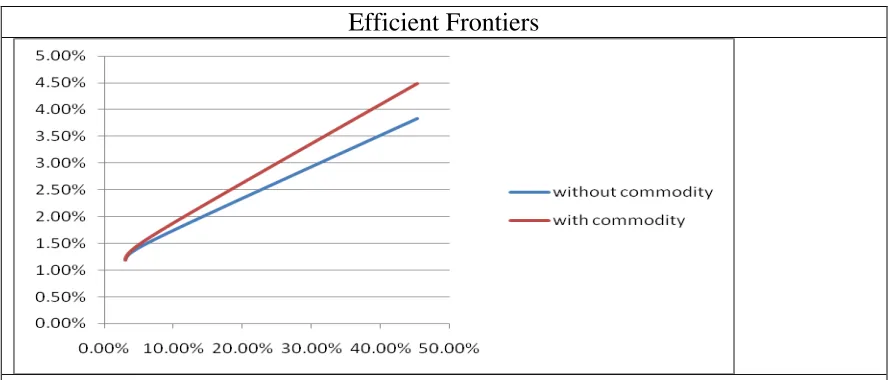
commodities is significant during the long horizons. The portfolios constructed
based on the estimation results provide further evidence to support the explanation.
In figure 3, the portfolio with commodity futures is more efficient, has a higher
ratio of return to risk, than the portfolio without commodity futures.
The second tentative explanation is from the aspect of the return
distributions. It is a well established fact that traditional asset returns, for example,
stock returns, are negatively skewed, and the distribution of commodity returns is
positively skewed. The positive skewness of commodity return together with its
lower volatility relative to stock return, imply that commodity has lower
downward risk compared to equities like stocks. In this study, the skewness for
monthly average excess stock and commodity returns are -0.62 and 0.49, while the
volatilities for them are 14.74% and 10.39%, respectively. If the tail events can
happen simultaneously for the two asset classes, commodity, as an independent
asset class, can provide large diversification benefits to the portfolio allocation.
Another explanation comes from the correlation between commodity
returns and inflation. This is because the ultimate function of portfolios is for
consumption. Thus, investors should consider the real purchasing power of their
returns; that is, the asset classes' ability of hedging against inflation Traditional
asset classes such as stocks and bonds are negatively correlated with inflation and
are not good asset classes for hedging against inflation. However, commodities
represented by commodity futures, may be a better hedge against inflation because
(i) they have a positive correlation with inflation in the long run; (ii) commodity
prices are directly linked to unexpected inflation shocks, which is an important
component of inflation. These together may explain why commodities are a better
asset class of hedging against inflation risk than stocks and bonds.
hedging demand for commodities found in this paper suggest that commodity can
be an attractive asset class to diversify traditional portfolio of stocks and bonds.
4. Controlling for International Stock Markets
To check for the robustness and stableness of the estimated hedging demand for
commodities, we expand the analysis by allowing the investors to access
international equity markets, in addition to domestic stocks, bonds, commodities,
and bills. We use the MSCI World Equity Index ex U.S. as a proxy for foreign
stock market, which makes the calibration not too complicated. In this case,
investors can make a strategic asset allocation across domestic bills, bonds, stocks,
commodities, as well as foreign stocks. We estimate the expanded VAR system
and use the CCV approach to approach the mean total, myopic, and hedging
demands for each of the asset classes. To reserve space, we will not report the
VAR estimation results.
Table 5 reports the mean total, myopic, and intertemporal hedging
demands (in percentage) for domestic bills, stocks, bonds and commodities as well
as foreign stocks for a U.S. investor. The results are computed by setting the
intertemporal elasticity of substitution 1 and the coefficient of relative risk
aversion equal to 4, 7, and 10, respectively. The demands for various asset
classes decrease, as the relative risk aversion increases. The first striking
finding is U.S. investors continue to have relative large mean total and
foreign equity markets, although these demands are no more significant according
to the 90% confidence intervals. However, the mean myopic demand for domestic
stock is essentially low compared to when they can only allocate across domestic
asset classes. The large magnitude in mean total and hedging demands for
domestic stocks is consistent with the well-established theoretical and empirical
finance literature that U.S. investors have home bias (e.g., Cooper and Kaplanis,
1994; Coval and Moskowitz, 1999; Norman and Xu, 2003; Barron and Ni, 2008).
The second striking finding is the significant mean total and myopic demand for
foreign stocks, although the mean total demand is lower relative to the mean total
demand for domestic stocks. This interesting phenomenon can be intuitively
explained based on some summary statistic characteristics of excess domestic and
foreign stock returns. The standard deviations of domestic and foreign stock
returns are almost equal, but the log excess foreign stock returns are almost two
times that for domestic stock. Thus, the foreign stock returns have higher Sharpe
ratio than domestic stock returns. All else equal, investors should have higher
myopic demands for assets with higher Sharpe ratio, which explains why the
myopic demand for domestic stocks is lower for U.S. investors.
The most striking results in Table 5 is the mean intertemporal hedging
demands for commodities. The mean intertemporal hedging as well as the mean
total and myopic demand for commodities are fairly stable compared to when
investors only have access to domestic asset classes. Furthermore, the
after investors can access foreign asset classes. This implies the intertemporal
hedging demands for commodities is stable and confirms commodities should be a
conservative component in strategic asset allocation. To give a direct explanation,
we plot the intertemporal hedging and demands for domestic bonds, stocks, and
commodities, as well as foreign stocks in Figure 2. Overall, the hedging demand
for commodity appears to be the most stable as compared to those for both
domestic and foreign stocks and bonds. Also, the hedging demand for
commodity and stock are well above the hedging demand for bonds and foreign
stocks over most of the sample period.
[Insert Table 5 Here]
[Insert Figure 2 Here]
We also compute the mean demands for stock, bond, and commodity by
setting values of intertemporal substitution equal to 0.3, 1, and 1.5. As shown
in Table 6, investors become willing to make more trade-off between
contemporary and future consumption, i.e., the hedging demands for stock
increase substantially and gradually become positively significant, as the
intertemporal substitution increases from 0.3 to 1.3. Similarly, when investors
can only access domestic asset classes, the mean hedging demand for commodities
changes very little and are always positively significant, as the value of
increases. It confirms again that commodity is effective in portfolio diversification
asset allocation process. In summary, investors in U.S. have significant
intertemporal hedging demands for commodities, in addition to domestic stocks.
This intertemporal hedging demand remains significant in amount, even when
investors have opportunities to invest in other asset classes, for example, foreign
stocks.
In summary, the results above indicate that commodity is one of the
important determinants in the process of strategic asset allocation and multi-period
portfolio choice. There exists a significant and relatively stable intertemporal
hedging demand for commodities, as well as for domestic stocks for U.S.
investors.
[Insert Table 6 Here]
5. The Utility Benefits from Including Commodities
In this section, we differentiate out the importance of the commodity asset class by
comparing the utility of an investor who has access to commodities with the utility
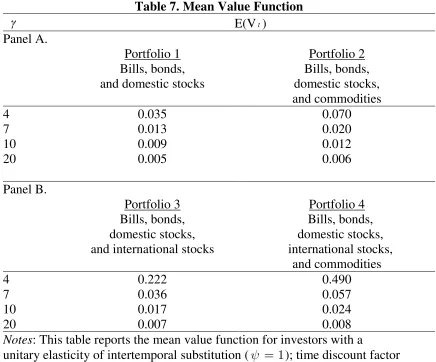
of an investor who does not. Table 7 reports the mean value function when values
of are set to 4, 7, 10, and 20. Panel A compares the mean value function when
two investors can only allocate across domestic asset classes. Panel B compares
the mean value function when two investors can allocate across domestics as well
as international asset classes. The value function is normalized so that a doubling
from one portfolio to another implies that an investor would require twice as much
one.
A comparison of portfolio 1 of panel A, in which commodities are not
included, with portfolio 2 shows that commodities generate large welfare gains for
all investors. Both aggressive and conservative investors gain by allocating some
weights to commodities, which can help hedge against the long positions in
domestic stocks and inflation risk of real interest rates. One can draw the same
conclusion by comparing portfolio 3 and 4 in panel B. In addition, a comparison of
portfolio 1 with portfolio 3 and portfolio 2 with portfolio 4 suggest that the
addition of foreign stocks to an investor's portfolio also creates large gains for all
investors.
[Insert Table 7 Here]
6. Conclusions
Using the Reuters/Jefferies Commodity Research Bureau (CRB) index as a proxy
for commodity, this paper has documented relatively strong and stable
intertemporal hedging demands of U.S. investors for commodity. The result is
robust when other traditional assets, for example, foreign stocks, are included in
the portfolio choice. We also provide evidence that the intertemporal hedging
demand for commodity are relatively stable and permanent in magnitude by
setting the intertemporal substitution and the relative risk aversion to
various values. In addition, the results referring to stock market are consistent with
stock.
A more difficult question is why U.S. investors have a strong
intertemporal hedging demand for the commodity asset class. In this paper, we
have tried to make progress on this question by providing some tentative
interpretations based on modern portfolio theory, return characteristics, as well as
the ability of hedging against inflation. The results presented in this study show,
perhaps interestingly, the significant intertemporal hedging demand for
commodity, because commodity return has low and negative correlations with
traditional asset classes, while having a lower downward risk by having higher
positive skewness. In addition, the surprisingly significant intertemporal hedging
demand for commodity seems to come through its increased ability to hedge
against the unexpected future inflation, compared to traditional assets.
Institution investors have been increasingly interested in commodities
during the past few years. There are currently many intense debates on the role of
commodities in strategic asset allocation. This study provides some new empirical
evidence for advocating commodities as an asset class in portfolio choice. Despite
this, future efforts are needed to build an well-accepted theoretical model on
commodity pricing and to analyze the sources of commodity returns and their role
References
Barron, J. M., and Ni, J., 2008, Endogenous Asymmetric Information and
International Equity Home Bias: The Effects of Portfolio Size and Information
Costs, Journal of International Money and Finance, 27, 4, 617-35.
Bodie, Zvi and Victor Rosansky., 1980, "Diversification Returns And Asset
Contributions", Financial Analysts Journal, (May/June): 26-32.
Balduzzi, P., Lynch, A., 1999, Transaction costs and predictability: some utility
cost calculations, Journal of Financial Economics, 52, 47--78.
Barberis, N.C., 2000, Investing for the long run when returns are predictable,
Journal of Finance, 55, 225--264.
Bhamra, H.S., Uppal, R., 2006, The role of risk aversion and intertemporal
substitution in dynamic consumption-portfolio choice with recursive utility,
Journal of Economic Dynamics and Control, 30 (6), 967--991.
Brennan, M.J., Schwartz, E.S., Lagnado, R., 1997, Strategic asset allocation,
Journal of Economic Dynamics and Control, 21, 1377--1403.
Campbell, J.Y., 1991. A variance decomposition for stock returns. Economic
Journal 101, 157--179.
Campbell, J.Y., Viceira, L.M., 1999, Consumption and portfolio decisions when
expected returns are time varying, Quarterly Journal of Economics, 114,
433--495.
expected returns are time varying: erratum, Unpublished paper, Harvard
University, available on the authors' websites.
Campbell, J.Y., Viceira, L.M., 2001, Who should buy long-term bonds? American
Economic Review, 91, 99--127.
Campbell, J.Y., Viceira, L.M., 2002, Strategic Asset Allocation: Portfolio Choice
for Long-Term Investors, Oxford University Press, Oxford.
Campbell, J.Y., Chan, Y.L., Viceira, L.M., 2003, A multivariate model of strategic
asset allocation, Journal of Financial Economics, 67 (1), 41--81.
Cooper, L., and Kaplanis, E., 1994, Home Bias in Equity Portfolios, Inflation
Hedging, and International Capital Market Equilibrium, Review of Financial
Studies, 7, 1, 45-60.
Coval, J.D., and Moskowitz, T.J., 1999, Home Bias at Home: Local Equity
Preference in Domestic Portfolios, Journal of Finance, 54, 6, 2045-73.
Gorton, Gary, and Geert Rouwenhorst. 2006, Facts and Fantasies about
Commodity Futures. Financial Analysts Journal, 62, 47-68.
Greer, Robert J., 1978, Conservative Commodities a Key Inflation Hedge, Journal
of Portfolio Management, 4(4), 26-29.
Idzorek, M.T., 2008, Strategic Asset Allocation and Commodities, Ibboston
Associates Reports.
Merton, R.C., 1969, Lifetime portfolio selection under uncertainty: the
continuous time case, Review of Economics and Statistics, 51, 3, 247--257.
from Survey Data, Review of Economics and Statistics, 85, 2, 307-12.
Rapach, E.D., and Wohar, E.M., 2009, "International Asset Allocation with
Regime Shifts," Journal of International Money and Finance, 28, 1137--1387.
Lynch, A.W., 2001, Portfolio choice and equity characteristics: characterizing the
hedging demands induced by return predictability, Journal of Financial
Economics, 62, 67--130.
Lynch, A.W., Tan, S., 2010, Multiple Risky Assets, Transaction Costs and Return
Predictability: Allocation Rules and Implications for U.S. Investors, Journal of
Financial and Quantitative Analysis, Forthcoming.
Stambaugh, R.F., 1999. Predictive regressions, Journal of Financial Economics,
Table 1. Summary Statistics
variables mean standard deviation
Skewness Sharpe ratio
U.S., 1956:10-2004:05
rtbt 1.391 0.989 -0.185
xrt 4.624 14.739 -0.615 0.314
xbt 1.170 5.873 0.067 0.199
xct 1.973 10.394 0.493 0.190
yt -0.018 1.072 -0.175
divt 1.125 0.385 -0.020 sprt 1.424 1.206 -0.870
xfrt 7.390 16.921 -0.399 0.437
Notes: rtbt real Treasury bill return, xrt excess domestic stock return,
t
xb excess bond return, xct excess commodity return,
t
y nominal Treasury bill yield, divt log dividend yield,
t
Table 2. VAR Estimation Results
Dependent Variables
rtbt1
t
xrt1
t
xbt1
t
xct1
t
yt1
t
divt1
t
sprt1
t R2
p
VAR estimation results
rtbt 0.379 0.003 0.005 -0.017 0.00007 0.0001 0.00009 0.196 (7.974) (1.213) (0.703) (-3.342) (-0.456) (0.356) (0.856) (0.000)
xrt 0.900 -0.001 0.212 -0.085 -0.004 0.007 0.002 0.043 (1.458) (-0.022) (1.700) (-1.272) ( -1.693) (1.276) (0.816) (0.001)
xbt 0.656 -0.063 0.152 -0.070 0.001 0.0002 0.002 0.083 (2.283) (-3.303) (2.414) (-2.153) (0.974) (0.106) (2.825) (0.000)
xct -0.738 -0.035 -0.039 0.004 0.0007 -0.002 0.002 0.013 (-1.468) (-1.108) (-0.371) (0.068) (0.378) (-0.626) (1.203) (0.001)
yt -9.629 1.481 -5.991 3.857 0.873 -0.016 0.038 0.802 (-1.020) (2.587) (-2.490) (3.726) (27.028) (-0.253) (1.998) (0.000)
divt -1.038 0.017 -0.231 0.081 0.005 0.994 -0.0008 0.987
(-1.634) (0.292) (-1.827) (1.208) (2.017) (175.941) (-0.408) (0.000)
sprt -2.520 -0.228 2.623 -2.658 -0.006 0.0004 0.938 0.889
(-0.329) (-0.479) (1.414) (-3.420) (-0.220) (0.007) (51.876) (0.000)
Cross-correlation of residuals
rtb xr xb xc y div spr rtb 1.000 0.049 -0.035 -0.007 0.112 -0.074 -0.141
xr 1.000 0.138 0.050 -0.038 -0.968 -0.089
xb 1.000 -0.131 -0.652 -0.133 0.024
xc 1.000 0.067 -0.042 0.039
y 1.000 0.027 -0.735
div 1.000 0.100
spr 1.000
Notes: rtbt real Treasury bill return, xrt excess domestic stock return,
t
xb excess bond return, xct excess commodity return,
t
y nominal Treasury bill yield, divt log dividend yield,
t
Table 3. Mean Demands for Domestic Asset Classes
CRRA 4 7 10
Stocks Total demand 120.889 84.224 65.284
[29.43,196.24] [22.74,153.33] [10.36,121.10] Myopic demand 60.339 34.333 23.930
[12.26, 72.41] [6.30, 40.63] [4.32, 28.33] Hedging demand 60.549 49.891 41.354
[11.64,133.75] [6.15, 112.37] [8.54, 101.86]
Bonds Total demand 70.157 36.890 24.582 [-70.33,269.44] [-39.77,154.31] [-29.11,107.85] Myopic demand 98.847 56.787 39.964
[-76.33,251.84] [-43.98,143.71] [-30.56,100.74] Hedging demand -28.690 -19.897 -15.381
[-48.56, 29.84] [-32.59, 20.69] [-28.17, 13.00]
Commodities Total demand 80.678 49.080 35.827
[15.41, 159.16] [9.63, 93.58] [7.54, 67.27] Myopic demand 61.604 35.260 24.723
[9.04, 140.30] [5.20, 80.32] [3.62, 56.33] Hedging demand 19.074 13.820 11.104
[-0.19, 32.81] [0.44, 22.77] [1.60, 18.36]
Bills Total demand -171.723 -70.194 -25.693 [-404.42,38.79] [-226.65,42.92] [-146.17,53.11] Myopic demand -120.790 -26.380 11.383
[-305.91,77.90] [-132.03,86.99] [-70.74, 82.40] Hedging demand -50.933 -43.813 -37.077
[-161.94,-1.32] [-140.05,-9.98] [-108.88, 0.41]
Notes: This table reports mean monthly total, myopic, and hedging asset demands in percentage for stocks, 10-year government bonds,
commodities and 3-month Treasury bills (cash) for an investor with a unitary elasticity of intertemporal substitution ( 1); time discount
factor equals 0.921/12; and coefficient of relative risk aversion ( )
equal to 4, 7, or 10. Numbers in brackets are Bootstrapped 90% confidence interval. A bold entry indicates significance according
Table 4. Mean Demands for Domestic Asset Classes Assuming
Different Values for the Elasticity of Intertemporal Substitution ( )
CRRA 0. 3 1. 0 1. 3
Stocks Total demand 63.833 84.224 108.646
[16.28,152.46] [22.74,153.33] [12.57,148.42 ] Myopic demand 34.333 34.333 34.333
[9.16, 42.94] [6.30, 40.63] [7.57, 40.84] Hedging demand 29.501 49.891 74.313
[8.18, 122.59] [6.15, 112.37] [3.94, 115.96]
Bonds Total demand 32.525 36.890 42.651 [-26.86,160.95] [-39.77,154.31] [ -50.72,138.94] Myopic demand 56.788 56.787 56.787
[-28.19,147.36] [-43.98,143.71] [-28.73, 148.45] Hedging demand -24.262 -19.897 -14.136
[-32.29, 20.83] [-32.59, 20.69] [-33.56, 20.99]
Commodities Total demand 49.256 49.080 48.703
[13.04, 98.45] [9.63, 93.58] [0.72, 92.10] Myopic demand 35.260 35.260 35.260
[6.11, 82.90] [5.20, 80.32] [2.52, 81.54] Hedging demand 13.995 13.820 13.443
[2.17, 22.86] [0.44, 22.77] [0.46, 20.91]
Bills Total demand -45.614 -70.194 -100.000 [-224.27,41.22] [-226.65,42.92] [-224.86, 45.94] Myopic demand -26.380 -26.380 -26.380
[-135.99, 65.45]
[-132.03, 86.99]
[-128.46, 85.65]
Hedging demand -19.233 -43.813 -73.620
[-131.28, 7.15] [-140.05,-9.98] [-133.74, 5.62]
Notes: This table reports mean monthly total, myopic, and hedging asset demands in percentage for stocks, 10-year government bonds, commodities and 3-month Treasury bills (cash) for an investor with a unitary elasticity of intertemporal of relative risk aversion ( ) equal to 4. Numbers in brackets are
Table 5. Mean Demands for Domestic and International Asset Classes
CRRA 4 7 10
Domestic Total demand 77.01 58.37 46.80 Stocks [-52.30,165.25] [-33.47,134.21] [-22.24,115.66]
Myopic demand 8.60 4.69 3.12 [-45.57, 57.00] [-26.15, 33.60] [-21.50, 19.67] Hedging demand 68.41 53.69 43.68
[-17.88,160.44] [-13.13,134.95] [-6.44, 118.56] Domestic Total demand 127.00 69.27 46.96 Bonds [-17.01,363.00] [-14.35,205.01] [-12.26,142.90]
Myopic demand 141.02 81.08 57.10 [-17.88,337.15] [-9.87, 193.28] [-6.67, 135.73] Hedging demand -14.02 -11.81 -10.14
[-52.75, 65.19] [-37.36, 42.45] [-29.67, 29.65] Commodities Total demand 90.24 55.75 40.99
[34.54, 185.67] [24.52, 113.92] [16.41, 79.62] Myopic demand 63.95 36.62 25.69
[22.05, 162.01] [12.79, 92.76] [8.19, 64.09] Hedging demand 26.29 19.13 15.29
[4.49, 48.52] [4.82, 34.31] [3.97, 25.94] Domestic Total demand -262.15 -122.13 -61.86 Bills [-560.42,-25.35] [-350.23,-5.78] [-202.00,52.93]
Myopic demand -179.07 -59.80 -12.09 [-409.47,-17.48] [-191.68,32.76] [-104.56,52.86] Hedging demand -83.07 -62.33 -49.77
[-204.14, 35.68] [-158.30,-19.19] [-131.86,11.81]
Foreign Total demand 67.90 38.74 27.12
Stocks [-30.03, 115.64] [-16.55, 67.67] [-11.67, 47.47] Myopic demand 65.50 37.41 26.18
[-28.58, 122.47] [-16.24, 69.93] [-11.31, 48.93] Hedging demand 2.39 1.33 0.94
[-9.56, 18.13] [-6.72, 12.32] [-4.20, 10.15]
Table 6. Mean Demands for Domestic and International Asset Classes
Assuming Different Values for Elasticity of Intertemporal Substitution ( )
CRRA 0. 3 1. 0 1. 3
Domestic Total demand 28.03 58.37 121.19
Stocks [-29.82,136.66] [-33.47,134.21] [-26.25,140.56] Myopic demand 4.69 4.69 4.69
[-25.92, 27.65] [-26.15, 33.60] [-28.15, 33.83] Hedging demand 23.35 53.69 116.51
[-8.10, 135.21] [-13.13,134.95] [-20.32,125.89] Domestic Total demand 63.90 69.27 82.51 Bonds [-11.80,202.45] [-14.35,205.01] [-14.98,196.10]
Myopic demand 81.08 81.08 81.08 [-14.93,192.35] [-9.87, 193.28] [0.86, 189.29] Hedging demand -17.18 -11.81 1.44
[-39.66. 39.37] [-37.36, 42.45] [-37.59, 37.94] Commodities Total demand 54.86 55.75 56.00
[16.98, 112.65] [24.52, 113.92] [19.77, 112.32] Myopic demand 36.62 36.62 36.62
[5.92, 91.74] [12.79, 92.76] [8.78, 91.76] Hedging demand 18.24 19.13 19.38
[1.81, 30.46] [4.82, 34.31] [4.89, 32.74] Domestic Total demand -86.69 -122.13 -196.40 Bills [-305.45,30.41] [-350.23,-5.78] [-293.89,24.86]
Myopic demand -59.90 -59.80 -59.80 [-193.18,41.07] [-191.68,32.76] [-167.34,45.80] Hedging demand -26.89 -62.33 -136.61
[-175.51,10.47] [-158.30,-19.19] [-163.24,20.06] Foreign Total demand 39.90 38.74 36.70
Stocks [-16.95, 69.14] [-16.55, 67.67] [-20.97, 73.35] Myopic demand 37.41 37.41 37.41
[-21.66, 65.02] [-16.24, 69.93] [-21.79, 74.26] Hedging demand 2.49 1.33 -0.71
[-6.76, 12.32] [-6.72, 12.32] [-7.20, 12.88]
Notes: This table reports mean monthly total, myopic, and hedging asset demands in percentage for stocks, 10-year government bonds, commodities, 3-month Treasury bills (cash) and foreign stocks for an investor with elasticity
of intertemporal substitution ( 0.3,1,1.3); time discount factor equals 0.92
1/12
Table 7. Mean Value Function
E(Vt)
Panel A.
Portfolio 1 Portfolio 2 Bills, bonds,
and domestic stocks
Bills, bonds, domestic stocks, and commodities
4 0.035 0.070
7 0.013 0.020
10 0.009 0.012
20 0.005 0.006
Panel B.
Portfolio 3 Portfolio 4 Bills, bonds,
domestic stocks, and international stocks
Bills, bonds, domestic stocks, international stocks,
and commodities
4 0.222 0.490
7 0.036 0.057
10 0.017 0.024
20 0.007 0.008
Notes: This table reports the mean value function for investors with a
0 100 200 300 400 500 -100 -50 0 50 100 Time He dg in g de m an d stock bond commodity
Fig 1. Historical intertemporal hedging demands for domestic stocks, bonds and commodities for U.S. investors.
0 50 100 150 200 250 300 350 400
[image:34.612.109.506.377.572.2]-100 -50 0 50 100 Time He dg ing d em an d Figure 2. stock bond commodity foreign stock
Fig 2. Historical intertemporal hedging demands for domestic stocks,
Efficient Frontiers