Journal of Chemical and Pharmaceutical Research
__________________________________________________
ISSN No: 0975-7384 CODEN(USA): JCPRC5
J. Chem. Pharm. Res., 2011, 3(3):363-374
Development and validation of RP-HPLC method for the estimation
of ascorbic acid in health drinks
Konda Ravi Kumar *1, P. Praveen Kumar1 and N. MallikarjunaRao2
1
Department of Pharmaceutical Chemistry, Hindu College of Pharmacy, Guntur, A.P, India
2
Department of Pharmaceutical Analysis, Jawaharlal Nehru Technological University, Kakinada, A.P, India
______________________________________________________________________________
ABSTRACT
A simple, selective, linear, precise and accurate RP-HPLC method was developed and validated for rapid assay of Ascorbic acid in Health drinks. Isocratic elution at a flow rate of 0.9ml/min was employed on a symmetry C18 (250x4.6mm, 0.5µ in particle size) at ambient temperature. The
mobile phase consisted of Water with acetic acid: methanol 95:5% (v/v). The UV detection wavelength was 245 nm and 20µl sample was injected. The retention time for Ascorbic acid was 4.61+_ 0.22 min. The percentage RSD for precision and accuracy of the method was found to be less than the method was validated as per the ICH guidelines. The method was successfully applied for routine analysis of Ascorbic acid in Health drinks.
Key Words: Ascorbic acid, RP-HPLC, UV detection, Health drinks, recovery, linearity.
______________________________________________________________________________
INTRODUCTION
Ascorbic acid is a reductone sugar acid with antioxidant properties. Its appearance is white to light-yellow crystals or powder, and it is water-soluble. Ascorbic acid is one form (vitamer) of vitamin C, and was historically the first chemical compound to be synthesized, and identified, as vitamin C. The name is derived from a- (meaning "no") and scorbutus (scurvy), the disease
caused by a deficiency of vitamin C. Haworth and Szent-Györgyi when its structure was finally
proven by synthesis.[1] Ascorbic acid is an enzyme cofactor in tyrosine oxidation.[2] It creates
Ascorbate usually acts as an antioxidant by being available for energetically favourable
oxidation. Ascorbic acid is easily oxidized and so is used as a reductant in photographic
developer solutions (among others) and as a potassium, and calcium salts
compounds are water-soluble and thus cannot protect
Ascorbic acid Molecular formula IUPAC Name: (5R)-[(1S)-1,2
Chemicals and reagents
HPLC grade water with acetic acid, methanol and meta Merck Specalities Pvt. Ltd.
Instrumentation and analytical conditions
The analysis of drug was carried out on a
C18 column (250x4.6mm, 0.5µ
and a LC-UV7000 absorbance detector and running on Shimadzu version 1.06. Isocratic elution
0.9ml/min. The mobile phase was prepared freshly and degassed by sonicating for 5 min before use.
ANALYSIS OF THE METHOD Preparation of standard stock solution
10 mg of ascorbic acid was accurately weighed into a 100 ml standard flask and made up to the required volume with 0.56%
µg/ml. From this solution 0.1 ml is taken and diluted to 10 ml for ge µg/ml. From that a concentration ranging 0.1
Recording of a standard chromatogram
In the Shimadzu HPLC system, the chromatographic conditions were maintained. After a steady
base line was obtained, 20 µ
chromatograms were recorded.
Preparation of working standard solution
Serial concentration of 0.1-0.5 µ g/ml was prepared from the stock concentration of 10 µg/ml, Ascorbate usually acts as an antioxidant by being available for energetically favourable Ascorbic acid is easily oxidized and so is used as a reductant in photographic developer solutions (among others) and as a preservative. Ascorbic acid and its sodium,
salts are commonly used as antioxidant food additives
soluble and thus cannot protect fats from oxidation[5]
Ascorbic acid Molecular formula- C6H8O6 (fig.1) Molecular weight -176.12 g/mol.
1,2-dihydroxyethyl]-3,4-dihydroxyfuran-2(5H)-Fig.1 Chemical Structure of Ascorbic acid
EXPERIMENTAL SECTION
acetic acid, methanol and metaphosphoric acid was purchased from
Instrumentation and analytical conditions
The analysis of drug was carried out on a Shimadzu HPLC system equipped with a reverse phase 0.5µ in particle size), a LC-P7000 isocratic pump, a 20µl injection loop
nce detector and running on Shimadzu Chromatographic Software version 1.06. Isocratic elution with acetic acid: methanol 95:5% (v/v) was used at a flow rate of ml/min. The mobile phase was prepared freshly and degassed by sonicating for 5 min before
ANALYSIS OF THE METHOD Preparation of standard stock solution
10 mg of ascorbic acid was accurately weighed into a 100 ml standard flask and made up to the
required volume with 0.56% w/v of metaphosphoric acid solution to get a concentration of 100
µg/ml. From this solution 0.1 ml is taken and diluted to 10 ml for getting a concentration of 10 µg/ml. From that a concentration ranging 0.1-0.5 µ g/ml was prepared.
Recording of a standard chromatogram
In the Shimadzu HPLC system, the chromatographic conditions were maintained. After a steady
µl of the prepared working standard solution was injected and the
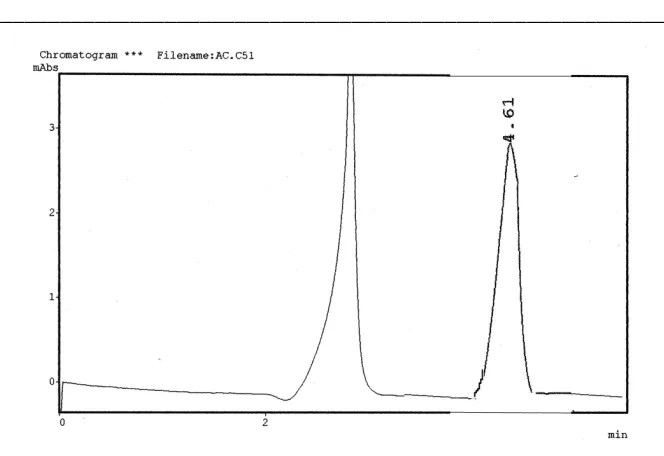
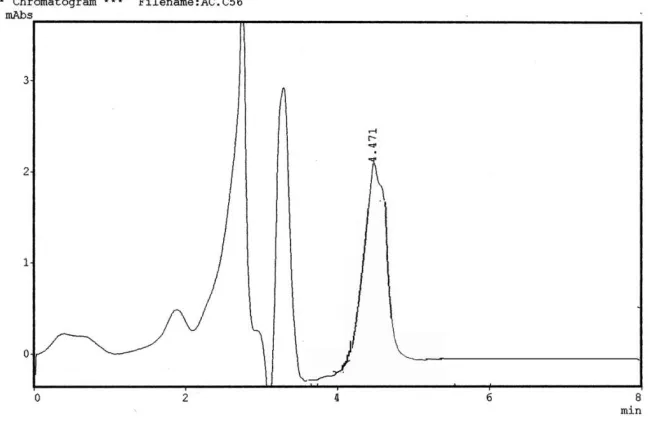
chromatograms were recorded.(Fig.2)
Preparation of working standard solution
0.5 µ g/ml was prepared from the stock concentration of 10 µg/ml, Ascorbate usually acts as an antioxidant by being available for energetically favourable Ascorbic acid is easily oxidized and so is used as a reductant in photographic . Ascorbic acid and its sodium, food additives[4]. These
[5].
176.12 g/mol. -one.
phosphoric acid was purchased from
HPLC system equipped with a reverse phase P7000 isocratic pump, a 20µl injection loop Chromatographic Software was used at a flow rate of ml/min. The mobile phase was prepared freshly and degassed by sonicating for 5 min before
10 mg of ascorbic acid was accurately weighed into a 100 ml standard flask and made up to the of metaphosphoric acid solution to get a concentration of 100 tting a concentration of 10
In the Shimadzu HPLC system, the chromatographic conditions were maintained. After a steady l of the prepared working standard solution was injected and the
from this 0.1, 0.2, 0.3, 0.4 and 0.5 was pipetted out into 10 ml standard flasks, and made up to the required volume with 0.56% w/v met phosphoric acid solution.
Extraction of ascorbic acid from marketed health drink
To extract ascorbic acid from fruit juices 0.56% w/v met phosphoric acid solution was added and centrifuged for 60 seconds at 2000 rpm and the filtrate was filtered and taken for the further studies.
FIG.2 Chromatogram of standard ascorbic acid
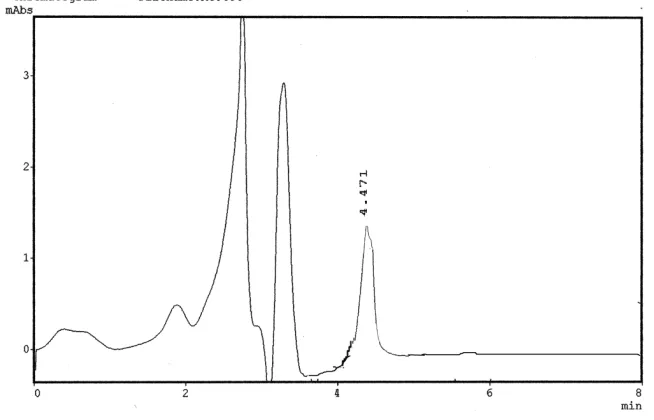
Fig4. Chromatogram of 0.2 µg/ml standard ascorbic acid
Fig.5. Chromatogram of 0.3 µg/ml standard ascorbic acid
Validation procedure
The objective of the method validation is to demonstrate that the method is suitable for its intended purpose as it is stated in ICH guidelines [6] . The method was validated for linearity, precision (repeatability and intermediate precision), accuracy, specificity, stability and system suitability.
Linearity and range
Fig.6. Chromatogram of 0.4 µg/ml standard ascorbic acid
Fig 7. Chromatogram of 0.5 µg/ml standard ascorbic acid
Precision
a) Intra day precision
b) Inter day precision
c) Repeatability of injection
Intra day precision
[image:5.595.147.448.350.544.2]Inter day precision
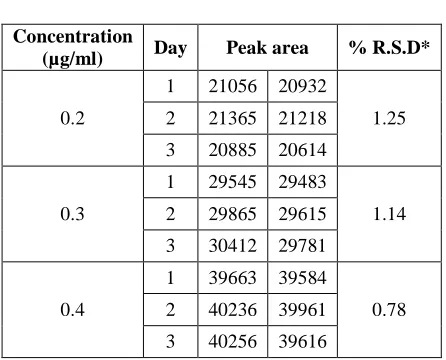
[image:6.595.131.461.163.375.2]It was found out by carrying out the analysis for three days with three different concentrations of the linearity range. The % RSD values were calculated.
Fig 8. Chromatogram of 0.6 µg/ml standard ascorbic acid
Repeatability of Injection
A standard solution of ascorbic acid was injected 6 times and its % RSD values were calculated.
Accuracy
To study the reliability, suitability and accuracy of the method, recovery studies were carried out. To the formulation equivalent to 10 mg of ascorbic acid at the levels of 50% and 100% were added. Pure ascorbic acid was extracted with 0.56% v/v of phosphoric acid and made upto mark with same. The concentration of drugs present in resulting solution was determined using assay method, percentage recovery and percentage RSD were calculated.
Robustness
In order to demonstrate the robustness of the method, the following optimized conditions were slightly varied.
± 2% in ratios of methanol in mobile phase
The response factors for these changed chromatographic parameters were almost same as that of the fixed chromatographic parameters and hence the developed method is said to be robust.
Specificity
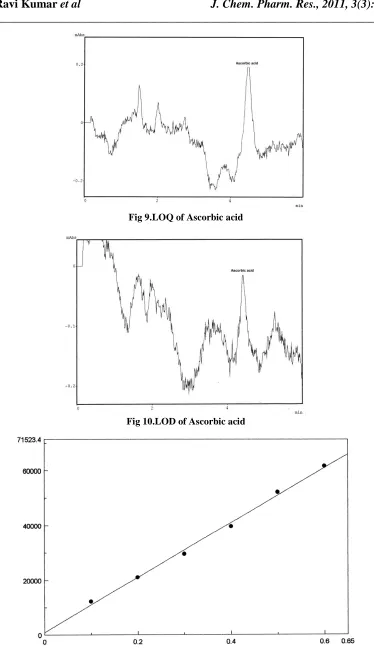
Fig 9.LOQ of Ascorbic acid
Fig 10.LOD of Ascorbic acid
Stability
Sample solutions were subjected to stability studies under refrigerated and room conditions. Stabilities were studied by looking for any change in retention time, resolution and peak shape.
System suitability studies
System suitability parameters like number of theoretical plates (N), peak asymmetry factor (As),
capacity factor (K1), selectivity factor (α), resolution (Rs) were studied.
LOD and LOQ
The LOD and LOQ of ascorbic acid was found to be 0.01 and 0.1 mcg/ml respectively (Fig.9-10).
Linearity
[image:8.595.153.444.344.508.2]The slope, intercept and correlation coefficient values were found to be 100166.8543, 993.2669 and 0.9979 respectively.(Fig.11)
TABLE 1: INTRADAY PRECISION
Day Concentration (µg/ml) Peak Area % RSD*
1 0.1 12223 1.34 12160 11916 0.2 21056 0.75 20866 20746 0.3 29545 0.62 29348 29179
* Mean RSD of three observations.
TABLE 2: INTERDAY PRECISION
Concentration
(µg/ml) Day Peak area % R.S.D*
0.2
1 21056 20932
1.25 2 21365 21218
3 20885 20614
0.3
1 29545 29483
1.14 2 29865 29615
3 30412 29781
0.4
1 39663 39584
0.78 2 40236 39961
3 40256 39616
[image:8.595.187.410.540.720.2]TABLE 3: REPEATABILITY OF INJECTION
Concentration
(µg/ml) Peak area % RSD
0.5
52183
0.77 51976
51865
51538 51318
51164
TABLE 4: ACCURACY
Drug % Recovery % RSD*
50% level 100% level 50% level 100% level Ascorbic acid 98.64 97.52 0.1528 0.3741
RESULTS AND DISCUSSION
STABILITY
[image:9.595.89.503.404.690.2]The solution stored under room temperature was stable up to 24 hrs and under refrigeration up to 48hrs.
TABLE 5: SYSTEM SUITABILITY PARAMETERS
Drug Rs N As K1 α
Ascorbic acid 8.95 2622 1.06 1.27 2.08
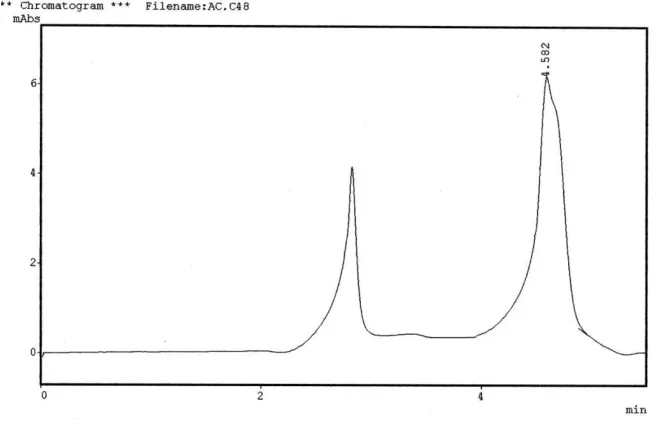
Fig 12. Chromatogram of ascorbic acid present in health drink
Fig 13. Chromatogram of ascorbic acid present in health drink
(At the end of 1st month)
Fig 14. Chromatogram of ascorbic acid present in health drink
(At the end of 2nd month)
Estimation of ascorbic acid content in marketed health drinks at various time intervals Preparation of sample
[image:10.595.135.460.374.586.2]Fig 15. Chromatogram of ascorbic acid present in health drink
[image:11.595.117.467.102.327.2](At the end of 3rd month)
Fig 16. Chromatogram of ascorbic acid present in health drink
(Last week of forth month (before the expiry date)).
Marketed health drinks at various months Concentration (µg/ml)
First week of manufacturing date 0.52 At the end of 1st month 0.47 At the end of 2nd month 0.31 At the end of 3rd month 0.18 Last week of fourth month (before the expiry date). 0.15
[image:11.595.135.462.363.573.2]CONCLUSION
The ascorbic acid content was observed to be 0.52 µg/ml when estimated within first week from the date of manufacturing.
The ascorbic acid content was found to decrease
by 1.10 fold after the first month.
by 1.68 fold after the second month.
by 2.89 fold after the third month.
by 3.47 fold after the last week of fourth month.
when compared to that of quantity estimated in the product within one week from the date of manufacturing.
REFERENCES
[1]. J.Sun,Y.F.Chu,X.Wu and R.H.Liu,Journal of the Agriculture Food chemistry,50,7449,2002. [2] http://www.jbc.org/content/196/2/761.full.pdf
[3] http://onlinelibrary.wiley.com/doi/10.1111/j.1365-2621.1981.tb15349.x/abstract [4] Story of Vitamin C's chemical discovery. Accessed Jan 21,2010
[5] Davies, Michael B.; Austin, John; Partridge, David A. ,1991, Vitamin C: Its Chemistry and Biochemistry, The Royal Society of Chemistry, p. 48, ISBN 0-85186-333-7
[6]International Conference on Harmonization, "Q2A: Text on Validation of Analytical Procedures," Federal Register 60(40), 11260–11262 ,1995.
[7] W.C.Willet,Journal of the Science,1994,254,532.
[8] Oxford University. 2005. http://physchem.ox.ac.uk/MSDS/AS/ascorbic_acid.html. Retrieved
2007.