On
r
-Edge-Connected
r
-Regular Bricks and
Braces and Inscribability
Kevin K. H. Cheung
School of Mathematics and Statistics Carleton University 1125 Colonel By Drive Ottawa, ON K1S 5B6 Canada ∗Corresponding Author: [email protected]
Copyright c⃝2013 Horizon Research Publishing All rights reserved.
Abstract
A classical result due to Steinitz states that a graph is isomorphic to the graph of some 3-dimensional polytopeP if and only if it is planar and 3-connected. If a graphGis isomorphic to the graph of a 3-dimensional polytope inscribed in a sphere, it is said to be of inscribable type. The problem of determining which graphs are of inscribable type dates back to 1832 and was open until Rivin proved a characterization in terms of the existence of a strictly feasible solution to a system of linear equations and inequalities which we call sys(G), which, surprisingly, also appears in the context of the Traveling Salesman Problem. Using such a characterization, various classes of graphs of inscribable type can be described. Dillencourt and Smith gave a characterization of 3-connected 3-regular planar graphs that are of inscribable and a linear-time algorithm for recognizing such graphs. In this paper, their results are generalized tor-edge-connectedr-regular graphs for oddr≥3 in the context of the existence of strictly feasible solutions to sys(G). An answer to an open question raised by D. Eppstein concerning the inscribability of 4-regular graphs is also given.
Keywords
Inscribable, Polytope, Regular, Graph, Sphere1
Background and main results
Given a 3-dimensional polytopeP, we define thegraph ofP, denoted byG(P), to be the graph (V, E) whereV
is the set of extreme points ofP anduv∈Eif and only ifuandv are adjacent inP.
LetG= (V, E) be an undirected simple graph. A clas-sical result due to Steinitz [16] connecting graph theory to geometry is the following:
Theorem 1. Gis isomorphic to the graph of some 3 -dimensional polytope P in R3 if and only if it is planar
and3-connected.
A 3-connected planar graph isomorphic to the graph of a 3-dimensional polytope inscribed in a sphere is said to be of inscribable type. Steinitz [17] gave examples of graphs that are not of inscribable type. The problem of determining which graphs are of inscribable type dates back to 1832 (see [15]) and was open until Hodgson et al.[10] announced the following in 1992:
Theorem 2. If G is 3-connected and planar, then G is of inscribable type if and only if there exists x∈RE
satisfying:
x(δ(v)) = 2π ∀ v∈V,
x(δ(S)) > 2π ∀ S⊂V, 2≤ |S| ≤ |V| −2, xe > 0 ∀ e∈E,
xe < π ∀ e∈E.
(For S ⊆ V, δ(S) denotes the set of edges with one end-vertex in S and one end-vertex not in S; δ({v}) is abbreviated as δ(v). For x ∈ RE and A ⊆ E, x(A) :=∑e∈Axe.)
inequalities strictly a strictly feasible solution. Using this terminology and with sys(G) denoting the system
x(δ(v)) = 2 ∀v∈V,
x(δ(S)) ≥ 2 ∀S⊂V, 2≤ |S| ≤ |V| −2, x ≥ 0,
Theorem 2 can be rephrased as follows:
Theorem 3. If Gis3-connected and planar, thenGis of inscribable type if and only if there exists a strictly
feasible solution to sys(G).
Note that constraints of the formxe≤1 wheree∈E (corresponding to xe ≤ π in Theorem 2) are super-fluous because xuv ≤ 1 is implied by the constraints x(δ({u, v})) ≥ 2, x(δ(u)) = 2, and x(δ(v)) = 2 where
uv∈E.
Rivin gave two proofs of Theorem 2. One uses hyper-bolic geometry [13]. The other is an elementary proof using mathematical optimization [14].
Incidentally, sys(G) also defines what is known as the
subtour-elimination polytopeofGin connection with the Traveling Salesman Problem. This remarkable, albeit accidental, connection between the subtour-elimination polytope and the century-old geometry problem pro-vided a motivation for studying strictly feasible solutions to the system sys(G).
Using Theorem 3, one can show that various classes of graphs are of inscribable type. For instance, Dil-lencourt and Smith [3] showed that, among others, 4-connected planar graphs and planar graphs obtained from 4-connected planar graphs by removing one vertex are of inscribable type. In [2], they gave necessary and sufficient conditions for a 3-connected 3-regular planar graph to be of inscribable type and a linear-time algo-rithm for recognizing such a graph. In particular, they showed the following:
Theorem 4. If G is a 3-edge-connected 3-regular pla-nar graph, then G is of inscribable type if and only if
G is more-than-1-tough or G is bipartite and has a 4 -connected dual.
In this paper, we extend the above result to the fol-lowing:
Theorem 5.IfGis anr-edge-connectedr-regular graph
wherer≥3is an odd integer, then sys(G)has a strictly feasible solution if and only if G is more-than-1-tough
orGis bipartite and has no non-trivialr-edge cut.
To see that Theorem 4 follows directly from Theo-rem 5, note that the dual of a 3-edge-connected 3-regular planar graph G is a maximal planar graph with more than four vertices. Such a maximal planar graph is 4-connected if and only if it does not have a separating triangle (see [9]), or equivalently, G has no non-trivial 3-edge-cut.
It turns out that Theorem 5 is equivalent to the fol-lowing:
Theorem 6. IfGis anr-edge-connectedr-regular graph
wherer≥3is an odd integer, then sys(G)has a strictly feasible solution if and only ifGis a brick or a brace.
Observe that every r-edge-connectedr-regular graph wherer≥3 is odd is necessarily 3-connected. The above equivalent formulation suggests connections with re-sults in perfect matchings forr-edge-connectedr-regular graphs. (Bricks and braces are the fundamental objects in the tight cut decomposition of a matching-covered graph, a procedure described in a landmark paper by Lov´asz [11] in the study of the matching lattice.) In ad-dition to proving Theorems 5 and 6, we also give a char-acterization of when such graphs are bricks and braces; the characterization generalizes a notion introduced by Dillencourt and Smith for 3-connected 3-regular planar graphs.
Before we end this section, we remark that a simpler -regular graph cannot be planar forr≥6. In addition, a simpler-regular planar graph cannot be bipartite forr≥
4. Thus, specializing Theorem 6 to edge-connected 5-regular planar graphs gives:
Theorem 7. A 5-edge-connected 5-regular simple pla-nar graph is of inscribable type if and only if it is a brick.
We mention in passing that edge-connected 5-regular simple bricks do exist and so they give a pre-viously unrecognized class of graphs of inscribable type. An example of such a graph can be found in [1].
2
Notation and definitions
Unless otherwise stated, graphs are assumed to be undirected and loopless but they may contain parallel edges. The vector with all entries equal to 1 is denoted by e. Let S be a finite set. If T ⊆S, then the vector
x∈RS withx
e= 1 ife∈T andxe= 0 ife /∈T is called the incidence vector of T. A family F of sets is called
nested if for any non-disjoint distinct membersSandT
Let G= (V, E) be a graph. The number of compo-nents ofGis denoted byω(G). Gis said to be1-toughif
|S| ≥ω(G−S) for every subsetSofV withω(G−S)>1, and ismore-than-1-tough if the inequality is strict.
For a subsetSofV, the graph induced bySis denoted byG[S].
IfS is a proper subset ofV with|S|>1, we letG×S
denote the (possibly not simple) graph obtained fromG
by contracting S, that is, removing all the vertices in
S and all the edges incident with a vertex in S from G
and adding a new vertex calledSand edgesuSfor every edgeus∈E wheres∈S andu /∈S. The new vertex is called apseudo-vertexofG×S.
For S, T ⊂ V, define γ(S, T) to be the set of edges incident with a vertex inSand a vertex inT. LetS⊂V
with 0<|S|<|V|. N(S) denotes the set{v∈V\S:vis adjacent to some vertex inS}. N({v}) is abbreviated as
N(v). Defineδ(S) :=γ(S, N(S)). δ({v}) is abbreviated asδ(v).
A set of edges Ais called a cut ofGif A=δ(S) for someS⊂V;SandV\S are called theshoresof the cut
A ifGis connected. A shoreS is called aproper shore
if|S| ≤ |V| −2. Cuts of the formδ(v) for some vertexv
aretrivialcuts. All other cuts arenon-trivial.
We denote the set of cuts of G by C(G). Two cuts
δ(S) and δ(T) are said tocross if the four sets S∩T,
S\T,T\S, andV\(S∪T) are all non-empty. Two cuts that do not cross are said to benon-crossing.
A subsetM of E is a matchingof Gif no two edges inM are incident with the same vertex. If every vertex is an end-vertex of some edge inM, thenM is aperfect matching. Gis calledmatching-coveredif for every edge
e∈E, there exists a perfect matching that contains e. The following characterization is due to Tutte [18].
Theorem 8. Ghas a perfect matching if and only if for
everyS ⊂V,odd(G−S)≤ |S|. (Here,odd(H)denotes the number of components of H having an odd number
of vertices.)
Let PM(G) denote the convex hull of incidence vec-tors of perfect matchings of G. An important result in matching theory is the following:
Theorem 9. (Edmonds [4]) PM(G) is the set of all x∈RE satisfying
x(δ(v)) = 1 ∀v∈V,
x(δ(S))≥1 ∀S⊂V,3≤ |S| ≤ |V2|,|S| is odd x≥0.
An immediate consequence of the above theorem is the following:
Corollary 10. If PM(G) is non-empty, then G has a perfect matching. Furthermore, if there exists x ∈
PM(G)withx >0, then Gis matching-covered.
A cut A ∈ C(G) is said to be tight if every perfect matching ofGcontains exactly one edge inA. Gis said to be bicritical ifG− {u, v} has a perfect matching for every pair u, v∈V. A graph is called a brickif it is 3-connected, bicritical, and has at least four vertices. A bi-partite graphGwith bipartition (U, W) is called abrace
ifGis matching-covered with at least four vertices and for all distinctu, u′∈U andw, w′∈W,G−{u, w, u′, w′}
has a perfect matching. It can be shown that a bipartite graph G with bipartition (U, W) and|U|=|W| ≥2 is a brace if and only if |N(X)| ≥ |X|+ 2 and for every subsetX ⊆U with 1≤ |X| ≤ |U|−2. Bricks and braces are fundamental objects in the study of matchings. (See for instance [12], [5] and [11].) Using the result [5] that each tight cut in a brick is trivial, Lov´asz [11] showed:
Theorem 11. A matching-covered graph has no
non-trivial tight cuts if and only if it is either a brick or a
brace.
The set of solutions to sys(G) is denoted by SEP(G).
Gis said to befeasibleif SEP(G) is non-empty. A cutA
of a feasible graph Gis said to beconstrictedifx(A) = 2 for all x ∈ SEP(G). It is not difficult to show the following:
Proposition 12. Feasible graphs are1-tough.
3
Proofs of Theorems 5 and 6
Throughout this section, G = (V, E) denotes an r -edge-connectedr-regular graph wherer≥3 is an odd in-teger. (We allowGto have parallel edges.) The next re-sult gives a connection between the subtour-elimination polytope and the perfect matching polytope ofG.
Proposition 13. dim(PM(G)) = dim(SEP(G)). Fur-thermore, a non-trivial cut of Gis tight if and only if it
is constricted.
Proof. Clearly, 1
2SEP(G) ⊆ PM(G). Hence,
dim(SEP(G))≤dim(PM(G)).
We now show that dim(SEP(G)) ≥ dim(PM(G)). Define the affine function f : RE → RE by f(x) =
1
rx+
2r−1
Let ˆx=f(χM) where χM denotes the incidence vector ofM. Then for any vertexv∈V,
ˆ
x(δ(v)) = 1
r +
∑
e∈δ(v)
2r−1
r2 =
1
r +
r(2r−1)
r2 = 2.
ConsiderS⊂V such that 1<|S|<|V|.
If |S| is odd, then |δ(S)∩M| ≥ 1 and |δ(S)| ≥ r. Hence,
ˆ
x(δ(S))≥1
r+
∑
e∈δ(S)
2r−1
r2 ≥
1
r+
r(2r−1)
r2 = 2.
If|S| is even, then|δ(S)|is even and so |δ(S)| ≥r+ 1. Hence,
ˆ
x(δ(S))≥ ∑ e∈δ(S)
2r−1
r2 ≥
(r+ 1)(2r−1)
r2 >2.
Hence, ˆx ∈ SEP(G). It follows that f(PM(G)) ⊆ SEP(G). As f is bijective, dim(f(PM(G))) = dim(PM(G)). Therefore, dim(PM(G))≤dim(SEP(G)). This proves the first part of the theorem.
We now prove the second part. LetC be a non-trivial cut. Suppose ˆx∈PM(G) is such that ˆx(C)>1. Let ˆy=
f(ˆx). Then ˆy(C) >2 and ˆy ∈ SEP(G), implying that
Cis not a constricted cut. Suppose ˆx∈SEP(G) is such that ˆx(C)>2. Then 12xˆ(C)>1. Since 12xˆ∈PM(G),C
is not a tight cut. The result now follows.
Proof of Theorem 6. Since x= 2re is a solution to sys(G) withx >0, sys(G) has a strictly feasible solution if and only ifG has no non-trivial constricted cut. By the second part of Proposition 13,Ghas no non-trivial constricted cut if and only ifGhas no non-trivial tight cut. The result now follows from Theorem 11 becauseG
is matching-covered by Corollary 10 as 1r∈PM(G). Theorem 5 follows from Theorem 6 and the next two lemmas.
Lemma 14. If G is non-bipartite, then Gis a brick if
and only ifGis more-than-1-tough.
Lemma 15. If Gis bipartite, then G is a brace if and
only ifGhas no non-trivialr-edge cuts.
Proof of Lemma 14. Observe thatG is 3-connected and has at least four vertices. Therefore, it suffices to show thatG is bicritical if and only ifG is more-than-1-tough.
Suppose thatGis not more-than-1-tough. Since Gis 1-tough (Proposition 12), there existsS ⊂V such that
ω(G−S) = |S| = k for some k > 1. Let S1, ..., Sk
denote the vertex sets of the components of G−S. Since Gisr-edge-connected, |δ(Si)| ≥r fori= 1, ..., k. Since
k ∪
i=1
δ(Si) ⊆ δ(S) ∪
v∈S
δ(v) and δ(Si), i = 1, . . . k,
are disjoint, we have k ∑
i=1
|δ(Si)| ≤ ∑
v∈S
|δ(v)| =rk, im-plying that |δ(Si)| = r for i = 1, ..., k. As r is odd and G is r-regular, |Si| is odd for i = 1, ..., k. Hence, odd(G−S) =|S|, implying thatGis not bicritical.
Conversely, suppose that G is not bicritical. Then there exist two vertices u, v ∈ V such that
H =G−{u, v}has no perfect matching. By Theorem 8, there existsS⊂V(H) such thatodd(H−S)>|S|. Ob-serve thatodd(H−S) and|S|must have the same parity. Hence, odd(G−(S∪ {u, v})) ≥ |S|+ 2 = |S∪ {u, v}|, implying thatGis not more-than-1-tough.
We use the following technical result in the proof of Lemma 15.
Lemma 16. Suppose thatGis bipartite with bipartition
(U, W). LetC be anr-edge cut andS⊂V be a shore of Csuch that|S∩U| ≥ |S∩W|. Then|S∩U|=|S∩W|+1
andδ(S) =γ(S∩U, W\S). Proof. SinceGisr-regular,
r|S∩U| − |γ(S∩U, W\S)| = ∑ v∈S∩U
|δ(v)| − |γ(S∩U, W\S)| = |γ(S∩U, W)| − |γ(S∩U, W\S)| = |γ(S∩U, S∩W)|
= ∑
v∈S∩W
|δ(v)| − |γ(S∩W, U\S)| = r|S∩W| − |γ(S∩W, U\S)|.
Thus, r|S∩U| −r|S∩W|=|γ(S∩U, W\S)| − |γ(S∩ W, U\S)| ≤ |δ(S)| = r, giving |S∩U| ≤ |S∩W|+ 1. If |S ∩U| < |S ∩W|+ 1, then |S ∩U| = |S ∩W|, implying that|γ(S∩U, W\S)|=|γ(S∩W, U\S)|. This is impossible as |γ(S∩U, W\S)|+|γ(S∩W, U\S)| =
|δ(S)|=randr is odd.
Proof of Lemma 15. By Theorem 11, it suffices to show thatGhas no non-trivial tight cut if and only if it has no non-trivialr-edge cut.
Let C be a non-trivial cut of G. Suppose that C is a tight cut. Then x(C) = 1 for allx ∈PM(G). Since
1
r ∈ PM(G), we must have |C| =r. Therefore, C is a non-trivialr-edge cut.
ofG. By Lemma 16,|S∩U|=|S∩W|+ 1 andδ(S) =
γ(S∩U, W\S). Hence, exactly one edge inM must be inγ(S∩U, W\S), implying thatδ(S) is a tight cut.
4
A note on 4-regular graphs
So far, the results that have been discussed concern
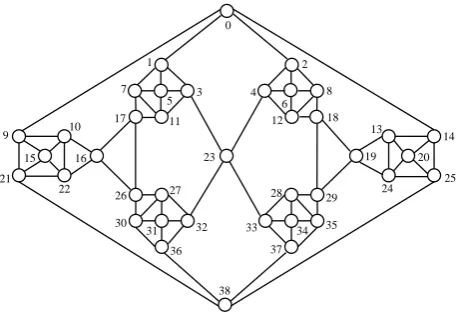
r-regular graphs whereris odd. Whenris even, the sit-uation is somewhat unclear and a characterization of all 3-connected 4-regular planar graphs of inscribable type using simple graph-theoretical terms is not yet known. For example, with regards to 4-regular planar graphs, Eppstein [6] raised the following question: Is a more-than-1-tough 3-connected 4-regular planar graph of in-scribable type? The answer is ‘no’ and the graph de-picted in Figure 1 is more-than-1-tough but is not of inscribable type. The technical details for showing this fact can be found in Section 6.2.1 of [1].
20
21
15 16
35 29 24
22 27 28
30
25 14
9 10 13
[image:5.595.63.293.383.542.2]19 26 31 34 17 11 3 1 7 4 18 8 2 12 5 23 33 6 38 0 36 37 32
Figure 1. A more-than-1-tough 3-connected 4-regular planar graph
However, we do have the following positive result:
Theorem 17. Let G = (V, E) be a 3-connected 4 -regular planar graph. If each non-trivial 4-edge cut is a matching ofG, then sys(G)has a strictly feasible so-lution.
We establish a number of lemmas before proving the result. We first define a useless edge. An edgeeis said to be uselessifxe= 0 for allx∈SEP(G). Hence, sys(G) has a strictly feasible solution if and only if G has no useless edge and no non-trivial constricted cut.
For the next few lemmas, let (P) denote the linear
programming problem: max 0 subject to
x(δ(v)) = 2 ∀v∈V(G)
−x(A)≤ −2 ∀A∈C(G)
x≥0
and let (D) denote the dual of (P):
min 2 ∑
v∈V(G)
zv−2 ∑
A∈C(G)
yA
subject to
zu+zv−
∑
A∈C(G):uv∈A
yA≥0 ∀ uv∈E(G) y≥0.
Let sys′(G) denote the set of constraints in (D). The next lemma gives a sufficient condition for a cut to be constricted and an edge to be useless.
Lemma 18. Let G be a feasible graph. If there exist
¯
y ∈RC+(G) andz¯∈RV(G) feasible for sys′(G) such that
∑
A∈C(G)
¯
yA = ∑
v∈V(G)
¯
zv, then all the cuts in {A : ¯yA > 0} are constricted and all the edges in∑ {uv : ¯zu+ ¯zv−
A∈C(G):uv∈A ¯
yA>0} are useless.
Proof. AsGis feasible, (P) has an optimal solution. The result now follows from complementary slackness.
Lemma 19. LetGbe a feasible graph. Then there exist
¯
y ∈RC+(G) andz¯∈RV(G) feasible for sys′(G) such that
the following hold: ∑
A∈C(G)
¯
yA = ∑
v∈V(G)
¯
zv, a cut A is
constricted if and only if y¯A > 0, and an edge uv is
useless if and only if z¯u+ ¯zv−
∑
A∈C(G):uv∈A ¯
yA>0.
Proof. Since Gis feasible, (P) has an optimal solution. By strict complementarity for linear programming, there exist an optimal solution ¯y,z¯such that a cut Ais con-stricted if and only if ¯yA>0, and an edgeuvis useless if and only if ¯zu+ ¯zv−
∑
A∈C(G):uv∈A ¯
yA>0. As the optimal value is 0, we have 2 ∑
v∈V(G)
¯
zv−2 ∑
A∈C(G)
¯
yA= 0, giving ∑
v∈V(G)
¯
zv= ∑
A∈C(G)
¯
yA.
Next, we obtain a refinement of Lemma 19 using the notion of uncrossing. Let ¯y,z¯be integral and feasible for sys′(G). LetA(¯y) denote the set{A∈C(G) : ¯yA>0}. Let δ(S) and δ(T) be crossing cuts in A(¯y). By un-crossingδ(S) andδ(T), we mean applying the following modifications to ¯y,z¯: Let ρ = min{y¯δ(S),y¯δ(T)}.
equal to{v} for somev∈V(G), then decrease ¯zv byρ; otherwise, increase ¯yδ(S∩T) byρ.
This technique of uncrossing is quite common in com-binatorics. (See for instance Chapter 4 of [7].) The next result is a specialization of the technique for the purposes of the current paper. The idea of the proof is similar to the idea used in the proof of Claim 1 of Theorem 4.7 in [5].
Lemma 20. Given an integral pair y,¯ z¯ feasible for sys′(G), one can obtain, by performing a finite number of uncrossings, an integral pairy′, z′ feasible for sys′(G)
such that ∑
A∈C(G)
¯
yA− ∑
v∈V(G)
¯
zv= ∑
A∈C(G)
y′A− ∑
v∈V(G)
zv′
and {A ∈ C(G) : yA′ > 0} is a non-crossing family of cuts.
Proof. For y ∈ ZC(G), let M(y) denote
∑
A∈C(G)
∑
B∈C(G)
πy(A, B) where
πy(A, B) = {
yAyB ifA, B cross; 0 otherwise.
Let A(¯y) denote {A ∈ C(G) : ¯yA > 0}. If M(¯y) = 0, then A(¯y) is a non-crossing family of cuts and we are done. Suppose that M(¯y) > 0. Then there exist
S, T ⊂ V(G) such that δ(S), δ(T) ∈ A(¯y) cross. Pick any such pair S, T. Let A = δ(S) and B = δ(T). Uncross A and B to obtain y′, z′. It is not diffi-cult to see that y′, z′ are still feasible for sys′(G) and
∑
A∈C(G)
¯
yA− ∑
v∈V(G)
¯
zv = ∑
A∈C(G)
y′A− ∑
v∈V(G)
z′v. For a cutC∈C(G), letK(C) denote the multiset of cutsD∈ C(G)\{A, B, δ(S∩T), δ(S∪T)}such thatCandDcross and the number of timesDappears inK(C) is given by ¯
yD. SinceyD′ = ¯yDfor allD /∈ {A, B, δ(S∩T), δ(S∪T)}, we have
M(y′) ≤ M(¯y) +ρ(|K(δ(S∩T))|+|K(δ(S∪T))|)−ρ(|K(A)|+|K(B)|)−ρ2
Note that any cut that crosses bothδ(S∩T) andδ(S∪T) also crosses both A and B. And any cut that crosses neitherAnorB also crosses neitherδ(S∩T) norδ(S∪ T). It follows thatρ(|K(δ(S∩T))|+|K(δ(S∪T))|)−
ρ(|K(A)|+|K(B)|) ≤ 0. However, this inequality is strict sinceB ∈K(A) butB /∈K(δ(S∩T))∪K(δ(S∪ T)). Hence, M(y′) < M(¯y) and we set ¯y to y′ and repeat the process. As M(¯y) is integral whenever y is integral, each uncrossing reduces M(¯y) by an integral amount until it reaches 0.
Lemma 21. For any 3-connected feasible graph G, sys(G)has no strictly feasible solution if and only if there
exist y¯∈RC+(G) andz¯∈RV(G) feasible for sys′(G)such
that the following hold: ∑A∈C(G)y¯A= ∑
v∈V(G)z¯v, the
set{A∈C(G) : ¯yA>0}is non-crossing, and thaty¯A> 0 for some A∈C(G) or ¯zu+ ¯zv−
∑
A∈C(G):uv∈A ¯
yA >0
for someuv∈E(G). (Here, “or” is not exclusive.) Proof. Sufficiency follows from Lemma 18.
To prove necessity, suppose that sys(G) has no strictly feasible solution. Then there exists either a constricted cutC∈C(G) or a useless edgee∈E(G). By Lemma 19, there exist an optimal solution ¯y,¯z for (D) such that ¯
yA>0 for every non-trivial constricted cutAand ¯zu+ ¯
zv−
∑
A∈C(G):uv∈A ¯
yA>0 for every useless edgeuv. Since the coefficients in (D) are integral and the constraints of (D) are homogeneous with optimal value equal to zero, we may assume that ¯yand ¯zare integral. By Lemma 20, we may assume{A∈C(G) : ¯yA>0}is a family of non-crossing cuts after unnon-crossing pairs of non-crossing cuts, if any.
It now suffices to show that after the uncrossings, we do not end up with ¯y = 0 and ¯zu+ ¯zv −
∑
uv∈A ¯
yA = 0 for all uv ∈ E(G). The case when G has a useless edgeuvis easy since uncrossings could not decrease the value of ¯zu+ ¯zv −
∑
A∈C(G):uv∈A ¯
yA, which initially was greater than zero. So, suppose that G has no useless edge. Then G has at least one non-trivial constricted cut. We claim that uncrossing leaves at least one cut in {A∈ C(G) : ¯yA >0}. Suppose that at some point, we uncrossed δ(S) and δ(T) where S ∩T = {u} and
V\(S∪T) ={v}, the only type of uncrossing that does not increase ¯yA for some A ∈ C(G). Since G has no useless edge, there exists ¯x∈SEP(G) such that ¯x >0. Then 4 = ¯x(δ(S))+ ¯x(δ(T)) = ¯x(δ(S∩T))+ ¯x(δ(S∪T))+ 2¯x(γ(S\T, T\S))≥4. It follows thatγ(S\T, T\S) =∅. But this meansG−{u, v}is disconnected, contradicting that G is 3-connected. Hence, each time we perform uncrossing, there is at least one non-trivial cut A such that ¯yA>0.
For a setS, 2S denotes the set of all subsets ofS. The following easy result is rather useful.
Lemma 22. LetG= (V, E)be a connected graph. IfA is a non-crossing family of cuts of G, then there exists
a nested family S(A) ⊂2V that contains precisely one
proper shore of each cut inA.
it in S(A). Clearly, S(A) contains precisely one shore of each cut in A. Suppose that there existS, T ∈S(A) such thatS∩T ̸=∅,S\T ̸=∅, andT\S ̸=∅. Asδ(S) andδ(T) do not cross, we haveV\(S∪T) =∅, which is impossible since|S|,|T| ≤ |V2|.
As no two r-edge cuts cross, Lemma 22 tells us that there is a nested family F of proper shores of all the
r-edge cuts with exactly one shore for eachr-edge cut.
Lemma 23. Let G be a feasible graph. If δ(S) is a non-trival constricted cut of G, then G[S] and G[V\S]
are connected.
Proof. Suppose that the statement is false. Without loss of generality, we may assume thatG[S] is not connected. Let T and U be non-empty proper subsets of S such thatS=T∪U,T∩U =∅, and there is no edge inG[S] joining a vertex inT and a vertex inU. Then, for any ¯
x∈SEP(G), ¯
x(δ(S)) = ¯x(δ(T)) + ¯x(δ(U))≥2 + 2 = 4,
contradicting thatδ(S) is constricted.
The next result appears in Gr¨unbaum [8]. The proof of the lemma is included here for the sake of complete-ness.
Lemma 24. Let G = (V, E) be a connected simple plane graph with at most one vertex of degree two. Then
there are at least six three vertices and
degree-three faces in total.
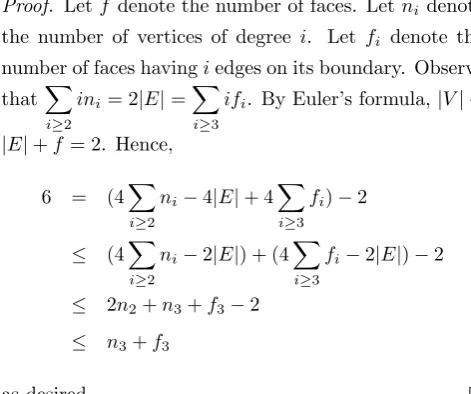
Proof. Letf denote the number of faces. Letni denote the number of vertices of degree i. Let fi denote the number of faces havingiedges on its boundary. Observe that∑
i≥2
ini= 2|E|= ∑
i≥3
ifi. By Euler’s formula,|V| −
|E|+f = 2. Hence,
6 = (4∑
i≥2
ni−4|E|+ 4 ∑
i≥3
fi)−2
≤ (4∑
i≥2
ni−2|E|) + (4 ∑
i≥3
fi−2|E|)−2
≤ 2n2+n3+f3−2
≤ n3+f3
as desired.
From Lemma 24, one deduces that
Lemma 25. If G= (V, E)is a4-regular planar graph, thenGcannot be bipartite.
Proof of Theorem 17. Suppose that sys(G) has no strictly feasible solution. Since 12e∈SEP(G), Gis fea-sible and has no useless edge. Therefore, G must have a non-trivial constricted cut. By Lemma 21, there exist ˆ
y ∈ RC+(G) and ˆz ∈ RV feasible for sys′(G) such that ∑
A∈C(G)
ˆ
yA = ∑
v∈V ˆ
zv and A(ˆy) :={A∈C(G) : ˆyA >0} is non-crossing and non-empty. AsA(ˆy) is non-crossing, by Lemma 22, there exists a nested family S of subsets of V containing exactly one shore of each cut in A(ˆy). Because Gis feasible, by Lemma 23,G[S] is connected for allS∈ S.
[image:7.595.56.292.543.740.2]T
Figure 2. Sets inS
Choose T ∈ S such that there exists a proper subset ofT that is inS and for any proper subsetRofT that is inS, there is no proper subset ofRthat is inS. If no suchT exists, letT =V.
Let S′ = {S ∈ S : S ⊂ T}. Observe that the ele-ments inS′are pairwise disjoint. Consider the graphH
obtained from G[T] by contracting each S ∈ S′. Note that H is connected and planar. We will show that H
is simple and non-bipartite.
To show thatH is simple, we first prove the following:
Claim. LetS ∈ S′. Then for every edge uv such that
u∈S andv /∈S, ˆzu= 0 and ˆzv>0.
An immediate consequence of this claim is that if w
is a neighbour of a pseudo-vertex in H, then wis not a pseudo-vertex and ˆzw>0.
To prove the claim, note that asGhas no useless edge, by Lemma 18, for allpq∈Esuch thatp, q∈S, we have ˆ
zp+ ˆzq− ∑
A∈C(G):pq∈A ˆ
yA= 0, giving ˆzp+ ˆzq = 0 as ˆyA= 0 for all A ∈ C(G) such that pq ∈ A. By Lemma 24,
G[S] contains a triangle asG[S] is connected and planar and has no more than 4 vertices of degree at most 3. Hence, ˆzp = 0 for all p∈S, giving ˆzu = 0. As sys′(G) contains the constraint ˆzu+ ˆzv −
∑
A∈C(G):uv∈A ˆ
yA ≥ 0, having ˆyδ(S)>0 and ˆzu = 0 implies that ˆzz >0. This completes the proof of the claim.
From this claim, one can see thatδ(S1) andδ(S2) are
each element of S′ does not create parallel edges. So
H is simple. Also, the set of pseudo-vertices in H is independent.
To show that H is non-bipartite, first suppose that
T =V. In this case,His simple, connected, planar, and 4-regular and therefore is non-bipartite by Lemma 25. Otherwise, H has exactly four vertices of degree three and no vertex of degree two. By Lemma 24, H has a triangle and therefore is non-bipartite.
Letvbe a neighbour of a pseudo-vertex inH. By the claim above, v is not a pseudo-vertex and ˆzv >0. Let X ={v∈ T : ˆzv >0}. Then, X is an independent set inH because, by Lemma 18, ˆzu+ ˆzv= 0 for alluv∈E such that u, v ∈ T\ ∪
S∈S′
S as G has no useless edge. In addition, H being connected implies that for every vertexv inH that is not a pseudo-vertex, ˆzv ̸= 0. If we letY be the set containing all the vertices v ∈ T with ˆ
zv<0 and the pseudo-vertices, thenX andY partition the set of vertices of H. Clearly, Y is an independent set inH. Hence,H is bipartite with bipartition (X, Y), contradicting thatH is non-bipartite.
Figure 3. A 3-connected 4-regular graphGwith sys(G) having no strictly feasible solution
Note that Theorem 17 does not hold if the condition to be planar is dropped. The graph depicted in Figure 3 is a 3-connected 4-regular graphGwhose non-trivial 4-edge cuts are matchings ofGbut sys(G) has no strictly fea-sible solution. Note that the graph is not more-than-1-tough and it has a non-trivial constricted cut. However, every non-trivial 4-edge cut of the graph is a matching. One might ask what happens if we restrict our attention to more-than-1-tough 4-regular graphs. We do not know the answer and so we have the following problem:
Problem 26. Let G be a more-than-1-tough 4-regular graph. If every non-trivial4-edge cut ofGis a matching, must sys(G) have a strictly feasible solution?
Acknowledgements
The research of this author was supported by NSERC.
REFERENCES
[1] K. K. H. Cheung, Subtour elimination polytopes and
graphs of inscribable type, Ph.D. Thesis, Department
of Combinatorics and Optimization, University of
Wa-terloo, 2003.
[2] M. B. Dillencourt and W. D. Smith. A linear-time
al-gorithm for testing the inscribability of trivalent
poly-hedra. Eighth Annual ACM Symposium on
Computa-tional Geometry (Berlin, 1992). International Journal
of Computational Geometry and Applications, 5:21–36,
1995.
[3] M. B. Dillencourt and W. D. Smith. Graph-theoretical
conditions for inscribability and Delaunay realizability.
Discrete Math., 161:63–77, 1996.
[4] J. Edmonds. Maximum matching and a polyhedron
with 0,1-vertices. J. Res. Nat. Bur. Standards Sect. B,
69B:125–130, 1965.
[5] J. Edmonds, L. Lov´asz, and W. R. Pulleyblank. Brick
decompositions and the matching rank of graphs.
Com-binatorica, 2:247–274, 1982.
[6] D. Eppstein. An uninscribable 4-regular polyhedron.
http://www.ics.uci.edu/~eppstein/junkyard/ uninscribable/
Last accessed: July 5, 2013.
[7] L. R. Ford Jr. and D. R. Fulkerson. Flows in
Net-works Princeton University Press, Princeton, New
Jer-sey, 1962.
[8] B. Gr¨unbaum.Convex Polytopes. Wiley and Sons, New
York, 1967.
[9] S. L. Hakimi and E. F. Schmeichel. On the connectivity
of maximal planar graphs. J. Graph Theory, 2(4), pp.
307–314, 1978.
[10] C. D. Hodgson, I. Rivin, W. D. Smith. A
character-ization of convex hyperbolic polyhedra and of convex
polyhedra inscribed in the sphere.
[11] L. Lov´asz. Matching structure and the matching lattice.
J. Combin. Theoy Ser. B, 43(2):187–222, 1987.
[12] L. Lov´asz and M. D. Plummer. Matching Theory.
Akad´emiai Kiad´o, North-Holland, Amsterdam, 1986.
[13] I. Rivin. A characterization of ideal polyhedra in
hy-perbolic 3-space. Ann. of Math. (2), 143:51–70, 1996.
[14] I. Rivin. Combinatorial optimization in geometry.
Adv. in Appl. Math., 31:242–271, 2003.
[15] J. Steiner.Systematische Entwicklung der Abh¨angigkeit
geometrischer Gestalten von einander. Reimer, Berlin,
[16] E. Steinitz. Polyeder und Raumeinteilungen.
Ency-clop¨adie der mathematischen Wissenschaften, 3:1–139,
1922.
[17] E. Steinitz. Uber isoperimetrische Probleme bei
kon-vexen Polyedern. J. Reine Angew. Math.159:133–143,
1928.
[18] W. T. Tutte. The factorization of linear graphs. The
Journal of the London Mathematical Society, 43:26–40,