THE IMPLEMENTATION OF GUIDED READING ACTIVITY
ON STUDENTS’ READING COMPREHENSION AT XI GRADE
OF SMAN 1 GADINGREJO
A Script
By
Hesti Setya Wati
LAMPUNG UNIVERSITY
BANDAR LAMPUNG
ABSTRACT
THE IMPLEMENTATION OF GUIDED READING ACTIVITY
ON READING COMPREHENSION AT XI GRADE OF SMAN 1
GADINGREJO
BY
HESTI SETYA WATI
The purposed of this research was to find out wether there is improvement on students’ reading comprehension through the implementatio of guided reading activity. The sample of this research is grade XI of SMAN 1 Gadingrejo. As the researcher use one pre-test post-test design, the researcher found out that there is an improvement in students’ reading comprehion after being taught by guided reading activity. The result showed that the mean of student gain score is 23, 38 from 58,43 up to 81,71 with total 2288. The t-test also revealed that the result was significant (p<0.05, p=0.000). It indicates that the implementation of guided reading activity improves studetns’ reading comprehension.
THE IMPLEMENTATION OF GUIDED READING ACTIVITY
ON STUDENTS’ READING COMPREHENSION AT XI GRADE
OF SMAN 1 GADINGREJO
By
Hesti Setya Wati
A Script
Submitted in a Partial Fulfillment of
The Requirement for S-1 Degree
in
The Language and Arts Department of
Teacher Training and Education Faculty
LAMPUNG UNIVERSITY
BANDAR LAMPUNG
CURRICULUM VITAE
Hesti Setya Wati is the first child of Sujito and Sumarsih. She was born on January, 5th, 1992 in Gadingrejo. She has a brother and a sister, Rudi Cahya Aksani and Dinda Tri Azzahra.
She started her study from at SDN 3 Gadingrejo and graduated on 2003. In the same year, she continued her study at SMPN 1 Gadingrejo. After graduating from Junior High School in 2006, she continued her study at SMAN 1 Gadingrejo and graduated in 2009.
In the same year, she was registered as a student of English Education Study Program of Lampung University. She accomplished her Teaching Training Program (Program Pengalaman Lapangan) as one of the requirements for FKIP students at SDN 1 Kemukus, South Lampung.
During her study in Lampung University, she was actively involve in UKM-U English Society (ESo). In the period of June 2010 to May 2011 she appointed as the head of Homebase and Administration Department followed by becoming general secretary for the next period of June 2011 to May 2012. In the periode of June 2012 to December 2013, she had appointed to be the President of UKM-U English Society (ESo) Lampung University.
DEDICATION
This paper would proudly be dedicated to
My parents: Sujito and Sumarsih, My brother: Rudi Cahya Aksani and Dinda,
MOTTO
Do not go gentle into that good night Rage rage against the dying of the light
ACKNOWLEDGEMENTS
Praise to Allah SWT, the Almighty and Merciful God, for blessing the writer with faith, health, and opportunity to finish this research which entitled The
Implementation of Guided Reding activity on Students’Reading Achievement at XI grade.of SMAN 1 Gadingrejo . This research paper is submitted to English
Education Program, Language and Arts Department of Teacher Training and Education Faculty of Lampung University in partial fulfillment of the requirement for the S-1 degree.
Gratitude and honor are addressed to all people who have helped and supported the writer to complete this research. It is necessary to be known that this research will never have come into its existence without any supports, encouragements, and assistances by several outstanding people and institutions. Therefore, the writer would like to acknowledge his respect and sincere gratitude to:
1. My advisors, Prof. Dr. Patuan Raja, M.Pd., and Budi Kadaryanto, S.Pd., M.A. who has guided and motivated the writer in writing this paper. 2. Ujang Suparman, M.A. Ph.D., as the examiner, for his suggestions, ideas,
and motivation to complete the paper sooner.
3. Dra. Ari Nurweni. as the Chief of English Education Study Program and all lecturers of English Education Study Program who have contributed their guidance during the completion process until accomplishing this research.
4. Dr. Mulyanto Widodo, M.Pd. as the Chairperson of Language and Arts Education Department.
5. Mr. Hidanti Karnila and Mr. Sumarno the English teacher of SMAN 1 Gadingrejo who has given the full support for this research.
6. All students of SMAN 1 Gadingrejo, English Club Sman 1 Gadingejo, and students of grade XI Science for their willingness to cooperate and participate in this research.
7. My best counterpart Emma Mattie, who taught me a lot on my ups and down during the program,
8. My group on Haida Gwai-Muaro Pijoan team, Ka Dian, Yolanda, Roo, Ary, ka Wawan, Adam, Dika, Laura, Cici, Natalie, Pingkan, Andien, Maddie, Clara, Graham, Kang Gilang, Dyllis, and Ichal. There is always a minute to think how wonderful you guys are.
9. My best friend Desi, Yesi, Maulia, Mailani, Diah, Lela, Vitha, Eka. 10. My incredible and spiritful squad of ICYEP 2014.
11. My always be biggest inspirator : Ka Tian, Mba chandra, Mba Mei, KA Arf, Ka Madlias, Ka Duki, ko Heri, and Mbak Indah
Elok, Atika, Tanjung, Dwi, Uli, Cita, Taufik, and all members that i can’t mention one by one. Thank you for all your passion and hardwork during the up and down in our period. Thank you for making time in ESo always become a fun things.
13. My PCMI squad : Ka yogi, Rizkur, Reinaldy, Afan, Ka Puti, Ave, Ade, Mia, Barry, Nouvindri, mika, ria, Ardian, bang rendi, ka mira, ka Nanda, Bang Ded Rus, Atu Tata and all of your bravest heart and Independent spirit.
14. All the writer’s friends of English Education: Frincelly, Dhonna, Ina, Ani, Basma, Arini, Dwi Fitrianingsih, Tri Lestari, Siti Mardeliza Dea, Fatimah Mulya Sari, Miftahur Rohibah, Ni wayan Dresti, Chairunissa, Desi Pertiwi, Ferayani Ulrica, Jessy Yunita Fadmadi, and Yusni Triana.
The writer believes that her writing may be still far from perfection. There may be drawbacks and weaknesses in the research. Thus, comments, critiques, and suggestions are always welcomed for the purpose of better research. Somehow, the writer hopes this research would give a positive contribution to the educational development, the reader, and to those who want to accomplish further research.
Bandar Lampung, March 2016
CONTENTS
Page
ABSTRACT…..... i
CURRICULUM VITAE... v
DEDICATION... vii
MOTTO ... viii
ACKNOWLEDGEMENTS... ix
CONTENTS... xi
LIST OF TABLES ... xiii
LIST OF GRAPHS ... ivx
LIST OF APPENDICES ... vx
I. INTRODUCTION 1.1 Background of the Problem ...1
1.2 Formulation of the Problem...3
1.3 Objectives of the Research ...4
1.4 Uses of the Research ...4
1.5 Scope of the Research...4
1.6 Definition of Terms ...4
II. LITERATURE REVIEW 2.1 Review of Previous Research ...6
2.2 Review of Related Literature 2.2.1 Concept of Guided Reading Activity ...7
2.2.2 Procedure of Teaching Reading through Guided Reading...10
2.2.3 Concept of Reading Comprehension...12
2.3 Theoritical Assumption ...16
2.4 Hypothesis ...16
III. RESEARCH METHOD 3.1 Research Design ...18
3.2 Population and Sampe ...19
3.3 Variables ...19
3.4 Research Procedures...20
3.5 Data Collecting Technique ...22
3.6 Try out of the Instrument ...23
3.6.1 Validity ...24
3.6.2 Reliability ...25
3.6.3 Level of Difficulty ...27
3.6.4 Discrimination Power ...28
3.7.1 Random Test ...29
3.7.2 Normality Test ...31
3.8 Data Analysis...31
3.9 Hypothesis Testing ...32
4 RESULTS AND DISCUSSION 4.1 Results ... 34
4.1.1 Report on the Implementation of the Experiment...35
4.1.1.1 Result of Pre-Test ...35
4.1.1.2 Result of the Post-Test ...36
4.1.2 Improvementof Students’ achievement in Reading Comprehension ...39
4.1.3 HypothesisTesting ...41
4.2 Discussions ...43
5 CONCLUSIONS AND SUGGESTIONS 5.1 Conclusions ...47
5.2 Suggestions ...48
6 REFERENCES...49
TABLES
Table 3.1 Specification of Data Collecting Instrument...24
Table 3.2 The data of Pretest ...30
Table 3.3 The data of Post Test ...30
Table 3.4 Normality Test ...31
Table 4.1 Distribution of Students’ Score of the Pretest...35
Table 4.2 Distribution of Students’ Pretest achievement in each Aspects of Reading ...36
Table 4.3 Distribution of StudentS’ Score of the Posttest ...37
Table 4.4 Distribution of Students’ Posttest achievement in each Aspects of Reading Comprehension ...38
Table 4.5 Improvement from the Pretest and Postest ...39
Table 4.6 Improvement from Pretest to Posttest in each Aspect of Reading Comprehension ...39
GRAPH
Graph 4.1 Improvementof the tudents’ Score in Five Aspects of Reading
APPENDICES
Appendix 1 Lesson Plan ... 53
Appendix 2 Score Distribution of Try Out Test... 78
Appendix 3 Reliability Test of Try Out Test ... 80
Appendix 4 Level of Difficulty and Discrimination Power of Try out Test ...81
Appendix 5 Result of Student Score in Pretest and Posttest...82
Appendix 6 Distribution of student Pretest ...83
Appendix 7 Distribution of Student Posttest...84
Appendix 8 Table Distribution of Pretest ...85
Appendix 9 Table Distribution of Posttest...86
Appendix 10 Random Test of Pretest and Posttest ...87
Appendix 11 The Normality Test of Pretest and Posttest ...88
Appendix 12 The Analysis of Hypothesis ...89
Appendix 13 T table ...90
Appendix 14 Sample of Student Try out test ...91
Appendix 15 Sample of Student Pretest ...95
Appendix 16 Sample of Student Posttest ...103
I. INTRODUCTION
This chapter discusses several points such as the background of the problem, which contains the reason why the researcher is interested in conducting the research of teaching reading through guided reading. It covers the background of the problem, identification of research problem, objective of the research, uses of the research, scope of the research, and definitions of terms.
1.1 Background of the problem
2
In addition to that, pre-research observation that has been conducted by the researcher showed that student had some limitation in the process of understanding the text. They sometimes unfamiliar with the text they read. They are lack of background knowledge about what they read. This case makes the student frustrate after reading. Their understanding about text is still in the level of vocabulary acquisition. This cases lead students difficulties in answering the question after reading the text in which the question asked is mostly about student comprehension based on the text. Thus they need a new approach in order to comprehend the text.
The researcher also found that some teachers are still using limited number of techniques to teach reading to the students. The teacher mainly focuses on direct explanation about the text, answering question and analyzing tenses usage on the text. The teacher needs some new technique to cope with the students’
comprehension problems.
Based on that, Richardson’s research (2010) found out that guided reading
strategies that has significant impact on increasing reading comprehension is
guided reading strategies that include multiple pre-reading strategies (some of
which intended to activate prior knowledge), slowing down to use during reading
strategies, and a student’s attitude toward reading. Therefore, the use of
pre-reading vocabulary and theme introduction would trigger student mindset to
3
Fountas and Pinnel (2012) stated that Guided reading is designed to help individual learner learning by group on how to process the variety level of challenging text with understanding and fluency. Guided reading aimed to make the student develop such strategy to understand the text. Thus, it makes the student enjoying the story because they can understand it and it is accessible to
them through their own strategies supported by the teacher’s introduction.
Moreover, as Fountas and Pinnell (1996) state that for the student, the guided reading lesson means reading and talking (and sometimes writing) about an interesting and engaging variety of fiction and nonfiction texts. Meanwhile for the teacher, guided reading means that taking the opportunity for careful text selection and creating intensive teaching systems of strategic activity for proficient reading.
In line with the reason stated above, the researcher focuses the research in English reading comprehension by using Guided reading activity. Therefore the researcher entitled the thesis by the Implementation of Guided reading activity onn student’s
reading comprehension at XI grade of SMAN 1 Gadingrejo.
1.2 Formulation of the problem
Based on the background above, the formulation of the problem is “is there any increase of the students’ reading comprehension after being taught with guided
4
1.3 Objective
The objective of the research is to find out whether there is increase of students.’
reading ccomprehension after being taught by guided reading activity.
1.4 Uses
The uses of research are as follow:
1. Theoretically, the results of this research can be verified the theories related to Guided reading activity in teaching reading.
2. Practically, the finding of this research can be used as a new technique and information for the teacher to teach reading
1.5 Scope
This study has conducted in the second year of student of senior high school of SMAN 1 Gadingrejo, Pringsewu. The researcher investigates students’ reading
comprehension by implementing Guided Reading activity.
1.6 Definition of term
In term to avoid misunderstanding, definitions of terms are provided as follows: a. Reading
5
b. Reading comprehension
Reading comprehension is the act of interpreting what is being read. A successful reading comprehension is affected by two main factor, those are the reader and the text.
c. Guided reading
II. LITERATURE REVIEW
This chapter deals with the theories from the experts as the background how the research conducted and how the researcher formulates the assumption from her research.
2.1 Review of Previous Research
7
Another research conducted by Richardson (2010) showed that pre-reading strategy was found to have the greatest impact on comprehension. It shows how step of pre reading strategies help the student in 11 weeks observation to improve their fluency and comprehension. It helps teacher to encourage students’
eagerness in reading by developing some question and background knowledge in pre reading activity.
Guided reading is also creating an active teaching learning process. As studied by Ofrina (2013), the combination of guided reading strategies and reciprocal teaching strategies made a successful result on student comprehension. Student had enjoyable learning in small group to share their text comprehension.
The previous researches that have been mention above shows how guided reading
has a good and significant impact in student. It increases not only students’
reading comprehension but also students’ fluency and accuracy. Guided reading
creates a positive learning environment.
2.2 Preview of Related Literature
2.2.1 Concept of Guided Reading Activity
Readingis a complex process. The ultimate goal of reading is “the construction of meaning from text. It is a cognitive and affective process where readers “actively
engage with the text and build their own understanding” (Braunger & Lewis,
8
Guided reading is a teaching approach designed to help individual students learn
how to process a variety of increasingly challenging texts with understanding and
fluency (Fountas and Pinnel, 2012). Guided reading occurs in a small‐group
context with a group of children who use similar reading processes and are able to
read similar levels of text with support. The teacher selects and introduces texts to
readers, works briefly with individuals in the groups as they read it, engages the
readers in a discussion, and makes teaching points after the reading. Sometimes,
after reading a text, the teacher extends the meaning of the text through writing,
text analysis, or another learning experience. The lesson also may include work
with words based on the specific needs of the group.
The ultimate goal of guided reading is to help children learn how to use independent strategies successfully. Teachers, based on their knowledge of children, possible texts, and the process involved in reading and learning to read, make a series of complex decisions that influence and mediate literacy for the young children in the group. Guided reading also involves ongoing observation
and assessment that informs the teacher’s interactions with individuals in the
group and helps the teacher select appropriate texts.
9
individually depending on the demands of the task and the needs of the child. Whole group activities include read-aloud, shared reading, write-aloud, and shared writing. Small group activities are based on developmental levels so that children are grouped according to abilities and include Guided Reading and guided writing. Individual groups include interventions in reading and writing, as well as independent reading and writing activities. Each of these has specific formats and materials. Guided Reading groups students together with similar strengths and weaknesses. It is based on text that is considered to be at their
instructional level and in their “zone of proximal development”.
According to Philips (2008: 3-4) the stages of Guided Reading Activity is divided into Before, During, and After Reading activities. Before Reading activities prepare the students to get ready to read by activating background knowledge and engaging the learners in questioning and predicting. It provides teachers with opportunities to assess what children already know and assisting them in teaching what they need to know to be successful in reading the text that will follow. It often includes mini-lessons on skills or strategies that may be helpful to the students to successfully read the selection.
During Reading activities may include reading out loud (sometimes called whisper reading), reading silently, reading to answer questions or for information, and opportunities to discuss comprehension or word difficulties as they arise.
10
After Reading activities include discussion of the material on a cognitive or affective level. This requires students to explain their positions using the text, prior experience, or both. Follow-up lessons often include specific target skills or strategies lessons based on the text. These may focus on the content of and the application of phonics, specific comprehension skills, fluency practice, and/or writing extension and applications of the newly explored skills and strategies.
All of these activities provide opportunities for collaboration and construction of meaning and understanding. It is also align with the three underlying constructivist concepts upon which the Two Step Model published by Flynn, Mesibov, Vermette, & Smith (2004) is based:
1. Student engagement with the information must precede teacher explanations,
2. Instruction (guidance) should come in the form of interventions as students engage with information, ideas, and concepts, and
3. Authentic tasks create an environment for student engagement and teacher interventions.
2.2.2 Procedure of Teaching Reading through Guided reading
11
Before reading
1. Selects four to six students based on assessment and observations
2. Prepares an introduction to the story
3. Briefly introduces the story, keeping in mind the meaning, language, and
visual information in the text, and the knowledge, experience, and skills of
the readers
4. Does pre reading vocabularies by skimming difficult words and try to
guess the meaning.
5. Leaves some questions to be answered through reading
During reading
1. Asks student to read the whole text independently
2. Observes the reader’s behaviors for evidence of strategy use and confirms
student’s problem‐solving attempts and successes
3. Interacts with individuals to assist with problem solving at difficulty
After reading
1. By working on with one group, returns to the text to discuss the story with
the students and clarify, if necessary, what was read
2. Invites personal response while student checks their predictions, reacts
personally to the story or information
3. Returns to the text for one or two teaching opportunities such as finding
evidence, discussing problem solving, phonics, word work, or review of
12
4. Assesses students’ understanding of what they read sometimes engages the
students in extending the story
5. Records observations and evaluates students’ reading to determine what
support is needed
6. Continue working on with the rest of the group with the same procedure
on after reading activity
2.2.3 Concept of Reading comprehension
As a cognitive process reading require not only decoding symbol in language but also memorizing some information. Reading has full range activity in order to make reading has a full meaning. The one who read is not only getting the information but also gaining new idea about what they have read.
As cited in Heston (2010), Fountas and Pinnell (2006) stated that comprehension is the vital, central core of the broader and more complex ability to reason. Without comprehension it is useless if readers or students only read the word or sentence. It is more than recognizing all the words in the written texts. When the readers are in the process of comprehending the content of the written text, they try to construct the meaning of the written text by recognizing the words in the written texts automatically to case them in relating their background knowledge to
13
Gunning (1996) identifies three main theories of reading comprehension. These theories are schema theory, mental model theory and proposition theory as explained that:
1. Schema Theory
Schema theory defines as the organized knowledge that one already has about people, places, things and events. Schema theory involves an interaction between the reader’s own knowledge and the text, which results in comprehension. This schema, as Gunning defines can be very broad, such as schema for social oppression, or narrower such as racism. Each schema is filled in an individual compartment and stored there. In attempt to comprehend reading materials, students can relate this new information of the existing information to have compartmentalized in
their minds, adding it to these “files” for future use. Based on the Schema theory, depending on how their “files” becomes, their degree of reading comprehension may vary.
2. Mental Model Theory
14
the main character are kept in the foreground according to Gunning, (1996). Sometimes misconceptions about important concepts reflect misleading mental models of the topic itself or the subject matter within which it sits. There are, however, interventions the teacher can do to help the reader to stay on track and create a more accurate picture. One suggestion is for the teachers to ask the students to disclose their mental models of the topics in question, through analogy, discussion, picturing, and other ways. This information gives the teacher insight on the student's knowledge gaps and misconceptions, therefore allowing them to help students reconstruct a more accurate picture.
3. Proposition Theory
Propositional theory involves the reader constructing a main idea or macrostructure as they process the text. These main ideas are organized in a hierarchical fashion with the most important things given the highest priority to be memorized (Gunning, 1996).
In addition, Suparman (2012) states that there are several aspects of reading comprehension skills that should be mastered by the reader to comprehend the text deeply, which is as follow:
1. Identifying a Main Idea
15
grasp and find the main point of the passage by summarizing the passage and look for repetition of ideas or words.
2. Identifying Details
It means looking for the information that relevant to the goal in mind and ignoring the irrelevant.
3. Making/Confirming/ Reference
Reference is the intentional usage of one thing to show something else in which one provides the information necessary to interpret the other. Finding reference means interpreting and determining one linguistic expression to another. There are two types of references; cataphoric and anaphoric reference. A anaphoric reference unit is another units which is introduced later on in the text. Meanwhile, an anaphoric reference is another unit that was introduced earlier on in the text.
4. Making/Confirming/Inference
Inference is a good guess or conclusion drawn based on logic of passage. Finding inference means the reader imply the sentence or passages understand and conclude it logically.
5. Understanding vocabulary
It means comprehend what the words mean. When vocabulary mastery improves, comprehension will be deeper.
Finally, it can be said that reading comprehension is the students’ ability in
16
relating their background knowledge to the writers’ ideas and information drawn
in the written texts.
The teacher can help he student to comprehend the text by using guided reading as fun activity in comprehending text. The student will get good fluency; accuracy and comprehension of the text by not only become an independent reader but also together with the group in comprehend the text.
2.3 Theoretical assumption
Considering the discussion of the literature review, the researcher find out the
result of students’ comprehension in reading byusing guided reading activity. The
researcher believes that guided reading has significant improvement on student’s
reading comprehension as has been shown in some of research conducting before. Moreover, student will have a good attitude toward the use of guided reading. Therefore, the researcher puts on an assumption that there will be increase on reading comprehension after being taught by guided reading.
2.4 Hypothesis
III. RESEARCH METHOD
This chapter focuses on methods of the research used in this study, such as: research design, population and sample, variables, instrument, data collecting technique, research procedure, analyzing the data and hypothesis testing
3.1 Research Design
The researcher has conducted quantitative research based on the experiment class with one group pre-test and post-test design. The researcher used one class as the experimental class. There was three times treatment of the experimental class to ensure that the students had a set of treatment in the following guided reading procedure. This research was conducted to see whether there is an increase of
students’ reading comprehension after being taught with guided reading activity.
18
toward the implementation of guided reading. Here is the illustration of one group pre-test post-test design:
T1 X T2
Where: T1 = Pretest X = Treatments T2 = Posttest (Setiyadi, 2004: 40)
3.2 Population and sample
Population is the whole subject of the research. The populations in this research were the second grade students of SMAN 1 Gadingrejo, where there were ten classes. Each class consists of approximately 25 to 30 students. Concerning to the fact that every class has relatively same level of proficiency in English, the researcher takes one classes randomly. The classes that were used were XI Social 1 as the tryout class and XI Science 1 as the experimental class. Both classes
were selected randomly through random probability sampling using lottery. It was applied based on the consideration that every student in population has the same chance to be chosen in order to avoid the subjectivity in the research (Setiyadi, 2006).
3.3 Variables
19
variable on dependent variable. An independent variable is a variable that influences dependent variable in a cause and effect relationship.
This research contains two variables as the measurement of students’ increasing
of reading comprehension, as follows:
1. Dependent variable, the result of students’ reading comprehension is the
dependent variable since it depends on guided reading activity. 2. Independent variable is guided reading activity. It is variable which is
selected, manipulated, and measured by the researcher.
3.4 Research Procedures
In order to ensure that the result deals with its best procedure to maintain a good process, the researcher deals with several steps as follow:
1. Selecting the instrument material. 2. Determining the population and sample
The populations of this research were ten classes’ students at the second
grade of SMAN 1 Gadingrejo where there were approximately 25 to 30 students in each class. The researcher took one classes using simple random sampling by lottery.
3. Administering the try out test
20
The test result consisted of 30 question with four choices; A, B, C, and D, and the time to do the test is 30 minutes.
4. Administering pre-test
This test was conducted to find out student’s basic reading comprehension,
how far was the student’s proficiency toward mastering reading
comprehension. The researcher gave the test before conducting the treatment; meanwhile the number of the test was 25 with 30 minutes for the students to answer the test. The chosen student was grade XI Science 1.
5. Conducting the treatment
After the pre-test, the researcher conducted the treatment in three meetings and it takes 45 minutes for each meeting of the treatment. The researcher taught reading comprehension through guided reading.
6. Conducting the post-test
After the treatment given, the researcher gave the post-test to find out whether there is any improvement between their score in the pre-test and the post-test. The tests were multiple choice tests with 25 questions done in 30 minutes.
7. Analyzing the data
21
8. Concluding and reporting the result of analysis data
As the pre-test and post-test already analyzed, the researcher then drew the conclusion regarding the result of the research and report it on the script by also adding the suggestion for further research.
3.5 Data Collecting Technique
In this research, the instrument for data collection was in the form of questions of
the reading comprehension tests; i.e. factual report text. The questions were used
as the measurement that consisted of a number of recount texts with 25 multiple
choices items. Each item had four options (A, B, C, and D) with one correct
answer and three distracters. In order to find out the problems that the students
face during the application of Guide Reading, the researcher divide the students as
the representatives of upper and lower group. The upper and lower group student
was identified after giving the posttest.
Those questions were arranged as pretest and posttest. The pretest and the posttest
were similar, only the order of the texts and their corresponding items were
rearranged for the posttest. The instrument for these two tests was previously
qualified trough the tryout test.
In collecting the data, this research was conducted as the following steps:
a. Pretest
The pretest was conducted before the treatment. It was used to identify
22
information, reference, inference, and vocabulary. The pretest included 25
items with four options (A, B, C, and D); one correct answer and three
distracters. The pretest required 30 minutes for the test. The materials that
were tested were descriptive text. Pretest was given to know how far the
competence of the students in reading comprehension before treatment
was conducted.
b. Posttest
The posttest was conducted after the treatment. The test was multiple
choices consisting of 25 items; each item has four options, (A, B, C, and
D) one correct answer and three distracters. It required 30 minutes for the
test. It was used to identify whether the students had understood about the
aspects of reading comprehension and how well they could comprehend a
factual report text after the application of guided reading for their reading
comprehension. The items of the posttest were similar to those in the
pretest, but the order of the texts and their corresponding items were
rearranged.
3.6 Tryout of the Instrument
23
3.6.1 Validity
Validity refers to the extent to which the test measures what is intended to measure. It means that it relates directly to the purpose of the test. A test can be considered valid if it can precisely measure the quality of the test (Shohamy (1985). There are several types of validity according to the different purpose of the tests. In this research, the writer used content validity and construct validity.
a. Content validity
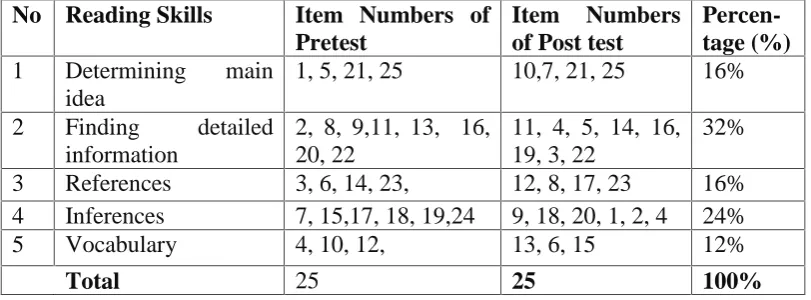
[image:39.595.110.516.510.660.2]Content validity is the extent to which a test measures a representative sample of the subject matter content, the focus of content validity is adequacy of the sample and simply on the appearance of the test. In this research, the researcher formulates table specification, so every test item can be matched with both goal and materials which have been taught. The content of the item is presented in the table of specification below:
Table 3.1 Table of Specification of Data Colecting Instrument
The researcher has focused more on two aspects of content such as finding detailed information and making inferences. It happens due to the reason
No Reading Skills Item Numbers of Pretest
Item Numbers of Post test
Percen-tage (%)
1 Determining main idea
1, 5, 21, 25 10,7, 21, 25 16% 2 Finding detailed
information
2, 8, 9,11, 13, 16, 20, 22
11, 4, 5, 14, 16, 19, 3, 22
32% 3 References 3, 6, 14, 23, 12, 8, 17, 23 16% 4 Inferences 7, 15,17, 18, 19,24 9, 18, 20, 1, 2, 4 24% 5 Vocabulary 4, 10, 12, 13, 6, 15 12%
24
that guided reading goal is to construct the meaning of the text by first finding detailed information on the text. This aspect takes 32 percent of the instrument question becauce finding detailed information can be a way for the student to explain about the text in a more fluent way.
After that, the researher is try to find out how the student grrasp the meaning of the text, so that the researcher find out how student making inferences from the text. The aspects of determining main idea and making reference has the same percentage because by these aspects, the researcher is try to find out how guided reading made the students coprehend the part of their readig texts so they can point out the the reference of their answer.
b. Construct Validity
Construct validity is concerned with whether the test is actually in line with the theory of what it means to know the language. Knowing the test is true reflection of the theory in reading comprehension, the researcher examines whether the test questions actually reflect the means of reading comprehension or not. The test consist of some reading skills namely, determining the main idea, finding supporting details, making reference an inference and solving vocabulary difficulties.
3.6.2 Reliability
Reliability is defined as the extent to which a questionnaire, test, observation or
any measurement procedure produces the same results on repeated trials. In short,
25
(1985:70) stated that reliability refers to whether the test is consistent in its
scoring and gives us an indication of how accurate the test score are. It is a
measure of accuracy, consistency, dependability, or fairness of scores resulting
from the administration of particular examination. Reliability is a necessary
characteristic of any good test.
To measure the coefficient of the reliability between odd and even number
(reliability of half test), the researcher uses Pearson Product Moment, in the
following formula:
= ∑
[∑ ][∑ ]
Note:
rl: Coefficient of reliability between odd and even numbers items.
x: Odd number.
y: Even number.
x2: Total score of odd number items.
y2: Total score of even number items.
xy: Total number of odd and even numbers.
The criteria of reliability:
0.0–0.49 = low
0.5–0.89 = moderate
0.9–1.00 = high
26
In this research, the result of reliability of the try-out test was 0.95 (see appendix
3). It could be inferred that the test had very high level of reliability, in the range
0.90-1.00. It indicated that this instrument would produce consistent result when it
was administered under similar condition, to the same participants, and in
different. So, it can be concluded that the test was reliable.
3.6.3 Level of difficulty
Level of difficulty is used to see whether the test items are good or not. The test
has to have an average score that is telling that the test is not too difficult and not
too easy. In the other word the difficulty level is average. The classification of the
difficulty level is as follow:
0.0–0.3 = too difficult
0.3–0.7 = average
0.7–1.0 = too easy
The formula used to determine the difficulty level of each test item is as follow:
= +
In which:
LD : level of difficulty
U : the proportion of upper group students who answer correctly
L : the proportion of lower group students who answer correctly
27
Based on the criteria above, there were 5 difficult items (11, 22,23, 24, 25, 26)
and there were 25 average items. (see appendix 4)
3.6.4 Discrimination Power
Discrimination power is the ability of the item to differentiate between the
students who have high ability and those who have low ability. It can be
calculated with this formula of the discriminate power:
= − ÷12
In which:
D = discrimination power
U = the number of students from the upper group who answer
correctly
L = the number of students from the lower who answer correctly
N = the number of students
Shohamy (1985)
The criteria are:
0.00-0.20 = Poor items
0.21-0.40 = Satisfactory items
0.41-0.70 = Good items
0.71-1.00 = Excellent items
- (negative) = Bad items, should be ommited
28
Based on the criteria above, there were 14 satisfactory items and 11 good items.
Meanwhile there were 5 items in the try-out test which did not fulfill the standard
of discrimination power, since those items had discrimination index under 0.20
which meant that the items had bad and poor discrimination power. By looking on
discrimination power and level of difficulty, the total items that were administered
were 25 items (1,2,3,4,5,6,7,8,9,10,12,13,14,15,16,17,18,19,21, 26,27,28,29,30)).
Those items had discrimination power more than 0.21 with the criteria satisfactory
to excellent items. (see appendix 4).
Students’ responses in each aspects of reading in the tryout, the pretest, and the
posttest were scored using the following formula:
= × 100
In which:
S : the score
R : the total correct answers
N : the number of items
3.7 Data Treatment
3.7.1 Random Test
This research used random test to prove that the data were taken randomly. The
data was tested by using SPSS 17.0 for Windows, descriptive statistics (Runs
29
Table 3.2 The data of the Pre-Test
Runs Test
pretest
Test Valuea 58.43
Cases < Test Value 16
Cases >= Test Value 12
Total Cases 28
Number of Runs 6
Z -3.232
Asymp. Sig.
(2-tailed)
.001
a. Mean
3.3 The data of the Post Test
Runs Test
posttest
Test Valuea 81.71 Cases < Test Value 10 Cases >= Test Value 18
Total Cases 28
Number of Runs 9
Z -1.834
Asymp. Sig. (2-tailed)
.067
a. Mean
From the Table 3.2 and 3.3, it showed that the data of Pre-test and Posttest were
randomly distributed. The 2-tailed significant of Pre-test is .001 and 2-tailed
30
3.7.2 Normality Test
This research also used normality test to determine whether the data were
normally distributed or not. The data were tested by One-sample
Kolmogorov-Smirnov Formula (SPSS 17.0 for Windows) to test normality of the data. It is
[image:46.595.112.447.260.427.2]shown in the table below:
Table 3.4 Normality Test
One-Sample Kolmogorov-Smirnov Test
pretest posttest
N 28 28
Normal Parametersa,,b Mean 58.43 81.71
Std. Deviation 10.290 10.746 Most Extreme Differences Absolute .165 .227
Positive .165 .169
Negative -.084 -.227
Kolmogorov-Smirnov Z .872 1.202
Asymp. Sig. (2-tailed) .433 .111
a. Test distribution is Normal. b. Calculated from data.
The Table 3.4 inferred that the result of normality of the pretest in showed that the
value of two tailed significance was 0.433. In this case the hypothesis was
accepted if Sign> , 0.433>0.05. It means that the distribution of the data of the
test was normal. Meanwhile, the result of the normality test of the posttest showed
that the value of two tail significance was 0.111. Since Sign> , 0.111>0.05, it
can be concluded that the data of the posttest was normally distributed.
3.8 Data Analysis
31
be intelligible and interpretable so that the relation of research problem can be studied.
In order to find out how significant the increasing of the students’ reading
comprehension in descriptive text through guided reading, the data were analyzed by these following procedures:
1. Scoring the pretest and posttest
2. Tabulating the results of the tests and calculating the scores of the pretest and posttest
3. Drawing conclusion from the tabulated result of the pretest and posttest which statistically analyzed using Repaeted Measuares T-Test computer through SPSS version 17.0.
3.9 Hypothesis Testing
The hypothesis testing which shows that there is any increase the students’
reading comprehension significantly, was statistically tested by using statistic computerization (SPSS 17), in which the significant was determined by p<0.05. Therefore, the hypothesis is as follows:
Hα There is significant increase of students’ reading
comprehension ability after the application of Guided reading for understanding teaching reading descriptive text.
H0 There is no significant increase of students’ reading
32
The criteria are:
Ha (alternative hypothesis) is accepted if alpha level is lower than 0.05
(α<0.05).
Ho (null hypothesis) is accepted if alpha level is higher than 0.05
(α>0.05).
V. CONCLUSIONS AND SUGGESTIONS
This chapter presents conclusions that are based on the research’s results and
discussions in the previous chapter. It also presents some suggestions for English
teachers and other researchers who want to try to apply Guided Reading Activity
technique in the teaching of reading comprehension.
5.1. Conclusions
In this research, the researcher used Guided Reading Activity technique in helping
students to improve their reading ability. Based on the result of the data analysis,
several points are concluded as follows:
1. There was an increase of students’ reading comprehension after being
taught through Guided Reading Activity at SMAN 1 Gadingrejo. The
increase can be seen from the mean of students’ pre-test and post-test
score in experimental class which increased from 58.42 up to 81.28 with
48
5.2. Suggestions
Regarding the conclusions stated previously, the researcher would like to propose
several suggestions as follows:
1. For the teacher
For the teacher who would like to use Guided Reading Activity are sugessted
to add more variety of books and texts that is suitable for the student based on
their level of reading comprehension. By doing this, the student will easily
choose the text that is appropriate to their level of reading. In addition to that,
the difficulty in understanding vocabulary should be seen by the teacher as a
chance to broaden students knowledge by inttroducing another meaning of the
word, finding the synonym or antonym or guessing by giving another example
of word using. It is better for the teacher to not directly translate the word
directly into Bahasa.
2. For Further research
It is suggested to apply interview to look on students’ difficulties toward the
implementaion of Guided Reading activity. So the challenge on implementing
49
REFERENCES
Arikunto, S. 2006. Prosedur Penelitian Suatu Pendekatan Praktik. Jakarta: Rineka Cipta.
Biddulp, J. 2002. The guided reading approach:Theory and Research. New Zealand: Learning Media Limited.
Braunger, J. and Lewis, J. 1998. Building a Knowledge Base in Reading. Oregon: Northwest Regional Educational Laboratory’s Curriculumand Instruction Services.
Cox, A. 2010. Guided Reading. Evidence Based Intervention Network. From
http://www.ecu.edu/cs-cas/psyc/rileytillmant/EBI-Network-Homepage.cfm, August 3rd, 2015
Dilbeck, D. 2015. Journey to Reading Theories. From http://learningace.com , August 3rd, 2015
Flynn, P., Mesibov, D., Vermette, P., and Smith, R. M. (2004). Applying
standards-based constructivism: A two-step guide for motivating elementary students. Larchmont, NY: Eye on Education.
Fountas, I. C., and Pinnell, G. S. 1996. Guided Reading: Good First Teaching for
All Children. Portsmouth, NH: Heinemann.
Fountas, I.C., and Pinnell, G.S. 2001. Guiding Readers and Writers: Teaching
Comprehension, genre, and content literacy. Portsmouth, NH: Heinemann.
50
Fountas, I. C., and Pinnel, G. S. 2012.Guided Reading Program: Research Base
for Guided Reading as an Instructional Approach. From www.scholastic.com. Accessed on August 3rd, 2015
Freeman, D L. 2000. Techniques and Principles in Language Teaching. Hongkong: Oxford University Press.
Gabl, K. A., Kaiser, K. L., Long, J. K., and Roemer, J. L. 2007. Improving
Reading Comprehension and Fluency through the use of Guided Reading.
Illionis: unpublished paper
Gunning, T. G. 1996. Creating Reading Instruction for All Children. Chapter 6. 192-236. Boston:Allyn and Bacon
Heston, K. 2010. The Effects of Guided Reading Instruction on Students' Fluency,
Accuracy, and Comprehension at Woodview Elementary School.
Unpublished article
Iaquinta, A. 2006. Guided Reading: A Research-Based Response to the Challenges of Early Reading Instruction. Early Childhood Education
Journal, Vol. 33, No. 6, June 2006. From http://www.mheresearch.com , August 18th, 2015
Ofrina, M. 2013. Teaching reading comprehension by combining guided reading
strategy and reciprocal teaching strategies at senior high school. STKIP
PGRI Sumatera Barat. Unpublished paper
Philips, D. 2008. Guided Reading : Constructivism in Action. Institute for
Learning Centered Education. From
www.jpacte.org/uploads/9/0/0/6/9006355/2008-1-phillips.pdf , accesed on
August 18th, 2015
Reeves, C. 2011. Teacher Perceptions of Guided Reading. Education and Human Development Master's Theses, Paper 63. the Ralph C. Wilson, Jr. School of Education at Fisher Digital Publications, fom
http://digitalcommons.brockport.edu/cgi/viewcontent.cgi?article=1060and
context=ehd_theses, on July 30th, 2015
Richardson, N. 2010. Guided Reading Strategies for Reading Comprehension. Education Masters. Paper 19: the Ralph C. Wilson, Jr. School of Education at Fisher Digital Publications
Schwartz, R. 2005. Decision, Decision: Responding to Primary Students during
Guided Reading. International Reading Association (pp. 436–443)
Setiyadi, Ag. Bambang.2006. Metode Penelitian untuk Pengajaran Bahasa Asing. Yogyakarta: Graha Ilmu
51
Shohamy, E. 1985. A Practical Handbook in Language Testing for The Second
Language Teacher. Tel Aviv: Tel Aviv University.
Suparman, U. 2007. Reading strategies of English as a Foreign Language (EFL). Tangerang Selatan:Mata Baca Publisher
Suparman,U. 2010.Phsycholinguistics The Thory of Language Acquisition. Bandung: Arfino Raya.
Suparman,U. 2012. Developing Reading Comprehension Skills and Strategies. Bandung: Arfino Raya.
Taylor, B., Pressley, M., and Pearson, D. 2002. Research-Supported
Characteristics of Teachers and Schools that Promote Reading
Achievement. Wahington DC: The Natioanal Education Association.
Torgesen, J. 2006.Factors that influence Reading Comprehension: Developmental and Instructional Considerations Instructional Considerations. Presented on Research Core Knowledge Conference
Vigotsky, L. 1978. Interaction between Learning and Development. From : Mind
and Society (pp. 79-91) Cambridge, MA: Harvard University Press.
Wiherell, N. 2007. The Guided Reading Classroom: How to Keep All Students