FINAL REPORT
FINAL REPORT
FINAL REPORT
FINAL REPORT
A review of effectiveness, including cost
effectiveness wherever possible, of
commissioned healthy weight-related projects
in City and Hackney.
`
I
nstitute for Health and Human
Development
www.uel.ac.uk/ihhd
REPORT AUTHORS
Angela Harden Emee Vida Estacio Patrick Tobi Faye Adams-Eaton Marcello Bertotti Shahana Lais
CONTRIBUTORS Adrian Renton Gail Barrow-Guevara Justine Cawley Alison Trimble Krystallia Arwodorou Michelle Bloom Claire Bowyer
ACKNOWLEDGEMENTS
We would like to thank all the project leads and delivery teams who took part in this study for sharing their valuable insights. We would also like to thank all those service users who gave up their time to share their views with us. Special thanks to David Woodhead, Fiona Bragg and Joy Kahumbu at NHS City and Hackney for their support throughout this project. Thanks also to the finance and administrative team at UEL.
CONTACT DETAILS [email protected] UEL
Stratford Campus Romford Road Stratford E15 4LZ
Prepared by:
Institute for Health and Human Development
CONTENTS
EXECUTIVE SUMMARY ... 4
1 INTRODUCTION ... 6
2 METHOD ... 10
3 SURVEY ... 12
4 CASE STUDIES ... 23
5 ASSESSMENT METRIC DEVELOPMENT ... 37
6 ASSESSMENT METRIC RESULTS AND OVERALL PROGRAMME ASSESSMENT... 50
7 CONCLUSIONS AND RECOMMENDATIONS ... 62
E
XECUTIVE
S
UMMARY
B
A C K G R O U N D A N D A I M SCombatting rising levels of overweight and obesity and their subsequent negative impact on health and well-being is an international, national and local priority. Strategies for promoting healthy weight need to encompass efforts to tackle the obesogenic environment as well as individual lifestyles. Before launching new strategies and projects there is a need to take stock of what is already happening. What is required is a clear picture of the kinds of healthy weight related projects that are currently in operation and an assessment of whether these projects demonstrate the characteristics known to associated with effectiveness, acceptability, accessibility and good practice.
The research project described in this report aimed to: identify and map healthy weight-related projects at a local level in the London boroughs of City and Hackney, review project strengths and weaknesses, and develop a set of assessment metrics (including cost where possible) to review and monitor projects in the future. The project was part of a larger programme of work commissioned by NHS City and Hackney, Hackney Council, the Corporation of London and their partners who are seeking to effect a step change in their strategy to tackle obesity and promote healthy weight.
M
E T H O D SAs many as possible of all the healthy weight-related projects in City and Hackney funded by NHS City and Hackney or their partners were identified and then surveyed. Data were collected on location, organisational set-up, processes and activities, costs, and monitoring and evaluation. In-depth case studies of five projects were undertaken chosen in consultation with NHS City and Hackney. Background documentary material on the projects was reviewed and semi-structured interviews were conducted with project managers, front-line project staff and a small number of services users. A set of assessment metrics was developed which combined a) information from research evidence, national and local strategy on the efftiveness of healthy weight-related interventions with b) the perspectives of project providers and commissioners on effectiveness, coherence and integration and value for money. The assessment metircs were applied to each identified project to assess potential impact and value for money.
P
R I N C I P A L F I N D I N G SA total of 47 projects were identified and 38 (81%) of these repsonded to the survey. There was a balance between primary prevention projects that aimed to facilitate healthy weight in the population as a whole and secondary prevention projects that aimed to facilitate healthy weight amongst individuals referred to projects on the basis of weight, disease or clinical risk factors. Although the majority of projects worked directly with individuals there were a significant number of projects that targeted settings such as schools and nurseries to promote healthy environments. Projects targeted all ages across the life course although the greatest concentration of projects was upon primary aged children and adults. Individually-based projects varied in their capacity from just 14 participants per year to 1,770. Some exceeded their capacity in 2008 whilst others fell significantly below. Survey responses suggest that it is personal circumstances that account for why participants drop out.
review and feedback. The case studies were more likely to identify problems with the project itself as a reason for drop out or low take-up than the survey.
Combining the views of commissioners and project delivery teams with information from the research evidence and national and local strategy, we developed a Value for Money (VfM) metric to measure economy, efficiency and effectiveness. This metric helped to assess, in an explicit and transparent way, the potential impact of projects. The VfM metric was made up of the following 10 criteria: acceptability, multi-component, ongoing, intergenerational, equity promoting, not facility dependent, monitoring and evaluation, coverage, retention, and cost. Projects were assessed within five separate clusters: 1) individually-based projects with weight or disease related entry criteria; 2) individually-based projects without weight or disease-related entry criteria; 3) settings focused projects; 4) dietetic services; and 5) universal national programmes.
C
O N C L U S I O N S A N D R E C O M M E N D A T I O N SThere are a diverse range of healthy weight-related projects operating in City and Hackney which together target many of the key determinants of obesity identified in both research evidence and national strategy. However, there are some notable gaps such as projects targeting young people, primary prevention projects for adults and older people, and projects which attempt to change the environment itself through for example, transport policy and working with the food production industry.
The following recommendations were made in terms of strengthening existing provision and individual projects, developing the healthy weight programme as a whole, and future mechanisms for monitoring and evaluation:
• There is a need to continue to invest in projects from all five clusters identified in this report.
Although settings-focused projects represent the greatest potential impact, such projects need to be supplemented by more intensive projects that target those who are already overweight and those at risk. Interventions that target the whole population plus targeted interventions to those most in need represent the best strategy for promoting health and reducing inequalities.
• Ways of increasing publicity for projects and strengthening referral routes should be explored. To support projects that experience difficulties with coverage and retention there is a need for greater coherence and integration between individual projects and between projects and other local services and organisations.
• There is a need to explore the potential for increasing the number of projects which rely less on fixed facilities and venues. Being able practice healthy lifestyles independent of fixed facilities and equipment is an important factor in sustaining behaviour change over the longer term.
• Consideration should be given to investing in projects over a longer term. Funding instability was a factor that impacted on the ability of projects to invest in follow-up activities and planning for the long-term.
1
I
NTRODUCTION
There is currently global, national and local concern about rising rates of overweight and obesity and the consequences of this for individuals, communities and for wider society. Strategies for preventing obesity and promoting healthy weight need to encompass efforts to tackle the obesogenic environment as well as individual lifestyles. However, we do not yet have a detailed picture of the kinds of healthy-weight related projects that are currently in operation in the UK or up-to-date information on how well these projects are working in terms of process, outcomes and costs. The project reported in this document is part of a larger programme of work commissioned by City and Hackney NHS, Hackney Council, the Corporation of London and their partners who are seeking to effect a step change in their strategy to promote healthy weight. The project aimed to identify, describe and evaluate healthy-weight projects operating in the London borough of City and Hackney to help City and Hackney NHS examine what has been achieved to date and identify opportunities for future developments.
1.1
N
ATIONALT
REND S O NH
EAL THY-W
EIG HTObesity is a global epidemic. In 2003, the World Health Organisation (WHO) estimated that about 1 billion adults were considered ‘overweight’ of whom about 300 million were obese1. International comparisons show that the prevalence of obesity in England is considered the highest in the EU - 15 countries, and one of the highest in the wider cohort of OECD countries2, with nearly a quarter of adults (aged 16 or over) classified as obese in 20073. If current trends continue, it is expected that 9 out of 10 adults will be either overweight or obese by 20504.
[image:6.595.87.546.461.730.2]Table 1.1 below shows the proportion of body mass index among adults in England as reported in the most recent Health Survey for England.
Table 1.1 Body mass index (BMI) among adults aged 16 and over by region and gender, 20073
North
East
North West
Yorkshire and the Humber
East Midland s
West Midland s
East England
London South West
Men
Underweight 1 1 1 2 2 2 1 0
Normal 32 32 27 29 33 35 41 35
Overweight 36 43 45 44 42 41 37 41
Obese 29 22 25 24 23 22 19 22
Morbidly obese 2 2 1 1 - 1 2 1
Women
Underweight 3 2 2 1 2 1 2 2
Normal 36 39 37 46 42 43 45 41
Overweight 32 36 33 31 33 30 30 34
Obese 24 20 28 19 20 24 21 21
Morbidly obese 5 3 1 4 2 2 2 2
Obesity has detrimental costs to people’s health and wellbeing. It has been associated with chronic conditions such as Type 2 diabetes, coronary heart disease, hypertension, stroke, and several cancers5. Being severely obese has also been related with psychological issues such as depression6. The total cost to the NHS of overweight and obesity was estimated at £4.2 billion and is forecasted to double by 20507. The NHS Information Centre also estimated that the number of people in England having obesity surgery has risen by 40% in the last year8. The cost to the wider economy was estimated at £16 billion per year, and is expected to rise to £50 billion by 2050 if the current trends continue9.
1.2
H
EAL THY-W
E IGHT INC
ITY A NDH
ACK NEYThe City and Hackney Joint Strategic Needs Assessment (JSNA) in 2008 reflected a 7% adult obesity rate based on GP records. In Hackney, it was reported that 51% of its residents do not participate in moderate exercise, whereas only 22% of City residents participate in thirty minutes of moderate physical activity at least three times a week.
At the local level, a key driver of change is the prevalence of obesity and overweight among children. Data from 2006/07 indicate that Reception year school children have the highest levels of obesity in the country at 16.0%, and another 14.4% are overweight. In Year 6 pupils, the rates of obesity and overweight were even higher - 24.2% and 16.0% respectively, second highest levels in the country.
High levels of deprivation and the presence of substantial ethnic minority groups are further important local factors to consider. The JSNA reported that Hackney’s wards are among the 10% most deprived wards nationally while the Portsoken ward in the City is among the 25% most deprived bracket. Socioeconomic factors are worth noting, considering the trends relating to household income and obesity. As shown in Table 1.2 below, the prevalence of obesity among men in the highest income bracket was about 24%, compared to 27% in the 4th quintile. For women, 49% from the highest income bracket are considered overweight or obese, compared to 63% for the lowest income quintile.
Table 1.2 BMI among adults aged 16 and over by social by household income quintiles and gender, 20072
Percentages
Highest 2nd 3rd 4th Lowest
Men
Underweight 0 1 1 2 3
Normal 31 36 36 34 35
Overweight 44 40 39 36 42
Obese 24 22 23 27 17
Morbidly obese 1 1 1 1 3
Overweight including obese 69 63 63 64 62
[image:7.595.97.532.474.767.2]Percentages
Highest 2nd 3rd 4th Lowest
Morbidly obese 2 2 3 3 3
Overweight including obese 49 56 62 62 63
Ethnic trends in obesity are also worth considering. Hackney IS characterised for its cultural and ethnic diversitywith 11% Black African, 9% Black Caribbean, 9 % South Asian, and 7% Charedi. The resident population in City, on the other hand, is predominantly White (83%). This is noteworthy considering that the prevalence of obesity is currently greatest in the Caucasian and Bangladeshi populations10.
1.3
P
ROM OTIN GH
EAL T HYW
EIGHTIn 2001, the Department of Health (DOH) published the White Paper, Choosing Health, Making Healthier
Choices Easier which set the national agenda for tackling obesity. It was recognised that promoting
healthy weight requires a holistic approach that considers various dimensions that influence lifestyle choices. In line with this framework, the Foresight Report11identified the following core principles for tackling obesity:
• A system-wide approach, redefining the nation’s health as a societal and economic issue
• Higher priority for the prevention of health problems, with clearer leadership, accountability, strategy and management structures
• Engagement of stakeholders within and outside Government
• Long-term, sustained interventions
• On-going evaluation and a focus on continuous improvement
Recently in 2008, the Healthy-Weight, Healthy Lives cross-governmental strategy for England was released. Immediate plans proposed in this strategy include promoting healthy weight among children, promoting healthier food choices, integrating physical activity into people’s lives, creating incentives for better health, and providing personalised advice and support.
As part of its concerted efforts to promote healthy weight, Change4Life, an initiative supported by the Department of Health was set-up. This campaign brings together national, regional and local partners including health care professionals, teachers, charities, government agencies, the media, big businesses and community organisations with the shared aims to prevent people from becoming overweight by encouraging them to eat better and move more. The Change4Life advertising campaign was launched in January 2009 on television, in the press, on billboards and online.
At a local level, City and Hackney NHS developed an Obesity Strategy for 2007-2010 with an aim to deliver prevention and weight loss services across the lifespan. Its objectives are to prevent overweight and obesity in children and adults, to support weight loss, and to promote the adoption of healthier lifestyles in those who are already obese. The action plan for this strategy includes:
• Partnership working
• Obesity prevention and treatment in children and young people
• Obesity prevention in adults and older people
• Targeted interventions for risk groups
City and Hackney also have a Nutrition and Health Eating Strategy which aims 1) to provide a framework for agencies working in City and Hackney around food and health to enable them to improve health, identify the role of nutrition in meeting targets, reduce inequalities in health, and coordinate their activities; and 2) to work in partnership with organisations that may not consider nutrition and healthy eating as part of their remit to develop a holistic strategy to improve the food provision and awareness of healthy eating.
Currently, local action by City and Hackney to promote healthy weight include initiatives that are in-line with the proposed strategy above, such as:
• Health promotion campaigns building on national messages and highlighting local opportunities for physical activity and healthy eating
• Active support for initiation of breastfeeding
• Improved access to affordable fruit and vegetables, including school and nursery based initiatives
• Organisation of healthy eating and associated skill development events
• Physical activity sessions in pre-school, school and other community settings frequented by adults and young people
• Provision of school and pre-school based healthy lifestyle initiatives
• Brief interventions training for front-line staff to enable them to effectively broach and address the issue of overweight and obesity
• Work with partners to develop an environment conducive to healthy lifestyle choices
• Development of local care pathways for the treatment of obesity and overweight
City and Hackney NHS is currently developing a set of ambitious plans to promote healthy weight for the future. In developing this revised strategy, it is essential to examine what initiatives are currently in place, to understand what works and what does not, and to develop indicators to measure effectiveness for future interventions.
1.4
A
IM S ANDR
ES EARC HQ
UESTIO NSThis project has the following aims:
• to identify and map healthy-weight related projects in the borough of City and Hackney;
• to review the characteristics of healthy-weight projects in City and Hackney including location, organisational set-up, processes and activities, costs, and monitoring and evaluation activities;
• to provide in-depth ‘on the ground’ perspectives on the context, processes and outcomes of a selected number of projects;
• to develop a set of assessment metrics to review and monitor projects in the future
The following research questions will be addressed in this exercise:
• What are the characteristics of healthy-weight projects in City and Hackney?
• What are the barriers to, and facilitators of, success in these projects?
• How do healthy weight projects in City and Hackney relate to international, national and local recommendations for promoting healthy weight and reducing obesity?
2
M
ETHOD
The research used a mixed-methods, multi-perspective approach and was conducted in the following three stages:
• A survey to identify and describe healthy-weight projects in City and Hackney
• In-depth case studies of a selected number of projects
• Development and application of assessment metrics to evaluate and monitor projects
The survey aims to provide an overview of the characteristics of healthy-weight projects in City and Hackney and to provide a general impression of the barriers to, and facilitators of, success in these projects. The case studies aim to provide in-depth and contextualised perspectives on the healthy-weight strategy and how it is implemented on the ground. Insights from healthy-weight project providers and commissioners will be combined with a review of evidence to develop the evaluation tool. Integration of information collated from these methods will provide insights into how healthy-weight projects in City and Hackney relate to international, national and local recommendations for promoting healthy weight and reducing obesity and will raise recommendations for future developments in this area.
2.1
S
URVEYCommissioners and service delivery teams from City and Hackney NHS, the local authority and the voluntary sector were approached by the evaluation team. They were asked to generate a list of all existing healthy-weight related projects commissioned by City and Hackney NHS or their partners and to specify the key contact person for each project. Responses were collated in a database to form a directory of healthy-weight projects in City and Hackney (see Appendix 1.1). The key contact person for each project was invited to complete an online questionnaire about their project. The questionnaire requested information in a range of areas including the project location, funding, organisational set-up and processes. Full details of the questionnaire can be found in (see Appendix 6.7). Chapter 3 presents the key findings from this survey.
2.2
C
ASES
TUD IESFive projects were chosen in consultation with City and Hackney NHS for further in-depth study. Projects were chosen to represent a range of target groups, location and activities. Data were collected through semi-structured interviews with project managers and frontline staff; interviews with service users; and a review of project monitoring and feedback reports and other relevant documentation. A combination of process12 and outcome evaluation13 frameworks was used to guide data collection. The aim was to develop rich qualitative and quantitative descriptions of the design, implementation and outcomes of these projects. Interviews with service delivery teams included discussions on the organisational structure, the target audience, project aims and design, implementation, project reach, participant recruitment and experience, and project outcomes. They were also asked to discuss their overall experience of running the project including their recommendations for future developments. Interviews with service users focused on their experiences of the project, how they knew about the project, what motivated them to participate, their relationship with service providers and users, the barriers and facilitators to the project’s success and their recommendations for the future.
The five case studies included in this review were:
• Family Cycle Club • Healthy Lifestyles • Personal Bests • Young at Heart
The findings from the case studies are presented in Chapter 4.
2.3
A
SSES SM ENT M ETR ICS D EVEL OP M ENT AND A P P L ICATION3
S
URVEY
3.1
S
UM M ARY• The 38 projects that responded to our survey represent a highly diverse mix in terms of groups targeted, settings, activities and staff.
• There was a balance between primary prevention projects that aimed to facilitate healthy weight in the population as a whole and secondary prevention projects that aimed to facilitate healthy weight amongst individuals referred to projects on the basis of weight, disease or clinical risk factors. • Projects were categorised into five distinct clusters: 1) Individually-based projects providing a service
for clients referred on the basis of weight or disease-related criteria (N=10); 2) Individually-based projects open to all regardless of weight, disease or clinical risk factor (N=13); 3) Projects targeting settings (N=8); 4) Dietetic services (N=5); and 5) Universal national programmes (N=2).
• Projects targeted all ages across the life course although the greatest concentration of projects was upon primary aged children and adults. A significant number of projects sought to engage the whole family even when their primary focus was on children.
• There were no projects operating in workplaces.
• There was a trend across all projects for a greater focus on changing individuals as compared to direct changes to the obesogenic environment.
• Individually-based projects varied in their capacity from just 14 participants per year to 1,770. Some exceeded their capacity in 2008 whilst others fell significantly below.
• Of the 24 projects providing data the total costs were £1,236,379.
• There appears to be a great willingness amongst projects to monitor and evaluate themselves with nearly all collecting baseline and follow-up data and service user feedback.
3.2
O
VER AL LP
RO JECTA
P P ROACH,
T ARGET GR O UP S AND S ETTI NG3.2.1
P
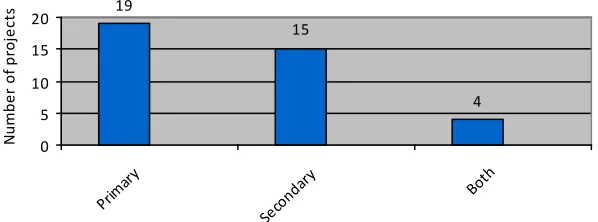
R O J E C T A P P R O A C HProjects differed in their emphasis on primary and secondary prevention with slightly more projects focused on primary prevention (Fig 3.1). Those categorised as primary prevention were open to all groups regardless of weight, disease or clinical risk factors. Some of these projects did have a particular emphasis on overweight groups but they did not restrict entry into the project on this basis. Those projects categorised as secondary prevention included weight management programmes such as ‘Counterweight’ and GP exercise referral schemes. Four projects had several strands some of which had a primary prevention focus, some a secondary focus. For example, the ‘Child Health Promotion Programme’ offers all families screening tests, immunisation and guidance on health choices with additional services to those at risk. Similarly, the ‘Be Active/ Keep Healthy Project within the Jewish Orthodox community offers structured exercise programmes for all Jewish young people as well as a weight management programme for those who are overweight.
Extending the above classification of projects further, projects clustered into five broadly distinct categories (Figure 3.2). The first category was individually-based projects providing a service for clients referred on the basis of weight or disease related criteria. The second category was individually-based projects that were open to all regardless of such criteria. The third category were projects focused on facilitating the creation of healthy settings included those targeting early years settings such as Happy@Home, Happy in Hackney and the Nursery Fruit Scheme, the Hackney Healthy Schools Programme for all primary and secondary schools and those targeting communities such as the refurbishment of Community Kitchens and Neighbourhood Maps. The fourth category was the dietetic services which ran a number of healthy weight related projects including one to one weight management clinics, professional training for those delivering weight management projects, and education and awareness raising. The dietetic services included projects that could fall under any of the preceding categories. The fifth category covered the two national universal programmes running in City and Hackney: the Child Health Promotion Programme and the National Child Measurement Programme and school health services.
Fi gure 3.1: Di s tri buti on of proje cts (N=38) a ccordi ng to focus on pri ma ry or s e conda ry pre ve nti on
19
4 15
0 5 10 15 20
Prim ary
Seco ndar
y
Both
N
u
m
b
e
r
o
f
p
ro
je
c
[image:13.595.120.419.331.442.2]Figure 3.2: Distribution of projects (N=38) according to type of project
10
8
5
2 13
0 2 4 6 8 10 12 14
Wei ght/
dise as...
Ope n to
all reg.
.. Sett
ings focu
sed Diet
etic ser
vice s Univ
ersa l ser
vice
N
u
m
b
e
r
o
f
p
ro
je
ct
s
3.2.2
T A R G E T G R O U P SThere were projects covering all age categories across the life course although children of primary school age, adults and older people appear to be the best served (Figure 3.3). There were, however, only four projects that solely focused on older adults (Chinese Cardio Project; Counterweight; Healthwise; and Young at Heart). There was only one project that catered specifically for older children and young people (Youth in Progress).
Those projects classified as targeting all ages included those that focused on working with whole families, such as STA Bikes who run a family cycle club, those providing an antenatal and early years service and those that were focused on the community as a whole such as the refurbishment of community kitchens project, East London Food Access and Neighbourhood Maps.
Figure 3.3: Distribution of projects (N=38) according to age category*
2
12
8 8
12 12
9
5
0 2 4 6 8 10 12 14
Ante nata
l
Pr e-scho
ol
Prim ary
aged
Seco ndar
y ag ed
Youn g pe
ople Adul
ts
Old er P
eopl e
All a ges
*N does not add up to 38 as projects could cover more than one age catergory
N
u
m
b
e
r
o
f
p
ro
je
ct
s
[image:14.595.101.442.528.664.2]note, however, that only a small number of these restricted entries into the project according to these socio-demographics variables.
Figure 3.4: Distribution of projects (N=17) according to socio-demographic group targeted
2 4
8
4 11
0 2 4 6 8 10 12
Disa bilit
y
Ethi c gr
oups
Fem ale
Soci o-ec
onom ic...
Oth er
*N does not add up to 17* as projects could target more than one group
N
u
m
b
e
r
o
f
p
ro
je
ct
s
3.2.3
T
A R G E T A R E A A N D S E T T I N GOf the 38 projects, 10 were implemented across both City and Hackney, 3 operated solely in the City and 26 operated solely in Hackney.
Projects were implemented in a variety of settings (figure 3.5). The most frequently occurring settings were in primary schools and community centres. The ‘other’ category included parks, pupil referral units, special schools and trips out to the seaside. The only setting that was never used was the workplace.
Figure 3.5: Distribution of projects (N=37≠*) according to setting
7 8
3 0
6 5
1 2
6 19
7 9 6
15
0 5 10 15 20
Pr e-scho
ol
Prim ary
Seco ndar
y FE/H
E
Wor kpla
ce
Prim ary
Care Hosp
ital Hosp
ice
Resid entia
l Car e
Hom e
Com mun
ity C entr
e
Out reac
h
Leisu re C
entr e
Oth er
≠One project did not answer this question so N=37 rather than 38
*N does not add up to 37 as projects could cover more than one setting catergory
N
u
m
b
e
r
o
f
p
ro
je
ct
[image:15.595.104.443.532.666.2]3.3
P
ROJE CT COM P ONEN T S,
P ROV ID ERS A ND L E NGTH3.3.1
P
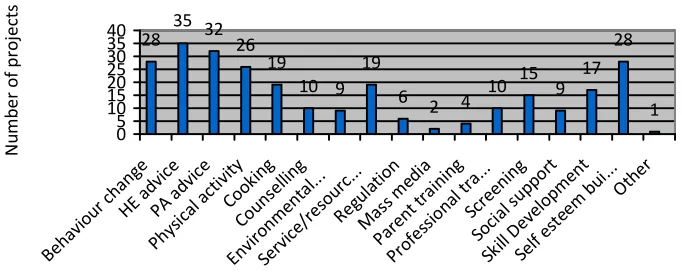
R O J E C T C O M P O N E N T S [image:16.595.103.444.231.370.2]Nearly all of the projects offered participants’ advice on healthy eating and physical activity and a significant majority used behaviour change techniques and self-esteem building activities (figure 3.6). Other components focused on individuals such as skill development, screening and risk assessment, cooking, tasting and food preparation and counselling were also employed in many projects.
Figure 3.6: Distribution of projects (N=38*) according to project components
28 32 26 19
10 9 19
6 2 4
10 15 9 17
28
1 35
0 5 10 15 20 25 30 35 40
Beha viou
r cha nge
HE a dvic
e
PA a dvic
e
Phys ical
act ivity
Cook ing
Coun selli
ng
Envi ronm
enta l...
Serv ice/
reso urc.
..
Regu latio
n
Mas s m
edia
Pare nt tr
aini ng
Prof essio
nal t ra... Scre
enin g
Soci al su
ppor t
Skill Dev
elop men
t
Self este
em b ui...Other
*N does not add up to 37 as projects could cover more than one age catergory
N
u
m
b
e
r
o
f
p
ro
je
ct
s
Across all projects there appears to be a trend towards a greater focus on physical activity. Twent-six out of the 38 projects offered opportunities for participation in some form of physical activity compared to 19 projects offering opportunities for healthy cooking, food preparation and tasting.
Another trend is a greater focus across all projects on components targeted towards individuals in terms of advice giving, skill development, counselling and so on. Fewer projects contained components that changed the environment, increased access to services and resources or trained professionals.
3.3.2
P
R O J E C TP
R O V I D E R SFigure 3.7: Distribution of projects (N=38*) according to type of project provider
2 5 6 2
18
5 12
6 1
22
11 5
10 4
0 5 10 15 20 25
Holis tic th
erap ist
Serv ice
user
Com mun
ity w o...
Coun sello
r Nur
se
Diet icia
n/N utiti
...
GP/D octo
r
Heat h pr
omot i...
Psyc holo
gist
Rese arch
er
Spor ts c
oach Teac
her
Volu ntee
r Oth
er
*N does not add up to 38 as projects could use more than one type of provider
N
u
m
b
e
r
o
f
p
ro
je
ct
s
3.3.3
P
R O J E C TL
E N G T H A N D F O L L O W-
U PThe core period of all but seven projects lasted for 10 weeks or more with a significant majority lasting more than 12 weeks (figure 3.8). Projects included in the latter category includes those who operate all year round such as the dietetic services and ‘Hackney Healthy Schools’ as well as those that run discrete programmes which last a number of weeks or months.
Figure 3.8: Distribution of projects (N=38) according to project length
3 3
0
11
22
1 0
5 10 15 20 25
<1 w eek
1 w eek
2 to 6 w
eeks
7 to 9 w
eeks
10 to 12
wee ks
>12 wee
ks
N
u
m
b
e
r
o
f
p
ro
je
ct
s
[image:17.595.103.444.466.610.2]Figure 3.9: Distribution of projects (N=38) according to whether they include follow-up activites
7
27
4
0 5 10 15 20 25 30
No follo
w-u p
One -off
follo w-u
p
Oth er fo
llow -up
N
u
m
b
e
r
o
f
p
ro
je
ct
s
3.4
R
EFERRAL ROUTE S,
P A RTICIP AT ION AND D RO P-
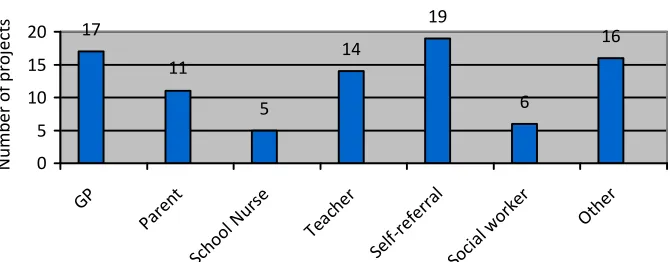
OUTThe main referral routes into projects were through GPs or through self-referral (figure 3.10). Other referral routes mentioned were through health professionals such as physiotherapists, counsellors, psychologists, and early years workers. Many projects emphasised the importance of word-of-mouth and advertising within the local media.
Figure 3.9: Distribution of projects (N=38*) according to referral into project
17
5
14
19
6
16
11
0 5 10 15 20
GP
Pare nt
Scho ol N
urse
Teac her
Se lf-refe
rral
Soci al w
orke r
Oth er
*N adds up to more than 38 as projects could have more than one referral route
N
u
m
b
e
r
o
f
p
ro
je
ct
s
Of the 23 projects that recruited individuals into their projects, we had data on the number of participants projects can accommodate per year for 22 projects and data on the actual number of participants for 20 projects. Just 12 projects provided data on drop-out rates.
projects exceeded their capacity in 2008, whilst others fell significantly below 100% capacity. The range was between 30% to 175% with an average of 82%.
On average 65 participants dropped out from the projects before completion but across projects these figures ranged from 0 to 640. The average drop-out rate across the 13 projects that provided figures was 17% (range 0 to 47%).
3.5
P
ROJE CT SET UP,
FU N D ING A ND COST S3.5.1
P
R O J E C TS
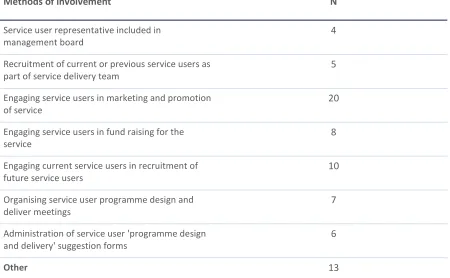
E T U P29 projects reported that service users were involved in the design or delivery of the project. Of these projects 28 provided details of how service users were involved. Users were most often involved through marketing and promotion of the service (table 3.2).
Table 3.2 Distribution of projects (N=28) according to ways in which service users were involved in the design or delivery of projects
Methods of involvement N
Service user representative included in management board
4
Recruitment of current or previous service users as part of service delivery team
5
Engaging service users in marketing and promotion of service
20
Engaging service users in fund raising for the service
8
Engaging current service users in recruitment of future service users
10
Organising service user programme design and deliver meetings
7
Administration of service user 'programme design and delivery' suggestion forms
6
Other 13
[image:19.595.93.543.285.563.2] [image:19.595.89.542.667.762.2]Thirty-five projects indicated which types of information they had used to inform the project design and delivery (table 3.2). The most commonly used were, an analysis of local needs and experience of other interventions. The least source of information used was guidance from NICE.
Table 3.2 Distribution of projects (N=35) according to source of information used in setting up the project
Source of information N
Source of information N
Expert advice 19
NICE 2006 guidance 3
Other research evidence (please specify below) 8
3.5.2
P
R O J E C T F U N D I N G A N D C O S T SA total of 24 projects provided an estimate of the total cost of their projects. The total costs of these projects in 2008 were £1,236,379. Costs ranged from £2500 to £235,000 with an average cost of £51,516.
[image:20.595.103.442.342.471.2]Twenty-nine projects provided data on the source(s) of their funding (figure 3.13). NHS City and Hackney were the most common source of funding. For eight projects, funding from this source was the only source of funding.
Figure 3.13: Distribution of projects (N=29*) according to source of funding
5
20
8
3 5 6
2
0 5 10 15 20 25
Char
ities DH
NHS City
& H
ac... LA
Serv ice us
er
In k ind
cont ribu.
..
Oth er
*N does not add up to 29 as projects could have more than one funding source
N
u
m
b
e
r
o
f
p
ro
je
ct
s
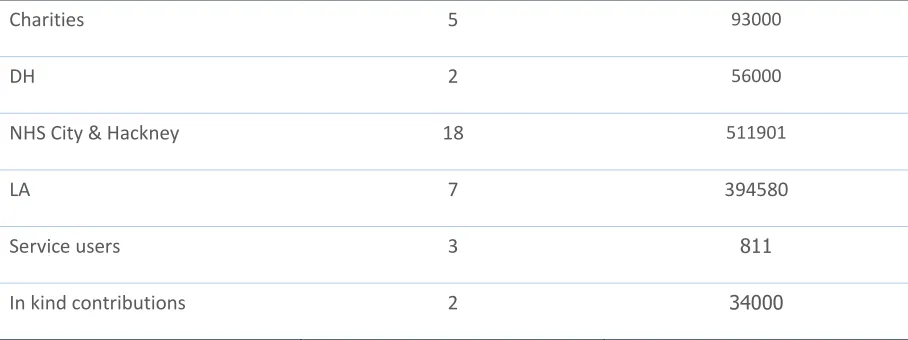
[image:20.595.89.543.593.763.2]Twenty-five projects provided data on how much funding they received from each source (table 3.4)
Table 3.4 Amount of funding projects receive according to source
Number of projects Total amount of funding (£)
Charities 5 93000
DH 2 56000
NHS City & Hackney 18 511901
LA 7 394580
Service users 3 811
Number of projects Total amount of funding (£)
Other 5 375000
3.6
M
ONITOR ING AND E V AL UATIO N3.6.1
B A S E L I N E A N D F O L L O W-
U P D A T A [image:21.595.105.443.308.428.2]The majority of projects have collected monitoring and evaluation data or are in the process of doing so (figure 3.14) and a significant number collect both baseline and follow-up data (figure 3.15)
Figure 3.14: Distribution of projects (N=38) according to whether monitoring and evaluation data are collected
31
2 5
0 5 10 15 20 25 30 35
Yes No
In p roce
ss
N
u
m
b
e
r
o
f
p
ro
je
ct
s
Figure 3.15: Distribution of projects (N=38) according to whether baseline and follow-up data are collected
27
8 8
3 4
26
0 5 10 15 20 25 30
Base line
Follo w-u
p
N
u
m
b
e
r
o
f
p
ro
je
ct
s
Yes
No
[image:21.595.108.447.536.663.2]3.6.2
M E A S U R I N G S U C C E S S [image:22.595.103.443.212.362.2]Success is measured in a variety of ways by projects although changes in knowledge, behaviour and attitudes were the outcomes most often specified by projects (figure 3.16). Other measures included self esteem, changes in body shape and appearance, continued adherence, fitness, blood pressure and, in the case of the refurbishment of community kitchens project, capital works completed on time.
Figure 3.16: Distribution of projects (N=38) according to measure of success*
11 15
23 23 23
3
15
4 7
0 5 10 15 20 25
BM I
Wai st m
easu r...
Wei ght
Know ledg
e
Beha viou
r cha nge
Attit udes
Polic y an
d Pr actic
e Oth
er
Not spec
ified
*N does not add up to 38 as projects could cover specify more than one measure
N
u
m
b
e
r
o
f
p
ro
je
ct
s
3.6.3
S E R V I C E U S E R F E E D B A C KAll but two projects ask for feedback from service users, with 31 projects asking for such feedback regularly and four asking for it occasionally. One project does ask for service user feedback but this was reported to be done ‘rarely’. Out of the 36 projects that collect feedback, the most common method of obtaining feedback was through a survey on completion of the course (Figure 3.17).
Figure 3.17: Distribution of projects collecting service user feedback (N=36*) according to method employed
25
8
13 7
0 5 10 15 20 25 30
Surv ey
Use r gro
ups
Info rmal
ly
Oth er
*N does not add up to 36 as projects coupld specify more than one means of collecting service user feedback
N
u
m
b
e
r
o
f
p
ro
je
ct
[image:22.595.109.444.576.696.2]4
C
ASE
S
TUDIES
Summary. Five case studies identified with NHS City and Hackney were examined to provide in-depth and contextualised descriptions of sample healthy-weight projects in the area. The five projects were Exercise on Referral, Family Cycle Club, Healthy Lifestyles, Personal Best, and Young at Heart. Key project descriptions are highlighted in a summary box and are discussed in-depth following a structured format detailing its context, processes and outcomes. An assessment of barriers and facilitators to success are then presented. Overall key barriers identified are limited resources for long-term follow-up; personal circumstances of service users; inappropriate or insufficient referrals; lack of support from schools (where applicable); insufficient publicity; availability of venues and facilities; and the weather. Key facilitators include no or minimal cost to service users; inclusivity of projects; safe environments and friendly atmosphere; family bonding; highly-qualified and experienced staff; effective teams; good management and operating systems; and availability of project review and feedback. Comments from service users are also presented here.
4.1
E
X ERCI SE ONR
E FERR AL4.1.1
C
O N T E X THackney’s Healthwise Exercise Referral Scheme (ERS) is a partnership between the NHS City and Hackney, London Borough of Hackney and Greenwich Leisure Ltd (GLL). Set-up in 2007, the project’s main aim is to provide high-quality exercise on referral for people living with chronic health conditions. It also aims to provide 1) diverse opportunities to engage people in physical activity; 2) follow up and support for the client through-out the journey; and 3) an enjoyable social opportunity for residents in Hackney. It targets a wide age range and aims to reach those who do not normally have access to any leisure facilities. The scheme utilises venues such as Britannia, Queens Bridge, Kingshall and Clissold Leisure centres. The leisure centres are open from 8:00 to 20.00.
4.1.2
P
R O C E S SERS offers behaviour change techniques, including advice and information about healthy eating, physical activity and self-esteem building. Supervised exercise sessions are provided to people with the following conditions: risk of developing or existing CHD, hypertension, diabetes (type 1 or 2), mild to moderate depression, back pain, asthma, osteoporosis, stroke, stress, obesity, have fallen or at risk of falling, and children aged 8 - 13 who are obese. Exclusion criteria include unstable cardiac disease, emphysema, advanced diabetes, severe osteoporosis, severe rheumatoid, arthritis with mobility problems and recent stroke. Referrals are usually made by GPs or practice and hospital specialist nurses, pharmacists, cardiac rehab and community dieticians.
Exercise activities offered in this scheme include gym based sessions, aqua aerobics, circuit/body
Aim: to provide high-quality, affordable exercise referral scheme within a safe and structured environment for people with long-term conditions
Location: Hackney
Year set-up: 2007
Provider: Greenwich Leisure Limited (GLL)
Key partners: Physiotherapy department (St Leonard’s Hospital), Dietetics and Cardiac Departments (Homerton Hospital), Public Health Department, Hackney Council
Target groups: People with long-term health conditions
Participants for this scheme are entitled to free access to the leisure facilities for an initial period of 13 weeks, after which are either offered GLL membership at a reduced rate or are sign posted to an appropriate community based exit route. GLL membership starts from £11.95 per month, and are increased annually in stages to full price membership (Year 2 – £15.95, Year 3 – £24.95 or concessionary £18.95 and Year 4 onwards).
There is currently a six week waiting list for the project. The programme lasts for 13-26 weeks. Following completion, participants graduate into ‘Wellness’, which is the point at which they should have the necessary competencies and skills to work on their own.
Participant experience is monitored through telephone calls and periodic reassessments. ERS employs the SF12 to assess satisfaction. The scheme also receives general feedback from users and GPs via telephone calls, questionnaires and letters. Health improvement is monitored through the collection of physical indicators. Whilst no formal evaluation is available at this time, the manager highlighted that a service review is currently being drafted. Front line staff assess the programme from participant records and personal interactions. Where appropriate, ongoing contact with participants is offered for up to 26 weeks.
4.1.3
O
U T C O M E SIn 2007 it was estimated that 200 participants a month would enter and 1400 would fully complete the scheme. Furthermore it was estimated that 1000 participants who completed the scheme would then be referred to an exit route. More recent data highlights an actual average figure of 1500 per year entering the scheme (instead of estimated 2400). Management suggests they receive 100 referrals per week. Completion rate of those referrals however was still unavailable.
According to staff, a successful participant might achieve increased self-esteem, higher self-confidence, health education and increased mental well being and weight loss.
4.1.4
A
N A L Y S I SOverall the programme was considered successful and appropriate by both staff and service users. Future repetitions of the project would need to include the flexibility, a strong team and supportive colleagues. Front line staff would also like to increase the number of specific classes including techniques like ‘stretching’ and ‘breathing’. The model appears to lend itself well to duplication and according to the manager this is something that is currently being worked on. There are also plans to improve administration systems. ERS management is looking to the future to continually improve the service through monitoring and evaluation. The five factors considered to contribute to the success of the project are 1) the diversity of programmes offered; 2) follow up assessments; 3) motivational interviewing; 4) safe environment; and 5) highly qualified staff. The ERS project is also multi-component in design and is consistently adapted through consultation with key stakeholders and key government policy, guidance and recommendations.
However, ERS faces several barriers to participant engagement. The average drop out rate for the previous two years was 500, whilst the actual dropout rate for 2008 was 640. Reasons for dropping out are related to participants’ personal circumstances and onward referrals. ERS staff highlight that while it is often difficult to change participants’ habits, the process should allow them to set goals that are in line
‘I was not discouraged in any way and the project works for me -
thanks guys!’
‘Improved energy, stamina, strength and flexibility. I will continue and the effects will continue… I hope to get even
fitter!’
‘The two month wait was too long, the initial assessment went
wrong due to poor time management and the trainers clearly had more work than they
could deal with.’
‘The project has helped considerably, improved concentration and well being.’
‘I can swim, I can do gym, weights I can run - a whole load of things.’
‘A wonderful scheme - should be offered to everybody for free on the NHS as a cost effective means
with what they are personally prepared to work towards. The initial consultation lasts around an hour during which staff identify the most appropriate exercise plan for participants. Staff are also aware that the initial point of contact will influence the perceived quality of their service and are mindful to offer a sensitive and empathic introduction to all their new starters. Phone calls are also made within 1, 3 and 6 months of joining the course to see what participants have learned so far. Staff also suggest that social support is an important element to keep participants motivated.
From an organisational perspective, there is also insufficient capacity to focus on longer term follow-up which is also partly due to ‘inappropriate referrals’ from community health workers. Front line staff felt that there was insufficient time dedicated for ‘one on one attention’ for participants. To address this, it was suggested that initial referrals should be reduced to enable staff to offer a more supportive role to clients.
It has also been suggested that more staff training would be beneficial for the scheme, especially in terms of counseling and cultural sensitivity. ERS staff deal with extremely diverse clients including those with social phobias and mental health issues. They also deal with cultural issues (e.g. women might not want to reveal their skin). Furthermore, as obesity and depression often come hand in hand, staff highlighted the need to have the necessary skills to be able to deal with this effectively.
Sustainability is also an issue to be considered. Introduction of cost for access to leisure centres after 3 months has been identified as a barrier to continued participation. Challenges also remain as the programme needs more space within the leisure centres. According to staff, a recent increase in available centres has enabled the team to be more flexible.
4.1.5
VFM
P
R O J E C TS
C O R EP
R
O
J
E
C
T
S
A
c
c
e
p
ta
b
il
it
y
M
u
lt
i-c
o
m
p
o
n
e
n
t
O
n
g
o
in
g
/l
o
n
g
t
e
rm
In
te
rg
e
n
e
ra
ti
o
n
a
l
E
q
u
it
y
p
ro
m
o
ti
n
g
N
o
t
fa
c
il
it
y
d
e
p
e
n
d
e
n
t
M
o
n
it
o
ri
n
g
a
n
d
e
v
a
lu
a
ti
o
n
C
o
v
e
ra
g
e
R
e
te
n
ti
o
n
r
a
te
C
o
s
t
V
fM
S
c
o
re
Weight 9 10 9 9 10 6 8 9 8 6
INDIVIDUALLY-BASED PROJECTS WITH WEIGHT/DISEASE ENTRY CRITERIA (range of VfM minimum score = 84 maximum = 252, average VfM score: 172)
Healthwise
Raw 2 2 2 1 2 1 3 3 1 3
168
4.2
F
AM IL YC
YCL EC
L UB4.2.1
C
O N T E X TFamily Cycle Club (FCC) is a six-week family cycle course for all ages and abilities, designed specifically to encourage families to be active together and to encourage healthy lifestyles within the family culture. Based in Hackney, FCC was launched in October 2007 after Team Hackney won the £30,000 bid to continue and expand existing family cycle clubs as part of its campaign to tackle childhood obesity.
The scheme has the following aims: 1) to encourage healthy lifestyles; 2) to train families to cycle and be active together; 3) to encourage sustainable means of transport; and 4) to promote the environmental benefits of cycling. The scheme particularly aims to help ‘hard to reach’ groups including ethnic minority groups, families on benefits,
disability groups, families with children with special needs, lone parents, Charedi community members, inactive children/adults and non-riders.
‘Families working together and learning together’ is the underlying principle for FCC. It places healthy
living and physical activity within the family context wherein parents and children learn together which encourages bonding and social support within families. It introduces young people to cycling within a safe environment and provides training for both parents and children to develop the necessary skills to encourage cycling in the long-term.
4.2.2
P
R O C E S SThe six-week course runs every Saturday morning and is being held in primary schools, estates, and parks in Hackney, including Sir Thomas Abney Primary, Tyssen Community Primary, Milton Grove, Wilton Estate and Fellows Court. The project provides opportunities for families to learn ‘cycle safety’ and ‘confidence skills’. It combines cycle training, bike maintenance, second hand bicycle purchase and the provision of a voucher for £30 towards the purchase of a bike at the end of completion of successful training. Bike maintenance is considered an essential component of the scheme to address the often poor quality of bikes owned by participants. Second hand bikes are being purchased to support those who do not have a bike of their own or whose bikes are beyond repair. Second hand bikes are being obtained partly via Waltham Forest Bike Recycling Project.
The cycle training components of the scheme are tailored to suit the individual’s needs. Participants are initially assessed to evaluate their cycling skills level based on a set of ‘Bikeability Milestones’. The scheme incorporates sustainable healthy lifestyles to include messages on healthy eating and to develop the skills to maintain this lifestyle. Participants’ progress are assessed individually and participants’ feedback are also collected. As Gail Bristow from STA Bikes explained:
‘… We have training components and we try to increase ability of cycling. We first train them to use the bike and then how to maintain the bike and we give them a little gentle input of healthy eating about what you eat and how it affects how you feel. We encourage them to have good breakfast to get more energy and try to reinforce them. We try to make it fun and we organise events and people make their own networks. We evaluate progress and we have a report from every person who participates. They are in groups and we evaluate them in groups in terms of age and often split parents from children because you get different messages. We have [different] levels of abilities. At the end of the session each individual has to fill out what they covered. They have an initial assessment and at the end we are able to assess their progress and then they get a certificate…’
Aim: to encourage healthy lifestyles by training families to cycle and be active together
Location: Hackney
Year set-up: 2007
Provider: STA Bikes
Key partners: London Cycle Campaign, Team Hackney, Streetscene (London Borough of Hackney)
Target groups: ‘Hard to reach’ groups
The cycle training is offered free of charge. The scheme is publicised via schools, posters, newspaper advertisements, and most popularly, through word-of-mouth.
4.2.3
O
U T C O M E SIn their submission for the London Cycle Campaign Awards in 2008, Team Hackney proudly highlighted the 432 attendances for all the cycling sessions,
including 77 people who had never cycled before. According to STA Bikes staff, the positive outcomes of this scheme could include improved self-esteem, increased knowledge on cycling and healthy living, and increased awareness of service provision and facilities in the borough. It also fosters social cohesion and promotes positive attitudes about keeping fit, staying active and encouraging healthy environments.
4.2.4
A
N A L Y S I SOne of FCC’s major strengths is its ability to encourage bonding in families by providing them with the opportunity to do something together. This is particularly highlighted among families with a child with a special need. Cycling is considered as an activity that every member of the family can take part in.
Cycle training is also delivered in an informal and friendly atmosphere by highly-trained and experienced staff. There is a positive and encouraging atmosphere that makes learning fun and enjoyable. The programme is designed to become culturally sensitive and flexible to suit individual participants’ ages and skills. There are also mechanics on hand and the venue provides a suitable and secure environment to learn how to cycle.
With Hackney’s diverse population, language can sometimes become an issue. But with FCC’s focus on the family, there are occasions when older children act as interpreters for their parents whose first language is not English.
FCC also fosters social cohesion by bringing together individuals from various segments of the community. FCC staff prides this scheme for enabling some of its participants to gain skills and capabilities, especially among young people. As part of the training, participants are taught how to maintain bicycles. With this skill, young people can help other members of the community to maintain their bikes and gain a more approachable (if not respectable) position in their community.
However, due to the lack of funding, FCC is not able to offer follow-up sessions for its service users. There are also no informal drop-in facilities to repair bikes or to brush up on their skills. Public attitudes on cycling have also been a barrier for FCC. As Gail Bristow expressed:
‘I am more confident, no problem getting on the bike.’
‘We enjoyed riding the bikes, made a few friends, and we told more people about it.’
‘The trainers were extremely patient with us.’
‘The trainers worked really well with different age groups.’
‘You can really get an understanding on how to do the simplest of things… things that are common sensical, but when you’re riding you
don’t know how to do it.’
‘It was perfect – I couldn’t fault it if I tried.’
‘Keep up the good work. It’s valuable for me and my family… advertise it more and let
more people know about it…’
‘The kids will remember this as a positive experience… it’s fun and they learned to ride a
bike through this club.’
embarrassed when we go to parks; they don’t want others seeing them that they do not know how to cycle. It doesn’t happen in schools because they are familiar with the environment and feel safe…’
The public perception of cycling as a poor person’s transport also needs to be overcome. As STA Bikes staff explained, there is a need for cycling to be perceived as aspirational and to make it look more attractive to people. The fear of the road is also a barrier to participant engagement. There is a need to encourage people to use cycle training to overcome this fear by delivering techniques on how to be safe when they on the road. Structural and environmental barriers also exist such as issues with safe parking, and of course, the good old British weather.
In October 2008, FCC won the London Cycling Campaign Award for the Best Community Cycling Initiative for Young People or Children. Service users and members of staff are truly proud to be part of the scheme and to receive recognition for the good work they have accomplished so far.
4.2.5
VFM
P
R O J E C TS
C O R EP
R
O
J
E
C
T
S
A
c
c
e
p
ta
b
il
it
y
M
u
lt
i-c
o
m
p
o
n
e
n
t
O
n
g
o
in
g
/l
o
n
g
t
e
rm
In
te
rg
e
n
e
ra
ti
o
n
a
l
E
q
u
it
y
p
ro
m
o
ti
n
g
N
o
t
fa
c
il
it
y
d
e
p
e
n
d
e
n
t
M
o
n
it
o
ri
n
g
a
n
d
e
v
a
lu
a
ti
o
n
C
o
v
e
ra
g
e
R
e
te
n
ti
o
n
r
a
te
C
o
s
t
V
fM
S
c
o
re
Weight 9 10 9 9 10 6 8 9 8 6
INDIVIDUALLY-BASED PROJECTS WITHOUT WEIGHT/DISEASE ENTRY CRITERIA (range of VfM minimum score = 84 maximum = 252, average VfM score: 193)
STA Bikes Saturday Family Cycle Club
Raw 2 3 2 3 3 2 3 3 3 3
228
Weighted 18 30 18 27 30 12 24 27 24 18
4.3
H
EAL THYL
IFE STYL ES4.3.1
C
O N T E X TThe Healthy Lifestyles project is funded by Team Hackney, an initiative which is lead by NHS City and Hackney. The project aims to work with children between the ages of 7 to 13 years and their parents to address childhood obesity. The programme offers support to young people in achieving healthier lifestyles through physical activity, healthier eating and behaviour change, with an emphasis on having fun and building self-esteem.
There are 10 members of staff which includes the project co-ordinator, fitness instructors, community dieticians, drama leaders and psychologists. The sessions are conducted between 17.00 to 19.00 at Space Leisure Centre (Tuesday) and 9.30 to 11.00 (Saturday).
Aim: to help families become healthier by enabling them to make healthier choices, build self-esteem and confidence
Location: Hackney
Year set-up: 2006
Providers: Core Fitness Club
Key partners: NHS City and Hackney, Hackney Council, 2012 Olympic Unit, School Sports Partnership, Immediate Theatre
Target groups: No specific target group
4.3.2
P
R O C E S SA structured 10 week program is offered to help prevent and treat childhood obesity with an aim to reduce weight or stop weight gain. This is achieved by promoting physical activity, healthy eating and positive self esteem within the family setting. Each week comprises of physical activity sessions for an hour and a combination of 10 one-hour sessions of healthy eating/healthier lifestyles with the parents (i.e. sessions around emotional well being, confidence building, self-esteem, body image and assertiveness). Activities are facilitated through drama skills workshop to help participants achieve and maintain a healthier lifestyle. In order to address some of the fundamental reasons behind childhood obesity, parents are also encouraged to take part in a new component to the programme which consists of psychology sessions to increase their own knowledge, provide parents with the skills and support system for their children, and to assist them to make their own healthier lifestyle choices.
Before families are invited onto the programme, they must go through an initial consultation and assessment session which is carried out before the sessions commence. Participants’ BMIs, waist circumference and body fat percentages are measured before and after participating in the project. Pre and post project questionnaires are also conducted to enable families and the team to review and assess their attitudes and knowledge on eating and exercise habits and to observe any health behaviour changes at the end of the programme. Registers are taken each week to monitor attendance. Participants are also asked to provide feedback after each session and take part in team meetings to discuss any issues they may have.
After the completion of the project, communication with the participant is maintained for 6 months to 1 year. There is a Healthy Lifestyles Club they can attend to continue with their physical activity and there is also gym membership for children. If funding allows, parents may also be entitled to subsidised memb